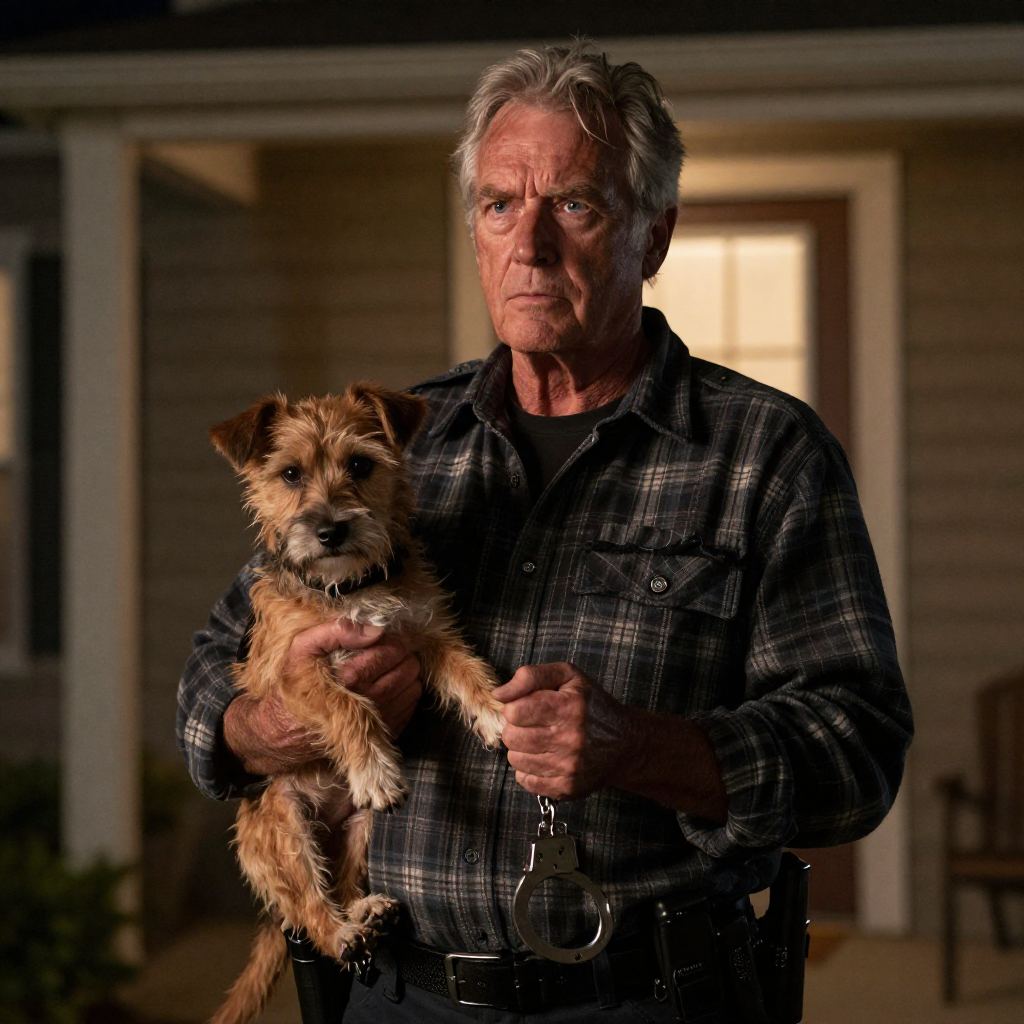
HE DRAGGED THE SCREAMING DOG BY THE EARS AND THREW HIM INTO THE DUMPSTER LIKE GARBAGE, THINKING NO ONE WAS WATCHING THE CRUELTY UNFOLD. He dusted his hands off and went inside to eat dinner, unaware that I had seen everything from my window, and that the man knocking on his door an hour later wasn’t just a concerned neighbor, but a retired detective holding the trembling animal in one arm and a pair of steel handcuffs in the other.
I retired three years ago because I thought I had seen enough of what people are capable of doing to one another. I wanted a quiet life. I bought a small house in a subdivision where the lawns are manicured within an inch of their lives and the loudest sound is usually the hum of a pool filter. I thought I could turn it off—the instinct, the suspicion, the way my eyes automatically scan a perimeter when I walk out the front door. I was wrong. You don’t stop being a detective just because you hand in the badge. You just stop getting paid for the nightmares.
It was a Tuesday, late afternoon. The light was turning that heavy, golden amber that usually signals the end of a workday. I was sitting on my front porch, a book in my lap that I hadn’t actually read a page of in twenty minutes. I was watching the street. It’s a habit. I tell myself I’m just enjoying the air, but really, I’m watching. Across the street and two houses down lives a man named Brad. He’s young, maybe late twenties, drives a car that costs more than my first house, and walks with the unearned confidence of someone who has never been told ‘no’ in his entire life.
He has a dog. Or, he had a dog. A scruffy little terrier mix, mostly wire hair and anxious eyes. I’d seen them walking before. It was never a walk with love. It was a drag. Brad would be on his phone, scrolling, ignoring the creature tethered to him, yanking the leash whenever the dog stopped to sniff a blade of grass. It irritated me, but it wasn’t illegal to be a jerk. If being a bad person was a crime, I’d have arrested half the city by 1995.
But today was different. I saw Brad’s front door fly open. He didn’t have the leash. He had the dog by the scruff of the neck and one ear. The sound hit me before the visual did—a high-pitched, confused yelp that was cut short by a hard shake. My stomach dropped. I sat up, the book sliding off my lap onto the decking, but I didn’t move yet. I needed to see. You always need to see clearly before you act.
Brad was shouting something, but I couldn’t make out the words. It was the tone that mattered—pure, unadulterated rage. He dragged the animal down his driveway. The dog’s paws were scrambling against the concrete, nails clicking frantically, trying to find purchase, trying to stop the momentum. But he was small, maybe fifteen pounds, and Brad was a big guy. It was no contest. It was bullying in its purest, most pathetic form.
They reached the end of the driveway where the large, green municipal dumpsters sat waiting for tomorrow’s collection. Brad didn’t hesitate. He didn’t look around to see if anyone was watching. That’s the thing about people like him; they assume they are the main character of the universe, and their actions don’t have consequences until they are forced to face them.
He lifted the heavy plastic lid with one hand. With the other, he swung the dog up. Not placed him. Swung him. Like a bag of kitchen trash. Like a broken toaster. The dog went up in an arc and disappeared into the hollow darkness of the bin. Brad slammed the lid down. The sound of the plastic clapping shut echoed off the quiet suburban houses like a gunshot.
He stood there for a second, brushing his hands on his jeans as if he had touched something filthy. Then, he turned around and walked back to his house. He didn’t look back. He walked inside and closed the door.
Silence returned to the street. A bird chirped somewhere. A car drove by a block away. But in my ears, there was only a ringing silence. I sat there, frozen for a heartbeat, processing the sheer callousness of it. In thirty years on the force, I dealt with murderers, thieves, and con artists. But cruelty to the helpless—to children and animals—always hit a different nerve. It speaks to a rot in the soul that you can’t rehabilitate.
I stood up. My knees popped, a reminder of my age, but my hands were steady. I walked down my steps and crossed the street. I didn’t run. Running draws attention, and right now, I didn’t want Brad to know I was coming. I wanted the element of surprise. I wanted to see his face change.
When I reached the dumpster, I could hear it. A soft, muffled scratching against the plastic walls. A low whine. Not a bark—he was too scared to bark. I lifted the lid. The smell of garbage—rotting melon, coffee grounds, stale beer—wafted up. And there, sitting atop a black garbage bag, shivering so violently he looked like a blur, was the dog.
He looked up at me. He didn’t growl. He didn’t bare his teeth. He just cowed, pressing his belly into the trash, expecting another blow. That broke me. If he had been aggressive, it would have been instinct. But this was submission. This was a creature that had learned that existence meant pain.
“Hey, buddy,” I whispered. My voice was rougher than I intended. “It’s okay. I got you.”
I reached in. He flinched, closing his eyes tight. I gently scooped him up, supporting his back legs, ignoring the grime on his coat. I pulled him out of the darkness and into the evening light. He weighed nothing. He was just bones and fear wrapped in dirty fur.
I carried him back to my house. I didn’t look at Brad’s windows. I took the dog into my utility room and set him on a towel. I checked him over. No broken bones, thankfully, but his ear was red and tender where he’d been dragged. He was dehydrated and terrified. I gave him a bowl of water and he drank it so fast he choked. Then he looked at me, and for the first time, his tail gave a tiny, hesitant thump.
That thump sealed Brad’s fate.
I went to my bedroom closet. On the top shelf, behind the winter sweaters, was a shoebox I hadn’t opened since my retirement party. I took the lid off. Inside lay my shield—gold and heavy—and my old service cuffs. I hadn’t carried them in years. I wasn’t an active officer anymore. I had no jurisdiction to arrest him in the official sense. But I knew the law, and I knew exactly which statutes covered animal cruelty in this state. And more importantly, I knew how to make a man like Brad realize his life as he knew it was over.
I put the badge in my pocket. I hooked the cuffs onto my belt loop, tucking them under my shirt. I wasn’t going to impersonate an officer; I was going to perform a citizen’s arrest until the uniformed boys arrived. But I wanted him to see the metal. I wanted him to know this wasn’t a neighborly dispute.
I picked up the dog. He settled into the crook of my arm like he belonged there. He seemed to know that we were going back, but that this time, the dynamic had shifted.
Walking back across the street, the sun was fully down. The streetlights had flickered on. Brad’s house was lit up. I could see the blue flicker of a large TV screen through the front window. He was probably watching a game, drinking a beer, completely unbothered by the fact that a living soul was slowly dying in a box twenty yards from his driveway.
I walked up the driveway. My boots felt heavy on the pavement. I didn’t rehearse what I was going to say. I never did. You wait to see the suspect’s eyes, and then you know what needs to be said.
I reached the front door. I didn’t ring the bell. I knocked. The hard, rhythmic knock of a cop. The knock that wakes you up at 3 AM to tell you your son isn’t coming home. The knock that demands an answer.
Inside, the TV muted. Footsteps approached. I shifted the dog’s weight, making sure he was visible. I rested my hand near the cuffs.
The door swung open. Brad stood there, holding a slice of pizza, looking annoyed. “Yeah? Can I hel—”
He stopped. His eyes went to my face, then down to the dog in my arms. The color drained from his face so fast it was like someone pulled a plug. He looked back at me, and he saw it. He saw the look. The look that says *I know.*
“Good evening,” I said, my voice low and terrifyingly calm. “I think you dropped something.”
CHAPTER II
Brad’s face didn’t go through the stages of grief; it went through the stages of a cheap appliance short-circuiting. First, there was the blank stare of a man who had forgotten he had a neighbor, then the flicker of recognition, and finally the sparks of a defensive, ugly fire. He looked at me, then at the shivering bundle of wet fur in my left arm, and finally at the rusted steel of the handcuffs dangling from my right hand. The silence between us wasn’t empty. It was heavy, like the air right before a transformer blows.
“Frank,” he said, his voice trying for a casual pitch that missed by an octave. “What the hell is this? You’re trespassing.”
“I’m standing on the sidewalk, Brad. The property line ends four inches behind my heels. I’ve lived here thirty years. I know where the line is.” I didn’t raise my voice. A lifetime in interrogation rooms had taught me that the quieter you speak, the more the other person has to lean in, and the more they lean in, the more they lose their balance. “I found your dog. In the dumpster. Under a bag of grass clippings.”
Brad leaned against the doorframe, trying to project a sense of ease that his twitching eyelid betrayed. He was wearing a pristine polo shirt, the kind of man who cared very much about how his lawn looked but didn’t give a damn about what lived on it. “He’s a nuisance, Frank. He’s been digging up the flower beds. He bit the delivery guy last week. I was… I was taking him to a shelter later. I just put him there so he wouldn’t run off while I got the car ready.”
It was a lie so thin I could see the cowardice right through it. I felt Buster—that’s what I’d decided to call him, a name with some starch in it—tremble against my ribs. The dog’s heartbeat was a frantic, irregular drumming. I looked Brad in the eye, using the stare that used to make career criminals look at the floor.
“The shelter isn’t at the bottom of a trash bin, Brad. And you didn’t have the car ready. You had the TV on. I could hear the game through the window.” I stepped a fraction of an inch closer, still on the legal side of the line, but invading his perceived safety. “Do you know what happens to a dog in a metal bin in ninety-degree heat? It’s not a shelter. It’s an oven.”
This was the opening of the box. In the department, we called it ‘The Box’—the psychological space you trap a suspect in until the only way out is the truth. But Brad wasn’t a criminal mastermind. He was just a small, cruel man who thought no one was watching.
“Look, Frank,” he said, his voice hardening. “It’s just a dog. A mutt. I bought him, he’s my property, and I can do what I want with my property. You’re a retired cop, emphasis on the retired. You don’t have a badge, you don’t have a warrant, and you’re starting to annoy me. Give me the dog and go back to your porch before I call the real police.”
He reached out, his hand grasping for the scruff of Buster’s neck. The dog let out a low, pathetic whimper and tried to burrow into my chest. I didn’t think. I didn’t plan. I just moved. It was muscle memory from a thousand arrests. I pivoted my shoulder, shielding the dog, and snapped the left cuff around Brad’s extended wrist. The metallic *clack-click* was the most satisfying sound I’d heard in five years.
“What the—! Are you crazy?” Brad lunged forward, but I used his momentum against him, catching his other arm and bringing it around. He was soft, uncoordinated. I had him turned and pressed against his own doorframe before he could process the weight of the steel.
“You’re under citizen’s arrest, Brad. Felony animal cruelty. And if you move, I’ll consider it resisting.”
As I held him there, the old wound began to throb. Not a physical one, but the memory of the Riley case. Five years ago, I’d been too aggressive. I’d pushed a suspect too hard in a room without a camera, and when he tripped and broke his collarbone, the department didn’t back me up. They used it as an excuse to push me into early retirement, citing ‘temperament issues.’ I’d left the force with a handshake that felt like a slap and a pension that felt like hush money. I wasn’t supposed to have these handcuffs. I’d ‘lost’ them during my final equipment turn-in. It was my secret, a piece of my identity I’d shoplifted from my own life because I didn’t know who I was without the power to make things right.
“Let me go! You’re hurting me!” Brad yelled. His voice carried across the quiet suburban street. This was the moment of no return. Mrs. Gable from across the street stopped watering her begonias. The young couple three doors down, the ones with the Tesla, stepped onto their driveway, phones already out.
I could have let him go then. I could have apologized, blamed it on a ‘senior moment,’ and walked away with the dog. But if I did, Brad would win. He’d take the dog back, or he’d call the cops and I’d be the one in a cell. The moral dilemma sat in my gut like a stone: to save the dog and punish the man, I had to break the law I’d spent thirty years upholding. I was impersonating an officer in spirit, if not in words. I was using a badge I no longer had the right to carry.
“Call them,” I said, my voice dropping to a gravelly whisper in his ear. “Call the real police. Tell them your neighbor caught you dumping a living creature in the trash. Tell them he found the video from his security camera showing you dragging that dog by its ears. I’d love to see the look on the responding officer’s face when he sees the footage.”
I was bluffing about the camera—I hadn’t even checked if mine was recording—but Brad didn’t know that. His body went limp. The fight drained out of him, replaced by a cold, radiating fear. This was the public exposure. The neighborhood was watching. The man who mowed his lawn in perfect diagonals was currently handcuffed to his own front door by the ‘crazy old man’ next door.
“Please, Frank,” he hissed, his face pressed against the wood. “Don’t do this. I’ve got a promotion coming up. If this gets out… if the police come…”
“You should have thought about your promotion before you decided to kill a soul for being inconvenient,” I said.
Just then, the familiar whoop of a siren drifted from the end of the block. Someone—probably Mrs. Gable—had called it in. A patrol car turned the corner, its lights dancing off the manicured hedges and the white picket fences. My heart hammered. This was it. I recognized the car. It was from my old precinct.
When the cruiser pulled up, the officer who stepped out wasn’t a stranger. It was Miller. I’d trained him. He was a good kid, or he had been three years ago. He looked at the scene—the retired legend holding a dog and a handcuffed neighbor—and his jaw actually dropped.
“Sergeant? Frank? What the hell is going on here?” Miller asked, his hand hovering near his belt but not unholstering.
“Citizen’s arrest, Miller,” I said, trying to keep my voice steady. “Suspect was attempting to kill an animal through neglect and abandonment. I witnessed the act and intervened. He became combative.”
Brad started wailing. “He’s lying! He attacked me! He’s got illegal handcuffs! He’s not a cop anymore!”
Miller looked at me, then at the cuffs. He knew. He knew those weren’t department-issued for a retiree. He looked at the dog in my arms—Buster had finally stopped shaking and was licking a bead of sweat off my thumb. It was a small, silent plea. Miller looked at the neighbors gathered on the sidewalk, their cameras recording every second.
If Miller followed the letter of the law, he’d have to cite me. He’d have to take Brad’s side on the assault charge. But Miller had seen the worst of humanity with me. He’d seen the bruised kids and the broken women. He looked at Brad’s pristine polo shirt and then at the filth on my clothes from the dumpster.
“Brad, is it?” Miller said, stepping toward him. “My Sergeant here says you were disposing of a dog in a dumpster. That’s a violation of city ordinance 4-12 and state penal code 597. We’re going to need to take a look at that dumpster. And Frank… let’s get those cuffs off him. I’ll use my own.”
It was a lifeline. Miller was giving me a way out. I reached into my pocket, found the key, and unlocked the cuffs. My hands were shaking, a delayed reaction to the adrenaline. As the steel fell away, Brad started to bluster again, but Miller cut him off.
“Zip it, Brad. You have the right to remain silent. I suggest you use it before I decide to add ‘filing a false police report’ to your list of problems today.”
As Miller led a stunned, silent Brad toward the cruiser, the neighbors began to disperse, whispering among themselves. The veil of suburban perfection had been ripped open, and the rot was showing. Brad wouldn’t be getting that promotion. He’d be lucky if he could stay in the neighborhood after the video of this hit the local Facebook group.
I stood on the sidewalk, the weight of the day finally crashing down on me. My knees felt like they were made of water. I looked down at Buster. He was looking up at me, his brown eyes clear and trusting. He didn’t know about the Riley case. He didn’t know about my stolen badge or my ‘temperament issues.’ He just knew I was the person who had pulled him out of the dark.
Miller walked back over to me while his partner finished the paperwork in the car. He looked at the dog, then at me. “You’re lucky, Frank. If it had been anyone else but me, you’d be the one in the back of that car for what you did with those cuffs.”
“I know,” I said. “I wasn’t thinking about the cuffs, Miller. I was thinking about the dog.”
“What are you going to do with him?” Miller asked. “Animal Control is on their way. They’ll take him to the county shelter. It’s… it’s a high-kill facility, Frank. You know that.”
That was the second moral dilemma of the hour. If I let them take him, I was just handing him over to a different kind of dumpster, one with a needle at the end of the day. The system I had served for three decades was designed to process evidence, not to save lives. Buster looked at me, and I felt a connection I hadn’t felt since my wife passed away. A sense of being needed. A sense of purpose that didn’t require a badge or a gun.
“He’s not going to the shelter,” I said, my voice firmer than it had been in years. “He’s mine. He’s staying with me.”
Miller smiled, a small, knowing thing. “Technically, he’s evidence in an ongoing cruelty investigation. But… I think I can list him as being ‘released to a qualified witness for temporary foster care.’ Just make sure he’s at the hearing next month.”
“He’ll be there,” I promised.
As the police cruiser pulled away with Brad in the back, the street returned to its eerie, quiet stillness. But it was different now. The air felt lighter. I walked back to my porch, Buster tucked under my arm like a precious cargo. I sat down in my old wicker chair, the one where I usually spent my afternoons waiting for the sun to go down so I could justify a drink.
I didn’t want a drink. I wanted to find a bowl of water. I wanted to find an old blanket.
I looked at my house—the peeling paint, the overgrown weeds in the back, the dusty rooms filled with memories of a woman who was gone and a career that had ended in shame. For five years, this house had been a tomb. I had been a ghost haunting my own life, clinging to a badge and a pair of cuffs because they were the only things that made me feel solid.
I set Buster down on the porch. He didn’t run. He didn’t cower. He sniffed the leg of my chair, then circled three times and flopped down right on my feet, his chin resting on my boot. He was dirty, he smelled like old grass and fear, and he was the best thing that had happened to this house in a decade.
I reached down and scratched the spot behind his ears, the place where the fur was softest. My old wound—the Riley case, the feeling of being a failure—didn’t go away, but it felt smaller. It felt like something that happened to a different man.
“We’re going to be okay, Buster,” I whispered.
But as I sat there, watching the sun begin to dip behind the houses, a cold thought crept into the back of my mind. Brad was a small man, but small men are often the most vindictive. He knew I’d used illegal cuffs. He knew I’d bullied him. And he knew exactly where I lived. This wasn’t the end of the story. It was just the end of the first round.
I looked at the badge sitting on the side table inside the screen door. It caught the last of the light, shining with a dull, deceptive luster. I’d spent my life believing that the badge made the man. I was starting to realize that the man makes the badge, and sometimes, you have to throw the badge away to save your soul.
I picked up Buster and carried him inside. I locked the door—not because I was afraid, but because I finally had something worth protecting. The house didn’t feel like a tomb anymore. It felt like a fortress. And for the first time in five years, I didn’t feel like a retired detective. I felt like a man with a job to do.
I spent the evening cleaning him up properly this time. I found some old towels and a bottle of mild soap. As I washed the last of the dumpster grime off him, I noticed things I’d missed before—a scar on his flank, a notch in his ear. He’d had a hard life long before Brad got a hold of him. He was a survivor. Just like me.
We sat in the living room as the shadows grew long. I talked to him, telling him stories about the old days, the cases I’d solved, the people I’d helped. He listened with the kind of intensity that only a dog can manage, his head tilting whenever I mentioned a name or a place.
I realized then that I’d been hiding for five years. I’d been waiting for someone to give me permission to be a person again. I thought I needed the department, the city, or the law to tell me I was useful. But all I really needed was a creature that didn’t care about my past, only about whether I was going to keep him safe tonight.
Tomorrow, there would be paperwork. There would be phone calls from the precinct. There would be the inevitable backlash from Brad’s lawyer. My secret was out—at least to Miller—and my reputation in the neighborhood was forever changed. I was the vigilante of Elm Street now.
But as Buster let out a long, contented sigh and fell into a deep sleep at the foot of my bed, I knew I’d make the same choice again. I’d use the cuffs, I’d take the risk, and I’d stand on that property line until the end of time if it meant one less innocent thing had to suffer.
The silence of the house was different now. It wasn’t the silence of absence; it was the silence of peace. And as I closed my eyes, I didn’t see the Riley case or the faces of the people I’d failed. I saw the road ahead. It was going to be difficult, and it was going to be messy, but for the first time in a long time, I wasn’t walking it alone.
CHAPTER III
The silence of the morning was the first thing that felt wrong. Usually, the city has a certain hum, a vibration that reaches even the quietest suburban porches. But that Tuesday, the air felt thick, like the moments before a storm breaks. I was sitting on my back step, watching Buster sniff at a patch of clover. He was walking better now, his limp almost gone, his coat starting to regain a bit of shine. He looked like a dog that expected to live. I was the one who felt like I was dying.
The envelope had arrived an hour ago. No return address. Inside were three things: a photograph of me from 1994, a copy of a disciplinary report from the Riley case, and a typed note that said, ‘Drop the charges by five p.m. or I drop the hammer.’
Brad wasn’t just a cruel man; he was a rich, vindictive man with friends in the records department. The Riley case. It was the ghost that lived in the back of my throat. It was the reason I’d retired early. I hadn’t done anything illegal back then, but I’d been slow. I’d followed the protocol instead of my gut, and a seven-year-old girl had paid the price for my patience. It was the kind of failure that doesn’t just stain a career; it erodes the soul. Brad had found the one thing I couldn’t bear to have dragged into the light, especially not now, when the neighborhood saw me as some kind of hero.
I looked at Buster. He looked back, his head tilted, his brown eyes trusting and simple. He didn’t know about police protocols or disciplinary records. He only knew that I was the man who had pulled him out of the trash.
I felt the weight of my old handcuffs in my pocket. They felt like lead. They felt like a lie.
Phase two began with a phone call. I didn’t have to check the caller ID. I knew it was him.
“Did you get my little care package, Frank?” Brad’s voice was smooth, devoid of the rage he’d shown in the alley. He sounded like a man closing a real estate deal.
“I got it,” I said. My voice was steady, but my hand was shaking.
“Good. Then you know how this goes. You call Miller. You tell him you’re not testifying. You tell him the dog was a misunderstanding and you’re returning him to his rightful owner. If you do that, the Riley files stay in my safe. If you don’t, I’m going to the local news. I’ll make sure every person in this city knows that the ‘hero detective’ is a washed-up failure who lets kids get hurt because he’s too busy checking boxes. And I’ll have you charged with grand theft and impersonating an officer. Your pension? Gone. Your house? I’ll take that too.”
I looked at the peeling paint on my siding. This house was all I had left of my life with Sarah. It was my history.
“He’s just a dog, Frank,” Brad said, his voice dropping to a whisper. “Is a mutt worth your entire life?”
I didn’t answer. I hung up. I sat there for a long time, the phone still in my hand. The choice was a jagged line through my heart. On one side was my safety, my reputation, my father’s legacy, and my financial security. On the other side was a creature that had finally stopped shaking when I touched him.
Phase three arrived in the form of a black and white patrol car pulling into my driveway. Miller stepped out. He wasn’t wearing his usual easy grin. He looked tired. He looked like he’d been up all night.
“We need to talk, Frank,” he said, walking toward the porch. He didn’t wait for an invite. He sat down on the steps next to me.
I told him about the blackmail. I told him about the Riley case—the whole truth, the parts I’d never even told him when he was my trainee. I expected him to be shocked, or disappointed. Instead, he just stared at his boots.
“He’s already been to the station, Frank,” Miller said quietly. “Not Brad. His lawyer. They’re looking for the inventory logs for those handcuffs you used. They’re looking for the arrest report. They’re looking for a reason to sue the department for millions.”
“I’m sorry, Miller,” I said. “I didn’t mean to drag you into my mess.”
Miller looked up at me, and his eyes were hard. “You don’t get it. I’ve already burned myself for you. When I took you home that night, I didn’t file the report the way it happened. I didn’t mention the unauthorized gear. I listed it as a collaborative intervention. I’ve been scrubbing the digital trail for three days, Frank. If Brad pushes this, and Internal Affairs starts digging, I don’t just lose my job. I go to jail for falsifying records.”
The air left my lungs. The weight wasn’t just on me anymore. It was on the kid I’d mentored, the one good thing I’d contributed to the force. My desire to save one dog had put a good cop’s life on the chopping block.
“What do I do?” I asked. It was a pathetic question.
“Brad’s coming here,” Miller said. “He’s coming to get the dog at noon. He thinks he’s won. He’s got the lawyer, the money, and the dirt. He told me he’s going to make an example out of you.”
“I can’t let him take Buster,” I whispered.
“Then you have to stop being a cop, Frank,” Miller said. “You’re still trying to play by the rules while he’s burning the rulebook. You’re holding onto that badge like it’s a shield, but right now, it’s a target. If you want to save that dog, you have to be willing to lose everything else.”
Phase four was a blur of high-stakes motion. At 11:55 AM, Brad’s sleek black SUV pulled up to the curb. He stepped out, wearing an expensive suit and a smirk that felt like a slap. Behind him was a man with a briefcase and a woman holding a professional-grade camera. He wasn’t just here for the dog; he was here for the PR win. He was going to document the ‘voluntary return’ of his property.
I stood on the porch, my hand resting on Buster’s collar. The dog was growling, a low, vibrating sound in his chest that I’d never heard before. He knew.
“Ready to be a sensible man, Frank?” Brad called out, walking up the path. The camerawoman began filming. “Let’s do this quick. I have a lunch meeting.”
“The dog stays here,” I said. My voice was low, carrying across the yard.
Brad stopped. The smirk didn’t vanish, but it flickered. “Check your phone, Frank. My lawyer just sent over the draft of the press release regarding your history with the Riley family. Don’t be a hero. You’re not built for it.”
I took the old handcuffs out of my pocket. I looked at them for a second—the silver plating worn down to the steel. They represented thirty years of my life. They represented the man I thought I was. I threw them. They landed in the grass at Brad’s feet with a dull thud.
“I’m not a cop anymore, Brad,” I said. “I’m just a man standing on his own property. And you’re trespassing.”
Brad laughed. “You think that matters? I have the law on my side. I have the paperwork. I have—”
“You have nothing,” a new voice interrupted.
A silver sedan had pulled up behind Brad’s SUV. A woman stepped out. She was in her sixties, dressed in a sharp grey suit, carrying the kind of authority that makes people straighten their backs. It was Sarah Jenkins, the District Attorney. I’d worked twenty cases with her before I retired.
Beside her was Miller, looking pale but resolute.
“Mr. Miller brought some very interesting information to my office this morning,” the DA said, walking toward the porch. She didn’t even look at the camera. “Not about Detective Frank. About you, Mr. Brad. It turns out that when you were busy digging into Frank’s past, you left a very clear trail of witness intimidation and attempted bribery of a public official. We’ve been monitoring your calls for the last two hours.”
Brad’s face turned the color of ash. “This is a private matter. He stole my property!”
“The ‘property’ in question is currently evidence in a felony animal cruelty case,” the DA replied coldly. “And as of five minutes ago, your bail has been revoked. Officer Miller?”
Miller stepped forward. He didn’t look at me. He looked at Brad. There was no hesitation now. He pulled out his own cuffs—the real ones, the legal ones.
“Hands behind your back, Brad,” Miller said.
The lawyer tried to speak, but the DA silenced him with a single look. The camerawoman lowered her lens, realizing she was filming her boss’s ruin instead of his redemption.
As Miller led Brad away, the silence returned to the neighborhood. But it was a different kind of silence. The thickness was gone.
The DA walked up to the porch. She looked at me, then at the handcuffs lying in the grass.
“You’re a mess, Frank,” she said softly.
“I know,” I said.
“Miller told me everything. He’s going to face a disciplinary hearing for what he did to help you. He might lose his stripes. And you? You’re lucky I’m not booking you for half a dozen things right now.”
“I’ll do whatever I have to,” I said. “Just don’t let him take the dog.”
She looked at Buster. The dog had stopped growling. He sat down and leaned his weight against my leg.
“The dog is safe,” she said. “But you’re done, Frank. No more badges. No more ‘citizen’s arrests.’ You’re just a civilian with a dog. Can you handle that?”
I looked at the handcuffs in the grass. I looked at the man I used to be, and then I looked at the creature shivering under my hand.
“Yeah,” I said. “I think I can.”
But as the DA drove away, and the street went quiet again, I realized the cost. Miller’s career was in ruins because of me. My reputation was a tattered rag. The Riley case was no longer a secret. I had saved Buster, but in the process, I had burned down the only world I knew.
I reached down and unclipped Buster’s leash. He didn’t run. He just stood there, waiting for me to tell him what to do next. For the first time in my life, I didn’t have a manual. I didn’t have a code. I just had the cold air and a sense of terrifying, absolute freedom.
CHAPTER IV
The silence in the house was thick enough to taste. It coated everything, clinging to the furniture, muffling the sounds of Buster moving around in the living room. He was probably looking for me. I hadn’t been much company lately. The adrenaline had worn off, leaving behind an ache that settled deep in my bones. It wasn’t a physical pain, not really. It was the kind that comes from knowing you’ve broken something, and you’re not sure how to fix it, or if it can even be fixed at all.
The news vans had finally left. The reporters had packed up their cameras and microphones, moving on to the next story. But the echoes of their questions, their accusations, lingered. They played on a loop in my head, each one a fresh stab of shame. “Detective Rourke, how do you justify breaking the law?” “Detective Rourke, do you regret your actions?” Detective Rourke. I wasn’t a detective anymore. Not after this. Not after everything.
I sat in the armchair, the one I’d always considered my thinking chair, and stared at the wall. The blank, beige wall. It offered no answers, no comfort. Just an empty space reflecting the emptiness inside me. My phone buzzed on the coffee table, but I ignored it. It was probably another call from Sarah, or Miller. Or maybe even my daughter, checking to see if I was still alive. I couldn’t face any of them. Not yet.
I got up and walked into the kitchen. The sink was full of dirty dishes, a testament to my neglect. I started to wash them, the familiar routine a small anchor in the chaos. As I scrubbed a plate, I saw my reflection in the window. A tired old man with haunted eyes. Was this what it had all come to? A broken cop, a disgraced detective, washing dishes in a silent house with a rescued dog for company? It felt pathetic.
The first article hit the web that morning. “Disgraced Detective’s Past Comes Back to Haunt Him.” It detailed the Riley case, painting me as a man obsessed with procedure, a man whose rigidity had cost a young girl her life. It was all true, of course. But seeing it laid out in black and white, dissected and judged by strangers, was a different kind of pain. Then came the interview with Brad. He was careful, of course, framing himself as a victim, a misunderstood animal lover. He even shed a few tears for the cameras.
My phone rang. I knew it was Sarah. I let it go to voicemail.
Later that day, the local news picked up the story. They showed footage of me rescuing Buster, then cut to a clip of Brad, looking suitably contrite. They interviewed a neighbor, a woman I barely knew, who said she was “shocked” by my behavior. The anchor concluded the segment with a somber warning about the dangers of vigilantism. It was a public execution, and I was the condemned man.
Miller called that evening, his voice tight with worry. “Frank, have you seen the news?” I told him I had. There was a long pause. “The department’s launched an internal investigation,” he finally said. “They’re going to want to talk to you. And me.”
I knew what that meant. His career was on the line. Because of me. “I’m sorry, Miller,” I said. It felt inadequate, a hollow apology for the damage I’d caused. “Don’t worry about it, Frank,” he said, but I could hear the fear in his voice. He was trying to protect me, even now. But I didn’t deserve it.
I hung up the phone and walked outside. Buster was waiting for me on the porch, his tail wagging tentatively. I knelt down and buried my face in his fur. He licked my cheek, a small act of forgiveness. “It’s okay, boy,” I whispered. “We’ll get through this. Somehow.”
My daughter, Emily, came by the next day. She hadn’t called, just showed up, her face etched with concern. “Dad,” she said, “what’s going on? I saw the news…” I invited her in and made her a cup of tea. I told her everything, from the moment I saw Brad abusing Buster to the standoff in my living room. I didn’t sugarcoat anything, didn’t try to justify my actions. I just told her the truth. When I was done, she was silent for a long time.
“Dad,” she finally said, “I don’t understand why you did it. You could have lost everything.” “I know,” I said. “But I couldn’t stand by and do nothing.” She looked at me, her eyes searching mine. “But Miller, Dad… his career…” That hit me hard. “I know, honey. I know. I messed up.”
Emily didn’t say anything for a while. I could see she was wrestling with what I told her. She was struggling to reconcile the father she knew with the man the media was portraying. “What are you going to do?” she asked finally. I looked at her, and I knew I couldn’t lie to her. “I don’t know,” I said. “I really don’t.”
Two weeks later, the summons arrived. An official letter from the police department, informing me that I was required to appear at a disciplinary hearing. Officer Miller was also named in the letter. My stomach clenched. This was it. The moment of reckoning.
I called Sarah. She sounded tired, defeated. “Frank,” she said, “I did everything I could. But the department… they’re under a lot of pressure. The Riley case… it’s all anyone is talking about.” “What about Miller?” I asked. “He’s going to lose his job, isn’t he?” Sarah sighed. “It doesn’t look good, Frank. He admitted to covering up your actions. That’s a serious offense.” I closed my eyes. I had ruined him. My need to do what was right had cost someone else everything.
“I’ll testify,” I said. “I’ll tell them everything. I’ll take full responsibility.” “That won’t help Miller, Frank,” Sarah said. “The damage is done.” But I knew I had to try. I owed it to him.
That night, I couldn’t sleep. I kept replaying the events in my head, searching for a different outcome, a way to undo the damage. But there was none. I was trapped in a cycle of regret, a prisoner of my own mistakes.
The day of the hearing was cold and gray. The building felt sterile, impersonal. I sat in the waiting room, my hands clammy, my heart pounding. Miller arrived a few minutes later. He looked pale and drawn. We didn’t say anything, just exchanged a brief, awkward nod. The silence spoke volumes.
When my name was called, I walked into the hearing room. It was filled with stern-faced officers, their eyes cold and judgmental. I sat down at the table and faced the music. They asked me questions, probing, accusatory questions. I answered them truthfully, admitting my mistakes, accepting responsibility for my actions. I didn’t try to justify myself, didn’t try to shift the blame. I just told the truth.
Then it was Miller’s turn. He testified with quiet dignity, admitting his role in the cover-up. He didn’t try to excuse his actions, didn’t try to minimize his involvement. He just told the truth. As I watched him, I felt a surge of guilt and gratitude. He was sacrificing himself to protect me, even though I didn’t deserve it.
The hearing concluded, and we were dismissed. The board would deliberate and issue their decision in a few days. I walked out of the building, feeling numb. I had done what I could. The rest was out of my hands.
As I stood outside, unsure where to go or what to do, I saw Emily waiting for me. She ran up to me and hugged me tight. “I’m proud of you, Dad,” she said. “You did the right thing.” Her words were a balm to my wounded soul. Maybe, just maybe, there was still some hope left.
A week later, the verdicts came down. I received a formal reprimand and was stripped of my pension. Miller was suspended without pay for six months. It wasn’t the worst possible outcome, but it was far from a victory. We had both paid a heavy price for my actions.
I went to see Miller after he got his suspension notice. He was packing up his desk, his face expressionless. “I’m sorry, Miller,” I said. “I ruined your career.” He looked at me, his eyes filled with a mixture of anger and resignation. “It’s okay, Frank,” he said. “I knew what I was doing. I made my choice.” But I could see the disappointment in his eyes. He had wanted to be a cop his whole life. And now, because of me, that dream was on hold, possibly shattered.
A few weeks later, I started volunteering at the local animal shelter. It wasn’t much, just cleaning kennels and walking dogs. But it was something. It gave me a sense of purpose, a way to atone for my mistakes. And it kept me busy.
Buster came with me every day. He seemed to enjoy the company of the other dogs, the smells, the activity. He was a happy dog, despite everything he had been through. And he was a constant reminder that even in the darkest of times, there was still hope.
One afternoon, as I was cleaning a kennel, a young woman approached me. She introduced herself as a reporter from the local newspaper. “Mr. Rourke,” she said, “I’m doing a story on the animal shelter. I was wondering if I could ask you a few questions.” I hesitated. I didn’t want to relive the past, didn’t want to be dragged back into the spotlight.
“I don’t know,” I said. “I’m not sure I have anything to say.” “Please, Mr. Rourke,” she said. “Your story could help the shelter. It could inspire others to volunteer, to adopt.” I looked at her, and I saw the sincerity in her eyes. And I knew I couldn’t refuse.
So, I told her my story. I told her about Buster, about Brad, about the Riley case, about everything. I didn’t hold anything back. And when I was done, she thanked me and left.
The article came out a few days later. It was fair and balanced, portraying me as a flawed but well-intentioned man. It highlighted my volunteer work at the shelter and emphasized the importance of animal rescue. It wasn’t a redemption story, not exactly. But it was a start.
Life had settled into a quiet routine. I still walked Buster every day, still volunteered at the animal shelter, still wrestled with my regrets. But I was learning to live with them, to accept them as part of who I was. I was no longer a detective, no longer a hero. But maybe, just maybe, I was becoming a better man.
One evening, as I was sitting on the porch with Buster, watching the sunset, I saw a familiar figure walking down the street. It was Miller. He looked different, somehow. More relaxed, more at peace. He stopped in front of my house and smiled. “Hey, Frank,” he said. “Got a minute?” I nodded, and he sat down next to me on the steps. We sat in silence for a few minutes, watching the sun dip below the horizon.
“I wanted to thank you, Frank,” he said finally. “For telling the truth at the hearing. It wasn’t easy, but it was the right thing to do.” I looked at him, surprised. “I thought you’d be angry with me,” I said. “I cost you your job.” He shrugged. “It wasn’t your fault, Frank,” he said. “I made my own choices. And maybe… maybe this is a good thing. Maybe it’s time for me to find something else to do with my life.”
He paused, then smiled. “I’m thinking about going back to school,” he said. “Getting a degree in social work. I want to help people, Frank. Really help them.” I smiled back. “I think you’d be great at it,” I said. “You always had a good heart, Miller.”
We sat in silence for a few more minutes, watching the stars come out. The air was cool and still, and the only sound was the gentle rustling of the leaves. It was a peaceful moment, a moment of quiet understanding. And in that moment, I knew that everything was going to be okay. Not perfect, not easy, but okay. We had both lost something, but we had also gained something. A new perspective, a new appreciation for life, a new understanding of ourselves. And maybe, just maybe, that was enough.
One evening, as I was getting ready for bed, I opened my nightstand drawer and saw the old handcuffs. The ones I had used to arrest Brad. The ones I had thrown away in anger and frustration. I picked them up and held them in my hand. They felt heavy, cold, impersonal. They were a symbol of my past, a reminder of who I used to be.
I closed the drawer and turned off the light. As I lay in bed, I thought about the Riley case, about Miller, about Buster, about everything that had happened. And I realized that I couldn’t change the past, couldn’t undo my mistakes. But I could learn from them. I could use them to become a better person. I could let go of the badge, the gun, the handcuffs. And embrace a new life, a new purpose. A life of quiet service, of simple kindness, of unconditional love. A life with Buster by my side.
And as I drifted off to sleep, I felt a sense of peace I hadn’t felt in a long time. The weight on my chest had lifted, the burden had eased. I was free. Finally free.
CHAPTER V
The silence in the house was heavier now. Not an angry silence, like it had been after the news broke, after the articles, after the whispers started. This was the silence of acceptance. Of the inevitable. Buster, sensing the shift, nudged my hand with his wet nose. He didn’t understand the nuances of disgrace, of course. He just knew I was home, and that meant food and walks and the occasional belly rub.
I spent my days volunteering at the shelter. Cleaning kennels, walking dogs, trying to make myself useful. It was a far cry from chasing down leads and interrogating suspects, but it was honest work. And the dogs didn’t judge. They just needed a kind hand.
My daughter, Sarah, visited when she could. The visits were strained. She tried to be supportive, but I could see the disappointment in her eyes. The shame. It wasn’t just my life I’d messed up; it was hers too. Her career. Her reputation. “Dad,” she said one afternoon, stirring her coffee, “Miller’s hearing is next week.”
I nodded. I knew. I’d been following it in the papers, online. The whole city was watching. Miller was a good cop, maybe too good. He’d made a mistake, covering for me, and now he was paying the price. A steeper price than I was, maybe.
“He’s going to lose his job,” Sarah said, her voice tight.
“I know,” I said again. What else could I say? Knowing something and being able to fix it were two different things. This was the consequence. Mine, and his.
PHASE 1
I decided I couldn’t just sit there, watching Miller’s life fall apart. I owed him more than just an apology. I needed to do something. Anything.
I started making calls. Old contacts. People I hadn’t spoken to in years. Cops, lawyers, even a few reporters who still owed me favors. Most of them were polite, some were sympathetic, but none of them could offer any real help. My name was mud. Association with Frank Parish was a liability, not an asset.
Then I remembered Judge Thompson. A gruff old man, but fair. I’d helped him out once, years ago, on a case involving his daughter. It was a long shot, but it was all I had.
I found his number and dialed. He answered on the third ring.
“Frank? Frank Parish? Is that you?”
“Yes, Judge. It’s me.”
There was a pause. I could hear him breathing on the other end.
“I read about what happened, Frank. I’m sorry to hear it.”
“Thank you, Judge.”
“What can I do for you?” he asked, his voice cautious.
I explained Miller’s situation, his potential, his one mistake. I didn’t ask him to fix anything, just to listen. To consider. To maybe, just maybe, say a word in the right ear.
He listened patiently, without interrupting. When I was finished, he sighed.
“Frank, I can’t promise anything. But I’ll look into it. Miller sounds like a decent kid. And you… you did some good work in your time.”
It wasn’t a guarantee, but it was something. A flicker of hope in the darkness. I thanked him, hung up, and let out a breath I didn’t realize I’d been holding.
That night, I dreamt about the Riley case. The faces of the victims. The weight of the badge. The choices I’d made. I woke up in a cold sweat, Buster whining softly beside me.
PHASE 2
The day of Miller’s hearing arrived like a storm cloud. The news vans were parked outside the precinct, reporters jostling for position. I stayed away. My presence would only make things worse.
I spent the morning at the animal shelter, scrubbing kennels until my hands were raw. It was a mindless task, but it kept me from thinking. From worrying. From feeling the guilt gnawing at my insides.
Around lunchtime, Sarah called.
“It’s over, Dad,” she said, her voice flat.
My heart sank. “What happened?”
“He’s suspended. Without pay. For six months.”
It could have been worse. He could have been fired. But it was still a heavy blow. A stain on his record. A setback to his career.
“I’m sorry, Sarah,” I said, the words feeling hollow.
“He wants to see you,” she said.
I hesitated. “Are you sure?”
“Yes, Dad. He needs to talk.”
I drove to Miller’s apartment. It was a small, cramped place, filled with the remnants of a life interrupted. Textbooks stacked on the coffee table. A half-finished model airplane on the desk. He opened the door before I could knock.
He looked tired. Defeated. But there was a flicker of something else in his eyes. Gratitude?
“Thanks for coming, Frank,” he said, stepping aside to let me in.
We sat in silence for a few minutes. The air was thick with unspoken words. Finally, Miller spoke.
“I messed up, Frank. I know that. But… I don’t regret it.”
I looked at him, surprised. “You don’t?”
“No,” he said, shaking his head. “I did what I thought was right. I protected you. And… I learned something. About the system. About loyalty. About myself.”
He paused, took a deep breath. “I’m thinking about going back to school. Getting a degree in social work. Maybe I can do some real good, instead of just chasing bad guys.”
A wave of relief washed over me. Maybe, just maybe, this wasn’t the end of his story. Maybe it was the beginning of something new.
“I think you’d be good at that, Miller,” I said, managing a weak smile.
“Yeah?” he said, a hint of a smile returning to his face. “Maybe. But I’m going to need some help. Tuition’s not cheap.”
PHASE 3
That was the opening I needed. I may have lost my pension, but I had some savings. Enough to make a difference. Enough to give Miller a second chance.
I offered to pay for his tuition. He refused at first, of course. Pride. But I insisted. It wasn’t charity, I told him. It was an investment. In his future. In the future of the community.
He finally agreed, reluctantly. We shook hands. A silent promise. A bond forged in the crucible of mistakes and consequences.
I started visiting him regularly. Helping him with his studies. Listening to his ideas. Sharing my own experiences, the good and the bad. I became a mentor, in a way. A guide. Someone who could help him navigate the complexities of the world, without repeating my errors.
Sarah was skeptical at first. She didn’t understand why I was helping Miller, after everything that had happened. But she came around, eventually. She saw the change in him. The hope. The potential.
“You’re doing a good thing, Dad,” she said one evening, as we were washing dishes. “I’m proud of you.”
It was the first time she’d said those words in a long time. They felt good. Like a balm on a wound that had been festering for years.
Time passed. Miller excelled in his studies. He volunteered at a local community center, working with troubled youth. He found his calling. His purpose.
I continued to volunteer at the animal shelter. Walking dogs. Cleaning kennels. Finding homes for abandoned animals. It wasn’t glamorous work, but it was meaningful. It gave me a sense of purpose. A reason to get out of bed in the morning.
I still thought about the Riley case. About the victims. About the choices I’d made. But the memories were less painful now. Less consuming. I was learning to live with them. To accept them as part of my story.
PHASE 4
One afternoon, a few years later, I was walking Buster in the park. He was getting old, his muzzle graying, his pace slowing. But he still loved his walks. Still loved sniffing the trees and chasing the squirrels.
As we rounded a bend in the path, I saw a young woman sitting on a bench, crying. She looked distraught. Lost.
I hesitated. I wasn’t a detective anymore. I didn’t have the right to interfere. But I couldn’t just walk by.
“Are you okay?” I asked, approaching her cautiously.
She looked up, startled. Her eyes were red and swollen.
“No,” she said, her voice trembling. “I… I don’t know what to do.”
I sat down beside her on the bench. I didn’t say anything. I just waited. Let her gather her thoughts.
“My boyfriend… he’s… he’s hurting my dog,” she said, finally. “I don’t know how to stop him.”
My blood ran cold. The rage, the old anger, started to simmer. But I tamped it down. I couldn’t let it consume me. Not again.
“Have you called the police?” I asked, my voice calm.
“Yes, but they said they can’t do anything unless they see him doing it,” she said, sobbing.
I thought for a moment. Then I remembered Miller. He was working for the city now, in the social services department. He had connections. He knew how to navigate the system.
“I know someone who can help,” I said. “Give me your phone.”
I called Miller. Explained the situation. He listened patiently, without interrupting.
“I’ll be right there, Frank,” he said. “Just stay with her.”
He arrived a few minutes later, with two officers in tow. They spoke to the woman, took her statement, and went to her apartment. I stayed with her, offering comfort and support.
A few hours later, Miller called. The boyfriend was in custody. The dog was safe. The woman was going to be okay.
I hung up the phone and looked at the woman. She was smiling now, a small, tentative smile.
“Thank you,” she said. “I don’t know what I would have done without you.”
I shrugged. “Just doing what anyone would do.”
But it wasn’t just anyone. It was me. Frank Parish. The disgraced detective. The dog rescuer. The mentor. The imperfect man who had finally found a way to make a difference, without a badge, without a gun, without crossing the line.
I walked home with Buster, the sun setting behind us. The air was cool and crisp. The sky was painted with hues of orange and purple. I felt a sense of peace I hadn’t felt in years. An acceptance of my past. A hope for the future. Maybe, just maybe, I could live with myself after all. And I was quietly supporting my daughter now that she was rising in the DA’s office, a future political star.
Buster nudged my hand, reminding me he was there. I scratched him behind the ears. “Good boy,” I said.
We walked on, into the twilight.
What’s done is done, but what you do with what’s left is all that matters. END.