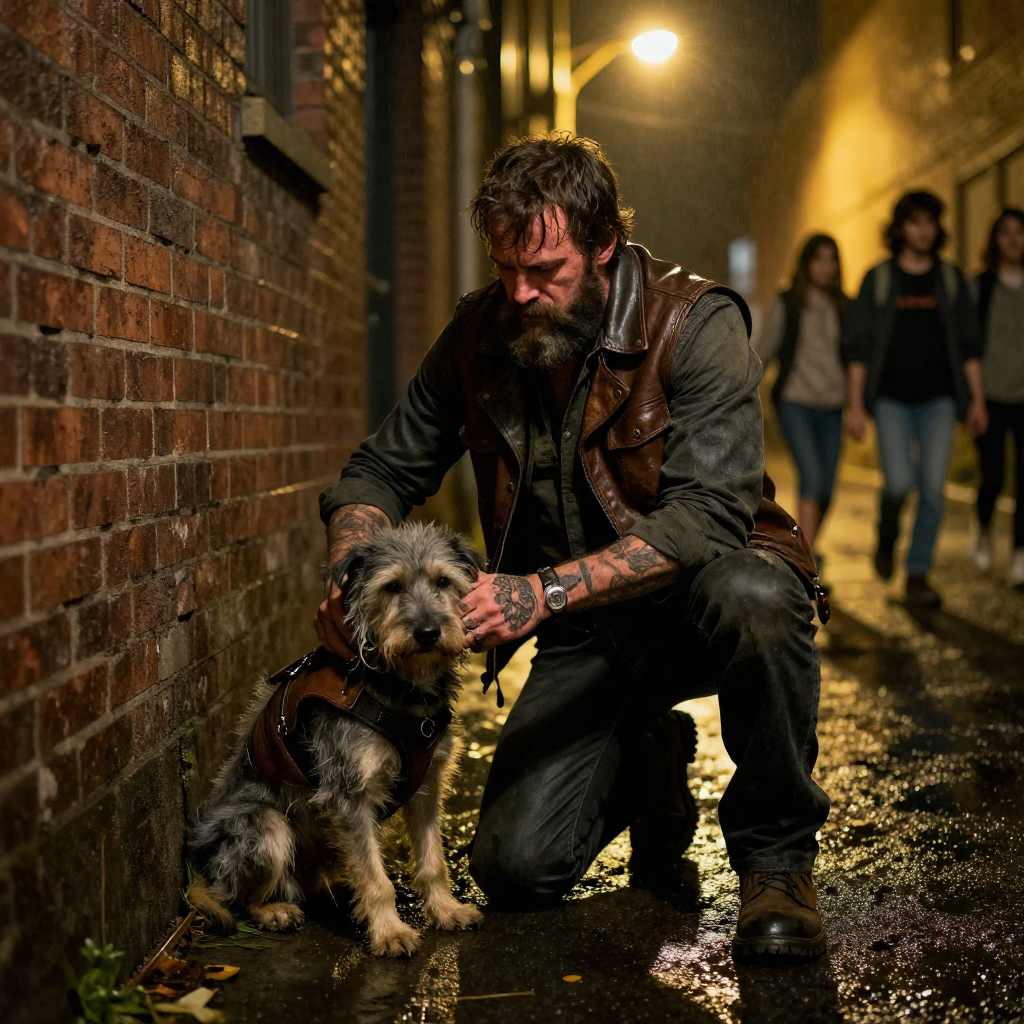
THEY WERE LAUGHING AS THE FIRECRACKERS BURNED HIS PAWS, BUT THE LAUGHTER DIED THE SECOND I STEPPED OUT OF THE SHADOWS AND BLOCKED THEIR PATH.
The sound was what stopped me first. It wasn’t the roar of my own engine—a ’98 Dyna that rumbles loud enough to shake the fillings out of your teeth—but something sharper. Something piercing. It cut through the heavy, humid air of the Tuesday night like a jagged piece of glass.
Pop. Pop-pop. Then a yelp. A high-pitched, desperate sound that didn’t belong in a civilized neighborhood.
I killed the ignition. The silence that followed should have been peaceful, just the ticking of cooling metal and the distant hum of traffic on the interstate. Instead, it was filled with laughter. That cruel, breathless, hyena-like laughter that only teenage boys in a pack can produce. It’s a sound I know well. It’s the sound of weakness masquerading as power.
I was tired. My shift at the warehouse had ended an hour ago, and my knuckles still ached from hauling crates. I just wanted a shower and a cold beer. But my boots were already hitting the pavement before I made a conscious decision to move. I pulled my helmet off, hanging it on the handlebar. The night air hit my face, smelling of impending rain and sulfur.
I walked toward the alley behind the convenience store. The flickering neon sign of the shop buzzed overhead, casting a sickly yellow light onto the wet asphalt. As I rounded the corner, the scene laid itself out before me like a tableau of everything wrong with the human heart.
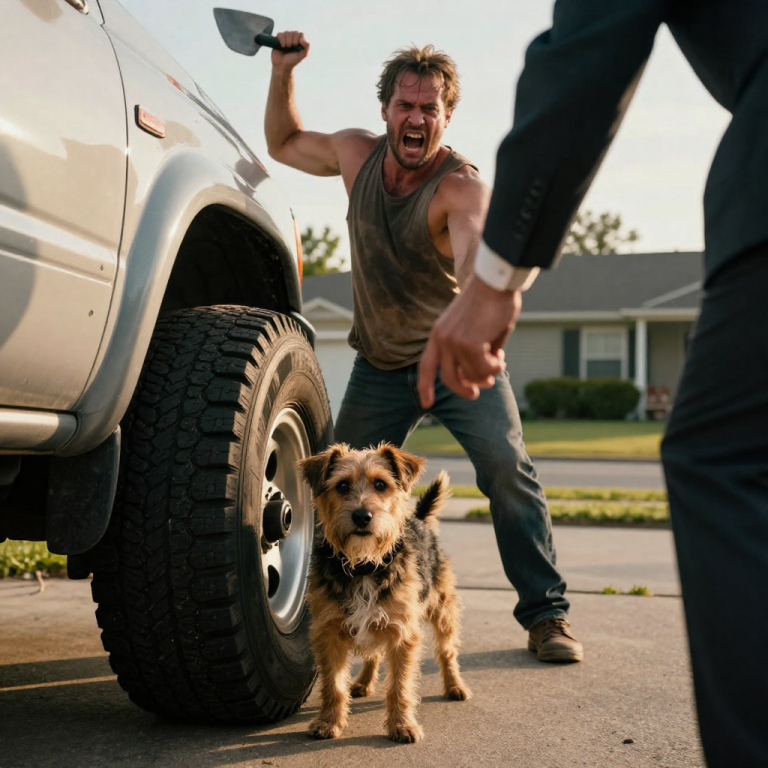
There were four of them. Maybe fifteen or sixteen years old. Clean clothes, expensive sneakers—kids who had never missed a meal, kids who had soft beds waiting for them. And in the corner, wedged between a rusted dumpster and a brick wall, was a dog.
It wasn’t much of a dog anymore. Matted gray fur, ribs pushing against skin like the hull of a starving ship, one ear torn and bleeding. It was pressed so far back into the corner it looked like it was trying to merge with the bricks. At its feet, the pavement was scorched black.
“Throw the big one,” the tall kid said. He was wearing a varsity jacket, looking for all the world like the hero of his own little movie. “See if he jumps this time.”
He held a red cylinder in his hand. A heavy-duty firecracker. Illegal in this county, dangerous anywhere.
The dog didn’t growl. It didn’t bare its teeth. It just shivered. A vibration so intense I could see it from twenty feet away. It had given up. It was waiting to die.
The tall kid flicked the lighter. The flame danced. He drew his arm back.
“Don’t,” I said.
I didn’t shout. I didn’t scream. I spoke with the low, gravelly timbre that twenty years of smoking and shouting over machinery gives you. It wasn’t a request.
The boy froze. The flame stayed lit, hovering inches from the fuse. All four heads snapped toward me.
I stepped into the light. I’m not a small man. I stand six-four, broad at the shoulders, with a beard that hides the scars on my jaw and arms covered in ink that tells the story of a life lived hard. I was wearing my cut—the leather vest with patches that mean things these boys only saw in movies. But the only thing that mattered right now was the tattoo across my knuckles on my right hand.
J-U-S-T.
And on the left.
I-C-E.
“Who are you?” the tall kid asked. His voice cracked. The bravado was leaking out of him like air from a punctured tire.
I didn’t answer. I just walked. I walked with the slow, deliberate pace of a thunderstorm rolling in. Heavy boots on wet concrete. *Clomp. Clomp. Clomp.*
The other three boys took a step back. They weren’t the leaders; they were the audience. Without the show, they were nothing. But the tall kid, the ringleader, he had pride. Stupid, dangerous pride.
“This ain’t your business, old man,” he sneered, though the hand holding the lighter was shaking now.
I stopped three feet from him. I could smell his cologne—something cheap and overpowering—mixed with the fear sweat breaking out on his forehead. I looked down at the firecracker in his hand, then up into his eyes.
“Drop it,” I said.
“Or what?” he challenged. He looked at his friends, desperate for backup, but they were already edging toward the street.
“Or I make sure your mother has to feed you through a straw for the next six months,” I lied. I wouldn’t hit a kid. Not really. But he didn’t know that. He looked at my eyes, and he saw something dark there. He saw the reflection of the violence he was inflicting on that innocent animal, turned back on him tenfold.
The lighter flickered out. The firecracker fell from his hand, rolling harmlessly into a puddle.
“Go,” I whispered.
That was the breaking point. The tension snapped. The ringleader scoffed, trying to save face, muttering something about “crazy biker trash,” but his feet were moving backward. Fast. Within ten seconds, they were gone. I heard their sneakers slapping against the pavement as they ran, their laughter replaced by the frantic noise of escape.
And then, it was just me and the dog.
The silence returned, but it was heavy now. I turned slowly toward the corner. The dog hadn’t moved. Its eyes were wide, rolling white with terror. It expected me to finish what the boys had started. Humans had taught it that pain was the only transaction we understood.
My heart hammered against my ribs. I felt a surge of nausea. How could they? How could they look at something so helpless and find joy in its suffering?
I crouched down. My knees cracked on the pavement. I made myself smaller, less like a mountain, more like a hill.
“Hey, buddy,” I murmured. My voice was soft now, stripped of the steel I’d used on the boys. “It’s okay. They’re gone.”
The dog flinched at the sound of my voice. It pressed its head into the trash bags, trying to disappear.
I saw the burns on its paws then. Raw, angry red marks where the explosives had gone off. The smell of singed hair was sickening. My gut twisted. This wasn’t just bullying; this was torture.
“I’m not gonna hurt you,” I said, extending my hand slowly. Palm up. Open. “I promise.”
We stayed like that for a long time. Maybe ten minutes. Just me kneeling in the alley trash, and him shivering in the dark. I didn’t push. I let him smell me—the leather, the tobacco, the sweat, the exhaust. I let him decide.
Slowly, agonizingly slowly, he turned his head. He sniffed the air. He looked at me, really looked at me, with eyes that were ancient and exhausted.
He let out a small whimper. It was the saddest sound I had ever heard. It was a plea. *Please, no more.*
“No more,” I agreed, answering the unspoken request. “No more pain. Not on my watch.”
I reached into my saddlebag, which I’d unclipped before walking over, and pulled out the beef jerky I kept for emergencies. I tore off a small piece and tossed it halfway between us.
He stared at it. Hunger warred with fear. Hunger won. He stretched his neck, snatched the meat, and swallowed it whole without chewing.
I tossed another piece closer. Then another.
By the time the bag was empty, he was sniffing my fingertips. His nose was cold and wet. I gently touched the top of his head, avoiding the torn ear. He stiffened, but he didn’t pull away.
“Alright,” I said, standing up slowly. “We can’t stay here.”
I took off my leather vest. It was my armor, my identity. I laid it on the ground.
“Come here,” I coaxed.
I scooped him up. He yelped once, sharp and pained, as I put pressure on his ribs, but then he settled. He was shockingly light. Just a bundle of hollow bones and fear. I wrapped him in the leather, covering his shivering body with the heavy material. He buried his face in the crook of my arm, hiding from the world.
I walked back to the bike. The street was empty. The boys were long gone, back to their video games and their soft beds, likely forgetting this ever happened. But I wouldn’t forget. And neither would this dog.
I sat on the bike, cradling him against my chest with one arm. It was going to be a slow ride home.
“You need a name,” I whispered into the wind as I kicked the starter. The engine roared to life, a deep, comforting rumble this time. The dog didn’t flinch. Maybe he knew that this sound, unlike the pops and bangs, meant safety.
I looked down at the letters tattooed on my knuckles gripping the handlebar.
*JUSTICE.*
“We’ll figure it out,” I told him. “Let’s just get you home first.”
CHAPTER II
The wind on the highway at midnight usually acts as a cleanser, stripping away the grease and the noise of the city from my skin, but tonight, the weight against my chest was a constant reminder that I hadn’t left anything behind. The dog—I hadn’t named him yet, he was just a bundle of shivering fur and trauma—was tucked into the front of my leather vest. I could feel his heart hammering against my ribs, a frantic, syncopated rhythm that matched the vibration of my Panhead engine. He didn’t struggle. He didn’t even whimper. He just existed in a state of frozen terror, his small body absorbing the heat from mine.
I pulled into the gravel lot of my apartment building, a converted industrial space on the edge of the docks where the air always smelled of salt and rust. It wasn’t much—a single room above a defunct machine shop—but it was quiet, and more importantly, nobody asked questions. I killed the engine, the silence of the night rushing back in to fill the void. I sat there for a long moment, the heat from the tailpipes clicking as the metal cooled, wondering what the hell I was doing. I was a man who lived out of a duffel bag and a tool roll. I didn’t do ‘responsibilities’ that required more than an oil change.
I unzipped the vest slowly, keeping my movements deliberate. The dog’s eyes reflected the dim yellow of the streetlamp, wide and unblinking. I scooped him up, my large, scarred hands feeling clumsy and oversized against his fragile frame. He felt like he was made of nothing but bird bones and matted hair.
“We’re here,” I muttered, my voice sounding like gravel grinding together. I didn’t know why I was talking to him. Maybe I was trying to convince myself as much as him.
Upstairs, the room was cold. I didn’t turn on the overhead light, opting instead for the low amber glow of a desk lamp. I set him down on a pile of clean rags in the corner, but he didn’t stay there. He crawled toward the shadow of my workbench, tucking himself behind a stack of spare tires. I let him go. I knew what it was like to want to disappear into the dark.
I filled a shallow ceramic bowl with water and set it near him, then I went to the bathroom to gather what I needed: a clean basin, mild soap, and the first-aid kit I kept for the inevitable road rashes and bar-fight splits. When I came back, I sat on the floor, keeping a respectful distance.
“I have to see how bad it is,” I said softly.
I reached out, and for the first time, he growled. It wasn’t a threatening sound; it was the sound of a creature who had reached his absolute limit of tolerance. I looked at my knuckles—the ‘JUSTICE’ tattoo I’d had inked twenty years ago when I still believed the word meant something. The ink was faded, the skin over my joints thickened by scar tissue from a dozen different mistakes.
This was my Old Wound. Not the physical ones, though they were many, but the memory of a night in a different city, a different life. I had been younger then, wearing a different kind of uniform, and I had stood by while someone else—someone I was supposed to trust—did something irredeemable. I hadn’t stopped it. I had looked away. I told myself then that it wasn’t my fight, that ‘justice’ was a complicated, bureaucratic machine. But the silence I kept that night had hollowed me out, leaving a cavity where my conscience used to be. Every time I looked at my hands, I saw the ghost of the man I should have been.
I didn’t pull my hand back from the dog. I let it hover, palm up. “I’m not them,” I whispered. “I’m a lot of things, but I’m not them.”
Eventually, he let me pull him out from behind the tires. I began to wash him. The water in the basin turned a muddy, reddish-brown almost instantly. As the grime and the smell of the alley washed away, the true extent of the damage emerged. The boys had been thorough. The firecrackers hadn’t just singed his fur; there were deep, angry burns on his underbelly and the pads of his hind paws. His skin was parchment-thin, stretched over ribs that looked like they might snap if he breathed too hard.
I worked in silence for an hour, dabbing at the wounds with antiseptic. He flinched every time I touched the raw skin, but he stayed still, his gaze locked on mine. There was an intelligence in those eyes—a heavy, ancient judgment.
“Judge,” I said, the name clicking into place. “That’s who you are. Judge.”
By the time I finished, my back ached and the sun was beginning to threaten the horizon with a pale, grey light. Judge was wrapped in a dry towel, finally falling into a fitful sleep. I, however, couldn’t rest. I knew the burns were infected. The smell—sweet and sickly—was unmistakable. He needed a vet, and he needed one now.
I checked my wallet. Sixty dollars. That wouldn’t even cover the door fee at the 24-hour emergency clinic downtown.
I looked at the floorboards near the corner of the room, under the heavy iron safe where I kept my legal documents. Beneath the loose plank sat a small, metal ammunition box. Inside that box was my Secret. It was nearly five thousand dollars in cash—money that didn’t exist on any ledger. It was the payout from my final ‘job’ before I went off the grid, the money I’d sworn I would never touch because it was tied to the very people I was hiding from. Using that money meant dipping back into a pool of filth I’d spent five years trying to climb out of. It was my safety net, my escape hatch if the past ever caught up with me.
But as I looked at Judge, his chest heaving with the effort of fighting off the infection, the math was simple. I could keep the money and let the dog die in a pile of rags, or I could use the money and risk putting a target back on my head.
I grabbed the box.
I loaded Judge back into the vest and rode to the ‘North Star Emergency Veterinary Clinic.’ It was a sterile, brightly lit place that smelled of ozone and floor wax. There were three other people in the waiting room—a woman with a cat carrier, an old man holding a birdcage, and a man I recognized immediately.
It was Mr. Henderson, my landlord.
My heart did a slow, heavy roll in my chest. Henderson was a small, litigious man who owned half the block and hated every inch of it. He had been trying to find a reason to evict me for months because a luxury developer wanted to turn my building into ‘lofts.’ My lease was ironclad, but it had one specific, non-negotiable clause: No pets. No exceptions.
I tried to pull my collar up and keep my head down, but Judge chose that exact moment to let out a sharp, pained yelp.
Henderson turned. His eyes narrowed behind his thick glasses. He looked at my vest, then at the small, mangy head poking out of the zipper.
“Elias?” he said, his voice rising in that shrill, annoying way it did when he smelled blood. “Is that a dog?”
“It’s nothing, Henderson,” I said, my voice low and warning. I walked toward the reception desk, but he stepped into my path, his phone already out and the camera app open.
“It’s not ‘nothing,’ it’s a violation of Paragraph 12 of your rental agreement. I told you, Elias, I don’t want those filthy animals in my properties. They carry disease. They ruin the floors.”
He snapped a photo. The flash was blinding in the dim waiting room.
“He’s hurt,” I said, feeling the heat rise in my neck. I could feel the old urge to use my knuckles—to bring ‘Justice’ to Henderson’s face—but I held it back. If I touched him, I’d be in a cell, and Judge would be in a kill shelter by noon.
“I don’t care if it’s dying,” Henderson sneered, loud enough for the entire waiting room to hear. A nurse behind the desk looked up, her expression tightening. “You have twenty-four hours to get that thing out, or I’m filing the eviction notice. In fact, consider this your verbal notice. I have witnesses.”
This was the Triggering Event. The public confrontation had stripped away my anonymity and my sanctuary. There was no going back to the quiet life I’d built. By tomorrow, the process servers would be at my door.
“Sir?” the nurse asked, looking at me. “Are you checking in?”
I ignored Henderson, though he stayed there, muttering into his phone, recording a voice memo about ‘aggressive tenants and illegal animals.’ I walked to the desk.
“He needs help,” I said, my hand trembling slightly as I set the dog on the counter. “Burns. Infection.”
They took Judge into the back almost immediately. I sat in one of the plastic chairs, the air conditioning humming overhead. Henderson had left, no doubt to call his lawyer, leaving a trail of smug satisfaction behind him.
An hour later, a vet in green scrubs came out. She looked tired. “Mr. Elias?”
“Just Elias,” I said, standing up.
“Your dog… Judge… he’s stable, but it’s bad. The burns on his paws are third-degree. There’s signs of blunt force trauma to the ribs, and his bloodwork shows he’s severely malnourished. We need to keep him on an IV and perform a debridement procedure on the necrotic tissue. If we don’t, the sepsis will take him.”
She paused, looking at my tattered vest and the grease under my fingernails. She was gauging my ability to pay. “The estimate for the first forty-eight hours, including the surgery, is thirty-two hundred dollars. We require a fifty-percent deposit up front.”
This was the Moral Dilemma.
I reached into my pocket and pulled out the envelope from the ammunition box. The cash was crisp, the bills smelling of old metal and desperation. To hand this over was to leave a paper trail. The clinic would have to record the transaction. Large cash payments in a city like this were flagged. The people I’d hidden from—the ones who knew exactly where that money came from—would eventually hear about a biker spending thousands in cash at a vet clinic.
If I paid, I was essentially lighting a flare in the middle of a dark ocean, telling my enemies exactly where to find me. If I didn’t pay, Judge would be ‘humanely euthanized’ because the clinic couldn’t absorb the cost of a stray’s recovery.
I looked at the ‘JUSTICE’ on my left hand. I thought about the night I had done nothing. I thought about the way Judge had looked at me when I was washing him—not with gratitude, but with a silent demand that I be better than the world that had broken him.
Choosing ‘right’ meant I would lose my home, my safety, and potentially my life.
Choosing ‘wrong’ meant I could walk away, keep my money, find a new apartment, and continue my grey, empty existence.
I looked at the vet. She was waiting for me to make an excuse, to say I couldn’t afford it and walk out the door.
“Do the surgery,” I said. I counted out sixteen hundred dollars in hundred-dollar bills and laid them on the counter.
As the nurse began to count the money, I felt the weight of the world shift. The bridge behind me wasn’t just burning; it was gone. I had no home to go back to, no secret stash to rely on, and a landlord who was currently drafting the papers to throw me onto the street.
I walked out of the clinic and stood on the sidewalk. The sun was fully up now, hitting the chrome of my bike and making it glint like a blade. I had saved the dog, but in doing so, I had destroyed the only version of peace I’d ever known.
I swung my leg over the Harley and kicked the starter. The engine roared to life, a defiant, angry sound that echoed off the sterile walls of the clinic. I didn’t know where I was going to sleep tomorrow, or who would come looking for me once that cash was deposited in the bank, but as I pulled away, all I could think about was the look in Judge’s eyes.
For the first time in five years, the ink on my knuckles didn’t feel like a lie. It felt like a sentence.
CHAPTER III
The clock on the wall of my studio did not tick. It hummed. A low, electric vibration that felt like it was drilling into the base of my skull. I had twenty-four hours before the world I had built out of silence and shadows collapsed. My duffel bag sat on the stained mattress, half-full. I didn’t have much. A few tools. A leather jacket that had seen more miles than most people see in a lifetime. A photograph of a woman whose face I was starting to forget. And the dog. Judge.
Judge wasn’t there, of course. He was still at the clinic, stitched up and fighting an infection that wanted to turn his blood into poison. I could still smell him in the room, though. That scent of wet fur, copper, and the antiseptic the vet had used. It was the smell of my failure. It was the smell of the choice I had made. Three thousand two hundred dollars. I had peeled those bills from the plastic-wrapped stack hidden in the crawlspace behind the water heater. Blood money. It wasn’t a metaphor. That money had been sitting there for five years, waiting to either rot or scream. I had finally let it scream.
I sat on the floor, my back against the radiator. My knuckles felt heavy. The ink of ‘JUSTICE’ seemed to throb with every heartbeat. I had spent years trying to be a ghost. A ghost doesn’t get evicted. A ghost doesn’t care about a stray dog in an alley. But I wasn’t a ghost anymore. I was a target. I knew the moment I handed those crisp, sequential bills to the receptionist at the emergency vet that a silent alarm had gone off in a high-rise office downtown. That money was marked, not by the law, but by men who never forget a debt.
The afternoon light started to fail, casting long, skeletal shadows across the floorboards. I heard the stairs groan. It wasn’t Henderson. Henderson walked with a frantic, shuffling gait, the sound of a man who was always afraid of losing a penny. This footfall was different. It was heavy, deliberate, and rhythmic. It was the sound of someone who owned the air they breathed. I didn’t reach for a weapon. I didn’t have one anymore. I had traded my steel for the chance to save a creature that didn’t even know my name.
The door didn’t open with a crash. It swung wide, slowly, as if the person on the other side wanted me to savor the anticipation. Silas stood in the threshold. He looked exactly the same. The same charcoal suit. The same silver hair. The same predatory stillness. He didn’t look like a killer. He looked like an accountant for the end of the world. He stepped inside, ignoring the peeling wallpaper and the smell of stale coffee. He looked at the duffel bag on the bed and then at me.
‘You have a very distinctive signature, Elias,’ Silas said. His voice was like a razor blade wrapped in silk. ‘We thought you were dead. Some of us even hoped you were. But then you go and spend three large on a mutt. In a zip code where you’re supposed to be invisible. It’s almost poetic. Or maybe it’s just pathetic.’
I didn’t stand up. I stayed on the floor, looking up at him. ‘The money was mine. I earned it.’
‘You stole it,’ Silas corrected softly. ‘You were the driver. You weren’t the owner. You left the crew in the rain and took the insurance policy with you. We didn’t care about the cash, Elias. We cared about the precedent. And now, you’ve brought both back into the light.’
He walked toward the window, looking out at the gray street below. ‘Henderson called us, you know. He’s a greedy little man. He thought he was reporting a squatter with a dangerous animal. He didn’t realize he was calling the people who actually own the deed to this building. We keep these places for rainy days. You’ve been living in our house, Elias. For free.’
The irony hit me like a physical blow. I had been hiding in the lion’s mouth, thinking I was safe because I was small. Henderson wasn’t just a landlord; he was a low-level property manager for the organization I had betrayed. My silence hadn’t been a shield; it had been a stay of execution I didn’t know I was serving.
‘Where is the dog?’ Silas asked. He didn’t turn around.
‘He’s safe,’ I said, my voice cracking. ‘He’s at the clinic.’
‘He’s an expense,’ Silas said. ‘And you’re a liability. I’m here to close the account.’
Before I could respond, the hallway erupted in noise. Heavy boots. Shouted orders. The sharp, authoritative rap of a nightstick against a doorframe. Henderson’s voice rose above the din, high-pitched and hysterical. ‘In there! Room 4C! I told you, he’s a menace! He’s got an illegal animal and he’s threatening the tenants!’
Silas didn’t flinch. He just watched the door as it was kicked open. Two uniformed police officers stormed in, followed by a woman in a tan jumpsuit with ‘Animal Control’ stitched on the pocket. Behind them, Henderson hovered, his face flushed with a mixture of fear and triumph. He saw Silas and froze. He didn’t know who Silas was, but he knew power when he saw it. The air in the room became thick, pressurized by the collision of two different kinds of law.
‘Sir, stay where you are,’ the first officer said, his hand hovering over his holster. He was looking at me, but his eyes kept darting toward Silas. Silas just smiled, a thin, bloodless line. He pulled a small leather wallet from his jacket and flipped it open. It wasn’t a badge, but whatever it was made the officer’s shoulders drop an inch. It was the kind of identification that suggested phone calls to people who could end careers.
‘This man is a trespasser,’ Henderson shrieked, pointing at me. ‘And that dog! I want it gone! It’s a public health hazard! I have the eviction order right here!’ He waved a crumpled piece of paper in the air. The woman from Animal Control stepped forward, her face set in a mask of bureaucratic indifference. ‘We have a report of a dangerous animal being kept in unsanitary conditions. We’re here to take custody of the canine for evaluation.’
Evaluation. I knew what that meant. In a city like this, for a dog like Judge, evaluation meant a needle and a cold floor. They weren’t here to save him. They were here to erase the problem. I looked at Silas. He was enjoying this. He wanted to see what I would do. He wanted to see if the ‘JUSTICE’ on my knuckles meant I would fight the cops or if I would let them take the only thing I had left.
‘The dog is at the clinic,’ I said, standing up slowly. My legs were shaking. ‘He’s recovering from surgery. You can’t take him. He’ll die.’
‘That’s not our concern, sir,’ the officer said. ‘Mr. Henderson has filed a formal complaint. You’re being evicted effective immediately. We’re here to ensure the animal is removed from your care.’
I looked at Silas again. He tilted his head, waiting. If I fought them, Silas would kill me. If I didn’t, they would kill Judge. It was a perfect trap. The old Elias would have swung. He would have broken the officer’s jaw and been out the window before the second one could draw. He would have lived to run another day. But that Elias didn’t care about a dog.
‘Wait,’ a new voice said. It was deep, resonant, and carried a weight that even Silas’s presence couldn’t diminish. An older man in a charcoal overcoat stepped into the room. He was followed by Dr. Aris, the vet from the clinic. The doctor looked terrified, but she stood her ground.
‘Who are you?’ the officer asked, sounding annoyed.
‘I’m Arthur Sterling,’ the man said. ‘District Attorney’s office. Or, more accurately, I’m the man who just received a very interesting tip regarding the cash used to pay for a veterinary bill this morning.’
Sterling looked at me, then at Silas. His eyes narrowed. ‘I’ve been looking for those serial numbers for five years, Silas. I didn’t expect to find them in a vet’s office in the South Side. And I certainly didn’t expect to find you here, supervising an eviction.’
Silas’s smile vanished. For the first time, I saw a flicker of something human in his eyes. Fear. ‘This is a private property matter, Arthur. My company owns the building.’
‘Your company is a shell for a money-laundering operation that I’ve been dismantling brick by brick,’ Sterling said. He turned to the officers. ‘Step outside. Now. This is no longer a civil matter. And Mr. Henderson, if you say one more word, I’ll have you charged with aiding and abetting a known criminal enterprise.’
Henderson’s mouth snapped shut. He looked like he was about to faint. The officers hesitated, then retreated into the hallway. The power in the room had shifted. The law wasn’t a nightstick anymore; it was a mountain.
Sterling walked over to me. He looked at my knuckles. ‘You’re the one who brought him in, aren’t you? The dog.’
‘Yes,’ I said.
‘Dr. Aris tells me you spent your last dollar to save that animal’s life,’ Sterling said. ‘She also tells me the animal was a victim of severe abuse. We’ve already identified the teenagers. Their parents are quite influential, which is why the police were so eager to help Mr. Henderson clear the air. They wanted the evidence—the dog—to disappear.’
The truth hit me like a splash of ice water. The teenagers weren’t just kids. They were the children of people who didn’t want a lawsuit or a scandal. Henderson was doing a favor for his bosses, who were doing a favor for the local elites. It was a circle of corruption, and Judge was the only thing standing in the middle of it.
‘The money you spent,’ Sterling said, his voice dropping to a whisper. ‘It’s evidence in a federal case. If you give it up, if you tell me where the rest of it is and who gave it to you… I can make sure the dog stays in a protected facility. I can make sure he’s never touched again.’
I looked at Silas. He was watching me, his hand slipping into his coat. He was going to kill me the moment Sterling left the room. Or maybe he’d kill us both. I had the remaining forty thousand dollars in the duffel bag. It was my ticket out. It was my life. If I gave it to Sterling, I had nothing. I’d be a witness. I’d be a target for the rest of my life. I’d be in a cell or a safehouse, but I wouldn’t be free.
I looked at Dr. Aris. She was holding a clipboard, her knuckles white. She looked at me with something like pity. Or maybe it was hope.
‘He’s a good dog,’ I said. My voice was steady now. ‘His name is Judge.’
I picked up the duffel bag and handed it to Sterling. ‘The rest is in here. All of it. I kept a log of the dates, the locations, the names. It’s all in the lining.’
Silas moved. It was a blur of gray and silver. But Sterling was faster. He didn’t pull a gun; he didn’t have to. Two plainclothes federal agents stepped from the hallway, their weapons drawn and silent. They didn’t shout. They just moved Silas against the wall. The sound of handcuffs clicking into place was the most beautiful thing I had ever heard.
‘You’re a fool, Elias,’ Silas hissed, his face pressed against the wallpaper. ‘You’re dead either way.’
‘Maybe,’ I said. ‘But the dog lives.’
Sterling took the bag. He looked at me for a long time. ‘You’re going to have to come with us, Elias. For your own safety. And for the case. It’s not going to be easy.’
‘I’ve never had it easy,’ I said.
I walked toward the door. Henderson was cowering in the corner of the hallway, a broken, pathetic man. I didn’t even look at him. I looked at Dr. Aris. ‘Take care of him. Until I can come back.’
‘I will,’ she promised. ‘I’ll bring him to the station when the doctors clear him.’
As I walked down the stairs, flanked by federal agents, I felt the weight of the coins lifting. I was homeless. I was a rat. I was a man with a target on his back. But as I stepped out into the cold night air, I looked at my knuckles. For the first time in my life, the word didn’t feel like a lie. Justice. It wasn’t about the law. It wasn’t about revenge. It was about the choice to lose everything so that something smaller and weaker didn’t have to die in the dark.
I got into the back of the black sedan. The engine started, a low, powerful purr. We pulled away from the curb, leaving the studio apartment and the life I had built behind. I looked back at the building. Henderson was standing on the sidewalk, watching his empire crumble. I didn’t hate him. I didn’t feel anything for him at all.
I closed my eyes and pictured Judge. I saw him running in a field, his fur grown back, his wounds healed. I saw him happy. And for the first time in five years, I fell asleep without checking the lock on the door.
CHAPTER IV
The bars felt colder than I expected. Not bone-chilling, just…sterile. Like the whole place had been scrubbed clean of feeling. Maybe it was. Maybe that’s what they did to you after a while. Emptied you out. I sat on the thin mattress, the jumpsuit scratchy against my skin, and waited. Waited for the questions, the paperwork, the next step in a life I didn’t recognize anymore.
The news hit like a wave. Not just the local channels, but the national ones too. Elias Thorne – former wheelman, now a cooperating witness. They showed my old mugshot, the one from a decade ago. Then, grainy footage of Silas being led away in handcuffs. They talked about the dog, Judge. The ‘Justice for Judge’ hashtag was trending. People were leaving toys and donations at the animal shelter. Mr. Henderson, my puppet landlord, was interviewed, looking pale and sweating under the studio lights. He denied everything, of course. Said he was just trying to run a business.
My lawyer, a sharp woman named Ms. Davies, visited me the next day. “You did the right thing, Elias,” she said, but her voice lacked conviction. The system was slow, even when you played along. A new identity, witness protection, it all took time. Meanwhile, I was stuck in limbo. Every day felt like a week.
Public Reaction
The trial was a circus. The courtroom was packed. The media ate it up. Silas, predictably, pleaded not guilty. His lawyers tried to paint me as a liar, a criminal trying to save his own skin. They dredged up every mistake I’d ever made. The prosecution, led by Arthur Sterling, was relentless. He used my testimony, my memories, to dismantle Silas’s empire piece by piece. Sterling wasn’t doing this for me; he was using me. But I didn’t care. I’d made my choice. Each morning, I walked into that courtroom, looked Silas in the eye, and told the truth. It felt like carving the ‘JUSTICE’ tattoo off my knuckles, one painful layer at a time.
The world outside the courtroom was even stranger. I saw my face on the cover of magazines. Talk shows debated whether I was a hero or a villain. There were protests outside the courthouse – some supporting Judge, some condemning me for my past. One woman held a sign that read, “Elias Thorne: Criminal or Canine Savior?” I guess it depended on who you asked. The irony wasn’t lost on me.
Personal Loss
I didn’t sleep much. The faces haunted me. The victims of Silas’s operation, the people I’d hurt along the way. I kept seeing Judge’s battered face, his eyes filled with pain and confusion. Was I really doing this for him, or was I just trying to wash away my own sins? The guilt was a constant companion. It gnawed at me, whispered in my ear every time I closed my eyes.
Ms. Davies told me that Judge was recovering. The surgery had been successful. He was in a foster home, learning to trust again. I asked if I could see him, but she said it wasn’t possible. Not yet. Maybe not ever. That hit me harder than I expected. I’d risked everything for that dog, and now I couldn’t even be near him. I knew it was for his own good, for my own safety, but it still felt like a piece of me was missing.
I lost everything, of course. My name, my past, my freedom. But I also lost something more intangible – the illusion that I could ever truly escape what I had done. The blood money was gone, but the bloodstains remained. I would carry them with me, no matter where I went or who I became.
New Event: The Letter
Weeks turned into months. The trial ended. Silas was convicted. The news reported a lighter sentence than expected due to insufficient evidence on some charges, leading to outrage from animal rights activists. I was debriefed, processed, and prepared for my new life. Ms. Davies handed me a thick envelope. “From Arthur Sterling,” she said. “He wanted you to have this.”
Inside was a letter. Not a formal document, but a handwritten note. It said:
*Thorne,
I don’t pretend to understand what you did, or why. But you made a difference. Silas is behind bars, and that dog is alive because of you. Don’t waste it. Whatever name you choose, whatever life you build, make it count. And one more thing. I’m paying for Judge’s ongoing care. Consider it a debt paid.
Arthur Sterling.*
There was something else in the envelope. A photograph. It was Judge. He was standing in a park, tail wagging, with a young girl petting him. He looked happy. He looked…free.
Moral Residues
I was given a new name, a new identity. David Miller. A fresh start. I was relocated to a small town in Montana. Miles away from the city, miles away from everything I knew.
The first few months were the hardest. I was constantly looking over my shoulder, expecting Silas’s people to find me. Every stranger was a potential threat. Every phone call made my heart race. Slowly, though, the fear began to fade. The nightmares became less frequent. I started to breathe a little easier.
I found work at a local hardware store. The owner, a kind old man named Earl, took a chance on me. I learned to fix things, to build things, to work with my hands. It was honest work, simple work. It was a world away from the life I used to live.
But the past was always there. A shadow lurking in the corner of my mind. I couldn’t escape it, and I knew I never would. Justice had been served, to some extent, but it felt hollow. Silas was in prison, but the system that allowed him to thrive was still in place. Judge was safe, but countless other animals were still suffering. And I was free, but I was still a prisoner of my own actions.
One evening, I was watching the local news. There was a story about a dog rescue organization that was struggling to stay afloat. They needed donations, volunteers, anything to keep going. I thought about Judge, about the life he deserved. And I knew what I had to do.
A Quiet Act
I wrote a check. Not a large one, but enough to make a difference. I signed it David Miller. Then, I wrote a letter to the organization, explaining why I was donating. I didn’t mention my past, my real name, or the trial. I just told them about Judge. About how he had changed my life. I sealed the envelope and walked to the mailbox.
As I dropped the letter in, I felt a sense of peace I hadn’t felt in years. It wasn’t absolution, it wasn’t redemption, but it was something. A small act of kindness in a world that often seemed devoid of it.
The new event, the letter from Arthur Sterling, changed everything. The photo of Judge gave me something to hold onto, something to believe in. It reminded me that even in the darkest of times, there was still hope. Sterling’s gesture, unexpected and generous, chipped away at my cynicism. He saw something in me, something beyond the criminal, and that meant more than I could say.
It didn’t erase the past, it didn’t magically make me a good person, but it gave me a direction. It gave me a reason to keep going. I was still David Miller, ex-con, new identity, but maybe, just maybe, I could also be someone who made a difference. Someone who honored the sacrifice I had made, not by wallowing in guilt, but by living a life worthy of Judge’s second chance.
Haunted Still
The nightmares faded, but they never completely disappeared. Sometimes, I’d wake up in a cold sweat, reliving the chase, the gunshots, the fear. And then I would remember Judge. His eyes, his wagging tail, the way he would nudge my hand with his wet nose. And I would know that I had done the right thing.
I never saw Judge again. I knew it was for the best, but I still missed him. I imagined him running in the park, playing with the girl in the photo, living the life he deserved. And I smiled. Because even though I couldn’t be there with him, I knew that he was finally free.
Time blurred. Seasons changed. Montana became home. The hardware store became my refuge. I learned to embrace the quiet, to find solace in the ordinary. I was no longer running from my past, but I wasn’t exactly facing it either. I was simply…existing.
One day, a package arrived at the hardware store. It was addressed to David Miller. Inside was a book. It was a collection of stories about rescued animals. On the cover was a picture of a dog. A familiar-looking dog. I opened the book and started to read.
The first story was about a pit bull who had been abused and abandoned. He had been found wandering the streets, starving and injured. But he had been rescued by a kind woman who nursed him back to health. He had learned to trust again, to love again. And he had gone on to become a therapy dog, helping other people heal.
As I read the story, tears streamed down my face. I knew that dog. I knew his story. It was Judge’s story. I turned the page. There was a photograph. It was Judge, wearing a vest that said “Therapy Dog.” He was sitting next to a young boy in a wheelchair. The boy was smiling.
I closed the book and held it to my chest. I didn’t need to read any more. I knew what I had to do. I had to find a way to tell my story. Not for fame, not for glory, but for Judge. For all the other abused and abandoned animals in the world. And for myself.
This time, I wouldn’t stay silent.
CHAPTER V
The book lay open on the kitchen table, the glossy photo of Judge staring back at me. ‘Unlikely Heroes,’ it was called, and it told stories of animals rescued from unimaginable cruelty, animals who, against all odds, had become healers themselves. I’d read it cover to cover a dozen times since it arrived. Each time, I’d pause at Judge’s picture, a wave of something I couldn’t quite name washing over me. Pride, maybe? Or perhaps just a raw, aching tenderness for the creature who’d unknowingly dragged me back from the brink.
I’d been David Miller for almost two years now. Montana suited me. The vast, open spaces, the crisp mountain air, the quiet. It was a world away from the claustrophobic streets of the city, from the constant thrum of fear that had vibrated beneath my skin for so long. Here, I could almost breathe. Almost forget.
But the past was a stubborn thing. It clung to me like the scent of gasoline after a long drive. I saw it in my reflection, in the lines etched around my eyes, in the way I still flinched at sudden noises. I tried to bury it, to build a new life on top of the old one, but it was no use. The past was always there, waiting.
The money I’d donated to the dog rescue, ‘Second Chance Ranch,’ had been put to good use. Sterling sent me updates every few months – photos of Judge working with veterans, his gentle presence a balm to their unseen wounds. I told myself that was enough. That I’d done my part. That I could finally let it go.
But seeing Judge in that book… it stirred something deep inside me. A discontent I couldn’t ignore. Was I really content to just disappear? To live out my days as a ghost, haunted by what I’d done and what I hadn’t?
The answer, I knew, was no.
###
The decision wasn’t easy. It took weeks of sleepless nights, pacing the floor, replaying every mistake, every regret. I thought about Silas, rotting in some prison cell. I thought about the families I’d hurt, the lives I’d disrupted. And I thought about Judge, the small, broken dog who’d shown me that even the most damaged creatures were capable of forgiveness.
I picked up the phone. My hand trembled as I dialed Arthur Sterling’s number. It rang three times before he answered.
“Sterling,” he said, his voice cautious.
“It’s Miller,” I said, my voice hoarse. “David Miller.”
There was a long silence on the other end of the line. “I thought we’d lost you,” he finally said. “Is everything alright?”
“No,” I said. “Everything’s not alright. I need to talk to someone. I need to tell my story.”
He didn’t try to dissuade me. He knew me too well. He knew that once I’d made up my mind, there was no turning back.
We arranged to meet in a neutral location, a small town halfway between Montana and his office in the city. I packed a bag, grabbed my coat, and headed out into the cold Montana air. As I drove, I couldn’t shake the feeling that I was crossing a threshold, stepping into a new and uncertain future.
###
Sterling looked older, more tired than I remembered. The years had taken their toll. His hair was grayer, his face more lined. But his eyes were still sharp, still full of that unwavering determination that had always impressed me.
We met in a diner, a place with worn vinyl booths and the smell of stale coffee. He listened without interrupting as I told him everything. About Silas, about the robberies, about the life I’d lived before Judge. I told him about the guilt, the shame, the constant fear that I’d never be able to escape my past.
When I finished, he sat in silence for a long moment, his gaze fixed on the tabletop. Then, he looked up at me, his eyes filled with a mixture of understanding and concern.
“What do you want to do, David?” he asked.
“I want to tell the truth,” I said. “I want people to know what happened. I want them to know about Judge, about what he did for me. And I want to use my story to help other animals, to fight against the kind of cruelty that almost killed him.”
He nodded slowly. “It won’t be easy,” he said. “You’ll be exposing yourself. You’ll be opening yourself up to criticism, to judgment. Are you prepared for that?”
“I have to be,” I said. “I owe it to Judge. I owe it to myself.”
We spent the next few hours discussing the logistics. How to protect my identity, how to control the narrative, how to ensure that the focus remained on animal welfare. Sterling agreed to help me, to use his connections to find the right platform, the right audience.
As I left the diner, I felt a sense of purpose I hadn’t felt in years. The fear was still there, but it was tempered by a newfound hope. I was finally taking control of my story, using my voice to make a difference in the world.
###
The interview was anonymous, conducted by a journalist who specialized in animal rights issues. We met in a secluded location, a small cabin in the woods. I told my story, from beginning to end, leaving nothing out. The journalist listened intently, her face a mask of compassion and understanding.
The article was published a few weeks later. It was raw, honest, and unflinching. It didn’t shy away from my past, but it also highlighted the transformative power of Judge’s rescue. It generated a huge response, both positive and negative. Some people praised me for my courage, for my willingness to speak out. Others condemned me for my past actions, for the harm I’d caused.
I tried to ignore the negativity, to focus on the positive impact the article was having. Donations to Second Chance Ranch skyrocketed. Other animal rescue organizations reached out, eager to collaborate. Judge’s story was inspiring people to take action, to make a difference in the lives of animals in need.
I even heard from Sarah, the author of ‘Unlikely Heroes.’ She thanked me for sharing my story, for giving Judge a voice. She told me that my experiences had resonated with her, that they had reinforced her belief in the power of redemption.
The attention was overwhelming, but it was also cathartic. For the first time in my life, I felt like I was finally living in the light, no longer hiding in the shadows of my past. I was still David Miller, but I was also Elias, the man who had rescued Judge. And I was finally okay with that.
The threats came eventually, whispers at first, then more direct messages online. Silas’s remaining associates hadn’t forgotten. Sterling got me moved again, deeper into the anonymity. It was a trade-off I was prepared to make.
The last time I saw Judge, he was nuzzling the cheek of a young boy in a wheelchair. The boy’s face was lit up, a smile that reached all the way to his eyes. It was a moment of pure, unadulterated joy, a reminder of the good that could come from even the darkest of beginnings.
I knew then that I had made the right choice. That even though my past would always be a part of me, it didn’t have to define me. I could use my experiences, my voice, to create a better future, a future where animals like Judge were treated with the love and respect they deserved.
Montana is still my home. The mountains are a constant reminder of the long climb, the hard work, the quiet strength it takes to keep moving forward. I still donate to Second Chance Ranch, and I occasionally visit, always careful to remain unseen. I’ve learned to live with the fear, the guilt, the knowledge that I can never truly escape my past. But I’ve also learned to live with hope, with the belief that even the most broken souls can find redemption.
I am not proud of the man I was, but I am proud of the man I am becoming. Judge saved me, and in saving him, I finally found a way to save myself.
END.