HE THREW MY ONLY BELONGINGS INTO THE DIRT AND LAUGHED, UNTIL HIS FATHER ARRIVED AND DROPPED TO HIS KNEES IN TEARS.
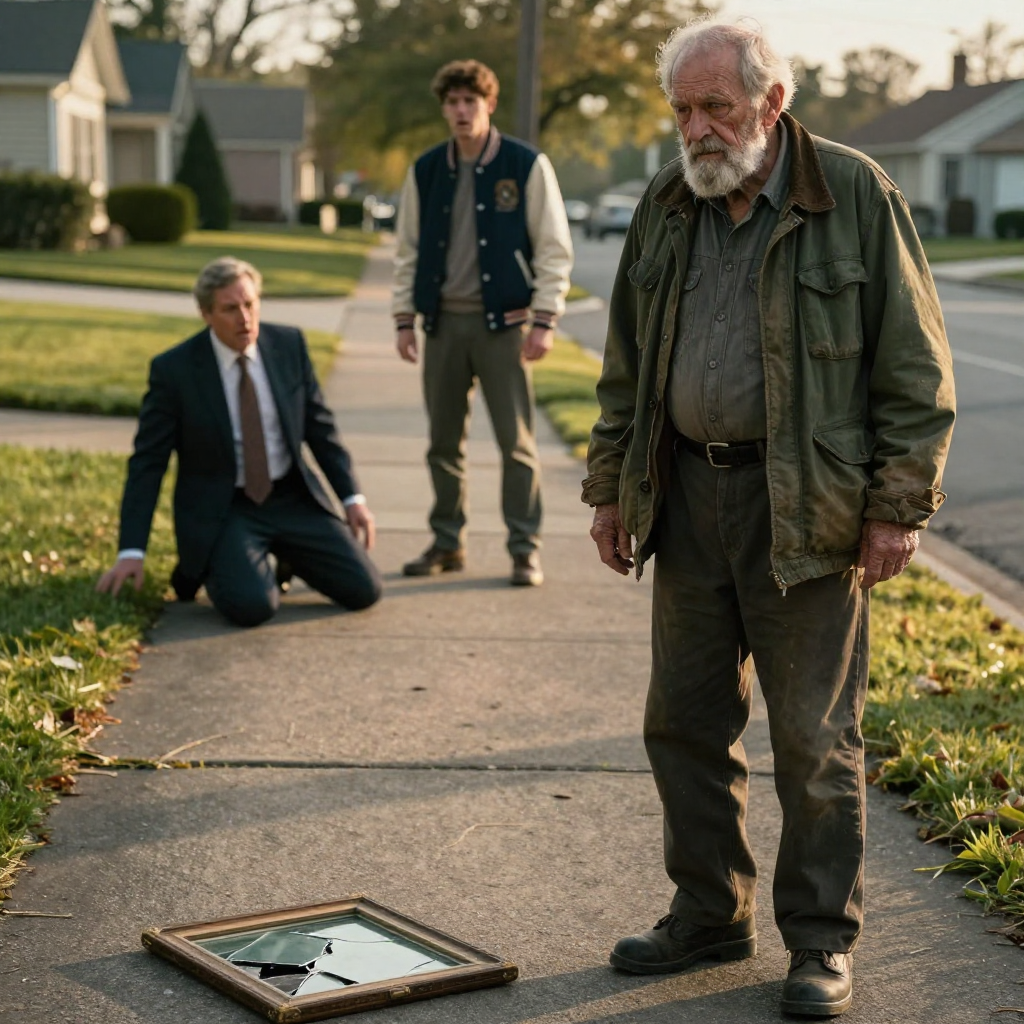
The sound of shattering glass is distinct. It doesn’t just break; it screams. That was the sound of my life hitting the pavement. It was a picture frame, a cheap thing with faux-wood edges, holding the only photo I had left of my unit. It landed face down in the gutter, the glass spider-webbing across the faces of men who were better than me, men who didn’t make it back to get thrown out of an apartment complex on a Tuesday afternoon.
“You don’t belong here, loser!”
The voice was young, cracking with the kind of arrogance that only comes from never having been punched in the mouth. Brad. The landlord’s son. He was nineteen, maybe twenty. He wore a varsity jacket that looked too new and sneakers that cost more than my disability check. He stood on the porch of the duplex I’d been renting for three years, holding my duffel bag like it was contaminated waste.
I didn’t say anything. I just stood there, leaning heavily on my cane. My left knee was throbbing, a phantom ache from shrapnel embedded decades ago, reacting to the humidity and the stress. I watched him heave the bag. It tumbled down the concrete stairs, zipper bursting open, spilling my socks and shirts onto the dirty walkway.
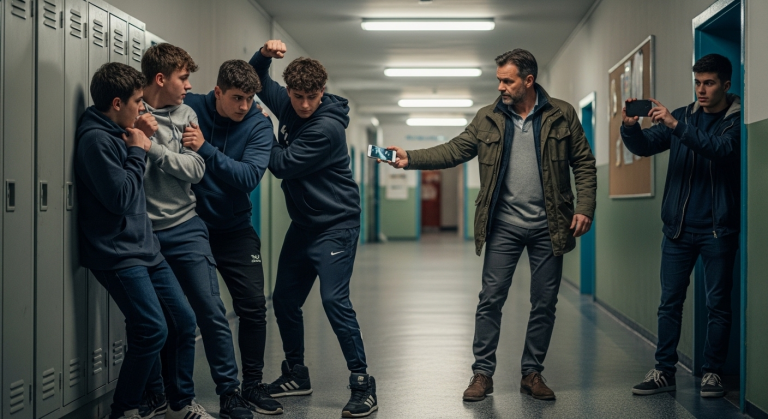
“Did you hear me?” Brad shouted, stepping down one step, looming over me. He wanted a reaction. He was filming it, or his friend was—a skinny kid by the hedges holding a phone up, grinning like this was the funniest thing he’d seen all week. “My dad said you’re out. The lease is done. We don’t want squatters bringing down the property value.”
I took a breath, holding it in my chest, letting the anger cool into something hard and heavy in my gut. “I have until the end of the month, Brad,” I said. My voice sounded rusty, even to my own ears. I don’t talk much these days. “I paid the rent. I have the receipt.”
“Receipts don’t matter when you’re trash!” he spat. He kicked a book that had fallen out of the bag. It was a worn copy of Marcus Aurelius, dog-eared and stained with coffee. It skidded across the asphalt and landed in a puddle of oil. “Look at you. You’re pathetic. Limping around here like you own the place. You think because you’re old we have to respect you? This is the real world. If you can’t pay the new rate, you get out.”
The new rate was double. A convenient way to evict me without technically evicting me. I knew the game. I just needed a few more days to find a place, to pack my dignity properly. But Brad had decided to expedite the process while his father was at a meeting.
I bent down to pick up the book. The movement was slow, painful. I heard the snicker from the friend filming. To them, I wasn’t a person. I was a prop. I was content for their social feed. A ‘Karen’ male, a bum, a loser. They didn’t see the scars under my shirt. They didn’t see the way my hand trembled not from fear, but from the immense effort it took not to snap into combat mode.
“Don’t touch that!” Brad yelled, rushing down the remaining stairs. He kicked the book away from my reaching hand. It slid under a parked car.
I froze. I stayed crouched for a second, staring at the empty space where the book had been. That book had traveled six thousand miles with me. It had been in my pocket when the humvee hit the I.E.D. It was scorched on the back cover.
I slowly straightened up. I looked Brad in the eye. He flinched, just for a fraction of a second. He saw something there, something ancient and dangerous, but his ego covered it up quickly.
“What?” he challenged, puffing his chest out. “You gonna do something? You gonna hit me? Go ahead. I’ll sue you so hard you’ll be living in a cardboard box instead of just looking like you belong in one.”
“I’m not going to hit you, son,” I said quietly. “I’m just waiting.”
“Waiting for what? The garbage truck?” He laughed, looking back at his friend for validation. The friend laughed too, but it sounded nervous. People were watching now. Neighbors were peeking out from behind blinds. A woman walking a dog stopped, watched for a moment, and then crossed the street to avoid the scene. No one intervened. That’s the reality of it. People don’t like conflict. They don’t like mess. And I looked like a mess.
Brad grabbed my grandfathers quilt—hand-stitched, fraying at the edges—and held it over a mud puddle. “This smells like mothballs and death,” he sneered. “Maybe I should do you a favor and wash it.”
“Brad, put it down,” I said. My voice dropped an octave. It was the command voice. The voice I hadn’t used since the valley.
He hesitated. The tone cut through his bravado. But he was a child playing at being a man, and he couldn’t back down in front of an audience. “Make me,” he said, and he dropped the quilt into the mud.
My heart hammered against my ribs. I closed my eyes for a second. *Control. Breathing. Assess.* I opened my eyes. I walked over to the quilt. I didn’t look at him. I reached down and picked it up, shaking off the heavy sludge. It was ruined. The stain would never come out.
“You’re deaf too?” Brad mocked. “I said get your crap and get off the property. My dad is on his way, and he’s gonna laugh when he sees I already handled the trash.”
“Your father knows I’m here?” I asked, wiping the mud from my hands onto my pants.
“He knows I’m clearing out the unit. He told me to handle it. He’s a busy man, he doesn’t have time for charity cases.”
I nodded. I knew his father. Not well, but we had spoken when I signed the lease. Mr. Henderson. A stiff, nervous man who always wore long sleeves and avoided eye contact. He knew I was a veteran, but we never swapped stories. He just took the check and gave me the keys. I assumed he was just another businessman.
A sleek black sedan turned the corner. The engine purred, a sound of money and precision. Brad’s face lit up. “Here he comes. Now you’re gonna get it. He hates it when people loiter.”
The car pulled into the driveway, tires crunching on the gravel Brad had kicked onto the sidewalk. The driver’s door opened. Mr. Henderson stepped out. He was on his phone, looking distracted, holding a briefcase. He looked immaculate in a grey suit, but he looked tired.
“Dad!” Brad shouted, jogging over to him, switching instantly from bully to dutiful son. “I did it. I got the guy out. He was trying to argue, but I told him we don’t run a shelter here.”
Mr. Henderson hung up the phone and looked up, squinting in the afternoon sun. “Brad? What is all this stuff on the lawn? I told you to ask him nicely if he could vacate early, not cause a scene.”
“I did ask!” Brad lied effortlessly. “He started yelling. He was threatening me, Dad. I had to be firm. Look at this mess he made.” He pointed at my scattered life. The broken frame, the muddy quilt, the clothes in the dirt.
Mr. Henderson sighed, adjusting his glasses. He looked annoyed. He walked toward us, his eyes on the ground, scanning the debris. “Sir,” he started, addressing me without really looking at me, “I’m afraid if you’re causing a disturbance, I’ll have to—”
Then he looked up.
He saw the cane first. Then the boots. Then he saw my face.
I didn’t move. I stood straight, despite the pain in my knee. I held his gaze. I let the silence stretch out between us, heavy and suffocating. The wind blew a piece of paper across the lawn—a discharge paper that had flown out of my folder.
Mr. Henderson stopped walking. He stopped breathing. The color drained from his face so fast I thought he was having a stroke. His briefcase slipped from his hand and hit the pavement with a dull thud. He didn’t even notice.
“Dad?” Brad asked, his smile faltering. “Dad, what’s wrong? Call the cops on him.”
Mr. Henderson’s mouth opened, but no sound came out. He took a step forward, his legs shaking. He looked at the broken picture frame in the gutter. He looked at the muddy quilt in my hands. And then he looked back at my eyes. The arrogance of the landlord vanished. The busy businessman dissolved. All that was left was a terrified twenty-year-old radio operator who remembered exactly who I was.
“Commander?” he whispered.
Brad laughed nervously. “Commander? Dad, what are you talking about? This guy is a bum. He’s the guy from 2B.”
“Shut up,” Mr. Henderson said. It wasn’t a shout; it was a gasp. “Brad, shut up.”
“But Dad—”
“I SAID SHUT UP!” Mr. Henderson roared, his voice cracking, turning on his son with a ferocity that made the boy stumble back. The neighbors on the porches went silent. The friend with the phone lowered it.
Mr. Henderson turned back to me. His hands were trembling violently. He looked at the mess on the sidewalk—the disrespect, the cruelty, the ruins of my dignity scattered by his own flesh and blood. He looked at me, the man who had carried him three miles through the fire when the extraction chopper didn’t come. The man he thought was dead, or lost, or just a ghost.
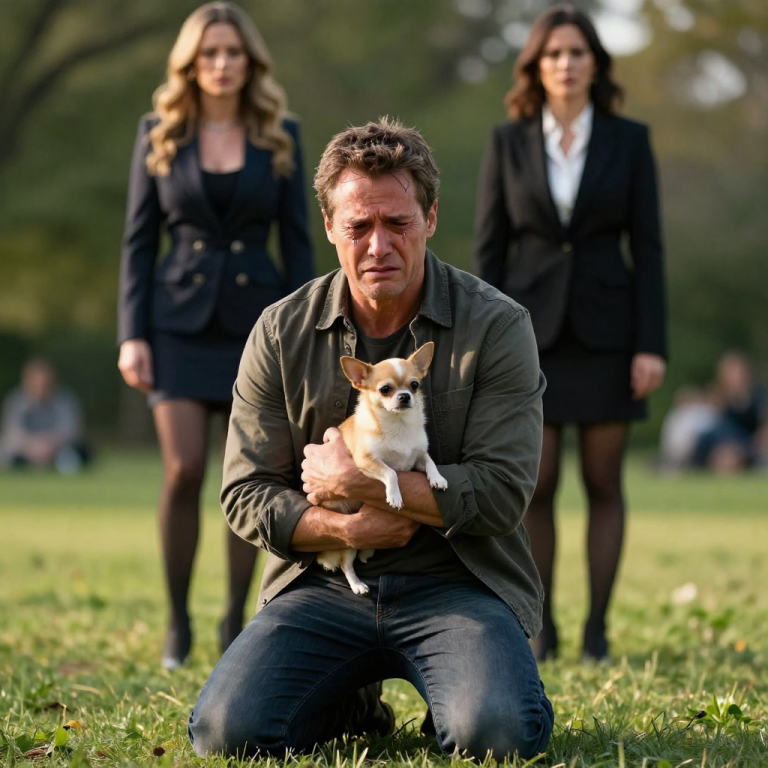
He didn’t just apologize. He collapsed. He fell to his knees right there on the concrete, indifferent to the ruin of his expensive suit pants, indifferent to the watching neighbors.
“Sergeant Major,” he choked out, tears instantly filling his eyes. “Oh my god. I didn’t know. I swear to God, Thomas, I didn’t know it was you.”
Brad stood frozen, his mouth agape, looking from his weeping father to the ‘bum’ he had just tormented. The silence that followed was louder than the glass breaking had ever been.
CHAPTER II
The silence hung thick and heavy, heavier than the humid Georgia air. Mr. Henderson remained on his knees, his face buried in his hands. Brad, for once, looked speechless, the sneer wiped clean from his face, replaced by something akin to… fear? Disbelief? I couldn’t tell. He kept glancing from his father to me, like he was watching some bizarre play unfold, a play he hadn’t been given a script for.
“Brad…” Mr. Henderson finally choked out, his voice muffled. He looked up, his eyes red and brimming with tears. “Brad, what have you done?”
Brad swallowed hard, his Adam’s apple bobbing nervously. “Dad, I… I don’t understand. You okay?”
Mr. Henderson pushed himself to his feet, though he swayed unsteadily. He reached out, grabbing Brad’s arm with surprising strength. His grip looked painful. “Do you know who this is? Do you even have a clue?”
Brad pulled away, a flicker of his old arrogance returning. “Some… some bum we’re evicting. What’s the big deal? He’s squatting on our property.”
Mr. Henderson’s face twisted in a way I hadn’t seen since… well, since the war. That look of controlled fury, of a barely suppressed rage, brought back memories I’d tried so hard to bury. “This ‘bum,’ as you so eloquently put it, is Sergeant Major Thomas. He was *my* Sergeant Major. He saved my life.”
The words seemed to deflate Brad. He stammered, “Saved your life? But… but you never said anything about…”
“There are a lot of things I haven’t said, Brad,” Mr. Henderson snapped, his voice gaining strength. “Things you wouldn’t understand. Now, you listen to me, and you listen good. You will apologize to Sergeant Major Thomas right now. And then, you will pick up every single item you threw out of his house. Every. Single. One.”
Brad looked like he might argue, but the look in his father’s eyes stopped him. He mumbled, “Apologize? But he was…”
“NOW, Brad!” Mr. Henderson roared, the sound echoing in the suddenly quiet street. The neighbors who had been watching with morbid curiosity seemed to shrink back into their homes, disappearing behind curtains and closed doors.
Brad shuffled his feet, looking anywhere but at me. “I… I’m sorry,” he muttered, the words barely audible. “Sorry I… threw your stuff.”
Mr. Henderson glared at him. “Pick it up, Brad. Every last piece.”
Reluctantly, Brad began to pick up the scattered belongings. He started with the clothes, gingerly lifting them from the mud. Then, he picked up a dented pot, one of my old army mess kits. Finally, he reached for the quilt, the one my grandmother had made. He hesitated, his fingers hovering over the mud-stained fabric.
“The quilt, Brad,” Mr. Henderson said, his voice softer now, but still firm. “Pick it up.”
Brad picked up the quilt, holding it like it was contaminated. He avoided looking at me, his face flushed with shame and anger.
As he worked, Mr. Henderson turned to me, his eyes filled with remorse. “Thomas… Sergeant Major… I am so sorry. I had no idea. If I had…”
“It’s alright, Henderson,” I said, my voice flat. It wasn’t alright, of course. But what else could I say? Seeing him like this, so broken and ashamed, it stirred something in me. Not pity, exactly. More like… disappointment. This wasn’t the man I remembered. The Henderson I knew in Vietnam, the scared kid I’d pulled through hell, was a different person than this wealthy, suburban father.
“No, it’s not alright,” he insisted, shaking his head. “You saved my life, Thomas. I owe you everything. Three miles. Three miles through that godforsaken jungle, carrying me on your back while Charlie was raining down fire. I wouldn’t be here today if it wasn’t for you.”
The words hung in the air, stark and brutal. Three miles. It had felt like thirty. Henderson had taken a bullet in the leg, a clean shot that shattered the bone. He’d screamed, of course, a high-pitched, terrified scream that I still heard sometimes in my dreams. I’d patched him up as best I could, then hoisted him onto my back and started walking. Three miles, with the jungle pressing in on all sides, the fear of ambush a constant companion. Three miles, with Henderson moaning and bleeding, his weight threatening to pull me down with every step. Three miles, fueled by adrenaline and a grim determination that I wouldn’t leave another man behind.
“You don’t owe me anything,” I said, the words sounding hollow even to my own ears. “We were in a war. We looked out for each other.”
“That’s not how I see it,” Henderson said, his voice thick with emotion. “I’ve tried to… to repay that debt in my own way. Supporting veteran’s charities, donating to the Wounded Warrior Project. But it’s not the same. It’s not enough.”
He looked at me, his eyes pleading. “What can I do, Thomas? Tell me. What can I do to make this right?”
I looked at Brad, who was now stacking my belongings in a somewhat neater pile. He still hadn’t met my gaze. I looked at the neighbors, their faces peeking out from behind their curtains, their curiosity warring with their embarrassment. I looked at the muddy ground, at the scattered remnants of my life.
“Just let me live here,” I said finally. “That’s all I ask. Just let me live out my days in peace.”
Henderson nodded, his face etched with relief. “Of course, Thomas. Of course. You can stay here as long as you want. Rent-free. Consider it… a small token of my gratitude.”
“I don’t want your charity,” I said, my voice hardening. “I just want to be left alone.”
“It’s not charity,” Henderson insisted. “It’s… it’s the least I can do.”
He turned to Brad, who had finished gathering my things. “Brad, take Sergeant Major Thomas’s belongings inside. Carefully. And then, I want you to clean this mess up. Every speck of dirt. Do you understand?”
Brad nodded, his face still flushed. He picked up the pile of belongings, struggling under the weight. As he passed me, he finally met my gaze. There was something in his eyes then, something I couldn’t quite decipher. Resentment, yes, but also… something else. Confusion? Maybe even a flicker of respect?
He carried the belongings inside, leaving me alone with Henderson.
“I’ll… I’ll leave you to it, Thomas,” Henderson said, his voice hesitant. “I need to… have a word with my son. I’ll make sure you’re not disturbed again.”
He walked towards the house, his shoulders slumped. As he reached the door, he turned back to me. “Thank you, Thomas,” he said softly. “For everything.”
Then, he disappeared inside, leaving me standing alone in the yard. The neighbors had retreated completely now, their curtains drawn tight. The only sound was the gentle breeze rustling through the trees.
I looked around at the muddy ground, at the house that was now, once again, my home. But it didn’t feel like home. It felt like a battleground. A battleground where the lines were blurred, where the enemy wasn’t always who you thought it was.
I walked over to the porch and sat down on the steps. I pulled out my cigarettes and lit one, the smoke curling up into the air. I took a long drag, the nicotine calming my nerves. But it didn’t ease the ache in my heart.
Seeing Henderson like that, so humbled and ashamed, it had stirred up a lot of old memories. Memories of the war, of the men I’d served with, of the things I’d seen and done. Memories I’d tried so hard to forget.
And it had stirred up something else too. A question that had been nagging at me for years. A question about what it all meant. What was the point of fighting, of sacrificing, of risking your life, if this was the result? If the men you saved ended up raising sons like Brad? If the world you were fighting for was still full of so much hate and injustice?
I didn’t have any answers, of course. I just had the smoke, and the memories, and the ache in my heart. And the feeling that things were about to get a whole lot more complicated.
I watched as Brad came out of the house, carrying a bucket and a scrub brush. He started scrubbing the mud from the porch, his movements stiff and resentful. He didn’t look at me. I watched him for a long time, wondering what he was thinking. Wondering if he understood what his father had done for him. Wondering if he would ever understand what I had done for his father.
As the sun began to set, casting long shadows across the yard, I knew one thing for sure. This wasn’t over. Not by a long shot. The events of the day had set something in motion, something that couldn’t be stopped. And I had a feeling that things were about to get a lot worse before they got better. If they ever got better at all.
The secret was out, the old wound reopened. Now, all that remained was the fallout. The moral dilemma of how to navigate a future where the lines between right and wrong were so thoroughly blurred.
Later that evening, after Brad had finished cleaning and retreated inside, I found a note tucked under my door. It was from Henderson. Just one sentence: “Come by tomorrow. We need to talk.”
I crumpled the note in my hand and tossed it into the fire pit. There was nothing to talk about. He had his life, and I had mine. Our paths had crossed again, briefly, but they would soon diverge once more. That was how it had to be.
But deep down, I knew that wasn’t true. Our paths were intertwined now, bound together by the past, by the war, by the events of the day. And no matter how hard I tried to pull away, I knew I would never truly be free.
I sat on the porch until the fire died down to embers, watching the smoke drift up into the night sky. The air was cool now, the humidity gone. The only sound was the crickets chirping in the distance.
I thought about Henderson, about Brad, about the war. I thought about the choices I had made, the sacrifices I had endured. And I wondered if it had all been worth it. If I had made a difference. Or if I had just wasted my life fighting for a lost cause.
The answer, I knew, was probably somewhere in between. Life wasn’t black and white. It was a messy, complicated shade of gray. And all you could do was try to make the best of it. Try to do what was right. Even when it was hard. Even when it hurt.
But as I looked up at the stars, I couldn’t shake the feeling that I was about to face a challenge unlike any I had ever faced before. A challenge that would test my courage, my loyalty, and my very soul. And I wasn’t sure if I was ready.
CHAPTER III
The knock came late, after midnight. Not a polite knock, but a heavy-handed bang that rattled the thin walls of the little house. I knew who it was before I opened the door. Brad.
He stood there, swaying slightly, a smirk plastered on his face. “Having a good night, old man?” he slurred. Beer reeked from his breath.
I didn’t answer, just stared him down. He wasn’t much of a threat, but there was a meanness in his eyes that made me uneasy.
“Just thought I’d, uh, check on things,” he said, pushing past me into the house. “Make sure you’re not, you know, trashing the place.”
I grabbed his arm. “Get out, Brad.”
He wrenched free. “Or what? You gonna hit me, old timer? I bet you can’t even lift your arms that high.”
I stayed silent. Fighting him would solve nothing.
He swaggered into the small living room, kicking over a stack of books. “Nice décor,” he sneered. “Real classy.”
That’s when I saw it – a small gas can, tucked behind the couch. My blood ran cold.
“What’s that, Brad?” I asked, my voice low.
He followed my gaze, his smirk widening. “Oh, that? Just a little insurance. Make sure you don’t get any ideas about staying here too long.”
“You wouldn’t,” I said, but I knew he would.
“Try me,” he said, and pulled out a lighter.
I lunged for him, but he was too quick. He flicked the lighter, and a small flame danced to life. He held it over the gas can, his eyes locked on mine.
“Get out!” I yelled. “Get out now!”
He laughed, a high-pitched, manic sound. “This is for kicking us off our land! This is for making my dad feel sorry for you!”
I didn’t hesitate. I tackled him, knocking the lighter from his hand. It clattered to the floor, the flame extinguished.
We wrestled on the floor, a tangle of limbs and rage. He was younger, stronger, but I had years of fighting experience on my side. I managed to pin him, my knee in his chest.
“Get off me!” he screamed.
“What the hell is going on here?”
Mr. Henderson stood in the doorway, his face a mask of fury. Behind him, I saw Brad’s mother, her hand over her mouth in shock.
Brad stopped struggling. He looked at his father, then back at me, a flicker of fear in his eyes.
“He attacked me, Dad!” he cried. “He went crazy!”
Henderson looked at the gas can, then at the overturned furniture. His face hardened.
“Thomas,” he said, his voice dangerously low. “What happened here?”
I looked him in the eye. “He was going to burn the house down, Henderson. With me inside.”
Brad started protesting, but Henderson cut him off with a wave of his hand.
“Shut up, Brad,” he said. “Just shut up.”
He turned back to me, his eyes filled with a mixture of anger and disbelief. “I don’t understand,” he said. “Why would you do this, Thomas? After everything I’ve done for you.”
“I didn’t do anything, Henderson. He did.”
“Enough!” Mrs. Henderson stepped forward, her voice trembling. “I believe him, George. I saw Brad with the gas can earlier today. He was acting strange.”
Henderson stared at his wife, then back at his son. The color drained from Brad’s face.
“Is this true, Brad?” Henderson asked, his voice barely a whisper.
Brad didn’t answer. He just looked down at the floor.
Henderson grabbed his son by the arm and dragged him outside. I could hear their muffled voices arguing in the yard.
Mrs. Henderson stayed behind, her eyes filled with pity. “I’m so sorry, Thomas,” she said. “I had no idea he was capable of this.”
“It’s not your fault,” I said, but my voice sounded hollow, even to my own ears.
She shook her head. “George has always protected him, made excuses for him. But this… this is too much. I don’t know what’s going to happen now.”
I didn’t either. All I knew was that things had just gone from bad to worse.
Henderson came back inside, his face grim. He didn’t look at me. “I’m taking Brad to a clinic,” he said. “He needs help.”
“What about the house?” I asked.
“I don’t know,” he said. “I just don’t know anymore.”
He walked out, leaving me alone in the wreckage of the night.
I sat down on the couch, my head in my hands. It wasn’t over. Not by a long shot. Brad may have been stopped for now, but the resentment, the anger, it was still there, simmering beneath the surface.
I knew he would be back. And next time, he wouldn’t make the same mistake.
Days turned into weeks. Henderson never mentioned the incident again. He acted as if nothing had happened, as if Brad hadn’t tried to burn me alive. But the silence was deafening, the tension in the air thick enough to cut with a knife.
I saw Brad a few times, always from a distance. He looked different, subdued. But there was still a flicker of hatred in his eyes whenever he saw me.
I started sleeping with a knife under my pillow. I knew it wouldn’t be enough if he really came after me, but it was better than nothing.
One afternoon, Henderson found me outside, splitting wood. He watched me for a while, his expression unreadable.
“Thomas,” he said finally, “I need to talk to you.”
I put down the axe and turned to face him. “About what?”
“About Brad,” he said. “About… everything.”
We went inside, and he sat down at the kitchen table. He looked tired, defeated.
“I don’t know what to do, Thomas,” he said. “I love my son, but I can’t condone what he did. I’ve tried to help him, but he just keeps getting worse.”
“He needs professional help, Henderson,” I said. “More than you can give him.”
“I know,” he said. “I’ve enrolled him in a program. It’s… intensive. He’ll be away for a while.”
“That’s good,” I said. “For everyone.”
He looked at me, his eyes filled with pain. “I feel like I’ve failed him, Thomas. As a father.”
“You did what you could,” I said. “Sometimes, that’s all you can do.”
He sighed. “There’s something else,” he said. “Something I need to tell you. About… the war.”
My stomach clenched. I knew this was coming. It had been hanging over us, a dark cloud waiting to burst.
“What about it?” I asked, my voice flat.
“About what really happened that night,” he said. “The night you saved me.”
I didn’t say anything. I just waited for him to continue.
“I wasn’t just shot, Thomas,” he said, his voice barely a whisper. “I… I panicked. I was going to run. Leave everyone behind.”
I stared at him, my mind reeling. I had always believed he was a hero, a good man. But now…
“You stopped me,” he said. “You threatened to shoot me yourself if I didn’t get my act together. You shamed me into doing the right thing.”
“I don’t remember that,” I said, but I did. Vaguely.
“It’s true,” he said. “I’ve carried that guilt with me for years. You saved my life, Thomas, but you also saved my soul. And I’ve never been able to repay you.”
“You don’t owe me anything,” I said. “We were at war. People do things they wouldn’t normally do.”
“But I do owe you,” he said. “And I’m going to make it right. I’m going to tell everyone the truth. About what really happened that night. About what kind of man you really are.”
I shook my head. “Don’t do that, Henderson. It won’t change anything. It’ll just make things worse.”
“No, it won’t,” he said. “It’s time the truth came out. It’s time people knew what you did for me. What you sacrificed.”
He stood up, his eyes filled with a new sense of purpose. “I’m going to the newspaper,” he said. “I’m going to tell them everything.”
I watched him go, my heart sinking. He was doing this for me, but I knew it would only bring more trouble. The truth was a dangerous thing, especially when it came to war. It had a way of twisting and distorting, of turning heroes into villains and villains into heroes.
And I knew, with a certainty that chilled me to the bone, that the truth about that night would destroy everything I had left.
I was right. The newspaper article came out the next day, splashed across the front page. “Local Hero Reveals Sergeant’s Bravery,” the headline screamed. The article detailed Henderson’s account of the night I saved him, painting me as a selfless hero who had risked his own life to save his comrade. But it also revealed his own moment of weakness, his near desertion, his shame.
The reaction was immediate. People stopped me on the street, shaking my hand, thanking me for my service. The local VFW post offered me a lifetime membership. The mayor even called, wanting to present me with a key to the city.
I hated it. All of it. I didn’t want their praise, their gratitude. I just wanted to be left alone.
But it was too late. The story had taken on a life of its own, and I was powerless to stop it. And then came the letters.
At first, they were supportive, congratulatory. But then, they started to change. Questions began to surface. Doubts were raised. And then, the accusations started.
“Is it true that you threatened to shoot Henderson?” one letter asked.
“Did you really force him to stay and fight?” another demanded.
“What really happened that night?” a third inquired.
I ignored them at first, but they kept coming, day after day, each one more accusatory than the last. And then, one day, I received a letter that made my blood run cold.
It was anonymous, typed on plain white paper. It read: “We know what you did, Sergeant Thomas. We know the truth about what happened that night. And we’re going to make you pay.”
I didn’t know who sent it, or what they meant by “the truth.” But I knew, with a certainty that gripped me with fear, that the past had finally caught up with me. And that the reckoning was about to begin.
I tried to talk to Henderson, but he wouldn’t listen. He was convinced that he had done the right thing, that he had finally set the record straight. He couldn’t see the danger, the storm that was brewing on the horizon.
“They’re just jealous, Thomas,” he said. “They’re just trying to tear you down because they can’t stand to see you succeed.”
“It’s not about jealousy, Henderson,” I said. “It’s about the truth. And the truth is a dangerous thing.”
But he wouldn’t listen. He was blinded by his own guilt, his own desire to make amends. And I knew, with a growing sense of dread, that I was on my own.
The first attack came a week later. I was walking home from the grocery store when a car screeched to a halt beside me. Two men jumped out, their faces hidden behind masks.
“You’re Sergeant Thomas, right?” one of them asked, his voice muffled.
I didn’t answer. I just braced myself for what was coming.
They didn’t say anything else. They just started punching and kicking me, knocking me to the ground. I tried to fight back, but they were too strong, too fast.
They beat me until I was barely conscious, then they jumped back in their car and sped away.
I lay there on the sidewalk, bleeding and bruised, my body aching all over. I didn’t know who they were, or why they had attacked me. But I knew it was just the beginning. The men were linked to the war and knew about the accident in which I had deserted my post. They knew the truth and would seek revenge.
I managed to drag myself home, where I collapsed on the couch. I didn’t call the police. I knew they wouldn’t be able to do anything. And besides, I didn’t want to involve Henderson. He had enough on his plate already.
I spent the next few days holed up in my house, nursing my wounds. I didn’t go outside, didn’t answer the phone. I just waited, knowing that they would be back.
And I was right. They came back a few nights later, while I was sleeping. I woke up to the sound of breaking glass. They had broken into my house.
I grabbed the knife from under my pillow and crept into the living room. The two men were there, ransacking the place.
“Looking for something?” I asked, my voice trembling.
They turned to face me, their eyes filled with hatred.
“We’re looking for justice, Sergeant Thomas,” one of them said. “We’re here to make you pay for what you did.”
“I don’t know what you’re talking about,” I said, but I did. I knew exactly what they were talking about.
“We know about the accident,” the other man said. “We know you left your men to die. We know the truth.”
I lunged at them, swinging the knife. They dodged out of the way, and one of them grabbed a lamp and smashed it over my head.
I fell to the ground, unconscious. When I woke up, the men were gone. My house was a mess, everything broken and destroyed. But they hadn’t taken anything. They weren’t there to steal. They were there to send a message.
The message was clear: they knew my secret, and they were going to destroy me for it.
I knew I had to leave. I couldn’t stay here any longer. They would keep coming after me, until they had finally finished the job.
I packed a bag, grabbed what little money I had, and slipped out of the house in the dead of night. I didn’t know where I was going, or what I was going to do. But I knew I had to get away. I had to disappear. Before they found me again.
As I walked away from the house, I looked back one last time. It was dark and silent, a ghost of what it once was. I knew I would never see it again.
And as I walked into the darkness, I knew that my life would never be the same.
I didn’t go far. I couldn’t. My age, the attack… it all caught up to me. I found a cheap motel on the edge of town. The kind of place where they don’t ask questions, as long as the money is green. I paid for a week, cash. Enough time to figure things out.
But figuring things out was hard. Every time I closed my eyes, I saw their faces. The masked men, Henderson’s disappointed stare, the faces of the men I left behind.
The guilt was a living thing, gnawing at me from the inside. I tried to distract myself, watching TV, reading old paperbacks. But nothing worked. The silence was the worst. It amplified everything.
Then, one evening, there was a knock at the door. My heart leaped into my throat. Had they found me already?
I peeked through the peephole. It wasn’t them. It was Mrs. Henderson.
I hesitated, then opened the door. Her face was etched with worry.
“Thomas,” she said, her voice barely a whisper. “I had to see you.”
“What are you doing here?” I asked.
“George is gone,” she said. “He left. Took off in the middle of the night.”
“What?” I said, my mind reeling.
“He left a note,” she said. “Said he couldn’t live with the guilt anymore. Said he was going to… confess everything.”
“Confess to what?” I asked, even though I knew the answer.
“To what happened that night,” she said. “To his cowardice. To how you saved him. To everything.”
I closed my eyes, my head spinning. This was it. The final act. The complete and utter destruction of everything I had ever held dear.
“Where did he go?” I asked.
“I don’t know,” she said. “He didn’t say. Just that he had to do it. Had to tell the world the truth.”
I opened my eyes, a new sense of purpose flooding through me. I had to stop him. I had to protect him. Even if it meant sacrificing myself.
“I have to go,” I said.
“Where?” she asked.
“To find him,” I said. “Before it’s too late.”
I walked out of the motel room, leaving Mrs. Henderson standing there, alone and afraid. I didn’t know where Henderson had gone, but I knew I had to find him. The truth was out there, waiting to explode. And I was the only one who could stop it.
I left the motel and flagged down a taxi. “Take me to the bus station,” I said. “And step on it.”
The driver looked at me in the rearview mirror, his eyebrows raised. “Something important, sir?”
“The most important thing in the world,” I said. “My past.”
The driver nodded and put his foot on the gas. And as we sped towards the bus station, I knew that my life was about to change forever. The bus station was a hive of activity, people rushing to and fro, their faces etched with anxiety and anticipation. I scanned the crowd, searching for Henderson. But he wasn’t there.
I went to the ticket counter and asked if anyone matching Henderson’s description had purchased a ticket recently. The clerk shook his head. “Sorry, sir. I haven’t seen anyone like that.”
I felt a surge of panic. Where could he be? Where would he go?
Then, I remembered something. Henderson had always talked about going back to the old battlefield. It was a pilgrimage he had put off for years. He said he wanted to pay his respects to the men who had died there, to finally come to terms with what had happened.
Could that be where he was going? Could he be planning to confess his sins on the very ground where they had been committed?
It was a long shot, but it was the only lead I had. I went back to the ticket counter and asked for a ticket to the nearest town to the old battlefield.
“One way or round trip, sir?” the clerk asked.
“One way,” I said. “I don’t think I’ll be coming back.”
The clerk raised his eyebrows again, but he didn’t say anything. He just printed the ticket and handed it to me.
I took the ticket and walked towards the gate, my heart pounding in my chest. I didn’t know what I would find when I got there. But I knew I had to try. I had to stop Henderson, even if it meant facing the truth myself. The bus was old and rickety, its seats worn and torn. The air inside was thick with the smell of diesel and stale cigarettes. I found a seat near the back and sat down, staring out the window as the bus pulled out of the station.
The landscape outside was bleak and desolate, a fitting backdrop for the journey I was about to undertake. The sky was gray and overcast, threatening rain.
I closed my eyes and leaned back in my seat, trying to relax. But it was no use. My mind was racing, filled with memories of the past.
The accident, the desertion, the faces of the men I had left behind. They were all there, haunting me, tormenting me.
I opened my eyes and looked out the window again. The bus was still moving, carrying me further and further away from everything I knew. I didn’t know what the future held. But I knew that it was going to be a long and difficult journey. I was tired and weary, but also know I had to find a way to find Henderson, to reconcile with my past and to tell everyone, including the men, the truth. The whole truth.
CHAPTER IV
The article hit the town like a damn bomb. Henderson’s name, plastered across the front page of the local paper, alongside mine and the ugly details of what happened that night in Kandahar. It wasn’t just the cowardice, the hiding – it was the lie he’d carried for all these years, the medal he didn’t deserve. Suddenly, everyone had an opinion, a judgment. Whispers followed me in the street, not of respect, but of accusation. Some saw me as a hero exposing a fraud. Others saw me as a vengeful old man, tearing down a respected pillar of the community.
I holed up in that cheap motel room, the TV news looping the same story. Henderson had vanished. His wife, bless her heart, gave a tearful statement, saying he’d left a note, something about needing to atone. A chill ran through me. Atonement? Knowing Henderson, that could mean anything. And Brad… I hadn’t seen or heard from him since the fire, but I knew, deep down, that boy wasn’t done.
The first call came from Sarah. My daughter. We hadn’t spoken much since I came back, the war always a wall between us. But her voice was different now, softer, laced with concern. She’d read the article, of course. “Dad,” she said, “what really happened over there?” I told her. The whole ugly truth, stripped bare. She listened without interrupting, and when I was finished, there was just silence. A long, heavy silence that spoke volumes.
“I… I need time to process this, Dad,” she finally said. And just like that, the line went dead. Another casualty. The newspaper hadn’t just exposed Henderson’s lie; it had exposed mine too. The lie I told myself, that I could come home and everything would be alright. That I could protect the people I loved from the fallout of the war.
Then the calls started coming from the veterans, my brothers. Some were supportive, understanding. Others were angry, accusing me of breaking the code, of airing dirty laundry. “Henderson was one of us, Thomas,” one of them spat. “You don’t do this to your own.” I hung up on him. Didn’t have the strength to argue. They didn’t get it. None of them did.
The motel room felt smaller each day. The walls closing in. I couldn’t sleep, couldn’t eat. The faces of the men we lost in Kandahar haunted my dreams. Henderson’s face, twisted with fear, was always there too. I had to find him. Before he did something stupid. Before Brad did something even worse.
I found him at the old battlefield, the place where it all went down. He was kneeling by a makeshift memorial, the names of the fallen etched into a wooden cross. He looked broken, defeated. The Henderson I knew, the one who walked with his head held high, was gone. Replaced by a shell of a man.
“I had to come back here, Thomas,” he said, his voice barely a whisper. “To face them. To face what I did.”
“Don’t,” I said, my voice cracking. “Don’t do this. It won’t bring them back. It won’t change anything.”
He stood up, his eyes filled with a pain I knew all too well. “I have to, Thomas. I can’t live with this anymore.” He started walking towards the memorial, his hand reaching for the cross. I grabbed his arm, pulling him back. And then, the words just poured out of me, a torrent of anger and regret.
“Why, Henderson? Why did you lie? Why did you let me carry that burden all these years?”
He flinched, his face contorting with guilt. “I was scared, Thomas. I was so damn scared. I didn’t want to die.”
“And what about me? What about the others? We weren’t scared?” I pushed him harder, my grip tightening on his arm. “We did what we had to do. We lived with it. But you… you hid. You lied. You stole their honor.”
He started to cry, tears streaming down his face. “I know, Thomas. I know. And I’m sorry. God, I’m so sorry.”
I wanted to hit him. I wanted to scream. I wanted to make him feel the pain I had been carrying for all these years. But I couldn’t. Looking at him, I saw not a hero, not a coward, but just a broken man. Another victim of that damn war.
“It’s over, Henderson,” I said, my voice barely above a whisper. “Just go home. Be with your family. Try to make amends.”
He shook his head. “I can’t. They’ll never forgive me.”
“Maybe not,” I said. “But you have to try. For them. For yourself.” I let go of his arm, and he just stood there, staring at the memorial, lost in his own private hell.
That’s when I saw Brad. He came over the hill in his truck. He drove straight to us, stopping just feet away. He jumps out. His face was contorted with rage, his eyes fixed on me. He had a gun in his hand. An old rifle I had seen in his house.
“You,” he screamed, pointing the gun at me. “You ruined everything! You destroyed my family!”
I stood my ground, my heart pounding in my chest. “Brad, put the gun down. This isn’t the way.”
“Shut up!” he yelled, his voice cracking. “You’re the reason my father left! You’re the reason everyone hates us!”
Henderson stepped forward, trying to shield me. “Brad, no! Don’t do this!”
Brad ignored him, his eyes still locked on me. “I should have killed you in that house. I should have finished the job.”
“Brad, listen to me,” I said, trying to keep my voice calm. “Your father made his own choices. I didn’t force him to do anything.”
“Liar!” he screamed. “You exposed him! You made him a laughingstock!”
He raised the gun, his finger tightening on the trigger. I closed my eyes, bracing for the impact. But it never came. Instead, there was a loud bang, followed by a sickening thud.
I opened my eyes. Henderson was lying on the ground, a pool of blood spreading around him. Brad stood there, the gun still in his hand, his face a mask of horror.
“Dad!” he screamed, dropping the gun and rushing to his father’s side. “Dad, no! What have I done?”
I knelt beside Henderson, checking for a pulse. Nothing. He was gone. He took the bullet. He was a coward once but died a hero’s death.
Brad was sobbing uncontrollably, cradling his father’s head in his lap. “I didn’t mean to,” he choked out. “I didn’t mean to kill him.”
The sirens wailed in the distance, growing louder. The police would be here soon. Brad was going to jail. His life was over. All because of a war that happened half a world away.
I stood up, my body numb. Another life lost. Another family destroyed. And for what? For honor? For truth? All I knew was that the war never really ends. It just keeps taking and taking, long after the last shot has been fired.
I walked away, leaving Brad to his grief. I didn’t know where I was going. I didn’t care. All I wanted was to be alone. To find some peace, some solace, in a world that seemed to have none to offer.
The trial was a circus. The media, the public, everyone had an opinion. Brad pleaded guilty to manslaughter. His lawyer argued that he was suffering from severe emotional distress, brought on by his father’s public shaming and the revelation of his wartime cowardice. The judge, a stern-faced woman with no patience for excuses, sentenced him to fifteen years. Fifteen years for a moment of rage, a lifetime of regret.
I didn’t attend the trial. Couldn’t bring myself to face Brad, to see the pain in his eyes. I knew he was a broken kid, twisted by anger and resentment. But I couldn’t forgive him. Not for what he did. Not for taking Henderson’s life. I just couldn’t.
The town never really recovered. The Henderson name, once synonymous with respect and integrity, was now a stain on the community. The church where he had been a deacon for so many years remained empty. His wife sold their house and moved away, seeking a fresh start, a place where she wouldn’t be reminded of her husband’s shame every day.
I tried to go back to my old life, to find some semblance of normalcy. But it was impossible. The whispers followed me, the accusations lingered. Some people still saw me as a hero, but most just saw me as a troublemaker, a pariah. I lost my friends, my community. I was alone, more alone than I had ever been before.
Sarah called again, a few months after the trial. Her voice was different this time, warmer, more understanding. She had done some research, she said. Read about the war, about PTSD, about the things soldiers go through. She finally understood what I had been trying to tell her all these years.
“Dad,” she said, “I’m sorry. I’m sorry for not being there for you. I’m sorry for judging you.”
I didn’t say anything. Just listened. Her words were like a balm on a wound that had been festering for decades.
“I want you to come home, Dad,” she said. “Come live with me and the kids. Let us take care of you.”
I hesitated. Could I really go back? Could I really face my family after all that had happened? After all the pain I had caused?
“I don’t know, Sarah,” I said. “I don’t know if I can.”
“Just try, Dad,” she said. “Please. For me.”
I took a deep breath. “Okay,” I said. “Okay, I’ll try.”
So I went back. Back to my daughter, back to my grandchildren, back to a life I thought I had lost forever. It wasn’t easy. The war was still there, lurking in the shadows, a constant reminder of the past. But with Sarah’s help, with the love of my family, I started to heal. To find some peace, some meaning, in the aftermath of the storm.
But I never forgot Henderson. Or Brad. Or the men we lost in Kandahar. Their faces are etched in my memory, a permanent reminder of the cost of war. A cost that is far too high. A cost that we can never truly afford.
CHAPTER V
The spare room at Sarah’s wasn’t much, just a bed, a dresser, and a window looking out on a small, overgrown garden. But it was safe. Safe from the stares, the whispers, the memories that clung to the old house like cobwebs. I tried to settle in, unpacking the few belongings I’d salvaged. Mostly clothes, some photographs. Ghosts in cardboard boxes.
The first few weeks were a blur of forced smiles and awkward silences. Sarah tried, God bless her, but the air was thick with unspoken things. Brad’s name hung between us like a lead weight. The trial was set for late spring. Murder one, they said. Henderson’s sacrifice… it hadn’t changed anything, really. Just shifted the guilt around.
The grandkids, Emily and young Tom, were my only solace. They didn’t know the full story, just that Grandpa had been through a lot. They’d crawl into my lap, wanting stories of the war. I’d tell them sanitized versions, tales of bravery and camaraderie, leaving out the fear, the blood, the moral compromises. They deserved the clean version, at least for now.
Sarah worked long hours at the hospital. She was a nurse, always patching up other people’s messes. I tried to help around the house, but my hands were clumsy, my mind elsewhere. I’d start a load of laundry and forget about it, or burn dinner trying to recreate a meal from my youth. Small failures that felt monumental.
Sleep was a battlefield. The nightmares came nightly, Henderson’s face twisting in agony, Brad’s eyes burning with hate. Sometimes, I’d wake up screaming, Sarah rushing in to comfort me. I hated being a burden, a broken man in her house. But where else could I go?
One afternoon, Emily found my old army trunk in the garage. She dragged it into the living room, eager to explore its contents. Sarah tried to dissuade her, but I waved her off. “It’s okay,” I said, my voice raspy. “They should know.”
Inside the trunk were my uniform, medals, letters from my wife, and a few souvenirs from the war. Emily and Tom were fascinated, handling each item with reverence. Then Emily pulled out the photograph – the one of Henderson and me, young and hopeful, before everything went wrong. “Who’s this, Grandpa?” she asked.
I hesitated, the weight of the past pressing down on me. “That’s Mr. Henderson,” I said finally. “He… he was a good man.”
“Brad’s dad?” Tom asked, his brow furrowed.
I nodded, unable to say more. The silence stretched, thick and uncomfortable. Sarah ushered the kids out of the room, giving me a look of concern. I knew what she was thinking: Was I ready to face this? Was *she* ready for me to open that Pandora’s Box in front of her children?
That night, I couldn’t sleep. I lay in bed, staring at the ceiling, the photograph burned into my mind. Henderson. Brad. The war. It was all connected, a chain of cause and effect that had led to this moment. And I was the link that held it all together.
* * *
Spring arrived, painting the garden outside my window in vibrant colors. But inside, the darkness persisted. The trial was looming, and I knew I had to testify. I had to tell the truth, the whole truth, even if it meant exposing my own failings. Even if it meant condemning Brad to a life behind bars.
Sarah found me sitting on the porch one morning, staring blankly at the blooming flowers. “You okay, Dad?” she asked, her voice gentle.
“I don’t know,” I admitted. “I don’t know if I can do this. Go up there and speak about what happened.”
She sat down beside me, taking my hand. “You have to,” she said. “For Henderson. For Brad. For yourself.”
I looked at her, her face etched with worry. “What if I make it worse? What if I… break him completely?”
“He’s already broken, Dad,” she said softly. “The only way to fix him is to face the truth.”
The day of the trial was a media circus. The courthouse steps were thronged with reporters and protesters, their signs blaring accusations and demands for justice. I felt sick to my stomach, overwhelmed by the noise and the hatred.
Inside the courtroom, the atmosphere was tense. Brad sat at the defense table, his face pale and drawn. He avoided my gaze, staring straight ahead. I took the stand, my hands trembling. The prosecutor began his questioning, guiding me through the events leading up to Henderson’s death.
I told the truth, as best as I could remember it. I spoke of the war, of Henderson’s cowardice, of my own mistakes. I spoke of Brad’s anger, his resentment, his desperate need for answers. And I spoke of Henderson’s final act of sacrifice, his attempt to atone for his sins.
The defense attorney cross-examined me, trying to poke holes in my story, to paint me as a villain. But I stood my ground, refusing to be intimidated. I had nothing to hide anymore. The truth was out there, for everyone to see.
Then, something unexpected happened. Brad’s attorney asked if he could pose a question directly to me. The judge agreed, and Brad turned to face me, his eyes filled with a mixture of anger and despair.
“Why?” he asked, his voice barely a whisper. “Why did you let him die? Why didn’t you save him?”
The question hung in the air, heavy with accusation. I looked at Brad, seeing the pain in his eyes, the raw grief that consumed him. And in that moment, I understood. He wasn’t just angry at me. He was angry at the world, at the unfairness of it all. He was angry at his father for leaving him, for burdening him with the weight of his guilt.
“I tried,” I said, my voice cracking with emotion. “I tried to save him, but it was too late. He… he wouldn’t let me.”
Brad stared at me for a long moment, then looked away, his shoulders slumping. I knew then that I had reached him, that he had finally heard me. Whether it changed anything, I couldn’t say. But at least I had spoken my truth.
* * *
The verdict came a week later. Guilty. Manslaughter, not murder one. The jury had seen the mitigating circumstances, the years of trauma and resentment that had driven Brad to his breaking point. He was sentenced to fifteen years.
Sarah and I visited him in prison a few days later. The visiting room was cold and sterile, the air thick with the scent of disinfectant. Brad sat behind a thick glass partition, his face pale and weary. He looked older than his years.
I picked up the phone, my hand trembling. “Brad,” I said, my voice raspy. “I… I’m sorry.”
He looked at me, his eyes filled with a strange mixture of defiance and resignation. “Sorry for what?” he asked.
“For everything,” I said. “For what happened to your father. For what happened to you. For the war that started it all.”
He was silent for a moment, then he said, “It’s not your fault, Thomas. It’s no one’s fault, really. Just… the way things are.”
I stared at him, surprised by his words. It was the closest thing to forgiveness I could have expected. Maybe he was on his own path to peace.
“I’m going to be okay,” he continued, a faint glimmer of hope in his eyes. “I’ll get through this. And when I get out, I’m going to try to make something of my life. Something my dad would be proud of.”
I nodded, unable to speak. I knew it wouldn’t be easy, but maybe, just maybe, he could find redemption. Maybe we all could.
* * *
Life settled into a new rhythm after that. The nightmares faded, replaced by a quiet sense of acceptance. I spent my days gardening, playing with the grandkids, and reading. Sarah found a veterans group for me. We would meet and talk, and there was something cathartic about being with others who shared my experiences.
One evening, as I was tucking Emily into bed, she asked me a question that stopped me in my tracks. “Grandpa,” she said, “do you think Mr. Henderson is in heaven?”
I looked at her, her innocent eyes searching for answers. And I realized that I couldn’t lie to her, not anymore. “I don’t know, sweetheart,” I said. “But I hope he is. I hope he’s finally at peace.”
She smiled, satisfied with my answer. “I think he is,” she said. “I think he’s watching over us.”
I kissed her goodnight, my heart aching with a mixture of sadness and hope. Maybe she was right. Maybe Henderson was watching over us, guiding us towards a better future. Maybe, just maybe, his sacrifice hadn’t been in vain.
I sat on the porch long after everyone else had gone to bed, watching the stars twinkle in the night sky. The war was over, the battles fought, the wounds inflicted. But the scars remained, a permanent reminder of the past.
I thought about Henderson, about Brad, about Sarah, about my grandkids. And I realized that the only way to heal was to forgive. Not just them, but myself.
It wasn’t easy. Forgiveness was a long and arduous process, a daily struggle against the demons of my past. But I was determined to try. For their sake, for my sake, for the sake of a future free from the burden of hate.
The sun began to rise, painting the sky in hues of orange and pink. I took a deep breath, filling my lungs with the fresh morning air. It was a new day, a new beginning. And I was ready to face it, with all its challenges and uncertainties.
The garden needed weeding, and young Tom was waiting for me to teach him how to skip stones.
There was life to live, and love to give, and I wasn’t going to waste another moment dwelling on the ghosts of yesterday.
END.