THEY FORCED ME TO STAND IN THE SCORCHING HEAT WITHOUT WATER, MOCKING MY SAGGING CLOTHES AND SHAKING HANDS WHILE THEY SAT IN THE SHADE. THEY DIDN’T KNOW I WAS THE ONE WHO SIGNED THEIR FATHER’S PAYCHECKS, OR THAT THE BLACK CAR SPEEDING TOWARD US WASN’T COMING TO ARREST ME—IT WAS COMING TO BEG FOR MY FORGIVENESS.
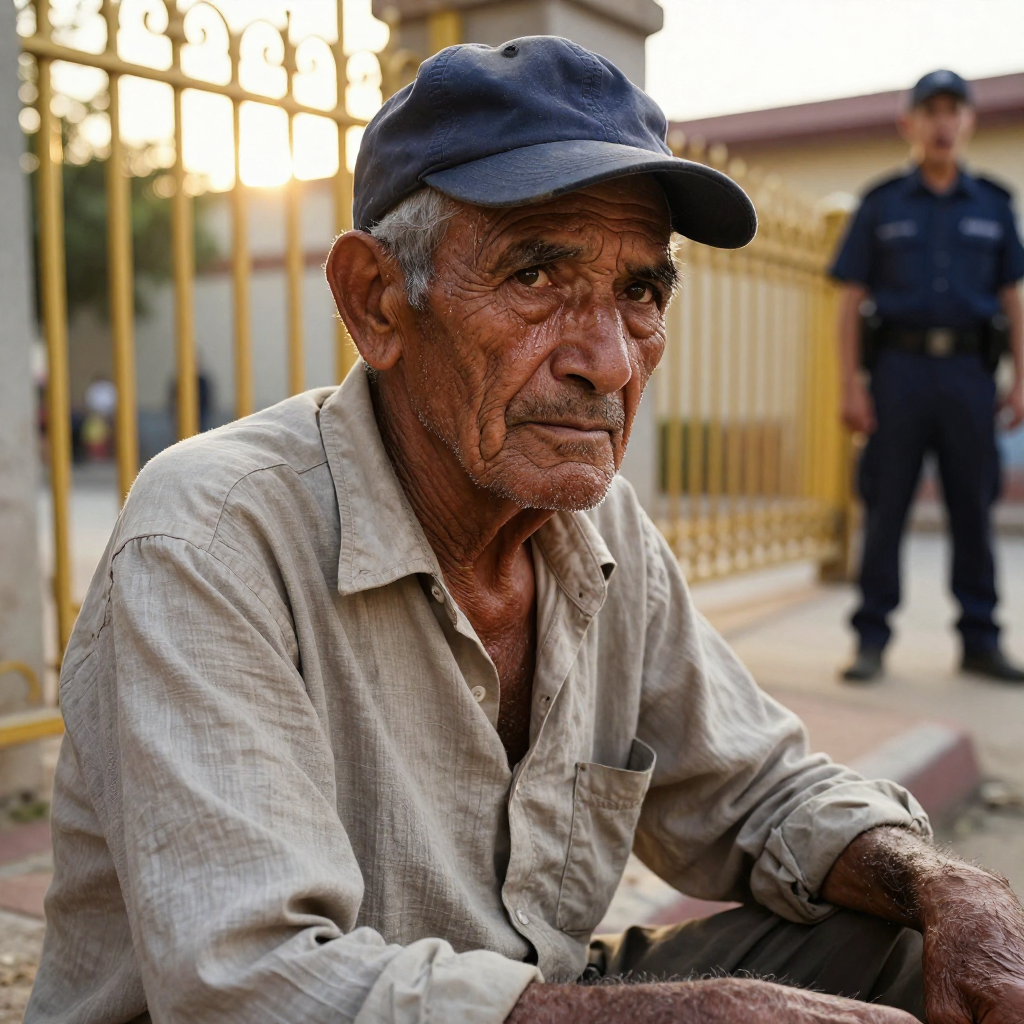
The heat was the first thing to betray me. It wasn’t the kind of heat I remembered from the jungle, wet and heavy enough to drown you while you stood upright. This was a dry, suburban American heat, radiant and angry, bouncing off the pristine asphalt of the country club driveway. It cooked the air until the horizon shimmered like oil. I adjusted my hat—a faded navy blue baseball cap with a simple gold emblem that had long since lost its threading—and leaned heavily on my cane. My left leg was throbbing, the old metal plate warming up under the sun, reminding me of a day forty years ago when I couldn’t walk away from a fight.
“I told you, pops, the delivery entrance is around the back,” the boy said. He couldn’t have been more than twenty-two. He had that specific look of someone who had never been told ‘no’ in his life—perfect teeth, a polo shirt tucked in with military precision but none of the discipline, and sunglasses that probably cost more than my first car. He was sitting in the guard booth, the air conditioning humming a low, sweet song behind the glass.
“I’m not a delivery driver,” I said, my voice raspier than I wanted it to be. Dehydration does that. It steals your dignity before it steals your consciousness. “I have a meeting. With David. David Sterling.”
The boy laughed. It was a sharp, barking sound that made his friend, another young man leaning against the gate, look up from his phone. “David Sterling? You’re meeting the CEO of Sterling Equities? You?”
He looked me up and down. I knew what he saw. He saw the wrinkled linen shirt that I hadn’t ironed because my hands were shaking too much this morning. He saw the dust on my shoes from the walk up the hill when my old truck overheated. He saw an old man, frail and confused, wandering where he didn’t belong. He didn’t see the man who had built the Sterling empire from a garage in 1982. He didn’t see the Chairman of the Board.
“Just call him,” I said, steadying myself against the hot metal of the gate. “Tell him Arthur is here.”
“Look, buddy,” the second boy said, stepping forward. He had a bottle of sparkling water in his hand. Condensation dripped down the side, tracing a cold, clear path that made my throat constrict. “Mr. Sterling is hosting the Regional Investors Summit today. He doesn’t have time for… whatever this is. If you don’t clear the driveway, we’re going to have to call security. Real security.”
“I’ll wait,” I said. I moved to sit on the low curb of the flowerbed, just outside the shade of the gatehouse awning.
“You can’t sit there,” the first boy snapped. “That’s for guests. You’re scaring the clientele. Move across the street.”
Across the street was nothing but a scorched strip of gravel and weeds, fully exposed to the one o’clock sun. But I didn’t have the energy to argue. I limped across the asphalt, the heat radiating through the soles of my shoes. I sat on a large, jagged rock, clutching my cane. My mouth felt like it was filled with cotton. I watched them high-five each other. I watched them crack open another cold drink. They didn’t offer me a drop.
Time became a slippery thing. I must have been there for an hour, maybe two. The sun beat down on my neck, relentless and cruel. I closed my eyes and tried to meditate, a trick I learned a lifetime ago to conserve oxygen, to lower the heart rate. But the thirst was a sharp, panic-inducing animal in my chest.
“Hey! Grandpa!” one of them shouted. I opened my eyes. The first boy was holding a hose, watering the perfectly manicured hydrangeas by the gate. He looked at me, smirked, and sprayed a jet of water into the air, letting the mist evaporate just inches from my face. “Thirsty? Open wide!”
They howled with laughter. I didn’t move. I didn’t flinch. I just watched them. I watched them with the patience of a man who knows that winter always follows autumn. They thought they were kings of this little patch of concrete. They thought power was a gate key and a clipboard.
My vision was starting to blur at the edges when the black SUV appeared. It was moving fast, too fast for the winding club road. The tires screeched slightly as it took the final turn toward the gate. The boys straightened up immediately. They knew that car. Everyone who worked for the company knew that car.
It was David’s personal Escalade.
The first boy, the ringleader, smoothed his hair and stepped out of the booth, putting on his best customer-service smile. He held his hand up to wave the car through, expecting a nod, a localized blessing from the boss.
But the car didn’t drive through. It slammed to a halt right in front of the gate, blocking the entrance. The door flew open before the vehicle had even fully settled on its suspension.
David Sterling stepped out. He was fifty years old now, wearing a suit that cost five thousand dollars, but he looked like a terrified child. His face was pale, his eyes wide and frantic. He scanned the entrance, ignoring the guards entirely, until his eyes landed on the heap of gravel across the road.
He saw me.
I tried to stand, but my legs wouldn’t cooperate. I just sat there, clutching my cane, as David ran toward me. He didn’t walk—he ran, sprinting across the hot asphalt in his Italian leather shoes.
“Mr. Chairman!” he screamed. It wasn’t a greeting; it was a cry of distress.
The boys by the gate froze. Their smiles dropped. The color drained from their faces so fast it looked like a magic trick. They watched as the man they feared most in the world, the man who signed their paychecks, the man they tried to emulate, threw himself onto his knees in the dirt beside me.
“Arthur,” David gasped, his hands hovering over me, afraid to touch, afraid he was too late. “My God, Arthur. I didn’t know. Reception just told me—they said you’ve been out here for two hours? In this heat?”
“I’m alright, David,” I whispered, though my voice cracked. “Just… a little dry.”
David turned his head toward the gate. I had known David since he was an intern. I had mentored him, promoted him, protected him. I had never seen him look like this. His face contorted into a mask of pure, unadulterated fury. The vein in his neck bulged.
“WATER!” he roared at the boys. It was a sound that shook the leaves on the trees. “GET HIM WATER! NOW!”
The boys scrambled, tripping over each other, dropping their clipboards, fumbling for bottles. The arrogance was gone, replaced by the primal terror of prey realizing they have been toying with a predator.
David looked back at me, tears welling in his eyes. He took off his suit jacket and tried to create shade over my head. “I am so sorry, Arthur. I am so, so sorry. I swear to you, I didn’t know. I’ll kill them. I’ll fire them all. Just… please be okay.”
One of the boys came running with a bottle of water, his hands shaking so violently he could barely unscrew the cap. He fell to his knees beside David, extending the bottle toward me, his head bowed low, unable to meet my eyes.
“I’m sorry,” the boy stammered, his voice trembling. “Sir, I—I didn’t know. I didn’t know who you were.”
I took the bottle with a shaky hand. The cool plastic felt like salvation. I took a small sip, letting the liquid coat my parched tongue. Then I lowered the bottle and looked at the boy. I didn’t shout. I didn’t scream. I just looked at him with the cold, hard stare of a man who has seen empires rise and fall.
“Son,” I said quietly, “you don’t treat a man with dignity because of who he is. You do it because of who *you* are. And right now? You are nothing.”
David grabbed the boy by the collar of his pristine polo shirt and shoved him backward into the dirt. “Get out of my sight,” David hissed. “Before I lose what little control I have left.”
As the boy scrambled away in the dust, I looked at David. “Help me up, David. We have a meeting.”
CHAPTER II
David’s hand trembled slightly as he helped me to my feet. The heat still radiated off the pavement, a shimmering haze distorting the manicured lawn. “Arthur, I… I can’t apologize enough. This is unacceptable.”
I took another long pull from the water bottle, the cool liquid a temporary balm against the simmering anger. “Save it, David. Apologies are for accidents. This was a choice.”
He flinched, his perfectly tailored suit suddenly looking a little too tight. “Of course. You’re right. What do you want me to do?”
“Let’s start with that meeting, shall we?” I gestured towards the gleaming glass doors of Sterling Equities headquarters. “I believe some people are waiting.”
He nodded, relief flickering across his face. “Right. Right. Let’s go.” He steered me towards the entrance, his hand a little too firm on my elbow. I didn’t miss the way he subtly tried to brush some dust off my worn jacket. The contrast between us must have been striking: him, the picture of corporate success, and me, looking like I’d just crawled out from under a rock.
Inside, the air conditioning was a shock to the system. The hushed reverence of the lobby felt almost comical after the indignity I’d just endured. David hurried me towards the elevators, his apologies continuing in a low, urgent murmur. I cut him off.
“David. Enough. We have a meeting to run. Focus.”
He straightened, the CEO mask snapping back into place. “Of course, Arthur. As you wish.”
The boardroom was everything I’d come to expect: mahogany, leather, and a panoramic view of the city. A dozen faces turned as we entered, a mixture of curiosity and thinly veiled impatience etched on their features. These were the people who held Sterling Equities in their hands, the investors who trusted us with their fortunes. They were accustomed to crisp presentations, optimistic projections, and the smooth reassurances of David Sterling. I was quite sure I wasn’t on the agenda.
David cleared his throat, his usual confidence faltering for a fraction of a second. “Ladies and gentlemen, I apologize for the slight delay. I’d like to introduce someone you all know, though perhaps not in this… context. My mentor, my friend, and the founder of Sterling Equities, Arthur Sterling.”
A ripple of murmurs spread around the table. A few faces registered recognition, others polite confusion. I saw old man Hemmings cough nervously in the corner. I gave a curt nod, ignoring the outstretched hand of a particularly slick-looking fellow in a pinstripe suit.
“Thank you, David. Now, if you don’t mind, I’d like to say a few words.” I walked to the head of the table, the chair I hadn’t occupied in years. It felt… foreign. Like a relic from a past life.
David looked panicked. This wasn’t how things were supposed to go. But he knew me well enough to understand that once I had something to say, I’d say it, no matter what his agenda was. He’d learned that lesson the hard way, many years ago.
“I believe some of you may be wondering why I’m here, looking as I do.” I gestured to my dusty clothes, the lines etched deeper into my face by the sun. “I had a rather… enlightening experience at the front gate this morning. A reminder, perhaps, that success can blind us to the realities of the world.”
I paused, letting my words sink in. I saw a flicker of unease in the eyes of a few of the investors. They weren’t used to this kind of talk. They were used to numbers, projections, and the illusion of control.
“I was denied entry. Mistaken for someone… less important. Someone unworthy of respect.” I let my gaze sweep across the room, lingering for a moment on David’s increasingly pale face. “And that, ladies and gentlemen, is a dangerous thing. Because when we forget the value of every human being, regardless of their station, we lose our way.”
I could feel the tension in the room building. This was going off-script, and they didn’t like it one bit.
“I’ve always believed that a company is only as good as the people who work for it. From the CEO to the security guard. Every single person contributes to the whole. And when we fail to recognize that, we fail as leaders.”
My gaze settled on David. “Which brings me to the matter of the two gentlemen who greeted me this morning.”
David swallowed hard. “Arthur, I assure you, they will be dealt with appropriately.”
“Appropriately?” I raised an eyebrow. “What does that mean, David? A stern talking-to? A temporary suspension? Or perhaps a quiet dismissal, swept under the rug as if nothing happened?”
He hesitated, searching for the right words. “I… I haven’t decided yet. I wanted to discuss it with you first.”
“Discuss it?” I laughed, a short, sharp sound that echoed in the silent room. “There’s nothing to discuss, David. You know exactly what needs to be done.”
I turned to the investors, my voice hardening. “I built this company on certain principles. Principles of fairness, integrity, and respect. And I will not stand by and watch those principles be eroded, not even in the name of profit.”
“Those guards, David,” I said, turning back to him. “Bring them in here.”
The color drained completely from David’s face. “Arthur, I don’t think that’s necessary. We can handle this privately.”
“Bring them in, David.” My voice was quiet, but firm. “I want everyone to hear what I have to say.”
He hesitated for a moment longer, then nodded reluctantly. He barked an order to his secretary, who scurried out of the room. The silence stretched, thick and heavy, as we waited. I could feel the weight of a dozen pairs of eyes on me, questioning, judging, wondering what I was going to do.
The door opened, and the two guards shuffled in, their faces a mixture of fear and confusion. They looked even younger and more vulnerable than they had in the parking lot. I felt a pang of something akin to pity, quickly suppressed. They had made their choices.
“Gentlemen,” I said, my voice calm and steady. “I believe you had the pleasure of making my acquaintance earlier today.”
They mumbled something inaudible, their eyes fixed on the floor.
“I understand you were simply doing your job,” I continued. “Following protocol. But there’s a difference between following orders and using your own judgment. A difference between security and cruelty.”
I paused, letting my words sink in. “You judged me. You decided I was unworthy of respect based on my appearance. And in doing so, you revealed something about yourselves.”
I turned to the investors. “These men made a mistake. A serious mistake. But they are also young. And they have the potential to learn.”
I looked back at the guards. “I could fire you. Ruin your careers before they’ve even begun. And some might say that would be justified. But I’m not going to do that.”
A collective gasp filled the room. David looked stunned.
“Instead,” I continued, “I’m going to give you a chance. A chance to learn from your mistake. A chance to prove that you are better than the choices you made today.”
I turned to David. “I want these men to undergo extensive training in customer service, sensitivity, and ethical conduct. I want them to understand the value of every human being, regardless of their background or appearance. And I want them to volunteer at a local homeless shelter for the next six months.”
David stared at me, speechless.
“And,” I added, my voice hardening again, “I want them to write a formal letter of apology. Not just to me, but to every single employee of Sterling Equities. A letter that acknowledges their mistake and commits to doing better in the future.”
I looked at the guards. “Do you understand?”
They nodded eagerly, their eyes wide with relief.
“Good.” I turned back to the investors. “This is how we do things at Sterling Equities. We don’t punish. We educate. We don’t destroy. We rebuild. We give people a second chance.”
I could feel the shift in the room. The tension hadn’t dissipated entirely, but it had been replaced by something else: a grudging respect. They may not have agreed with my methods, but they understood the underlying principle. I was protecting the brand, even as I seemed to undermine it.
“Now,” I said, clapping my hands together. “Let’s get on with the meeting, shall we? David, I believe you have some projections to share.”
David stammered, trying to regain his composure. He signaled for the presentation to begin, but his eyes kept darting back to me, a mixture of gratitude and apprehension in their depths.
As the meeting progressed, I listened intently, asking questions, offering suggestions, guiding the conversation. I was back in control, but something had changed. The boardroom felt different, the faces around the table seemed… altered. I had exposed a fault line, a hidden vulnerability in the carefully constructed facade of Sterling Equities. And I knew, with a certainty that chilled me to the bone, that the repercussions were far from over.
After the meeting, as the investors filed out, murmuring their polite farewells, David lingered behind.
“Arthur,” he said, his voice low and earnest. “Thank you. For not firing them. For… for giving them a chance.”
“Don’t thank me yet, David,” I replied, my gaze fixed on the city skyline. “The real test is yet to come.”
He frowned. “What do you mean?”
I turned to face him, my expression grim. “Those guards, David. They’re not the real problem.”
His brow furrowed in confusion. “Then what is?”
I hesitated, weighing my words carefully. The secret I had been carrying for so long, the old wound that had never fully healed, threatened to burst open.
“The real problem, David,” I said, my voice barely a whisper, “is you.”
His eyes widened in shock. “Me? But… I don’t understand.”
“You will,” I said, turning away. “You will.”
As I walked towards the elevator, I knew that I had crossed a line. I had challenged David, publicly and unequivocally. I had put everything on the line: my reputation, my legacy, and the future of Sterling Equities. And I had done it all to protect something that was far more important than money or power: the integrity of my soul.
But I also knew that I had unleashed a force that I might not be able to control. David was ambitious, ruthless, and fiercely protective of his position. He wouldn’t take my challenge lying down. He would fight back. And when he did, the consequences would be devastating.
I stepped into the elevator, the doors sliding shut behind me. As I descended, I closed my eyes, bracing myself for the storm that was about to break.
I found myself back out on the street. As I took a deep breath of the fresh air, I noticed the two security guards. They were now working. This time though, they offered me a pleasant wave, and genuine smile as I walked past. Perhaps I had done the right thing, maybe those young men would change. Only time would tell.
I started walking towards home, I had some decisions to make, and they would be life changing.
CHAPTER III
The air in the boardroom thickened. You could taste the tension, metallic and sharp. My words hung there, unanswered, daring David to deny them. The investors shifted, their faces a mix of shock and dawning comprehension. Hemmings, the old vulture, was the first to break the silence.
“David,” he rasped, his voice like sandpaper. “Is this true?”
David’s face was pale, but his eyes were hard. He looked at me, a flicker of something unreadable passing between us. Then he turned to the investors, his voice steady, almost defiant.
“Yes,” he said. “It’s true.”
A collective gasp went through the room. The silence that followed was deafening.
“Explain yourself, David,” Hemmings demanded, leaning forward, predatory. “Explain this… indiscretion.”
David took a breath. “Ten years ago,” he began, his voice flat, “Sterling Equities was on the brink. We were hemorrhaging money, losing clients left and right. The market was in freefall.”
He paused, his gaze sweeping the room. “I found an opportunity. A risky one. A deal that skirted the edges of legality. It wasn’t clean, it wasn’t pretty, but it saved this company. It saved all of you.”
“Skirting the edges of legality?” another investor sputtered. “You mean it was illegal!”
“It was a necessary evil,” David retorted, his voice rising. “I made a choice, and I stand by it. This company wouldn’t be where it is today without that choice.”
I watched him, my heart heavy. He was defending himself, justifying his actions. But I could see the fear in his eyes, the desperation to hold onto control.
“And the money?” Hemmings pressed. “The money from this… deal? Where did it go?”
David hesitated. “It was reinvested,” he said finally. “Back into the company.”
“All of it?” I asked, my voice quiet but firm.
He looked at me, his eyes pleading. “Yes,” he said. “All of it.”
I knew he was lying. I could see it in the way his jaw tightened, in the slight tremor in his hands. But I didn’t say anything. Not yet.
“This is outrageous!” an investor shouted. “We demand answers!”
The room erupted in chaos. Voices overlapped, accusations flew. The investors were turning on David, their trust shattered.
I raised my hand, silencing the room.
“There’s more,” I said, my voice calm but carrying. “David didn’t tell you everything.”
All eyes were on me. David stared at me, his face a mask of dread.
“The money,” I continued, “wasn’t all reinvested. A portion of it… disappeared.”
“Disappeared?” Hemmings repeated, his eyes glinting. “Where did it disappear to, Arthur?”
I looked at David, my gaze unwavering. “It went to a private account,” I said. “An account in his name.”
The room exploded again. This time, the accusations were louder, the anger more palpable. David was cornered, his lies exposed.
“That’s not true!” he shouted, his voice cracking. “It was a loan! A temporary loan! I intended to pay it back!”
“Did you?” I asked, my voice soft. “Did you ever pay it back, David?”
He didn’t answer. His silence was an admission.
“I’ve been covering for you for years, David,” I said, my voice filled with sorrow. “Protecting you. But I can’t do it anymore. This company is more important than you or me.”
I looked at the investors. “I’m calling for a vote of no confidence,” I said. “I believe David is no longer fit to lead Sterling Equities.”
The investors didn’t hesitate. The vote was unanimous. David was out.
He stood there, stunned, his face ashen. He looked at me, his eyes filled with betrayal.
“How could you do this to me?” he whispered. “After everything I’ve done for you?”
“You did this to yourself, David,” I said. “You made your choices, and you have to live with the consequences.”
He turned and walked out of the boardroom, his shoulders slumped, his career in ruins.
The room was silent. The investors were waiting for me to speak, to tell them what would happen next.
But I didn’t have an answer. I had won, but it felt like a hollow victory. I had exposed David’s lies, but I had also destroyed him.
I looked at the two security guards, who were still standing by the door, their faces pale and frightened. They had witnessed everything. They were collateral damage in this corporate war.
“Guards,” I said, my voice tired. “Escort Mr. Sterling out.”
They hesitated, then moved forward, their hands hovering near David’s arms. He flinched away from them, his eyes filled with shame.
As they led him out of the room, he turned and looked at me one last time. His eyes were filled with hatred.
I looked away. I couldn’t bear to see the pain I had caused.
The investors began to murmur, their voices low and anxious. They were worried about the future of the company, about their investments.
I knew I had to say something, to reassure them. But I didn’t know what to say. I had exposed the truth, but I had also created chaos.
I took a deep breath and stood up.
“We have a lot of work to do,” I said, my voice firm. “We need to rebuild trust, restore confidence. We need to show the world that Sterling Equities is still a company worth investing in.”
“What about David?” Hemmings asked. “Will he be prosecuted?”
I hesitated. “That’s a matter for the authorities,” I said finally. “I’m not going to comment on that.”
“And the money?” another investor asked. “Will we get it back?”
“We’ll do everything we can,” I said. “But I can’t make any promises.”
The investors were silent, their faces grim. They knew that the future was uncertain. They knew that Sterling Equities was in trouble.
I looked at the two security guards, who were still standing by the door. They were young, inexperienced, but they had seen the truth. They had seen the dark side of corporate power.
I knew that I had to do something for them. I had to show them that I valued them, that I respected them.
“Guards,” I said. “I want you to know that I appreciate your service. You were just doing your job. You didn’t deserve to be caught in the middle of this mess.”
They looked at me, their eyes wide with surprise.
“I’m going to give you both a raise,” I said. “And I’m going to make sure you get the training you need to succeed in this company.”
They smiled, their faces filled with gratitude.
“Thank you, Mr. Sterling,” one of them said.
“You’re welcome,” I said. “Now, if you’ll excuse me, I have a company to save.”
I turned and walked out of the boardroom, leaving the investors to their own devices. I had made my choice. I had exposed the truth. Now, I had to face the consequences.
The days that followed were a blur of meetings, phone calls, and media interviews. The scandal at Sterling Equities was front-page news. The company’s stock price plummeted. Investors panicked.
I worked tirelessly to contain the damage, to reassure investors, to restore confidence. But it was an uphill battle. The company’s reputation was tarnished. It would take years to recover.
David was nowhere to be found. He had disappeared, leaving behind a trail of broken promises and shattered dreams.
I felt a pang of guilt. I had destroyed him, but I hadn’t wanted to. I had only wanted to expose the truth, to protect the company.
But the truth had a price. And the price was David’s career, his reputation, his life.
I wondered if I had done the right thing. I wondered if I had gone too far. I wondered if I had become the very thing I had fought against.
One evening, I was sitting in my office, staring out at the city lights. I was exhausted, both physically and emotionally. I felt like I had aged ten years in the past week.
My phone rang. I hesitated, then answered it.
“Hello?” I said, my voice weary.
“Arthur?” a voice said on the other end. “It’s David.”
I froze. I hadn’t heard from him since he had left the boardroom.
“David,” I said, my voice cold. “Where are you?”
“That doesn’t matter,” he said. “I just wanted to say… I understand.”
“Understand what?” I asked.
“Why you did what you did,” he said. “You had to protect the company. I get it.”
I was silent. I didn’t know what to say.
“I’m sorry,” he said. “I’m sorry for everything. I messed up. I let you down.”
“I know,” I said. “But it’s not too late to fix things, David.”
“No, it is,” he said. “It’s over for me, Arthur. But you can still save the company. You have to.”
“I will,” I said. “I promise.”
“Good,” he said. “Goodbye, Arthur.”
“David, wait!” I shouted. But it was too late. He had hung up.
I stared at the phone, my heart pounding. I knew something was wrong. I could feel it in my gut.
I tried to call him back, but he didn’t answer. I tried again and again, but it went straight to voicemail.
I hung up the phone and ran out of my office. I had to find him. I had to save him.
I drove to his apartment, but he wasn’t there. I drove to his favorite restaurant, but he wasn’t there. I drove to his country house, but he wasn’t there.
I searched for him all night, but I couldn’t find him. He had vanished without a trace.
In the morning, I received a call from the police. They had found his car abandoned near the river.
They said they were searching for his body. They said they didn’t expect to find him alive.
I felt like I had been punched in the stomach. I couldn’t breathe. I couldn’t think.
David was gone. And it was my fault.
I had exposed his lies, I had destroyed his career, I had driven him to suicide.
I had won, but I had lost everything.
The news of David’s disappearance sent shockwaves through the company. The stock price plummeted even further. Investors fled in droves.
Sterling Equities was on the brink of collapse.
I knew I had to do something. I had to save the company. I had to honor David’s last wish.
I called a press conference and announced my resignation as CEO of Sterling Equities.
I said that I was taking full responsibility for the scandal, that I was stepping down to allow the company to move forward.
I also announced that I was donating all of my shares in the company to a charitable foundation.
I said that I wanted to use my wealth to help people who had been hurt by corporate greed and corruption.
My announcement stunned the world. People couldn’t believe that I was giving up everything I had worked for.
But I knew it was the right thing to do. I had made a mistake, and I had to pay the price.
I had lost my son, but I could still save the company. I could still make a difference in the world.
I walked away from Sterling Equities with nothing but the clothes on my back. But I had a clear conscience. I had done the right thing.
As I walked away, I saw the two security guards standing by the door. They smiled at me, their eyes filled with respect.
I smiled back at them. They were the only ones who understood what I had done.
I walked out into the city, ready to start a new life. I had lost everything, but I had gained something even more valuable: my soul.
The following weeks were a whirlwind. Sterling Equities teetered on the edge of bankruptcy. The media scrutinized every detail of David’s past, every deal, every decision. The two security guards, initially swept up in the drama, became reluctant symbols of corporate accountability. They gave a few carefully worded interviews, their faces etched with a mixture of discomfort and pride. They were just trying to do their jobs.
Then, something unexpected happened. A small, independent news outlet published an anonymous exposé. It detailed not just David’s questionable deals, but a pattern of similar behavior stretching back decades, implicating not just David, but other executives within Sterling Equities. The article hinted at a culture of cutthroat ambition, where ethical compromises were not just tolerated, but encouraged.
And then came the name that stopped everyone cold: Arthur Sterling.
The article alleged that the very foundation of Sterling Equities was built on similar morally grey actions, decisions I had made in my ruthless pursuit of success. It suggested that David was merely a product of the environment I had created, a protégé who had learned at the feet of a master.
The fallout was immediate and devastating. The charitable foundation I had established rejected my donation. My name, once synonymous with success, became synonymous with shame. I was ostracized, vilified, condemned.
The security guards, who had briefly enjoyed a moment in the sun, found themselves once again in the shadows, their association with Sterling Equities a mark of disgrace.
Then the authorities stepped in. Not to investigate Sterling Equities, but to investigate David’s death. The official narrative was suicide, but the exposé had raised uncomfortable questions. Had David been pushed? Had he been silenced? The investigation was perfunctory, a mere formality to appease public outcry. But it cast a long, dark shadow over everyone involved.
I was called in for questioning. The investigators were polite, respectful, but their eyes held a flicker of suspicion. They asked about David, about his state of mind, about the events leading up to his death. I answered truthfully, but I could sense their skepticism. They didn’t believe me. They thought I was hiding something.
The investigation dragged on for weeks, then months. It consumed my life, turning me into a pariah. I was isolated, alone, haunted by the ghost of David and the weight of my own sins.
One day, I received a package in the mail. It was a small, unmarked envelope. Inside was a single photograph. It was a picture of David, taken years ago. He was young, vibrant, full of life. He was smiling.
On the back of the photograph, a single word was written:
“Why?”
The question echoed in my mind, a constant, unrelenting torment. Why had I done what I had done? Why had I sacrificed David? Why had I destroyed my own life?
I had no answer. I only had regret.
I looked at the photograph of David, and I wept.
Then the phone rang.
It was Hemmings.
“Arthur,” he said, his voice smooth as silk. “We need to talk.”
“About what?” I asked, my voice weary.
“About the future of Sterling Equities,” he said. “And about your role in it.”
I hesitated. “I don’t have a role anymore,” I said.
“Oh, but you do,” he said. “You always will.”
“What do you want, Hemmings?” I asked.
“I want to make you an offer,” he said. “An offer you can’t refuse.”
I knew what he was going to say. I knew what he wanted. He wanted me to come back. He wanted me to fix the mess I had created.
And I knew I couldn’t refuse. I had a responsibility. I had a duty.
I had to save Sterling Equities. Even if it meant sacrificing myself.
I took a deep breath. “Alright, Hemmings,” I said. “I’m listening.”
Then Hemmings told me his plan. And as he spoke, I realized that I had made a terrible mistake. I had thought I was acting in the best interests of the company, but I had been wrong. I had been manipulated. I had been played.
Hemmings wasn’t interested in saving Sterling Equities. He was interested in power. He was interested in control. And he was going to use me to get it.
I had walked into a trap. And there was no way out.
Later that day, I made the call. It was a call I had been dreading for weeks. A call that would change everything.
I picked up the phone and dialed the number. I waited, my heart pounding, as the phone rang.
Finally, someone answered.
“Hello?” a voice said.
It was one of the security guards. The younger one.
“I need your help,” I said. “I need you to do something for me.”
He hesitated. “What is it, Mr. Sterling?”
“I need you to tell the truth,” I said. “I need you to tell everyone what you saw.”
He was silent for a moment. Then he spoke.
“I don’t know if I can do that, Mr. Sterling,” he said. “It’s too dangerous.”
“I know it is,” I said. “But it’s the only way to save the company. It’s the only way to clear David’s name. It’s the only way to stop Hemmings.”
He hesitated again. Then he spoke.
“Alright, Mr. Sterling,” he said. “I’ll do it. I’ll tell the truth.”
I felt a surge of hope. I had found an ally. I had found someone who was willing to stand up for what was right.
But I also knew that I had put him in danger. I had made him a target. And I would do everything in my power to protect him.
The next day, the security guard went public. He gave an interview to a national news network, detailing everything he had seen and heard in the boardroom. He spoke about David’s desperation, about my betrayal, about Hemmings’ manipulation.
His testimony was explosive. It confirmed everything that the exposé had alleged. It exposed the rot at the heart of Sterling Equities.
The authorities reopened the investigation into David’s death. Hemmings was arrested and charged with fraud, conspiracy, and obstruction of justice.
Sterling Equities was placed under federal oversight. The company’s assets were frozen. Its future was uncertain.
But the truth had been revealed. And that was all that mattered.
I watched the news unfold from my secluded apartment, a sense of grim satisfaction washing over me. I had lost everything, but I had finally done the right thing.
The phone rang. I picked it up.
“Hello?” I said.
It was the other security guard. The older one.
“They got to him, Mr. Sterling,” he said, his voice trembling. “They got to Michael.”
My blood ran cold. “What do you mean?” I asked.
“He’s dead, Mr. Sterling,” he said. “They killed him.”
I hung up the phone, my hands shaking. I had made a terrible mistake. I had thought I was doing the right thing, but I had only made things worse.
I had sacrificed David, and now I had sacrificed Michael.
I had destroyed everything I had ever loved. And I was alone. Utterly and completely alone. The old investor Hemmings set a trap, and these young guards are now dead because of it.
I stared out the window at the city lights, my eyes filled with tears. I had no idea what to do. I had no idea how to go on.
Then, I heard a knock at the door.
I hesitated. Who could it be? The police? Hemmings’ men? Or someone else entirely?
I took a deep breath and walked to the door. I opened it.
Standing there, in the dim light of the hallway, was David.
He was alive.
I stared at him, speechless. I couldn’t believe my eyes. He was supposed to be dead. His body was suppose to be at the bottom of the river.
“David,” I whispered. “How?”
He smiled, a sad, weary smile. “It’s a long story, Arthur,” he said. “Can I come in?”
I stepped aside and let him into the apartment. He walked inside, his eyes scanning the room.
“So,” he said. “This is where it all ends.”
I didn’t say anything. I was still trying to process the fact that he was alive.
“I know what you did, Arthur,” he said. “I know you tried to save me. I know you tried to do the right thing.”
“But it was all for nothing, wasn’t it?” he continued. “Michael is dead. Sterling Equities is ruined. And we’re both back where we started.”
I hung my head. “I’m sorry, David,” I said. “I never meant for any of this to happen.”
“I know,” he said. “But it did. And now we have to deal with the consequences.”
He paused, then looked at me, his eyes filled with a strange mixture of sadness and determination.
“There’s only one way out of this, Arthur,” he said.
I looked at him, my heart pounding. “What do you mean?” I asked.
He took a deep breath.
“We have to go down together,” he said. “We have to expose everything. We have to bring down Sterling Equities once and for all.”
I stared at him, shocked. “But that would destroy everything,” I said.
“I know,” he said. “But it’s the only way to make things right. It’s the only way to honor Michael’s memory. It’s the only way to find peace.”
I hesitated. He was asking me to sacrifice everything. To destroy the company I had built with my own hands. To betray my legacy.
But I knew he was right. It was the only way.
I took a deep breath. “Alright, David,” I said. “I’m with you. Let’s do it.”
He smiled, a genuine smile this time. “Thank you, Arthur,” he said. “I knew I could count on you.”
Then, we began to plan. We knew it wouldn’t be easy. We knew we would be risking our lives. But we were determined to expose the truth, no matter the cost.
We had nothing to lose. We had already lost everything.
As we planned, I couldn’t help but think of the two security guards. They were just trying to do their jobs. They had been caught in the crossfire of our corporate war. And one of them had paid the ultimate price.
I vowed to honor their memory. I vowed to make sure that their deaths were not in vain. I vowed to bring justice to those who had wronged them.
And as I looked at David, standing beside me, I knew that we could do it. We could bring down Sterling Equities. We could expose the truth. We could find peace.
But I also knew that it would come at a cost. A terrible cost. A cost that would change our lives forever.
The question now remains, is there truly a way out?
CHAPTER IV
The silence after the storm was deafening. The news cycle, once a ravenous beast fixated on Sterling Equities, had moved on. A new scandal, some politician’s indiscretion, had captured the public’s fleeting attention. But for me, Arthur Sterling, the quiet was a constant, grinding reminder of what we had lost, and what was irrevocably broken.
The phones stopped ringing. The concerned calls from old colleagues, the venomous shouts from strangers – all faded into a dull hum. My brownstone, once a symbol of success, felt like a mausoleum. Even Mrs. Henderson, my longtime housekeeper, now moved with a hushed reverence, as if afraid to disturb a ghost.
I tried to read, to lose myself in the familiar comfort of biographies, but the words blurred. David’s face, contorted in rage and then shadowed by a desperate resolve, kept intruding. Michael’s young, earnest face, a victim of our twisted legacy, haunted every page.
The shares I had donated—a grand gesture, meant to cleanse the stain—were now tied up in legal battles. The charities that had initially accepted them with open arms were now hesitant, fearing further repercussions. Even in philanthropy, the Sterling name was toxic.
David called. The burner phone crackled with static, his voice a low, urgent whisper. “Are you watching?” he asked. “They’re already circling.”
He was right. The vultures were gathering. Lawsuits, investigations, regulatory probes—they were dismantling Sterling Equities piece by piece. It was what we wanted, wasn’t it? To tear down the corrupt empire we had both helped build?
But seeing it happen, watching the slow, agonizing death of something that had once been my life’s work, was a different kind of pain. A hollow ache in my gut that no amount of scotch could soothe.
The plan was simple, in its brutal elegance. David, the ghost returned, would provide the documented proof of Sterling Equities’ systemic corruption – the hidden accounts, the offshore holdings, the illegal deals that had lined our pockets for decades. I would corroborate his story, using my remaining influence to sway the investors and the public.
But the moral cost… that was the part I hadn’t fully grasped. The lives ruined, the careers destroyed, the innocent bystanders caught in the crossfire. Was it worth it? Could any amount of justice truly justify the collateral damage?
**Phase 1: The Price of Silence**
My first public appearance was a disaster. A hastily arranged press conference, meant to demonstrate my contrition and support for the investigation, turned into a feeding frenzy. Reporters hurled accusations, demanding to know the extent of my involvement, the details of David’s supposed death, my motives for this sudden act of supposed redemption.
I stammered, my carefully prepared statement dissolving into a jumble of half-truths and weak apologies. The camera flashes felt like physical blows, each one capturing a moment of my humiliation. I saw the doubt in their eyes, the skepticism that I was anything more than a desperate man trying to salvage his reputation.
Leaving the building, I was met with a wall of protesters. Their signs screamed accusations: “Sterling: Thief!” “Blood on Your Hands!” “Where’s David?” Their faces were contorted with rage, their voices a chorus of condemnation.
One sign stood out: a photo of Michael, his young face smiling innocently. Underneath, the words: “He knew the truth. Now he’s dead.” That image pierced me like a shard of ice. Michael. A young man who had tried to do the right thing, and paid the ultimate price. His death was on my hands, as much as anyone’s.
Back in the brownstone, I locked myself in my study, the only room that still felt remotely like a sanctuary. The weight of my guilt was crushing, suffocating. I poured myself a drink, the scotch burning a path down my throat, but it offered no relief.
The phone rang. It was David. “How did it go?” he asked, his voice tight.
“A disaster,” I said, my voice hoarse. “They hate me, David. They all hate me.”
“That’s the point, Arthur,” he said. “They need to hate you. They need to see you suffer. It’s the only way they’ll believe us.”
Believe us? Or believe that we’re both monsters, finally getting what we deserve?
**Phase 2: Confronting Hemmings**
David arranged the meeting. A dingy warehouse on the outskirts of the city, the kind of place where deals were made and secrets were buried. Hemmings was waiting, his face a mask of cold indifference. He was flanked by two men, their eyes hard and their hands resting casually inside their jackets.
“Arthur,” Hemmings said, his voice smooth as silk. “David. What a surprise. I thought you were dead, boy.”
“I’m very much alive, Hemmings,” David said, his voice steady. “And I’m here to expose you, and everything you’ve done.”
Hemmings chuckled. “Expose me? You have nothing. You’re a disgraced ex-CEO, and your father here is a pariah. No one will believe you.”
“I have the documents, Hemmings,” David said. “The records, the emails, the wire transfers. Everything.”
Hemmings’ eyes narrowed. “Give them to me, David,” he said. “Let’s make a deal. You disappear, I make sure your family is taken care of. Everyone wins.”
“No deal,” David said. “I’m going to the authorities. I’m going to the press. Everyone will know the truth.”
Hemmings nodded slowly. “A pity,” he said. He gestured to his men. “Take them.”
David and I fought back, but we were outnumbered. Hemmings’ men were professionals, their movements swift and brutal. I felt a sharp pain in my ribs, a sickening crack as one of them landed a blow. David fared no better, his face quickly becoming a bloody mess.
Just when I thought it was over, the warehouse door burst open. A squad of police officers stormed in, guns drawn. Hemmings and his men were quickly subdued, their faces registering surprise and betrayal.
As I lay on the floor, gasping for breath, I saw David staring at me, his eyes filled with a mixture of relief and suspicion.
“You called them?” he asked, his voice barely a whisper.
I shook my head. “I swear, David. I didn’t.”
Then who did?
**Phase 3: The Price of Truth**
The arrest of Hemmings sent shockwaves through the financial world. Sterling Equities’ stock plummeted, its reputation shattered beyond repair. The investigation widened, ensnaring other executives, board members, and even some politicians.
David and I became reluctant heroes, the men who had dared to expose the truth. The media hailed us as courageous whistleblowers, finally bringing justice to the corrupt elite.
But the victory felt hollow. The constant scrutiny, the endless interviews, the relentless pressure—it was exhausting. David and I were living under constant security, fearing retaliation from Hemmings’ associates.
Our relationship, already strained by years of resentment and betrayal, was now hanging by a thread. We were bound together by a common goal, but the underlying distrust remained. I couldn’t shake the feeling that David was still hiding something, that his motives weren’t entirely pure.
One evening, I found him staring out the window, his face etched with a familiar sadness. “Do you ever regret it, Arthur?” he asked, his voice barely audible.
“Regret what?” I said.
“All of it,” he said. “Building Sterling Equities. The lies, the secrets, the compromises. Was it worth it?”
I thought of Michael, of the lives ruined, of the damage we had inflicted. “No, David,” I said. “It wasn’t worth it.”
He turned to me, his eyes filled with a strange intensity. “Then why did we do it, Arthur? Why?”
I didn’t have an answer. Was it greed? Ambition? A desperate need for validation? I didn’t know anymore.
**Phase 4: Unforeseen Consequences**
The new event came in the form of a subpoena. Not for me, but for Sarah, David’s ex-wife. They wanted her to testify about David’s activities before, during, and after his faked death. The summons was broad, unsettling.
David was furious. “They’re trying to get to me through her,” he said, pacing the floor. “They think she knows something.”
“Does she?” I asked, the question hanging heavy in the air.
He stopped pacing, his face hardening. “It doesn’t matter,” he said. “I won’t let them hurt her.”
He disappeared that night. No note, no explanation. Just gone. I tried calling him, but the burner phone was dead. I contacted our security detail, but they hadn’t seen him. It was like he had vanished into thin air, just like before.
Days turned into weeks, and still no sign of David. The investigation stalled, the media lost interest, and the world moved on. But I couldn’t shake the feeling that something was terribly wrong.
Then, a package arrived at my brownstone. A plain brown envelope, with no return address. Inside, a single photograph. It was a picture of Sarah, sitting at a cafe, talking to a man I didn’t recognize. He was leaning in close, his expression intense. On the table between them, a file folder.
On the back of the photo, a handwritten note: “She knows everything. And she’s willing to talk.”
I knew then that David hadn’t run. He had gone to protect Sarah, to silence her before she could reveal the truth. But what truth was she hiding? And what price would he pay to keep it buried?
I was left alone again, with nothing but my guilt and the haunting question of whether our actions, however well-intentioned, had ultimately made things worse. The moral residues were bitter, and the justice we sought felt incomplete, tainted by the sacrifices we had made and the secrets we had yet to uncover. Perhaps some wounds never truly heal, and some debts can never truly be repaid.
CHAPTER V
The silence in the house was heavier than usual. Mrs. Henderson had stopped coming by, said her arthritis was acting up, but I knew better. She couldn’t bear to look at me, not after everything. The newspapers still arrived, though I hadn’t renewed the subscription. They just kept coming, filled with stories I pretended not to read, whispers I couldn’t block out. Sterling Equities was a ghost, a shell of what it had been. The name, once synonymous with power, now evoked shame.
The phone rang. I almost didn’t answer it. Every call was a potential disaster, another lawyer, another reporter, another reminder. But it rang again, insistent, and I picked it up. “Sterling,” I said, my voice raspy from disuse.
“Arthur? It’s Sarah.”
Her voice was a jolt, a spark in the dead air. “Sarah,” I repeated, the name catching in my throat. “Where are you? Are you alright?”
“I’m… I’m fine. I needed to talk to you. About David.”
My chest tightened. David. Always David. My son, my adversary, my… failure. “What about him?”
“He contacted me. After… after he disappeared. He’s alive, Arthur.”
Alive. The word echoed in my mind, a thunderclap in a silent room. Relief washed over me, followed by a wave of something darker, more complicated. Anger, betrayal, perhaps even a sliver of… disappointment? “Where is he? Why hasn’t he contacted me?”
“He can’t. Not yet. He’s… he’s trying to protect me. He knows Hemmings’ people are still out there.”
Hemmings. Even behind bars, the man’s shadow loomed large. “Protect you from what, Sarah? What aren’t you telling me?”
She hesitated. I could hear her breathing on the other end of the line, shallow and rapid. “It’s… about the subpoena. About what I knew about Hemmings’ dealings. I… I lied, Arthur. I lied to protect David. I knew what he was planning, I knew about the fake death. I helped him.”
Her confession hit me like a physical blow. Sarah, caught in the crossfire, complicit in David’s scheme. And David, still pulling the strings, still trying to control everything, even from the shadows. “You lied under oath? You’re risking everything for him?”
“He’s my family, Arthur. He always will be. Even after… everything. I love him.”
Love. A word that had become so twisted, so corrupted in the Sterling family lexicon. Love of power, love of control, love of self. And now, Sarah’s love for David, a fragile, defiant flame in the darkness. “Where is he, Sarah? I need to see him.”
“No, Arthur. You can’t. It’s too dangerous. For both of you. Just… just know that he’s alive. And that he’s thinking of you.”
The line went dead. I stood there, the phone still clutched in my hand, the silence once again descending, heavier than before.
***
The next few days were a blur. I couldn’t shake Sarah’s words, the image of David out there, somewhere, still running, still fighting. But fighting for what? And at what cost? I paced the house, haunted by memories, by regrets. I thought of Michael, the security guard, silenced for telling the truth. His face swam before me, a constant, accusing presence.
I knew what I had to do. I couldn’t let David continue to operate in the shadows, endangering himself and Sarah. I couldn’t let Hemmings’ poison continue to spread. And I couldn’t continue to live with the weight of my own lies, my own complicity.
I called my lawyer, a different one this time, someone I could trust, someone who wasn’t afraid. “I need to make a full confession,” I said. “Everything. About Hemmings, about David, about everything I’ve done.”
He tried to dissuade me, warned me of the consequences. Prison, financial ruin, complete and utter disgrace. But I was beyond caring. I had already lost everything that mattered. What was left to fear?
The confession was a brutal, agonizing process. Every detail, every lie, every betrayal laid bare. The lawyer listened, impassive, as I unburdened myself of decades of guilt and deceit. It took days, weeks even. When it was finally over, I felt… empty. Drained. But also, strangely, lighter.
The authorities acted swiftly. Hemmings’ network was dismantled, his remaining assets seized. Sarah was granted immunity in exchange for her testimony. And David… David remained a fugitive, a ghost in the machine. I didn’t know if I would ever see him again. I didn’t know whether he would ever forgive me.
***
The trial was a media circus. The Sterling name was dragged through the mud once more, every sordid detail splashed across the headlines. I sat there, day after day, listening to the accusations, the condemnations, the pronouncements of guilt. I didn’t defend myself. I didn’t offer excuses. I simply listened, and waited.
The sentence was harsh, but fair. A long prison term, a complete forfeiture of my remaining assets. I accepted it without protest. I had earned it. More than earned it.
As I was led away, I saw Sarah in the gallery. Her eyes met mine, filled with a mixture of sadness, anger, and… something else. Pity? Understanding? I couldn’t tell. She didn’t smile. She didn’t wave. She just stood there, watching me go.
Prison was exactly what I expected. Cold, impersonal, unforgiving. The other inmates treated me with a mixture of curiosity and contempt. I kept to myself, avoided eye contact, tried to disappear into the background. I read a lot. Mostly history. I found a strange comfort in learning about the mistakes of others, the follies of empires, the rise and fall of kings.
One day, I received a letter. It was from David. It was short, just a few lines. He said he was safe, that he was watching over Sarah. He didn’t say he forgave me. He didn’t say he loved me. He just said, “I understand.”
I understand. Those two words were enough. They were a lifeline in the darkness, a flicker of hope in the abyss.
***
Years passed. I became an old man in prison, a shadow of my former self. The world outside continued to spin, oblivious to my existence. Sterling Equities faded into memory, a cautionary tale whispered in business schools. Hemmings died in prison, unrepentant to the end.
One morning, I was called to the warden’s office. I assumed it was bad news, a transfer, a disciplinary hearing. But it wasn’t. It was Sarah. She had come to visit me.
She looked older, her face etched with lines of worry and weariness. But her eyes were still bright, still filled with that same stubborn spark.
“Arthur,” she said, her voice soft. “I wanted to see you. To tell you… thank you.”
“Thank me? For what? For ruining your life?”
“For doing the right thing. Eventually. For telling the truth. It wasn’t easy, but it was necessary. David… he’s… he’s finally starting to heal. He’s living a quiet life, far away from all this. He’s… he’s happy.”
Happy. The word sounded strange, alien. But coming from Sarah, it felt real, tangible.
“He still thinks about you,” she said. “He doesn’t talk about it much. But I know he does.”
We sat in silence for a few minutes, the weight of the past hanging heavy between us. Then, Sarah stood up. “I have to go,” she said. “But I wanted you to know. That it wasn’t all for nothing.”
She turned to leave, then paused at the door. “He sends his love,” she said, her voice barely a whisper. And then she was gone.
I sat there for a long time, staring at the empty chair. The sun streamed through the window, casting long shadows across the room. I thought about David, about Sarah, about Michael, about all the lives that had been touched, and broken, by my actions. I thought about the price of power, the cost of ambition, the corrosive nature of greed.
I had lost everything. My company, my reputation, my family. But in losing everything, I had perhaps gained something too. A measure of understanding. A glimmer of peace. And the knowledge that, even in the darkest of times, love and forgiveness were still possible. I understand now that the true prison wasn’t the one made of stone and bars, but the one I had built for myself, brick by brick, with every lie, every betrayal, every act of selfishness. Getting out wasn’t about escaping the walls, but about dismantling the prison within. And maybe, just maybe, I had finally started to do that.
END.