“GET OUT OF MY SIGHT!” HE SCREAMED, THROWING HIS DRINK IN MY FACE, NOT KNOWING I ONCE SAVED HIS FATHER’S LIFE IN THE TRENCHES.
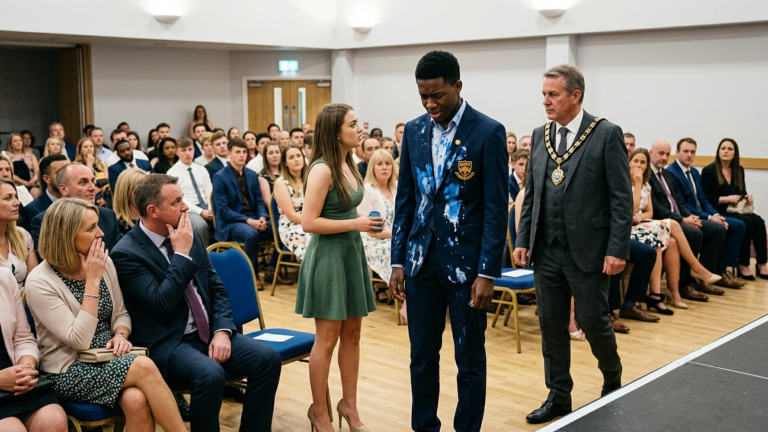
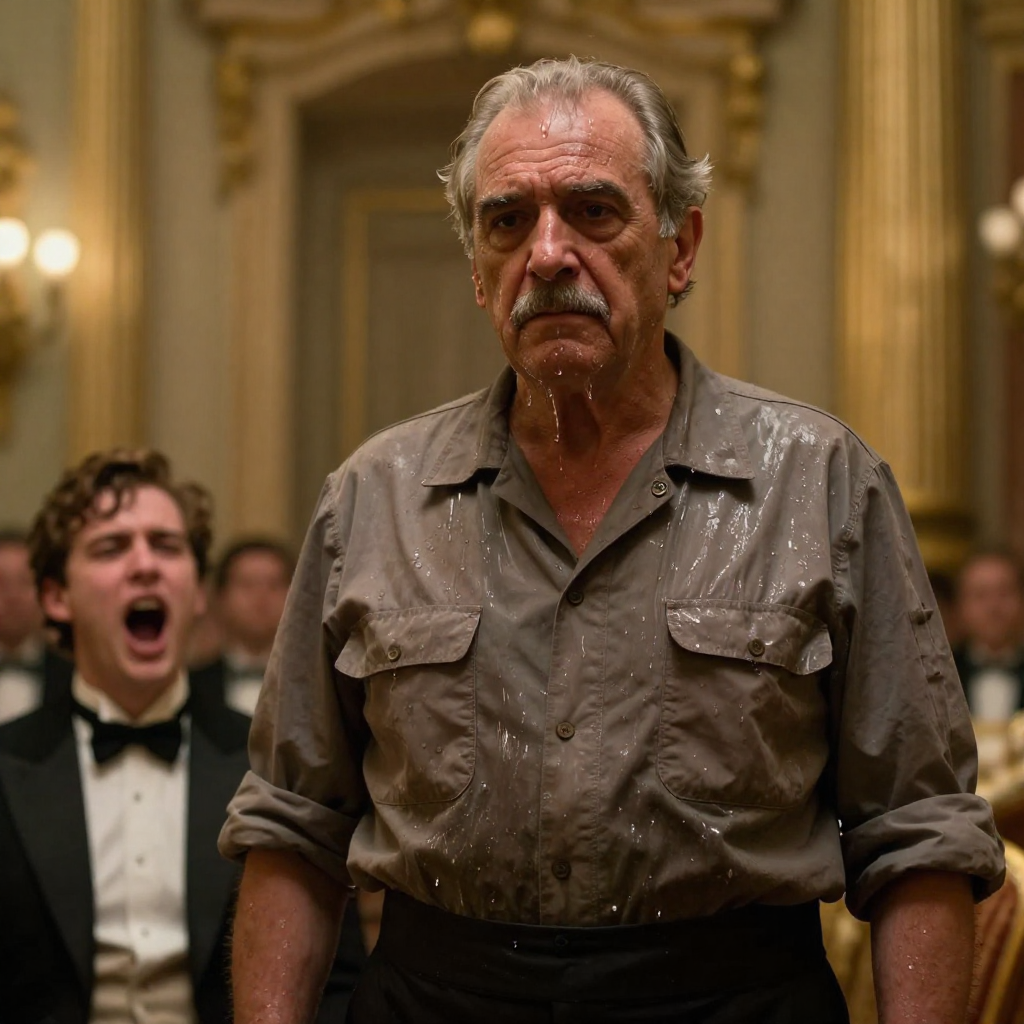
The water hit me before the sound did. It was ice-cold, shocking against the flushed heat of my face, soaking instantly into the collar of my cheap, ill-fitting waiter’s uniform. I gasped, a sharp, involuntary intake of breath, as the liquid dripped from my eyelashes and blurred my vision. The jazz band in the corner faltered, then stopped. The ambient chatter of two hundred wealthy guests—the clinking of crystal, the polite laughter, the rustle of silk—died instantly. Silence, thick and suffocating, descended on the ballroom of the Sterling Estate.
I didn’t wipe my face. I didn’t step back. I just stood there, letting the water drip onto the polished marble floor, holding the silver tray against my chest like a shield that had failed to protect me. My hands were shaking. They always shake now. It’s not fear, though everyone thinks it is. It’s the nerves, the result of a mortar blast twenty years ago that rewired the electricity in my arms. But to the young man standing in front of me, flushed with expensive whiskey and unearned arrogance, it looked like terror.
“Look at him,” Julian sneered, his voice cracking with a cruel sort of delight. He was twenty-two, maybe twenty-three. A boy. A child who had never known a day of hunger or a night of true darkness. He pointed a manicured finger at my chest. “I asked for sparkling, you senile idiot. Sparkling. And you spill tap water on my Italian loafers?”
I looked down. There was a single, dime-sized drop of water on his black leather shoe. I had flinched when a champagne cork popped nearby—a reflex I still haven’t managed to kill—and the pitcher had tilted just a fraction. That was my crime.
“I apologize, sir,” I said. My voice was low, raspy from years of breathing in dust and smoke. “I will fetch a towel immediately.”
“You won’t fetch anything,” Julian stepped closer, invading my personal space. He smelled of expensive cologne and sour mash. “You’ll stand there and you’ll listen. Do you know who I am? Do you have any idea how much these shoes cost? They cost more than you make in a year, old man.”
I kept my eyes fixed on the knot of his silk tie. It was a coping mechanism. Focus on the details. The weave of the fabric. The way the light caught the dust motes in the air. Don’t look at the threat. Don’t engage. In the sandbox, engaging meant escalation, and escalation meant death. Here, it just meant losing the job that paid for my small studio apartment and the medication that kept the nightmares at bay.
“I am sorry, Mr. Sterling,” I repeated, keeping my tone flat. “It was an accident.”
“An accident?” He laughed, turning to his friends—a group of equally polished, beautiful young people who were watching with a mix of amusement and discomfort. “He calls it an accident. Look at his hands! He’s shaking like a leaf. It’s pathetic.”
Julian grabbed another glass from a passing tray—a full tumbler of amber liquid—and for a second, I calculated the trajectory. If he swung, I could disarm him in under two seconds. Step left, seize the wrist, torque the elbow. The muscle memory was dormant, not dead. But I didn’t move. I couldn’t. I wasn’t Sergeant Major Arthur Penhaligon anymore. I was just Arthur, the temp agency hire. I was the help.
“You’re a coward,” Julian spat, the venom in his voice so real it felt physical. “Look at you. You can’t even look me in the eye. You’re just a trembling, broken old man who ruins everything he touches. Get out of my sight! You make me sick.”
He threw the second glass. This time, it wasn’t water. It was whiskey, and it burned my eyes. The glass struck my shoulder and shattered on the floor, sending shards skittering across the marble. The crowd gasped. Someone murmured, “Julian, that’s enough,” but nobody stepped forward. Nobody moved. They were paralyzed by the spectacle of it—the raw, unfiltered cruelty of a powerful man’s son against a nobody.
I closed my eyes for a heartbeat. In the darkness behind my lids, I wasn’t in a ballroom. I was back in the valley. The heat was oppressive. The radio was screaming for evac. I was holding a boy—about Julian’s age—whose legs were gone, telling him he was going to make it, even though I knew he wouldn’t. I had held men together while they died. I had walked through fire to pull my brothers out of the wreckage. I had earned the Silver Star, the Purple Heart, and the silence that comes after the war ends.
And now, I was being called a coward by a boy who got angry because his shoes got wet.
The injustice of it burned hotter than the whiskey. But I swallowed it down. I had to. I needed this paycheck. My rent was due on Tuesday.
“I’ll clean it up,” I whispered, bending down to pick up the broken glass. My knees popped audibly.
“Don’t touch it!” Julian kicked the shards toward me. “Leave it. You’ll just cut yourself and bleed on the floor, you useless wretch. Just get out. Go!”
He loomed over me as I knelt there, a king looking down at a peasant. The humiliation was total. I felt the heat rising in my neck, the shame of it. Not shame for what I had done, but shame that I had allowed myself to fall this low. That the world had forgotten so quickly what men like me had given so that boys like him could wear Italian loafers and drink scotch in safety.
I started to stand, my hand gripping the edge of a table for support. My knuckles were white.
“I’m waiting!” Julian yelled, his voice echoing off the high, vaulted ceiling. “Are you deaf, too? I said—”
“Julian.”
The voice was quiet, but it cut through the room like a knife. It wasn’t a shout. It was a command. Absolute. Unyielding. It was the voice of a man who didn’t need to raise his volume to be heard.
The crowd parted instantly. Julian froze, his mouth still half-open.
Walking through the guests was a man in his sixties, impeccably dressed in a tuxedo that fit him like armor. His hair was silver, his face lined with the kind of stress that comes from running a multinational empire. It was Richard Sterling. The host. The billionaire. Julian’s father.
But I didn’t see a billionaire. I saw ‘Lieutenant Richie.’ I saw the young officer I had carried three miles on my back through a hostile jungle when his leg was shattered by shrapnel. I saw the man who had cried in my arms when we lost the platoon. I hadn’t seen him in thirty years. I knew he was wealthy now, knew he was powerful, but I had never reached out. I didn’t want charity. I didn’t want to be a reminder of the worst days of his life.
Richard stopped ten feet away. He looked at the shattered glass. He looked at the whiskey soaking into my uniform. He looked at his son, whose face was rapidly draining of color.
“Dad,” Julian stammered, his arrogance evaporating instantly. “I was just handling this… this staff member. He ruined my shoes. He’s incompetent. I was just telling him to leave.”
Richard didn’t look at his son. He was looking at me. His eyes were wide, scanning my face, searching for the man beneath the wrinkles and the gray hair and the waiter’s uniform. He looked at the scar on my chin—the one I got pulling him out of a burning Humvee.
He went pale. A ghost had just walked into his ballroom.
“Arthur?” Richard whispered. The name hung in the air, heavy and impossible.
Julian laughed nervously. “You know his name? Dad, he’s just a temp. He’s a nobody.”
Richard slowly turned his head to look at his son. The expression on his face wasn’t anger. It was horror. It was a profound, devastating disappointment that seemed to age him ten years in a second.
“A nobody?” Richard’s voice trembled, but not with fear. “You think he is a nobody?”
“He’s a waiter, Dad! Look at him! He’s shaking! He’s a pathetic coward who can’t even hold a tray!”
Richard closed the distance between them in two long strides. He grabbed Julian by the lapels of his expensive tuxedo and shoved him—hard. Julian stumbled back, shock written all over his face. The room gasped. Richard Sterling never lost his temper. Richard Sterling was a pillar of composure.
“Shut your mouth,” Richard hissed, his voice shaking with a rage so deep it felt dangerous. “Do not speak another word.”
“Dad, what the hell?” Julian whined, straightening his jacket. “Over a waiter?”
Richard turned back to me. He ignored his son. He ignored the guests. He walked right up to me, heedless of the broken glass, heedless of the whiskey puddle. He stopped inches from me. He looked at my shaking hands. He looked at the water dripping from my face.
Slowly, Richard Sterling, one of the most powerful men in the country, dropped to his knees.
The room went dead silent. You could hear a pin drop.
He didn’t care about his suit. He knelt in the whiskey and the glass. He reached out and took my trembling hands in his own. His hands were warm, steady. He looked up at me, and I saw tears pooling in his eyes.
“Sergeant Major,” he choked out, his voice breaking. “My God. Arthur.”
I swallowed hard, trying to keep my own composure. “Hello, Lieutenant. It’s been a long time.”
Richard turned his head, looking up at his son from his knees. The look he gave Julian was terrifying. It was the look of a man who realizes his legacy is rot.
“You called him a coward?” Richard asked, his voice rising, cracking with emotion. “You called this man a coward?”
“Dad, get up, you’re embarrassing me,” Julian hissed, looking around at the guests.
“Do you have any idea whose life you just tried to ruin?” Richard roared, the sound echoing off the walls. He stood up slowly, pulling me up with him, keeping a firm grip on my arm as if he was afraid I would vanish if he let go. He turned to the room, addressing the hundreds of stunned faces.
“You see a waiter,” Richard announced, his voice booming with authority. He pointed at me. “You see a servant. But I see the man who walked into hell three times to save my life. I see the man who carries the shrapnel in his back that was meant for me. I am alive—my son is alive, this company exists, this house stands—only because Arthur Penhaligon stood his ground when everyone else ran.”
He turned to Julian, who was now trembling.
“You are not fit to polish his boots,” Richard said, his voice dropping to a deadly whisper. “Get out.”
“Dad?”
“I said, get out of my sight!” Richard screamed, a raw, gutteral sound that I had only heard once before—on a battlefield, amidst the dying. “Go!”
Julian scrambled back, terrified, retreating into the crowd. Richard turned back to me, ignoring the staring guests. He took a handkerchief from his pocket and gently began to wipe the whiskey from my uniform.
“I’m sorry,” he whispered, the tears finally spilling over. “I am so, so sorry, Arthur. Please. Tell me how to fix this.”
I looked at him, and for the first time in twenty years, the shaking in my hands stopped just enough for me to grip his shoulder.
“You can start,” I said softly, “by getting me a dry shirt.”
CHAPTER II
The silence after Richard Sterling’s pronouncement hung thicker than the cigar smoke. Every head in the ballroom was turned, every pair of eyes a spotlight. I just stood there, soaked, the whiskey and water now clinging to me like a second skin. I wanted to disappear.
Richard, still kneeling, finally rose, his face a mask of conflicting emotions – gratitude, shame, perhaps even a flicker of the old camaraderie. He extended a hand. “Sergeant Major Penhaligon… Arthur. Please, come with me.”
I hesitated only a moment. What choice did I have? The room felt like a trap, and Richard’s outstretched hand, though unexpected, was at least a path out. I took it, his grip surprisingly firm. He led me, not gently, but with a purpose, through the stunned crowd, past the whispering women in their glittering gowns, past the men whose tailored suits suddenly seemed less impressive. Julian, his face a twisted knot of embarrassment and something I couldn’t quite decipher, remained frozen near the makeshift stage.
Richard steered me through a side door, down a short hallway, and into what I assumed was his private study. The room was everything the ballroom wasn’t: quiet, intimate, lined with books, the air smelling of leather and old paper. He released my hand, finally, and turned to face me, his expression now one of naked apology.
“Arthur… I… I don’t know what to say. I had no idea.”
“It’s alright, Richard,” I said, though it wasn’t. Nothing about this was alright. “It was a long time ago.”
“Long time ago?” He scoffed, running a hand through his perfectly coiffed hair, dislodging it slightly. “Twenty years, Arthur. Twenty years I’ve been walking around, living this… this life, knowing I owed you everything, and never even trying to find you.”
He gestured around the room, a sweeping motion that encompassed the wealth, the privilege, the sheer excess of his existence. “Look at this. All of this… it should have been yours too.”
“I didn’t want any of this, Richard,” I said, my voice flat. It was the truth. I’d seen enough blood and guts to last a lifetime; I wasn’t about to start chasing money.
“But you deserved it,” he insisted, his voice rising. “You saved my life! You carried me out of that… that hellhole!”
The memories, as always, were right there, lurking just beneath the surface. The burning sand, the acrid smell of diesel, the screams… and Richard, his leg shattered, his face pale with shock and pain. I pushed them back down, the way I always did. “It was my job, Richard. I was a Sergeant Major. That’s what I did.”
He stared at me, his eyes searching. “And after? Why didn’t you ever contact me? I had people looking for you, you know. I wanted to… to repay you.”
I looked away, unable to meet his gaze. This was the part I didn’t want to talk about, the part I kept buried deep inside. “I wasn’t… I wasn’t in a good place, Richard. I couldn’t…”
“Couldn’t what?” he pressed, his voice softer now. “Couldn’t accept help? Couldn’t face me?”
“Both,” I admitted, the word tasting like ash in my mouth. “I was… ashamed. I came back… different. I wasn’t the same man who went over there. I didn’t want you to see me like that.”
He stepped closer, his hand reaching out, then hesitating, as if unsure whether to touch me. “Arthur… you’re still the same man. You’re a hero.”
“No, Richard,” I said, shaking my head. “I’m not. Heroes don’t end up cleaning toilets in a banquet hall.”
He flinched, as if I’d slapped him. “Don’t say that. Don’t you ever say that. You’re more of a hero now than you ever were then. You survived. You kept going. That’s more than most of us can say.”
Just then, a hesitant knock on the door. Julian stood there, his face pale, his eyes darting between Richard and me.
“Dad… I… I wanted to apologize to Sergeant… to Arthur. For what I did. It was… it was stupid. And disrespectful. I didn’t know…”
Richard turned to his son, his expression unreadable. “Did you hear what I said out there, Julian? Do you understand what this man did for me?”
Julian swallowed hard, his Adam’s apple bobbing nervously. “Yes, sir. I… I heard. But I didn’t really… understand. Not until you said it. I thought… I thought you were just… being dramatic.”
Richard sighed, a weary sound that spoke of years of disappointment. “Dramatic? Julian, this man saved my life. He risked his own life to pull me out of a burning tank. He carried me for miles, under fire, until we reached the extraction point. If it wasn’t for him, I wouldn’t be here today. You wouldn’t be here today.”
Julian looked at me, his eyes filled with a mixture of shame and… something else. Curiosity? Respect? It was hard to tell. “Sergeant… Arthur. I’m… I’m truly sorry. I had no right to treat you like that. It was… I was trying to impress people. Being an idiot.”
I looked at him, really looked at him, for the first time. He was younger than I’d initially thought, barely more than a boy, really. A boy who’d been given everything, and who had no idea what it meant to earn something.
“It’s alright, son,” I said, surprising myself. The words came out easily, without bitterness. “Just… try to be better.”
He nodded, his eyes fixed on mine. “I will. I promise. Dad told me… he told me what you actually *did*. The tank was already hit, right? The ammunition was cooking off?”
I nodded once, sharply. The memory was vivid. “We didn’t have much time. Your father was pinned. The heat…”
“And you went in anyway,” Julian breathed. “Dad said you went in and cut him loose with a knife. The lock was jammed. You could have been blown to pieces.”
“I wasn’t thinking about that,” I said, the words automatic. “I was thinking about getting him out.”
Julian looked down at his hands, clenching and unclenching them. “I… I don’t think I could do that. I don’t think I have that kind of… strength.”
Richard placed a hand on his son’s shoulder, his grip firm. “You don’t need to have that kind of strength, Julian. You just need to have the courage to do what’s right.”
He turned back to me, his expression softening. “Arthur, you must be freezing. Let me get you some dry clothes. And a drink. A strong one.”
He moved towards the door, then hesitated, turning back to me with a look of genuine concern. “And then… then we need to talk. About what happened over there. About what happened afterwards. About… everything.”
I nodded, the weight of the past twenty years settling on my shoulders. It was going to be a long night.
Richard led me to an adjoining bathroom. It was opulent, with marble countertops and gold-plated fixtures. A stark contrast to the cramped, dingy apartment I called home. He rummaged through a cabinet and pulled out a thick, fluffy towel.
“Here,” he said, handing it to me. “Get cleaned up. I’ll find you something to wear.”
I took the towel, the soft fabric a small comfort against my chilled skin. As I began to dry myself, I caught a glimpse of my reflection in the mirror. The man staring back at me was not the same man who had gone to war. The years had etched lines of weariness and pain into my face. My eyes, once bright and full of hope, were now clouded with a sadness that seemed to seep into my very soul.
Richard returned with a neatly folded pile of clothes. “These should fit,” he said. “They’re some of my old things. Nothing fancy, but they’re clean and dry.”
I took the clothes and retreated into the bathroom to change. As I pulled on the soft cotton shirt and the comfortable chinos, I felt a strange sense of… displacement. It was as if I were trying on someone else’s life, someone else’s identity.
When I emerged from the bathroom, Richard was waiting for me, a glass of amber liquid in his hand. He offered it to me with a wry smile.
“Scotch,” he said. “The good stuff. I figured you deserved it.”
I took the glass and took a long, slow sip. The warmth of the whiskey spread through me, chasing away the chill and easing the tension in my muscles.
“Thank you, Richard,” I said, my voice hoarse.
He gestured to a pair of leather armchairs in front of the fireplace. “Sit down, Arthur. Let’s talk.”
We sat in silence for a moment, the only sound the crackling of the fire. Richard swirled the whiskey in his glass, his eyes fixed on the flames.
“I still have nightmares, you know,” he said, his voice barely a whisper. “About that day. About the tank. About… everything.”
I nodded, understandingly. “Me too.”
“Do you ever… regret it?” he asked, his eyes searching mine. “Regret saving me?”
I thought about it for a moment, honestly. Regret? No, I didn’t regret saving him. It was the right thing to do. But did I regret the consequences? The way my life had turned out? The pain and the suffering? That was a different question.
“Sometimes,” I admitted. “Sometimes I wonder what would have happened if I’d just left you there. If I’d just walked away.”
He flinched again, the pain in his eyes palpable. “Don’t say that, Arthur. Please don’t say that.”
“I’m just being honest, Richard,” I said, my voice flat. “It’s the truth.”
He took a deep breath, his shoulders slumping slightly. “I know,” he said. “I know it is.”
We sat in silence again, the fire crackling and popping, the weight of the past hanging heavy in the air. The apologies, the revelations… they were just the beginning. There was so much more to unpack, so much more to understand. And I wasn’t sure I was ready for it.
The triggering event arrived subtly, a quiet question from Julian who had been listening from the doorway.
“Arthur, what did you do after? After you got back? Dad said he couldn’t find you.”
I tensed. This was the secret. The one I guarded most fiercely.
“I… drifted,” I said vaguely. “Took some odd jobs.”
“But Dad had people looking,” Julian persisted, a youthful intensity in his gaze. “He hired detectives. He wanted to give you a medal, a pension… anything.”
Richard shot his son a warning look, but it was too late. The question was out there, hanging in the air.
I took another gulp of scotch, the liquid burning a path down my throat. “I didn’t want anything,” I said, my voice low. “I just wanted to be left alone.”
“But why?” Julian pressed. “Why wouldn’t you let Dad help you?”
I hesitated, my mind racing. How much to reveal? How much to keep hidden? This was the moral dilemma. The truth would destroy the fragile peace we had established. But a lie would be a betrayal.
“Because,” I said finally, the word heavy with unspoken meaning. “Because when I came back… I wasn’t alone.”
The silence that followed was deafening. Richard stared at me, his eyes wide with disbelief. Julian looked confused, unsure of what I meant.
“What do you mean, you weren’t alone?” Richard asked, his voice trembling slightly.
I took a deep breath, bracing myself for the storm that was about to break. “I mean… I had a son.”
The words hung in the air, a ticking time bomb. The secret was out. And everything was about to change.
The lie, the half-truth I’d been living for twenty years, was crumbling around me. My son… he wasn’t just *a* son. He was Richard’s son too. Conceived in a moment of drunken recklessness before I shipped out, a secret I had guarded to protect everyone involved, most of all myself. But Julian’s innocent question had detonated it all.
Richard’s face contorted, a mix of shock, anger, and betrayal warring for dominance. “You… you had a son? My son? And you never told me?”
I looked down at my hands, unable to meet his gaze. The shame was overwhelming, a tidal wave threatening to drown me.
“I was going to,” I mumbled. “Before I went away. I found out… just before. But then… then everything happened. The war… I didn’t know if I’d come back. And after… I didn’t think you’d want to know.”
“Want to know?” He exploded, his voice shaking with fury. “Of course, I wanted to know! That’s my son! My flesh and blood!”
Julian looked from his father to me, his face a mask of confusion and dawning horror. “What’s going on? What are you talking about?”
Richard turned to his son, his face softening slightly. “Julian… there’s something you need to know. Arthur… Arthur is your…”
He hesitated, unable to bring himself to say the word. I finished the sentence for him.
“He’s your brother, Julian,” I said, my voice barely audible. “Your half-brother.”
The room fell silent again, the only sound the frantic pounding of my own heart. The bomb had exploded, and the fallout was just beginning. I braced myself for the impact.
The old wound, the unacknowledged trauma of war, the guilt and the PTSD, had been reopened. The secret, the existence of my son (our son), was now exposed. And the moral dilemma, the choice between protecting my son and telling the truth, had been ripped from my hands. The decision had been made for me, and I had no idea what the consequences would be.
The comfortable study, the reconciliation, the fragile peace… it was all shattered. We were back to square one, only this time, the stakes were much, much higher. This time, it wasn’t just about me. It was about my son. And about the family I had unknowingly created, and the family I was about to destroy.
The night was far from over.
CHAPTER III
The silence hung, thick and heavy. Richard stared at me, his face a mask of disbelief. Julian shifted, his earlier arrogance replaced by a bewildered confusion. The air in the study felt suddenly thin, difficult to breathe.
“A son?” Richard finally choked out, his voice barely a whisper. “You have a son?”
I nodded, the weight of decades pressing down on me. “His name is… was… David.”
The past tense hung in the air, a ghost I couldn’t escape.
Julian stepped forward, his brow furrowed. “David? But… why didn’t you ever say anything?”
“Because it wasn’t my place,” I said, my voice low. “It was Richard’s secret to keep, or not.”
Richard ran a hand through his thinning hair, pacing the room like a caged animal. “But… when? How old is he?”
“He would be…” I swallowed hard, the lump in my throat almost unbearable. “He would have been thirty-two this year.”
Richard stopped pacing, his eyes locking onto mine. “Would have been? What do you mean, would have been?”
The words caught in my throat. This was the part I had dreaded, the truth I had kept buried for so long. “David… he’s gone.”
Julian’s face paled. “Gone? What happened?”
“An accident,” I said, the word feeling hollow and inadequate. “A car accident, ten years ago.”
Richard sank into a chair, his face etched with pain. “Ten years… and I never knew. I had a son for twenty-two years, and I never knew.”
“It wasn’t your fault,” I said, though the words felt empty even to my own ears. “I made the choice to raise him alone. I didn’t want anything from you.”
“But why?” Julian asked, his voice laced with genuine confusion. “Why keep him a secret? Why not let my father know?”
I looked at Julian, at his privileged life, his easy confidence, and I knew he would never understand. “Because I didn’t want him growing up like you,” I said, the words sharper than I intended.
Julian recoiled, stung by the accusation. Richard looked up, his eyes filled with a mixture of pain and understanding.
“What do you mean?” Julian asked, his voice defensive.
“I mean I didn’t want him spoiled, entitled, thinking the world owed him something,” I said. “I wanted him to earn his way, to know the value of hard work, to be a decent human being.”
“And you think I’m not decent?” Julian shot back, his voice rising.
“I think you’ve had everything handed to you on a silver platter,” I said. “You’ve never had to struggle, never had to face real hardship. You don’t know what it’s like to be hungry, to be cold, to be afraid.”
Richard stood up, his voice firm. “Enough, both of you. This isn’t helping anything.”
He turned to me, his eyes pleading. “Arthur, tell me about him. Tell me about David. What was he like?”
I hesitated, the memories flooding back, both joyful and painful. “He was… he was a good kid,” I said, my voice thick with emotion. “Smart, funny, kind. He had a good heart.”
“What did he do? What were his dreams?”
“He worked hard,” I said. “He put himself through college, working nights at a warehouse. He wanted to be a teacher.”
“A teacher?” Richard repeated, a flicker of pride in his eyes. “He wanted to make a difference.”
I nodded. “He did. He volunteered at a local community center, helping kids with their homework. He cared about people.”
Richard walked over to the window, staring out at the sprawling grounds. “And I missed it all,” he said, his voice filled with regret. “I missed his entire life.”
Julian stepped forward, his face softening. “Maybe… maybe we can still do something,” he said. “We can honor his memory. We can set up a scholarship in his name. We can…”
“No,” I said, cutting him off. “Don’t you dare. Don’t you dare try to use his memory to make yourselves feel better.”
“Arthur,” Richard said, his voice pleading. “We want to help. We want to do something good.”
“Then leave him alone,” I said. “Let him rest in peace. He wouldn’t want anything from you.”
I turned to leave, but Richard stopped me.
“Arthur, wait,” he said. “There’s something else you should know.”
I turned back, bracing myself for whatever was coming next.
“After David died…” Richard began, his voice hesitant. “I hired a private investigator. I wanted to know… I wanted to know everything about him.”
My blood ran cold. “You what?”
“I know it was wrong,” Richard said, his eyes filled with shame. “But I had to know. I had to know what kind of life he had lived.”
“And what did you find?” I asked, my voice barely a whisper.
Richard hesitated, his face pale. “He… he was in debt. He had a lot of medical bills. He was struggling to make ends meet.”
My heart sank. I had known he was struggling, but I hadn’t realized how bad it was.
“And?” I pressed, my voice trembling.
“And…” Richard took a deep breath. “And he was working on a project. A… a report. About some… irregularities. At the warehouse where he worked.”
“Irregularities? What kind of irregularities?”
Richard hesitated again, his eyes darting nervously around the room. “I don’t know all the details,” he said. “But it had something to do with… with illegal dumping. Toxic waste.”
My mind reeled. David had been investigating illegal dumping? And he had died in a car accident shortly after?
“Are you saying… you think his death wasn’t an accident?” Julian asked, his voice filled with disbelief.
Richard shrugged, his face a mask of uncertainty. “I don’t know what to think,” he said. “But the timing… it’s suspicious.”
I stared at Richard, my mind racing. Could it be possible? Could David’s death have been more than just a tragic accident?
Suddenly, a figure appeared in the doorway. It was a woman, impeccably dressed and radiating an air of authority.
“Richard,” she said, her voice sharp and commanding. “What’s going on here? I heard shouting.”
It was Richard’s wife, Eleanor. She had been away on business, but had returned unexpectedly.
Richard turned to her, his face drawn. “Eleanor, I… we were just having a discussion.”
Eleanor’s eyes narrowed, taking in the scene. She looked at me, then at Julian, then back at Richard.
“What’s going on?” she repeated, her voice cold.
Richard hesitated, unsure how to explain. “Eleanor, this is Arthur Penhaligon,” he said. “He… he’s an old friend.”
Eleanor’s eyes flickered with recognition. “Penhaligon,” she said, her voice dripping with disdain. “I’ve heard about you.”
She turned to Richard, her voice low and menacing. “What is he doing here, Richard? What have you been telling him?”
Richard’s face paled. He knew that Eleanor would not react well to the truth.
“Eleanor, please,” he said. “Let’s talk about this later.”
“No,” Eleanor said, her voice rising. “I want to know now. What is going on?”
Richard sighed, his shoulders slumping. He knew he couldn’t keep the truth hidden any longer.
“Eleanor,” he said, his voice barely a whisper. “Arthur… Arthur is David’s father.”
Eleanor’s face froze. She stared at Richard, her eyes wide with disbelief.
“David?” she repeated, her voice trembling. “You mean… the boy who died?”
Richard nodded, his face filled with shame.
Eleanor’s eyes flashed with anger. She turned to me, her face contorted with rage.
“You!” she spat, her voice filled with venom. “You kept this from me? You kept my husband’s son a secret?”
“Eleanor, please,” Richard said, trying to calm her down. “It’s not his fault.”
“Not his fault?” Eleanor shrieked. “He’s been manipulating you, Richard! He’s trying to take everything from us!”
She turned to Julian, her eyes pleading. “Julian, say something! Do something!”
Julian looked at his mother, then at his father, then at me. He was caught in the middle, torn between loyalty and confusion.
“Mom, please,” he said. “Just calm down.”
“Calm down?” Eleanor screamed. “How can I calm down? This man is trying to destroy our family!”
She turned back to me, her eyes filled with hatred. “Get out!” she screamed. “Get out of my house!”
I didn’t need to be told twice. I turned and walked out of the study, leaving Richard and his family to their own private hell.
As I walked away, I couldn’t shake the feeling that I had unleashed something terrible. The truth had come out, but it had only created more pain and more division. And I was afraid that the worst was yet to come.
I went back to my small apartment, the events of the evening replaying in my mind. I couldn’t sleep. I kept thinking about David, about his life, about his death. And I couldn’t shake the feeling that I had failed him.
The next morning, I received a phone call. It was from a detective, a man named Harding. He said he was investigating David’s death.
“Mr. Penhaligon,” he said, his voice serious. “I need to ask you some questions about your son.”
I agreed to meet him at his office. When I arrived, he led me into a small, windowless room.
“Mr. Penhaligon,” he said, “we believe your son’s death may not have been an accident.”
My heart pounded in my chest. “What do you mean?”
“We believe he may have been murdered,” Harding said.
I stared at him, my mind reeling. “Murdered? But… why?”
“We believe it had something to do with his investigation into the illegal dumping at the warehouse,” Harding said. “We think he may have uncovered something that someone wanted to keep hidden.”
“Who?” I asked, my voice trembling.
Harding hesitated. “We’re not sure yet,” he said. “But we’re looking into it. We need your help, Mr. Penhaligon. We need you to tell us everything you know about your son’s investigation.”
I told him everything I knew, everything David had told me about the irregularities at the warehouse. I told him about the toxic waste, about the suspicious activities he had witnessed.
Harding listened intently, taking notes. When I was finished, he looked at me, his eyes filled with sympathy.
“Mr. Penhaligon,” he said, “this is a dangerous situation. Whoever killed your son is still out there. And they won’t hesitate to kill again.”
He handed me a card. “If you hear anything, if you see anything suspicious, call me immediately,” he said. “And be careful, Mr. Penhaligon. Your life may be in danger.”
I left Harding’s office, my mind racing. David had been murdered. And his killer was still out there. And now, my life was in danger too.
I knew I couldn’t let David’s death go unpunished. I had to find his killer. I had to bring them to justice. Even if it meant risking my own life.
That night, I went back to the warehouse where David had worked. I wanted to see for myself what he had been investigating. I wanted to find some clue, some piece of evidence that would lead me to his killer.
The warehouse was deserted, the gates locked. But I managed to climb over the fence and slip inside.
The air was thick with the stench of chemicals. I walked through the darkened warehouse, my heart pounding in my chest.
Suddenly, I heard a noise. A footstep. Someone was there.
I froze, holding my breath. I could hear the footsteps getting closer.
I ducked behind a stack of crates, waiting for whoever it was to pass by.
But they didn’t pass by. They stopped right in front of the crates.
“I know you’re there, Penhaligon,” a voice said. “Come out. I don’t want to have to hurt you.”
The voice was cold, menacing. I knew who it was. It was the person who had killed David.
I stepped out from behind the crates, my hands raised in surrender.
“Who are you?” I asked, my voice trembling.
The figure stepped out of the shadows. It was Julian. He stood there, a gun in his hand. His face was emotionless.
“I’m sorry, Arthur,” he said. “But you know too much. And I can’t let you tell anyone.”
My mouth went dry. “Julian?” I stammered. “But… why?”
“It’s not my fault,” he said. “It’s my father. He ordered me to do it. He said it was the only way to protect the family.”
“Protect the family?” I repeated, my voice filled with disbelief. “By killing my son?”
“He didn’t want to do it,” Julian said. “But he had no choice. David was going to expose everything. He was going to ruin us all.”
“And you?” I said, my voice rising. “You were willing to kill for your father?”
Julian hesitated, his face contorted with pain. “I didn’t want to do it,” he said. “But I had to. I had to protect my family. I had to protect my mother.”
“And what about David?” I asked. “Didn’t he deserve to be protected?”
Julian didn’t answer. He just stood there, the gun still pointed at me. Richard stepped out from behind Julian.
“I am sorry it has to be this way, Arthur,” Richard said.
“Julian, lower the gun,” A voice boomed. It was Eleanor. “What are you doing?” Eleanor demanded.
“Mother, I am protecting the family,” Julian said.
“There will be no protecting if you kill anyone!” Eleanor shouted. “I will not allow it.”
“Mother, you do not understand-,” Julian started. Eleanor slapped him across the face, the sound echoing through the warehouse.
“I said lower the gun!” Eleanor screamed. Julian lowered the gun. Eleanor grabbed it and turned to Richard.
“How could you!” Eleanor shrieked. “I am taking care of this.”
Eleanor raised the gun and fired it. I braced for impact, but nothing happened. Eleanor had shot Richard. He crumpled to the ground.
“I am the only one who can protect this family,” Eleanor said. “Now, Arthur, I suggest you leave. And never come back.”
I didn’t need to be told twice. I ran from the warehouse, leaving Eleanor and Julian to deal with the consequences of their actions.
CHAPTER IV
The silence in the house was a heavy blanket. Eleanor had called the authorities, a controlled, almost regal performance. She’d painted a picture of Richard as a man driven mad by grief over David’s death, a man who’d confessed to things he hadn’t done, and then… a tragic accident. Self-defense, she’d called it. Julian stood beside her, a pale ghost, his eyes hollow. I was gone before the police arrived, vanishing into the night as silently as I’d come. Arthur Penhaligon – war hero, cuckold, forgotten father. I was all of them, and none of them.
The next few days were a blur. I holed up in a cheap motel on the outskirts of town, the kind where the sheets smelled faintly of bleach and regret. The television droned on, a constant stream of noise that I barely registered. News reports flashed across the screen – Richard Sterling’s ‘untimely death,’ Eleanor Sterling’s ‘bravery in the face of tragedy,’ Julian Sterling’s ‘unwavering support for his mother.’ They were building their narrative, brick by bloody brick.
The public ate it up. Richard, the philanthropist, the pillar of the community, brought down by grief. Eleanor, the grieving widow, now the sole protector of her son and the family legacy. Julian, the dutiful son, standing strong beside his mother. They were masters of illusion, and I was a ghost in their machine.
My phone rang. It was a number I didn’t recognize. Hesitantly, I answered. A woman’s voice, cold and precise, filled my ear. “Mr. Penhaligon,” she said, “we know everything. We know about David. We know about Julian. And we know about your… involvement.” She didn’t need to say who ‘we’ was. The message was clear: stay silent, or face the consequences.
The weight of it all threatened to crush me. David was gone. Richard was dead. Julian was trapped. And Eleanor… Eleanor was winning. Was this justice? Was this what I wanted? I’d spent my life fighting for what was right, but what was ‘right’ now? Exposing the Sterlings would destroy them, yes, but it would also destroy me. It would drag David’s name through the mud, reveal the truth of his parentage, and expose my own complicity in this mess.
I walked to the window and looked out at the rain-slicked street. A neon sign flickered across the way, casting a lurid glow on the scene. The city was a beast, indifferent to the pain and suffering of its inhabitants. I was just another piece of prey, caught in its jaws.
Then, I made a decision. I wouldn’t run. I wouldn’t hide. I would do what David would have wanted. I would bring them down. But I wouldn’t do it with anger, or revenge. I would do it with the truth.
The first thing I did was call Sarah, David’s former colleague. She’d been suspicious of the Sterling Group’s activities long before David’s death. I told her everything – about David, about Richard, about Julian, about Eleanor. I told her about the toxic waste, about the cover-ups, about the lies.
She listened in stunned silence, her voice trembling when I finished. “I knew it,” she whispered. “I knew something wasn’t right.” She agreed to help me, to gather evidence, to expose the Sterlings’ crimes. She was brave, far braver than I’d ever been.
Working with Sarah gave me a purpose, a focus. We spent weeks poring over documents, tracking down witnesses, piecing together the puzzle of the Sterling Group’s illegal activities. It was slow, painstaking work, but we were making progress. We uncovered evidence of illegal dumping, falsified reports, and payoffs to local officials. The Sterlings’ carefully constructed facade was beginning to crumble.
The media, initially sympathetic to Eleanor, began to turn. Whispers of corruption and cover-ups started to circulate. The police, under mounting pressure, reopened the investigation into David’s death. Julian, cracking under the strain, retreated further into himself, his silence fueling the growing speculation.
Then, the call came. It was Sarah. Her voice was frantic. “They know,” she said. “They know we’re onto them. I’m being followed.” I told her to go into hiding, to disappear until things cooled down. But it was too late. A few hours later, I saw the report on the news. Sarah had been killed in a hit-and-run accident. The police were investigating.
Her death hit me hard. I felt responsible, guilty. I’d brought her into this, and now she was dead. The Sterlings’ reach was longer, their power greater, than I’d imagined. I was facing a formidable enemy, one that would stop at nothing to protect itself.
I sat alone in my motel room, the television flickering in the darkness. Despair threatened to engulf me. Was it worth it? Was I just chasing a ghost, leading more people to their doom? I thought of David, of Sarah, of all the lives the Sterlings had touched, and I knew I couldn’t give up.
I decided to confront Eleanor directly. I knew it was risky, but I had nothing to lose. I drove to Sterling Manor, the imposing mansion that had been the backdrop to so much pain and suffering. The gates were open, the house silent and still. I walked up to the front door and knocked.
Eleanor answered the door herself. She was dressed in black, her face pale and drawn. Her eyes, however, were as cold and hard as ever. “Arthur,” she said, her voice flat. “What do you want?”
“I want the truth,” I said. “I want justice for David. And I want you to pay for what you’ve done.”
She laughed, a dry, humorless sound. “Justice?” she said. “There’s no such thing, Arthur. Only power. And I have it.”
“Not anymore,” I said. “I know about the toxic waste. I know about the cover-ups. And I know that you ordered David’s death.”
Her face didn’t flicker. “Prove it,” she said.
“I will,” I said. “I have evidence. And I’m going to the police.”
She smiled, a slow, predatory smile. “You won’t,” she said. “Because if you do, I’ll tell them everything. About David. About your relationship with him. About your… involvement in Richard’s death. Who do you think they’ll believe, Arthur? A war hero with a shady past, or a grieving widow?”
I stared at her, stunned. She was right. She had me trapped. I couldn’t win. “Why?” I asked. “Why did you do it?”
Her eyes hardened. “For my family,” she said. “For the Sterling legacy. I wouldn’t let David destroy everything we’d built.”
“But he was your family too,” I said.
“He was a threat,” she said. “And I eliminated him.”
Julian appeared in the doorway, his face ashen. He’d heard everything. He looked at his mother with horror and disbelief. “Mother,” he whispered. “How could you?”
Eleanor turned to him, her face softening slightly. “Julian,” she said. “I did it for you. For us.”
“No,” he said. “You did it for yourself. You destroyed our family.”
He turned and ran, disappearing into the house.
Eleanor watched him go, her face a mask of cold indifference. She turned back to me. “It’s over, Arthur,” she said. “You can’t win.”
“Maybe not,” I said. “But neither can you.”
I walked away, leaving her standing alone in the doorway. The Sterling legacy was in ruins, their family shattered beyond repair. Eleanor had won, but at what cost?
I went to the police. I told them everything – about David, about the toxic waste, about Eleanor’s confession. I knew it was a risk, but I had to try.
The police listened, skeptical at first, but gradually they began to believe me. They launched a full-scale investigation into the Sterling Group, uncovering a web of corruption and deceit.
Eleanor was arrested, along with several other Sterling Group executives. Julian, devastated by his mother’s betrayal, cooperated with the police, providing crucial evidence.
The trial was a media circus. The Sterlings’ dirty laundry was aired for all to see. The public, once enamored with the family, turned against them with a vengeance.
Eleanor was found guilty of conspiracy, obstruction of justice, and tampering with evidence. She was sentenced to a long prison term. Julian, cleared of any wrongdoing, was left to pick up the pieces of his shattered life.
As for me, I testified at the trial, telling the truth about everything. I was vilified by some, praised by others. But I didn’t care. I had done what I had to do.
After the trial, I left town. I needed to get away from the memories, from the pain. I drove north, to a remote cabin in the woods. I spent my days hiking, fishing, and reading. I tried to find peace, to heal the wounds of the past.
I never forgot David. He was always with me, a silent presence in my life. I often wondered what he would have thought of everything that had happened. I hoped he would have been proud of me.
One day, I received a letter. It was from Julian. He wrote that he was trying to rebuild his life, to atone for his past mistakes. He thanked me for exposing the truth, for bringing his mother to justice. He said that he understood why I had done what I had done.
He ended the letter with a simple sentence: “David would have been proud of you.”
I sat on the porch of my cabin, the letter in my hand, and looked out at the forest. The sun was setting, casting long shadows across the trees. A gentle breeze rustled the leaves. I felt a sense of peace, a sense of closure.
It was over. The Sterlings were gone. David was avenged. And I was finally free.
But even in that freedom, there was a lingering sadness, a knowledge that the scars of the past would never fully heal. I had won, but at a great cost. And I knew that the memory of David, and the events that had led to his death, would haunt me forever.
I took a deep breath and closed my eyes. The forest was silent, the air still. I was alone, but I was not afraid. I was ready to face the future, whatever it might bring.
The news of Sarah’s “accident” never sat right with me. I knew Eleanor was capable of anything, and I also knew I couldn’t prove a damn thing. The injustice of it burned like acid. But there was nothing I could do.
The trial became a grotesque spectacle. The media loved the fallen dynasty, the rags-to-riches story turned bloodbath. Eleanor, even in handcuffs, maintained an air of icy composure. Julian looked like he’d aged a decade in a month. He testified against his mother, his voice barely a whisper. It was a complete betrayal. Still, I pitied him.
Eleanor received a life sentence. No parole. Julian inherited what was left of the Sterling empire – a poisoned chalice if ever there was one. The Sterling Foundation was dissolved. Their legacy was mud.
And me? I became a pariah. Some lauded me as a hero, a truth-teller who dared to stand up to the powerful. Others saw me as a villain, a home-wrecker who’d destroyed a family. The truth, as always, lay somewhere in between.
The nightmares started soon after the trial ended. I’d see David’s face, his eyes accusing, his voice a mournful whisper. I’d wake up in a cold sweat, my heart pounding, the image of his lifeless body burned into my brain. Sleep became a battlefield. Even in my dreams, I couldn’t escape the Sterlings.
I tried therapy. I tried medication. I tried everything I could think of to silence the voices in my head. But nothing worked. The guilt, the grief, the anger – they were all still there, festering beneath the surface. The cost of truth was that every one was hurt by it.
One afternoon, I received a package in the mail. It was unmarked, no return address. I opened it cautiously, my heart pounding in my chest. Inside was a single photograph. It was a picture of David, taken shortly before his death. He was smiling, his eyes full of life. On the back of the photo, someone had written a single word: “Remember.”
I stared at the photo for a long time, tears streaming down my face. I realized that I had a choice to make. I could let the past consume me, let the Sterlings win, even from behind bars. Or I could honor David’s memory by living my life to the fullest, by finding joy and meaning in the world, despite the pain.
I decided to do just that. I sold my house, packed my bags, and set off on a journey. I traveled the world, seeing new places, meeting new people, experiencing new things. I volunteered at a refugee camp in Greece, helping families who had lost everything. I taught English to underprivileged children in Nepal. I climbed mountains in Patagonia, swam in the Dead Sea, and walked the Great Wall of China.
Slowly, gradually, the wounds began to heal. The nightmares became less frequent. The guilt and anger began to fade. I started to find joy in the simple things, like a beautiful sunset, a kind word, a shared laugh.
One evening, as I sat on a beach in Thailand, watching the waves crash against the shore, I realized that I had finally found peace. I would never forget David, or the Sterlings, or the events that had changed my life forever. But I was no longer defined by them. I was free to be myself, to live my life on my own terms.
I closed my eyes and took a deep breath. The sea was calm, the air warm. I was alone, but I was not lonely. I was at peace. And in that peace, I found a measure of redemption.
Months later, I got another letter from Julian. He was working to restore the Sterling name and reputation – but in new ways. He was investing in environmental causes, donating to social programs, and trying to make amends for his family’s sins. He would never erase what his parents had done, but he could forge a new path. He said that the weight of everything that had happened rested on his shoulders, but he hoped to carry that weight with dignity and honor.
Then, he wrote something that hit me hard. “I understand why you went to the police,” he said. “It must have been difficult.” He paused, then added: “Thank you for doing what I couldn’t.” The moral residue of David’s murder was etched onto both our souls.
I wanted to write back. To say I understood his pain. I wanted to say he had courage to do the right thing. I wanted to tell him he’d been brave. But I didn’t. I simply folded the letter, and tucked it away.
Time and distance. That’s all I had left. Time and distance. It didn’t solve everything, but it helped. Some things you just have to live with.
CHAPTER V
The letter arrived in a simple, unadorned envelope, postmarked from a town I barely recognized. Inside, the handwriting was familiar, though I hadn’t seen it in what felt like a lifetime. It was from Julian.
I hadn’t spoken to him since the trial. He’d testified against his own mother, a decision that must have fractured something essential within him. I’d heard whispers – rumors of his quiet life, his attempts to distance himself from the Sterling name, from the toxic legacy that clung to his family like a shroud. Part of me felt a cold satisfaction, a sense that he was paying a price. But another part, a part I tried to ignore, felt a flicker of something akin to pity. He was, in his own way, a victim too.
The letter was short, direct. He was living in a small town, working as a carpenter. He asked if I would be willing to meet. There was something he needed to say, something he hoped I could hear.
I stared at the letter for a long time. The request felt like reopening a wound that had finally begun to scar over. What could he possibly say that would make any difference? What absolution could he offer that I hadn’t already denied myself? But the truth was, I was tired of carrying the weight of my anger. The anger at Richard, at Eleanor, at Julian, at myself. It had become a constant companion, a heavy cloak that muffled the light.
So, I wrote back, a single sentence. ‘I’ll be there.’
The town was small, the kind of place where everyone knew everyone else’s business. The air was clean, the sky a vast, unbroken blue. It was a stark contrast to the grime and shadows that had haunted my life for so long.
Julian was waiting for me at a small coffee shop. He looked older, thinner. The sharp edges of his face seemed more pronounced, the youthful arrogance replaced by a weariness that mirrored my own.
We sat in silence for a long moment, the unspoken words hanging heavy between us. He’d chosen a table in the corner, away from the other patrons, as if he still carried the shame of his family’s crimes. Or perhaps he was protecting me from the whispers he likely endured.
‘Thank you for coming,’ he said finally, his voice barely a whisper.
I nodded, offering no encouragement.
‘I… I don’t know what to say,’ he continued, his eyes darting around the room, avoiding my gaze. ‘I know saying sorry isn’t enough. It can never be enough.’
‘No, it isn’t,’ I said, the words sharper than I intended.
He flinched, then took a deep breath. ‘I understand. But I needed to say it. I am sorry, Arthur. For everything. For what my father did. For what my mother did. For what I did.’
He looked at me then, his eyes filled with a raw, desperate plea. ‘I know I can’t undo the past. But I want to try to make amends. I want to live a life that honors David’s memory, not tarnishes it.’
‘How?’ I asked, the word laced with skepticism.
‘I don’t know,’ he admitted, his voice cracking. ‘I’m still trying to figure that out. But I’m working. I volunteer at a homeless shelter. I donate to environmental causes. It’s not much, but it’s something.’
He paused, then added, ‘I think about David every day. I see his face in my dreams. I know I deserve to be haunted. But… I also want to believe that one day, I can find some kind of peace.’
I looked at him, really looked at him, for the first time since the trial. I saw not the spoiled, entitled son of a corporate monster, but a broken man, struggling to reconcile with the enormity of his family’s sins. And I realized something then, something that had been eluding me for months.
Forgiveness wasn’t about condoning what had happened. It wasn’t about erasing the past or pretending that David was still alive. It was about releasing myself from the prison of my anger, about refusing to let the Sterling family continue to control my life.
‘Peace doesn’t come easy, Julian,’ I said, my voice softer now. ‘You have to earn it. You have to fight for it. Every single day.’
He nodded, a flicker of hope in his eyes.
‘I know,’ he said. ‘I’m ready to fight.’
I stood up, the silence stretching. I walked to the door, but stopped. I had to say something, but I didn’t know what.
‘I’m going to be alright, Julian’, I said.
I turned and left.
Later that day, I thought about what I needed to do.
I began to travel. I visited communities ravaged by corporate greed and environmental destruction. I met people who had lost their homes, their health, their loved ones, all in the name of profit. I listened to their stories, their anger, their despair. And I realized that David’s death, while a personal tragedy, was also part of a larger pattern of injustice. He was not just my son; he was a symbol of the voiceless, the forgotten, the exploited.
I started to volunteer with organizations that fought for environmental protection and social justice. I used my skills as a lawyer to help people navigate the legal system, to hold corporations accountable for their actions. It wasn’t easy. There were setbacks, frustrations, moments when I wanted to give up. But I kept going, driven by a sense of purpose I hadn’t felt in years.
One day, I found myself in a small town in West Virginia, a place ravaged by coal mining. The mountains were scarred, the water polluted, the air thick with dust. I met a group of activists who were fighting to protect their community from further destruction. They were ordinary people – teachers, farmers, shopkeepers – but they possessed an extraordinary courage. They were willing to risk everything to stand up for what they believed in.
I joined their fight. I helped them organize protests, raise awareness, file lawsuits. We faced opposition from the coal companies, from the local government, even from some members of the community who were dependent on the mines for their livelihoods. But we persevered. We won small victories, small battles. And slowly, we began to make a difference.
One evening, after a long day of meetings and protests, I sat on the porch of a small house, watching the sun set over the scarred mountains. The air was still and quiet, the only sound the gentle hum of crickets. I felt a sense of peace I hadn’t felt in a long time. It wasn’t the peace of forgetting, but the peace of acceptance. I knew that David would never be truly gone. His memory would always be with me, a source of both pain and inspiration.
And I knew that I couldn’t bring him back. But I could honor his life by fighting for the things he believed in, by standing up for the voiceless, by working to create a world where corporate greed didn’t trump human dignity.
That night, as I drifted off to sleep, I dreamed of David. He was young, vibrant, full of life. He was smiling at me, his eyes filled with love. And I knew, in that moment, that he was finally at peace. And so, finally, was I.
I continued my work, traveling from community to community, fighting for justice, honoring David’s memory. I never forgot what had happened, but I refused to let it define me. I had found a new purpose, a new direction. And I knew that as long as I kept fighting, David would never truly be gone.
I would be walking down the street, and I would see a person who reminded me of David, and I would remember the anger, the fear, the loss, but also the knowledge that I had survived. I had to move on to make something of myself.
There were times when I would get calls in the middle of the night from Julian, who was working to expose more of the Sterling Groups’ wrongdoings. He would ask if I thought David would be proud. I would always say yes.
I remember the day that Sarah’s case was finally closed. The Sterling Group’s new board of directors issued a statement. I hadn’t sought it out. I was just walking down the street in the small town I had come to call home, and I saw it plastered across the front page of the local paper. It said, ‘We, the Sterling Group, on behalf of the board of directors, would like to formally apologize to the families of David and Sarah, who were needlessly targeted due to the malice of former board members. We are committed to ensuring this never happens again.’
I chuckled, and bought the paper. I kept it in my desk drawer for years, and would occasionally pull it out. It helped to know I did something good, something worth remembering.
I had lost so much, but I had gained something too. A sense of purpose. A sense of connection to something larger than myself. A sense of hope.
One day, years later, I received another letter from Julian. He was getting married. He wanted me to be there.
I hesitated. Part of me still recoiled at the thought of being in the same room with him, of reliving the pain of the past. But another part, the part that had learned to forgive, knew that I had to go.
The wedding was small, intimate. Julian looked happy, at peace. His bride was a kind, gentle woman who seemed to understand the burdens he carried.
As I watched them exchange vows, I felt a wave of emotion wash over me. Sadness, yes, but also joy. Joy for Julian, for his new beginning. And joy for myself, for the long journey that had led me to this place.
After the ceremony, Julian came over to me, his eyes filled with gratitude. ‘Thank you for being here, Arthur,’ he said. ‘It means more than you know.’
I smiled, a genuine smile this time. ‘I wouldn’t have missed it,’ I said. ‘I’m happy for you, Julian. You deserve this.’
He reached out and shook my hand, his grip firm. ‘I’ll never forget what you’ve done for me, Arthur,’ he said. ‘You helped me find my way back.’
I nodded, my heart full. ‘You found your own way back, Julian,’ I said. ‘I just showed you the path.’
As the sun began to set, casting a golden glow over the celebration, I raised my glass in a toast. ‘To Julian and [his wife’s name],’ I said. ‘May your future be filled with love, happiness, and peace.’
And as I looked around at the smiling faces, I knew that David would have been proud.
My work continued for decades. I grew old, and tired, but I never gave up the fight. I have come to terms with David’s death. I am alright.
The old house feels cold now. I have had the same dream almost every night for the last few years. The details change, but the message is always clear.
I am ready.
I don’t know when, and I don’t know how, but I know I will see David again.
I put the letter away in my desk drawer with Sarah’s case. I will make sure someone knows to bury it with me.
I sit back in my chair and close my eyes. I am no longer afraid.
Time is running out. That’s alright.
The world keeps turning.
It always will.
I can hear David’s voice in the wind.
I have made my peace. He has too.
I’m going home now.
The stars wait for no one.
END.