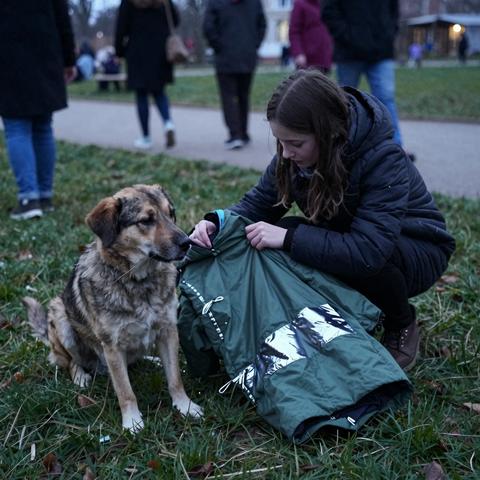
THEY LAUGHED AND POURED DRINKS WHILE THEIR LOYAL GOLDEN RETRIEVER COLLAPSED ON THE SCORCHING CONCRETE, GASPING FOR THE AIR THAT WAS SLOWLY LEAVING HIS LUNGS. I watched for two hours as the Texas sun beat down without mercy, and when I finally took a sledgehammer to their locked gate, I didn’t care about the law or their property rights—I only cared that the music stopped and the suffering ended.
You learn to recognize the sound of surrender. It isn’t a scream. It isn’t a cry. It’s a specific kind of silence that settles in when the body decides that fighting is no longer worth the energy. I recognized that silence from places far away from this manicured suburb, places where the sand was hot enough to melt boot rubber and the air tasted like sulfur. I never expected to see it in the eyes of a dog in my own neighbor’s backyard.
It was one hundred and four degrees. That’s not just hot; that’s oppressive. It’s the kind of heat that sits on your chest like a physical weight. The asphalt on our street was shimmering, turning the neighborhood into a hazy mirage of suburbia. I was sitting on my back porch, trying to find a rhythm in the humidity, nursing a glass of iced tea that was sweating faster than I was. My fence is old wood, slightly warped, with gaps wide enough to see through if you’re looking. I wasn’t trying to look. I was trying to mind my own business, something I’ve gotten very good at since coming home.
But the noise made it impossible.
The house next door, the one with the pristine siding and the expensive landscaping, was vibrating. Bass thumped through the ground, a repetitive, hollow thudding that rattled the ice in my glass. They were having a party. I could hear the clink of glass, the high-pitched shrieks of laughter, the performative joy of people who have never had to worry about anything more serious than a Wi-Fi outage. I didn’t know them well. The husband, Brad, was a man who wore sunglasses on the back of his neck and spoke loudly on his phone while pacing the driveway. The wife, influential in the HOA, smiled with her teeth but never her eyes.
And then I saw him.
He was a Golden Retriever, maybe five or six years old. A beautiful animal, or he would have been if he weren’t currently being cooked alive. He was locked in the side run of their yard, a narrow strip of concrete between the garage and the fence. There was no shade. The sun was directly overhead, turning that concrete strip into a skillet.
At first, he was pacing. I watched him trot back and forth, his tongue lolling out, panting with a heavy, wet rhythm. He would go to the back door, scratch once or twice, and then wait. Inside, the music swelled. Someone shouted a toast. The dog lowered his head and walked back to the gate, pressing his nose against the wood, trying to sniff the cooler air on the street.
I stood up and walked to the fence line. “Hey, buddy,” I said softly.
He looked at me. His eyes were wide, rimmed with white. He didn’t wag his tail. He just looked at me with a confusion that broke my heart. He couldn’t understand why the people who fed him were currently torturing him. I scanned the enclosure. There was a metal bowl overturned in the corner. Dry. Bone dry.
I checked my watch. 1:15 PM. The peak of the day.
“Hang on,” I muttered. I went inside, grabbed a pitcher of water, and returned to the fence. I tried to pour it through the gap, aiming for the overturned bowl. The water splashed onto the concrete, sizzling as it hit. The dog scrambled for it, licking the wet pavement desperately, his tongue rasping against the rough stone. It wasn’t enough. It evaporated in seconds.
I felt that familiar tightening in my chest. The discipline I’d built over twenty years told me to assess, evaluate, and act. But civilian life has rules. You don’t cross property lines. You don’t interfere. You call the authorities and you wait.
I called Animal Control. A recorded voice told me that due to high call volumes, wait times were exceeding two hours. Two hours. In this heat, two hours was a death sentence.
I walked around to their front door. The driveway was packed with luxury SUVs. I could hear the party clearly now—pop music and chatter. I rang the doorbell. Nothing. I banged on the door with the flat of my hand.
After a minute, the door swung open. It was Brad. He was holding a beer, his face flushed, wearing a polo shirt unbuttoned one too many. He looked at me like I was a solicitor selling pest control.
“Can I help you, man? We’re kinda in the middle of something.”
“Your dog,” I said, keeping my voice low. I learned a long time ago that shouting reveals weakness. “He’s in the side run. No water. No shade. It’s over a hundred degrees.”
Brad blinked, then laughed, a short, dismissive bark. “Oh, Buster? He’s fine. He loves the sun. We put him out because he gets anxious with the guests. He jumps on people.”
“He’s not fine,” I said, stepping closer. “He’s panting excessively. He’s licking the concrete. You need to bring him inside.”
Brad’s smile dropped. He took a step back, trying to close the door. “Look, thanks for the concern, neighbor, but I know how to handle my dog. He’s a dog. They live outside. Now, if you don’t mind…”
He slammed the door in my face.
I stood there for a moment, staring at the wood grain. I could hear him laughing on the other side, saying something about “creepy vet next door.”
I walked back to my yard. I went to the fence.
Buster wasn’t pacing anymore. He was lying on his side. His breathing had changed. It wasn’t the rhythmic panting of a hot dog; it was shallow, rapid, and raspy. His gums, visible as his lip curled back, looked dark, tacky. He was entering heat stroke. His body was shutting down.
I spoke to him. “Buster? Get up, boy.”
He didn’t move. His eye twitched, but he didn’t lift his head. The sun was relentless, a physical hammer beating down on his golden fur. I saw a tremor run through his back legs. Seizure territory was next. Then organ failure. Then the end.
I looked at the house. The party was louder. They were playing a game now, cheering.
I looked at the gate. It was a six-foot privacy fence, locked with a heavy padlock from the inside.
I didn’t think. I didn’t weigh the legal consequences. I didn’t consider the trespassing charges or the lawsuit Brad would inevitably threaten. The code I lived by didn’t vanish when I took off the uniform. You protect the defenseless. You do not leave a man—or a good boy—behind.
I walked to my garage. I bypassed the rake, the shovel, and the broom. I reached for the sledgehammer I used for breaking up old concrete. The handle was worn smooth, familiar in my grip. The weight of the head felt centering.
I walked back to the property line. I didn’t run. I walked with purpose.
I stood before their side gate. Through the slats, I saw Buster’s chest heave one shallow, desperate time. He closed his eyes.
“Not today,” I whispered.
I swung.
The sound of steel hitting wood echoed like a gunshot through the neighborhood. The wood splintered, but the lock held. I swung again. This time, the bracket twisted. The music inside the house seemed to falter, or maybe that was just my auditory exclusion kicking in, tunneling my senses down to the mission.
Third swing. The wood around the latch shattered. The gate swung inward with a groan.
I dropped the hammer and sprinted to the dog.
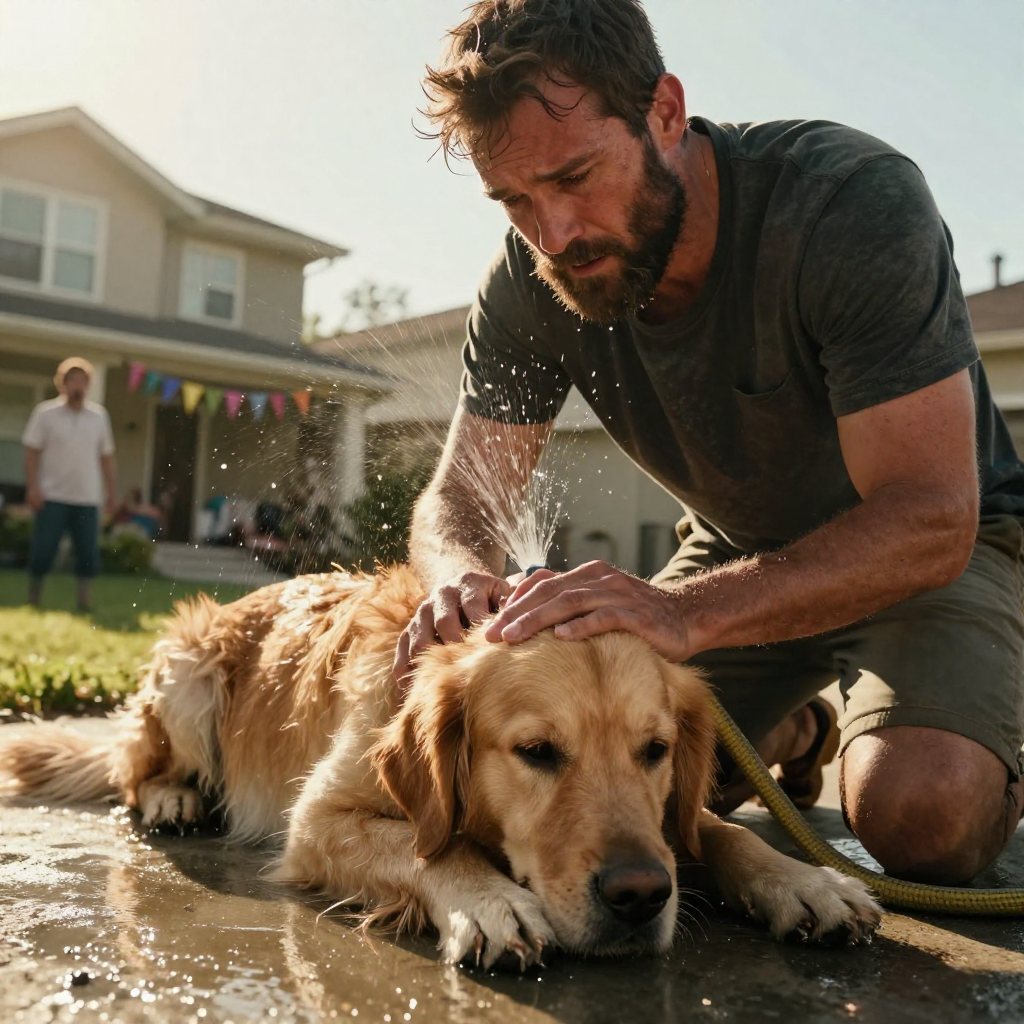
The heat coming off the concrete burned my knees as I knelt. Buster was burning up. He was a furnace. I scooped him up—he was heavy, dead weight, completely limp—and carried him immediately to the shade of my own porch. I didn’t have a hose in their yard, but I had a spigot right there.
I turned the water on low. Not ice cold—that could cause shock. Just cool. I ran the water over his paws, his belly, the back of his neck.
“Stay with me,” I commanded. “You stay right here.”
His tongue was hanging out, dry and purple. I cupped my hand and wet his gums. He didn’t swallow.
“HEY! WHAT THE HELL DO YOU THINK YOU’RE DOING?”
The voice was a screech. I didn’t look up. I kept wetting the dog’s fur, feeling for a heartbeat. It was there, but it was thready. Fast and weak.
“I SAID, WHAT ARE YOU DOING? YOU CRAZY LUNATIC, YOU BROKE MY GATE!”
Brad was standing there. Behind him, the party guests were spilling out, holding their solo cups, looking confused and frightened. Brad’s face was a mask of indignation. He was pointing a finger at me, shaking with rage.
“I’m calling the police!” his wife screamed from the patio. “He has a weapon! He has a hammer!”
I slowly stood up. My knees were wet. My shirt was soaked with sweat and hose water. I looked down at Buster. He let out a small whimper. It was the best sound I’d ever heard. He was still in there.
I turned to face them. I didn’t pick up the hammer. I didn’t need it. I just looked at Brad. I let him see the eyes of a man who has seen things Brad couldn’t imagine in his worst nightmares. I let him see the absolute, cold certainty of my rage.
“Call them,” I said. My voice wasn’t loud, but it cut through the summer air like a blade. The chatter of the guests died instantly. “Call the police. Tell them you left a living creature to cook on concrete in hundred-and-four-degree heat while you drank beer ten feet away. Tell them I had to break your property to save a life you were too lazy to protect.”
Brad stammered. He looked at his guests, looking for support. But nobody was looking at him. They were looking at the dog lying motionless in the mud I’d created. They were looking at the steam rising off the poor creature’s body. They were looking at the overturned, dry bowl in the neighbor’s yard.
“He… he had water,” Brad lied, his voice cracking. “He must have spilled it.”
I took a step forward. Just one step. Brad flinched so hard he almost dropped his drink.
“The bowl was bone dry, Brad. It had dust in it. Don’t lie to me. Not now.”
Buster coughed. A wet, hacking sound. I dropped back to my knees instantly, ignoring the humans. He lifted his head about an inch. I offered my hand, cupped with water. He lapped at it. Once. Twice.
“You’re trespassing,” Brad’s wife hissed, though she stayed behind the safety of her glass door.
“I’m saving a life,” I replied, not looking back. “And if you want to stop me, you’re going to have to make me move.”
Nobody moved. The silence in the backyard was heavier than the heat. The music had stopped. The only sound was the wet lap of a dog drinking water, and the distant wail of a siren approaching.
I didn’t know who called them—me or her. And I didn’t care. I just kept pouring water, watching the life slowly, painfully, flicker back into the eyes of the dog they had thrown away.
CHAPTER II
The flashing lights painted the stucco a lurid purple and red. My chest heaved, the sledgehammer still heavy in my grip. Brad, face contorted with rage, jabbed a finger at the broken gate. “He broke my property! I want him arrested!” His wife, a blonde woman in a sundress, clung to his arm, her eyes wide with a mixture of fear and indignation.
Officer Miller, a young guy barely out of the academy, stepped between us. He had that fresh-faced look that hadn’t yet been hardened by the job. “Alright, alright, let’s everyone calm down. Sir,” he said to Brad, “I need you to take a step back.”
“Calm down?” Brad sputtered. “This… this maniac destroyed my gate! He could have hurt someone!” He glanced around at his guests, who were now a silent, judging audience.
I lowered the sledgehammer, the weight a little less oppressive now that Buster was safe. “Your dog was dying, Brad. You left him in that run in this heat. He collapsed. I had to get him out.” My voice was rough, raw with adrenaline and anger.
Miller turned to me, his expression unreadable. “Sir, what’s your name?”
“Elias. Elias Thorne. And I’m a veteran. I know what neglect looks like.”
The word ‘veteran’ hung in the air, a heavy, unspoken thing. It was my shield, my justification, my plea for understanding. But it was also a brand, a scarlet letter that marked me as different, as someone who had seen things, done things, that others couldn’t comprehend.
Miller’s gaze flickered over me, taking in my worn jeans, my calloused hands, the haunted look in my eyes. “Okay, Mr. Thorne. I understand you were concerned about the dog. But you can’t just go around destroying people’s property.”
“He could have gotten a warrant,” Brad’s wife piped up, her voice shrill. “He could have called animal control!”
“Animal control takes time,” I retorted. “Buster didn’t have time. He was suffocating.”
A woman in the crowd gasped. “Oh my god, is the dog okay?”
I nodded. “He’s cooling down. He’s still weak, but he’s alive.” I looked directly at Brad. “Thanks to me.”
Miller sighed, running a hand through his short hair. “Alright, this is getting us nowhere. Sir,” he said to Brad, “I need you to give me your statement. And Mr. Thorne, I’m going to have to ask you to come with me to the station.”
“Am I under arrest?” I asked, my stomach clenching.
“Not yet,” Miller said cautiously. “But I need to get your side of the story. And we need to check on the dog, make sure he’s alright.”
The ride to the station was a blur. I sat in the back of the patrol car, the hard plastic seat digging into my back. My mind raced, replaying the events of the past hour. Had I done the right thing? Of course, I had. But had I gone too far? Had my rage blinded me to the consequences?
At the station, I was led to a small, sterile room with a metal table and two chairs. Miller sat across from me, a notepad in his hand. He asked me questions, and I answered them as honestly as I could. I told him about finding Buster in the run, about Brad’s dismissive attitude, about the moment I realized the dog was in mortal danger.
“So, you admit to damaging Mr. Peterson’s property?” Miller asked, his voice neutral.
“I admit to breaking down a gate to save a dog’s life,” I said firmly. “I’d do it again in a heartbeat.”
Miller scribbled something in his notepad. “Mr. Peterson is claiming you assaulted him. He says you threatened him with the sledgehammer.”
“That’s a lie,” I said, my anger flaring up again. “I never threatened him. I just wanted him to let the dog out.”
“He says you were yelling, acting aggressively.”
“I was upset,” I conceded. “But I never laid a hand on him.”
Miller leaned back in his chair, studying me. “Mr. Thorne, I understand you were trying to help. But you have to understand that you can’t take the law into your own hands.”
“What was I supposed to do?” I asked, my voice rising. “Watch that dog die? Just stand there and do nothing?”
He sighed. “I don’t know, Mr. Thorne. But breaking down someone’s property is not the answer.”
As I sat in the interrogation room, the implications of my actions began to sink in. I could be facing charges. Fines. Maybe even jail time. All for trying to save a dog.
The old wound throbbed—the feeling of helplessness, the weight of responsibility, the knowledge that doing what’s right often comes at a cost. It was the same feeling I had carried through the war, the same feeling that haunted my nightmares. The feeling of being alone, against the world, fighting a battle that no one else understood.
**OLD WOUND:** My time in the service had instilled in me an unwavering sense of duty and a fierce protectiveness towards the vulnerable. Witnessing cruelty or injustice triggered a deep-seated rage, a need to intervene, regardless of the consequences. This impulse had served me well in combat, but it was a liability in civilian life. It had already cost me my marriage and a series of jobs. This protectiveness of animals comes from having to put down dogs in the military after they were injured. It feels inhumane to not protect them.
Hours later, I was released with a citation for property damage and a court date looming. As I walked out of the station, I saw Sarah, my next-door neighbor, waiting for me. Her face was etched with worry.
“Elias!” she exclaimed, rushing towards me. “Are you okay? What happened?”
I told her the story, leaving out the details of the interrogation. She listened intently, her eyes filled with sympathy.
“Oh, Elias,” she said, squeezing my arm. “You did the right thing. Everyone in the neighborhood is talking about it. They’re disgusted with Brad and his wife.”
“But I broke his gate,” I said, feeling a wave of guilt wash over me. “I could be in serious trouble.”
“Don’t worry,” Sarah said. “We’re all going to support you. Brad and his wife have been neglecting that dog for months. We’ve all seen it. But no one wanted to get involved. You were brave enough to do what we were all too afraid to do.”
Sarah’s words were a small comfort, but they couldn’t erase the knot of anxiety in my stomach. I knew that this was just the beginning. The legal battle, the judgment of the community, the constant scrutiny—it was all going to take a toll.
The next morning, I woke up to a barrage of text messages and phone calls. News of the incident had spread like wildfire. Some people praised me as a hero, while others condemned me as a vigilante. My social media accounts were flooded with comments, both positive and negative.
As I scrolled through the messages, I saw one that made my blood run cold. It was from an anonymous account, and it contained a picture of my house with a message that read: “Mind your own business, old man. You don’t know who you’re messing with.”
My heart pounded in my chest. This wasn’t just about a dog anymore. This was about something else, something darker, something I didn’t understand.
**SECRET:** I had a secret. A secret involving my late father’s business dealings and a sum of money that had gone missing years ago. I’d always suspected he was involved in something shady, but I never had any proof. A few weeks ago, I had received a cryptic letter hinting at the truth, a truth that could expose a network of corruption and put me and those around me in danger. I had kept it from everyone, fearing the consequences of stirring up the past. That letter is hidden inside a locked safe in my basement.
The threat felt connected to something deeper, something tied to the past I had tried so hard to bury. Was this just a random act of intimidation, or was it a warning, a signal that someone knew about my secret?
I tried to dismiss the message as a prank, but I couldn’t shake the feeling that I was being watched, that I was in danger. I started locking my doors and windows, checking my rearview mirror whenever I drove, and avoiding dark or isolated places. I felt like I was back in the war zone, constantly scanning for threats, always on edge.
The situation with Brad and Buster continued to escalate. The local news picked up the story, and soon it was all over the internet. Animal rights activists rallied in my defense, while Brad and his wife became the target of online hate campaigns. Their business was boycotted, and their social media accounts were flooded with angry messages.
The pressure was immense, and Brad started to crack. He lashed out at reporters, blaming me for ruining his life. He even threatened to sue me for defamation. His wife, who had initially supported him, began to distance herself, whispering to neighbors about his drinking and his temper.
One evening, I received a call from Officer Miller. He told me that the vet had examined Buster and confirmed that he had suffered from severe heatstroke. The vet had also found evidence of previous neglect, including malnourishment and dehydration.
“We’re filing animal cruelty charges against Mr. Peterson,” Miller said. “Thanks to you, that dog has a chance at a better life.”
Miller’s words were a small victory, but they couldn’t erase the larger problems I faced. I was still facing charges for property damage, I was being threatened by unknown individuals, and I was caught in the middle of a media circus.
And then came the moral dilemma.
**MORAL DILEMMA:** A local animal rescue organization approached me with an offer. They wanted to pay for my legal defense, cover the cost of the gate repair, and provide me with a lifetime supply of dog food—in exchange for me publicly endorsing their organization and becoming their spokesperson. It was a generous offer, one that could solve all my immediate problems. But it felt wrong. It felt like I was profiting from Buster’s suffering, exploiting his story for personal gain. If I accept, I will become a liar. If I don’t accept, I will go to jail.
I wrestled with the decision for days. On the one hand, I needed the help. I couldn’t afford a lawyer, and I didn’t want to go to jail. On the other hand, I didn’t want to be a hypocrite. I didn’t want to be seen as someone who was using Buster’s plight to advance my own agenda.
One afternoon, as I was walking Buster in the park, I saw Brad sitting on a bench, alone and dejected. His wife was nowhere to be seen. He looked like he hadn’t slept in days. His clothes were rumpled, and his eyes were bloodshot.
I hesitated, wondering if I should approach him. I knew that he was suffering, but I also knew that he had brought it on himself. But then I remembered the look on Buster’s face when I found him in the run, the look of desperation and despair. And I knew that I couldn’t just walk away.
I walked over to the bench and sat down next to Brad. He didn’t acknowledge me.
“Brad,” I said softly. “How are you doing?”
He looked up at me, his eyes filled with hatred.
“How do you think I’m doing?” he spat. “You ruined my life!”
“I didn’t ruin your life, Brad,” I said calmly. “You ruined your own life. You neglected your dog. You treated him like he was nothing. And now you’re paying the price.”
“He was just a dog!” Brad shouted, his voice cracking. “He was just a pet!”
“He was more than that, Brad,” I said. “He was a living, breathing creature. He deserved to be treated with respect and compassion.”
Brad started to cry, his body shaking with sobs. “I didn’t mean to hurt him,” he said, his voice barely a whisper. “I just… I just got busy. I forgot.”
I looked at Brad, and I saw a broken man. A man who had made a terrible mistake, a man who was now facing the consequences of his actions.
And in that moment, I realized that I had a choice to make. I could continue to hate him, to seek revenge, to revel in his downfall. Or I could offer him forgiveness, a chance to redeem himself, a path towards healing.
The decision was agonizing. It went against everything I believed in. It challenged my sense of justice, my need for retribution. But I knew that it was the right thing to do. It was the only way to break the cycle of violence and hate.
I stood up and put my hand on Brad’s shoulder.
“Brad,” I said. “I’m going to help you.”
His head snapped up, his eyes wide with disbelief.
“What?” he stammered.
“I’m going to help you get your life back on track,” I said. “I’m going to help you make amends for what you did. I’m going to help you become a better person.”
Brad stared at me, his face a mask of confusion and suspicion.
“Why would you do that?” he asked.
“Because it’s the right thing to do,” I said. “Because we all deserve a second chance. Because even you, Brad Peterson, are capable of redemption.”
As I walked away, leaving Brad on the bench, I knew that I had made a decision that would change my life forever. I had chosen forgiveness over vengeance, compassion over hatred, hope over despair. But I also knew that I had opened myself up to a world of pain, a world of uncertainty, a world where anything was possible.
The Trigger: Later that night, a brick crashed through my living room window, shattering the glass and sending shards flying across the room. A note was attached to the brick, scrawled in menacing block letters: “DROP THE DOG ACT, OR YOU’RE NEXT.”
This was not just about Buster anymore. This was a declaration of war. And I knew, with chilling certainty, that the battle had just begun.
CHAPTER III
The brick shattered the silence. Glass rained down, glittering in the moonlight. I stood frozen, heart hammering, staring at the gaping hole in my living room window. This wasn’t just about a dog anymore.
It was personal.
I moved cautiously, stepping over shards of glass. My phone was in the kitchen. I had to get to it, call the police, but a primal instinct screamed at me to be careful. This felt… different. More calculated.
As I reached the kitchen, a figure moved in the shadows outside. I ducked behind the counter, adrenaline surging. It was a man, tall and broad, his face obscured by a baseball cap. He was holding something.
A gun.
I scrambled back, adrenaline coursing through me. My mind raced, trying to formulate a plan. I wasn’t a soldier anymore. I was just… me. A guy who rescued a dog.
The back door. The woods. It was my only chance.
I bolted, crashing through the back door and into the darkness. Thorns tore at my skin as I ran, the man’s heavy footsteps pounding behind me. He yelled something, but I didn’t hear the words. I just ran. Blindly.
I didn’t stop until I reached the creek, gasping for breath, my lungs burning. I plunged into the icy water, the shock stealing my breath. The water would mask my scent.
He wouldn’t find me here.
I waited, shivering, for what felt like an eternity. The only sound was the rushing water and my own ragged breathing. Finally, after what seemed like hours, I heard him retreat. Slowly, cautiously, I crawled out of the creek.
I had to figure out what was going on.
I went back to the house. The police were already there, yellow tape cordoning off the yard. I gave them my statement, but I left out the part about seeing the gun. I didn’t trust them. Not anymore.
I needed answers, and I knew only one place to find them: my father’s old office. It had been locked up since he died, the files untouched. I had avoided it, not wanting to confront the ghosts of his past. But now, I had no choice.
The office was downtown, above a dusty pawn shop. I hadn’t been there in years. The lock was rusty, but I managed to pick it with a hairpin I found in my car. The air inside was thick with dust and the scent of old paper.
The files were neatly organized, but the names meant nothing to me. Until I found one labeled “Project Nightingale.” My father had always been secretive about his work, but this… this felt different.
The file contained documents, photographs, and handwritten notes. It told a story of corruption, bribery, and betrayal. My father had been involved in something big, something dangerous.
And then I saw the names. Prominent politicians, wealthy businessmen, and… Brad’s father.
I understood. The dog, the party, the threats… it was all connected. My father had stolen money from these people, and they wanted it back. And now, they thought I had it.
I had to get out of here. I gathered the files, stuffing them into a bag.
Suddenly, the door crashed open. The man from my house, the one with the gun, stood there, blocking my exit.
“Looking for something?” he asked, his voice cold and menacing.
“I don’t know what you’re talking about,” I said, trying to sound braver than I felt.
He chuckled. “Don’t play dumb with me, Thorne. We know about the money. Your father stole it, and now we want it back.”
“I don’t have any money,” I said. “I don’t know anything about it.”
He raised the gun. “You’re lying.”
I knew I was out of options. I had to tell him something, anything, to buy myself some time. “Okay, fine,” I said. “I know where the money is. But you have to promise to leave me alone, to leave my friends alone.”
He hesitated. “Where is it?”
“It’s… it’s buried,” I said. “In the woods, near my house. I’ll take you there, but you have to promise…”
He nodded. “Alright. Let’s go.”
We drove in silence to the woods. The man kept the gun trained on me the whole time. I led him through the trees, towards the creek where I had hidden earlier.
“It’s here somewhere,” I said, stalling for time. “I just need to find the spot.”
He grew impatient. “Hurry up.”
I stopped near the creek. “This is it,” I said. “It’s buried under that tree.”
He started digging, his eyes fixed on the ground. I knew this was my chance. I lunged at him, knocking him off balance. The gun flew from his hand and landed in the creek.
We grappled on the ground, each of us fighting for our lives. I managed to get on top of him, pinning him down. I started punching him, again and again, until he stopped moving.
I stood there, panting, covered in dirt and blood. I had done it. I had survived.
But it wasn’t over yet. I knew these people wouldn’t give up easily. I had to expose them, to bring them to justice.
I picked up the gun from the creek and headed back to my car. I had a plan.
I went straight to Brad’s house. It was late, but I didn’t care. I pounded on the door until he answered, bleary-eyed and confused.
“What do you want, Thorne?” he asked.
“I know about your father,” I said. “I know about Project Nightingale.”
His face paled. “I don’t know what you’re talking about.”
“Don’t lie to me, Brad,” I said. “I have the files. I know everything.”
He hesitated, then sighed. “Come in,” he said.
I followed him inside. His wife was asleep on the couch. He led me to the kitchen and closed the door.
“How did you find out?” he asked.
“It doesn’t matter,” I said. “What matters is that I’m going to expose your father, and everyone else involved.”
He shook his head. “You can’t do that, Thorne. It’s too dangerous. They’ll kill you.”
“I don’t care,” I said. “I’m not going to let them get away with it.”
He looked at me, his eyes filled with a mixture of fear and admiration. “What do you want me to do?” he asked.
“I want you to help me,” I said. “I want you to testify against your father.”
He hesitated. “I… I don’t know if I can.”
“You have to, Brad,” I said. “It’s the only way to stop them.”
He thought for a moment, then nodded. “Okay,” he said. “I’ll do it.”
I knew it wouldn’t be easy. We would be putting ourselves in grave danger. But I also knew it was the right thing to do. We had to stand up to these people, to show them that they couldn’t get away with their corruption and greed.
We spent the next few days gathering evidence and preparing for the trial. Brad was nervous, but he was determined to do the right thing. He knew his father would never forgive him, but he couldn’t live with himself if he didn’t speak out.
Finally, the day of the trial arrived. The courtroom was packed with reporters and onlookers. Brad and I sat at the defendant’s table, facing a team of high-powered lawyers. Brad’s father sat in the front row, his face a mask of anger and betrayal.
The trial lasted for days. The prosecution presented a mountain of evidence, including the files I had found in my father’s office and Brad’s testimony. The defense tried to discredit us, but they couldn’t deny the truth.
In the end, the jury found Brad’s father and his co-conspirators guilty on all counts. They were sentenced to long prison terms.
As they were led away, Brad’s father turned to him, his eyes filled with hate. “You’ll regret this, Brad,” he said. “You’ll regret the day you were born.”
Brad didn’t say anything. He just watched his father go, his face filled with sadness.
After the trial, things slowly started to return to normal. The threats stopped, and I was able to sleep through the night without worrying about someone breaking into my house.
Brad and I became close friends. He was a changed man. He had finally stood up to his father and done the right thing. He was now working to help other people who had been victimized by corruption.
And Buster? Buster was doing great. He was happy and healthy, and he loved playing in the yard. He was a symbol of hope, a reminder that even in the darkest of times, there is always light.
But the experience had changed me. I was no longer the same person I had been before. I had seen the darkness in the world, and I knew that it was always there, lurking beneath the surface. I had learned that sometimes, you have to fight for what’s right, even if it means putting your own life at risk. And I had learned that even the most unlikely of people can find redemption.
I had also learned that some secrets are best left buried. My father’s actions had unleashed a chain of events that had nearly destroyed me. I knew that I would never fully escape his past, but I was determined to live my own life, to make my own choices.
One evening, as I was sitting on my porch, watching the sunset, I saw Brad walking towards me, Buster trotting happily at his heels.
“Hey, Elias,” he said. “Mind if we join you?”
“Of course,” I said. “Come on up.”
We sat in silence for a few minutes, watching the sky turn orange and pink. Then, Brad turned to me and said, “Thank you, Elias. For everything.”
“You don’t have to thank me, Brad,” I said. “We did what we had to do.”
He smiled. “Yeah, I guess we did.”
We sat there, side by side, two men who had been through hell and back. We were different people now, but we were bound together by a shared experience, a shared sense of purpose. And we knew that whatever the future held, we would face it together.
I leaned back in my chair, closed my eyes, and breathed in the cool evening air. The scent of freshly cut grass filled my nostrils. I could hear the crickets chirping in the distance. It was a peaceful moment, a moment of quiet contentment.
But I knew that the peace wouldn’t last forever. The world was a dangerous place, and there were always new battles to be fought. But I was ready. I was no longer afraid. I had faced my demons, and I had survived. And I knew that whatever came next, I would be ready to face it head-on.
I opened my eyes and looked at Brad and Buster. They were both smiling. I smiled back. We were a team, a family. And we would protect each other, no matter what.
I knew that my father’s past would always be a part of me, but it wouldn’t define me. I was my own man, and I would live my life on my own terms. I would fight for what was right, and I would never give up. That was my promise to myself, and to the world.
And as the sun dipped below the horizon, casting long shadows across the yard, I knew that I was finally free.
Free from the past, free from the fear, free to live my life to the fullest.
And it all started with a dog.
I drove to the animal shelter. It was small, cramped, and smelled of disinfectant. But the people who worked there were dedicated, passionate about saving animals. I told them I would be their spokesperson, pro bono.
They were overjoyed.
As I left, I saw a familiar face. It was Sarah, the reporter who had covered the Buster story. She smiled.
“So,” she said. “You’re the animal shelter’s new hero?”
I shrugged. “I’m just trying to do what’s right.”
“Well, you’re doing a good job,” she said. “Keep it up.”
She turned to leave, then stopped.
“Oh, and Elias?” she said. “Be careful. There are still some people out there who aren’t happy with what you did.”
I nodded. “I know,” I said. “But I’m not afraid.”
She smiled again and walked away. I watched her go, then got in my car and drove home.
I knew that the danger was still there, lurking in the shadows. But I wasn’t going to let it control me. I was going to live my life, and I was going to do what was right. And if that meant putting myself in harm’s way, then so be it.
Because in the end, it’s not about the money or the power or the fame. It’s about doing what’s right, even when it’s hard. It’s about standing up for what you believe in, even when you’re afraid. And it’s about making a difference in the world, even if it’s just one dog at a time.
And as I drove into the sunset, I knew that I was finally on the right path.
The path of purpose. The path of integrity. The path of hope.
And that was all that mattered.
CHAPTER IV
The silence was the loudest thing. Louder than the shouting matches with Brad’s wife after Buster almost died. Louder than the brick shattering my window. Louder than the gavel slamming down in the courtroom. Just…silence. It filled the apartment, clung to the walls, and settled in my chest like a stone. The trial was over. The men involved in Nightingale were going to prison. Brad’s father included. We’d won, I guess. But winning felt a lot like losing something I couldn’t name.
Sarah, the reporter, called a few times. She wanted an interview, a victory lap. I ignored her calls. What was there to say? ‘We did it. Justice prevailed?’ It all sounded so hollow. Justice didn’t bring my father back. It didn’t erase the threats, the fear, the constant looking over my shoulder. It just…ended.
Brad was a mess. He’d testified against his own father. I couldn’t imagine the kind of hell that put him through. He stopped by a few times, his eyes red-rimmed and haunted. He’d just stand there, fidgeting, not saying much. “Thanks, Elias,” was all he managed the last time I saw him. Then he was gone.
The media circus died down. People moved on. Another scandal, another headline, another outrage to fuel the 24-hour news cycle. But I couldn’t move on. It was like the whole thing had burrowed under my skin.
I started volunteering at the animal shelter more often. Being around the animals was…calming. They didn’t care about Nightingale, about my father, about any of it. They just needed food, water, and a little bit of affection. Buster was adopted by a nice young couple. I saw them walking him in the park once. He looked happy. Healthier.
One evening, I got a letter. No return address. Inside was a single photograph: my father, younger, laughing with a group of men I didn’t recognize. On the back, a single word was scrawled in faded ink: ‘Debts.’
That was phase 1. The silence.
Phase 2 began with a knock on the door. It was Detective Reynolds. He looked tired, older than I remembered.
“Elias, we need to talk,” he said, his voice low. “About Nightingale. It’s not over.”
I felt a knot tighten in my stomach. “What do you mean? The trial…”
“The men you took down,” Reynolds interrupted, “they weren’t the only ones involved. We’ve been digging, following the money. It leads to someone else. Someone powerful. And they’re not happy.”
He told me about offshore accounts, shell corporations, and a web of corruption that stretched far beyond what we’d uncovered. The men we put away were just pawns. The real players were still out there, pulling the strings.
“We need your help, Elias,” Reynolds said. “You know more than you think. About your father, about Nightingale. We need you to testify again.”
I hesitated. I was tired. So tired of the lies, the threats, the danger. I wanted to be done with it, to move on with my life. But I knew I couldn’t. Not really. Because even if I walked away, they wouldn’t let me. They couldn’t.
“Who is it?” I asked, my voice barely a whisper.
Reynolds leaned in, his eyes grim. “Senator Caldwell,” he said. “He was the one who funded project Nightingale from the start.”
The name hit me like a punch to the gut. Caldwell was a pillar of the community, a respected politician, a man of the people. Or so everyone thought.
“We have evidence,” Reynolds continued, “but it’s circumstantial. We need something concrete, something that ties him directly to Nightingale. And we think your father might have had it.”
He explained that they’d searched my father’s house, his office, everything. But they’d found nothing. It was like he’d erased himself from the project. But Reynolds believed there was something, somewhere, that my father had hidden. A failsafe, a way to protect himself if things went south.
“Think, Elias,” Reynolds pleaded. “Anything. A safety deposit box, a hidden account, a code word. Anything that could lead us to the truth.”
I closed my eyes, trying to remember. My father was a complicated man, a man of secrets. I never really knew him. But maybe, just maybe, there was something I could remember.
Then it hit me. A memory, buried deep in my mind. I was a child, maybe ten years old. My father was working late in his study. I snuck in to say goodnight, and I saw him hiding something in a book. Not just any book, but a first edition copy of ‘The Count of Monte Cristo’. He told me it was his favorite book, that he loved the story of revenge and redemption. He told me to never touch it, but I always wondered why that book specifically.
“The book,” I said, my eyes snapping open. “He had a book. A first edition of ‘The Count of Monte Cristo’. He always kept it locked away.”
Reynolds’ eyes lit up. “Where is it now?”
I shook my head. “I don’t know. After he died, I never saw it again. I assumed it was sold off with the rest of his things.”
“We need to find that book, Elias,” Reynolds said. “It could be the key to everything.”
That night, I couldn’t sleep. The weight of it all was crushing me. Nightingale wasn’t over. It was just evolving. I felt like I was trapped in a nightmare, a never-ending cycle of lies and corruption.
I went to Brad’s house. He looked worse than the last time I saw him. The bags under his eyes were darker, his face gaunt. He hadn’t shaved in days.
“They’re going after Caldwell now,” I said, without preamble.
Brad stared at me blankly. “Caldwell? The senator?”
I nodded. “He was behind Nightingale. Reynolds thinks my father hid something that could take him down. A book. A first edition of ‘The Count of Monte Cristo’.”
Brad’s eyes widened. “I remember that book,” he said. “Your father was obsessed with it. He used to carry it around everywhere.”
“Do you know where it is?” I asked, my voice filled with desperation.
Brad shook his head. “No. But…my mother might. She handled all of your father’s affairs after he died. She might know what happened to it.”
I hesitated. Brad’s mother was a cold, calculating woman. She had never liked me, never trusted me. But I had no other choice. I needed to find that book.
We drove to Brad’s mother’s house. It was a large, imposing mansion in the wealthy part of town. The kind of house that screamed money and power. Brad was nervous, his hands trembling as he rang the doorbell.
The door was opened by a stern-faced woman in a tailored suit. Brad’s mother. She looked at us with disdain.
“What do you want, Brad?” she asked, her voice cold and sharp.
“Mom, I need to ask you something,” Brad said. “About Elias’s father. About a book he had. ‘The Count of Monte Cristo’.”
Her eyes narrowed. “I don’t know what you’re talking about.”
“Mom, please,” Brad pleaded. “It’s important. It could help a lot of people.”
She sighed, a look of annoyance on her face. “I suppose I do recall something about a book. After Elias’s father passed, I sold a lot of his belongings. I wouldn’t remember where that specific book went”
I tried to interject. “Can you check your records, please? Maybe you sold it to a collector, or a bookstore?”
She gave me a withering look. “I’m a very busy woman, Elias. I don’t have time for this.”
“Please, just a few minutes,” I said. “It could make a big difference.”
She hesitated, then relented. “Fine,” she said. “But make it quick.”
She led us into her study, a large room filled with bookshelves and expensive antiques. She sat down at her desk and opened a drawer, pulling out a stack of old documents. She began flipping through them, her brow furrowed in concentration.
After what felt like an eternity, she stopped. “Here,” she said, handing me a receipt. “I sold a collection of rare books to a dealer in New York City. This one was included.”
The name of the dealer was unfamiliar to me, but the address was there. New York City. It was a long shot, but it was the only lead I had.
Phase 3 was the hunt. The desperate, cross-country chase after a ghost.
I flew to New York the next day. Brad came with me. He said he needed to get away from his mother, from everything. I couldn’t blame him.
We found the book dealer, a small, unassuming shop in Greenwich Village. The owner was an old man with glasses and a tweed jacket. He remembered buying the collection of books from Brad’s mother. He even remembered ‘The Count of Monte Cristo’.
“A beautiful book,” he said, his eyes twinkling. “A true classic.”
“Do you still have it?” I asked, my heart pounding.
He shook his head. “I sold it a few years ago. To a private collector.”
My heart sank. Another dead end.
“Do you know who the collector was?” I asked, my voice barely above a whisper.
He hesitated. “I’m not sure I should say. He prefers to remain anonymous.”
I pleaded with him, explained the situation, told him about Nightingale and Senator Caldwell. Finally, he relented.
“I can’t give you his name,” he said. “But I can tell you where he lives. He has a house in upstate New York. A large estate. Everyone calls it ‘Monte Cristo’.”
Monte Cristo. The name sent a chill down my spine.
We drove to upstate New York that night. The estate was even more imposing than Brad’s mother’s house. It was surrounded by high walls and security cameras. We parked the car down the road and walked the rest of the way.
We found a break in the wall and slipped through, making our way to the main house. It was dark and silent, but I could see lights on in the distance.
We crept closer, hiding behind bushes and trees. We reached a large window and peeked inside. There, sitting at a desk, was Senator Caldwell. He was reading a book.
I couldn’t see the cover, but I knew what it was. ‘The Count of Monte Cristo’.
Phase 4. Confrontation. The bitter taste of truth and ashes.
Brad and I looked at each other. We didn’t need to say anything. We knew what we had to do.
We burst through the front door, catching Caldwell completely by surprise. He jumped up from his desk, his face pale with shock.
“What the hell is this?” he demanded, his voice trembling.
“It’s over, Senator,” I said, my voice cold and hard. “We know about Nightingale. We know about everything.”
He tried to deny it, to lie his way out of it. But we had him. We had the book, the evidence, the truth.
He knew he was defeated. He sank back into his chair, his face buried in his hands.
“How did you find me?” he asked, his voice muffled.
I didn’t answer. It didn’t matter anymore.
The police arrived a few minutes later. They took Caldwell into custody. As they led him away, he looked at me, his eyes filled with hatred.
“You haven’t won, Thorne,” he said. “This isn’t over.”
I didn’t say anything. I knew he was right. It would never be over. The scars of the past would always remain. But maybe, just maybe, we had made a difference. Maybe we had stopped something terrible from happening. Maybe we had brought a little bit of justice to the world.
After Caldwell’s arrest, I expected a sense of closure. Instead, there was a gnawing emptiness. The spotlight shifted again, the media clamoring for sound bites and sensational headlines. Sarah, relentless as ever, finally cornered me for an interview.
“Elias, how does it feel to bring down Senator Caldwell?” she asked, her pen poised above her notepad.
I stared at her, the question hanging in the air like a stale accusation. “It feels…complicated,” I said, the words inadequate, hollow. “There’s no victory here, Sarah. Just a lot of broken people.”
Brad retreated further into himself, consumed by guilt and regret. His father’s actions had tainted his entire life, casting a long shadow over everything he held dear. He stopped answering my calls, disappearing into a self-imposed exile.
Then the call came. It was from Detective Reynolds. His voice was grim.
“Elias, we found something,” he said. “Something you need to see.”
I met him at the police station. He led me to a back room, where a table was covered with evidence bags.
“We’ve been going through Caldwell’s files,” Reynolds said. “We found this.”
He handed me a photograph. It was a picture of my father, standing next to Caldwell. They were smiling, shaking hands. Behind them, I saw a group of men I recognized from the picture I’d received earlier.
But there was something else in the photograph. Something that made my blood run cold. In the background, partially obscured by a tree, was a figure I knew all too well. A figure I thought I’d buried long ago.
It was my uncle. My mother’s brother. The man who had raised me after my parents died.
“We’re still trying to piece it together,” Reynolds said. “But it looks like your uncle was involved in Nightingale from the beginning. He was the one who introduced your father to Caldwell.”
The world spun. My uncle? The man I had trusted, the man I had loved? He was part of all of this?
I stumbled out of the police station, gasping for air. The weight of it all was too much to bear. I felt betrayed, hollowed out, utterly alone.
I went back to my apartment and sat in the dark, staring at the photograph. My father, Caldwell, my uncle. A web of lies and deceit that had spanned decades. A web that had ensnared my entire life.
Suddenly, everything made sense. The threats, the attacks, the brick through the window. It wasn’t just about my father’s past. It was about my uncle’s present. He was trying to protect himself, to silence me before I could uncover the truth.
But why? What was his role in Nightingale? What was he hiding?
As I sat there, lost in thought, I noticed something else in the photograph. A small detail I had missed before. On my uncle’s wrist, I saw a bracelet. A silver bracelet with a distinctive clasp.
I knew that bracelet. I had given it to him when I was a child. It was a gift for his birthday. A gift I had made myself.
And then I remembered something else. Something my uncle had said to me, years ago. Something I had dismissed as a joke.
“Elias,” he had said, “never trust anyone. Everyone has secrets. Even the ones you love the most.”
I had no idea how right he was.
I stood up, my heart pounding in my chest. I knew what I had to do. I had to confront my uncle. I had to find out the truth.
I drove to his house. It was late, but I didn’t care. I needed answers. I needed to know why.
I parked the car and walked up to the front door. I knocked, my hand trembling.
The door opened, and there he was. My uncle. He looked surprised to see me.
“Elias,” he said, his voice strained. “What are you doing here?”
I held up the photograph. “I know,” I said. “I know about Nightingale. I know about Caldwell. And I know about you.”
He stared at the photograph, his face paling. He didn’t say anything.
“Why?” I asked, my voice filled with pain. “Why did you do it?”
He hesitated, then sighed. “Come in, Elias,” he said. “Let’s talk.”
He led me inside, and I knew, with a chilling certainty, that my life was about to change forever. Again.
My uncle’s confession was a slow, agonizing bleed. He’d been involved with Nightingale from the start, lured in by the promise of wealth and power. He was the one who connected my father to Caldwell, the one who facilitated the entire operation. He’d justified it to himself as a means to an end, a way to secure a better future for our family. But the truth was, he’d been blinded by greed.
“And my father?” I asked, my voice trembling. “Did he know what he was getting into?”
My uncle hesitated. “He wasn’t innocent, Elias. He knew the risks. But he believed in the cause. He thought he was doing something good.”
I didn’t want to believe it, but deep down, I knew it was true. My father had always been a flawed man, a man driven by ambition and a desire for recognition. Nightingale had given him that, albeit at a terrible cost.
The revelation that stung the most was how deeply my uncle had been playing me. The comforting shoulder after my parents died, the guiding hand as I grew up – all a carefully constructed facade to keep me in the dark. He’d even encouraged my pursuit of justice against Caldwell, knowing it would ultimately lead back to him, gambling that his manipulation would protect him.
“Why didn’t you just tell me?” I asked, tears streaming down my face. “Why did you let me believe all these lies?”
“I was trying to protect you, Elias,” he said, his voice filled with remorse. “I didn’t want you to get hurt.”
“Protect me?” I screamed. “You lied to me my whole life! You used me! How is that protecting me?”
He didn’t have an answer. He just sat there, his head in his hands, consumed by shame.
I left his house that night feeling more lost and alone than ever before. The world I thought I knew had crumbled around me, revealing a foundation built on lies and betrayal. The justice I had fought so hard to achieve felt hollow, tainted by the knowledge that the people closest to me were deeply involved in the corruption I had tried to expose.
The following days were a blur. I cooperated with the authorities, providing them with the information my uncle had given me. He was arrested and charged with conspiracy and fraud. The news sent shockwaves through the community, shattering the image of the respected businessman and philanthropist he had carefully cultivated.
Brad, after hearing the news about my uncle, showed up at my door. He didn’t say a word, just wrapped me in a hug.
I resigned from my position as a spokesperson for the animal shelter. I couldn’t face the public, couldn’t bear the thought of pretending that everything was okay. I needed time to heal, to process everything that had happened.
I started going to therapy. It was slow, painful work, but it helped me to understand the trauma I had experienced and to begin to rebuild my life. I learned that forgiveness wasn’t about condoning the actions of others, but about freeing myself from the burden of anger and resentment.
One day, I visited my uncle in prison. He looked old and defeated, a shadow of the man I once knew.
“I’m sorry, Elias,” he said, his voice barely audible. “I never meant for any of this to happen.”
I looked at him, my heart filled with a mixture of sadness and anger. “I don’t know if I can ever forgive you,” I said. “But I hope, someday, I can understand.”
I walked away, leaving him alone in his cell. As I stepped out into the sunlight, I felt a sense of peace I hadn’t felt in a long time. The scars of the past would always be there, but I was no longer defined by them. I was free to create my own future, to find my own meaning in the world.
I started volunteering at a local soup kitchen, helping to feed the homeless and the hungry. It wasn’t glamorous work, but it was meaningful. It reminded me that even in the darkest of times, there was always hope, always a chance to make a difference.
One evening, as I was leaving the soup kitchen, I saw a familiar figure standing across the street. It was Sarah, the reporter.
She smiled at me. “Elias,” she said. “I just wanted to say…I’m sorry. About everything. I know I can be a pain, but I admire what you’ve done.”
I smiled back. “Thanks, Sarah,” I said. “I appreciate that.”
We stood there for a moment, in silence. Then, she turned and walked away. I watched her go, feeling a sense of gratitude for the small acts of kindness that had helped me through the darkest of times.
As I walked home that night, I realized that the silence wasn’t so loud anymore. It was still there, but it was different. It was the silence of peace, of acceptance, of hope. And in that silence, I could finally hear the sound of my own heart, beating strong and true.
The quiet end.
CHAPTER V
The photograph of my uncle, Daniel, standing beside Senator Caldwell at what looked like a groundbreaking ceremony, felt like a physical blow. It wasn’t just the confirmation of his involvement in Nightingale; it was the casualness of it, the normalcy. Like posing for a snapshot at a family picnic. The man who taught me to fish, who bandaged my scraped knees, was complicit in something so deeply rotten. I stared at the picture for hours, the faces blurring into a grotesque caricature of betrayal.
I didn’t call him. Couldn’t. The words felt like ash in my mouth. I needed to see him, to look into his eyes and understand – or at least try to. But a part of me was terrified of what I would find. So, I drove. Drove the familiar route to his lakeside cabin, the one where we’d spent countless summer afternoons. The air was thick with humidity, the lake still and reflecting the oppressive sky.
He was on the porch, whittling a piece of wood. Didn’t look up until I was halfway up the steps. “Elias,” he said, his voice flat. No surprise, no welcome. Just my name, hanging in the heavy air.
“The photo,” I said, holding up the printout. “Nightingale.”
He sighed, the sound of air leaking from a punctured tire. “I suppose it was inevitable.”
That was it? No denial? No elaborate justification?
“Why, Daniel?”
He gestured to a chair. I remained standing.
“Sit down, Elias. It’s a long story.”
“I don’t want a story. I want the truth.”
He looked out at the lake, his eyes distant. “The truth is rarely simple, Elias. Your father… he wasn’t the saint you thought he was.”
That stung. “Don’t try to make this about him.”
“It *is* about him. Nightingale… it started as something good, something meant to help people. But it got corrupted. Money, power… it changes people.”
“And you?”
He finally met my gaze. “I thought I could control it. That I could keep things from going too far. I was wrong.”
“Control it? You were part of it! You benefited from it!”
“I tried to help people!” he snapped, his voice rising for the first time. “I funneled money to families who were hurt! I…”
“That doesn’t excuse what you did!” I shouted, finally sitting down, the anger a physical ache in my chest.
We sat in silence for a long time, the only sound the buzzing of insects. The idyllic setting felt obscene, a mockery of the memories I held so dear.
Finally, I spoke. “Did you know about… what happened to Buster?”
He shook his head. “No. I swear to God, Elias, I didn’t. I wouldn’t…”
I wanted to believe him. But could I?
I stood up. “I don’t know what to say, Daniel. I don’t know if I can ever forgive you.”
He didn’t try to stop me as I walked away.
The drive back was a blur. The anger had subsided, replaced by a bone-deep weariness. I pulled into my driveway, Buster barking a greeting from the backyard. I let him out, burying my face in his fur, trying to find some comfort in his unwavering affection.
Later that evening, Brad called. He sounded different, subdued.
“My father… he’s trying to appeal the verdict,” he said.
“I figured he would.”
“He wants me to lie. To recant my testimony.”
I didn’t say anything. There was nothing to say.
“I can’t do it, Elias. I won’t.”
“I know you won’t.”
“But… it’s still my father. And I… I don’t know how to feel.”
“There’s no right way to feel, Brad. Just… feel.”
We talked for a while longer, about nothing and everything. It was a strange kind of comfort, sharing the burden of our fathers’ sins.
The appeal failed. My uncle was never charged. He wasn’t senior enough. The layers of protection were airtight. He disappeared from public view, retreating to his cabin by the lake.
Phase 2
The days turned into weeks, the weeks into months. The animal shelter became my refuge. The unconditional love of the animals was a balm for my wounded soul. I spent hours cleaning cages, feeding strays, and just being present with them. It wasn’t a cure, but it was a start.
One afternoon, Sarah, the reporter, stopped by the shelter.
“I wanted to see how you were doing,” she said.
“I’m doing,” I replied, noncommittally.
“The Nightingale story… it’s still making waves. People are finally starting to pay attention to the corruption that’s been going on for years.”
“Good.”
“But… it’s also brought out the worst in some people. There’s been a lot of… anger.”
“I’m aware.”
“I was wondering… have you thought about speaking out? About… what you’ve learned?”
I hesitated. I wasn’t sure I had anything left to say. “I don’t know, Sarah. I’m not sure it would make a difference.”
“It might. It might give people hope. Show them that it’s possible to fight back.”
I thought about it for a long time after she left. Hope. Was that something I still believed in? I looked around at the animals, their faces trusting, their tails wagging. Maybe, just maybe, it was.
I started small, giving interviews to local newspapers, talking about the importance of animal welfare, about the need for transparency and accountability. I didn’t preach or moralize. I just told my story, honestly and simply. And people listened.
Letters started arriving, from all over the country. People who had been affected by corruption, people who had lost loved ones, people who had simply been inspired by my story. Their words gave me strength, a sense of purpose I hadn’t felt in years.
One letter, in particular, stood out. It was from a young woman whose father had been a victim of Nightingale. She had lost everything, her home, her family, her hope. But she wrote that my story had given her the courage to keep fighting, to keep searching for justice.
That letter changed everything. It made me realize that my silence was a form of complicity. That I had a responsibility to speak out, not just for myself, but for all those who had been silenced.
I started working with Sarah, helping her to uncover more details about Nightingale, to expose the people who were still benefiting from its corruption. It was dangerous work, but I didn’t care. I had found my purpose, and I wasn’t going to let it go.
Phase 3
Time continued its relentless march. Brad and I started a foundation, small but dedicated, providing legal assistance to victims of corporate malfeasance and animal abuse. We focused locally, on cases that slipped through the cracks, the ones the big firms ignored. Brad, surprisingly, had a knack for fundraising; his name, despite his father’s disgrace, still carried weight in certain circles. He used it for good now.
My uncle never reached out. The silence was a constant ache, a missing piece of my life that I couldn’t replace. I knew, intellectually, that forgiveness was a choice, a conscious act of will. But emotionally, it felt impossible. The betrayal was too deep, the wound too raw.
One day, a package arrived at the shelter. It was a small, wooden box, addressed to me in my uncle’s handwriting. Inside, there was a fishing lure, the same kind he had taught me to use when I was a boy. And a note.
“Elias,” it read. “I don’t expect you to forgive me. I only hope that someday, you can understand. I did what I thought was right, but I was wrong. I’m sorry. Daniel.”
Tears streamed down my face. It wasn’t an apology, not really. But it was an acknowledgement. A recognition of the pain he had caused. And maybe, just maybe, it was enough.
I drove to the lake. His cabin was still there, but the porch was empty. The windows were dark. I walked down to the water’s edge, cast the lure out into the lake.
The line sang in the wind. The sun glinted on the water. I closed my eyes, remembering the feel of his hand on mine, teaching me how to cast, how to reel. The memory was bittersweet, laced with both love and regret.
I stayed there for a long time, the silence broken only by the lapping of the waves. Finally, I reeled in the line, packed up my tackle box, and walked away.
I never saw him again.
Phase 4
The foundation grew, slowly but steadily. We helped dozens of families, rescued countless animals. Brad found a kind of peace in his work, a way to atone for his father’s sins. He even started seeing a therapist, dealing with the emotional fallout of the trial.
I continued to volunteer at the shelter, finding solace in the simple act of caring for those who couldn’t care for themselves. Buster was always by my side, a constant reminder of the good that can come from even the darkest of situations.
One evening, I was sitting on my porch, watching the sunset, Buster asleep at my feet. I thought about my father, about my uncle, about all the things that had happened, all the things that had been lost.
There was still pain, still regret. But there was also something else. A sense of acceptance. A recognition that the past couldn’t be changed, but that the future was still unwritten.
Sarah came to visit.
“I’m writing a book,” she said. “About Nightingale. About the people who were affected by it. About you.”
I smiled. “I hope you tell the truth.”
“I will,” she said. “All of it.”
She published. It did well. People finally knew the truth. The old guard started to crumble, and I knew I had helped to topple them.
“It’s not a happy ending,” I said.
“No,” she replied. “But it’s an honest one.”
I looked out at the horizon, the sky ablaze with color. It wasn’t a perfect world, not by a long shot. But it was a world worth fighting for. A world where even in the face of betrayal and loss, hope could still bloom.
The faces of the animals at the shelter flashed through my mind. Their needs were so simple, so pure. Maybe that was the key to it all. To focus on the small things, the things that truly mattered. To find joy in the everyday moments, the kindness of strangers, the unconditional love of a dog.
I petted Buster’s head, feeling the warmth of his fur beneath my fingers. He looked up at me, his eyes full of trust and affection.
I realized, not with a sudden flash of insight but with a slow, quiet certainty, that true justice wasn’t about revenge. It wasn’t about punishing the guilty or righting the wrongs of the past. It was about finding peace within myself, about contributing to a better world, one small act of kindness at a time.
The revelation didn’t erase the pain. It didn’t bring back what was lost. But it did offer a path forward, a way to live with the scars of the past and still find meaning in the present. And that, I knew, was enough. More than enough.
I sat there on the porch, the sun setting on my face, Buster by my side. I had stared into the abyss, and though it had taken much, it had also given me something in return: a quiet understanding that the only way to truly heal was to keep living, keep loving, keep fighting for the light, even when the darkness seemed overwhelming. It was the understanding that it was my duty to add light to the world, not more darkness. That was my justice.
The air grew cooler, the stars began to emerge. It was time to go inside. I stood up, Buster stretching and yawning beside me. I opened the door, and together, we stepped into the light.
That was my life, then and now. It wasn’t what I would have asked for, but I was grateful for what it was. It had been hard, but I had survived. More than that, I had learned. Justice wasn’t about retribution. It was about doing what I could to prevent others from being hurt the way I was.
The scars would always be there, a reminder of what I had lost. But they were also a reminder of what I had gained: strength, resilience, and a deeper understanding of the human heart.
I looked back at my life. It was complicated, but it was good. And that was all that mattered. That was enough.
My uncle was gone, but the foundation of my life was sound. Brad was healing, and I was, too. Justice had been served, as best it could be. I couldn’t ask for more.
END.