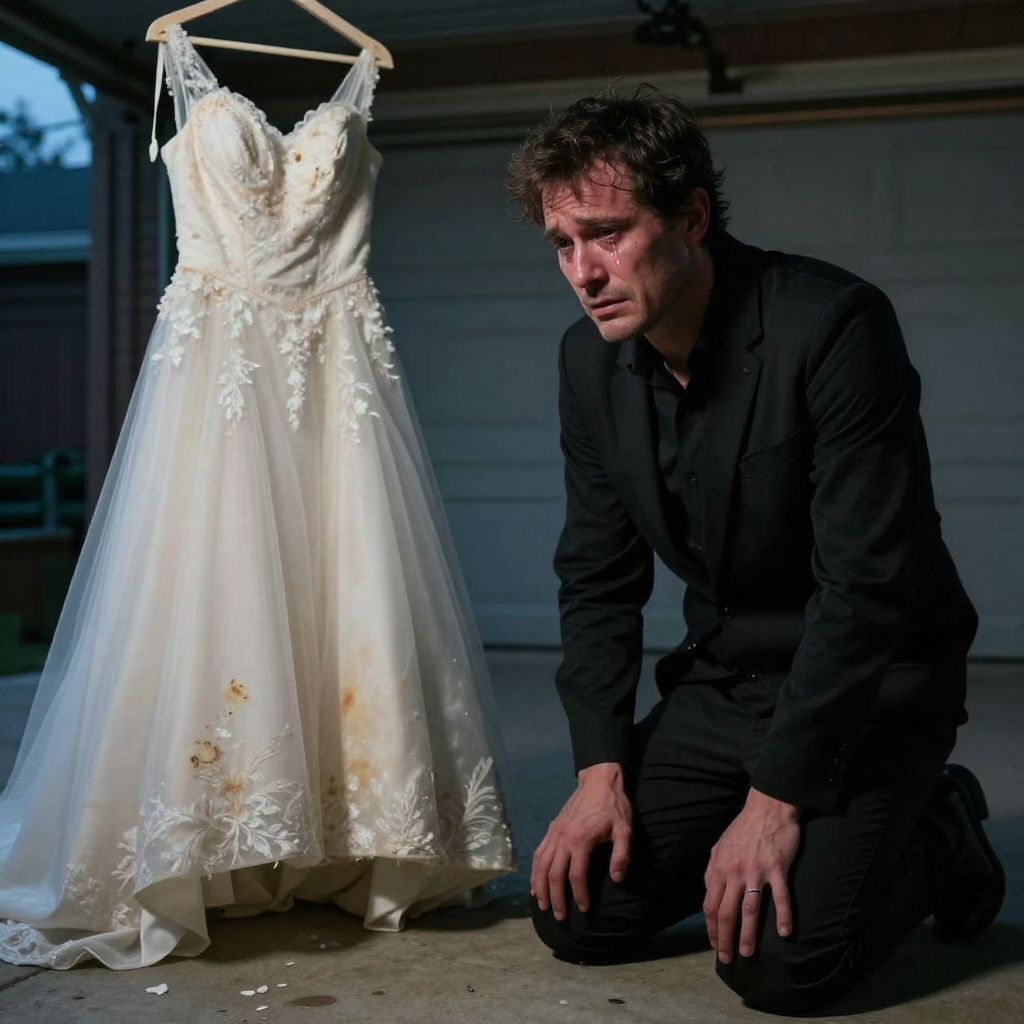
THEY DESTROYED HER DRESS, THEY’LL PAY THE PRICE: Bleach burned my memories as they held me down, now they will learn what happens when you create a real enemy.
The smell hit me first – acrid and sharp, like chlorine but somehow heavier, tainted with something else. Disgust, maybe. Or triumph. Hard to say what goes through the mind of someone who enjoys watching a memory die.
I thrashed against the arms holding me down, the metal folding chair digging into my back. My vision tunneled, focusing only on the slow, deliberate pour of bleach onto the white silk. Not just any silk, but the silk. Her dress. The one she floated in on our wedding day, the one I swore I’d keep pristine, untouched, a monument to the best day of my life. Now it was dissolving in front of my eyes, the pristine white turning yellow, then orange, then nothing at all.
“Please,” I choked out, my voice cracking. “Just…stop.”
Brenda, the ringleader of this little…ceremony, just laughed. It was a high, shrill sound, the kind that grates on your nerves and makes you want to punch something. Or someone. “Oh, we’re just getting started, honey. You think you can just waltz in here, disrupt our community, and get away with it? This is a message. You’re not welcome here.”
My community. That’s what I thought it was, too. A quiet suburb, good schools, friendly neighbors. A place to raise a family, to build a life after…after everything I’d been through. I should have known better. I should have seen the cracks in the facade, the simmering resentment beneath the smiles.
It started with the garden. I know, it sounds ridiculous. But it did. After Sarah died, I threw myself into it. It was a way to feel close to her, to nurture something beautiful in the face of so much loss. She always loved roses, so I planted dozens of them, different colors, different varieties. They exploded with life, a riot of color in my front yard. People complimented them, asked me for tips. It felt…good. For the first time in a long time, I felt like I was contributing something positive to the world.
Then the complaints started. Anonymous letters in my mailbox, then snide remarks at the grocery store. “Too showy,” they said. “Doesn’t fit in.” “Lowers property values.” I tried to ignore it, to brush it off as petty jealousy. But it escalated. The letters became more threatening, the remarks more personal. They started targeting Sarah, saying I was disrespecting her memory by flaunting my grief.
That’s when I realized it wasn’t about the roses. It was about me. About the outsider, the newcomer, the one who didn’t belong. I’d seen it before, that tribalism, that need to protect the status quo at any cost. I thought I’d left it behind, buried it with the other ghosts of my past. But it turns out, some things follow you no matter how far you run.
The bleach kept pouring. The dress was almost gone now, just a few tattered pieces clinging to the hanger. I could smell the chemicals burning my skin, hear the triumphant laughter of the women holding me down. I closed my eyes, trying to block it all out, to find some semblance of peace in the darkness.
But there was no peace. Only anger. A cold, hard knot of rage that tightened in my chest with every drop of bleach. It was a familiar feeling, one I thought I’d conquered, controlled. But it was back now, stronger than ever. And it was hungry.
When they finally let me up, I didn’t say a word. I just stared at the ruined dress, the puddle of chemicals on the floor. My hands were shaking, my teeth clenched. I wanted to scream, to lash out, to tear them limb from limb. But I didn’t. I couldn’t. Not yet.
I needed to be smart about this. I needed to be careful. Because if I lost control, if I let the monster out, there would be no going back.
I turned and walked away, leaving them standing there in their smug victory. Let them think they’d won. Let them think they’d broken me. They had no idea what they’d done.
That night, I couldn’t sleep. Every time I closed my eyes, I saw the dress, the bleach, their faces. I tossed and turned, the anger churning inside me. I tried to think of Sarah, of her smile, her laugh, the way she made me feel. But even those memories were tainted now, poisoned by what had happened.
I got out of bed and went to the garage. It was my sanctuary, my workshop, the place where I could escape the world and lose myself in the act of creation. Tonight, though, there would be no creation. Only destruction.
I walked over to the workbench and opened the bottom drawer. Inside, nestled among the tools and spare parts, was a metal box. I hadn’t opened it in years, not since…well, not since before Sarah. I hesitated for a moment, my hand hovering over the latch.
I knew what was inside. I knew what it meant to open it. It meant crossing a line, embracing a part of myself I’d tried so hard to suppress. But as I stood there in the darkness, the image of the ruined dress burned into my mind, I knew I had no choice.
I flipped open the latch and lifted the lid. The box contained everything I needed. Everything I’d tried to forget. Everything that made me who I was.
A monster.
The first thing I did was clean my guns. I hadn’t touched them since I left the service, but the muscle memory was still there. I stripped them down, oiled them, checked the sights. Each movement was precise, deliberate, calming. It was a ritual, a way of preparing myself for what was to come.
Then I started making plans. I needed information, resources, a strategy. I couldn’t just go in guns blazing. That’s what they would expect. I needed to be smarter than that. I needed to be methodical. I needed to make them pay.
As I worked, I felt a strange sense of calm wash over me. The anger was still there, but it was different now. It was focused, controlled, channeled. I was no longer a victim. I was a predator.
I knew what I was doing was wrong. I knew it would lead to more violence, more pain. But I didn’t care. They had taken something from me that I could never get back. They had desecrated the memory of my wife. And for that, they would suffer.
The next morning, I woke up before dawn. I showered, shaved, and put on the clothes I hadn’t worn in years: black jeans, black t-shirt, black boots. I looked in the mirror and barely recognized myself. The man staring back was cold, hard, and emotionless. He was a ghost of the man I used to be.
I went to the kitchen and made myself a cup of coffee. I sat at the table and looked out the window at the sunrise. It was a beautiful sight, but I couldn’t appreciate it. All I could see was the darkness inside me, the rage that was consuming me.
I finished my coffee, put on my jacket, and walked out the door. I didn’t know what the day would bring, but I knew one thing for sure: things were about to change. My quiet suburban life was over. The monster had been unleashed. And there was no going back.
I started with Brenda. She was the ringleader, the one who orchestrated the whole thing. I needed to know why she did it, what she hoped to accomplish. I needed to understand her motivations, her weaknesses.
I followed her for days, watching her every move. I learned her routine, her habits, her vulnerabilities. I discovered she was having an affair with the mayor, that she was deeply in debt, that she was terrified of losing her social standing.
I used that information to my advantage. I started spreading rumors, leaking information to the press, making her life a living hell. It was slow, methodical, but it was working. She was starting to crack.
Then I moved on to the others. Each one had their own secrets, their own flaws. I exploited them all, turning them against each other, sowing discord and chaos.
The community that had once been so unified was now tearing itself apart. Accusations flew, friendships dissolved, and paranoia reigned. It was exactly what I wanted.
As I watched them destroy themselves, I felt a sense of satisfaction. It wasn’t enough, not yet. But it was a start. They had taken something from me, and I was going to make them pay tenfold.
I knew I was walking a dangerous path. I knew I could end up in jail, or worse. But I didn’t care. I was driven by a force stronger than fear, stronger than reason. I was driven by revenge.
The day I confronted Brenda, it was raining. The sky was dark and ominous, mirroring the storm inside me. She was alone in her house, her husband away on a business trip. I walked up to the front door and knocked.
She opened it, her face pale and drawn. She looked like she hadn’t slept in days. “What do you want?” she asked, her voice trembling.
“We need to talk,” I said, my voice cold and flat.
She hesitated for a moment, then stepped aside and let me in. The house was a mess, clothes strewn everywhere, dishes piled in the sink. It was a far cry from the perfectly manicured image she usually presented to the world.
We went into the living room and sat down. The silence was thick and heavy, broken only by the sound of the rain beating against the windows.
“Why did you do it?” I asked, my eyes fixed on hers. “Why did you destroy her dress?”
She looked away, unable to meet my gaze. “It was a mistake,” she mumbled. “We didn’t mean for it to go that far.”
“A mistake?” I said, my voice rising. “You poured bleach on my wife’s wedding dress! You held me down and watched it dissolve! How is that a mistake?”
Tears welled up in her eyes. “We were just trying to send a message,” she said. “We wanted you to leave. You don’t belong here.”
“So you thought you could drive me out by destroying my memories?” I said, my voice dripping with sarcasm. “You thought that would solve everything?”
“We just wanted things to go back to normal,” she said. “Before you came here, everything was perfect.”
“Perfect?” I laughed. “You call this perfect? This community is rotten to the core. It’s built on lies and secrets and resentment. And you’re all so afraid of anything that threatens your little bubble.”
“That’s not true,” she said, her voice barely a whisper.
“Yes, it is,” I said. “And you know it. You’re all living a lie. And I’m going to expose you all for what you really are.”
I stood up and walked towards the door. “This isn’t over, Brenda,” I said. “It’s just beginning.”
I left her standing there, sobbing in her ruined house. As I walked away, I felt a surge of power. I was no longer afraid. I was no longer a victim. I was in control. And I was going to make them all pay.
CHAPTER II
The first thing I did was throw away the roses. Every single one. I dug them up, roots and all, and tossed them into the dumpster behind the hardware store. It felt good, physically wrenching them out of the ground. Each tug was a small act of defiance, a rejection of the pretty facade they represented. The perfect life, the perfect garden, the perfect neighbor – all lies. My hands were blistered and bleeding, but I didn’t stop until the rose bed was just raw earth. I needed to erase them, to purge that image of normalcy that had been so violently shattered. The memory of those women, their faces contorted with hate as they ripped apart Sarah’s dress… it burned behind my eyes. I could still smell the cheap perfume Brenda wore, a cloying sweetness that turned my stomach. I went back inside, showered, and scrubbed my skin raw, trying to wash away the feeling of their hands on me, the shame of being helpless. But some stains, I knew, went deeper than skin.
I sat at the kitchen table, staring at the bare walls. Sarah had chosen the paint color, a soft, calming blue. Now, it just felt mocking. Everything in this house reminded me of her, of what I had lost. Of what they had taken. The rage was a constant hum beneath my skin, a low thrum of violence that threatened to overwhelm me. I knew I couldn’t let it consume me. I had a plan. A careful, deliberate plan. And it started with understanding my enemy.
I started with Brenda. Her online footprint was surprisingly extensive. Social media profiles, local news articles, even a poorly maintained blog about suburban life. It painted a picture of a woman desperate to be seen, to be admired. The perfect wife, the perfect mother, the perfect community organizer. It was all a performance, I could see that now. A fragile construct built on lies and insecurity. Her husband, Mark, was a VP at some mid-sized insurance company. Two kids, a minivan, a mortgage. The whole package. I dug deeper, looking for cracks in the facade. Financial records were surprisingly easy to access. A few well-placed inquiries, a little social engineering, and I had a clear picture of their finances. They were leveraged to the hilt, drowning in debt. The perfect pressure point.
The information felt cold in my hands, like a weapon waiting to be used. I hesitated for a moment, the weight of what I was about to do settling on my chest. This wasn’t the man Sarah loved. This wasn’t the life we had built. But Sarah was gone. And they had taken her from me. They had violated her memory, desecrated her wedding dress, and awakened something dark inside me that I thought I had buried long ago. The soldier I used to be, the one I thought I had left behind in the desert, was back. And he was thirsty for justice. Or maybe it was just revenge. I wasn’t sure anymore. All I knew was that I couldn’t let them get away with it.
My old training kicked in. I needed to be methodical, disciplined. I couldn’t afford to make mistakes. I started with small things. Anonymous tips to the IRS about Mark’s questionable expense reports. A few strategically placed rumors about Brenda’s… extracurricular activities at the community center. Nothing concrete, just enough to sow seeds of doubt, to create friction. I watched from the shadows, a ghost in their perfect suburban world, as the cracks began to appear.
One evening, I saw Brenda arguing with Mark in their front yard. Her voice was shrill, accusatory. He looked tired, defeated. The kids were inside, watching from the window. I could almost feel their fear, their confusion. It was a small victory, but it fueled me. I needed to keep the pressure on, to tighten the screws. I started targeting the other women involved. Sarah Miller, the PTA president, was next. A compromising photo, subtly altered and anonymously sent to the school board, raised questions about her judgment. Then came Carol, the self-proclaimed fitness guru, whose carefully crafted image was shattered by a fabricated story about steroid use. One by one, their lives began to unravel.
I was careful to leave no trace, to operate in the shadows. I used burner phones, encrypted emails, and anonymous accounts. I knew the risks. If I was caught, I would lose everything. But the thought of Sarah, of her beautiful smile, of the life we had planned, kept me going. I told myself I was doing this for her, that I was honoring her memory by punishing those who had wronged her. But deep down, I knew it was about more than that. It was about control. About taking back the power that had been stolen from me. It was about silencing the rage that threatened to consume me.
I remembered the desert. The heat, the dust, the constant fear. The things I had seen, the things I had done. I had tried to bury that part of myself, to build a new life in this quiet suburban community. But the violence was always there, simmering beneath the surface. Sarah had calmed it, soothed it. But now, she was gone. And the beast was loose.
The triggering incident came on a Saturday afternoon. I was at the grocery store, picking up a few things for dinner, when I saw Brenda. She was standing in the checkout line, her face pale, her eyes red and swollen. She looked like she hadn’t slept in days. Her kids were clinging to her legs, whining about wanting candy. She snapped at them, her voice harsh and strained. I watched her, a cold satisfaction creeping through me. My work was paying off.
As she paid for her groceries, her credit card was declined. She tried another one, and another, but none of them worked. The cashier looked at her with thinly veiled contempt. The people in line behind her started to murmur, their faces etched with impatience. Brenda’s face crumpled. Tears welled up in her eyes. She looked around, desperate for help, but everyone avoided her gaze. That’s when she saw me.
Our eyes met. For a moment, she didn’t recognize me. Then, the realization dawned, and her face contorted with a mixture of fear and rage. “You,” she hissed, her voice trembling. “This is all your fault!” She lunged at me, her nails outstretched, her eyes filled with hate. I reacted without thinking. My training took over. I grabbed her wrist, twisted it sharply, and forced her to the ground. The kids screamed. People gasped. The cashier called for security.
I stood over her, my heart pounding, my breath coming in ragged gasps. I could have hurt her. I could have broken her arm. But I didn’t. I just stood there, looking down at her, as the security guards rushed over and dragged her away. As they pulled her up, the contents of her purse spilled onto the floor. Among the lipstick and crumpled tissues, a small, white envelope caught my eye. It was addressed to me, in Sarah’s handwriting.
Everything else faded away. The noise, the people, the chaos. All that mattered was that envelope. I reached down and picked it up, my hands trembling. The security guards didn’t notice. They were too busy trying to control Brenda, who was still screaming and struggling. I slipped the envelope into my pocket and walked out of the store, leaving the scene behind me. I had to get home. I had to know what it said.
Back in the quiet of my house, I sat at the kitchen table, the envelope lying in front of me like a ticking bomb. I hesitated, afraid of what I might find inside. Sarah had been gone for six months. What could she possibly have written to me? Finally, I couldn’t stand it anymore. I tore open the envelope and pulled out the letter. It was short, only a few sentences, written in her familiar, elegant script.
*My Dearest,* it began. *If you’re reading this, it means I’m gone. I know this is going to be incredibly difficult for you, but I need you to promise me something. Please, don’t let my death consume you. Don’t let it turn you into someone I wouldn’t recognize. Find happiness again, my love. Live your life to the fullest. And never forget how much I love you.*
The words hit me like a physical blow. Tears streamed down my face. I clutched the letter to my chest, sobbing uncontrollably. Sarah knew. She knew the darkness that lurked inside me. She knew the danger I posed to myself. And she was pleading with me to let it go. To choose love over revenge. But it was too late. I had already crossed the line. I had already unleashed the beast. There was no turning back now.
The supermarket incident was all over the local news that evening. Brenda was painted as a victim, a wronged woman driven to desperation by a cruel and heartless neighbor. My name wasn’t mentioned, but everyone knew who they were talking about. I watched the news reports with a detached sense of curiosity, as if I were watching a movie about someone else’s life. I had become a monster, a pariah. And Sarah’s letter was a constant reminder of the man I used to be, of the man I could have been.
That night, I couldn’t sleep. I tossed and turned, haunted by memories of Sarah, of the war, of the things I had done. The faces of the people I had killed flashed before my eyes. I saw Brenda’s face, contorted with hate, and then Sarah’s face, filled with love and forgiveness. The two images clashed, tearing me apart. I knew I had to make a choice. I could either continue down this path of destruction, consumed by revenge, or I could honor Sarah’s memory and try to find a way back to the light. But the pull of the darkness was strong. It was familiar. It was comforting, in a twisted way. It was all I had left.
I got out of bed and walked to the window. The moon was full, casting long, eerie shadows across the lawn. I looked out at the neighborhood, at the houses where my enemies lived. They were all sleeping, oblivious to the storm that was brewing. I smiled, a cold, hard smile. They thought they had won. They thought they had broken me. But they were wrong. This was just the beginning. I closed my eyes, took a deep breath, and made my decision. I would finish what I had started. I would make them pay for what they had done. And then, maybe, just maybe, I could finally find some peace. Even if it meant losing myself completely.
The next morning, a woman named Evelyn showed up at my door. I hadn’t seen her in almost fifteen years. She was older, her face etched with wrinkles, but her eyes were the same. Cold, hard, and unforgiving. We stared at each other for a long moment, neither of us speaking. Finally, she broke the silence. “I saw what happened on the news,” she said, her voice flat. “I know what you’re doing.” I didn’t say anything. I just looked at her, waiting. “I’m here to help,” she said. “If you want it.”
Evelyn was from my past, a part of the life I had tried so hard to leave behind. We had served together in the military, in a black ops unit that specialized in… unconventional methods. She was the best of us, a natural killer. Ruthless, efficient, and utterly without remorse. She was also the only person who knew the full extent of my darkness. The only person who understood what I was truly capable of. I had cut ties with her years ago, trying to escape that life. But now, she was back. And she was offering me a way out. Or maybe, a way in. A way to embrace the darkness completely. I hesitated, torn between my desire for revenge and my fear of becoming the monster I knew I could be. But in the end, there was no choice. I needed her. I needed her skills, her expertise, her willingness to do the things I couldn’t bring myself to do. I nodded slowly. “I want your help,” I said. “But you need to understand something. This isn’t just about revenge anymore. It’s about justice. It’s about protecting the innocent. It’s about making sure that what happened to Sarah never happens to anyone else.” Evelyn smiled, a thin, cruel smile. “Don’t worry,” she said. “I understand perfectly. Let’s get to work.”
CHAPTER III
The roses. They were all that was left. And they wanted to take that too.
Evelyn stood beside me, a shadow in the morning light. “Ready?” she asked, her voice low. I nodded, the rage a cold knot in my stomach. This was it. The culmination of everything. It had to end today.
I pictured Sarah, her smile, her love for those damned roses. And Brenda, with her pinched face, her petty jealousy. It all came down to this. A reckoning.
I walked toward Brenda’s house. Evelyn was right behind me. I could feel her energy, a coiled spring ready to unleash. I had to control this. I had to make sure it didn’t go too far. But deep down, a part of me wanted it to go as far as it could.
I raised my hand and knocked. Hard. The door opened and Brenda stood there, her eyes widening in surprise, then narrowing in suspicion.
“What do you want?” she spat.
“We need to talk,” I said, my voice flat. “About the roses. About Sarah.”
She scoffed. “I have nothing to say to you.”
I stepped forward, pushing past her. “Oh, I think you do.”
Evelyn followed me inside. Brenda’s house was immaculate, sterile. No sign of life, no warmth. Just perfect, polished surfaces. Like Brenda herself.
The other women were there, of course. Gathered in the living room, like vultures waiting for a kill. Carol, Susan, and even Martha, her face pale and drawn. They all looked terrified.
“What is the meaning of this?” Carol demanded, her voice trembling.
“This is about justice,” I said, my eyes scanning each of their faces. “For Sarah. For what you did.”
“We didn’t do anything,” Susan whined. “It was just a joke.”
“A joke?” I repeated, my voice rising. “You destroyed her wedding dress! You desecrated her memory! And you call that a joke?”
Brenda stepped forward, her eyes blazing. “She was in my way! She always was!”
“In your way?” I asked, confused. “What are you talking about?”
“Don’t act so innocent,” Brenda spat. “You know exactly what I’m talking about. David loved her! He always loved her! Even after we were married. He was obsessed with her roses. I couldn’t stand it.”
The air in the room crackled with tension. The other women shifted uncomfortably, avoiding my gaze. I looked at Brenda, her face contorted with hatred and jealousy. It was all so clear now. The roses weren’t just a symbol of Sarah’s life. They were a constant reminder of Brenda’s own insecurities, her own failures.
“So you destroyed them,” I said, my voice low. “Because you couldn’t stand the thought of him loving someone else.”
“Yes!” she screamed. “Yes, I did! And I’d do it again!”
Evelyn stepped forward, her hand moving to her belt. I knew what she was going to do. She was going to pull out her knife.
“No,” I said, my voice firm. “Don’t.”
Evelyn hesitated, her eyes questioning. I shook my head. This wasn’t the way. I couldn’t let it end like this. Not with violence. Not with more hate.
“Get out,” I said to Evelyn. “Go wait in the car.”
Evelyn looked at me, her face a mask of fury. But she didn’t argue. She turned and walked out of the house, slamming the door behind her.
I turned back to Brenda and the other women. They were all staring at me, their faces a mixture of fear and confusion.
“I’m not going to hurt you,” I said, my voice calm. “But I want you to know what you’ve done. You’ve destroyed a good woman’s memory. You’ve poisoned this community with your petty jealousy and hate. And for what? Because you were insecure? Because you couldn’t stand the thought of someone else being happy?”
I paused, taking a deep breath. “I came here for peace. I came here to rebuild my life. But you wouldn’t let me. You wouldn’t let me move on. You had to tear it all down.”
“Well, I’m done,” I said. “I’m done with the hate. I’m done with the revenge. I’m leaving.”
I turned and walked out of the house, leaving them standing there in stunned silence. As I walked to the car, I could feel Evelyn’s eyes on me, burning with anger and disappointment.
I got into the car and started the engine. “Let’s go,” I said.
Evelyn didn’t say a word. She just stared straight ahead, her jaw clenched tight. As we drove away, I looked back at Brenda’s house. The windows were dark, the curtains drawn. It looked like a tomb.
I knew I was making a mistake. I knew I was letting them get away with it. But I couldn’t do it. I couldn’t become like them. I couldn’t let the hate consume me. Sarah wouldn’t have wanted that.
But as we drove further and further away, I couldn’t shake the feeling that I was leaving something behind. Something important. Something that I would never be able to get back.
I looked at Evelyn. “I’m sorry,” I said. “I couldn’t do it.”
She finally turned to me, her eyes filled with a cold, hard light. “You’ll regret this,” she said. “You’ll regret this for the rest of your life.”
I didn’t say anything. I just kept driving, the weight of her words pressing down on me like a stone.
I saw flashing lights in the rearview mirror. A police car. Then another. Evelyn cursed under her breath.
“They’re after us,” she said. “They know.”
I pulled over to the side of the road. The police cars screeched to a halt behind us. Officers jumped out, their guns drawn.
“Get out of the car!” one of them shouted.
We got out of the car, our hands raised in the air. The officers approached us cautiously, their weapons trained on us.
“What’s going on?” I asked.
“You’re under arrest,” one of the officers said. “For assault and battery.”
“Assault and battery?” I repeated, confused. “Who did we assault?”
“Brenda Miller and several other women,” the officer said. “They filed a complaint against you.”
I looked at Evelyn. She just shrugged. I knew she had done something. She had gone back to the house after I left.
“I didn’t do anything,” I said. “It was her.”
I pointed at Evelyn. The officers turned their attention to her.
“What do you have to say for yourself?” one of them asked.
Evelyn didn’t say anything. She just smiled.
The officers handcuffed us and put us in separate police cars. As they drove me away, I looked back at Evelyn. She was still smiling, her eyes filled with a strange, unsettling light.
I knew I had made a terrible mistake. I had brought Evelyn into my life, and she had destroyed everything. My chance at peace, my chance at happiness. All gone. And all because of my thirst for revenge. My old war buddies showing up was a terrible decision. I should have known better.
Now I was going to jail. And for what? Because I couldn’t let go of the past? Because I couldn’t forgive?
I closed my eyes and leaned back against the seat. The weight of my failure was crushing me. Sarah, I had failed you. I had betrayed your memory. I’m so sorry.
I was processed, booked, and thrown into a cell. The cold, damp concrete walls seemed to close in on me, suffocating me. I was alone, with nothing but my thoughts. My dark, twisted thoughts.
Hours passed. I didn’t know how many. Time had lost all meaning. I just sat there, staring at the floor, lost in my own private hell.
Then, the cell door opened. A guard stood there, his face grim.
“You have a visitor,” he said.
I stood up, my legs stiff and sore. Who would want to visit me? Evelyn? Brenda? The police?
I followed the guard down the hallway to a small, windowless room. A woman was sitting at a table, her back to me.
As I got closer, I recognized her. It was Martha.
I stopped, my heart pounding in my chest. What was she doing here? Why would she want to see me?
I sat down across from her, my eyes searching her face. She looked tired, defeated.
“Why are you here?” I asked.
She looked at me, her eyes filled with tears. “I had to see you,” she said. “I had to tell you the truth.”
“The truth?” I repeated, confused. “What truth?”
“Brenda didn’t act alone,” Martha said, her voice trembling. “We all did. We all hated her. We all felt trapped. Your roses, your happiness, were a symbol of everything we wanted but couldn’t have.”
“What are you saying?” I asked. It was so hard to process.
“David,” Martha continued, her voice barely a whisper. “David was in love with Sarah. Before he ever met Brenda. She knew it. We all knew it. The roses were a constant reminder of that. It drove her mad. She was scared of losing him. She thought if she could get rid of the roses, she could finally have him all to herself.”
I stared at her, my mind reeling. It was all so twisted, so perverse. And I had been caught in the middle of it. I had let myself be consumed by hate and revenge, and for what?
“I’m so sorry,” Martha said, her voice breaking. “I’m so sorry for everything.”
I didn’t say anything. I just sat there, staring at her, the weight of her words crushing me. I had destroyed my life for nothing. For a lie. For a petty, jealous feud that had nothing to do with me.
The guard came back and told me my time was up. I stood up and walked out of the room, leaving Martha sitting there, alone with her guilt and regret.
As I walked back to my cell, I thought about Sarah. About her love, her kindness, her forgiveness. And I knew that I had betrayed her. I had let the darkness consume me. And now, I was paying the price.
The next morning, I was released. Brenda and the women didn’t press charges. I think Martha convinced them. I walked out of the jail a broken man, with nothing but the clothes on my back and the knowledge that I had ruined everything. I was free, but I was also lost. I had no home, no family, no purpose. All I had was regret.
I didn’t know where to go or what to do. I just started walking, aimlessly wandering through the streets, lost in my own thoughts. The weight of my actions was crushing me. I had become the very thing I hated. A monster.
The sun began to set, casting long shadows across the street. I found myself standing in front of a church. I hadn’t been to church in years. Not since Sarah died. But something drew me in. A sense of peace, of hope. I didn’t know what I was looking for, but I knew I needed something. I needed help.
I walked through the doors and into the sanctuary. It was empty, silent. The only light came from the stained-glass windows, casting colorful patterns on the floor.
I sat down in one of the pews and closed my eyes. I didn’t pray. I didn’t know how. I just sat there, listening to the silence, trying to find some kind of solace. After all that had happened, could I ever have a normal life?
Then, I heard a voice. A soft, gentle voice.
“Can I help you?” the voice asked.
I opened my eyes and looked up. A priest was standing there, his face kind and compassionate.
I hesitated, unsure of what to say. But then, the words just came pouring out of me. I told him everything. About Sarah, about the roses, about Brenda and the other women, about Evelyn, about the revenge, about the jail, about everything.
The priest listened patiently, without interrupting. When I was finished, he just sat there for a moment, his eyes filled with sadness.
“You’ve been through a lot,” he said. “But it’s not too late. You can still find peace. You can still find forgiveness.”
“How?” I asked, my voice desperate. “How can I forgive myself for what I’ve done?”
“It’s not easy,” the priest said. “But it’s possible. You have to start by forgiving others. And then, you have to forgive yourself.”
He paused, taking a deep breath. “But most importantly,” he said, “you have to let go of the hate. You have to let go of the anger. You have to let go of the past. Otherwise, it will consume you.”
I looked at him, my eyes filled with tears. “I don’t know if I can,” I said. “I don’t know if I’m strong enough.”
“You are,” the priest said. “You just have to believe in yourself. And you have to believe in the power of forgiveness.”
He smiled at me, his eyes filled with hope. “Come back tomorrow,” he said. “We’ll talk more.”
I nodded, my heart filled with a flicker of hope. I stood up and walked out of the church, leaving the priest standing there in the sanctuary.
As I walked down the street, I felt a little lighter. A little less burdened. Maybe, just maybe, there was still hope for me. Maybe, just maybe, I could find a way to forgive myself and move on with my life. But I knew it wouldn’t be easy. The road ahead would be long and difficult. But for the first time in a long time, I felt like I had a reason to keep going.
The sun had set, and the sky was dark. The stars were shining brightly, like diamonds scattered across a velvet cloth. I looked up at them, and I thought about Sarah. About her love, her light. And I knew that she was watching over me, guiding me, helping me find my way back to the light.
I had to keep going. I had to keep fighting. For her. For myself. For the chance to find peace, to find forgiveness, to find love again. It was the only way I could honor her memory. The only way I could truly be free.
Back in my car, parked a few blocks from the jail, I found Sarah’s letter. I had almost forgotten it. I opened it, the paper worn and faded. Her handwriting was clear, elegant.
*My Dearest Love,*
*If you are reading this, then I am gone. I know this is hard for you. But please, don’t let my death consume you. Don’t let it turn you into someone you’re not. I want you to be happy. I want you to live your life to the fullest. And I want you to forgive.*
*Forgive those who have wronged you. Forgive yourself for your mistakes. Forgive the world for its pain and suffering. Forgiveness is the only way to find peace. It’s the only way to break free from the chains of hate and anger.*
*I love you more than words can say. And I will always be with you, in your heart, in your mind, in your soul. Don’t forget me, but don’t let me hold you back. Let me be a light in your life, not a shadow.*
*With all my love,*
*Sarah*
Tears streamed down my face as I read her words. I had failed her. I had let her down. I had let the darkness win. But it wasn’t too late. I could still change. I could still honor her memory. I just had to find the strength to forgive.
I folded the letter and put it back in my pocket. I took a deep breath and started the car. It was time to go home. Time to start over. Time to find peace, to find forgiveness, to find love again. It wouldn’t be easy. But I knew I could do it. Because Sarah was with me. Always.
I drove off into the night, leaving the darkness behind me. The road ahead was long and uncertain. But for the first time in a long time, I felt like I was heading in the right direction.
CHAPTER IV
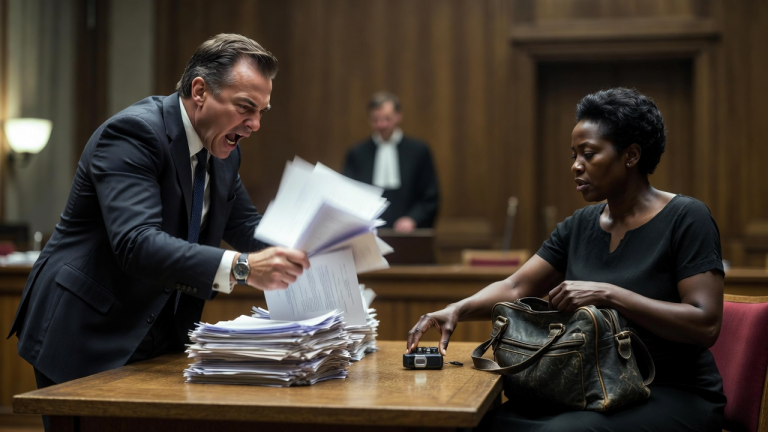
The courtroom felt colder after the verdict. Colder than the jail cell had, colder than the November wind that whipped through the bare rose bushes outside my window. It wasn’t the temperature, though. It was the weight. The weight of the judge’s words, the weight of the jury’s decision, the weight of Evelyn’s betrayal, but mostly the weight of Sarah. Her memory, her dreams, all crushed under the heel of my… what? Justice? Revenge? I wasn’t sure anymore. Only that it felt like ash in my mouth.
I walked out of the courthouse a free man, technically. The charges against me had been reduced to accessory after the fact, and time served covered it. Evelyn, however, was still facing serious assault charges. No one looked at me. Or maybe they did, and I just couldn’t meet their eyes. The news vans were gone, the reporters moved on to fresher blood. Brenda was gone too, presumably back to her quiet, miserable life. The roses were waiting for me, dormant in the cold earth, their thorns still sharp. I got into my truck, feeling like an empty shell, and drove home.
The first few days back were a blur. Sleep was fitful, haunted by nightmares of Sarah’s dress burning, Evelyn’s rage, and Brenda’s hollow eyes. The silence in the house was deafening, broken only by the ticking of the grandfather clock in the hall – a clock Sarah had loved for its gentle chime. I tried to tend the roses, but my hands shook too much. I tried to read, but the words swam before my eyes. The house, once a sanctuary, now felt like a prison of my own making.
Then came the letters. They started small, a few each day. At first, they were just condolences, messages of support from people I barely knew. But soon, the tone shifted. The local paper ran a piece highlighting Sarah’s work at the community center, juxtaposing it with my actions. The comments section exploded. Some were sympathetic, calling me a grieving widower pushed to the edge. Others were scathing, branding me a vigilante and a disgrace to Sarah’s memory. Each word felt like a fresh wound. Then the anonymous letters started. Hateful, cruel, filled with accusations and threats. I stopped opening them, letting them pile up on the kitchen counter like a monument to my failure.
I went to visit Evelyn. She was locked up tight, awaiting trial. When they brought her in, she looked… smaller. Defeated. The fire in her eyes was gone, replaced by a dull, listless gaze. I tried to apologize, to tell her I never wanted any of this to happen. She just stared at me, silent, unblinking. Finally, she spoke, her voice raspy and low. “You used me,” she said. “You used me, and now look where we are.” I had no answer. The glass separated us again, and I walked out, feeling even heavier than before.
One afternoon, a car pulled up to my house. It was Brenda. I almost didn’t recognize her without her usual armor of anger and resentment. She looked tired, worn down. She stepped out of the car, her shoulders slumped, and walked slowly toward me. I stood on the porch, waiting, my heart pounding in my chest. What did she want? More accusations? More hatred? “I came to apologize,” she said, her voice barely a whisper. “For everything.” She didn’t elaborate, didn’t offer excuses. She just stood there, her eyes filled with a strange mix of shame and something that looked almost like… understanding? I didn’t say anything. What could I say?
She turned to leave. “My husband… he’s seeing a therapist,” she said, almost as an afterthought. “He admitted… he admitted he had feelings for Sarah. A long time ago.” She paused. “I should have dealt with it then. Instead… I let it fester. And it poisoned everything.” She walked back to her car, got in, and drove away. I stood there, watching her go, the weight in my chest shifting slightly. Not lighter, exactly, but… different. More complicated.
That night, I dreamed of Sarah. She was standing in the rose garden, surrounded by blooming flowers. She was smiling, her eyes filled with warmth and love. She reached out her hand to me, but I couldn’t move. I was stuck, rooted to the spot, weighed down by my guilt and regret. “Let it go,” she said, her voice soft but firm. “Let it go, and come home.”
I woke up with a start, the dream fresh in my mind. I got out of bed, walked to the kitchen, and looked at the pile of unopened letters on the counter. I picked one up, tore it open, and began to read.
***
The letter was from a local church group. They knew about Sarah, about her dedication to the community, about my loss and my… actions. They offered no judgment, no condemnation. Just an invitation. An invitation to join their weekly grief support group. An invitation to talk, to listen, to share my pain with others who understood. An invitation to heal.
I almost threw the letter away. It was too easy, too convenient. A quick fix for a broken soul. But something stopped me. Maybe it was Sarah’s dream. Maybe it was Brenda’s apology. Or maybe it was just the desperate need for something, anything, to fill the emptiness inside me. I decided to go.
The group met in the church basement. It was a small gathering, maybe a dozen people. Old and young, men and women, all carrying their own burdens of grief and loss. I sat in the back, silent and apprehensive, feeling like an imposter. The facilitator, a kind-faced woman named Martha, welcomed me with a gentle smile. She explained the rules: listen without judgment, share if you feel comfortable, and respect each other’s privacy. Then she opened the floor.
One by one, people began to share their stories. Stories of lost loved ones, of shattered dreams, of unbearable pain. I listened, tears welling up in my eyes. I had thought I was alone in my suffering, but I wasn’t. These people understood. They had been through the same darkness, the same despair. And they had survived. They were still standing, broken but not defeated.
Finally, Martha turned to me. “Would you like to share, John?” she asked. I hesitated. I didn’t know what to say. How could I explain the anger, the hatred, the revenge? How could I admit what I had done? But then I thought of Sarah. Of her forgiveness, her compassion, her unwavering belief in the good in people. And I began to talk.
I told them everything. About Sarah, about her death, about Brenda, about Evelyn, about the fire, about the arrest, about the guilt and regret that were consuming me. I spoke for what felt like hours, the words pouring out of me like a dam had broken. When I was finished, I sat there, exhausted and vulnerable, waiting for their judgment. But it didn’t come.
Instead, they offered me compassion. Understanding. Support. They didn’t excuse my actions, but they didn’t condemn me either. They acknowledged my pain, my loss, my anger. And they helped me to see that I wasn’t defined by my mistakes. That I could still find a way to honor Sarah’s memory, to rebuild my life, to find peace.
I kept going to the group. Week after week, I sat in that church basement, listening and sharing, slowly beginning to heal. It wasn’t easy. There were setbacks, moments of doubt, days when the darkness threatened to overwhelm me again. But I kept going. Because I knew that Sarah would have wanted me to. Because I knew that I owed it to her, and to myself, to find a way back to the light.
The trial of Evelyn was approaching. I considered testifying on her behalf, explaining the circumstances, pleading for leniency. But my lawyer advised against it. He said it would only hurt her case, reminding the jury of my own involvement. I knew he was right, but it still felt wrong. I couldn’t just abandon her. I had to do something.
I visited her again in jail. This time, she looked… calmer. More resigned. She still didn’t speak much, but she listened. I told her about the grief group, about the healing I was beginning to experience. I told her that I was sorry, that I would do everything I could to help her. “It’s too late,” she said, her voice flat. “It’s too late for both of us.” I tried to argue, but she cut me off. “Just… let it go, John,” she said. “Let it go and move on.”
I knew she was right. The past couldn’t be changed. All I could do was focus on the future. On honoring Sarah’s memory, on rebuilding my life, on finding peace. I decided to sell the house. It held too many memories, too much pain. I needed a fresh start, a new beginning. I found a small cottage on the coast, overlooking the ocean. It was simple, quiet, peaceful. I started packing.
The day before I left, I went to the rose garden. It was late autumn, the bushes bare and dormant. I knelt down and touched the earth, feeling the coldness beneath my fingers. I thought of Sarah, of her love for these roses, of her dream for a peaceful and loving community. I closed my eyes and whispered a prayer. For her, for myself, for Brenda, for Evelyn, for everyone who had been hurt by my actions. A prayer for forgiveness. A prayer for healing. A prayer for peace.
I stood up, took one last look at the garden, and walked away. As I drove out of town, I felt a strange sense of lightness. Not happiness, exactly, but… release. The weight was still there, but it was shifting, transforming. It was becoming a burden I could carry, a reminder of the past that would guide me toward a better future. The road ahead was long and uncertain, but for the first time in a long time, I felt a glimmer of hope. Sarah was right. Forgiveness wasn’t absolution, but it was the only way to begin again. It was the only way to honour the memory of a life stolen too soon.
I drove toward the coast, toward the ocean, toward a new beginning. The roses would bloom again in the spring, even if I wasn’t there to see them. And maybe, just maybe, so would I.
CHAPTER V
The salt air stung my face, a welcome change from the stale, recirculated air of the grief group. The house was small, a simple cottage overlooking the Pacific. No room for ghosts here, I hoped. Just the endless horizon and the rhythmic crash of waves – a constant reminder that life, like the ocean, keeps moving, whether you’re ready or not. I still wasn’t ready, not entirely. Selling the house, leaving everything behind…it felt like another loss, another severing. But staying would have been a slow, agonizing death. Every corner held a memory, every object whispered Sarah’s name. I needed to breathe again, and the ocean seemed like the only place that could offer that. The boxes were stacked in the living room, half unpacked. I hadn’t had the energy to do more than the essentials: bed, coffee maker, a couple of framed photos. Sarah’s smile greeted me from one of them, a candid shot from our trip to Maine. I traced her face with my fingertip, the familiar ache settling in my chest. It wasn’t a sharp, stabbing pain anymore, but a dull, persistent throb – the kind that reminds you it’s always there, waiting. I walked out onto the small porch, the wooden planks weathered and worn. The previous owner had left a faded blue rocking chair, which I sank into gratefully. The sun was beginning its descent, painting the sky in hues of orange and pink. It was beautiful, undeniably so, but beauty felt…complicated. I didn’t deserve it, not after everything. I’d caused so much pain, so much damage. Brenda, Evelyn…their faces haunted my dreams. I’d wanted justice for Sarah, but all I’d achieved was more suffering. Sarah wouldn’t have wanted that. That was the truth that had been slowly dawning on me, a truth I’d resisted for so long. Her love wasn’t vengeful; it was boundless. And I’d tarnished her memory with my anger.
The first few weeks were a blur of unpacking, exploring the small town, and trying to avoid human contact. I frequented the local coffee shop, ordering the same black coffee every morning and retreating to a corner table with a book. I walked the beach at dawn, watching the surfers brave the waves and the seagulls scavenge for scraps. I volunteered at the local animal shelter, cleaning cages and feeding stray cats. It was mindless work, but it kept my hands busy and my mind quiet. One day, a woman approached me as I was leaving the shelter. Her name was Maria, and she was the shelter director. She thanked me for my help, her eyes kind and her smile genuine. “We really appreciate you being here, John,” she said. “The animals can sense your compassion.” I mumbled a thank you and hurried away, feeling a warmth spread through my chest. Compassion. It was a word I hadn’t associated with myself in a long time. Maybe, just maybe, there was still some good left in me. A few days later, Maria asked me if I’d be willing to help with a special project: fostering a litter of kittens whose mother had been hit by a car. I hesitated. Kittens were…a lot of responsibility. But Maria’s pleading eyes convinced me. And so, I found myself with four tiny, mewling creatures in my spare bedroom. They were fragile and helpless, completely dependent on me for survival. It was terrifying. But as I held one of them in my palm, feeling its tiny heart beat against my skin, something shifted inside me. A tenderness I thought I’d lost forever resurfaced. I named them after constellations: Lyra, Orion, Cassiopeia, and Leo. They were a constant source of chaos and amusement, batting at my shoelaces, climbing the curtains, and purring contentedly on my lap. They forced me to get out of bed in the morning, to buy cat food and litter, to clean up their messes. They gave me a reason to smile, a reason to laugh. They reminded me that life, even in its smallest forms, was precious.
One evening, I was sitting on the porch, watching the sunset with Lyra curled up in my lap. The sky was ablaze with color, a breathtaking spectacle. I thought of Sarah, of how much she would have loved it. And for the first time since her death, the memory didn’t bring a wave of overwhelming sadness. Instead, a faint smile touched my lips. I remembered her laughter, her infectious enthusiasm, her unwavering belief in the goodness of people. She had seen the best in me, even when I couldn’t see it myself. And she had loved me unconditionally, despite my flaws and my mistakes. Her love wasn’t limited to me; it extended to everyone she met. She had a gift for making people feel seen, feel valued, feel loved. And I had forgotten that. I had become so consumed by my own grief, my own anger, that I had closed myself off to the world. I had stopped seeing the beauty, the kindness, the potential for connection that existed all around me. But the kittens, the sunsets, Maria’s gentle smile…they were all reminders that life was still worth living, that love was still possible, even after loss. I started volunteering at a local soup kitchen, serving meals to the homeless and the needy. It was humbling work, witnessing the struggles of others. But it was also incredibly rewarding, seeing the gratitude in their eyes, hearing their stories of resilience. I joined a book club at the library, meeting a diverse group of people who shared my love of reading. We debated literature, shared our personal experiences, and formed genuine connections. I even started dating again, tentatively at first, then with more confidence. It wasn’t the same as with Sarah; it couldn’t be. But it was something new, something different, something…hopeful. I was learning to live again, not in spite of my grief, but because of it. I was honoring Sarah’s memory by embracing life, by opening my heart to others, by finding joy in the simple things.
The change wasn’t dramatic, no sudden burst of happiness or miraculous recovery. It was gradual, subtle, a slow chipping away at the wall I had built around myself. There were still days when the grief overwhelmed me, when I couldn’t get out of bed, when I felt like I was drowning in sorrow. But those days were becoming less frequent, less intense. And on those days, I had the kittens, the sunsets, the friends I had made, to pull me back from the brink. One afternoon, I received a letter from Evelyn. She was being released from prison early, due to good behavior. She apologized for her actions, expressed remorse for the pain she had caused. She didn’t ask for forgiveness, but she hoped that one day, I could find it in my heart to understand. I sat with the letter for a long time, rereading it several times. I thought of Brenda, of the pain she must still be carrying. I thought of Sarah, of her unwavering capacity for forgiveness. And I knew what I had to do. I wrote a letter to Brenda, expressing my sympathy for her loss, acknowledging my role in the events that had transpired. I didn’t excuse my behavior, but I offered her my forgiveness. It wasn’t easy, but it felt…right. A weight lifted from my shoulders, a burden I had been carrying for too long. I didn’t expect her to respond, but a week later, I received a card in the mail. It was a simple card, with a picture of a seascape on the front. Inside, she had written a single sentence: “Thank you.” It wasn’t much, but it was enough. I knew that we would never be friends, but we had reached a place of understanding, a place of peace. And that was all I could ask for. I walked down to the beach, the sand cool beneath my feet. The sun was setting, casting a golden glow on the water. I closed my eyes, took a deep breath, and smiled. Sarah was gone, but her love remained. It was woven into the fabric of my being, a part of who I was. And I would carry it with me always, honoring her memory by living a life filled with compassion, kindness, and joy. Life wasn’t perfect, far from it. But it was beautiful, in its own messy, imperfect way. And I was grateful for every moment, every breath, every sunrise. The ocean roared, the seagulls cried, and the world kept turning. And I was finally ready to turn with it.
The waves crashed against the shore, a constant rhythm of beginning and end. I stood there, feeling the cool mist on my face, and realized that Sarah wasn’t just a memory. She was the ocean, the sky, the sand beneath my feet. She was everywhere, in everything. Her love wasn’t a possession; it was a gift, freely given and endlessly shared. I had tried to hold onto it, to protect it, to keep it for myself. But love wasn’t meant to be hoarded; it was meant to be spread. And I could honor her by letting it flow through me, by extending that same love and compassion to others. I looked out at the horizon, the sun dipping below the waves. A single ray of light pierced through the clouds, illuminating the water. It was a moment of pure, unadulterated beauty. And in that moment, I felt a flicker of something I hadn’t felt in a long time: joy. Not the carefree joy of my youth, but a quiet, contented joy, born of loss and resilience. A joy that knew the depths of sorrow, but still chose to embrace the light. I turned and walked back towards the house, the kittens waiting for me, the soup kitchen calling, the book club beckoning. Life was waiting. And I was ready. The rocking chair creaked softly on the porch, a gentle invitation. I paused, looked back at the ocean, and whispered, “Thank you, Sarah.” Then, I went inside. END.