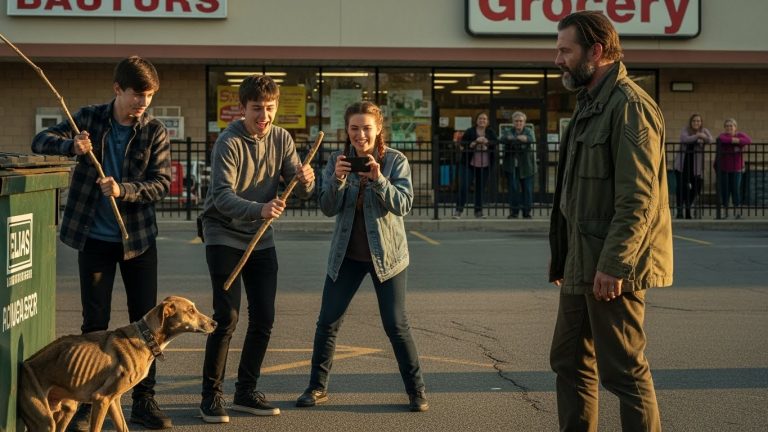
I thought I’d left that life behind, the flashbangs and the heavy gear, until I saw what those kids were doing to that dog. They called it a “prank,” a way to get views, but they didn’t realize who was watching
Chapter 1: The Ghost of Sector Four
The morning air in Oakhaven, Pennsylvania, always carried a specific weight to it. It was heavy with the scent of damp earth, woodsmoke from a few early-morning fireplaces, and that faint, metallic tang that precedes a storm. For most people, it was a peaceful suburban fragrance. For me, it was a trigger. It smelled like the outskirts of Kandahar or the industrial docks of South Philly—places where the air was never just air, but a medium for impending violence.
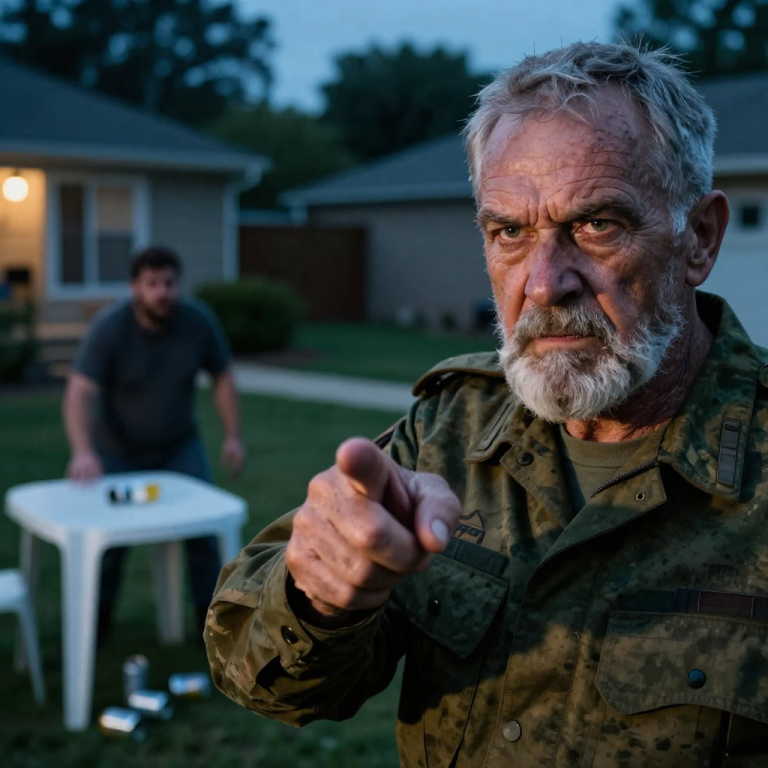
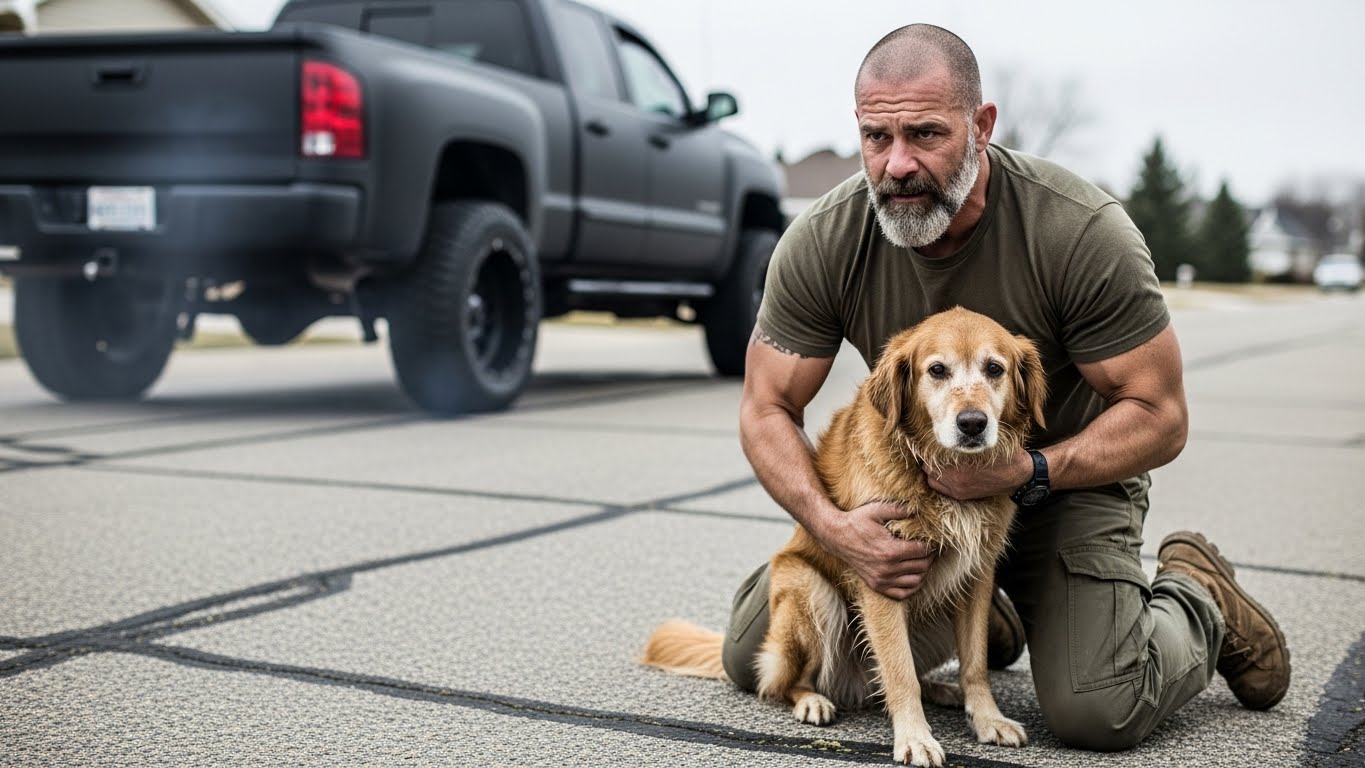
My name is Jax Carter. I’m forty-six years old, but my knees feel sixty and my mind feels like an old VHS tape that’s been rewound and played too many times. I spent fifteen years as a lead breacher and team leader for a Tier-1 SWAT unit. I’ve seen the worst things humans can do to each other in the name of pride, money, or just plain boredom. I’d walked away three years ago with a medical pension, a chest full of medals I kept in a shoebox under the bed, and a nervous system that was permanently set to “High Alert.”
I lived in a small, two-bedroom rancher on the edge of a cul-de-sac. It was the kind of neighborhood where people cared about the height of their grass and the color of their shutters. I was the outlier. My lawn was neat, but only because I treated it like a perimeter. My shutters were black because anything else felt too loud.
The only thing that kept me tethered to this version of reality was Bones.
Bones was a pit-bull mix I’d found shivering behind a dumpster outside the VA hospital where I went for my physical therapy. He was a mess—missing a hind leg, half an ear torn off, and eyes that looked like they’d seen the heat of a thousand suns. When I looked at him, I didn’t see a dog; I saw a reflection. I took him home, fed him steak, and we spent our days in a silent pact: I wouldn’t ask about his scars if he didn’t ask about mine.
“Easy, buddy,” I muttered that Tuesday morning, my voice sounding like two stones grinding together. I was sitting on my porch, a mug of black coffee in my hand. It was 07:15. The neighborhood was stirring.
Bones was leaned up against my leg, his weight a grounding presence. He didn’t bark at the squirrels or the passing cars. He just watched. He had the “thousand-yard stare” down better than any operator I’d ever served with.
Then, the silence of Oakhaven was shattered.
It started as a low-frequency vibration, the kind you feel in your molars before you hear it. A moment later, the roar of a modified engine tore through the cul-de-sac. A matte-black Ford Raptor, lifted so high it looked like a monster truck, rounded the corner on two wheels, its tires screaming against the pavement. It wasn’t just driving; it was invading.
“Targets identified,” my brain whispered, a reflex I couldn’t shut off.
The truck slammed to a halt three houses down, right in front of the Miller residence. The doors flew open, and four boys hopped out. They were young—maybe nineteen or twenty—decked out in designer hoodies and high-end sneakers that probably cost more than my monthly mortgage. They were shouting, their voices high and jagged with a specific kind of adrenaline.
I recognized the leader immediately. Tyler Vance.
Tyler was the son of Richard Vance, the District Attorney for the county. Richard was a man who viewed the law as a tool for his own advancement, and he’d raised a son who viewed the world as a playground with no rules. Tyler had been in and out of trouble since he was twelve—vandalism, petty theft, reckless driving—but it always vanished. A phone call from Daddy, a “donation” to the right fund, and Tyler was back on the street, more entitled than before.
One of the boys was holding a professional-grade camera rig. Another had a smartphone on a gimbal. They weren’t just hanging out; they were “creating content.”
“Check it out, check it out!” Tyler yelled, his voice echoing off the quiet houses. “We’re live! The ‘Sticky Situation’ challenge is a go. We’re about to make Oakhaven famous, boys!”
They huddled around the bed of the truck, laughing and pointing. I watched them, my grip tightening on my coffee mug until my knuckles turned white. Bones felt the shift in my energy. He let out a low, vibrating hum—not a growl, but a warning.
“Stay, Bones,” I said softly.
They pulled two items from the truck: a large, industrial-sized canister of spray adhesive—the kind used for roofing—and a high-decibel air horn. They started looking around, their eyes scanning the pristine yards. They weren’t looking for a person; they were looking for a victim that couldn’t fight back.
Then, Tyler spotted Goldie.
Goldie was a neighborhood fixture, a golden retriever mix who had outlived three owners and now just belonged to the street. Everyone fed her. She was slow, arthritic, and had a heart that seemed to be made of pure sunshine. She was currently limping across the street, heading for a sun-drenched patch of grass near the curb.
Tyler’s eyes lit up. “Yo, we got a volunteer! Get the wide shot, Mark! This is gonna be epic.”
The four of them started to close in on the dog. My heart rate, usually a steady sixty beats per minute, began to climb. 70. 85. 100. The familiar hum of tactical clarity began to drown out the sound of the birds. The world started to fragment into distances, angles, and threat vectors.
I put my coffee down. The mission hadn’t started yet, but the briefing was over.
Chapter 2: The Sound of a Breaking Joke
I didn’t run. If you run, you surrender the element of surprise. I stepped off my porch and moved across the asphalt with the steady, rhythmic pace of a man walking into a breach. My boots made no sound.
Sarah, my neighbor from 4C, was standing on her lawn, her face pale. She was a nurse, a woman who dealt with blood and trauma every day, but this was different. This was predatory.
“Jax, don’t,” she whispered as I passed her. “Call the police. Don’t get involved with Tyler. His father will ruin you.”
“The police are ten minutes away,” I said, not looking at her. “That dog has ten seconds.”
I was twenty feet away when the boys surrounded Goldie. The old retriever stopped, her tail wagging tentatively. She looked up at Tyler, her tongue lolling out, expecting a scratch behind the ears. She had spent fifteen years learning that humans were kind. She was about to receive a brutal lesson in the exceptions to that rule.
“Yo, watch this!” Tyler shouted at the camera. He was grinning, a frantic, ugly expression. “We’re gonna see how much ‘clout’ this mutt can carry. Spray ‘er down!”
“Hey!” I barked.
The sound of my voice hit them like a physical blow. It was the voice I used to clear a crack house in the North Side—a deep, resonant command that bypassed the conscious mind and spoke directly to the instinct to obey.
The boys froze. Tyler turned, his sneer faltering for a split second before his father’s ego rushed back in to fill the gap. He looked at me—a guy in a faded shirt, cargo pants, and a stare that probably looked like two gun barrels pointed at his forehead.
“Back off, old man,” Tyler said, trying to regain his swagger. “We’re filming a prank. It’s for the internet. You wouldn’t understand, you’re like… what, eighty?”
“Leave the dog alone,” I said. I was now ten feet away. Close enough to see the sweat on his upper lip. “Go back to your truck. Drive away. Now.”
“Or what?” Tyler challenged. He stepped closer to Goldie, who was now whimpering, sensing the hostility in the air. “You gonna call the cops? My dad is the cops, basically. He’s the DA. He’ll have you in a holding cell before my video even finishes uploading.”
The kid with the camera laughed, a high-pitched, nervous sound. “Yeah, Pops. Chill out. It’s just a joke. We’re just gonna put some stuff on her, blow the horn, see her run. It’s funny.”
“It’s animal cruelty,” I said, my voice dropping to a low, dangerous register. “And it’s the last time I’m going to tell you to move.”
Tyler looked at his friends, then back at me. He needed to prove he wasn’t scared. He needed the “win” for his followers. He turned his back on me—the first mistake—and pointed the adhesive canister at Goldie.
“Check this out, followers!” he yelled.
He pulled the trigger. A thick, viscous stream of white industrial glue hit the dog’s flank. Goldie let out a confused, startled yelp, trying to twist away, but the glue was incredibly tacky. As she struggled, Tyler reached down with the air horn and pressed it against the side of her head.
BRAWWWWRRRRR!
The sound was a physical assault. It echoed off the houses like a gunshot. Goldie went into a blind panic. She shrieked—a sound I will never forget—and tried to bolt, but her paws slipped on the pavement. She fell hard, her leg sticking to her own side as the glue began to set. She was thrashing in the gutter, letting out high-pitched, agonizing cries.
The boys erupted. “Oh my god! Did you see that? She flipped!” Tyler was doubled over, laughing so hard he was gasping for air. “That’s gold! That’s viral gold right there!”
The world went white. Not with rage, but with a cold, crystalline focus.
I was across the ten-foot gap before Tyler could stand up straight. My left hand shot out, catching his wrist in a thumb-lock that made him scream. I twisted, forcing his arm behind his back, and slammed him chest-first against the side of his black Raptor. The sound of his face hitting the window was a dull thud.
“Drop it,” I hissed in his ear.
He dropped the adhesive canister. It clattered on the ground.
“You’re hurting me! Stop! You’re hurting me!” Tyler shrieked, his voice jumping two octaves.
“You don’t know what ‘hurting’ feels like yet,” I said. I felt the old Jax—the one I’d tried to bury—taking the wheel. My pulse was a steady, rhythmic drum. “You think this is a joke? You think pain is a punchline?”
The other three boys were frozen. The cameraman had lowered his rig, his mouth hanging open.
“Get him off him!” one of them yelled, but none of them moved. They were used to bullying people who were afraid of their fathers. They weren’t prepared for a man who had stared down gunmen in dark hallways.
I shoved Tyler’s face harder against the glass. “If I ever see you near an animal again—if I even hear your truck on this street—I will consider it a threat to my safety. Do you understand what happens when a man like me feels threatened, Tyler?”
“I’ll tell my dad!” Tyler sobbed, his nose bleeding onto the black paint of the truck. “You’re going to jail! You’re a dead man!”
I let him go. Not because I was finished, but because Goldie needed me. I shoved him toward the open door of his truck. He scrambled inside, his friends piling in after him like terrified rats.
“Go,” I said.
The Raptor roared to life, tires smoking as Tyler floored it. He clipped a trash can on his way out of the cul-de-sac, the roar of the engine fading into a distant whine.
I turned and knelt in the gutter. Goldie was shaking, her eyes rolled back in her head. The glue was hardening fast, pulling at her skin. I reached out, my hands—hands that had broken doors and held rifles—becoming as gentle as a surgeon’s.
“I’ve got you, girl,” I whispered. “I’ve got you.”
As I lifted her, I looked up. Every neighbor was on their porch. Some were looking away. Some were holding phones. And in the distance, I heard the first faint wail of a siren.
The “joke” was over. The war was just beginning.
Chapter 3: The Gathering Storm
By the time I carried Goldie into my kitchen, the adrenaline was starting to recede, replaced by the heavy, familiar ache of “The Aftermath.” I set her down on a pile of old towels. Bones was there in an instant, sniffing her muzzle, his tail tucked in a rare display of empathy.
“I need some help here, Sarah!” I yelled toward the open front door.
A moment later, Sarah ran in. She had a medical bag and a bottle of mineral oil. She didn’t ask questions. She saw the glue, saw the dog’s state, and went to work.
“It’s industrial grade,” Sarah muttered, her fingers moving quickly as she applied the oil to break down the adhesive. “It’s going to take hours to get this all off without taking her skin with it. Jax… what did you do?”
“I stopped a crime,” I said, standing up and looking out the window.
The sirens were louder now. Two patrol cars pulled into the cul-de-sac, their blue and red lights painting the neighborhood in a frantic strobe. They didn’t stop at the Miller place. They pulled right up onto my lawn.
“They’re here for me,” I said.
“Jax, listen to me,” Sarah said, looking up from the dog. “Officer Miller is out there. He’s a good guy. Just talk to him. Explain what happened. The neighbors saw it.”
“The neighbors saw the District Attorney’s son get roughed up by the ‘crazy vet’ in 4B,” I replied. “In this town, that’s the only story that matters.”
I walked to the front door and stepped out onto the porch. I didn’t hide. I didn’t reach for a weapon. I stood with my hands visible, feet shoulder-width apart.
Officer Miller stepped out of the lead car. He was younger than me, his uniform pressed, his face set in a mask of professional neutrality that hid a deep-seated unease. He knew who I was. He’d seen my file when I moved into town.
“Mr. Carter,” Miller said, his hand resting on his holster. “We got a call about an assault. A young man is at the ER with a broken nose and a possible concussion. He says you attacked him unprovoked.”
“He was torturing a dog, Miller. He used an air horn and industrial glue on a fifteen-year-old retriever. It’s all on his friends’ cameras. Check the ‘content’ they were so proud of.”
Miller sighed, looking down at his boots. “Jax, I believe you. I really do. But Richard Vance is already at the station. He’s screaming for your head on a platter. He’s calling this ‘vigilante violence against a minor.’ He wants you in cuffs.”
“Then do it,” I said, stepping down the stairs. “But if that dog dies because you’re busy protecting a bully, I’m going to make sure every news outlet in the state knows why.”
Miller hesitated. He looked at the other officer, who was eyeing my house like it was a fortified bunker.
“I can’t just leave, Jax. I have to take you in for questioning.”
“Then take me,” I said. “But let Sarah finish with the dog first.”
Suddenly, a third car screeched into the cul-de-sac. It wasn’t a cruiser. It was a silver Mercedes-Benz. Richard Vance climbed out, his suit costing more than Miller’s car. He was trembling with a rage that wasn’t about his son’s health—it was about his own power being challenged.
“That’s him!” Vance screamed, pointing a trembling finger at me. “That’s the animal! He attacked my son! He’s a deranged, violent veteran who shouldn’t be allowed near a civilized neighborhood!”
Vance marched up to Miller, ignoring the “police line.” “Why isn’t he in handcuffs? Why are you talking to him like he’s a person? Arrest him! Now!”
“Sir, I’m conducting an investigation—” Miller started.
“The investigation is over!” Vance roared. “My son is in the hospital! This man has a history of violence—I’ve seen his service record. He’s a ticking time bomb! If you don’t arrest him right now, I’ll have your badge by sundown!”
I looked at Vance. He was a small man in a big suit, a man who used words like “civilized” to hide the fact that he’d raised a monster.
“Your son is a coward, Richard,” I said, my voice carrying across the lawns. “And he learned it from you. You think the law is a shield for your family’s cruelty. It’s not.”
Vance turned his gaze on me, his eyes narrowing into slits. “You’re done, Carter. I’m going to use every resource I have to bury you. You’ll never see the outside of a cell again. And that pathetic dog? I’ll have animal control here within the hour to put it down as ‘evidence’ of your ‘delusional’ defense.”
The air around me seemed to freeze. My “work brain” clicked into a new gear. I wasn’t just defending a dog anymore. I was defending the line between right and wrong.
“Miller,” I said, my voice like a death warrant. “You want to take me in? Fine. But if anyone touches my property—or that dog—while I’m gone, you won’t need the DA to take your badge. You’ll need a priest.”
Vance laughed, a sharp, ugly sound. “Listen to him! Threats! Record that! He’s threatening a police officer!”
Miller looked torn. He looked at me, then at the screaming DA, then back at my house. He knew the truth, but he also knew the way the world worked.
“Handcuffs, Jax,” Miller whispered, his voice pained. “I’m sorry.”
I turned around and placed my hands behind my back. As the steel ratcheted shut against my wrists, I caught a glimpse of Tyler’s truck returning, parked at the edge of the street. Tyler was in the passenger seat, a bandage over his nose, holding his phone up. He was filming my arrest. He was smiling.
He thought he’d won. He thought the system was his playground.
He didn’t realize that by putting me in cuffs, they weren’t stopping the threat. They were just giving me a reason to stop playing by the rules.
As the patrol car door slammed shut, I looked through the glass at my house. Bones was at the window, his one good ear pricked up.
Hold the line, buddy, I thought. The heavy gear is coming back out.
Chapter 4: The Interrogation of a Ghost
The interrogation room at the Oakhaven Police Department smelled of industrial floor cleaner and stale coffee. It was a room designed to make people feel small. The walls were a sickly shade of beige, and the fluorescent light overhead hummed with a headache-inducing frequency. I sat at the metal table, my hands still cuffed in front of me. I didn’t look at the two-way mirror. I knew who was behind it.
Richard Vance was back there, breathing heavy, waiting for me to break.
The door opened, and Officer Miller walked in, followed by a man I didn’t recognize. This newcomer was older, wearing a cheap suit that fit him like a loose skin. He carried a legal pad and a look of profound exhaustion.
“This is Detective Marcus Thorne,” Miller said, his voice flat. “He’s handling the formal statement.”
Thorne sat down, clicked his pen, and looked at me. “Mr. Carter. Or should I say, Sergeant Carter? Your record is… impressive. Three commendations for valor. Two Purple Hearts. A decade of leading high-risk entries in Philly. You’re a man who knows the law.”
“I know the difference between right and wrong,” I said. “The law usually catches up eventually.”
“Let’s talk about ‘right,'” Thorne said, leaning in. “Right now, the District Attorney’s son has a broken nose and a hairline fracture in his cheekbone. He claims you assaulted him without provocation while he was ‘conducting a social experiment’ for his college media class.”
I almost laughed. “A social experiment? Is that what they’re calling animal torture these days?”
“He says the dog was a stray. He says he was trying to see how people would react to an ‘unconventional situation.’ He says you didn’t give him a chance to explain. You just went ‘full commando’ on a group of kids.”
“There’s video, Thorne,” I said, my voice steady. “They were filming everything. Look at the raw footage. Look at the dog. She’s fifteen years old, half-blind, and they were spraying her with roofing adhesive and blasting her with an air horn. If that’s a social experiment, then I’m the Pope.”
Thorne sighed, glancing toward the mirror. He knew the room was bugged. He knew Vance was listening. He leaned closer, lowering his voice so the mic wouldn’t pick it up clearly.
“Jax, listen to me. I grew up with dogs. I hate what those kids did. But Vance is a shark. He’s already framing this as a ‘PTSD-fueled’ attack. He’s looking to have you committed for a psychiatric evaluation before you even see a judge. He wants you off the board so he can scrub that video from the internet.”
“He can try,” I said. “But he’s forgetting one thing.”
“What’s that?”
“I wasn’t the only one watching.”
The door burst open. Richard Vance didn’t walk in; he invaded. His face was a mask of purple fury.
“Enough of this!” Vance shouted. “Thorne, why isn’t he processed? I want him in a transport van to the county lockup. Now!”
“Sir, we’re still taking the statement—”
“I don’t care about the statement! My son is in surgery! This man is a menace!” Vance turned to me, leaning over the table. “You think you’re a hero, Carter? You’re a relic. A broken tool. I’m going to make sure the world sees you for what you are: a violent, unstable veteran who attacked a child because he couldn’t handle the real world.”
I looked at him, my expression never changing. “You keep calling him a child, Richard. At nineteen, I was leading a fireteam in the Kunar Province. At nineteen, your son is a sadist who hides behind his daddy’s shadow. Which one of us is really unstable?”
Vance reached out, grabbing my collar. It was a mistake. Even in cuffs, I could have snapped his wrist in three places before he could blink. But I didn’t. I just looked at him.
“Touch me again,” I said softly, “and your son’s medical bill will be the least of your concerns.”
Vance recoiled as if he’d been burned. He pointed a finger at Miller. “Process him! Maximum security! No bail!”
He stormed out, the door slamming with a metallic clang. Thorne looked at me, a look of genuine pity in his eyes.
“He’s going to win this round, Jax. I can’t stop him. Not in this town.”
“That’s okay,” I said, leaning back. “The first breach is always the loudest. It’s the follow-through that matters.”
Chapter 5: The Viral Firestorm
While I was sitting in a holding cell, the world was moving at the speed of fiber-optics.
Tyler Vance had made a critical error. He thought that by being the son of the DA, he could control the narrative. He thought that by uploading a “trimmed” version of the video—one that showed me attacking him but cut out the part with the dog—he could win the court of public opinion.
He underestimated the neighborhood.
Sarah wasn’t just a nurse; she was a woman who lived for justice. While the police were taking me away, she had gone door-to-door. She had collected the Ring doorbell footage from four different houses. She had the high-definition shot of the air horn. She had the audio of Goldie screaming.
And she had a brother who worked as a producer for a major news network in Philadelphia.
By 2:00 PM, the “Sticky Situation” video was viral, but not in the way Tyler wanted. The hashtag #JusticeForGoldie was trending nationwide. But more importantly, the tactical community had woken up.
I spent the afternoon staring at the ceiling of my cell. Then, around 4:00 PM, the atmosphere in the precinct changed. I could hear it through the bars—the frantic ringing of phones, the hushed, panicked whispers of the desk sergeants.
Thorne came back to my cell. He wasn’t carrying a legal pad this time. He was carrying my personal effects.
“Change of plans,” he said, his voice trembling slightly.
“What happened?”
“The video got out. The real video. It’s got ten million views. People are calling from all over the country. The Governor’s office just called the Chief. They’re ‘inquisitive’ about why an animal abuser is being treated as a victim while a decorated veteran is in a cage.”
He unlocked the cell door. “But that’s not the biggest problem.”
“What is?”
Thorne pointed toward the front of the station. “Look outside.”
I walked to the front windows. The street in front of the Oakhaven PD was blocked off. Not by protesters, but by vehicles. Dozens of them. Black SUVs, old pickup trucks with “Operator” decals, and motorcycles.
There were men standing on the sidewalk. Big men. Men with the same “thousand-yard stare” I had. Men wearing the colors of various SWAT units and veteran organizations.
In the center of the crowd stood a man I hadn’t seen in three years. “Big Mac” Mackenzie, my former Number Two in the Philly SWAT. He was wearing his old tactical vest over a hoodie, arms crossed over a chest the size of a beer keg.
“They heard one of their own was being railroaded,” Thorne whispered. “They’ve been arriving for the last hour. They’re not saying anything. They’re just… waiting.”
The power dynamic had shifted. The District Attorney’s influence was a candle in a hurricane compared to the collective weight of the brotherhood.
“Am I free to go?” I asked.
“The charges haven’t been dropped, but the Chief is ‘re-evaluating’ the situation. You’re being released on your own recognizance. But Jax…” Thorne gripped my shoulder. “Vance is cornered. And a cornered man like that is a cornered rat. He’s lost his reputation. He’s losing his career. He’s going to lash out.”
“I know,” I said. “And I know exactly where he’ll hit.”
I walked out the front doors. The silence of the men outside was more powerful than any shout. Mac stepped forward, a grim smile on his face.
“Boss,” he said, his voice a low rumble. “Heard you were having some trouble with the local trash.”
“Mac,” I nodded. “You brought the whole family?”
“Just the ones who were bored,” Mac said, gesturing to the thirty-odd men behind him. “What’s the play?”
“I need to get home,” I said. “They’re going to go after the dog. It’s the only way they can hurt me now.”
“Then let’s roll,” Mac said, reaching into his SUV and pulling out a heavy tactical bag. “We brought the ‘heavy gear’ just in case you wanted to remind them how a real breach feels.”
Chapter 6: The Night of the Wolves
The sun was dipping below the horizon, painting the Pennsylvania hills in shades of bruised purple and blood orange. We drove back to Oakhaven in a convoy. I was in the lead, my hands gripping the steering wheel so hard the leather groaned.
My mind was a tactical map. I knew how Tyler and his friends thought. They were cowards who relied on the “shield” of their parents. Now that the shield was shattered, they wouldn’t go to the police. They would try to “even the score” in the only way they knew how—through a show of force when they thought no one was looking.
We pulled into the cul-de-sac. It was too quiet.
I jumped out of the truck before it had fully stopped. My house was dark. I ran to the porch, my heart hammering against my ribs.
“Bones!” I yelled. “Sarah!”
The front door was ajar.
I didn’t wait for Mac. I didn’t wait for a weapon. I burst through the door, my body low, eyes scanning the shadows.
The living room was a wreck. My TV had been smashed. My furniture overturned. But there was no blood.
“In the kitchen!” Mac shouted from behind me.
I sprinted down the hallway. There, huddled in the corner behind the kitchen island, was Sarah. She was holding a kitchen knife in one hand and my old service pistol—which I kept in a biometric safe she knew the code to—in the other.
Bones was standing in front of her, his hackles raised, a low, guttural growl vibrating in his chest. Goldie was behind them, tucked into a corner, still shivering under her bandages.
“They were here,” Sarah whispered, her eyes wide with terror. “Ten minutes ago. Tyler and those three boys. They had baseball bats and a can of gasoline. They said they were going to ‘finish the joke.'”
“Where are they?” I asked, my voice barely a whisper.
“They saw the headlights of your convoy and ran out the back,” she said. “But Jax… Tyler had a gun. A real one. He looked… he looked insane. He said if he was going down, he was taking everything you loved with him.”
I felt a coldness settle over me. It wasn’t fear. It was the absolute absence of emotion. This was the “Zero State.” The place where a soldier becomes a weapon.
“Mac,” I said, not turning around.
“Yeah, Boss?”
“Set up a perimeter. Two-man teams on every corner of the house. Thermal overlays if you brought them. Nobody gets within fifty yards of this property. If they see a matte-black Raptor, they disable the engine. Do not—I repeat, do not—engage the subjects unless they fire first.”
“You got it,” Mac said, already barking orders into his comms.
I knelt down and pulled Bones into a brief, hard embrace. Then I looked at Sarah.
“Stay here. Keep the pistol. If anyone who isn’t wearing a ‘Veteran’ patch comes through that door, you use it.”
“Where are you going?” she asked.
“I’m going to end the joke,” I said.
I walked to my bedroom and reached under the bed. I pulled out the shoebox, but I didn’t look at the medals. I pushed it aside and lifted the hidden floorboard. Inside was the gear I’d sworn I’d never wear again. The Grade-IV ceramic plates. The midnight-blue tactical vest with “SWAT” stenciled in faded white. The flashbangs. The zip-ties.
And my Benelli M4 tactical shotgun.
I didn’t put on a mask. I wanted Tyler to see my face. I wanted him to see the man his father had tried to bury.
I stepped out into the backyard. The woods behind my house were thick and dark, a perfect place for a coward to hide. I could smell the gasoline they’d spilled on my porch. I could hear the faint, rhythmic sound of a truck idling somewhere deep in the trees.
They weren’t running away. They were waiting for the “Old Man” to come out and play.
They didn’t realize they weren’t playing a game anymore. They were in a kill-box.
I clicked the safety off the Benelli. The sound was a sharp, mechanical “clack” that felt like the final period at the end of a long, ugly sentence.
Chapter 7: The Final Breach
The woods behind my house were a labyrinth of pine and oak, a place where the suburban illusion of safety dissolved into the raw, indifferent reality of nature. I moved through the undergrowth with a silence that was born of a thousand night operations. My boots didn’t snap twigs; my gear didn’t jingle. I was a part of the shadows, a ghost in a tactical vest, hunting the boys who thought cruelty was a hobby.
I could hear them before I saw them. Tyler’s voice was high, frantic, and jagged. He was spiraling.
“Where are they? I know they’re out there!” Tyler screamed.
I reached the edge of a small clearing where an old fire road cut through the trees. The matte-black Raptor was idling there, its headlights cutting through the mist like the eyes of a dying beast. Tyler was standing in the beam of the lights, a handgun shaking in his grip. His three friends were huddled by the truck, their faces pale and slick with sweat. They weren’t laughing anymore. The “clout” was gone, replaced by the cold, hard realization that they had brought a “prank” to a war zone.
“Tyler, put the gun down,” I said. My voice didn’t come from the shadows; it seemed to come from the trees themselves, low and omnipresent.
Tyler spun around, waving the pistol wildly. “Come out! Show yourself, you coward! You ruined everything! My dad says we’re leaving town, that his career is over because of you! You and that stupid, worthless dog!”
“Your father’s career ended the moment he taught you that other lives don’t matter,” I said, moving five feet to my left while he was focused on my last position. “And the dog has more value in her left paw than you have in your entire body.”
“I’ll kill you!” Tyler roared. He was sobbing now, the bravado of the bully finally cracking to reveal the hollow core of a spoiled child. “I’ll kill you and then I’ll go back and burn that house down with everyone in it!”
He raised the gun, aiming at nothing and everything.
I didn’t use the shotgun. I didn’t want to give him the satisfaction of a bullet. I reached into my vest and pulled out a M84 stun grenade—a flashbang. I pulled the pin, counted a beat, and tossed it. It landed at Tyler’s feet with a dull thud.
“Joke’s over,” I whispered.
WHAM.
Seven million candlepower and 170 decibels of pure, white noise exploded in the clearing. It wasn’t just a sound; it was a physical blow. The three boys by the truck collapsed, clutching their ears and eyes. Tyler was slammed back against the hood of his Raptor, the gun flying from his nerveless fingers as his nervous system was momentarily overloaded.
I was on him before the smoke cleared.
I didn’t hit him. I didn’t need to. I pinned him against the truck, my forearm across his throat, my face inches from his. He was blind, his eyes darting aimlessly, his mouth open in a silent scream of sensory terror.
“This is the world you wanted, Tyler,” I hissed. “No rules. No consequences. Just the strong and the weak. How does it feel to be the punchline?”
I heard the heavy thrum of boots on the fire road. Mac and the team arrived, moving in a perfect tactical diamond. They didn’t say a word. They didn’t need to. They saw me holding the boy who had tried to burn a neighborhood down for a “like.”
Mac stepped forward and picked up Tyler’s fallen handgun. He cleared the chamber, his expression one of pure disgust. “Cheap piece of plastic,” Mac muttered. “Just like the kid holding it.”
I let go of Tyler. He slumped to the ground, weeping into the dirt, the great “influencer” reduced to a pile of expensive laundry.
“Zip-tie them,” I said, my voice heavy with a sudden, crushing exhaustion. “And call Miller. Tell him the ‘social experiment’ has reached its conclusion.”
Chapter 8: The Weight of Peace
The sun rose over Oakhaven the next morning with a clarity that felt earned. The storm had passed, leaving the air crisp and the world feeling slightly more upright.
The fallout was swifter than I expected. With the release of the full, unedited video from the neighbors’ Ring cameras—and the footage of Tyler Vance brandishing a firearm in the woods—the District Attorney’s office crumbled like a sandcastle in a rising tide. Richard Vance was placed under investigation for witness intimidation and obstruction of justice. He resigned forty-eight hours later, his “legacy” burned to ash by his son’s vanity.
Tyler and his three friends were facing a litany of charges: felony animal cruelty, aggravated assault, and reckless endangerment. Because of the viral nature of the case, no judge in the state wanted to be seen as the one who let them off easy. The “Untouchables” were finally going to feel the weight of the law they had mocked.
I was sitting on my porch, the same spot where this had all started.
Goldie was lying at my feet. Sarah had spent the night cleaning the last of the adhesive from her fur. The old dog was shaved in patches, looking a bit like a moth-eaten rug, but she was alive. She was currently gnawing on a high-end soup bone, her tail giving a slow, rhythmic thump against the porch floor.
Bones was next to her, his head resting on his paws. He had accepted her into the pack. He knew a fellow survivor when he saw one.
Sarah walked out with two mugs of coffee. She handed one to me and sat on the top step.
“The local shelter says they’ve received over fifty thousand dollars in donations since the video went viral,” she said, her voice soft. “They’re naming a new wing after Goldie.”
“She deserves it,” I said, watching a hummingbird hover near the flower boxes. “She’s the only one in this whole mess who didn’t have a choice.”
“What about you, Jax?” Sarah asked, looking at me with those nurse’s eyes that could see right through a man’s armor. “What are you going to do now? The ‘Ghost of Sector Four’ is all over the news.”
I looked down at my hands. They were steady. The tremor I’d lived with since my last tour in Philly was gone.
“I think I’m done being a ghost,” I said. “I spent so long trying to forget who I was that I forgot what I was for. I’m a protector, Sarah. Always have been. I think Oakhaven could use someone to keep an eye on things. Someone who knows how to spot a bully before they pick up an air horn.”
Mac’s SUV pulled into the driveway. He hopped out, wearing a t-shirt that said ‘Bad Ideas Department.’ He looked at the dogs, then at me, and gave a sharp, professional nod.
“We’re heading back to Philly, Boss,” Mac said. “But the guys talked. We’re setting up a foundation. ‘The Sentinels.’ We’re going to provide security for animal rescues and veteran housing. We want you to run the board.”
I looked at Goldie, then at the quiet street where kids were once again riding their bikes and neighbors were waving to each other. The silence wasn’t a threat anymore. It was a victory.
“I’ll think about it, Mac,” I said, a small, genuine smile tugging at the corners of my mouth. “But right now, I have a dog to walk.”
I stood up, and for the first time in years, my knees didn’t ache. I whistled, and two dogs—one with three legs and one with patches of missing fur—scrambled to their feet.
We walked down the driveway together, a small, broken, beautiful family. I wasn’t a soldier in a war anymore. I was a man in a home. And as long as I was standing watch, the joke was officially over.
If you saw someone hurting an innocent animal for “views” in your neighborhood, would you step in like Jax did, or would you call the authorities and wait?