I HEARD A SOBS FROM THE STORM DRAIN DURING THE HURRICANE. WHEN I FOUND WHAT WAS INSIDE, MY LIFE CHANGED FOREVER.
CHAPTER 2: The Weight of a Small Heart
The rain was a solid wall now, the kind of torrential downpour that turned the world into a grayscale blur of motion and noise. Deputy Miller’s cruiser sat idling, its strobing lights painting the neighborhood in rhythmic flashes of emergency red and icy blue.
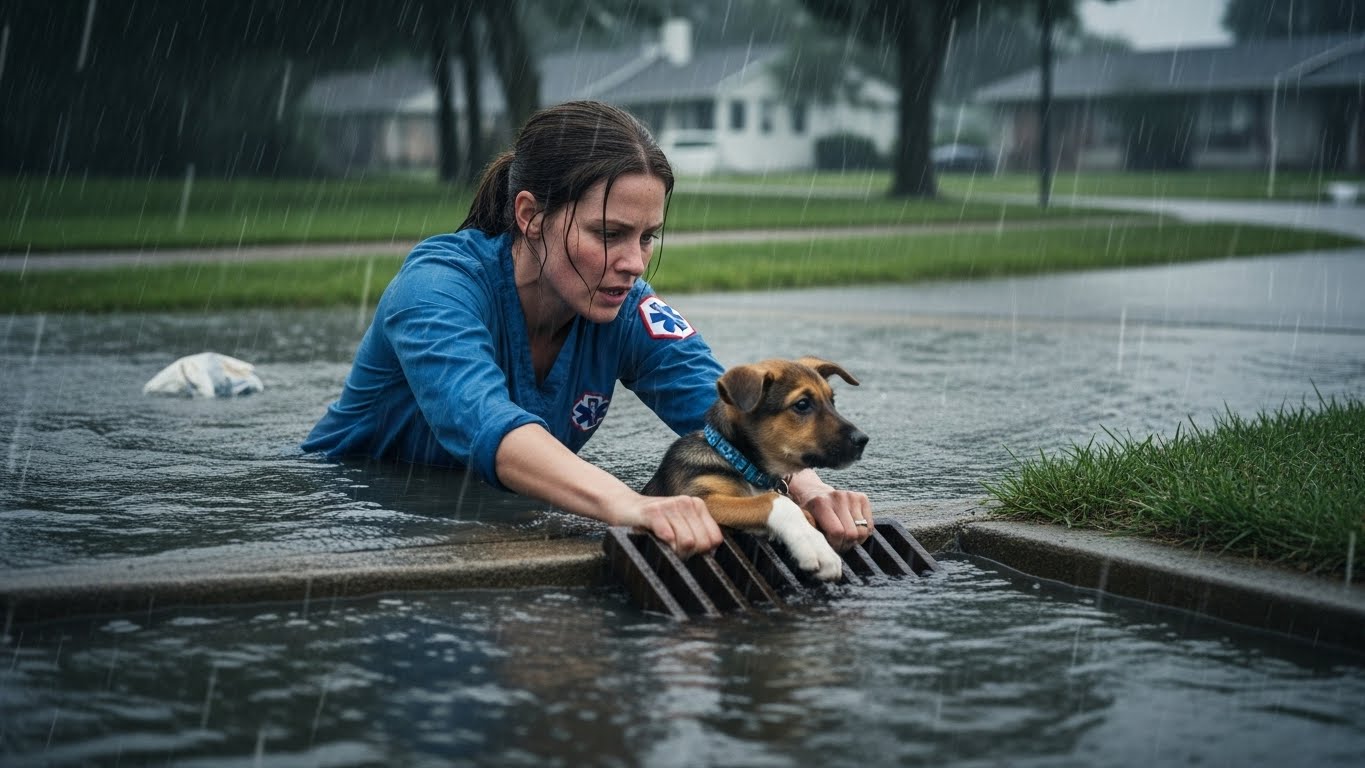
I stood there, knee-deep in the swirling runoff, clutching the shivering, mud-slicked bundle to my chest. The puppy’s heart was a frantic, staccato rhythm against my ribs—a tiny, fragile engine that I had somehow jump-started back to life.
“He’s mine, Sarah. Hand him over,” Jackson said, his voice straining to sound reasonable, though his eyes were darting toward Miller’s cruiser. He took a step toward me, his hand outstretched. “He must have slipped out of the yard. The storm spooked him.”
“Slipped out?” I croaked, my voice raw from the wind. I pointed a trembling finger at the storm drain, then at the frayed piece of blue nylon rope still snagged on the iron lip of the curb. “With a rope tied around his neck, Jackson? He didn’t slip. He was discarded.”
Deputy Miller stepped out of his car. He was a man in his late fifties, with a face like a roadmap of every bad night he’d ever seen in this county. He’d been the first on the scene two years ago, the night the car went into the creek. He was the one who had eventually pulled my shaking hands off that little girl’s chest and told me, “Sarah, it’s over. You did everything you could.”
He didn’t look like he wanted to be here. He looked like he wanted a cup of coffee and a dry bed.
“Alright, let’s lower the volume,” Miller said, his voice projecting over the roar of the rain. He looked at the puppy, then at the open drain, then at Jackson. “Jackson, you say this is your dog?”
“Got him from a litter out in the county last week,” Jackson lied, his jaw tight. “I was looking for him when I saw Sarah over here messing with the city property. She’s hysterical, Deputy. Look at her. She’s been… off… ever since she left the department.”
The sting of his words was meant to destabilize me. He was weaponizing my trauma in front of the one person who knew exactly how broken I had been.
“I’m not hysterical,” I said, my voice steadying. I tucked the puppy deeper into the warmth of my raincoat. The dog let out a soft, pained whimper, his tiny body wracked with tremors. “I’m a witness. I heard this dog screaming before the water got too high. And I saw that rope. You didn’t lose him, Jackson. You drowned him.”
“That’s a hell of an accusation, Sarah,” Miller said, rubbing the bridge of his nose. He looked at Jackson. “You got papers for the dog? A collar?”
“In the house. Somewhere,” Jackson muttered. “But I ain’t digging through files in a hurricane. Just tell her to give me my property.”
Property. The word made my stomach turn.
“He’s not property right now, he’s a medical emergency,” I said, stepping back toward my own driveway. “He’s hypothermic. He’s inhaled a lot of stagnant water. If he doesn’t get to an emergency vet in the next twenty minutes, he’s going to die anyway. Is that what you want, Jackson? To watch him die twice?”
Jackson’s face contorted into something ugly. He looked like he wanted to lung at me, but Miller’s presence was a physical barrier he couldn’t quite cross.
“Sarah’s right about one thing,” Miller said, his eyes narrowing as he looked at the puppy. “That dog looks like hell. Tell you what. Sarah, you take him to the 24-hour clinic over on Oak Street. Jackson, you stay here and talk to me. I want to see exactly where this dog ‘slipped’ out of your fence.”
“You can’t be serious,” Jackson spat.
“I’m very serious. Now, Sarah—go. Before I change my mind about the paperwork for that grate you just ripped up.”
I didn’t need to be told twice. I scrambled to my old Subaru, fumbling with the keys with numb, muddy fingers. I laid the puppy on a dry towel in the passenger seat, his eyes barely open, his breathing a shallow, wet rattle.
“Hang on,” I whispered, shifting into reverse. “Just hang on for ten more minutes.”
The drive to the Oak Street Veterinary Emergency Clinic felt like a descent into a watery underworld. The wipers couldn’t keep up with the deluge, and twice I had to swerve around fallen branches.
Every few seconds, I reached over to touch the puppy’s side, making sure it was still moving. He was so small. So impossibly small against the backdrop of the massive, indifferent storm outside.
I pulled up to the clinic’s brightly lit entrance, grabbed the bundle, and ran inside. The bell chimed, a cheerful sound that felt wildly out of place.
“Help! I need a doctor!” I shouted.
A young woman behind the desk, her scrubs decorated with cartoon cats, looked up with wide eyes. “What happened?”
“Found him in a storm drain. Submerged. Respiratory distress. Possible blunt force trauma,” I said, the old EMT terminology flowing out of me like I’d never left the job.
A door swung open, and Dr. Aris appeared. He was a tall man with tired eyes and a calm demeanor that immediately lowered my heart rate. He took the puppy from my arms, his hands moving with the practiced efficiency of a surgeon.
“Let’s get him back to the oxygen cage,” Aris said. “Stat.”
I stood in the waiting room, a dripping, muddy mess. I looked down at my hands. They were covered in a mixture of red clay, rust from the grate, and a small amount of blood—mine or the dog’s, I couldn’t tell.
The silence of the clinic was heavy. I sat on a hard plastic chair, my damp clothes clinging to my skin, and for the first time in two years, I didn’t feel the familiar, crushing weight of guilt. I felt something else. A spark of purpose.
An hour passed. Then two. The storm outside continued to batter the building, but the lights here stayed steady.
Finally, Dr. Aris walked back into the waiting room. He was holding a clipboard and looking at me with a strange expression.
“How is he?” I asked, standing up so fast my head spun.
“He’s stable. For now,” Aris said. “We got the fluid out of his lungs and he’s on a warming blanket. He’s a fighter, that one. But Sarah… I need to show you something.”
He led me back into the treatment area. The puppy was lying in a small clear box, a tiny oxygen mask over his snout. He looked cleaner now, his golden fur beginning to fluff up as it dried. But as Aris gently turned the puppy over with a gloved hand, my breath caught.
Around the puppy’s neck was a deep, raw ring of missing fur and bruised skin.
“That didn’t happen in the storm,” Aris said quietly. “That’s a ligature mark. Someone had a collar or a rope on him that was far too tight, for a long time. And here—on his ribs.” He pointed to a series of dark bruises. “Those are consistent with being kicked. These aren’t new injuries, Sarah. This puppy has been someone’s punching bag for weeks.”
A cold, sharp rage began to calcify in my chest. Jackson hadn’t just tried to kill the puppy to be rid of it. He had been tormenting it.
“There’s more,” Aris said, his voice dropping. “I ran a quick scan. He has a microchip.”
My heart skipped a beat. “A microchip? Then he’s not a stray.”
“No. He was registered four weeks ago to a family over in the Highland Estates. A mother and her eight-year-old son. They reported him stolen three days after they got him.”
“Highland Estates?” I whispered. That was the wealthy neighborhood three miles over. “How did he end up with Jackson?”
“I don’t know,” Aris said. “But the chip lists his name as ‘Chance.’ I think you should call Deputy Miller. This isn’t just animal cruelty anymore. This is theft. And if Jackson is stealing dogs from children…”
The door to the clinic suddenly swung open. I expected to see Deputy Miller, or perhaps a worried family.
Instead, it was Jackson.
He was soaked, his face flushed a deep, angry purple. He didn’t look at the vet. He didn’t look at the medical equipment. He looked straight at me, his eyes burning with a terrifying, quiet malice.
“I told you to give me my dog, Sarah,” he said, his voice a low hiss that made the hair on my arms stand up. “You shouldn’t have brought him here. You shouldn’t have involved the doctor.”
“Get out of here, Jackson,” I said, stepping between him and the oxygen cage. “The police are on their way. We know about the chip. We know he’s stolen.”
Jackson didn’t flinch. He just smiled, a slow, thin-lipped expression that didn’t reach his eyes.
“You think a little chip is gonna stop me?” he asked. “You’ve lived next to me for years, Sarah. You know I don’t like people sticking their noses where they don’t belong. You think your life was hard before? You have no idea what’s coming.”
He looked past me at the puppy—at Chance—and for a second, I saw something in his gaze that wasn’t just anger. It was a hunger. A dark, predatory satisfaction.
“Enjoy the dog while he’s still breathing,” Jackson said.
Then he turned and walked back out into the storm, leaving the door swinging in the wind.
I turned back to the puppy. He had opened his eyes. They were a clear, bright amber, and for the first time, he wasn’t looking at me with terror. He was looking at me with recognition.
I reached into the cage and let him lick my finger. His tongue was warm and sandpaper-rough.
“I’ve got you,” I whispered, though my heart was hammering against my ribs. “I’ve got you, Chance. And I’m not letting him near you ever again.”
But as I looked out the window at the dark, rain-soaked street, I knew Jackson wasn’t the kind of man who made idle threats. I had saved a life tonight, but in doing so, I had invited a monster to my doorstep.
The storm was far from over.
CHAPTER 3: The Shadows in the Suburbs
The storm had officially passed by three in the morning, leaving behind a neighborhood that looked like it had been chewed up and spat out by something prehistoric. Huge oak branches lay across power lines like broken limbs; the air was thick with the scent of damp earth and ozone. But for me, the silence that followed the wind was far more terrifying than the roar. It was a silence filled with anticipation.
I brought Chance home. Dr. Aris hadn’t wanted to let him go, but with the clinic overflowing with storm-injured animals and the puppy stabilized, he agreed that a quiet home was better than a chaotic ward.
He lay in a laundry basket lined with every soft towel I owned, placed right next to my bed. He was still weak, his breathing a rhythmic huff-huff that punctuated the stillness. Every time he stirred, I reached down, my fingers brushing his soft ears to remind him—and myself—that he was still here.
But as the sun began to bleed a pale, sickly yellow over the horizon, the reality of Jackson’s threat settled into my bones.
I sat at my kitchen table, a mug of cold coffee between my hands, staring out the window at the house across the street. Jackson’s place was a dark silhouette. No lights. No movement. But I knew he was awake. Men like Jackson don’t sleep when they feel they’ve been cheated.
A soft knock at my back door made me jump, nearly slopping coffee onto my lap.
I grabbed a heavy maglite from the counter—my only weapon—and crept to the door. I peered through the glass. It was Elena, the neighbor from across the street, Marcus’s wife. She looked frazzled, her hair pulled back in a messy knot, clutching a Tupperware container like a shield.
I unlocked the door and pulled her inside. “Elena? What are you doing? It’s five in the morning.”
She didn’t look at me. Her eyes darted around my kitchen before settling on the laundry basket in the corner of the living room. “Is it true? Did you really pull it out of the drain?”
“Yeah,” I said, my voice defensive. “I did. And Jackson tried to stop me.”
Elena shivered, though the kitchen was warm. “Sarah, you need to be careful. You don’t know the things people say about him. About what happens in that backyard of his.”
“I know he’s a coward who tries to drown puppies,” I snapped.
“It’s more than that,” she whispered, stepping closer. “My Marcus… he works at the hardware store. He says Jackson buys things. Heavy chains. Industrial lye. He hears things at night, Sarah. Sounds that aren’t just dogs.”
A cold finger of dread traced my spine. “Why hasn’t anyone called the police?”
Elena gave me a look of pure, unadulterated pity. “In this town? With the way things are? Jackson does favors for the right people. He fixes things. He makes problems go away. People like us? We just keep our heads down so we don’t become one of those problems.”
She set the Tupperware on the table. “I brought some muffins. Just… keep your doors locked, Sarah. And if I were you? I’d give the dog back. It’s not worth what he’ll do to you.”
“I’m not giving him back to a monster, Elena.”
“Then God help you,” she said, and she slipped out the door as quickly as she’d arrived.
By noon, the “Highland Estates” family arrived.
I had called the number linked to the microchip as soon as the sun was up. A woman named Claire Whitaker had answered on the first ring, her voice cracking the moment I mentioned the puppy.
When she pulled into my driveway in a white SUV that cost more than my house, a small boy scrambled out of the back seat before the car had even fully stopped. He was maybe eight years old, wearing a faded superhero t-shirt and a look of desperate hope that broke my heart.
“Is he okay? Is Cooper okay?” the boy cried, sprinting toward my porch.
“His name is Chance now, honey,” Claire said, following him, her face a mask of exhaustion and relief. “Oh, thank you for calling. We’ve been heart-broken.”
I led them inside. The moment the boy, Leo, saw the puppy in the basket, he dropped to his knees. He didn’t grab him; he just hovered his hands over the dog, his lower lip trembling.
“He’s hurt,” Leo whispered, seeing the shaved patches of fur and the bruising on Chance’s neck. “Why is he hurt, Mom?”
Claire looked at me, her eyes demanding an answer. I took her into the kitchen, away from the boy.
“He was found in a storm drain,” I said, my voice low. “With a rope around his neck. And he’s been abused, Claire. Systematically.”
Her hand flew to her mouth. “We only had him for three days before he was taken from our yard. We thought he just wandered off. We put up posters everywhere…”
“Did you put them up in this neighborhood?” I asked.
“Yes, all over the lower town. Why?”
I pointed out the window to Jackson’s house. “The man who lives there. Does he look familiar to you? Tall, camo hat, driving a rusted black Ford?”
Claire frowned, thinking. Then, her eyes widened. “He came to the house. Two days after Cooper—Chance—went missing. He said he saw a dog like him near the woods. He asked for the ‘reward’ money upfront so he could go ‘track him down.’ My husband gave him fifty bucks just to get him off the porch. He felt… oily.”
It clicked. Jackson wasn’t just a sadist; he was a scavenger. He stole dogs from the wealthy neighborhoods, waited for the posters to go up, and then squeezed the grieving families for “lead money” before disposing of the evidence. Chance wasn’t supposed to survive the storm. He was a loose end.
“You need to take him home,” I said. “And you need to go to the police. Tell them about the money. Tell them everything.”
“Come with us,” Claire said, reaching out to touch my arm. “You’ve done so much. You saved him. Leo would love for you to see him when he’s better.”
I looked at Leo, who was now curled up on the floor next to the basket, whispering a story to the sleeping puppy. For a moment, I felt a flash of the old Sarah—the one who saved people, the one who believed in happy endings.
“I can’t,” I said. “I have to stay here. If I leave, Jackson wins. He thinks he can scare me out of my own life.”
I helped them load Chance into the car. Leo hugged me so hard I thought my ribs might crack. “Thank you for finding my best friend,” he whispered.
As the SUV backed out of the driveway, I felt a strange sense of emptiness. The house felt too quiet. The mission was over.
Or so I thought.
I walked back onto my porch to pick up the empty laundry basket. That’s when I saw it.
Resting on my top step was a small, blue nylon rope. It was tied into a hangman’s noose.
My heart did a slow, sickening roll in my chest. I looked across the street. Jackson was standing on his porch, perfectly still. He wasn’t yelling. He wasn’t moving. He was just watching me. He held a cell phone to his ear, and a second later, my own phone vibrated in my pocket.
I pulled it out. It was an unknown number. I answered, my hand shaking.
“He’s a cute kid,” Jackson’s voice came through the line, low and gravelly. “Leo, right? Nice SUV. It’d be a shame if something happened on that long drive back to the Highlands. These roads are real slick after a storm, Sarah. Accidents happen.”
“If you touch them, Jackson, I will kill you myself,” I hissed, the words coming from a dark place I didn’t know I had.
“You won’t do anything,” he chuckled. “You’re a failure, Sarah. Everyone knows it. You couldn’t save that girl in the creek, and you won’t save this family. Unless…”
“Unless what?”
“Unless you come over here. Right now. We need to have a little neighborly chat about what you told that lady. Just you and me. No cops. If I see a blue light, I make a phone call, and that SUV doesn’t make it to the main road.”
He hung up.
I looked at the noose on my porch. I looked at the dark windows of the neighbors who were too afraid to help. And then I looked at the empty spot on the floor where a tiny, golden puppy had just been fighting for his life.
I didn’t call Deputy Miller. I knew Miller was twenty minutes away, and the Whitakers were already heading toward the winding, forested road that led out of the valley—a road Jackson knew better than anyone.
I walked into my kitchen, grabbed the heavy maglite, and tucked a serrated paring knife into my boot.
I wasn’t an EMT anymore. I wasn’t a victim.
I walked across the street, straight toward the house of the man who thought he could drown the world in his own darkness.
The front door to Jackson’s house was standing wide open.
“I’m coming, Jackson,” I whispered to the empty air. “And I’m bringing the storm with me.”
CHAPTER 4: The Light in the Drain
The interior of Jackson’s house smelled of damp drywall, stale tobacco, and something sharper—the metallic scent of old blood and neglect. It was a hoarder’s den of stolen lives. As I stepped over a pile of rusted tools in the entryway, my Maglite beam cut through the darkness, illuminating stacks of dog crates, some empty, some smelling of fear.
“I’m in the kitchen, Sarah,” Jackson’s voice drifted out, eerily calm. “I left the light on for you.”
I moved toward the back of the house, my heart hammering a frantic rhythm against my ribs. In the kitchen, a single flickering bulb hung from the ceiling. Jackson was sitting at a scarred wooden table, a burner phone resting in front of him. He wasn’t holding a gun. He was holding a remote—a small, black clicker.
“You like to play hero,” Jackson said, his eyes reflecting the dim light like a predator’s. “But heroes are just people who haven’t realized they’re outnumbered yet.”
“Call them off, Jackson,” I said, my voice low and dangerous. “The Whitakers. Call off whoever is waiting for them on the bridge.”
“Why should I? You went and ruined a very lucrative side hustle. Do you have any idea how much a purebred Golden costs? How much people will pay to get them back? Or how much I make when I sell the ones no one looks for to the labs out in the city?”
I felt a surge of nausea. He wasn’t just a thief; he was a trafficker.
“The puppy was a mistake,” he continued, glancing at the burner phone. “He was too loud. Too much spirit. I tried to break him, but he just kept looking at me with those damn eyes. So I decided to let the storm handle it. And then you crawled out of your hole to play Florence Nightingale.”
“You’re a sick man,” I whispered.
“I’m a businessman. And right now, business dictates that I remove the witnesses. My associate is on the Blackwood Bridge. It’s a forty-foot drop into a flooded ravine. One little nudge from a truck, and that SUV is gone. No one will ever know it wasn’t just another storm tragedy.”
He picked up the phone. His thumb hovered over the ‘send’ button.
In that moment, the ghost of the girl from the creek appeared in my mind. For two years, she had been a shadow of failure. But as I looked at Jackson, the shadow changed. She wasn’t a weight anymore; she was a compass. She was telling me that this time, I wouldn’t be too late.
I didn’t lung for the phone. I lunged for the light.
I swung the heavy Maglite with every ounce of strength I had, smashing the hanging bulb. The kitchen plunged into absolute pitch black.
“You bitch!” Jackson screamed.
I knew this layout. These houses were all identical to mine. I dropped to the floor, moving by instinct. I heard the scrape of his chair, the heavy thud of his boots. He was lunging toward where I had been standing.
I didn’t use the knife. Not yet. I used my ears.
I heard the click-click-click of the burner phone. He was trying to light the screen to see.
I rose up behind him, the Maglite gripped like a baton. I didn’t hit his head; I hit the back of his knee, a move I’d seen a thousand times in EMT training for subduing violent patients. He buckled with a roar of pain.
As he fell, I tackled him, pinning his arm to the floor. I grabbed the burner phone from his hand and smashed it against the corner of the table.
“It’s over, Jackson!” I yelled.
“You think breaking a phone stops it?” he hissed, his face pressed against the floorboards. “He knows the time! If I don’t check in by 6:15, he does it anyway!”
I looked at my watch. 6:12.
I stood up, dragging Jackson by his collar. “Then you’re going to tell me exactly who he is and what he’s driving, or I’ll make sure the police find more than just stolen dogs in this house.”
Suddenly, the front door burst open. Flashlight beams crisscrossed the room.
“Police! Hands in the air!”
It was Miller. And behind him, four other officers. But they weren’t alone. Behind the police line stood Marcus and Elena, along with three other neighbors I barely knew. They were all holding shovels, flashlights, and their own phones.
“We heard him, Sarah,” Elena said, her voice trembling but brave. “We heard the phone call on the baby monitor. Our systems crossed frequencies.”
“He’s got a man on Blackwood Bridge!” I screamed at Miller. “A white SUV! You have three minutes!”
Miller didn’t hesitate. He barked into his radio, his voice crackling with an urgency I hadn’t heard in years. “All units, intercept white SUV on Blackwood. Possible intentional collision. Use code three!”
The aftermath was a blur of blue lights and rain-soaked adrenaline.
They caught Jackson’s associate—his brother, as it turned out—less than a mile from the bridge. The Whitakers were pulled over, terrified but safe. Chance was in the back seat, curled in Leo’s arms, blissfully unaware of how close he had come to the edge.
As the sun finally rose, a true, clear gold over the horizon, the police began clearing out Jackson’s backyard. They found twelve dogs. Some were in bad shape, but all were alive.
I sat on my front porch, my hands wrapped in gauze where the iron grate had torn my skin. My house felt different. The air felt lighter.
Deputy Miller walked over, two cups of steaming coffee in his hands. He handed me one and sat down on the steps next to me.
“We found the ledger,” Miller said quietly. “He’d been doing this for years. Stalling, stealing, selling. The neighborhood… they knew, Sarah. They were just too scared to be the first one to say it out loud.”
“Fear is a powerful silencer,” I said, watching the mist rise off the asphalt.
“You did good, Sarah. Not just for the dog. For all of us.” He hesitated. “The department… we’ve been short on paramedics. You still have your certification.”
I looked at my hands. They were scarred, dirty, and tired. But for the first time in two years, they didn’t shake.
“I’ll think about it, Miller.”
A week later, a car pulled into my driveway.
It was the Whitakers. But they weren’t there to say goodbye. Leo ran up to me, and at his heels was a golden blur.
Chance—or Cooper, as he was now officially known—looked like a different dog. His fur was glowing, his ribs were covered, and the raw ring around his neck had faded into a thin, silver scar. He didn’t cower when I reached down. He leaned into my hand, his tail thumping against my legs with the force of a happy heart.
“We wanted to ask you something,” Claire said, smiling. “We’re moving. To a bigger place with more land. We’re going to start a rescue for the other dogs they found in that house.”
She looked at Leo, who was laughing as Chance licked his face.
“We need someone who knows how to heal,” she said. “Someone who isn’t afraid of the storm.”
I looked across the street. Jackson’s house was cordoned off with yellow tape, a hollow shell of a man’s greed. Then I looked at the storm drain. It was clear now. The water was gone. The sun was shining.
I looked at the puppy—the little life that had refused to stay silent in the dark.
“I think I’m ready for that,” I said.
Because I finally realized that the cries we hear in the dark aren’t just calls for help. They’re reminders that as long as we’re listening, no one—not even ourselves—is ever truly lost.
Fate didn’t just shift for a puppy that night; it shifted for a woman who finally remembered how to save herself.
THE END.