I Watched Them Break An Innocent Soul On My Street. They Didn’t Realize Who Was In The Shadows—Or What Happens When A Soldier Finally Snaps.
CHAPTER 2: The Weight of Ghostly Armor
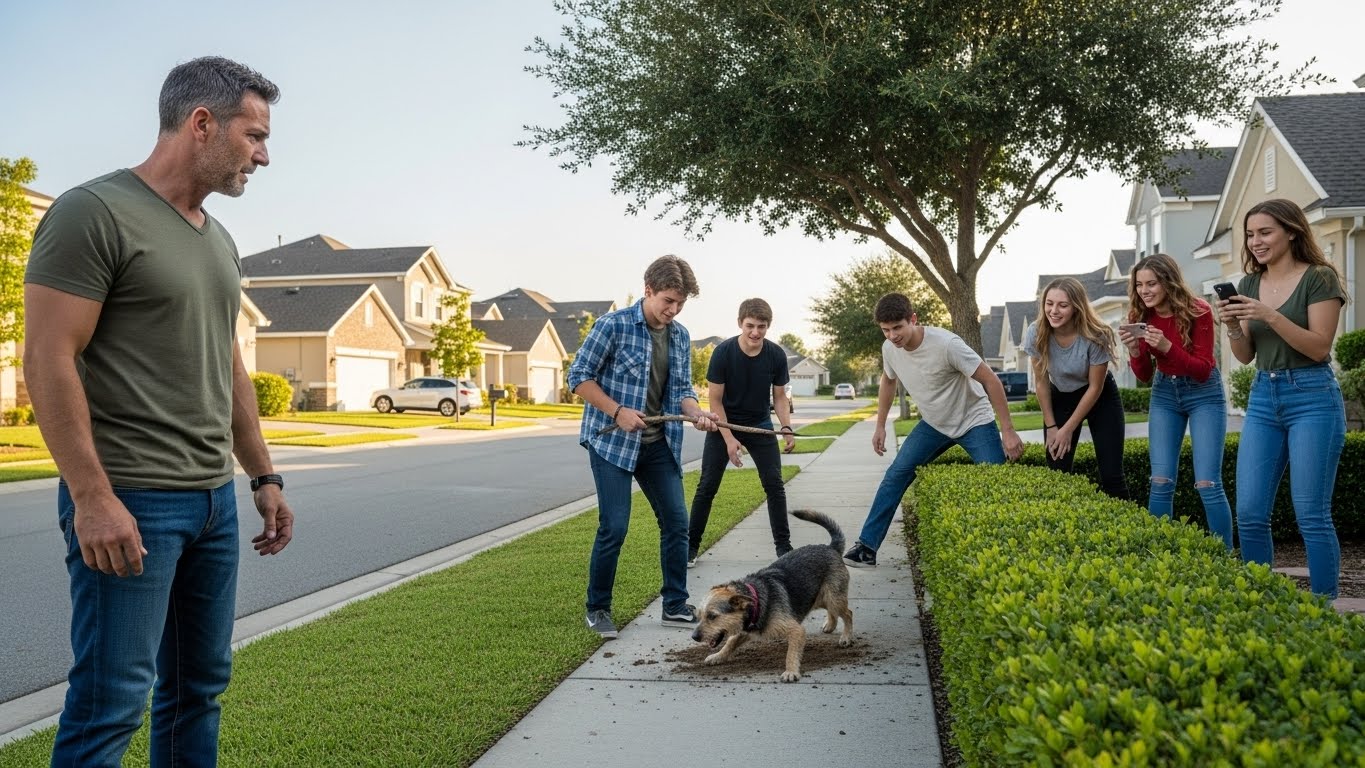
The three boys didn’t run. Not at first. That would have been an admission of fear, and in the hierarchy of Oakwood Creek’s teenage elite, fear was a social death sentence. Leo stood his ground for five agonizing seconds, his chest heaving, his expensive sneakers scuffing the asphalt. He looked at my hands—thick, calloused, scarred across the knuckles from a life spent holding things that were meant to destroy—and then he looked at my eyes.
That was his mistake. People like Leo are used to looking at people and seeing reflections of their own importance. When he looked at me, he saw a vacuum. He saw a man who had already lost everything that mattered and therefore had nothing left to lose.
“This isn’t over, Thorne,” Leo spat, though his voice cracked on the last syllable. He dropped the skateboard. It hit the ground with a hollow thwack that made the dog flinch so hard it let out a sharp, pained yelp. “My dad owns half the commercial real estate in this county. You’re just a psycho living in a junk house. Enjoy your fleabag.”
He turned, gesturing for his two shadows—Marcus and Jax—to follow. They retreated toward a pristine white Jeep Wrangler parked at the curb, their bravado returning the moment they reached the safety of the vehicle. The engine roared, a deliberate, aggressive sound, and they peeled away, leaving a streak of burnt rubber on the street I had spent twenty years trying to keep quiet.
I didn’t watch them go. I knelt.
My knees screamed—a sharp, stabbing reminder of a night in the Korengal Valley when I’d jumped from a hovering Chinook into a pile of jagged shale. I ignored it. I’d learned long ago that pain is just a signal, and signals can be muted.
“Hey there, big guy,” I whispered. My voice felt like rusted hinges moving for the first time in years.
The dog was a mess. Up close, he looked even worse than he had from the porch. He was a Golden Retriever mix, but the “golden” had been replaced by a muddy, matted gray. You could count every rib. There was a jagged cut above his left eye where the skateboard had clipped him, and he was holding his front paw at an angle that made my own stomach turn.
I reached out a hand. The dog didn’t growl. He didn’t even have the energy for that. He just pressed his face into the pavement and waited for the next blow. That broke something inside me—a small, tectonic shift in a heart I thought was solid stone. This dog expected the world to hurt him. He’d accepted it as the natural order of things.
“I’m not them,” I said, my hand hovering an inch from his matted fur. “I’m Elias. And you’re coming with me.”
I slid my arms under his shivering frame. He weighed next to nothing. As I lifted him, his head fell against my shoulder, his hot, ragged breath dampening the fabric of my t-shirt. He smelled of stagnant water, fear, and decay.
“Elias?”
I froze. I didn’t need to turn around to know it was Mrs. Gable from across the street. She was seventy-eight, a widow who spent her days tending to rosebushes that looked like they belonged in a magazine and her nights watching the neighborhood through a pair of vintage birdwatching binoculars.
“I saw what happened,” she said, her voice trembling as she walked toward the edge of her driveway. She was clutching a floral cardigan to her throat. “Those boys… they’ve been a menace for months. But Leo’s father, Richard… he’s not a good man to cross, Elias. He has the police chief on speed dial. He has the mayor at his dinner table.”
I looked at her then. Mrs. Gable had been the one to bring over a casserole when my son, Toby, died. She was the only person in this neighborhood who didn’t look at me like I was a ticking time bomb.
“Richard can have the whole world on speed dial, Martha,” I said, shifting the dog’s weight. “But he doesn’t have me.”
“They’ll come for you,” she warned, her eyes darting to the retreating tire tracks. “They don’t like people who remind them they aren’t in control.”
“Let them come,” I replied. “I’ve been hunted by professionals. These are just children playing at being monsters.”
I walked back to my house. The front yard was a disaster—the grass was calf-high, and the porch swing was missing a chain—but inside, it was a tomb of perfect order. Everything was exactly where it had been two years ago. Toby’s shoes were still by the door. His backpack was still slung over the kitchen chair. My wife, Sarah, had told me I was morbid. She’d told me that keeping a shrine wouldn’t bring him back. She was right, of course. That’s why she was in San Diego now, living a life filled with sunlight and new memories, and I was here, in the dark, guarding a ghost.
I carried the dog into the kitchen and laid him on a pile of old towels. I moved with a practiced, clinical efficiency. I’d been a combat medic for a stint before I moved to the Rangers; I knew how to patch a hole.
I got my old field kit from the hall closet. I cleaned the cut on his head with antiseptic, the dog’s body rigid with tension but never once snapping at me. I checked the leg. It wasn’t broken, just badly bruised and likely sprained.
“You’re a survivor, aren’t you?” I muttered, taping a clean gauze pad over the wound.
The dog finally looked at me. His eyes were a deep, soulful amber, clouded with cataracts but shimmering with a sudden, sharp intelligence. He let out a long sigh, his head thumping down onto the towels, and for the first time, he closed his eyes.
He trusted me. The realization hit me like a physical blow.
I sat on the kitchen floor, my back against the refrigerator, and watched him sleep. The house was silent, save for the hum of the fridge and the dog’s shallow breathing. I found myself thinking about Toby. Toby had wanted a dog for his eighth birthday. I’d told him no. I told him we weren’t ready for the responsibility, that my deployment schedule was too heavy, that a dog needed a father who was home more than three months a year.
I’d been so focused on being a soldier that I’d forgotten how to be a dad. And then, the accident happened. A distracted driver, a rainy Tuesday, and a world that ended in a screech of tires. Toby never got his dog. And I never got to say I was sorry.
A sharp knock on the front door shattered the silence.
I didn’t jump. My heart rate didn’t even climb. I just reached for the kitchen knife on the counter, then caught myself. Old habits. I stood up, my joints cracking, and walked to the door.
I looked through the peephole. It wasn’t Leo or his father. It was a man in a crisp blue uniform. Officer Miller.
Miller was a good cop, which was a rare thing in a town where the tax bracket usually determined the level of justice you received. He was also a guy I’d shared a few beers with at the VFW.
I opened the door.
“Elias,” Miller said, tipping his cap. He looked tired. There were bags under his eyes that suggested he’d been dealing with Oakwood Creek’s ‘finest’ all day. “I wish I was here for a beer, buddy.”
“I’m guessing Richard Sterling called,” I said, leaning against the doorframe.
Miller sighed, stepping onto the porch. “Not just him. His lawyer, too. And the mother of the other kid, Jax. They’re claiming you threatened three minors with ‘deadly intent.’ Leo says you moved like you were going to kill him.”
“I moved like a man stopping a crime, Miller. They were beating a dog to death with a skateboard. Check the street. There’s blood on the asphalt.”
Miller looked past me, his eyes landing on the kitchen where the dog was visible on the floor. “Is that the mutt?”
“That’s the dog,” I corrected.
“Elias, listen to me. Richard Sterling is a shark. He’s already pushing for a restraining order. He wants you out of this neighborhood. He says a man with your ‘history’—and yes, he used the word PTSD—is a danger to the community. He’s using the kids as a shield to get rid of the guy who makes the property values drop.”
I felt a cold, familiar heat rising in my chest. The kind of heat that usually preceded a firefight. “He can try.”
“He’s not just trying, Elias. He’s filing a report for assault. He says you grabbed Leo. Did you?”
“I didn’t touch the kid. If I had touched him, he wouldn’t have been able to walk back to his Jeep.”
Miller nodded slowly. He knew I was telling the truth. He also knew it didn’t matter. “Look, I can stall the paperwork for tonight. But they’re going to come for that dog. Sterling called Animal Control. He’s claiming the dog is a ‘vicious stray’ that attacked the boys, and you’re harboring a public health risk.”
I felt my jaw tighten until it ached. “The dog can barely stand, Miller. He didn’t attack anyone.”
“It’s his word against yours, and he owns the paper the word is written on,” Miller said, his voice dropping to a whisper. “Get the dog out of here, Elias. Take him to a vet in the next county. Hide him. Because if Animal Control shows up with a warrant tomorrow morning, I can’t stop them from taking him. And you know what happens to ‘vicious strays’ in this town.”
I looked back at the dog. He was still asleep, his tail giving a tiny, involuntary twitch.
“Thanks for the heads-up, Miller,” I said.
“I was never here,” Miller replied, turning to walk back to his cruiser. He stopped at the stairs and looked back. “Elias… be careful. Men like Richard Sterling don’t know how to lose. They think the world is a vending machine—they put in money, they get what they want. When the machine jams, they don’t just walk away. They kick it until it breaks.”
“I’m a pretty heavy machine to kick,” I said.
I closed the door and locked it. I went to the kitchen and sat back down next to the dog. I reached out and gently stroked his head. He didn’t wake up, but he leaned into my touch.
“I guess your name is Buddy,” I whispered. “And it looks like it’s you and me against the world, Buddy. Good thing I’ve got some experience with those odds.”
I looked at the clock. 10:45 PM. I had six hours until the sun came up. Six hours to decide if I was going to keep playing the role of the broken veteran, or if I was going to remind this town why they should have never poked the lion in the shadows.
I stood up and went to the basement. I hadn’t been down there in months. In the corner, under a heavy canvas tarp, sat a locked Pelican case. I wiped the dust off the top and entered the code.
The locks clicked open with a heavy, metallic sound. Inside wasn’t a weapon—at least, not the kind Miller would be looking for. It was my old tactical gear, my medals, and a series of journals I’d kept during my three tours. But at the bottom, tucked away in a velvet pouch, was something else.
A GoPro. And a set of high-end thermal binoculars I’d ‘forgotten’ to turn in during my out-processing.
If Richard Sterling wanted a war, he was going to get one. But he was used to fighting in courtrooms with mahogany tables. He wasn’t used to fighting a man who knew how to disappear into the tall grass.
I spent the rest of the night rigging my property. I wasn’t setting traps to hurt anyone—not yet. I was setting traps to see. Motion-activated cameras hidden in the overgrown bushes. Mic-pickups tucked under the eaves of the porch.
As I worked, the adrenaline cleared the fog of the bourbon and the grief. For the first time since Toby’s funeral, I felt like I had a mission.
Protect the asset. Neutralize the threat.
At 3:00 AM, I heard a car crawl slowly down the street. It didn’t have its headlights on. It stopped in front of my house for a long minute, then sped away.
I sat on the porch in the darkness, Buddy resting at my feet, the thermal goggles around my neck.
“They’re coming, Buddy,” I whispered.
The dog let out a soft, low woof, as if he understood.
I checked my watch. The sun would be up soon. And with it, the storm.
CHAPTER 3: The Siege of Oakwood Creek
The sun rose over Oakwood Creek like a spotlight on a stage set for a tragedy. At 6:00 AM, the neighborhood was a symphony of automated sprinklers and the distant clinking of coffee mugs. To anyone else, it was a beautiful Tuesday. To me, it was the start of a breach.
I sat in my darkened living room, the only light coming from the glowing monitors I’d set up on the coffee table. Buddy was lying across my feet. He’d eaten a bowl of warm rice and chicken I’d prepared, and though he still winced when he moved, the light in his eyes had returned. He looked at the monitors with a tilted head, as if he recognized the tactical feed.
“They’re early,” I whispered, stroking his ears.
On the screen, a white van with the municipal seal of “Animal Control” turned the corner, followed closely by a black SUV I didn’t recognize. No police cruiser. That was interesting. Richard Sterling didn’t want this on the official record yet; he wanted it handled “quietly.”
I stood up, my back popping like small-arms fire. I checked the camera at the front gate. Two men stepped out of the van. One was a tall, lanky man in a tan uniform—Henderson, the local animal control officer. I knew him. He was a man who followed the path of least resistance. The other man, stepping out of the SUV, was the shark itself.
Richard Sterling was exactly what I expected. He wore a tailored navy suit that cost more than my truck, and his silver hair was slicked back with the precision of a man who never let a strand go rogue. He stood on the sidewalk, looking at my house with a disgusted curl of his lip. He wasn’t just here for the dog. He was here to erase an eyesore.
I opened the front door before they could even reach the porch. I didn’t want them on my wood; I didn’t want them near my ghosts.
“Mr. Thorne,” Henderson said, his voice cracking slightly. He was holding a catch-pole—a long metal rod with a wire noose. “We’ve had a report of a dangerous animal on the premises. We’re going to need you to hand it over for observation.”
I didn’t look at Henderson. I looked at Sterling.
“Observation,” I said, my voice flat. “That’s a funny word for ‘euthanasia,’ isn’t it?”
Sterling stepped forward, invading my personal space. He smelled of expensive cologne and old money. “Let’s skip the theatrics, Elias. You’re a man of service, or at least you used to be. You know how this works. That animal attacked my son. It’s a liability. We’re taking it, and then we’re going to have a very serious conversation about the assault charges my son is currently filing against you.”
“Your son attacked the dog, Richard,” I said. “I have three neighbors who saw it. I have the blood on the street. And,” I paused, leaning in just enough to see his pupils dilate, “I have the footage.”
That was a bluff. The cameras I’d set up last night hadn’t been there for the initial incident. But Sterling didn’t know that.
His jaw tightened. “Footage? In this neighborhood? Nobody has cameras facing the street. It’s a privacy violation.”
“I do. Military grade. Low-light, high-def. It captures everything—from the way your son swung that skateboard like a club, to the way he laughed when the dog’s ribs snapped. It makes for a very compelling viral video, don’t you think? ‘The Son of Oakwood Creek’s Golden Boy Tortures a Stray.’ I wonder what that would do to your firm’s stock price.”
Sterling’s face turned a deep, mottled purple. He wasn’t used to people talking back, especially not men who lived in ‘junk houses.’
“You’re lying,” he hissed. “You’re a broken-down soldier playing games. Henderson, get in there and get the dog.”
Henderson looked between us, his face pale. “Uh, Mr. Sterling, if he has a camera… and if I don’t have a warrant…”
“I told you I’d handle the warrant!” Sterling shouted, losing his composure for a split second. “Get the damn dog!”
I stepped off the porch, closing the distance between me and Henderson. I didn’t touch him, but I moved into his “red zone.” I could see the sweat on his upper lip.
“Henderson,” I said softly. “You’ve got a wife and two kids over on Maple. You’re six years away from a pension. Do you really want to be the guy who illegally enters a combat veteran’s home to seize a dog that was being tortured by a bunch of rich punks? Because I promise you, when the civil rights lawsuit hits, Richard here will drop you faster than a hot shell casing.”
Henderson lowered the catch-pole. “I… I can’t do this without the paperwork, Mr. Sterling. The vet needs to sign off on the ‘vicious’ designation anyway.”
“You coward,” Sterling snarled. He turned his gaze back to me. “You think you’re smart, Thorne? You think you’re protecting something? Look at you. You’re a ghost living in a tomb. You’re one bad day away from a padded cell, and everyone in this town knows it. I’ll have the Sheriff here by noon. I’ll have your house condemned by the end of the week. I will bury you under so much litigation you won’t be able to breathe.”
“I’ve been buried before, Richard,” I said, my heart rate steady, my mind clear. It was the same feeling I had before a night raid. “The thing about being buried is, you eventually learn how to breathe through the dirt.”
Sterling turned on his heel and marched back to his SUV. Henderson followed, looking like a kicked dog himself. As they drove away, I didn’t feel a sense of victory. I felt the clock ticking.
I went back inside and closed the door. My hands were steady, but my mind was racing. Sterling wasn’t wrong about one thing—he had the power to make my life a living hell. If I stayed on the defensive, I’d lose. In the Rangers, we had a saying: Speed, Surprise, and Violence of Action.
I needed to go on the offensive.
I sat down at my laptop. I wasn’t just a medic and a shooter; I’d spent a year in intelligence. I knew how to find what people didn’t want found.
I started with Leo Sterling. I didn’t look at his Facebook or his Instagram—that was all filtered garbage. I went deeper. I looked at the school’s private forums, the local “confession” pages, and the police blotters from the surrounding towns.
It took me three hours.
Leo wasn’t just a bully. He was a serial offender. There were three separate incidents of “accidental” property damage and one “unsubstantiated” claim of animal cruelty at a local park six months ago. Each time, the charges had been dropped. Each time, the arresting officer’s report had been “revised” by a supervisor.
Then, I found it.
A dashcam video from a local Uber driver that had been posted to a niche subreddit for “Entitled Kids” and then quickly deleted. I’d archived the link through a cached search. The video showed Leo and his friends—Jax and Marcus—throwing rocks at a homeless man’s cat near the downtown transit center.
But it wasn’t just the cruelty. In the background of the video, a car was parked. A silver Mercedes with a specific license plate. Richard Sterling’s car.
Richard hadn’t just been “unaware” of his son’s behavior. He’d been there. He was the one who had cleaned it up. He was the one who had paid off the Uber driver to delete the footage.
As I watched the video, Buddy came over and rested his head on my knee. He let out a soft whine, his amber eyes reflecting the light of the screen.
“I’ve got him, Buddy,” I whispered. “I’ve got both of them.”
But knowledge wasn’t enough. I needed a catalyst. I needed to show the neighborhood—and the world—exactly who was living behind the white picket fences of Oakwood Creek.
I spent the afternoon editing. I took the footage from my own front porch—the part where Leo laughed as he hit Buddy—and spliced it with the Uber driver’s footage and the screenshots of the deleted police reports. I didn’t use music. I didn’t use flashy transitions. I let the raw, ugly truth speak for itself.
I titled the video: The Price of Silence in Oakwood Creek.
I was about to hit ‘Upload’ when a shadow crossed the window.
I didn’t reach for a weapon. I reached for the thermal goggles. I looked through the lens.
Three heat signatures. They weren’t men. They were smaller, leaner.
The kids were back. And they weren’t carrying skateboards this time. They were carrying canisters of gasoline.
My blood turned to ice. They weren’t just trying to get the dog anymore. They were going to burn the ‘junk house’ down with us inside.
“Buddy, get to the basement,” I commanded. My voice was the one I used in the field—unquestionable. The dog didn’t hesitate; he limped toward the cellar door.
I moved to the front door, but I didn’t open it. I waited. I watched them on the monitor. Leo was in the center, his face twisted in a mask of adolescent rage. He was dousing the porch—the porch where Toby’s old tricycle still sat in the corner, a relic I couldn’t bring myself to move.
“Do it, Leo!” Jax whispered, his voice caught on the mic I’d hidden in the eaves. “Burn the freak out!”
Leo pulled a lighter from his pocket. The flame flickered, a tiny spark in the gathering twilight.
This was it. The moment where the Soldier had to decide if he was going to save himself, or if he was going to save his soul.
I reached for the intercom I’d rigged to the porch speakers.
“Leo,” my voice boomed, amplified and distorted, sounding like the voice of a vengeful god.
The boys jumped, nearly dropping the gasoline. They looked around wildly, eyes wide with terror.
“Look up at the camera, Leo,” I said, my voice calm, terrifyingly so. “Say hi to the internet. Because right now, thirty thousand people are watching you hold that lighter. And your father? He’s watching, too.”
I hadn’t hit upload yet, but they didn’t know that. In the age of live-streaming, the threat was as real as the flame.
Leo froze. He looked up, his face illuminated by the lighter. He looked small. He looked like a child playing with fire who had finally realized he was standing in a powder keg.
“Drop it,” I said. “Drop the lighter, or the world sees everything. Not just tonight. Everything from the downtown transit center. Everything your father paid to hide.”
The lighter hit the gasoline-soaked wood with a dull clink. It didn’t ignite.
“Run,” I said.
They didn’t need to be told twice. They scrambled for the Jeep, tires screaming as they fled the scene.
I stood in the silence of my home, my heart hammering against my ribs. I had won the battle, but the war was far from over. Richard Sterling would be here soon, and this time, he wouldn’t be bringing a catch-pole.
I looked at the ‘Upload’ button. My finger hovered over the mouse.
If I did this, there was no going back. I would be the man who destroyed the town’s reputation. I would be the target of every powerful person in the county.
I looked at the cellar door. Buddy was peeking out, his tail giving a tentative, hopeful wag.
I thought about Toby. I thought about the dog I never got him. I thought about the man I wanted to be—the man Toby thought I was.
I clicked the button.
Video Uploading… 10%… 40%… 100%.
“Phase one complete,” I whispered.
Now, I just had to survive the night.
CHAPTER 4: The Ghost Who Came Home
The video didn’t just go viral; it went nuclear. By 10:00 PM, the view count was ticking upward like a Geiger counter in a reactor melt-down. In the digital age, a “perfect” suburb like Oakwood Creek was a tinderbox of repressed resentment, and I had just dropped a flare into the center of it.
I sat on the front porch, the smell of gasoline still heavy in the air. I had scrubbed the wood as best I could, but the scent lingered—a reminder of how close I’d come to losing the only things I had left. Buddy sat beside me, his head resting on my thigh. He wasn’t shaking anymore. He seemed to know the perimeter was secure.
The first set of headlights appeared at the end of the cul-de-sac. Then another. And another.
It wasn’t the police. It was the neighbors.
Mrs. Gable was the first to cross the street. She didn’t have her binoculars this time. She was carrying a bowl of warm stew and a leash. Behind her came the Millers, the Gomezes, and even the reclusive Smith family from the corner. They stood on the sidewalk, a silent semi-circle of suburbanites looking at the man they had spent years ignoring.
“We saw it, Elias,” Mrs. Gable said, her voice stronger than I’d ever heard it. “We saw the video. And we saw them here tonight with the cans.”
“I’ve lived here thirty years,” Mr. Gomez added, his arms crossed over his chest. “I knew Richard was a shark, but I didn’t know he was raising a monster. Not on our street.”
Before I could respond, the roar of a high-performance engine cut through the murmurs. A black Mercedes Maybach screeched to a halt, nearly clipping Mr. Gomez’s mailbox.
Richard Sterling stepped out.
He didn’t look like a CEO anymore. His tie was undone, his hair was disheveled, and his eyes were wild with the kind of panic that only comes to men who realize their empire is built on sand. He didn’t look at the neighbors. He looked straight at me.
“Take it down,” Sterling screamed, his voice cracking. “I’ll give you whatever you want. This house? I’ll buy it for triple the market value. I’ll get you a private medical team for your… your issues. Just take the video down!”
I stood up slowly. Buddy stood with me, a low rumble beginning in his chest. It wasn’t a vicious sound; it was a warning.
“It’s too late, Richard,” I said, my voice echoing in the quiet street. “The internet doesn’t have a ‘delete’ button for the truth. It’s already been mirrored, shared, and sent to the District Attorney’s office.”
“You’ve ruined him!” Sterling lunged toward the porch steps, but the neighbors moved as one, forming a human wall between him and my property.
“He ruined himself, Richard,” Miller said, stepping forward. He wasn’t in uniform, but he carried the authority of a man who had seen enough. “And you helped him do it. You taught him that people—and animals—are just things to be used and broken.”
Sterling looked at the faces of the people he had looked down on for decades. He saw no pity. He saw the collective weight of a community that had finally found its spine.
“I have lawyers…” Sterling stammered, his shoulders slumping. “I have—”
“You have a son who needs a father, not a fixer,” I interrupted. I walked down the steps, the neighbors parting to let me through. I stopped a foot away from Sterling. I didn’t feel anger anymore. I just felt a profound, weary clarity. “I lost my son, Richard. I’d give every cent I have, every medal I won, just to have one more day to teach him how to be a good man. You still have that chance. But you won’t find it in a courtroom. You’ll find it in the mirror.”
Sterling stared at me, his mouth working but no sound coming out. The sirens finally appeared in the distance—real police this time, called by the neighbors who had witnessed the attempted arson.
As the red and blue lights began to dance across the white siding of the houses, Sterling collapsed against his car, a broken man in an expensive suit.
THE AFTERMATH
The following weeks were a blur of depositions, news crews, and a level of attention I never wanted. Leo Sterling was placed in a juvenile diversion program, and his father was forced to resign from his firm following an investigation into his “legal expenditures.”
The “junk house” at number 42 didn’t look so much like a tomb anymore.
Mrs. Gable organized a weekend “work party.” A dozen neighbors showed up with lawnmowers, paintbrushes, and cases of beer. They mowed the grass, fixed the porch swing, and painted the shutters a bright, defiant blue.
I sat on the newly mended swing, watching Buddy—now clean, fed, and moving with only a slight limp—chase a tennis ball across the lawn. He wasn’t a “stray” anymore. He was the mascot of Oakwood Creek.
Officer Miller walked up the driveway, tossing a folder onto the small table beside me.
“Official adoption papers,” Miller said, smiling. “The county waived the fees. They figured you’d already paid enough in ‘security services.'”
“Thanks, Miller,” I said, watching Buddy drop the ball at the feet of a neighborhood kid.
“You doing okay, Elias?”
I looked at the house. For the first time in two years, the front door was open. The sun was streaming into the kitchen, hitting the spot where Toby’s backpack used to hang. I had finally moved the backpack—not into the trash, but into a cedar chest in my bedroom, alongside my own uniform.
“I’m getting there,” I said. “One patrol at a time.”
As the sun began to set, casting long, golden shadows across the street, I realized that the “Soldier” hadn’t gone away. He had just changed his mission. I wasn’t guarding a perimeter of grief anymore. I was guarding a home.
I whistled, and Buddy came sprinting toward the porch, his tail thumping against the wood like a heartbeat. He jumped up onto the swing beside me, his warm weight pressing against my side.
I looked up at the stars beginning to poke through the twilight.
“We did it, Toby,” I whispered into the cool evening air. “We got the dog.”
Buddy licked my hand, his amber eyes reflecting the light from the windows of a neighborhood that was finally, truly, quiet. Not the silence of a held breath, but the silence of peace.