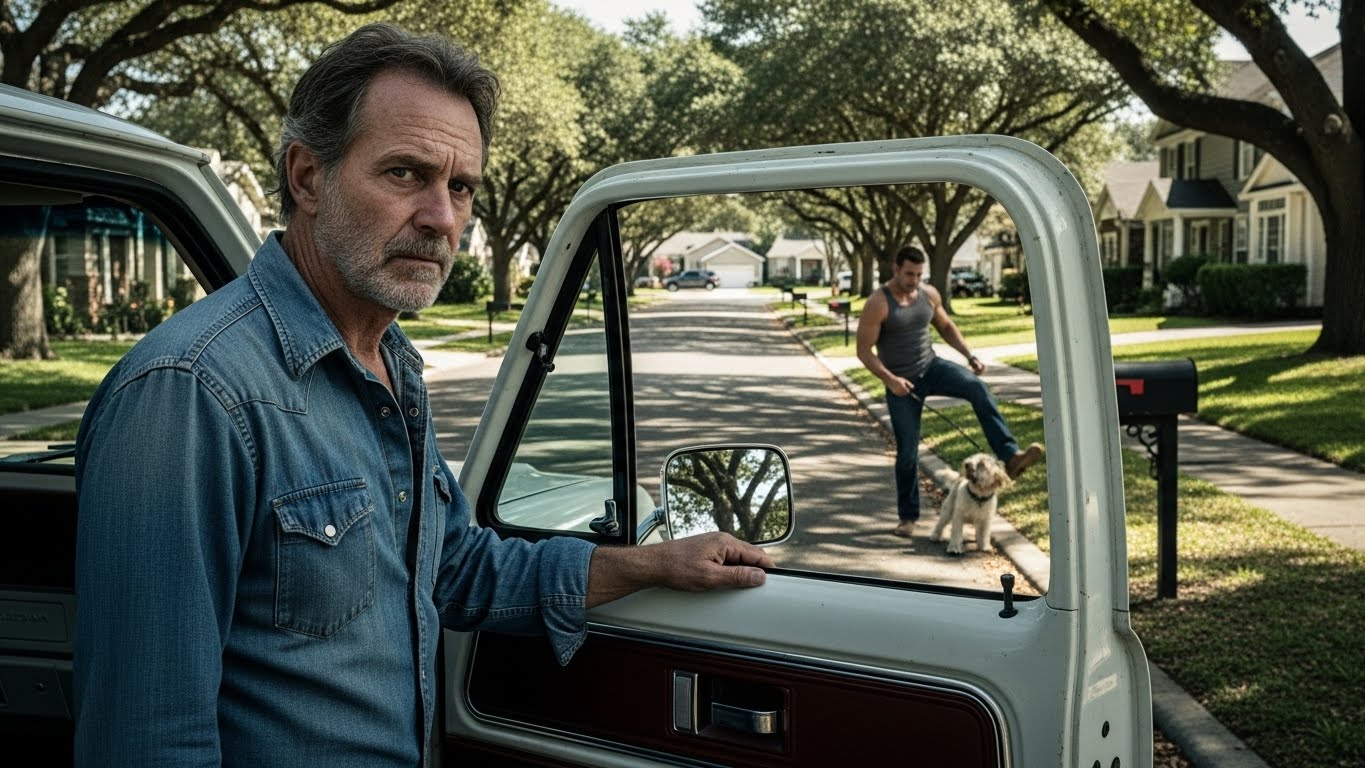
I spent twenty years kicking down doors just so I could forget the sound of screaming. I thought I’d finally found peace in this quiet suburb, hiding behind my shaking hands and a cup of black coffee.
CHAPTER 2: THE ECHOES OF THE STACK
The adrenaline crash hit me before Sarah’s taillights even faded at the end of the cul-de-sac.
It’s a specific kind of exhaustion—the kind that doesn’t just make your eyes heavy, but makes your bones feel like they’ve been replaced with lead pipes. In the tactical world, we call it the “black zone.” It’s the space where your body realizes it just survived a high-threat encounter and starts demanding payment in the form of every ounce of energy you have left.
I sat on my porch steps, my boots resting on the gravel. My hands were doing that thing again—a fine, rapid tremor that looked like a hummingbird’s wings. I gripped my knees until my knuckles turned white, trying to force the “Old Jack” back into the box.
“You okay, Jack?”
I didn’t have to look up to know it was Mrs. Gable. She lived at number 40. She was eighty if she was a day, with hair the color of a winter cloud and eyes that had seen the Great Depression, two world wars, and three generations of Oak Ridge drama. She was the neighborhood’s unofficial record-keeper.
“Fine, Mrs. Gable,” I muttered.
“I saw what you did,” she said, her voice surprisingly steady. She stepped off her lawn and onto the edge of mine, leaning on a mahogany cane. “Rick’s a rotter. Always has been. His father was a bully, too. Some fruit doesn’t just fall far from the tree; it rots right at the roots.”
I didn’t answer. I wasn’t looking for a conversation. I was looking for the silence I’d spent three years cultivating.
“The police are going to come, you know,” she added. “Rick’s the type to call 911 because a leaf fell on his truck. He won’t let this go.”
“Let them come,” I said.
I stood up, the joints in my knees popping like bubble wrap. I needed to clean up. I had ceramic shards on my porch and a ghost in my head that wouldn’t stop screaming.
Forty minutes later, a cruiser from the 4th Precinct pulled up. It wasn’t just any cruiser. I recognized the way it took the turn—too fast for a residential zone, a signature of someone who liked the feel of a steering wheel a little too much.
The door opened, and Officer Mike Miller stepped out.
Mike was thirty-two, had a buzz cut that was a little too tight, and wore his uniform like it was a suit of armor. I’d trained him when he was a green recruit back in the city. Back then, he called me “Sir.” Now, he just looked at me with a mix of pity and frustration.
“Jack,” Mike said, adjusting his duty belt as he walked up my driveway. “Tell me you didn’t.”
“Didn’t what, Mike?” I leaned against the porch railing, arms crossed.
“Rick Henderson. He’s at the station right now trying to file a felony assault charge. Says you attacked him unprovoked. Says you’re a ‘danger to the community’ with ‘military-grade combat training’ that makes you a walking weapon.”
I let out a short, dry laugh. “He’s got a creative imagination. Did he mention the dog?”
Mike sighed, taking off his mirrored sunglasses. His eyes were tired. “He mentioned a ‘pest’ he was ‘moving’ out of the road. Jack, look… I know Rick is a prick. Everyone in the precinct knows he’s a prick. But you can’t just go around laying hands on people. This isn’t the South Side. There are cameras everywhere.”
“Check the cameras then, Mike. Check Sarah’s Ring doorbell. Check mine. He was beating a ten-pound terrier. He was swinging at me. I used a compliance hold. No strikes, no permanent damage. Just gravity.”
Mike looked around the quiet street. A few neighbors were still lingering, watching the cop car. “He’s demanding an arrest, Jack. He’s making a lot of noise about your ‘mental state.’ He knows about the VA visits. He’s using your PTSD as a lever.”
The air in my lungs felt thin. That was the low blow. My “mental state” was the one thing I tried to keep under lock and key. In a world of “thank you for your service” stickers, nobody actually wants to deal with the guy who can’t handle a car backfiring or a dog yelping.
“So, what? You going to cuff me, Mike? Right here in front of Mrs. Gable?”
Mike looked at the ground, then back at me. “Not today. I talked the Sergeant down. We’re filing it as a domestic disturbance with no immediate threat. But Rick’s going to civil court. He wants a restraining order. He wants you out of this neighborhood.”
“He can try,” I said, my voice hardening.
“Jack,” Mike stepped closer, dropping his voice. “Is it worth it? You came here to disappear. You were doing so well. Why’d you break cover for a dog?”
I looked Mike square in the eye. “Because some things are worth the noise, Mike. You of all people should remember that.”
Mike held my gaze for a long second, then nodded. He knew what I was talking about. ’14. The warehouse fire. The kid we couldn’t get to. He knew that some silences are louder than others.
“Stay inside, Jack. Keep your doors locked. And for God’s sake, don’t talk to Rick if he comes back.”
I watched the cruiser pull away. The neighborhood felt like a pressure cooker. The peace was gone. The “quiet vet” was dead, replaced by the “dangerous man at number 42.”
I couldn’t stay in the house. The walls felt like they were closing in, the shadows in the corners morphing into the shapes of men I’d lost. I grabbed my keys and drove.
I ended up at the Westside Animal Emergency Clinic.
The waiting room smelled of antiseptic and old coffee. It was 2:00 PM on a Tuesday, and the place was mostly empty, except for a woman with a cat carrier and, in the far corner, Sarah and Lily.
Lily was curled up in a plastic chair, her face puffy from crying. Sarah was pacing, her phone clutched in her hand like a lifeline. When she saw me walk in, she stopped. For a second, I saw a flash of fear in her eyes—the same fear Rick had. It stung more than I cared to admit.
“How is he?” I asked, keeping my distance.
Sarah took a shaky breath. “The vet is with him now. They’re doing X-rays. He was coughing up blood, Jack. I think… I think his ribs are broken.”
“He’s a fighter,” I said, though I didn’t know if that was true. He was a dog. He shouldn’t have to be a fighter.
“Why did you do it?” Sarah asked suddenly. Her voice wasn’t grateful; it was confused. “You’ve lived across from us for three years. You never even said hello to Lily. You barely looked at Buster. Why risk everything for us today?”
I looked at a poster on the wall about heartworm prevention. “I spent a long time looking the other way, Sarah. I thought if I stayed quiet, the world would leave me alone. I was wrong. The world doesn’t leave you alone. It just waits until you’re not looking to hurt something that can’t hurt it back.”
Before she could respond, a door opened. A man in green scrubs walked out. He looked like he hadn’t slept since the Clinton administration. His name tag read Dr. Aris Thorne.
“Sarah?” he called out.
We both stepped forward. Dr. Thorne looked at me, then back at Sarah. “The little guy is stable. Two cracked ribs, a collapsed lung, and some significant bruising around the trachea. He’s lucky. Another inch, or a little more force, and he wouldn’t have made it to the car.”
Sarah let out a sob of relief, leaning against the reception desk.
“He’s going to need a few days of observation,” Thorne continued, his voice gruff but not unkind. “And the bill isn’t going to be pretty. The imaging alone is—”
“I’ve got it,” I interrupted.
Thorne looked at me, his eyebrows climbing toward his receding hairline. “It’s going to be upwards of three thousand, sir. That’s before the meds.”
I pulled my wallet out and handed him a black card. “I said I’ve got it. Put it all on there. Whatever he needs. Best meds, best care. If he needs a specialist, call one.”
Sarah grabbed my arm. “Jack, no. I can’t… I can’t let you do that. That’s your savings. That’s your life.”
“It’s just paper, Sarah,” I said, and for the first time in a long time, I meant it. “I’ve got plenty of paper. I don’t have a lot of peace. This buys me a little.”
Dr. Thorne took the card, his gaze lingering on me for a moment. He recognized the type. He’d probably treated police dogs before. He knew the look of a man who was trying to balance a scale that would never be even.
“I’ll get him started on the fluids,” Thorne said. “You can see him in an hour.”
As Thorne walked away, Lily came over. She didn’t say anything. She just wrapped her small arms around my waist and buried her face in my tactical vest. I stood there, paralyzed. I hadn’t been hugged by a child in a decade. I didn’t know where to put my hands.
Eventually, I rested one hand on her head. Her hair was soft, smelling of strawberry shampoo and sunshine.
“Is Buster going to be okay?” she whispered.
“Yeah, kiddo,” I said, my voice cracking just a little. “He’s a tough one. Just like you.”
I stayed with them for the hour. We didn’t talk much. We just sat in the hum of the clinic, a strange little island of broken people waiting for a broken dog.
But as I sat there, my phone buzzed in my pocket. It was a text from an unknown number.
I know where you were in ’14, Jack. I know what happened in that warehouse. You think you’re a hero? You’re a murderer. And I’m going to make sure everyone in Oak Ridge knows it. See you in court, “Commander.”
I looked out the window. The sun was setting, casting long, bloody shadows across the parking lot.
Rick wasn’t just going for a restraining order. He was going for my throat. He’d gone digging into my past, and in the age of the internet, nothing stays buried. Not even the things you’ve tried to drown in a bottle of bourbon.
I looked at Lily, who was finally asleep in her mother’s lap.
The “Old Jack” wanted to run. He wanted to pack his bags, leave the house, and disappear into the mountains where no one knew his name.
But then I thought of Buster, struggling for air on the hot pavement. I thought of Sarah, working three jobs just to keep a roof over her head.
The tremors in my hands stopped.
“Okay, Rick,” I whispered to the empty air. “You want to play in the dirt? Let’s play.”
CHAPTER 3: THE COURT OF PUBLIC OPINION
The morning after the “incident,” Oak Ridge felt different. The air was the same—heavy with the scent of freshly cut Kentucky Bluegrass and the hum of electric leaf blowers—ưng the atmosphere was electric. I walked to the edge of my driveway to grab the Washington Post, and I felt it: the Weight of the Gaze.
Mrs. Gable was watering her petunias two houses down. She didn’t wave. She didn’t look away, either. She just watched me with a tight, unreadable expression. Across the street, at number 45, Rick’s Raptor was gone, but his presence lingered like a bad smell. Someone had spray-painted a small, jagged red “X” on the curb in front of my house.
My phone vibrated. Another text from the unknown number.
“Everyone knows now, ‘Hero.’ Look at the neighborhood Facebook group. The truth is out. You’re a ticking time bomb.”
I didn’t want to look. I’d spent three years avoiding the digital sewage of social media. But in a suburb like this, Facebook was more powerful than the local police department. I opened the “Oak Ridge Community Page.”
The top post had over two hundred comments. It was a photo of me—taken by a neighbor’s Ring camera—holding Rick in the compliance hold. But the caption didn’t mention the dog.
“URGENT: Violent Incident at the Cul-de-Sac. Our ‘quiet neighbor’ Jack revealed his true colors yesterday. Did you know we have a former officer with a history of ‘excessive force’ and a ‘psychiatric discharge’ living among us? He attacked a neighbor for no reason. Is our community safe?”
The comments were a bloodbath. “I always thought he looked scary.” “My kids play on that street. Why wasn’t we notified a dangerous person lived here?” “I heard he killed someone in Chicago and got off on a technicality.”
I felt the familiar heat rising in my neck. The “Ghost of Kabul” wasn’t just a tremor anymore; it was a roar. The 2014 incident. The warehouse. The night I made the call to breach before the gas was cleared. There were three of us in that stack. Only two walked out. The third was Danny—my best friend, my younger brother in every way that mattered. The inquiry cleared me of legal wrongdoing, but the “moral wrongdoing” had stayed stuck in my marrow like a parasite.
I went back inside and dialed a number I hadn’t called in two years.
“Jack?” the voice on the other end was deep, gravelly, and instantly recognizable. “I figured I’d be hearing from you. The internet travels fast, even to the city.”
“Marcus,” I said, leaning my forehead against the cool glass of the kitchen window. “I need a favor.”
Marcus was my former Lieutenant. Now, he ran a high-end private security firm in Chicago. He was the only person who knew exactly how much of my soul stayed in that warehouse in 2014.
“I already looked into it, Jack,” Marcus said, his voice dropping an octave. “Rick Henderson didn’t just ‘find’ your file. Someone sold it to him. Or someone gave him access. That level of detail—the psychiatric discharge papers, the internal affairs transcripts—that’s not on Google. That’s behind a firewall.”
“Who?”
“I’m working on it. But Jack, listen… this guy isn’t just a bully with a truck. He’s connected. His cousin is a clerk at the Cook County courthouse. He’s digging for a reason. He wants you to snap. He wants you to prove the Facebook posts right.”
“He hurt the dog, Marcus. He was going to kill it.”
“I know. And that’s why you’re the man I’d trust in a foxhole. But in the suburbs? In the suburbs, the man who throws the second punch is always the villain. Don’t throw the second punch.”
I spent the afternoon in my garage, working on an old 1967 Mustang that I’d been “restoring” for three years. It was mostly an excuse to hold a wrench and feel something solid.
Around 4:00 PM, a shadow fell over the garage floor. I didn’t look up. I knew the gait. Heavy, confident, arrogant.
“Nice car,” Rick said.
I kept turning the bolt on the manifold. “Get off my property, Rick.”
“The street is public. And the HOA meeting is tonight at 7:00. Thought you should know. We’re discussing a ‘safety amendment’ regarding residents with violent histories.”
I dropped the wrench. It hit the concrete with a loud clang. I stood up slowly, wiping my greasy hands on a rag. Rick was standing at the edge of my driveway, wearing a smirk that made my knuckles ache.
“You’re really going this far?” I asked. “Over a dog?”
“It’s not about the dog, Jack. It’s about people like you. You think because you wore a badge and a vest that you’re better than us. You think you can come into a nice place like this and bring your war with you? You’re a freak. A broken, shaking freak.”
I walked toward him. He didn’t flinch this time. He knew I wouldn’t touch him—not with the “Safety Committee” watching from their windows.
“I saw Buster today,” I said, my voice low. “He’s in a cage with a tube in his chest because you were having a bad day. Does that make you feel like a big man, Rick? Hurting something that weighs ten pounds?”
Rick’s smirk flickered. For a split second, I saw it—the insecurity, the hollow center of a man who had never done anything brave in his entire life. “I don’t know what you’re talking about. The dog tripped me. I was defending myself.”
“You’re a liar,” I said. “And the worst kind of liar. The kind who believes his own bullshit.”
“See you at the meeting, Commander,” Rick sneered, turning on his heel. “I hear the board is very interested in the 2014 Warehouse transcripts. The part where your own team called you ‘unstable.’ Should be a fun night.”
The Oak Ridge Community Center was a sterile room that smelled of floor wax and stale donuts. Usually, these meetings were about the height of hedges or the color of trash cans. Tonight, the room was packed.
I walked in at 7:05 PM. The room went dead silent.
I saw Sarah in the back row. She looked small, her eyes red-rimmed. She gave me a tiny, terrified nod. Beside her was Mrs. Gable, who sat like a queen on her folding chair.
At the front table sat the HOA board. The leader was Linda—a woman who wore her blonde highlights like a helmet and possessed the unique ability to make “bless your heart” sound like a death threat.
“Jack,” Linda said, her voice echoing in the microphone. “Thank you for joining us. We were just discussing Section 4, Paragraph B: Community Safety and Resident Conduct.”
Rick was sitting in the front row, looking like a choir boy in a crisp polo shirt.
“I’d like to speak,” Rick said, standing up. He turned to face the crowd, his voice full of practiced emotion. “Friends, neighbors… we all want Oak Ridge to be a sanctuary. But yesterday, I was brutally assaulted in my own street. I’ve lived here for six years. I pay my dues. I follow the rules. But we have a man here who is clearly suffering from severe mental issues. He has a history of violence that he hid from us. He’s a liability. My insurance company is already talking about raising premiums for the whole block because of the ‘increased risk’ of having a high-threat individual in the vicinity.”
A murmur of fear ran through the room. “Risk” was the magic word in the suburbs.
“Jack,” Linda said, looking at me over her reading glasses. “Do you have anything to say in your defense?”
I stood up. My hands were in my pockets, gripping my thighs to keep the tremors at bay. I looked at the faces in the room. I saw fear, I saw judgment, but mostly, I saw a lack of courage. They wanted a villain so they could feel like heroes for “protecting” their lawns.
“I didn’t hide my history,” I said, my voice steady. “I served my city for twenty years. I made mistakes. I carry them every day. But what happened yesterday wasn’t about my history. It was about a man beating a dog.”
“He’s lying!” Rick shouted. “The dog attacked me! I was scared for my life!”
The room erupted into noise. Linda banged a plastic gavel.
“Enough!” a voice cracked through the chaos.
It was Sarah. She stood up, her hands shaking worse than mine ever had. She held up her phone.
“I have the video,” she said, her voice gaining strength. “My Ring camera caught it all. Not just the part where Jack stopped him. The part where Rick walked across the street, called the dog over, and kicked him while he was wagging his tail. I have the audio of Rick laughing while Buster screamed.”
The silence that followed was absolute.
Rick’s face went from pale to a deep, bruised purple. “That… that’s a private recording! That’s not admissible!”
“This isn’t a court of law, Rick,” Mrs. Gable said from her seat, her voice sharp as a razor. “This is a neighborhood. And I think we’ve seen enough of who the ‘threat’ really is.”
Sarah walked to the front and handed her phone to Linda. The board huddled around the small screen. The room waited, the only sound the faint, tinny yelps of a dog coming from the phone’s speakers.
Linda looked up. Her expression had shifted. The “Safety Committee” look was gone, replaced by something much older—the look of a mother who had just seen a predator in the yard.
“Rick,” Linda said, her voice cold. “I think you should leave.”
“You can’t kick me out! I own my house!”
“No,” Linda said. “But we can file a formal complaint with the animal cruelty division. We can fine you for every violation in the book. And we can make sure that every person in this county knows exactly what you are. Leave. Now.”
Rick looked around the room. He looked for an ally. He found none. Even the people who had posted the worst things about me on Facebook were looking at him with disgust. He was a bully, and bullies only thrive when they have a crowd. The crowd had just turned.
He grabbed his keys and stomped out, but not before pausing at my shoulder.
“This isn’t over, Jack,” he hissed. “The 2014 file… it’s going to the local news tomorrow. You’re still a murderer.”
He walked out, the heavy doors slamming behind him.
The room stayed quiet for a long moment. Then, one by one, people started to leave, avoiding my eyes. They weren’t on Rick’s side anymore, but they weren’t on mine either. I was still the “Old Jack.” I was still the man who knew how to hurt people.
Sarah walked over to me. She looked exhausted, but there was a light in her eyes I hadn’t seen before.
“He’s awake,” she whispered. “The vet said Buster is breathing on his own. He… he kept looking at the door. I think he’s looking for you.”
I felt a lump in my throat that I couldn’t swallow. “I’m not a dog person, Sarah.”
“Liar,” she said softly, reaching out and squeezing my hand.
For the first time in a decade, the tremors stopped. Not because of adrenaline. Not because of training. But because, for one small moment, I wasn’t a soldier. I was just a neighbor.
But as I walked out into the cool night air, I saw a black sedan parked at the far end of the lot. The headlights flicked on and off—a signal.
The 2014 file wasn’t just a threat. It was the beginning of a much larger war. Rick was a pawn. And whoever was holding the “X” spray-paint was finally stepping out of the shadows.
CHAPTER 4: THE SHEEPDOG’S PEACE
The black sedan didn’t move as I approached. It sat at the edge of the community center parking lot, its engine a low, predatory hum. I didn’t reach for a weapon—I didn’t have one—but my body fell into a familiar rhythm. Eyes scanning the perimeter. Breath controlled. Weight on the balls of my feet.
The window rolled down. The man inside wasn’t Rick. He was older, wearing a suit that cost more than my house, with eyes that held the cold, sterile light of a boardroom.
“You’ve made a lot of noise for a dead man, Jack,” he said.
I knew that voice. It was Elias Thorne, the brother of Danny—the man I’d lost in the warehouse in 2014. Elias wasn’t just a grieving relative; he was a high-level fixer for the city’s political elite. He’d spent a decade making sure the “official” version of the 2014 fire stayed official.
“Elias,” I said, my voice like grinding stones. “You sent Rick.”
“Rick is a useful idiot,” Elias said, tapping a rhythmic beat on the steering wheel. “He’s local. He’s loud. He was the perfect tool to flush you out. I needed to see if the ‘Commander’ was still in there, or if you’d truly turned into the broken ghost the VA said you were.”
“Why now? It’s been eleven years.”
“Because there’s a new inquiry into the warehouse fire, Jack. A journalist is digging. If you stay the ‘quiet vet,’ no one listens to you. But if you become the ‘violent psycho’ who beats up his neighbors and kills dogs… well, your testimony becomes worthless. You’re a liability I can’t afford.”
He looked at me, a thin, cruel smile touching his lips. “Rick isn’t done. He’s desperate now. He’s lost his standing in this neighborhood, and a man with nothing to lose is a very dangerous thing. I suggest you pack your bags and disappear again. For your sake. And for the girl’s.”
The mention of Lily sent a jolt of ice through my chest.
“If you touch them,” I said, leaning into the window, “you’ll find out exactly what’s left of the Commander.”
Elias just laughed, rolled up the window, and drove away, leaving me in a cloud of expensive exhaust and the realization that the war hadn’t just followed me home—it had moved in next door.
I didn’t go home. I drove straight to the vet clinic.
It was late, the “Open” sign flickering in the dark. Dr. Thorne was still there, sitting behind the desk with a cup of lukewarm coffee. He looked up as I entered.
“He’s doing better, Jack. We took the tube out an hour ago.”
“I need to take him home,” I said.
“He’s not ready. He needs observation—”
“He’s not safe here,” I interrupted. I looked Thorne in the eye. “And neither are you. Please. Trust me.”
Thorne saw something in my face—the look of a man who knew exactly where the exits were. He didn’t ask questions. He just led me to the back.
Buster was in a small, stainless steel kennel. When he saw me, his tail didn’t wag—he was too weak—but his eyes lit up with a recognition that hit me harder than any punch Rick had ever thrown. I wrapped him in a thick wool blanket and carried him out like a sleeping child.
I drove to Sarah’s house. I didn’t knock; I just stood on the porch until she opened the door, her eyes wide with fear.
“Get Lily,” I said. “Pack a bag for forty-eight hours. You’re staying at my place.”
“Jack, what’s happening? The meeting… Rick left… I thought it was over.”
“It’s not over. Rick is coming. And he’s not coming to talk.”
The storm broke around 2:00 AM.
Lightning illuminated the suburban street in jagged, blue flashes. Inside my house, Sarah and Lily were asleep on the floor of my basement—the only room with no windows and a reinforced door. Buster was curled up on a pile of my old flannel shirts, his breathing shallow but steady.
I sat in the dark of my living room, a heavy tactical flashlight in one hand and my old service radio in the other. My hands were perfectly still. The “Ghost of Kabul” had finally gone quiet. In the face of a real threat, the tremors always vanished. It was the peace that terrified me.
I heard the sound of a heavy engine long before I saw the headlights.
Rick’s Raptor didn’t pull into his driveway. It pulled onto my lawn, the massive tires churning up the sod I’d spent three years perfecting. He didn’t turn off the engine. He kept the high beams on, flooding my living room with a blinding, white glare.
I stood up and walked onto the porch.
Rick stepped out of the truck. He wasn’t the “man-child” from the morning. He was drunk, his movements heavy and erratic, and in his right hand, he held a gallon-sized red jerry can. The smell of gasoline drifted up to the porch even through the rain.
“You took everything, Jack!” Rick screamed over the thunder. “My reputation! My neighbors! They look at me like I’m a monster!”
“You are a monster, Rick,” I said, my voice calm. “I just turned the lights on so everyone could see.”
“I’m going to burn it down,” Rick sobbed, his voice breaking. “I’m going to burn you, and that rat, and everything you think you saved. Let’s see how the ‘hero’ handles a fire he can’t stop!”
He began splashing gasoline across my front steps.
I had a choice. I could go down there and break him. I could use the skills the city had paid for to ensure Rick Henderson never drew another breath. It would be easy. It would be “justified.”
But then I thought of Danny. I thought of the warehouse. I thought of the choice I’d made eleven years ago to prioritize the “objective” over the human lives in the stack.
I dropped the flashlight.
I walked down the steps, right into the puddle of gasoline. Rick froze, the jerry can trembling in his hand. He fumbled for a lighter in his pocket.
“Do it, Rick,” I said, stepping closer until the brim of my hat touched his forehead. “If you want to be a killer, be a killer. But look me in the eye when you do it. Don’t hide behind a truck or a fence. Look at the man you’re burning.”
Rick’s thumb sparked the lighter. A small, orange flame flickered in the rain.
“I’ll do it! I swear to God!”
“I know you will,” I whispered. “Because you’re afraid. You’ve been afraid your whole life. You’re afraid of Sarah’s strength, you’re afraid of the dog’s love, and you’re terrified of the silence inside yourself. But the fire won’t fix that, Rick. It just makes the dark bigger.”
We stood there for an eternity—two men in the rain, one holding a flame, the other holding a ghost.
Slowly, the lighter flickered and went out.
Rick’s shoulders slumped. The jerry can fell from his hand, splashing gas onto his own boots. He sank to his knees in the mud of my ruined lawn and began to howl—a sound of pure, pathetic grief.
I didn’t hit him. I didn’t pin him. I just stood over him, shielding him from the rain.
The sirens appeared a few minutes later. Officer Mike Miller was the first one out of the car. He saw the gas, he saw the lighter, and he saw me—standing there with my hands open and empty.
“He’s done, Mike,” I said. “Take him home. Not his house. The station.”
As they loaded a sobbing Rick into the back of the cruiser, Mike walked up to me.
“Elias Thorne called the station,” Mike said quietly. “He told us to expect a ‘violent escalation’ from you. He wanted us to come in hot, Jack. He wanted a shootout.”
“I know,” I said. “He wanted the old story. I decided to write a new one.”
Six months later.
The “X” on my curb had been scrubbed away. The lawn had been re-seeded, the green grass finally beginning to hide the scars of the Raptor’s tires. Rick was gone—sold his house to pay for his legal fees and a court-mandated stint in a psychiatric facility.
I sat on my porch, the morning sun warming my face. I had a new mug. It wasn’t ceramic; it was travel-grade plastic, because I didn’t need the weight anymore.
A soft thump sounded against the floorboards.
Buster sat down next to my boots. He moved a little slower now, and he had a permanent limp in his back leg, but his ear still pointed North. He rested his head on my knee.
“Morning, Buster,” I said.
I reached down. My hand didn’t shake. Not even a little. I ran my fingers behind his ears, and the dog let out a long, contented sigh.
Sarah and Lily were across the street, loading a picnic basket into their car. Lily saw me and waved frantically. “See you at the park, Mr. Jack!”
“See you there, kiddo,” I called back.
I watched them drive off. The neighborhood was quiet again, but it wasn’t the silence of a graveyard. It was the silence of a house after the windows have been opened and the dust has been cleared.
I used to think that being a sheepdog meant teeth and claws. I used to think the only way to protect the flock was to be more terrifying than the wolf.
But as Buster licked my hand and the sun climbed over the oaks of Oak Ridge, I realized I was wrong. The sheepdog’s job isn’t just to fight the war. It’s to make sure that, one day, the war finally ends.
I stood up, whistled for the dog, and walked toward my car. For the first time in twenty years, I wasn’t looking over my shoulder.
The monsters were gone, and for once, the hero got to go home.