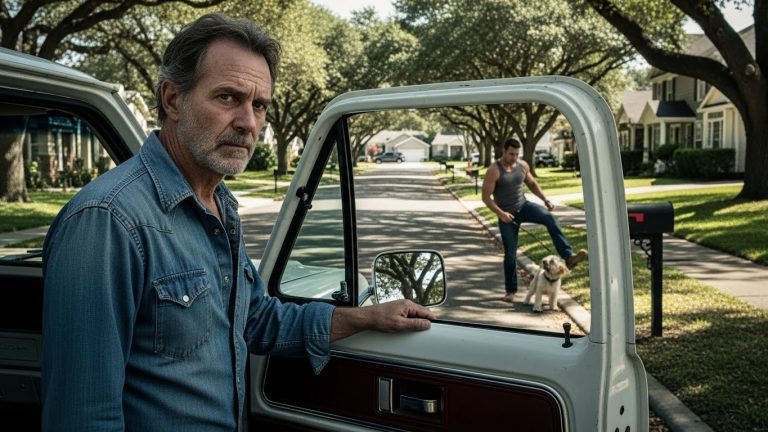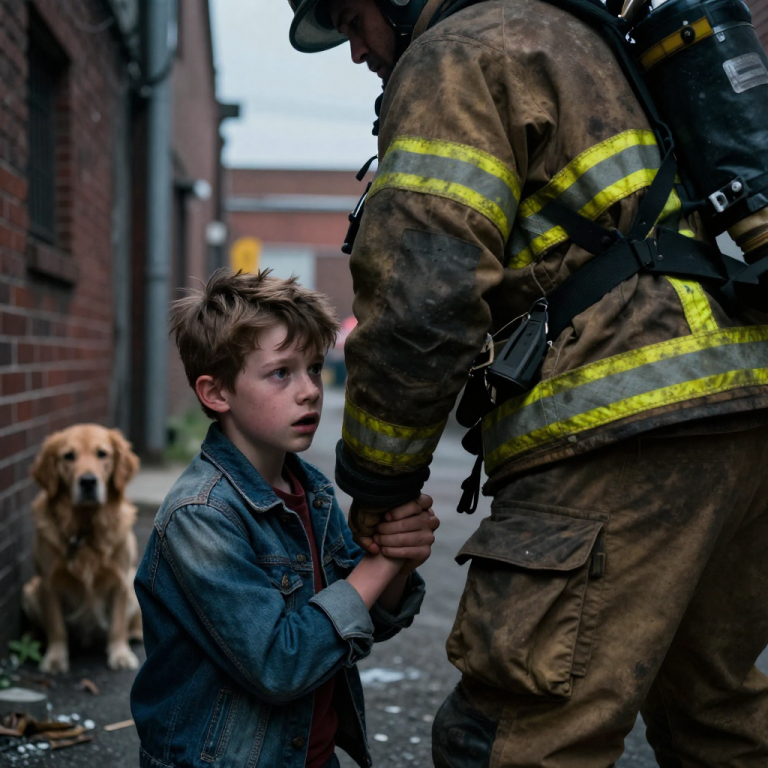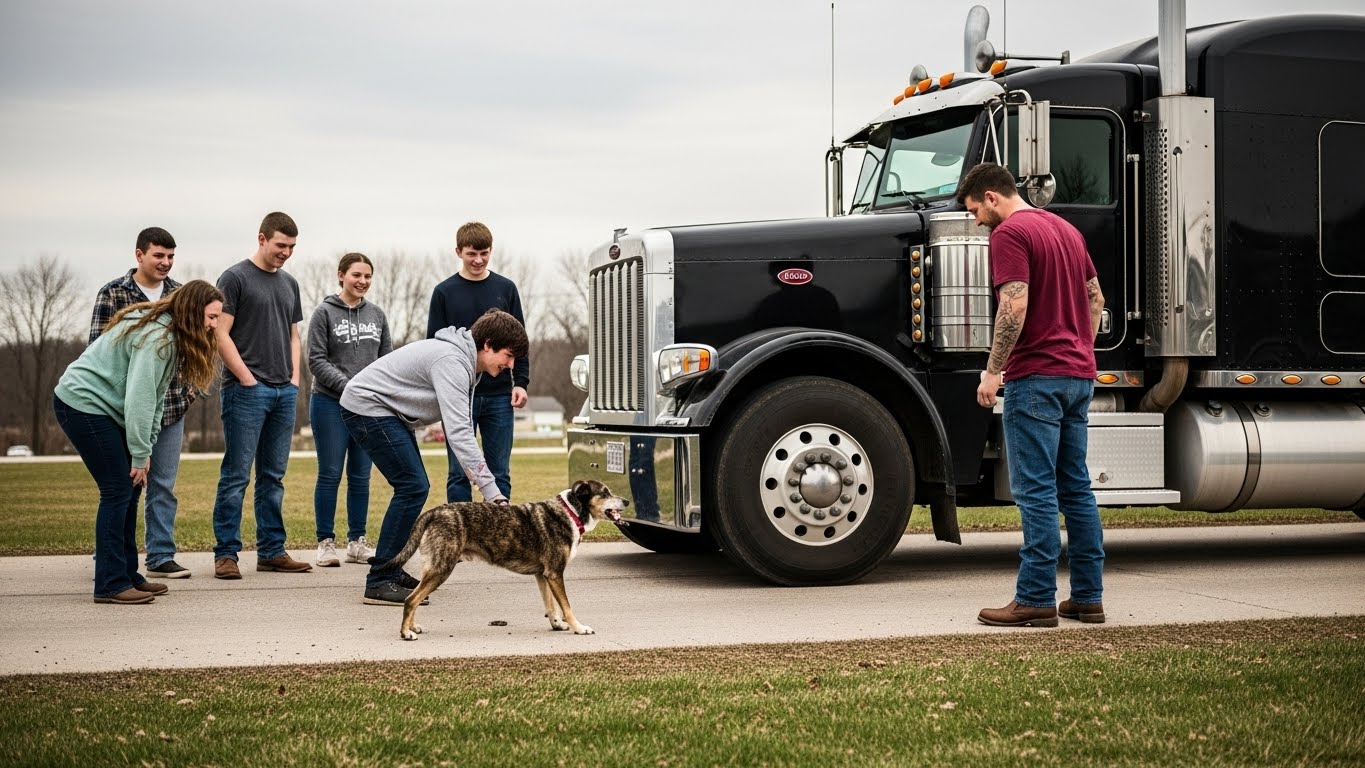
The neighborhood called him a “stray,” and the boys called him “target practice.” But when that 18-wheeler screeched to a halt and a man with nothing left to lose stepped out, everyone realized the dog wasn’t the only thing being hunted in this town.
CHAPTER 2: THE GHOST IN THE PASSENGER SEAT
The cab of the Peterbilt felt like a cathedral of chrome and diesel. For Jax, it was the only home he had left—a vibrating, forty-ton sanctuary that kept the rest of the world at arm’s length. But today, the sanctuary felt crowded.
“Lift his back end. Gently, kid. If you drop him, God help me, you’ll be walking home with a limp,” Jax growled, his hand supporting the dog’s chest.
Caleb Miller, the boy who minutes ago had been a king of the gravel pit, was now trembling. He gripped the dog’s hindquarters, his expensive sneakers sliding in the Ohio dust. The dog—whom Jax had started calling ‘Buster’ in his head—didn’t struggle. He was too tired for that. He just let out a soft, wheezing breath as they hoisted him onto the broad, leather passenger seat.
“He’s… he’s bleeding on your seat,” Caleb stammered, looking at a smear of dark blood on the pristine tan upholstery.
Jax didn’t even look at it. He pulled a clean, oversized flannel shirt from his sleeper berth and draped it over the dog like a shroud. “Blood washes out. Cruelty doesn’t. Now, get in.”
“What? No way. I’m not going anywhere with you!” Caleb backed away, his eyes darting toward his friends, Leo and Jaxson, who were already halfway down the block on their bikes, abandoning him to the giant in the truck.
Jax stepped down from the running board, his shadow stretching long and terrifying across the asphalt. “You’ve got two choices, Caleb. You get in that cab and help me keep him steady while I drive to the vet, or I call the Sheriff. I’m pretty sure ‘Animal Cruelty’ looks real nice on a juvenile record. What’s your dad gonna think about that? From what I hear, Frank Miller isn’t big on second chances.”
The mention of his father’s name hit Caleb like a physical blow. The boy’s face went from pale to a ghostly translucent. He climbed into the cab without another word, sitting on the edge of the seat, as far away from Jax as possible.
Jax slammed the door. The sound was final.
As the 18-wheeler roared back to life, the vibrations shook the floorboards. Jax shifted into gear, the heavy machinery groaning as they pulled back onto the highway. The dog let out a small whimper and rested its chin on Caleb’s knee. Caleb flinched, then slowly, almost involuntarily, rested a hand on the dog’s head.
“Why do you care?” Caleb asked after a mile of silence. His voice was tiny against the roar of the engine. “It’s just an old dog. My dad says things that can’t work or pull their weight are just a drain. He says sympathy is a luxury for people who don’t have bills to pay.”
Jax gripped the steering wheel, his knuckles turning white. He thought of his daughter, Maddie. She would have been seven this year. She had been the opposite of ‘work.’ She was just light. Pure, unadulterated light. And when the car accident happened on an icy bridge in Pennsylvania three years ago, that light had been snuffed out by a driver who was too busy texting to notice the world around him.
“Your dad is wrong,” Jax said, his voice thick. “Everything has value. Especially the things that can’t fight back. When you stop caring about the weak, you stop being human. You just become another piece of the machinery.”
They pulled into the gravel lot of ‘Miller’s Creek Veterinary Services’ ten minutes later. It was a modest clinic, a converted farmhouse with a peeling wrap-around porch.
Out stepped Dr. Aris Thorne. Aris was a woman in her late fifties with hair the color of woodsmoke and eyes that had seen too many farm accidents and neglected litters. She was a former Army medic who had retired to the quiet of Ohio only to find that the war never really ends—it just changes shape.
“Jax,” she said, wiping her hands on a green apron. “I heard your rig from three miles out. What have you brought me this time?”
“A survivor,” Jax said, jumping down and heading for the passenger side.
Between the three of them—Jax, Caleb, and Aris—they got the dog onto an exam table. Under the harsh fluorescent lights, the extent of the damage was clear. It wasn’t just the stones from today. There were old cigarette burns on his belly. A notched ear. And the collar—a thick, braided nylon thing—had been tightened so much it had started to grow into the skin of his neck.
Aris let out a long, low whistle of fury. “This wasn’t a stray, Jax. This was a prisoner.”
She looked at Caleb, who was standing by the door, looking like he wanted to vanish. “You. Boy. Hand me those surgical shears. The blue ones.”
Caleb obeyed, his movements robotic. As Aris began to clip away the matted fur and the embedded collar, the dog let out a sharp cry.
Jax didn’t think. He stepped forward and let the dog bury its nose in the crook of his elbow. “I’m here, buddy. I’m right here.”
“He’s severely dehydrated,” Aris muttered, her fingers moving with clinical precision. “Malnourished. But the worst part is the infection in his neck. If he’d been left on that chain another forty-eight hours, the sepsis would have taken him.”
She paused, looking at a small, silver tag she’d just cut away from the collar. It was hidden under the grime. She wiped it clean with a piece of gauze.
Her face went still. “Jax. Look at this.”
Jax leaned in. The tag didn’t have a name. It had a phone number and a single word stamped into the metal: PROPERTY.
Jax recognized the area code. It was local. But it was the handwriting-style engraving that made his blood run cold. It was the logo of Miller’s Heavy Equipment & Salvage.
Jax looked at Caleb. The boy’s eyes were wide, filled with a sudden, paralyzing terror.
“That’s your father’s business, isn’t it, Caleb?” Jax asked, his voice dangerously calm.
Caleb didn’t answer. He couldn’t. He just turned and bolted for the door.
“Caleb!” Jax yelled, but the boy was already across the gravel lot, sprinting toward the woods.
Aris sighed, putting the tag down on the steel table. “Frank Miller. I should have known. He’s been trying to buy this plot of land for his salvage yard for years. He’s a man who treats everything—animals, land, people—like something to be broken down for parts.”
Jax looked at the dog. Buster was finally drifting off under the sedative Aris had administered. The dog looked peaceful, but Jax felt a storm brewing in his chest. He thought about the stones Caleb had been throwing. He thought about the fear in the boy’s eyes when he looked at his father’s logo.
Caleb wasn’t just a bully. He was a product. He was being ‘broken down for parts’ by a father who didn’t know how to love.
“Keep him safe, Aris,” Jax said, grabbing his keys.
“Where are you going, Jax? Don’t do anything stupid. Frank has the Sheriff in his pocket.”
Jax climbed back into the Peterbilt. He looked at the bloodstain on his seat. He looked at the empty space where his daughter’s car seat used to be.
“I’m not going to do anything stupid,” Jax said, his hand slamming the gear shift into first. “I’m going to do something necessary.”
He roared out of the vet’s parking lot, the black smoke from his exhaust trailing behind him like a funeral shroud. He wasn’t just a trucker anymore. He was a man with a destination, and for the first time in three years, he knew exactly what he was hauling.
Justice. And it was going to be a heavy load.
CHAPTER 3: THE RUST IN THE BLOOD
The Miller Heavy Equipment & Salvage yard sat on the outskirts of Oakhaven like a metallic graveyard. It was ten acres of twisted steel, skeletal remains of Ford F-150s, and stacks of rusted washing machines that looked like jagged monuments to a forgotten era. In the center of the chaos stood a corrugated metal shed that served as the office, illuminated by a single, flickering neon sign that hummed with a low, irritating buzz.
Jax didn’t slow down as he approached the gate. The heavy chain-link fence was topped with concertina wire—not to keep people out, but to remind the world that everything inside belonged to Frank Miller.
Jax didn’t honk. He didn’t wait. He drove the nose of the Peterbilt right up to the gate, the chrome bumper kissing the metal mesh. He let the engine idle, a low-frequency roar that rattled the windows of the office fifty yards away.
A man stepped out of the shed.
Frank Miller was a man built out of sharp angles and hard opinions. He wore a grease-stained jumpsuit, unzipped to the waist to reveal a ribcage that looked like a bird’s nest. His eyes were small, dark, and predatory. He held a half-eaten sandwich in one hand and a heavy iron wrench in the other.
Behind him, a younger man named Silas—a yard hand with a missing front tooth and a reputation for being Frank’s “enforcer”—stepped out, wiping his hands on a rag.
Jax cut the engine. The silence that followed was heavier than the noise.
Jax jumped down, his boots crunching on the gravel. He didn’t look at Silas. He looked straight at Frank.
“You’ve got something of mine,” Jax said, his voice flat.
Frank let out a dry, rasping laugh that sounded like sandpaper on wood. “I don’t know you, trucker. And unless you’re here to buy a transmission for that oversized vibrator you’re driving, you’re trespassing.”
“The dog,” Jax said. “The Golden Retriever you had chained up at the Sinclair station. I took him to Aris Thorne.”
The air shifted. Frank’s smirk didn’t disappear, but it hardened. He took a bite of his sandwich, chewed slowly, and spat a piece of lettuce onto the ground. “That animal is private property, friend. He was a guard dog. Or he was supposed to be, until he got old and soft. Just like everything else, when it stops working, it goes to the yard.”
“He wasn’t guarding anything, Frank. He was dying,” Jax said. He started walking toward the gate. Silas took a step forward, raising his chin, but Frank held up a hand.
“And what’s it to you?” Frank asked, his voice dropping an octave. “You some kind of saint? Or you just got nothing better to do than stick your nose in a man’s business? I know your type. Long-haulers. You spend too much time alone with your thoughts and you start thinking you’re the hero of some country song.”
Jax stopped a foot from the gate. “I’m not a hero. I’m a man who’s seen what happens when people look the other way. I’m a man who knows that a chain around a neck eventually chokes the person holding it, too.”
“Deep,” Frank mocked. “Real deep. Now, get that rig off my property before I call the Sheriff and tell him you’re trying to hijack my inventory.”
“Call him,” Jax challenged. “Tell him about the cigarette burns on the dog’s belly. Tell him about the infection from the collar. I’m sure the local news would love a human interest story about the ‘King of Salvage’ and his little torture garden.”
Frank’s face flushed a deep, angry purple. He dropped the sandwich and gripped the wrench tighter. “You think you’re tough? You think you can come into my town and tell me how to handle my stock? That dog was mine to do with as I pleased. If I wanted to let him rot, that’s my right.”
“Is it your right to break your son, too?”
The question hit Frank like a physical punch. He blinked, his jaw working.
“I saw Caleb today,” Jax continued, his voice softening but gaining a lethal edge. “I saw him throwing stones at that dog. He wasn’t doing it because he’s a bad kid. He was doing it because he’s terrified of becoming the next thing you decide is ‘broken.’ He’s trying to be like you, Frank. And it’s killing him.”
From behind a stack of crushed sedans, a shadow moved. Caleb stepped out. He looked smaller than he had at the Sinclair station. He was still wearing the black hoodie, but the hood was down now, revealing a face that was streaked with dirt and tears.
“Dad…” Caleb’s voice was a whisper.
Frank didn’t turn around. “Go inside, Caleb. Now.”
“No,” Caleb said. His voice trembled, but he didn’t move. “He’s right. I hated it. I hated every minute of it. You told me to ‘toughen him up.’ You told me if he didn’t start barking at the kids, he wasn’t worth the food.”
“I told you to go inside!” Frank roared, turning around and pointing the wrench at his son.
In that moment, Jax saw it. He saw the flash of pure, unadulterated fear in Caleb’s eyes—the same fear he’d seen in the dog’s clouded gaze. It was a cycle. A machine of misery that Frank Miller had been running for years.
Jax felt something inside him snap. It wasn’t the cold, calculated anger he’d felt before. It was a white-hot explosion of grief. He thought of Maddie. He thought of the life she never got to live, the kindness she would have spread, and the father he never got to be. And here was a man who had a living, breathing son, and he was treating him like a rusted-out chassis.
“Open the gate, Frank,” Jax said. It wasn’t a request. It was a command.
“Or what?” Frank sneered, turning back to Jax. “You gonna run me over? You gonna be a murderer over a mangy dog and a kid who needs a lesson?”
Jax didn’t answer with words. He reached into the cab of his truck and pulled out a heavy iron crowbar—the one he used to check his tire pressure. He didn’t swing it at Frank. He jammed it into the heavy padlock on the gate.
“Hey!” Silas yelled, rushing forward.
Jax didn’t even look at him. He swung his elbow back, catching Silas square in the chest. The younger man wheezed and stumbled back, tripping over a pile of scrap.
Jax put his entire weight into the crowbar. He wasn’t just breaking a lock; he was breaking three years of silence. He was breaking the memory of the icy bridge and the sound of crushing metal. He was breaking the feeling of being helpless.
CRACK.
The padlock shattered. The gate swung open with a screech of protesting metal.
Jax stepped into the yard. He walked right up to Frank Miller. Frank was shorter than Jax, and for the first time, he looked it. He looked small. He looked like a man who had built a kingdom of trash because he was too afraid to live in a world he couldn’t control.
“The dog stays with the vet,” Jax said, leaning down so his face was inches from Frank’s. “And if I see so much as a bruise on that boy, if I hear that you even raised your voice to him because of today, I’m coming back. And I won’t bring a crowbar next time. I’ll bring the whole damn truck, and I’ll level this place until there isn’t a single piece of your ‘property’ left standing.”
Frank opened his mouth to speak, but no sound came out. He looked at Jax’s eyes—the eyes of a man who had already lost everything and therefore had nothing left to fear.
Jax turned to Caleb. “You have a choice, kid. You can stay here and become another piece of junk. Or you can walk over to that vet’s office and help Aris take care of that dog. You can start being the man you actually are, instead of the one he wants you to be.”
Caleb looked at his father. He saw the wrench. He saw the anger. And then he looked at Jax—a stranger who had done more for a dying dog than his father had done for him in years.
Caleb started walking. He walked past Silas, who was still gasping for air on the ground. He walked past Frank, who stood frozen in his own yard.
“Caleb!” Frank yelled. “You walk out that gate, don’t you bother coming back!”
Caleb stopped at the threshold. He didn’t turn around. “I think I’d rather sleep in the dirt with the dog, Dad.”
He kept walking.
Jax watched him go. He felt a strange, fluttering sensation in his chest—a ghost of a feeling he hadn’t felt since Pennsylvania. It wasn’t joy. It was too heavy for joy. It was purpose.
Jax turned back to Frank one last time. “You’re not the King of Salvage, Frank. You’re just a man sitting on a pile of rust. And rust eventually turns to dust.”
Jax walked back to the Peterbilt. He climbed into the cab and looked at the empty passenger seat. For the first time, it didn’t feel quite so empty.
As he pulled away, the sun was beginning to set over the Ohio hills, painting the sky in shades of bruised purple and burnt orange. In his rearview mirror, he saw Frank Miller standing alone in the middle of his yard, surrounded by the skeletons of things that used to be whole.
Jax shifted into gear. He had one more stop to make before he hit the long road back to nowhere. He had a dog to check on. And maybe, just maybe, he had a life to start rebuilding—not with steel and chrome, but with something a little more durable.
CHAPTER 4: THE OPEN ROAD AHEAD
The blue hour had settled over Oakhaven. That fleeting moment when the sun has dipped below the horizon, but the stars haven’t yet claimed the sky, leaving the world in a hazy, indigo dream. At Miller’s Creek Veterinary Services, the crickets had begun their rhythmic chirping, a sound that usually signaled peace, but for the boy sitting on the porch steps, it felt like a countdown.
Caleb Miller sat with his head in his hands. His knuckles were bruised from the afternoon’s tension, and his hoodie was stained with grease and dog hair. He didn’t know where he was going to sleep. He didn’t know if his father was currently drinking himself into a rage or if he’d already packed Caleb’s meager belongings into a trash bag and tossed them on the curb.
The heavy, rhythmic thump-thump of a diesel engine broke the silence.
The black Peterbilt pulled into the lot, its headlights cutting through the twilight like twin beacons. Jax climbed out, his movements slower now, the adrenaline of the confrontation at the salvage yard replaced by a bone-deep exhaustion. He walked over to the porch and sat down next to Caleb. He didn’t say anything at first. He just offered the boy a lukewarm bottle of Gatorade he’d grabbed from the truck’s cooler.
“Is he… is he okay?” Caleb asked, his voice cracking.
“Aris says he’s a fighter,” Jax replied, staring out at the darkening tree line. “She’s got him on an IV. The infection is nasty, but his heart is strong. Funny how that works. You can break a dog’s spirit, starve him, chain him up in the dirt, but if you give him one reason to keep beating, a heart just won’t quit.”
Caleb took a shaky sip of the drink. “My dad’s never gonna let me back in that house. You know that, right?”
“I know,” Jax said quietly. “But I also know that house wasn’t a home, Caleb. It was just another cage. You were just the one without the chain around your neck.”
A silence stretched between them—not the awkward silence of strangers, but the heavy, meaningful silence of two people who had walked through the same fire from different directions.
“Why did you do it?” Caleb asked, looking at Jax’s scarred profile. “You could have just kept driving. Most people do. They see something bad happening and they just… they look at their phones. They speed up. Why did you stop?”
Jax reached into his pocket and pulled out a small, laminated photograph. It was frayed at the edges. In the photo, a little girl with pigtails and a gap-toothed grin was hugging a scruffy terrier.
“That’s Maddie,” Jax said, his voice dropping to a whisper. “My daughter. She was seven when I lost her. A guy in a SUV was checking a text message and blew through a red light. Just like that, the world stopped turning.”
Jax rubbed his thumb over the plastic. “Maddie loved anything that was broken. She’d bring home birds with clipped wings, stray cats that looked like they’d been through a blender. She used to say, ‘Daddy, if we don’t fix them, who will?’ After she died, I spent three years just… driving. Trying to outrun the silence. I thought if I stayed moving, the grief couldn’t catch me.”
He looked at Caleb, his blue eyes shimmering with unshed tears. “Today, when I saw you with that rock, and I saw that dog… I heard her voice. I realized I’d been driving away from the very thing she loved most. I stopped because I couldn’t let another thing be broken just because someone was too busy or too mean to care.”
The door to the clinic creaked open. Aris stepped out, looking tired but wearing a small, triumphant smile. “He’s awake. And he’s asking for… well, he’s mostly asking for a biscuit, but I think he’d settle for a visitor.”
Caleb scrambled to his feet, but then paused, looking at his filthy hands.
“Go on,” Jax encouraged. “He’s waiting for you.”
Inside, the clinic smelled of antiseptic and old wood. In a large recovery kennel in the back, Buster was lying on a plush fleece blanket. His neck was wrapped in clean white gauze, and an IV line ran to his front paw, but his eyes were clear. When he saw Caleb, his tail hit the metal floor of the kennel—thump, thump, thump.
Caleb knelt by the gate. He didn’t reach in right away. He just stayed there, eye-level with the animal he had spent the morning tormenting.
“I’m sorry,” Caleb whispered, the tears finally breaking free. “I’m so sorry, Buster. I was a coward. I was just… I didn’t want him to hurt me anymore.”
The dog leaned forward, his nose pressing against the wire mesh. He licked the salt from Caleb’s cheek. It was a gesture of absolute, radical forgiveness—the kind that humans rarely master, but dogs give away for free.
Jax stood in the doorway, watching them. Aris walked up beside him, crossing her arms.
“So, what’s the plan, Jax?” she asked softly. “The boy can’t go back to Frank. The Sheriff is already filing a report based on the footage the waitress took, but the foster system in this county is a disaster.”
Jax looked at the boy and the dog. He thought about his empty cab. He thought about the thousands of miles of highway stretching out before him. He thought about the silence he’d been trying to outrun.
“I’ve got a sleeper cab with enough room for a kid and a dog,” Jax said. “And I’ve got a sister in Montana who runs a ranch for wayward kids and rescue animals. She’s been telling me for years to stop driving in circles and start driving toward something.”
Aris smiled. “Montana is a long way from Ohio.”
“The best places usually are,” Jax replied.
He walked over to Caleb and put a heavy hand on his shoulder. “Caleb, listen to me. I can’t offer you a perfect life. It’s a lot of gas station coffee, long nights, and living out of a suitcase. But you’ll be safe. You’ll be fed. And you’ll never have to throw another stone as long as you live. What do you say?”
Caleb looked at Jax, then at Buster. For the first time in his sixteen years, the weight of Oakhaven—the weight of his father’s expectations, the weight of the salvage yard, the weight of being ‘nothing’—lifted.
“Can Buster come?” Caleb asked.
Jax grinned, a real, wide grin that made the scar on his eyebrow crinkle. “I think he’s already claimed the passenger seat, kid. I’m just the driver.”
Two hours later, the Peterbilt’s engine roared to life one last time in Oakhaven. Aris stood on the porch, waving as the massive truck began to pull away.
In the cab, Buster was sprawled across the sleeper berth, snoring softly, his head resting on a pile of Jax’s flannel shirts. Caleb was in the passenger seat, his face pressed against the glass, watching the lights of his old life fade into the distance. He wasn’t crying anymore. He looked like a boy who had just woken up from a very long, very bad dream.
Jax shifted into gear, the gears clicking into place with a satisfying, metallic certainty. He reached out and adjusted the photo of Maddie on the dashboard, making sure she was facing the road ahead.
“You okay, kid?” Jax asked as they hit the entrance to the interstate.
Caleb looked at the endless ribbon of asphalt stretching toward the horizon, lit up by the truck’s powerful beams. He looked at the man beside him—a stranger who had become a savior, a giant who had shown him that true strength isn’t about how much you can break, but how much you can protect.
“Yeah,” Caleb said, his voice steady. “I think I’m finally okay.”
The 18-wheeler accelerated, its tires humming a new song against the pavement. The road was long, and the scars would take time to heal, but as the black truck disappeared into the Ohio night, it wasn’t hauling steel or scrap.
It was hauling hope. And in a world that often feels like it’s made of stone, that was the heaviest, most beautiful load of all.
The end of a road is just the beginning of a journey. If this story touched your heart, share it to remind someone that it’s never too late to stop throwing stones and start building a bridge.