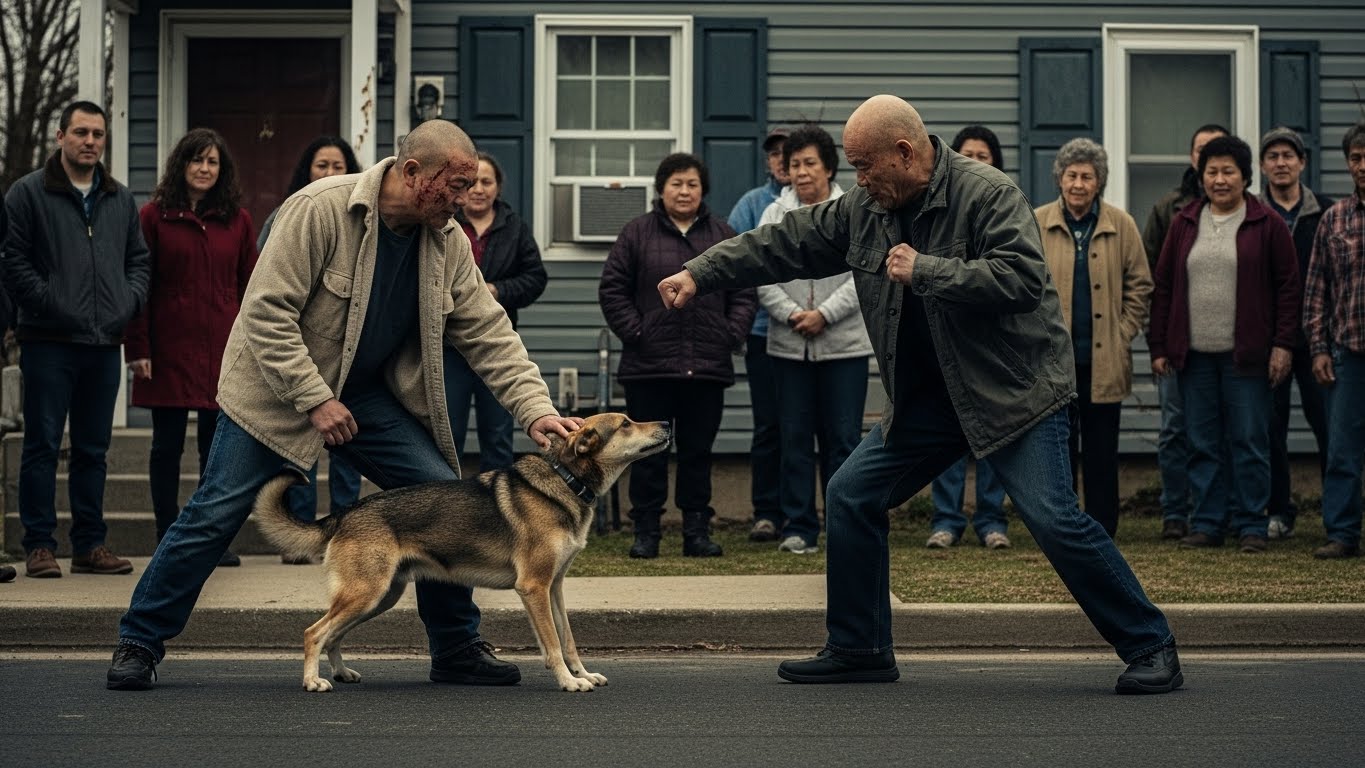
The Whole Neighborhood Watched While He Hurt That Poor Dog, Thinking No One Would Stop Him—Until The Silent Old Man From House 42 Finally Stood Up, And Everyone Realized The Most Dangerous Person In The Room Is The One Who Doesn’t Speak.
CHAPTER 2: THE ECHOES OF A BROKEN VOW
The interior of House 42 did not match the vibrant, meticulously manicured life of its garden. Inside, the air was still, heavy with the scent of cedar, old paper, and a faint, lingering trace of incense that seemed to cling to the floorboards. It was a Spartan existence. A single futon in the corner, a low wooden table, and a small, flickering candle in front of a framed photograph of a woman whose face had been blurred by years of sunlight.
Koji laid Barnaby on a clean white sheet in the center of the kitchen floor. The dog’s breathing was shallow and ragged, a rhythmic wheezing that tore at the silence of the room.
Koji’s hands, which had moved with such terrifying, lethal efficiency on the street, were now trembling slightly. He wasn’t shaking from fear or adrenaline; it was the weight of the choice he had made. For fifteen years, he had lived in Willow Creek as a shadow. He had taken a vow of Ahinsa—non-violence—not because he was a holy man, but because he was a man who knew exactly how much damage he was capable of. He was a man who had seen the way bone gave way under a strike, the way a soul left the eyes when the body was broken. He had come here to bury that version of himself under layers of mulch and topsoil.
And today, he had dug it back up.
“Forgive me,” Koji whispered, though it wasn’t clear if he was speaking to the dog, the woman in the photograph, or the God he had tried to appease for over a decade.
A sharp, hesitant knock at the door broke his concentration.
Koji didn’t move. He continued to gently palpate Barnaby’s ribs, checking for internal bleeding. He knew the gait of the person outside. It was Sarah. He recognized the uneven rhythm of her footsteps—the result of a car accident three years ago that had taken her husband and left her with a permanent limp and a heart full of jagged edges.
“Koji? It’s Sarah. From the diner,” her voice came through the wood, muffled and thick with emotion. “I… I brought some medical supplies. And some chicken broth. Please, let me help.”
Koji closed his eyes for a second. He wanted to remain a ghost. But the dog needed more than he could provide alone. He rose, his joints popping like dry twigs, and opened the door.
Sarah stood there, clutching a first-aid kit and a Tupperware container. Behind her, standing near the edge of the porch, was Officer Miller.
Miller looked small in his uniform. He was forty-five, with a soft middle and a face that seemed perpetually apologetic. He had been a cop for twenty years, and in that time, he had learned how to look the other way to survive. The Vance family owned the local lumber mill, the scrap yard, and half the city council. Arresting a Vance was like trying to arrest the weather—it only resulted in you getting soaked.
“I’m not here officially, Koji,” Miller said, his voice low, refusing to meet Koji’s eyes. “If I were here officially, I’d have to ask questions I don’t want to know the answers to. I’d have to ask where a seventy-year-old gardener learned to dismantle a two-hundred-pound man in four seconds.”
Koji stepped aside, letting Sarah in. She immediately knelt by the dog, her eyes filling with tears as she saw the extent of the bruising.
“Tyler’s at the hospital,” Miller continued, leaning against the doorframe but staying outside, as if the peace of the house was a barrier he didn’t dare cross. “His arm is shattered in three places. The doctors say it’s a clean break, almost… surgical. His old man, Big Al, is back from the city. He’s livid, Koji. He’s calling it an unprovoked assault on a ‘good boy.’ He’s looking for blood.”
Koji finally looked at the officer. “The boy was killing a soul. You watched.”
Miller winced as if he’d been slapped. His weakness was his silence, a cancer that had eaten away at his self-respect until there was nothing left but a badge and a pension. “I know. God help me, I know. But Big Al doesn’t care about the dog. He cares about the Vance name. You humiliated them in front of the whole block. He’s going to come for you, and I won’t be able to stop him when he does. You need to leave, Koji. Take the dog and go.”
“I have spent my life running,” Koji said, his voice gaining a sudden, resonant depth. “I have run across oceans. I have run into the silence of this house. I will not run from a man who hides behind a name.”
Sarah looked up from the dog, her hands covered in antiseptic. “He’s right, Koji. Big Al… he’s not like Tyler. Tyler is just a bully. Al is a predator. He’s got people. Dangerous people.”
As if on cue, a low, heavy rumble vibrated through the floorboards. It was the sound of a high-displacement engine, the kind that belonged to a blacked-out SUV. It cruised slowly past House 42, the engine a predatory growl in the dark. It didn’t stop, but the message was clear: We are watching. We are waiting.
“Why did you do it?” Miller asked, his voice almost a whisper. “After all these years of being the guy who wouldn’t even swat a fly… why did you break for a stray dog?”
Koji knelt back down beside Sarah. He reached out and touched Barnaby’s head. The dog leaned into his touch, a tiny, shivering spark of life.
“Because the dog did not choose this fight,” Koji said. “The dog has no malice. The dog only wanted to exist. When the world tries to extinguish something that is pure, simply because it is weak… that is the only time violence is a prayer.”
Sarah looked at Koji, really looked at him, and saw the scars on his forearms—not from gardening, but the faded, jagged marks of blades and burns. She realized then that Koji wasn’t a gardener who knew how to fight. He was a warrior who had tried to become a gardener.
“Who are you, Koji?” she asked softly.
Koji didn’t answer. Instead, he reached into the pocket of his apron and pulled out a small, wooden bead. He placed it around the dog’s neck.
“I am a man who failed once,” Koji said. “I failed to protect someone I loved because I thought peace was enough. I will not fail this creature. Even if I have to become the monster I promised never to be again.”
Outside, the streetlights flickered and died, plunged the cul-de-sac into a suffocating darkness. In the distance, the sound of boots on pavement began to approach—heavy, rhythmic, and purposeful.
Big Al Vance hadn’t sent the police. He had sent the “Fixers” from the mill.
Koji stood up. He didn’t look old anymore. He looked like an ancient statue carved from granite, immovable and lethal. He turned to Miller.
“Take Sarah and the dog to the basement,” Koji commanded. It wasn’t a request.
“Koji, there’s four of them,” Miller said, looking out the window at the shadows moving through the garden. “They have pipes. Maybe worse.”
Koji walked to the small closet near the entryway. He reached into the very back, behind the old coats and the bags of potting soil, and pulled out a long, narrow bundle wrapped in faded silk. He didn’t unwrap it, but the weight of it in his hands changed the very energy in the room.
“Four?” Koji murmured, a ghost of a smile—sad and terrifying—touching his lips. “Then they should have brought more.”
He stepped out onto the porch, closing the door behind him. The night air was cool, but Koji felt a familiar, searing heat rising in his chest. The silence of the garden was about to be broken, and for the first time in fifteen years, the Quiet Man was going to speak in the only language the Vances understood.
The language of consequences.
CHAPTER 3: THE GARDEN OF SHADOWS
The four men standing at the edge of Koji’s yard were not the clumsy, drunken bullies Tyler hung out with. These were Big Al’s “Insurance Policy”—men who worked the graveyard shift at the mill and spent their weekends doing things that required heavy gloves and no witnesses. They carried lengths of heavy industrial chain and thick wooden bats.
The leader was a man named Rex, a massive wall of a human with a beard stained by tobacco and eyes that had seen too many bar fights. He stepped onto Koji’s lawn, his heavy boots crushing a patch of prize-winning lavender.
“The old man’s still on the porch,” Rex chuckled, his voice a low rumble. “Hey, Pops. Big Al says you’re a real kung-fu master. Says you did something to his boy’s arm. We’re here to see if you can do that to all of us at once.”
Koji stood perfectly still. He held the silk-wrapped bundle in his left hand, down by his side. He didn’t take a fighting stance. He looked like a man waiting for a bus.
“You are trespassing,” Koji said. His voice didn’t shake. It didn’t even rise in volume, yet it carried across the yard with a strange, haunting clarity. “This garden is a place of peace. I suggest you leave before you ruin the soil.”
The man to Rex’s left, a twitchy kid with a shaved head, spat on the ground. “Ruin the soil? We’re gonna paint your porch with your insides, old man.”
Across the street, curtains flickered. The neighbors were watching, their faces pale behind the glass. They were waiting for the inevitable—for the quiet gardener to be swallowed by the violence of the world he lived in.
Rex lunged first.
He didn’t use a weapon; he just threw a massive, swinging punch intended to take Koji’s head off his shoulders. He moved with the confidence of a man who had never lost a fight to someone half his weight.
Koji didn’t block. He didn’t even seem to move until the fist was an inch from his face.
Then, Koji stepped into the punch.
With a pivot of his hips that looked like a dancer’s grace, he caught Rex’s wrist and used the big man’s own momentum to guide him forward. Koji’s other hand, open and flat, struck Rex twice in the ribs—thud-thud—the sound of a hammer hitting a rug.
Rex’s breath left him in a sickening gasp. Before he could recover, Koji swept his leg. The three-hundred-pound man hit the porch boards with a force that made the windows rattle.
The other three froze. The silence that followed was heavy, broken only by Rex’s desperate, wheezing attempts to find air.
“Get him!” the twitchy kid yelled, swinging a heavy chain.
The chain whistled through the air, aimed at Koji’s legs. Koji jumped—not high, but just enough—and as the chain passed under him, he stepped on it, pinning it to the porch. He grabbed the slack, jerked it toward him, and the kid was pulled forward into a knee that met his face with a wet, crunching sound.
The kid went down, clutching a shattered nose, blood spraying across the white-painted wood.
The remaining two men hesitated. This wasn’t a fight. This was a harvest.
“Who are you?” the third man whispered, his bat trembling in his hands. He was older, a father of two who worked the saws at the mill. He saw something in Koji’s eyes that terrified him—not anger, but a profound, weary expertise.
“I am the man who remembers,” Koji said.
He finally unwrapped the silk bundle. It wasn’t a sword, as many might have guessed. It was a Jo—a short staff made of white oak, polished to a mirror finish by decades of use.
“I remember what it is like to kill,” Koji continued, his voice dropping to a whisper. “I remember the weight of a life ending. And I remember the vow I took to never feel that weight again. Do not make me break my vow for men like you.”
The older man with the bat looked at his friend on the ground, then back at Koji. He dropped the bat. “I’m out. I’m not dying for a Vance.” He turned and ran into the darkness.
The fourth man, fueled by a mixture of fear and pride, roared and charged with a lead pipe.
Koji didn’t even look at him. The staff moved like an extension of his soul. A flick of the wrist sent the end of the wood into the man’s solar plexus. A second strike caught him on the temple—hard enough to stun, but not to kill. The man folded like a card table.
It was over in less than thirty seconds.
Koji stood alone on the porch, his chest barely heaving. He looked down at the three men groaning in the dirt and on the wood. He felt no victory. He felt only a crushing, familiar sorrow. The “Quiet Man” was gone, replaced by a ghost of the killing fields he had tried so hard to forget.
The door behind him creaked open. Sarah stepped out, her face pale. She saw the bodies, the blood, and the old man with the wooden staff.
“Koji…” she whispered, her voice trembling. “They’re gone. They ran.”
“They will come back,” Koji said, not looking at her. He was staring at the blood on his porch. “Big Al will not stop. He cannot afford to lose face. He will bring the police, or he will bring more men. And eventually, I will have to kill them.”
Sarah walked over and placed a hand on his arm. His muscles were as hard as iron, but he was shaking. “You saved us. You saved Barnaby.”
“At what cost, Sarah?” Koji turned to her, and for the first time, she saw the tears in his eyes. “I spent fifteen years building a garden. I thought if I made something beautiful, the world would let me be beautiful, too. But the world only wants the monster.”
From the basement, a small, rhythmic sound emerged. Click-click-click.
Barnaby hobbled out onto the porch. He was bandaged, limping, and clearly in pain, but he walked straight to Koji. The dog sat at the old man’s feet and let out a soft, encouraging whine. He licked the blood off Koji’s hand—not as a predator, but as a cleanser.
Koji looked down at the dog. The hardness in his posture broke. He dropped the staff and sank to his knees, burying his face in the stray dog’s neck.
In the distance, the sirens began to wail. Not one or two, but a chorus. Big Al had called in his favors. The police weren’t coming to investigate; they were coming to “clean up.”
Officer Miller pulled his cruiser up to the curb, his lights flashing red and blue against the houses. He got out slowly, his hand on his holster, but his face was a mask of agony.
“Koji,” Miller called out, his voice breaking. “I can’t help you this time. The Chief… he’s on his way. They’ve got a warrant for ‘Attempted Murder’ and ‘Aggravated Assault.’ They’re going to take you, and they’re going to put that dog down.”
Koji looked up. The sorrow was gone. In its place was a cold, shimmering clarity. He looked at Sarah, then at the dog, then at the line of police cars turning the corner.
“No,” Koji said, standing up. “They are not.”
He turned to Sarah. “Take the dog. Go through the back woods. There is a cabin three miles North, near the old creek. Wait for me there.”
“Koji, what are you going to do?” Sarah cried, clutching Barnaby to her chest.
Koji looked at the flickering lights of the approaching sirens. He reached into his pocket and pulled out a small, old flip phone. He dialed a number he hadn’t touched in twenty years.
“It’s me,” Koji said into the phone when someone answered. He spoke in Japanese, his voice like a blade being unsheathed. “The gardener is dead. Send the car. It is time to settle the debt of the Vance family.”
He hung up and looked at Sarah. “Go. Now.”
As Sarah disappeared into the shadows of the garden, Koji walked down the porch steps and stood in the middle of the street. He didn’t have his staff. He didn’t have a gun. He just stood there, a lone figure in a gardening apron, facing the entire weight of a corrupt town.
The sirens grew louder. The hunt had begun.
CHAPTER 4: THE GARDENER’S RECKONING
The intersection of Willow Creek and 5th Street looked like a war zone bathed in the strobe-light flicker of red and blue. Chief Higgins, a man whose neck was too thick for his tie and whose soul had been bought by the Vance family years ago, stepped out of the lead cruiser. Behind him, Big Al Vance surged forward, his face a mask of purple rage, his expensive silk shirt stained with the sweat of a man who was losing his grip on his kingdom.
“That’s him!” Big Al screamed, pointing a trembling finger at Koji. “That’s the animal who attacked my boy! Look at my men! He’s a goddamn terrorist! Shoot him! Why aren’t you shooting him?”
Koji didn’t move. He stood in the center of the road, the asphalt still warm beneath his feet. He looked small against the backdrop of half a dozen squad cars and the looming presence of the mill’s heavies. But there was a gravitational pull to him, a stillness so absolute that even the police officers hesitated, their hands hovering over their holsters. They didn’t see an old man; they saw a predator who had chosen to be a statue.
“Koji Sato,” Chief Higgins barked, though his voice lacked its usual authority. “Get on the ground. Hands behind your head. Now!”
Koji looked at the Chief. “You are three minutes early, Chief Higgins. I expected the paperwork for my arrest would take longer to forge.”
“Shut your mouth!” Higgins roared. “You’re going away for life.”
Just then, the sound of the sirens was drowned out by something deeper—the rhythmic, heavy thrum of high-performance engines. From the north end of the street, three black SUVs, windows tinted to a mirror finish, glided into the light. They didn’t have police markings. They didn’t have sirens. They just had the terrifying elegance of absolute power.
The SUVs pulled up in a perfect line, flanking Koji and cutting off the police cruisers.
The doors opened in unison. Six men stepped out. They weren’t wearing uniforms; they were wearing bespoke charcoal suits. They didn’t draw weapons. They didn’t need to. The air in Willow Creek suddenly felt very thin.
A tall, silver-haired Japanese man stepped forward from the middle vehicle. He walked past Big Al and the Chief as if they were nothing more than garden weeds. He stopped in front of Koji and bowed—a deep, respectful bow that made the neighborhood spectators gasp.
“Sato-sama,” the man said in a voice like velvet over gravel. “The car is ready. The documents you requested have been delivered to the Governor’s office and the Internal Affairs bureau in the city. The Vance family’s holdings are being frozen as we speak. The environmental violations at the mill alone… it is a massacre of paperwork.”
Big Al’s jaw dropped. “What? Who the hell are you? You can’t do that! I own this town!”
The silver-haired man turned, his eyes cold and devoid of pity. “You owned a sandbox, Mr. Vance. You made the mistake of throwing sand at a man who used to decide which governments lived and which died. Mr. Sato did not come to Willow Creek to hide from the law. He came to give the world a rest from his shadow.”
The neighbors were coming out of their houses now. Mrs. Gable, Officer Miller, the families who had lived in fear of the Vance name for decades—they stood on their lawns, watching the impossible. They saw Big Al Vance, the man who had bullied them for twenty years, being handcuffed by state troopers who had arrived silently behind the SUVs. They saw Chief Higgins being stripped of his badge right there under the streetlamp.
Koji didn’t look at the chaos. He didn’t look at Big Al’s screaming face as he was shoved into a car. He looked toward the woods at the edge of his property.
A small, limping shadow emerged from the treeline. Sarah was there, holding Barnaby. The dog’s tail gave a weak, tentative wag when he saw Koji.
Koji walked toward them. The men in suits stepped back, clearing a path as if for a king.
“He’s okay,” Sarah whispered, her face wet with tears. “He’s going to make it.”
Koji reached out and took the dog from her. Barnaby buried his head in Koji’s chest, a long, shaky sigh escaping his small body. The violence was over. The garden had been trampled, and the secret was out, but the air felt clean for the first time in memory.
“I have to go, Sarah,” Koji said softly. “The life I tried to leave… it has found me. I cannot stay in House 42 anymore.”
“Where will you go?” she asked, clutching his sleeve.
Koji looked down at Barnaby. The dog was looking up at him with eyes that didn’t care about his past, his scars, or the men in black suits. The dog only saw the man who had stood between him and the iron bar.
“Somewhere with a lot of sun,” Koji said, a genuine smile finally touching his lips. “And no fences. This one needs room to run.”
He handed Sarah a small, leather-bound book. “The deed to the house is in your name now. The garden… please. Don’t let the lavender die. It’s his favorite.”
Koji turned and walked toward the lead SUV. He didn’t look back at the town that had ignored him for fifteen years, nor at the neighbors who were now cheering his name. He climbed into the back seat, Barnaby nestled firmly in his lap.
As the convoy began to move, the silver-haired man looked at Koji through the rearview mirror. “It has been a long time, Sato-sama. Was it worth it? To break your silence for a stray?”
Koji stroked Barnaby’s folded ear. He thought of the blood on his porch and the peace in the dog’s breathing. He thought of how the world only values power until it meets a soul that refuses to break.
“It wasn’t for a stray,” Koji said, looking out the window as Willow Creek faded into the darkness. “It was for the only part of me that was still worth saving.”
The black cars disappeared onto the highway, leaving the neighborhood in a silence that was no longer heavy, but hopeful. The “Quiet Man” was gone, but in the garden of House 42, the lavender continued to bloom, a fragrant reminder that the most dangerous man is not the one who screams, but the one who loves enough to stop the world from hurting.
He spent his whole life learning how to end a heart’s beat, only to find that his own didn’t truly start until he decided to protect one.