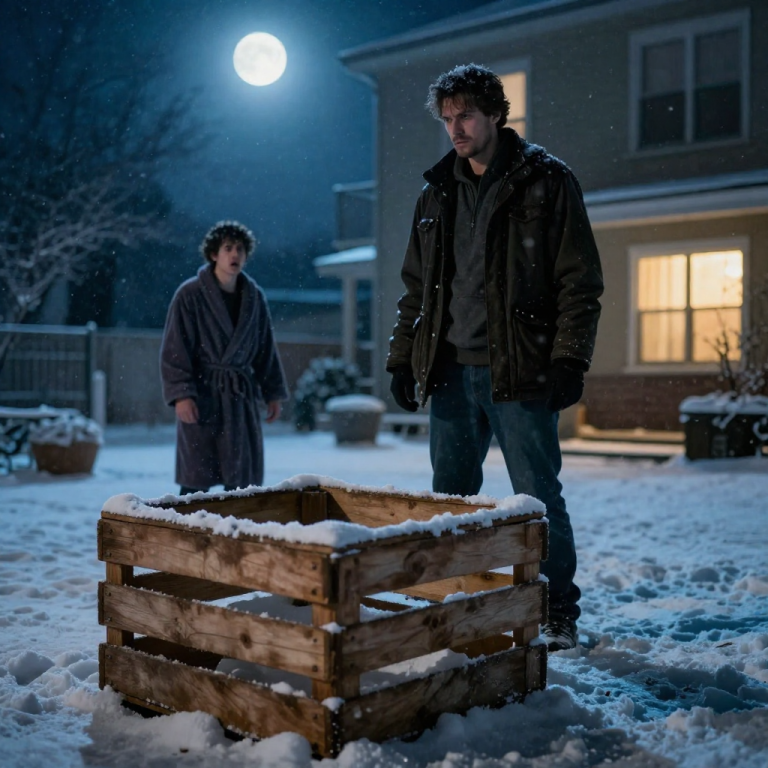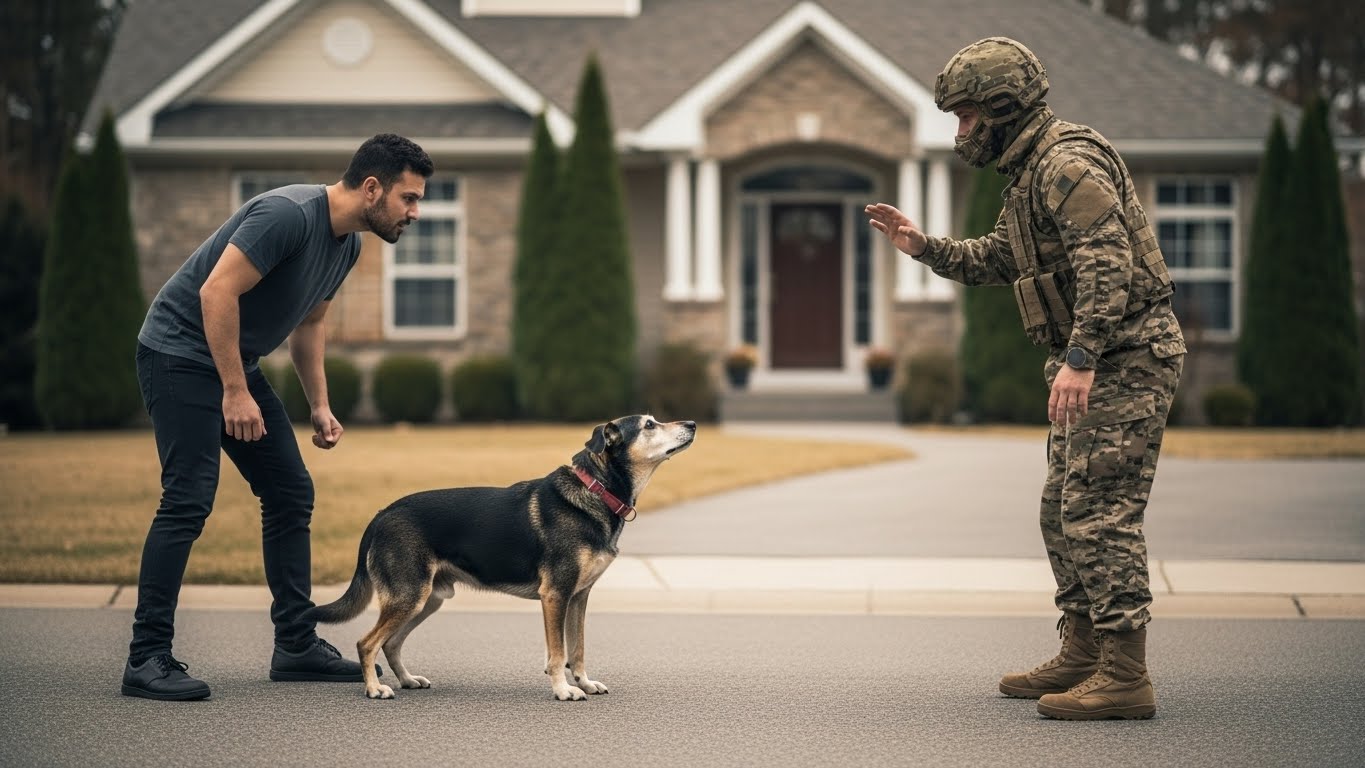
I watched my neighbor raise a golf club over my late father’s blind, 12-year-old dog. He thought he was the king of this suburb. He didn’t know I just got home from three tours in the sandbox—and I don’t leave family behind.
Chapter 2: The Red and Blue Horizon
The sirens didn’t scream; they chirped. It was that polite, suburban police siren—the kind that says, “We’re here to handle a noise complaint,” not “We’re heading into a firefight.” To me, it sounded like a countdown.
I sat on the top step of the porch, my back against the weathered wood, scratching the spot behind Cooper’s ears. He had finally stopped trembling, his heavy head resting on my thigh. He was snoring softly, oblivious to the fact that two squad cars were currently pulling up to the curb, their lights painting the neighborhood in rhythmic flashes of red and blue.
“Elias, please,” Sarah whispered from behind the screen door. “Just… let me do the talking. You know how you get.”
“I’m fine, Sarah,” I said. But I wasn’t. My heart was a percussion instrument, drumming against my ribs in a 4/4 beat of tactical readiness. I was scanning the street—counting the officers, checking their hands, noting the cover positions. It was muscle memory. A ghost in the machine.
Brad Miller was already on his feet, practically bouncing with indignation. He was pointing a trembling finger at me as the officers stepped out of their cruisers.
“That’s him! That’s the guy!” Brad yelled, his voice cracking. “He’s a maniac! He assaulted me! He destroyed my property!”
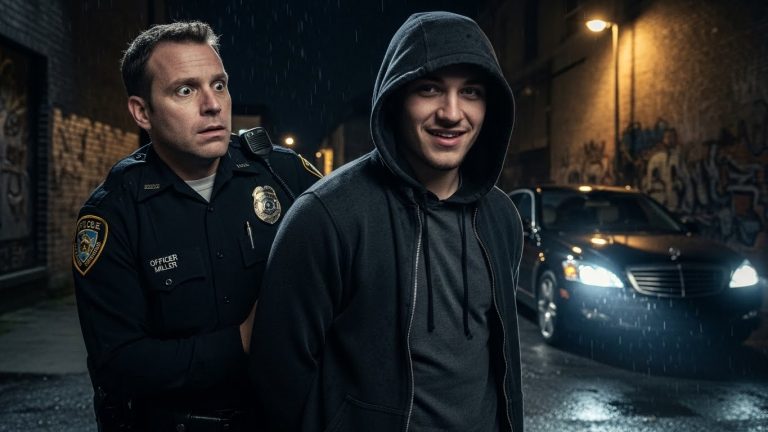
The lead officer was a man in his late fifties, a guy named Miller—no relation to Brad—who had been on the force since I was in middle school. He’d probably pulled me over for speeding when I was eighteen. Beside him was a younger cop, a woman with a sharp gaze and a tactical vest that looked a little too new.
Officer Miller looked at the bent nine-iron lying on the sidewalk. Then he looked at Brad. Finally, he looked at me.
“Evening, Elias,” Miller said, his voice level. He didn’t unholster his Taser, but his hand stayed near his belt. “Heard you were back in town. Welcome home.”
“Thanks, Miller,” I said, not moving from the step. I didn’t want to startle Cooper.
“He threatened my life!” Brad interrupted, stepping into Miller’s personal space. “He grabbed my club and twisted it like it was a piece of licorice! Look at it! That’s a three-hundred-dollar club!”
Miller looked at the club again. It was twisted into a grotesque ‘U’ shape. He let out a low whistle. “You always were a strong kid, Elias. Your old man used to brag about you winning those state wrestling titles.”
“Officer, are you going to arrest him or reminisce about his high school career?” Brad snapped.
The younger officer, whose name tag read Rodriguez, walked over to the sidewalk. She picked up the club with a gloved hand, examining the sheer force required to deform the metal. She looked at me, her eyes narrowing. She wasn’t seeing a local hero. She was seeing a high-risk variable.
“Mr. Miller claims you physically intimidated him and destroyed his property,” Rodriguez said, her voice clinical. “What’s your side?”
“He was going to hit the dog,” I said. I kept my voice low, matching her tone. “Cooper is twelve years old. He’s blind. He wandered onto the grass, and Brad swung a club at his head. I stopped the club.”
“I was defending my property!” Brad shouted. “That dog was—was bio-hazarding my lawn! Do you know how much I spend on fertilization? And the dog is a nuisance! It’s old, it’s smelly, and it doesn’t belong in a neighborhood this nice!”
I felt a surge of heat crawl up my neck. Sarah must have felt it too, because she stepped out onto the porch and put a firm hand on my shoulder.
“Officer Miller,” she said, her voice trembling but clear. “You know our father. You know how much Cooper meant to him. My brother just got back from three tours. He’s… he’s adjusting. But he didn’t touch Brad. He only touched the club.”
“Assault can be perceived, Sarah!” Brad retorted. “I felt threatened! I feared for my life!”
Miller sighed, a long, weary sound. He looked around at the neighbors who were still watching from their lawns. Mrs. Gable was still there, her phone held high.
“Mrs. Gable!” Miller called out. “You get all that on video?”
The old woman nodded vigorously. “Every bit of it, Dave! I saw the whole thing! Brad was screaming like a banshee and swung that club like he was trying to kill a snake! Elias just—poof—he was there! He saved that poor dog!”
Brad’s face went from red to a sickly shade of grey.
“Well,” Miller said, turning back to Brad. “Seems we have a witness. Now, Brad, I can take a report for the property damage. A three-hundred-dollar golf club. But if I do that, I also have to take a report for attempted animal cruelty. And given that half the neighborhood just watched you try to brain a blind Golden Retriever… I don’t think the judge is going to be on your side.”
“This is ridiculous!” Brad stammered. “I’m the president of the HOA!”
“And I’m the guy who’s going to write you a ticket for disturbing the peace if you don’t go back inside your house right now,” Miller said, his patience finally snapping.
Brad looked at me, then at the neighbors, and finally at the police. He realized the ‘king of the suburb’ had just lost his crown to a guy in a faded army jacket and a dog that couldn’t even see him. He snatched his bent club from Officer Rodriguez’s hand and stormed back toward his mansion, nearly tripping again on his way up the stairs.
Miller walked over to the porch, leaning his elbows on the railing. Rodriguez stayed back by the car, her hand still resting near her sidearm. She didn’t trust me. I didn’t blame her. I didn’t trust me either.
“You okay, Elias?” Miller asked softly.
“Yeah,” I lied.
“You don’t look okay. You look like you’re waiting for an airstrike.”
I looked down at Cooper. The dog had woken up and was licking my hand, his tail wagging slowly. “It’s just loud here, Dave. Everything is too loud and too quiet at the same time.”
Miller nodded. He’d seen it before. Small towns are full of guys who come back with the ‘hum’ in their ears. “Look, stay on your property for a few days. Let things simmer down. Brad is a coward, but he’s a coward with a lot of lawyers on speed-dial. Don’t give him a reason to make your life harder than it already is.”
“I’m not looking for trouble,” I said.
“I know,” Miller said, tipping his cap. “But trouble has a way of finding people who are good at it. Get some sleep, son.”
The police cars pulled away, the red and blue lights fading into the twilight. The neighborhood returned to its stifling silence.
Sarah let out a breath she’d been holding for ten minutes. “God, Elias. You almost went to jail.”
“He was going to hit him, Sarah,” I repeated. It was the only logic that made sense to me.
“I know. And I’m glad you stopped him. But you didn’t just stop him. You broke that club like it was a toothpick. You had this look in your eyes… like you weren’t even here.”
She sat down next to me, her shoulder touching mine. “Dad always said you were the protector. Even when you were six, you’d stand in front of me if a bigger kid was being mean. But you have to protect yourself too. This isn’t the sandbox. People here don’t understand the rules you lived by over there.”
“The rules are the same,” I said, my voice heavy. “You protect the ones who can’t protect themselves. That’s it. That’s the whole book.”
“Not to Brad Miller,” she said. “To him, the rules are about property values and appearances. And you just embarrassed him in front of the whole street. He won’t forget that.”
I looked across the street. Brad’s house was dark, but I could see the silhouette of a figure standing behind the second-floor curtains. He was watching us.
I felt a chill that had nothing to do with the evening air.
“Let him watch,” I said.
But as I led Cooper back inside, my hand brushed against the scar on my forearm—the one I’d gotten pulling my sergeant out of a burning Humvee. My skin felt tight, itchy.
I knew guys like Brad. They didn’t fight you in the street. They didn’t look you in the eye. They waited until you were sleeping. They waited until you thought you were safe.
That night, I didn’t sleep in my bed. I pulled a mattress into the living room, right by the front door. I laid down with my back to the wall, my hand resting on Cooper’s flank.
Every creak of the floorboards, every rustle of the wind in the trees, sounded like a footstep.
I was home. But for the first time in my life, I felt like I was behind enemy lines.
And then, around 3:00 AM, the first rock came through the window.
Chapter 3: The Ghost in the Garden
The sound of shattering glass is a specific kind of violence. It’s sharp, final, and it echoes. In the desert, it usually meant a breach. Here, in the quiet suburbs of Oak Ridge, it meant a message.
I was on my feet before the first shard hit the hardwood. My body moved without my brain’s permission—low, fast, sliding into the shadow of the hallway. My hand reached for a sidearm that wasn’t there. My heart wasn’t just beating; it was slamming against my ribs like a trapped bird.
“Elias?” Sarah’s voice came from the top of the stairs, thin and terrified. “Elias, what was that?”
“Stay upstairs!” I barked. It was my sergeant’s voice. Command, not request.
I crawled to the window. A heavy landscaping stone sat in the middle of the rug, surrounded by a glittering sea of glass. Wrapped around it with a thick rubber band was a piece of paper.
I didn’t open it. I didn’t need to. I knew the handwriting of a coward.
I looked through the hole in the pane. The street was empty. The amber glow of the streetlights hit the wet pavement, making everything look like a stage set. Brad’s house was dark, but a single motion-sensor light on his garage flickered off just as I looked.
He wasn’t just a bully; he was a ghost. And ghosts are hard to fight.
By morning, the neighborhood felt different. The “Welcome Home” atmosphere had curdled. As I boarded up the window with plywood, I saw the whispers. Mrs. Gable didn’t wave today. She just pulled her curtains shut.
Around 10:00 AM, a black SUV pulled up. Not the police. A man in a sharp suit stepped out—Mr. Henderson, the HOA’s legal representative. He didn’t come to the door; he stood on the sidewalk and called out to me.
“Mr. Thorne! I have a formal notice of violation!”
I stepped off the porch, my hammer still in hand. Henderson flinched, taking a step back toward his car.
“Violation of what?” I asked.
“Multiple counts. Unapproved exterior modifications—that plywood is a blight. Failure to restrain a dangerous animal. And,” he paused, clearing his throat, “a formal complaint of physical intimidation against a board member.”
“He tried to kill my dog,” I said, my voice dangerously calm.
“Mr. Miller has medical records showing a strained shoulder from the ‘assault,'” Henderson replied, refusing to look me in the eye. “And he’s filed a petition to have the dog removed from the premises as a public safety hazard. You have forty-eight hours to remove the animal, or the city will intervene.”
The world turned red at the edges. Not the red of anger, but the red of a targeting reticle. Forty-eight hours. They were trying to take the only thing I had left of my father. They were trying to take the only creature that didn’t look at me and see a “broken soldier.”
“Get off my property,” I said.
“Mr. Thorne, I strongly advise—”
“Get. Off. My. Property.”
I didn’t raise the hammer, but I didn’t need to. The air around me seemed to thicken. Henderson scrambled into his SUV and sped off, his tires chirping on the asphalt.
“They’re going to take him, aren’t they?” Sarah was standing behind me, her eyes red from a night of not sleeping.
“No,” I said. “They aren’t.”
But I was losing. In the military, you know who the enemy is. They wear a different uniform, they carry a different flag. But here? The enemy was the law. The enemy was a man with a polo shirt and a grudge.
That afternoon, a neighbor I hadn’t spoken to yet approached the fence. It was Marcus, a retired guy from three doors down. He was a big man, a former steelworker with hands like catcher’s mitts.
“He’s a snake, Elias,” Marcus said, leaning on the fence. “Brad. He’s done this before. He ran out the family that lived in your house before your dad bought it back. Used the HOA like a club until they went bankrupt from the fines.”
“Why didn’t anyone stop him?” I asked.
Marcus sighed. “Because people are afraid of the paperwork. They’re afraid of the fees. But you… you’re the first one who looked him in the eye and didn’t blink. That’s why he’s panicking. He’s not used to people who aren’t afraid of him.”
“I’ve spent the last six years being shot at, Marcus. A guy with a golf club doesn’t scare me.”
“It should,” Marcus said quietly. “Because he’s not going to shoot at you. He’s going to wait until you’re at your weakest, and then he’s going to call the people with the badges to do his dirty work.”
He was right.
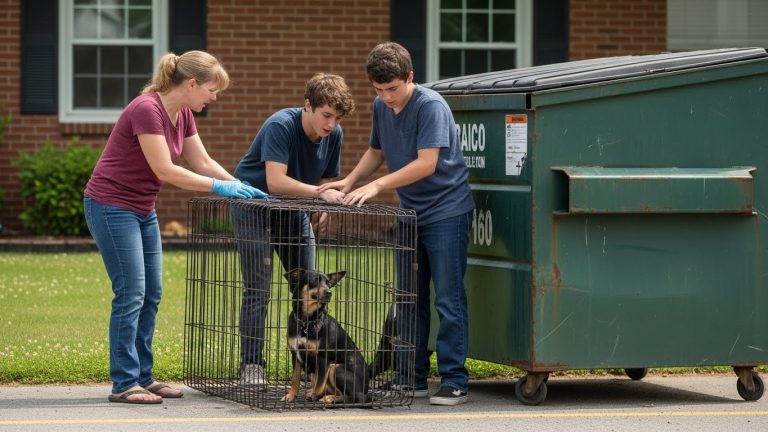
Two hours later, the white van pulled up. It didn’t say “Police.” It said “Animal Control.”
Two men in tan uniforms stepped out. They carried catch-poles—long metal rods with wire nooses at the end. They looked like they were going to a hunt.
Brad was standing on his porch, arms crossed, a smug, sickening grin on his face. He’d called them. He’d told them the “dangerous dog” was at it again.
Cooper was lying on the porch, his tail wagging because he heard footsteps. He thought someone was coming to pet him. He didn’t know he was being hunted.
“Elias Thorne?” one of the officers asked. “We have a warrant to seize a Golden Retriever following a report of an unprovoked attack on a resident.”
“There was no attack,” I said, stepping in front of the porch stairs. “The video proves it.”
“The video shows you interfering with a resident,” the officer said. “The ‘attack’ happened this morning. Mr. Miller claims the dog lunged at him while he was checking his mail.”
It was a lie. Brad hadn’t left his house all morning.
“He’s lying,” Sarah screamed from the doorway. “He’s lying!”
The officers didn’t care. They started up the walk.
This was it. This was the moment where the “hum” in my ears became a roar. I could feel my hands curling into fists. I could feel the tactical pathways in my brain lighting up—Target 1: throat. Target 2: knee. I could disable both of them in under four seconds.
But then I looked at Cooper.
The old dog had stood up, sensing the tension. He was leaning against my leg, his clouded eyes searching for my face. If I fought, if I became the monster they wanted me to be, I’d go to prison. And Cooper? He’d be put down in a cold shelter while I was behind bars.
I had to choose. My pride, or his life.
“Wait,” I said, my voice cracking.
I knelt down. I took Cooper’s face in my hands. He licked my nose, a wet, sloppy kiss that smelled like old age and loyalty.
“Elias, no!” Sarah sobbed.
“Cooper,” I whispered into his ear. “I need you to be a good boy. I need you to go with them. I’m going to come for you. I promise. I don’t leave family behind.”
I stood up and handed the leash to the officer. My heart felt like it was being ripped out of my chest with a pair of rusty pliers.
The officer tightened the leash. Cooper looked back at me, his tail giving one last, confused wag as they led him toward the van.
Brad let out a short, bark-like laugh from across the street. “That’s right, Sergeant! Know your place!”
I didn’t look at Brad. I didn’t look at the van as it drove away. I just looked at the empty spot on the porch where Cooper used to sleep.
I walked over to my garage. I picked up a heavy tactical bag I hadn’t opened since I got back.
“Elias?” Sarah asked, her voice trembling. “What are you doing?”
I zipped the bag shut. The sound was like a rifle bolt sliding into place.
“I tried to play by their rules, Sarah,” I said. “Now we’re going to play by mine.”
Chapter 4: The Reconnaissance of Justice
The bag didn’t contain a rifle. It contained something far more dangerous in a neighborhood like Oak Ridge: the tools of a professional scout. High-definition thermal optics, a long-range directional microphone, and a laptop with decryption software I’d learned to use during my second tour in Iraq.
Sarah stood in the doorway of the garage, her hands tucked into the sleeves of her oversized sweater. “Elias, what are you doing? You look like you’re going back to the front.”
“The front is across the street, Sarah,” I said, my voice flat. I didn’t look up as I checked the batteries on a drone no bigger than a sparrow. “Brad didn’t just take a dog. He attacked my father’s memory. He exploited a system designed to protect people to hurt a creature that couldn’t fight back. In the military, we call that a war crime. In Suburbia, they call it ‘HOA policy.’ I’m going to change the definition.”
“Please,” she whispered. “Don’t hurt him. If you go to jail, I lose both of you.”
I finally looked at her. The moonlight caught the silver in her hair—stress from the last few years of taking care of Dad alone while I was overseas. “I’m not going to touch him, Sarah. I’m going to unmake him.”
The mission began at 2200 hours.
I moved through the shadows of the backyards with the silence of a man who had walked through minefields. I didn’t need to break into Brad’s house. I just needed his data. Most people in these McMansions bought top-of-the-line security systems but never changed the factory-default passwords on their routers. It took me six minutes to sit behind a hydrangea bush and slide into his home network.
What I found wasn’t just evidence of a lie—it was a goldmine of suburban rot.
Brad Miller wasn’t the “successful developer” he claimed to be. His “Ring” doorbell footage from that morning didn’t show Cooper lunging at him. It showed Brad walking onto our sidewalk, poking the sleeping, blind dog with a sharpened stick until Cooper let out a confused, pained yelp. It showed Brad laughing as he called 911, feigning terror while he checked his reflection in his car window.
But there was more. I followed the digital trail into his emails and HOA accounting folders. Brad had been “reallocating” the neighborhood’s landscaping funds into a private account for two years to pay off a gambling debt that was drowning him.
The King of Oak Ridge was a thief in a polo shirt.
I spent the rest of the night working. I didn’t sleep. I didn’t eat. I moved with a cold, surgical precision. I compiled the video, the bank statements, and the emails into a single, encrypted file. I sent it to every resident in the neighborhood, the local police department, and the regional board of the HOA.
Then, I went to the animal shelter.
I was there before the sun came up, sitting on the hood of my truck in the gravel parking lot. When the doors opened at 8:00 AM, the same officer from the day before was there. He looked tired.
“Mr. Thorne,” he said, sighing. “I told you, there’s a process. We have to hold him for ten days for observation.”
“Check your email, Officer,” I said quietly.
He frowned, pulling out his phone. I watched his eyes move as he read the report I’d sent to the precinct. I watched his face pale as he saw the video of Brad poking a blind, senior dog with a stick.
“This son of a…” the officer muttered. He looked at me, then back at the phone. “Wait here.”
Ten minutes later, the heavy steel door opened. Cooper didn’t run out—his joints were too stiff for that. He shuffled, his nose twitching, his tail tucked between his legs. He looked terrified, smelling the scent of bleach and the fear of a hundred other dogs.
“Cooper,” I called out.
The change was instant. His head snapped toward my voice. His tail began to thump against the doorframe—thwack, thwack, thwack. He let out a high-pitched, joyful bark that echoed off the cinderblock walls. He practically fell into my arms, his wet nose burying itself in my neck.
“I told you,” I whispered, my eyes stinging. “I don’t leave family behind.”
I drove home with Cooper’s head resting on my shoulder. When we turned onto our street, the scene was unlike anything I’d ever seen.
The neighborhood wasn’t quiet anymore.
A crowd of thirty people was standing on Brad Miller’s lawn. Mrs. Gable was in the front, holding a sign that said ‘LIAR.’ Marcus, the steelworker, was standing by the curb, his arms crossed, looking like a gargoyle of justice.
Brad was on his porch, his face no longer red, but a ghostly, translucent white. He was holding a suitcase. A police cruiser—Officer Miller’s car—was idling in his driveway.
I pulled my truck into my own driveway. I got out and opened the passenger door. Cooper stepped out, smelling the familiar grass of home. He didn’t know about the drama. He just knew he was back where the sun felt warm.
The neighborhood went silent as they saw us. Then, Marcus started to clap. One by one, the people Brad had bullied and intimidated for years joined in. It wasn’t a roar; it was a steady, rhythmic acknowledgement.
Brad looked at me across the street. For a moment, our eyes locked. He looked for a spark of anger, something he could use to play the victim one last time. But he found nothing. I didn’t hate him anymore. You don’t hate the dirt you scrape off your boot; you just remove it.
“He’s being charged with felony embezzlement and filing a false police report,” Officer Miller said, walking over to my truck as Brad was led into the back of the cruiser in handcuffs. “Turns out, when you point a spotlight at a shadow, it disappears pretty fast.”
“Thanks, Dave,” I said.
“Don’t thank me. You did the heavy lifting, Elias. Your dad would have been proud. He always said you were the bravest kid he knew—not because you weren’t scared, but because you knew what was worth protecting.”
As the police car drove Brad away—leaving his mansion to be foreclosed on and his reputation in tatters—the neighborhood began to disperse. They came by our porch first, though. Mrs. Gable brought a bag of high-end dog treats. Marcus brought a six-pack of beer and a hammer to help me fix the window.
Sarah came out and hugged me so hard I thought my ribs might actually crack. “You did it,” she sobbed. “You really did it.”
“We did it,” I corrected her.
That evening, the “hum” in my ears was still there, but it was quieter. The desert felt further away. The war felt like a book I had finally finished reading.
I sat on the porch in the same chair I’d occupied forty-eight hours ago. Cooper was back at my feet, his breathing deep and rhythmic. The sun was setting, painting the suburban sky in shades of bruised purple and gold.
I realized then that ‘home’ wasn’t a place you just returned to. It was something you had to defend. It was something you had to build, brick by brick, truth by truth.
I reached down and let my hand rest on Cooper’s head. He leaned into my touch, a silent anchor in a world that had finally stopped shaking.
I was a soldier, a brother, and a son. And for the first time in a very long time, I was at peace.
The king was gone. The family was whole. And the silence of Oak Ridge was finally, truly, sacred.