I lost my hearing, my career, and my will to live. Then a stray dog barked against my ribcage, and for the first time in a decade, I didn’t just hear the music—I felt the soul of it.
Chapter 1: The Sound of Dust
The silence wasn’t actually silent. That was the first thing people got wrong about going deaf. They imagined a peaceful, snowy blanket falling over the world. The reality was a high-pitched, metallic hiss—the sound of a dying refrigerator that you could never unplug. It was a scream trapped inside my own skull, a constant reminder of what I’d lost at thirty-four, right as the New York Philharmonic was scouting me as their principal cellist.
Ten years later, I sat in my apartment in Portland, the kind of place where the wallpaper peels in sympathy with your life, watching dust motes dance in a shaft of gray, watery afternoon light. I used to hear the rhythm of the city outside—the syncopated beat of tires over potholes, the staccato rhythm of heels on the sidewalk, the distant jazz of a police siren. Now? Just the Hiss. And the ghosts of notes I’d never play again.
My cello, a 19th-century Italian masterpiece I’d named ‘Clara,’ sat in the corner in her velvet-lined case. She was gathering dust, her wood drying out in the radiator heat, her strings probably screaming for tension I couldn’t give her. Looking at her felt like looking at a lover who had passed away right in front of me but refused to leave the room. I hadn’t opened the case in three years. The thought of feeling the vibration of the strings without hearing the resulting glory was a special kind of torture I wasn’t strong enough to endure.
I was three months behind on rent. My landlord, Mr. Henderson, had stopped slipping pink notices under the door and had started taping them there with aggressive amounts of blue painter’s tape. My brother, Julian, a high-octane corporate lawyer in Seattle who viewed my “artistic temperament” as a treatable mental illness, had finally stopped taking my calls after I refused—again—to sell Clara to pay for “rehab and a real estate license.”
“Elias, look at yourself,” he’d shouted during our last FaceTime, his face pixelated with frustration. I assumed he was shouting based on the way the veins in his neck bulged like suspension cables. “The music is over. It’s gone. You’re living in a tomb. Get out before they bury you in it.”
He didn’t get it. He couldn’t. For a musician, the music isn’t just a job or a hobby. It’s the internal GPS. It’s how you navigate the emotional landscape of being alive. Without it, I was just spinning in circles in a dark room, waiting for the floor to give way.
I picked up a glass of lukewarm water, the vibration of it hitting the cheap laminate table sending a faint, dull thud through my fingertips. It was the only way I “heard” anything now—tactile vibrations. But they were clumsy. Ugly. A truck rumbling past was a chaotic shudder; a dropped pan was a jarring jolt. They weren’t music. They were just noise interrupting the Hiss.
I reached for my bottle of pills—the “Vitamin S” as I called the sleep aids that offered the only real escape—when the floorboards beneath my feet shuddered. It wasn’t the usual tremor of the ancient plumbing. This was sharp. Aggressive. Urgent.
Something, or someone, was at my door.
Chapter 2: The Resonant Guest
I didn’t expect to see Sarah. My daughter was twenty-one now, a college senior with my dark eyes and her mother’s stubborn, terrifying refusal to give up on lost causes. We hadn’t spoken in a year, not since I missed her graduation because the thought of being in a stadium full of cheering people—watching sound happen without participating in it—triggered a panic attack that left me curled on my bathroom floor for two days.
She wasn’t alone.
Leashed to her hand with a thick登山rope was a beast. That’s the only word for it. A massive, matted Golden Retriever mix with paws the size of dinner plates and eyes that looked like they’d seen the end of the world and decided it wasn’t that big of a deal. He smelled like wet wool and dumpster juice, a scent heavy enough that I could almost taste it.
“Dad,” she mouthed, her lips moving with exaggerated precision. I’d become an expert lip-reader out of pure survival, but seeing her say the word felt like an accusation. “He was going to be put down. Today. The shelter said he’s ‘unadoptable.’ Reactive, they said. Too loud.”
I shook my head, my hands already forming the jagged signs for No. Impossible. Look at this place.
“I can’t, Sarah,” I said, my voice sounding foreign and rusty in my own throat. I rarely spoke anymore; without auditory feedback, I never knew if I was shouting or whispering. “I am deaf. Not a saint. I can’t take care of a dog. I don’t know if he’s barking at the mailman or if he’s dying.”
“You’ll know,” she said, her eyes welling up with tears I couldn’t comfort away. She pushed past me into the apartment, the dog towing her like a sled. “Just… look at him, Elias. Please. I’m moving into my new dorm and they won’t let him in for a week. Just seven days.”
She left him there with a forty-pound bag of generic kibble and a worn-out rope toy that looked like a textile casualty of war. The door clicked shut, and the vibration of her leaving felt final.
For the first three hours, the dog—Barnaby, according to the intake paperwork Sarah left—didn’t move from the entryway rug. He watched me with a gaze that felt heavy, like a physical weight on my chest. He was a wreck, just like this apartment. Just like me.
I tried to ignore him. I went back to my desk, trying to read old scores, trying to force my brain to “hear” the Bach Cello Suite No. 1 the way I used to. But the Hiss was too loud today, fueled by anxiety. The memory of the melody was fraying at the edges, like an old photograph left in the sun. I couldn’t connect the dots on the page to the feelings in my heart anymore.
I was leaning against the wooden desk, my head in my hands, spiraling into that familiar, dark place where the silence feels like it’s physically crushing your ribs.
Then, it happened.
A jolt of pure energy shot through the floorboards, up through the legs of the chair, and directly into my spine. It wasn’t a thump. It wasn’t a door slamming. It was a frequency. It was clean, powerful, and demanding.
I bolted upright, my heart hammering against my ribs. Barnaby was standing in the middle of the room, his massive chest expanded, his muzzle pointed toward the ceiling. He wasn’t just barking; he was detonating.
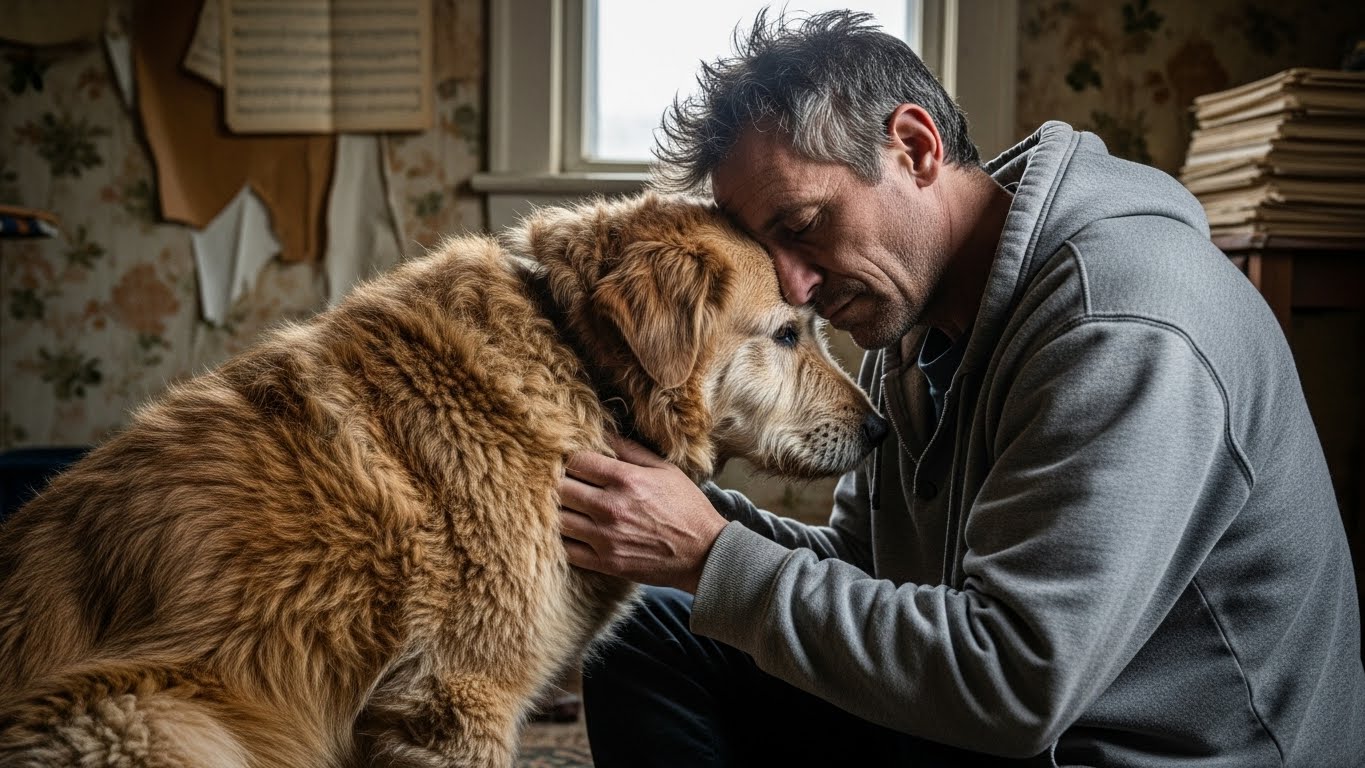
I walked over to him, wary. He didn’t shrink away. I hesitated, my hand hovering, then placed my palm flat on his side, right over his ribcage, beneath the thick mat of fur.
He let out another bark.
The vibration nearly knocked me backward. It wasn’t just a shudder. It was a perfect, resonant low E-flat. It was rich. It was round. It had a timber and a “color” I hadn’t felt in a decade. It wasn’t just a noise; it was a note. A pure, unadulterated musical note produced by bone and muscle and breath.
The dog looked at me, his golden eyes clearing for a second. His tail gave one slow, rhythmic wag against my shin.
Thump. Thump. Thump.
A perfect 4/4 time signature.
I looked from the dog to the cello case in the corner. For the first time in ten years, the Hiss in my ears didn’t feel like a death sentence. It felt like a blank canvas waiting for paint.
Chapter 3: The Tuning Fork
I didn’t sleep that night. Sleep was for people who didn’t have a sixty-pound tuning fork living in their living room.
Instead, I dragged my old chromatic tuner out of a junk drawer. The battery was dead, so I frantically cannibalized the smoke detector—a terrible idea, I knew, but priority was a strange beast at 3 A.M. I sat on the floor with Barnaby, who seemed bemused by my sudden shift from depressive lump to manic researcher.
“Speak,” I said, my voice cracking.
Barnaby tilted his huge head. He let out a soft woof.
My hand was on his chest. A gentle vibration. The tuner flickered: G3. A nice, warm mid-range tone.
“Again. Louder.”
He obliged with a sharp, attention-seeking bark. A crisp C-sharp.
I spent the next six hours mapping the dog. I was insane. I knew this. If Julian walked in, he’d have me committed before breakfast. I was a grown man, a former prodigy, sitting on a filthy rug at dawn, poking a stray dog and crying silently because his growl felt like a perfectly bowed cello C-string—low, rumbling, and dangerous.
Barnaby was an orchestra wrapped in fur. His whimpers were high woodwinds; his play-barks were brassy trumpets; his deep, warning chest-barks were the percussion section and the bass strings combined.
He didn’t just make noise. He communicated in pitch.
When he was hungry, he hit a persistent, nagging F-sharp. When he heard a squirrel outside, it was a staccato, excited series of A’s.
By the time the gray morning light started filtering through the dirty windows, I was surrounded by crumpled staff paper. I hadn’t written music in years—I’d burned most of my composition notebooks during the “Great Purge” of year three—but my hands remembered the shape of the clefs.
I looked at the scribbles. It was chaotic. It was raw. It was the first honest thing I’d created since the silence fell.
But the euphoria began to fade as the sun rose, replaced by the crushing weight of reality. I was starving. The fridge held half a jar of mustard and a questionable lemon. Barnaby was scratching at the empty food bag Sarah had left.
I had notes. I had inspiration. But inspiration doesn’t pay the rent, and it certainly doesn’t buy dog food. I looked at Clara in the corner. My stomach twisted. I had swore I’d never sell her. She was the last piece of my old life, the only thing that proved I used to be someone who mattered.
But then Barnaby nudged my elbow with a wet nose, letting out a soft, resonant G3 whine that vibrated straight to my bone. He was alive. He was here. And he was hungry.
Clara was just wood and wire.
I stood up, my knees cracking, and walked toward the case. My hands shook so violently I could barely undo the latches.
Chapter 4: The Pawn and the Promise
The walk to the “Sound & Silver Exchange” felt like a funeral march. I carried Clara’s case on my back—ten pounds of wood that felt like a hundred—and Barnaby trotted beside me on his makeshift rope leash. The Portland rain was doing its usual trick: a fine, relentless mist that soaked through your clothes until you felt like you were made of wet cardboard.
The pawn shop smelled of stale cigarettes, ozone from cheap electronics, and the quiet desperation of people who were trading their memories for grocery money.
Marcus sat behind the counter. He was a man built like a bulldog, with thick glasses that magnified his eyes and a permanent scowl that said he’d heard every lie in the book. I’d seen him before, years ago, when I was buying high-end rosin. Now, I was on the other side of the glass.
I laid the case on the scarred velvet counter. My hands were shaking so badly I had to tuck them into my armpits. I didn’t speak. I didn’t want him to hear the tremor in my voice. I just opened the latches.
The light hit Clara’s varnish—a deep, honeyed amber that seemed to glow even in this dismal place. Marcus’s eyes widened. He didn’t move for a long time. Then, he reached for a jeweler’s loupe and leaned in.
I felt the vibration of a door slamming somewhere in the back of the shop. A dull, heavy thud that vibrated through the floor and into my heels. Barnaby, who had been sitting quietly, suddenly let out a sharp, resonant bark.
E-natural.
Marcus jumped, his loupe nearly falling out of his eye. He looked at Barnaby, then back at the cello. He started talking, his lips moving fast—too fast for me to catch. I tapped my ear and shook my head.
He slowed down, his face softening into something like pity. I hated it.
“This is a 19th-century Gagliano,” he mouthed, his eyes fixed on the internal label. “Do you have any idea what this is worth? Even with the dry-crack on the lower bout?”
I nodded. I knew exactly what it was worth. It was worth my daughter’s tuition. It was worth a year of rent. It was worth my soul.
“Three thousand,” Marcus said, scribbling on a notepad. “Cash. Today. Because I know I can find a collector.”
Three thousand. It was a lowball offer, an insult to the craftsmanship, but to me, it was a mountain of gold. I reached for the pen.
Barnaby let out a low, sustained growl. It wasn’t aggressive; it was a vibration that started in the floor and traveled up through the counter, vibrating Clara’s very strings. I felt the low C-string hum in sympathy with the dog’s chest.
I froze.
The dog wasn’t looking at Marcus. He was looking at me. His eyes were wide, intelligent, and oddly mournful. In that moment, I didn’t just feel a note. I felt a memory. I remembered the first time I played Clara—the way the music didn’t just come out of the instrument, but seemed to flow through me, connecting my heart to the air.
If I sold her, the music wouldn’t just be silent. It would be dead.
I looked at the three hundred dollars in overdue rent notices in my head, and then I looked at the dog who had given me back my first note in a decade.
I snapped the case shut. The sound—the vibration of the latches clicking—felt like a heartbeat.
“No,” I said, my voice loud and discordant in the small shop.
Marcus looked baffled. He started to type on a calculator, probably raising the price, but I didn’t wait. I hoisted the case onto my shoulder, grabbed Barnaby’s leash, and walked out into the rain.
I didn’t have a cent. I didn’t have a plan. But for the first time in ten years, I had a rhythm.
Chapter 5: The Composition of Chaos
The next three days were a blur of manic energy and starvation. I stopped eating to make sure Barnaby had enough kibble. I lived on black coffee and the adrenaline of a man who has nothing left to lose.
I realized I couldn’t just write down “dog barks.” I needed the world. I needed the texture of life.
I took Barnaby to the Burnside Bridge. We sat there for hours, the dog leaning against my side. I kept one hand on his shoulder and the other on a notebook.
When the MAX light rail train thundered over the tracks, the world turned into a rhythmic earthquake. Barnaby didn’t bark; he tilted his head and let out a series of short, rhythmic huffs that perfectly mirrored the clack-clack-clack of the wheels.
1/8 notes. Syncopated. Industrial.
I scribbled it down.
A street performer, a guy named Leo with a saxophone that had seen better decades, set up twenty feet away. I couldn’t hear the sax, but I watched Barnaby’s ears. They twitched in time with the melody. When Leo hit a high, wailing note, Barnaby’s entire body vibrated with a high-frequency tension.
I walked over to Leo. He looked at me, a middle-aged white guy with a dog and a cello case, looking like he’d crawled out of a storm drain.
“I’m deaf,” I mouthed. I pointed to Barnaby. “He’s my ears. Play something… blue. Play something that feels like a rainy Monday.”
Leo grinned, revealing a missing molar, and put the reed to his lips.
I knelt down and pressed my forehead against Barnaby’s flank.
The vibration was incredible. It wasn’t the mechanical drone of the train. It was fluid. It was emotional. I felt the “slur” of the notes, the way the air moved through the brass, translated through the dog’s sensitive nervous system into my own skin.
It was a Minor 7th chord. I could feel the melancholy, the yearning.
I began to write. Not just notes, but instructions for the bow. Sul ponticello. Molto vibrato. I was writing a symphony for a world that didn’t use ears. I called it The Resonant Beast.
But as the sun began to set, the Hiss returned, louder than ever. It was a sharp, piercing whistle that seemed to mock my efforts. My hands were cramping. My vision was blurring from a lack of blood sugar.
“Elias!”
The vibration of the name hitting the air was sharp and familiar. I didn’t need to hear the voice to know who it was. The “flavor” of the vibration was corporate, polished, and impatient.
Julian.
Chapter 6: The Breach
My brother looked like he had been dropped into my world from a different planet. He stood on the sidewalk in a charcoal-grey suit that cost more than my entire life, holding a latte like it was a shield. His face was a mask of horror as he took in the scene: his prodigy brother, sitting on a dirty bridge, pressed against a stray dog, scribbling nonsense on stained paper.
“Get up,” he mouthed. He didn’t wait for a response. He grabbed my arm and pulled me toward his car—a silent, electric beast that I couldn’t even feel idling.
He pushed me into the passenger seat. Barnaby tried to jump in after me, but Julian slammed the door, leaving the dog on the sidewalk.
I let out a sound—a raw, guttural cry—and fumbled for the door handle. Julian locked it.
“No!” I shouted. “The dog! Barnaby!”
Julian was talking, his face red, his mouth moving in a blur of legalities and “tough love.” I couldn’t read his lips; he was moving too fast, too angry. He drove toward my apartment, his hands white-knuckled on the steering wheel.
When we got there, he marched me up the stairs. He saw the state of the place—the piles of sheet music, the empty food cans, the smell of damp dog.
He went to the corner and grabbed Clara.
I tackled him. It wasn’t a fight; it was a collision of two worlds. We hit the floor, and I felt the vibration of the impact—a dull, painful thwack in my ribs.
“Give. Her. To. Me.” I mouthed, my eyes burning.
Julian held the cello away, his face contorted. “I’m saving you, Elias! Sarah called me! She’s worried! You’re not eating! You’re talking to a dog! You’re delusional!”
He pulled out his phone and tapped a sequence. A few minutes later, there was a heavy vibration at the door. Not the rhythmic bark of Barnaby, but a rhythmic, official knocking.
Two men in uniforms entered. EMTs. Behind them stood Sarah, her face pale, her eyes red from crying.
“I’m sorry, Dad,” she mouthed. “You need help. You’re losing it.”
I looked around the room. To them, I was a madman. A deaf man living in a fantasy of sound. They didn’t see the music on the pages. They didn’t see the masterpiece I was building from the vibrations of the city.
One of the EMTs reached for my arm. I backed away, clutching my notebook to my chest.
Then, the floor began to shake.
It wasn’t a train. It wasn’t a knock. It was a roar.
Barnaby had followed the car. He had found the building. He was in the hallway, and he was letting out a bark so powerful it made the windowpanes in my apartment rattle.
Low G. The foundation.
I looked at Julian, then at the EMTs. I didn’t see them anymore. I saw the score. I saw the missing piece of the third movement.
“Listen,” I said, though I knew they could hear and I couldn’t. I pointed to the dog through the door. “Can’t you feel it? It’s not just a bark. It’s the resolution!”
Julian looked at the door, then back at me. He looked at the sheet music scattered like autumn leaves across the floor. For a split second, I saw a flash of doubt in his eyes. He looked at the cello, then at me, then at the door where the dog was practically trying to vibrate the hinges off.
“He’s not crazy,” Sarah whispered—I caught the “crazy” and the shake of her head. She walked toward the door and opened it.
Barnaby didn’t attack. He didn’t even growl. He ran straight to me, skidding on the hardwood, and shoved his head under my hand.
The vibration that hit my palm was the most beautiful thing I had ever felt. It was a soft, rhythmic purr of relief.
C-major. The home key.
I looked at Julian. “I’m not going anywhere,” I mouthed. “I’m finishing the symphony.”
Julian looked at the EMTs, his jaw working. The silence in the room was heavy, but for the first time in ten years, it wasn’t empty. It was full of the music they couldn’t see, and I couldn’t hear, but we were all, finally, feeling.
Chapter 7: The Ghost in the Strings
Julian didn’t call the police, and the EMTs eventually left, looking at me with the kind of confused pity you reserve for a man who insists the moon is made of blue cheese. But Julian left something behind. He left the cello. He placed it on the floor, didn’t say a word, and walked out. Sarah stayed.
For the next forty-eight hours, the apartment became a cathedral of vibration.
I didn’t use a bow at first. I sat on the floor, stripped to my undershirt, and pressed my bare chest against the back of the cello. I brought Barnaby in close, his heavy weight leaning against my right side.
I was a tripod of wood, fur, and failing nerves.
Every time I plucked a string, I waited for Barnaby’s reaction. If he tilted his head, the frequency was off. If he let out that low, harmonic hum from deep in his throat, I knew I’d hit the “color” I was looking for. I was translating his barks into C-major, his whimpers into vibrato, and the rhythmic thumping of his tail into a percussion section that felt like a heartbeat.
Sarah sat in the corner, recording everything on her phone. She brought me water. She brought me sandwiches I didn’t eat. I saw her crying once, her hand over her mouth as she watched me “listen” to the dog’s ribcage and then frantically scribble notes onto the wallpaper because I’d run out of paper.
I was dying to hear it. That was the hardest part. The psychological toll of creating something you can never truly experience is a special kind of grief. I was building a palace I could never live in.
By the second night, my fingers were bleeding. The tips were shredded from the steel strings, leaving small, dark crescents of blood on the spruce top of the cello.
“One more,” I mouthed to Barnaby. “The ending. It needs to be the end.”
The dog was exhausted. He laid his head on my knee, and for a long moment, he was silent. The Hiss in my ears reached a crescendo—a white-hot shriek that threatened to blind me. I closed my eyes and waited.
Then, Barnaby breathed.
It wasn’t a bark. It was a long, shuddering sigh—the sound of a creature finally finding safety after a lifetime of running. The vibration was so low it was almost sub-audible, a slow, descending slide from a G to a low C.
It was the most perfect resolution I had ever felt.
I wrote it down. My hand was shaking so much the pen tore through the paper. Fine. The end.
I slumped back against the radiator, my head spinning. I looked at Sarah. She was holding the phone, her face wet with tears. She mouthed something I’ll never forget.
“It’s beautiful, Dad. It sounds like… coming home.”
Chapter 8: The Sound of Silence
Six months later.
I am not in a concert hall. I am not standing under a spotlight in a tuxedo.
I am sitting in a small, wood-paneled recording studio in North Portland. Across from me, Sarah is behind the glass, her thumb up. Beside me, sitting on a custom-made orthopedic bed, is Barnaby. He’s wearing a pair of “silent” noise-canceling headphones, a gift from the sound engineer who thought the dog was the real star of the show.
They call the piece The Resonant Beast. It’s been viewed twelve million times online. People call it “visceral,” “haunting,” and “the most honest music of the decade.”
The critics say they can “hear the struggle for breath” in the cello lines. They talk about the “uncanny, animalistic rhythm” of the percussion. They don’t know that the percussion is just the sound of a dog’s tail hitting a wooden floor, amplified and slowed down until it sounds like the ticking of the universe’s clock.
I still can’t hear a single note of it.
But as I pick up the bow to play the final movement for the “Legacy” recording, I don’t feel empty. I don’t feel like a ghost.
I look at Barnaby. He looks back, his tail giving that familiar, 4/4 thump-thump-thump against the studio floor. I feel the vibration travel through the soles of my feet, up my legs, and into my heart.
I place the bow on the string. I don’t need my ears. I feel the tension of the horsehair, the resistance of the wood, and the sympathetic resonance of the dog sitting three feet away.
I play.
The music isn’t in the air. The music is in the way the air moves the hair on my arms. It’s in the way Sarah’s eyes brighten when I hit the high shift in the third measure. It’s in the way the “Hiss” in my ears finally, for the first time in ten years, seems to harmonize with the world instead of fighting it.
I am Elias Thorne. I am a deaf cellist. And I have never heard anything as clearly as the silence I share with this dog.
When I finish the final, descending sigh—the “Barnaby Note”—I let the bow linger in the air. The vibration fades slowly, a ghost leaving the room.
I look at the camera. I’m not playing for the millions of people who will hear this on their speakers. I’m playing for the people who are trapped in their own silences, whatever they may be.
I put the cello down and reach out, ruffling Barnaby’s ears. He licks my hand, his tongue warm and real.
The world is quiet. But for the first time, the quiet is enough.
Music isn’t what you hear. It’s what you refuse to let die when the lights go out.
If you lost the one thing that defined who you were, would you have the courage to listen to the world in a completely new way, or would you let the silence win?
Read More Stories I Wrote With This Link : https://storyteller.bryzaads.com/hcm1