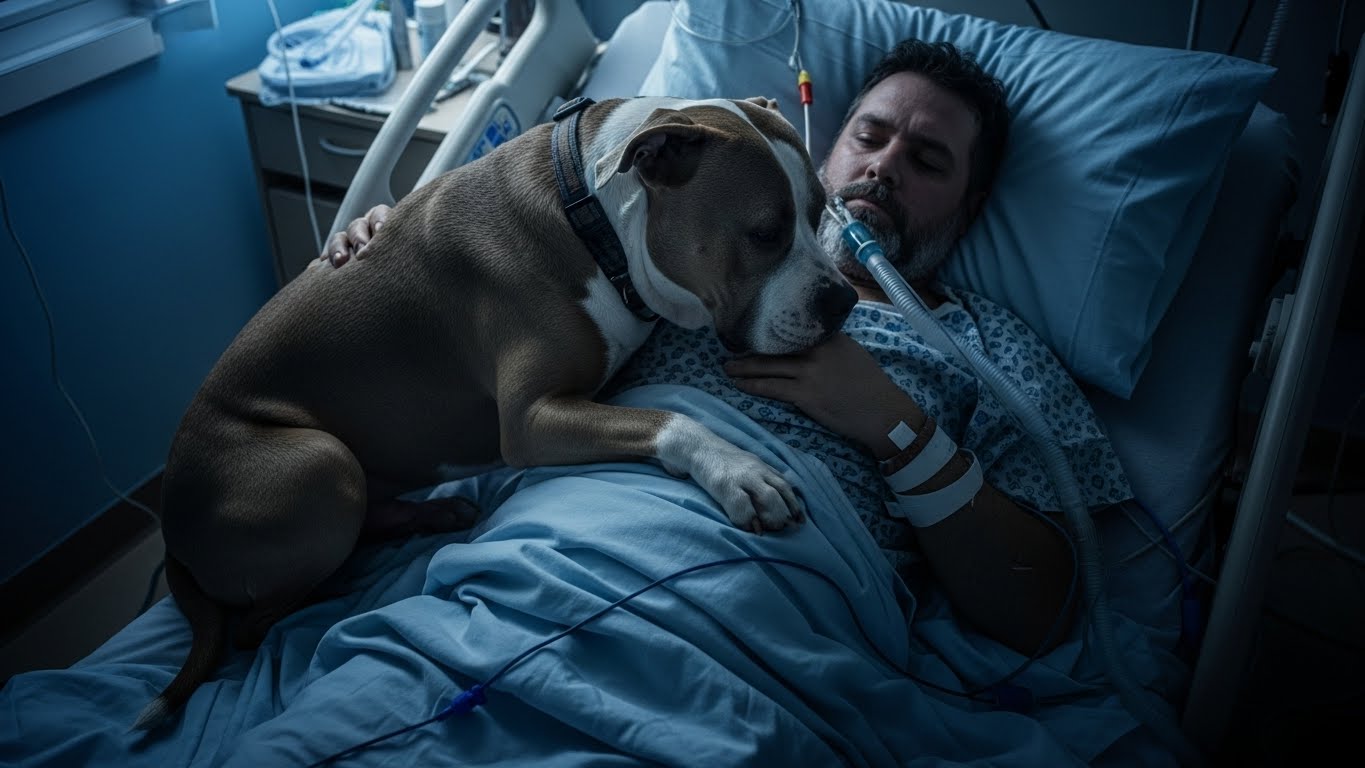
EVERYONE SAID MY BROTHER WAS GONE, A GHOST TRAPPED IN A BROKEN BODY. THEY WANTED TO PULL THE PLUG, TO SAY GOODBYE TO THE HERO WHO SAVED THE CITY. BUT THEY FORGOT ABOUT BOOMER, THE THREE-LEGGED STRAY WHO OWED HIM A LIFE. WHAT HAPPENED WHEN THAT DOG LIMPED INTO THE ICU IS SOMETHING NO DOCTOR CAN EXPLAIN.
Chapter 1: The Sound of White Noise
The air in St. Jude’s Recovery Wing didn’t smell like life. It smelled like industrial-grade bleach, lukewarm lime Jello, and the slow, agonizing passage of time. For six months, that’s all I’ve known. My name is Sarah Thorne, and I’m the girl who sits in the plastic chair until her legs go numb, watching the rise and fall of a chest that doesn’t belong to the man I grew up with.
My brother, Elias, used to be a force of nature. He was a Lieutenant at Engine 42, a “Southie” legend with a jawline like a granite block and a laugh that could shake the dust off the rafters of our local pub. He was the kind of guy who could carry a two-hundred-pound man over his shoulder while running down a crumbling stairwell without breaking a sweat. Now? Now he’s a collection of plastic tubes and a silence so heavy it feels like it has a physical weight.
The doctors call it a “persistent vegetative state” following the warehouse collapse in South Boston. They use big, clinical words to hide the ugly truth: they think he’s already checked out, and his body just hasn’t gotten the eviction notice yet.
“He’s not in there, Sarah,” Nurse Marcus said this morning. Marcus is a good man, a veteran with a faded “Semper Fi” tattoo on his forearm and a voice surprisingly gentle for someone who has spent twenty years watching people slip away. He was checking the IV site on Elias’s translucent arm, his movements practiced and efficient. “The brain trauma from the oxygen deprivation… it’s been half a year. You have to start thinking about the quality of life. Or the lack of it.”
I looked at Elias. His eyes were open, staring at a fixed point on the acoustic ceiling tiles, somewhere between the smoke detector and a water stain. He didn’t blink when the sun hit them. He didn’t flinch when the monitors wailed their electronic frustrations. He was a statue made of skin, bone, and regret.
I hated that look. I hated the way the hospital’s harsh fluorescent lights made his tan skin look like wax. But most of all, I hated the secret I was keeping. Because the night of the fire, Elias didn’t just get trapped. He went back in. Not for a person. Not for a fellow firefighter. He went back for Boomer.
Boomer was a mangy, terrified Pitbull-mix Elias had rescued from a fighting ring in Dorchester two years prior. The dog had lost a front leg in those pits, leaving him with a jagged scar across his chest and a permanent, lopsided limp. But Elias saw something in him—a shared stubbornness. They were two of a kind: scarred, fiercely loyal, and fundamentally misunderstood. When the roof of the warehouse groaned and the chief yelled for everyone to evacuate, Elias made it to the threshold. But then he heard it—a high-pitched, desperate yelp from the basement. Boomer, who had followed Elias to the scene in the truck like he always did, had bolted into the building in a moment of pure panic.
Elias didn’t hesitate. He dived back into the black smoke. He found the dog. He threw Boomer through a narrow ventilation window into the arms of the waiting crew just seconds before the second floor pancaked onto him.
The dog lived. My brother broke.
“I’m not giving up, Marcus,” I whispered, my fingers tracing the calluses on Elias’s hand—calluses that were slowly disappearing from disuse. “He’s still in there. He’s just… lost in the smoke. He needs a reason to come back.”
Marcus sighed, a sound of pure, bone-deep exhaustion. “The Ethics Board is meeting on Friday, Sarah. Dr. Aris is leading the charge. They’re going to recommend a transition to a long-term hospice. It’s a polite way of saying they need the bed for someone who actually has a chance. You need to prepare yourself.”
I felt a cold spike of panic. Hospice meant the end. It meant the quiet rooms where the morphine drips are the only rhythm left until the silence takes over. I couldn’t let him go out like that. Not my hero. Not for a dog.
Chapter 2: The Uninvited Guest
The plan was reckless. It was the kind of thing that could get me banned from the hospital, or worse, get me arrested for endangering “sterile environments.” But as I looked at the “No Pets Allowed” sign on the sliding glass doors of the main entrance, I felt a strange, cold clarity.
The duffel bag on my shoulder felt like it weighed eighty pounds, mostly because it was wiggling.
“Stay low, buddy,” I hissed, adjusting the strap as I walked through the lobby.
A muffled, wet snort came from inside the bag. Boomer was a “good boy,” but he was also thirty-five pounds of solid muscle and anxiety. Since the accident, he’d been a shadow of himself. He didn’t bark at the mailman anymore. He didn’t chase the squirrels in the park. He just sat by the front door of our apartment, his nose pressed against the floorboards, waiting for a key to turn in the lock that never would. He was grieving in the only way a dog knows how: by fading away.
I waited for the shift change at 7:00 PM. The lobby was a chaotic mess of tired nurses, weeping families, and the smell of burnt coffee. I kept my head down, my heart hammering against my ribs like a trapped bird.
“Hey! You!”
I froze. A security guard—a guy named Miller who I’d seen a dozen times—was looking in my direction. I tightened my grip on the bag, praying Boomer wouldn’t choose this moment to howl.
“The cafeteria is closed for cleaning,” Miller shouted, pointing toward the elevators. “Vending machines are on the fourth floor if you’re looking for a snack.”
“Thanks,” I squeaked, my voice two octaves higher than normal. I ducked into the closing elevator just as Boomer shifted, his tail thumping once against my hip.
I hit the button for the 6th floor. My breath hitched as the elevator groaned upward. When the doors opened, the smell of bleach hit me again. I moved fast, slipping past the nurse’s station while they were distracted by a heated argument over a missing chart.
Room 604. Elias.
I slipped inside and locked the door behind me, the “Do Not Disturb” sign hanging precariously on the handle. My hands were shaking so hard I could barely unzip the bag.
“Okay, Boomer. It’s now or never.”
The dog practically exploded out of the duffel bag. His three legs scrambled for purchase on the waxed linoleum floors, his claws making a frantic skritch-skritch-skritch sound that felt loud enough to wake the dead. He looked around, his nose twitching at the chemical scent of the room, his eyes scanning the monitors and the IV poles.
Then he saw the bed.
Boomer stopped. His ears, usually flopped over in a sad display of defeat, stood straight up. He didn’t whine. He didn’t bark. He just stared at the man lying under the thin white sheet. For a long, agonizing minute, I thought he wouldn’t recognize him. Elias didn’t look like the man who played tug-of-war in the park or shared his crusts of pizza. He looked like a stranger.
But Boomer knew.
With a low, guttural huff, the dog limped toward the bed. His missing front leg made his gait awkward, a rhythmic, heavy thumping that seemed to echo in the silence. He struggled, trying to hoist his front end up onto the high mattress.
“I’ll help you,” I whispered, lifting his heavy back end.
Boomer scrambled up, his heavy head landing right on Elias’s chest, right over the heart that was still beating despite the doctors’ grim predictions. He let out a long, shuddering sigh and closed his eyes, his tail giving one weak, uncertain wag against the metal bed rail.
“Look at him, Elias,” I pleaded, the tears finally breaking through. “He’s here. Your boy is here. You didn’t save him for nothing. Come back to us. Please.”
Elias didn’t move. His eyes remained fixed on that same spot on the ceiling. The ventilator hissed: In. Out. In. Out. It was a mechanical mockery of life.
I sat on the edge of the bed, my hand resting on Boomer’s scarred back, watching the flicker of the heart rate monitor. The numbers remained steady. 72 beats per minute. A flat, unwavering line of biological existence.
I felt a wave of crushing defeat. Maybe Marcus was right. Maybe the Elias I knew was gone, and I was just a desperate girl traumatizing a poor dog by bringing him to a funeral for a man who hadn’t stopped breathing yet.
“I’m sorry, Boomer,” I choked out, reaching for his collar. “I’m so sorry.”
I reached out to pull the dog down, to put him back in the bag and retreat into the dark Boston night.
But then, the monitor chirped.
It was a tiny sound, a slight jump in the rhythm. 74. 78. 82.
I looked at Elias. His face was still a mask of stone. But his right hand—the one resting near Boomer’s ear—wasn’t flat anymore.
The index finger twitched.
It wasn’t a spasm. It wasn’t the random firing of dying neurons. It was a slow, deliberate curl. A ghost of a movement.
My heart stopped. I watched, breathless, as the finger moved again, brushing against the coarse, golden fur of the dog’s ear.
“Elias?” I whispered, afraid that even a breath would shatter the moment.
The dog felt it too. Boomer’s head popped up, his eyes wide, his tongue lolling out in a sudden burst of canine joy. He began to lick Elias’s chin, a frantic, slobbering display of affection that bypassed all hospital protocols.
And then, it happened.
The man who hadn’t moved in six months let out a sound. It wasn’t a word. It was a dry, raspy wheeze, deep in the throat.
Elias’s eyes—the eyes that had been vacant for half a year—shifted. They moved from the ceiling. They tracked downward. They landed on the three-legged dog.
A single tear rolled from the corner of my brother’s eye, carving a path through the stubble on his cheek. His fingers closed. He gripped a handful of Boomer’s fur, holding on like a man catching a life raft in the middle of a storm.
Chapter 3: The Ghost in the Machine
The silence of the room was shattered by the sound of the door handle rattling. I panicked, shoving Boomer toward the far side of the bed, trying to hide his massive frame behind the curtain.
“Sarah? I heard a noise in there. Is everything okay?” It was Dr. Aris. The man who wanted to pull the plug.
I wiped my eyes frantically, my heart hammering. “I’m fine, Doctor! Just… I dropped my water bottle.”
The door pushed open. Dr. Aris walked in, his iPad tucked under his arm like a weapon. He was a man of cold logic, a specialist brought in to “manage expectations.” He looked at me, then at the monitors, and then his eyes narrowed as they landed on the lump under the covers next to Elias.
“What is that?” he asked, his voice dropping to a dangerous level of calm.
Before I could lie, Boomer let out a soft, contented “woof.”
Dr. Aris pulled back the curtain, and his face went pale with a mixture of shock and fury. “A dog? Are you out of your mind? This is a sterile Intensive Care unit, Sarah! The infection risk alone—”
“Look at his hand,” I interrupted, my voice trembling but fierce. “Don’t look at the dog. Look at my brother.”
Aris stopped mid-sentence. He looked down at Elias’s right hand. My brother’s fingers were still buried in Boomer’s fur. The knuckles were white. He wasn’t just touching the dog; he was clinging to him.
“It’s a reflex,” Aris said, though his voice lacked its usual bite. “Involuntary motor response to tactile stimuli. It doesn’t mean—”
“He looked at him, Doctor,” I snapped. “He didn’t look at the ceiling. He didn’t look at the wall. He looked at Boomer. He’s crying.”
Aris stepped closer, his skepticism warring with the undeniable evidence of the tear track on Elias’s cheek. He pulled out a penlight and shined it into Elias’s eyes. Usually, Elias wouldn’t react. But today, his pupils constricted sharply, and he let out another one of those raspy, guttural sounds.
“Lieutenant Thorne?” Aris whispered, leaning in close. “Elias? Can you hear me?”
Elias didn’t speak. He couldn’t. The ventilator was still breathing for him. But his jaw worked, his throat muscles straining against the tube. He squeezed the dog’s fur again. Boomer, sensing the tension, let out a low whine and licked the doctor’s hand, as if pleading for him to understand.
“This is… highly irregular,” Aris muttered, tapping his iPad. “His vitals have spiked, but not in a way that suggests distress. His heart rate is elevated but stable. It’s almost as if… he’s trying to wake up.”
“He is waking up,” I said, a spark of hope finally catching fire in my chest. “He just needed to know that Boomer was okay. He thought he died saving him. He’s been trapped in his own head, thinking he failed.”
Aris looked at the dog, then at the man. For the first time in six months, the doctor looked like a human being instead of a textbook. He checked the hallway to make sure no other staff were watching.
“I should report this,” Aris said quietly. “I should have security remove this animal immediately. It’s a violation of every protocol we have.”
He paused, looking at the way Boomer’s presence seemed to act like a grounding wire for Elias’s shattered nervous system.
“But,” Aris continued, “I’ve seen enough ‘miracles’ in this job to know when to shut up and watch. You have one hour, Sarah. Then that dog goes back in the bag and out of this building. If I see him here after 9:00 PM, I’m calling the police. Understood?”
“Understood,” I whispered, relief washing over me.
As Aris walked out, he stopped at the door. “And Sarah? If he moves those fingers again… record it. The Board won’t believe me without proof.”
I turned back to the bed. Elias’s eyes were still open, but they weren’t vacant anymore. There was a spark. A tiny, flickering light in the darkness. I grabbed my phone, but I didn’t record the hand. I recorded the moment Boomer rested his chin on Elias’s shoulder, and my brother, with a strength that shouldn’t have existed, leaned his head just an inch to the left to meet him.
It was the start of a fight. And for the first time, I knew Elias was going to win.
Chapter 4: The Red Tape and the Reality Check
The video on my phone was forty-two seconds of pure, unadulterated hope. I watched it so many times the image of Elias’s curling fingers was burned into my retinas. But sitting across from the St. Jude’s Ethics Board on Friday morning, that forty-two seconds felt like a paper shield against a firing squad.
The room was paneled in dark wood that looked like it belonged in a courthouse, not a hospital. Four people sat across from me. Dr. Aris was there, looking conflicted and tired. Beside him was a woman in a sharp grey suit named Evelyn Vance—the hospital’s legal counsel—and two other doctors who looked like they hadn’t slept since the nineties.
“Ms. Thorne,” Evelyn began, her voice as smooth and cold as a marble floor. “We’ve reviewed the footage you provided. While it is… emotionally compelling, we have to look at the clinical reality. Spontaneous motor movements are common in patients with your brother’s level of brain trauma. They are often misattributed as purposeful by grieving family members.”
“It wasn’t spontaneous,” I said, my voice cracking before I steadied it. “He reacted to his dog. He tracked him with his eyes. He cried. Is crying a ‘spontaneous motor movement’ too?”
The older doctor to the left, a man with thick glasses and a permanent scowl, leaned forward. “The brain is a complex machine, Sarah. When it’s damaged, it misfires. What you saw was likely a localized seizure or a reflex triggered by the scent and pressure of the animal. It doesn’t indicate cognitive recovery.”
I felt a hot flash of anger. “He saved that dog’s life. He went back into a literal inferno because he couldn’t leave a friend behind. You’re telling me that when that same friend shows up at his bedside, it’s just a coincidence that he starts moving?”
“We are saying,” Evelyn interrupted, “that the hospital cannot base life-altering medical decisions on an unauthorized, non-sterile animal being smuggled into an ICU. In fact, we should be discussing the security breach that allowed it to happen.”
I looked at Dr. Aris. He was staring at his hands. He knew. He had seen the way Elias’s eyes cleared for that split second.
“The recommendation stands,” the scowling doctor said. “Elias Thorne will be moved to the Sunnyside Hospice Pavilion on Monday. We need the bed in the acute care wing for patients with a higher probability of neurological rebound.”
“He’s a hero,” I whispered, the words feeling heavy and useless. “He’s a Lieutenant. He spent ten years running into buildings everyone else was running out of. And you’re tossing him out like yesterday’s trash because he won’t wake up on your schedule?”
“We are providing him with dignified end-of-life care,” Evelyn said.
I stood up, my chair screeching against the floor. “He’s not at the end of his life. He’s at the beginning of a fight. And if you move him now, you’re killing him. I won’t sign the transfer papers.”
“You don’t have to,” she replied softly. “The state-appointed guardian has already reviewed the medical necessity. It’s out of your hands.”
I walked out of that room feeling like I was suffocating. I went straight to Elias’s room, but there was a guard outside now. Not Miller. Someone new. Someone who had been told to watch out for a girl with a heavy duffel bag.
Chapter 5: The Breath of Life
Saturday was a nightmare. Without Boomer, the room felt stagnant again. The air was heavy with the smell of failure. I sat by Elias’s bed, holding his hand, but it was limp. The spark I’d seen on Wednesday was gone, replaced by the dull, flat stare that had haunted me for months.
“Talk to me, El,” I whispered. “Give me something. Anything. I can’t keep them away forever.”
His vitals were trending down. Not a crash, but a slow, steady decline. It was as if his body had realized the dog was gone and decided there was no reason to stay tuned in. His heart rate had dropped to the low 50s. His oxygen saturation was dipping, triggering the ventilator to hiss louder, forcing air into lungs that didn’t seem to want it anymore.
Nurse Marcus came in around noon. He didn’t say anything at first. He just checked the monitors and adjusted the pillows.
“They’re moving him Monday morning,” I said, staring out the window at the grey Boston skyline.
“I heard,” Marcus said. He stepped closer, lowering his voice. “I’m not supposed to tell you this, but Aris is pissed. He went to the Chief of Medicine this morning. He tried to argue for a PET scan—a high-res one to look for metabolic activity in the prefrontal cortex. They denied him. Said it was a waste of resources.”
“Because they’ve already decided he’s dead,” I said.
Marcus looked at the door, then back at me. “The dog. When you brought him in… Elias really looked at him?”
“He didn’t just look at him, Marcus. He recognized him. He was in there.”
Marcus rubbed his jaw. “I’ve been a nurse for a long time. I’ve seen people come back from the brink, and I’ve seen people stay in the dark. Usually, the ones who come back have a tether. Something pulling them toward the light. For some, it’s a kid. For others, it’s a grudge. Maybe for your brother… it’s that three-legged mutt.”
“I can’t get him back in here,” I said, gesturing to the guard in the hall. “They’re watching me like a hawk.”
“They’re watching the door,” Marcus said cryptically. “But they aren’t watching the loading dock. And they aren’t watching the service elevator that the laundry crew uses at 3:00 AM.”
I looked at him, my eyes widening. “Marcus… you’d lose your job.”
“I’m three years from retirement and I’m tired of watching heroes die in silence,” he said, his face hardening. “If Elias is in there, he deserves a fair fight. You get the dog here at 0245. Go to the back of the North Wing. There’s a steel door next to the dumpsters. I’ll be there.”
That night was the longest of my life. I sat in my apartment, watching Boomer pace. He knew something was up. He kept going to the door, whining, his tail tucked between his legs.
“We’re going to see him, Boomer,” I whispered, kneeling down to rub his ears. “One last shot. You have to be the best boy you’ve ever been.”
The drive to the hospital was a blur of rain and streetlights. I parked three blocks away and carried Boomer. He was heavy, and my arms ached, but I didn’t care. The cold rain soaked through my hoodie, but I didn’t feel it. All I felt was the ticking of the clock.
02:45 AM.
I stood by the steel door. It was rusted at the bottom, smelling of wet cardboard and old grease. I waited. Five minutes. Ten. A panic started to rise in my throat. What if Marcus changed his mind? What if he got caught?
Then, the heavy door groaned and swung open an inch.
“Quick,” Marcus hissed.
I slipped inside. The back hallways of the hospital were a labyrinth of pipes and concrete. We moved like ghosts, dodging the night janitors and the humming laundry machines. Marcus led us to a freight elevator that smelled of bleach and industrial soap.
When we reached the 6th floor, the hallway was dim, the main lights turned down for the night. The guard at the front of the unit was slumped in his chair, scrolling through his phone with headphones on.
We slipped into Room 604.
The room was freezing. Elias looked smaller, more fragile than he had even twenty-four hours ago. The “hospice” tag was already clipped to his chart at the foot of the bed.
“Go,” Marcus whispered, standing by the door. “You have twenty minutes before the night supervisor does her rounds.”
Chapter 6: The Final Stand
I didn’t waste time. I lifted Boomer onto the bed. This time, there was no struggle. Boomer knew exactly where to go. He crawled up to the head of the bed, his body curling around Elias’s head like a living crown of fur.
“Elias,” I whispered, leaning over the rail. “It’s Sarah. Boomer’s back. He’s here, El. But they’re taking you away. They’re taking you to a place where we can’t bring him. You have to wake up. You have to show them.”
Silence. Only the hiss of the machine.
“Please, Elias. I can’t do this alone. I can’t lose you.”
Boomer let out a soft, mournful whine. He began to lick Elias’s hand—the hand that had been so still. He licked the fingers, the palm, the wrist. He was desperate, his little tail thumping rhythmically against the mattress.
Nothing happened. The heart rate monitor stayed at a sluggish 48.
“Elias!” I said louder, my voice thick with a sudden, sharp desperation. “They think you gave up! They think you’re a ghost! Don’t let them be right! Fight for him! Fight for Boomer!”
Boomer suddenly did something he’d never done before. He let out a sharp, piercing bark. It echoed through the room like a gunshot.
“Shhh!” Marcus hissed from the door.
But Boomer didn’t stop. He barked again, then grabbed the edge of Elias’s hospital gown with his teeth and began to tug, his three legs bracing against the mattress. He was trying to pull Elias out of the bed, out of the coma, out of the dark.
“Elias!” I screamed, forgetting about the guards, forgetting about the rules.
The monitors suddenly went haywire. Beep-beep-beep-beep!
The heart rate spiked. 60. 80. 110. 130.
The alarm for the ventilator began to wail—a high-pitched scream indicating “patient resistance.” Elias wasn’t letting the machine breathe for him. He was fighting it.
His eyes flew open. They weren’t fixed on the ceiling. They were blown wide, filled with a sudden, violent clarity. His chest heaved. He gagged on the plastic tube in his throat, his face turning a terrifying shade of purple.
“He’s choking!” I cried out.
“No,” Marcus said, rushing to the bedside, his eyes wide with awe. “He’s trying to breathe on his own.”
The door burst open. The security guard and the night nurse, a woman named Clara, rushed in.
“What is going on here? Is that a dog?!” Clara screamed.
“Call a Code Blue!” Marcus yelled over the alarms. “He’s conscious! He’s fighting the vent!”
Elias’s hand—the right one—shot up. It didn’t twitch. It didn’t curl. It reached out and grabbed the front of the security guard’s uniform, pulling the man toward him with a strength that defied six months of atrophy.
His eyes were locked on Boomer.
With his other hand, Elias reached up and clawed at the tape holding the ventilator tube in place. He was frantic, his body bucking against the restraints.
“Get the tube out!” I screamed. “He’s going to hurt himself!”
Dr. Aris appeared in the doorway, his coat half-on, his hair a mess. He took in the scene—the barking dog, the fighting patient, the chaos. He didn’t hesitate.
“Extubate him! Now!” Aris commanded.
Clara and Marcus moved in. They deflated the balloon, snipped the tape, and with one smooth motion, pulled the long, clear plastic tube from Elias’s throat.
Elias collapsed back against the pillows, gasping for air. It was a raw, rattling sound. He coughed, a deep, wet sound that shook his entire frame.
The room went silent. Everyone held their breath.
Elias turned his head slowly. He looked at me. Then he looked at Marcus. Then his gaze settled on Boomer, who was now standing on his chest, tail wagging so hard his whole body shook.
Elias’s cracked, dry lips moved. No sound came out at first. He tried again, his voice a ghost of a whisper, a sound that seemed to come from miles away.
“B… B… Boomer.”
The dog let out a small, happy whimper and licked the tears that were now streaming down Elias’s face.
My brother looked at the security guard, who was still standing there, stunned. Elias’s eyes narrowed, a flash of the old, stubborn Lieutenant returning.
“Get… that man… a water,” Elias wheezed, his hand falling back onto Boomer’s head. “The dog… is thirsty.”
I fell to my knees, sobbing into the side of the bed. He was back. The hero had returned from the smoke.
Chapter 7: The Miracle on 6-West
The following weeks were a blur of “firsts.” The first time Elias swallowed real water. The first time he sat up without a harness. The first time he looked at a physical therapist and told her, in a voice like crushed gravel, that her exercises were “for wimps.”
The hospital administration didn’t know what to do with him. He was no longer a “case to be managed”; he was the “Thorne Miracle.” The story of the three-legged dog who barked a dead man back to life had leaked out—mostly because Marcus had “accidentally” shared a photo of Boomer on the bed with a friend at the Boston Globe. By Tuesday afternoon, there were news trucks in the parking lot and a pile of dog treats in the lobby large enough to feed a kennel for a year.
But for Elias, the fame didn’t matter. The only thing that mattered was the grueling, soul-crushing work of re-learning how to be a man.
“Come on, El. Just to the door,” I urged, standing by the foot of the bed.
Elias was drenched in sweat, his hospital gown clinging to his thin frame. He looked like a shadow of the firefighter who could bench-press three hundred pounds, but his eyes—those blue, stubborn Thorne eyes—were burning with a fierce intensity.
“I’m… trying… Sarah,” he gasped, his teeth gritted.
He was standing between two parallel bars in the rehab gym. His legs were shaking, the muscles firing for the first time in over half a year. He took a step. It was clumsy, a heavy dragging of his left foot. He groaned, his knuckles white as he gripped the bars.
“He’s doing it,” a voice said from the doorway. It was Dr. Aris. He wasn’t wearing his white coat today; just a sweater and a look of genuine disbelief. “Statistically, he shouldn’t be able to stand, let alone navigate a stride. The neural pathways were supposed to be dark.”
“Elias doesn’t care about your statistics, Doctor,” I said, not taking my eyes off my brother.
Then, Boomer moved. The dog had been granted “Emergency Therapy Animal” status—a fancy way for the hospital to avoid a PR nightmare—and he was sitting at the end of the bars. He let out a short, encouraging yip.
Elias looked at the dog. A ghost of a smile touched his lips. “Okay… boy. I’m… coming.”
He took another step. Then another. It wasn’t graceful. It was a battle of will against biology. But as he reached the end of the bars, he let go of the right rail for just a second to reach down and pat Boomer’s head. He stayed upright.
In that moment, the sterile air of the rehab gym felt electric. It was more than medicine. It was a man and his dog, two broken things refusing to stay down.
Chapter 8: The Only Way Home
Two months later, the smell of bleach was finally replaced by the scent of salt air and frying bacon.
We were back in our small apartment in Southie. The transition hadn’t been easy. Elias still used a cane, and his speech sometimes lagged when he was tired. He wouldn’t be returning to Engine 42—the smoke had done too much damage to his lungs for that—ưng but he had been offered a job as a dispatcher and a trainer at the academy.
It was a Tuesday evening, the sun dipping low over the harbor, casting long, golden shadows across the living room floor. Elias was sitting on the sofa, his “Life is Good” t-shirt hanging a bit loose on his shoulders. Boomer was sprawled across his lap, his three legs twitching as he chased dream-squirrels.
“You’re quiet tonight,” I said, setting a mug of tea on the coffee table.
Elias looked out the window, his hand rhythmically scratching Boomer’s favorite spot behind his ears. “I was just thinking about the warehouse, Sarah. About the moment the roof came down.”
I felt a chill. We hadn’t talked about the fire much. “What about it?”
“Everyone thinks I was a hero for going back in,” he said softly. “But in that basement… when the beams fell and the light went out… I wasn’t brave. I was terrified. I remember lying there in the dark, feeling the heat, hearing the wood groan. I thought, This is it. This is where I die.“
He looked down at the dog. Boomer opened one eye and let out a contented sigh.
“And then I heard him,” Elias continued. “I heard Boomer yelp. It was this tiny, desperate sound in all that noise. And I realized… if I didn’t get him out, he’d be alone in the dark. That dog had been through enough hell in those fighting pits. I couldn’t let him die in another one.”
“You saved him, El. And then he saved you.”
“No,” Elias said, his voice thick with emotion. “He didn’t just save me from the hospital. He saved me from the dark. When I was in that coma, it was like being underwater. I could see the surface, but I couldn’t swim to it. I was just… drifting. Until I felt him. I felt his fur. I felt his breath. It was like a rope being thrown into the water.”
He stood up, leaning heavily on his cane but moving with a new kind of grace. He walked over to the window, Boomer limping faithfully at his side, their rhythms perfectly in sync.
“People talk about miracles like they’re something that happens to you,” Elias said, looking out at the city he had protected for a decade. “But I think a miracle is just love with nowhere else to go. It finds a way. It always finds a way.”
I watched them—the man who shouldn’t be walking and the dog who shouldn’t be alive—framed by the setting sun. My brother wasn’t the same man he was before the fire. He was slower, quieter, and he carried the weight of the world in his eyes. But as he leaned down to whisper something into Boomer’s ear, and the dog responded with a joyous, lopsided leap, I realized he was something better than a hero.
He was home.
And as I watched them, I realized that the loudest sound in the world isn’t a fire alarm or a collapsing building; it’s the quiet, steady heartbeat of someone who refused to let go.
Would you have fought the hospital to bring Boomer in, even if it meant risking everything? Or do you believe some miracles are better left to the doctors?
Read More Stories I Wrote With This Link : https://storyteller.bryzaads.com/hcm1