She Thought She Could Break My Little Girl’s Spirit Because I Was “Just a Carpenter.” She Didn’t Realize She Was Waking a Sleeping Giant.
Chapter 1: The Silence in the Car
The silence in my truck was heavier than the load of lumber in the bed. Usually, the drive to Oak Creek Elementary was our time. Five-year-old Lily would be singing along to the radio, or telling me about her dreams, or asking why the sky was blue for the millionth time.

But for the last two weeks, the mornings had been a battle. Not a tantrum—a war of attrition.
“I don’t feel good, Daddy,” she whispered, her small hands gripping the seatbelt strap so hard her knuckles were white.
I glanced over, my heart doing that painful squeeze it had done every day since her mother, Sarah, passed away two years ago. Lily was the spitting image of her. The same messy blonde curls, the same eyes that looked like shattered sea glass. But Sarah’s eyes had been full of fire. Lily’s were currently filled with a terror that no five-year-old should know.
“Is it your tummy again, bug?” I asked gently, turning down the volume on the radio.
She nodded, staring out the window at the passing suburban manicured lawns of our neighborhood. It wasn’t the tummy. We’d been to the doctor. Physically, she was fine. But her spirit? Her spirit was fading, like a photograph left out in the sun too long.
“We’re almost there,” I said, trying to sound cheerful, though the dread in my own stomach was mirroring hers. “Mrs. Gable said the class is painting today. You love painting.”
At the mention of the name, Lily flinched. Actually flinched.
“I don’t want to paint,” she said, her voice trembling. “I paint wrong.”
I slammed on the brakes a little too hard at the stop sign. “What?” I turned to look at her fully. “Lily, there is no such thing as painting ‘wrong.’ Art is… it’s whatever you feel. Who told you that?”
She bit her lip, tears welling up, threatening to spill over her freckled cheeks. “Mrs. Gable says I make a mess. She says I don’t listen to the lines.”
My grip on the steering wheel tightened until the leather creaked. Mrs. Gable. The woman was an institution at Oak Creek Elementary. A veteran teacher, highly recommended, strict but “produces results,” the principal had told me. When I met her at the open house, she looked down her nose at my work boots and calloused hands, offering a limp, sanitized handshake. I had brushed it off as just her way. Now, I wasn’t so sure.
“Lily,” I said, reaching over to stroke her hair. “You paint however you want. If you want to paint the sun purple, you paint it purple. You hear me?”
She didn’t answer. We pulled up to the drop-off circle. The line of SUVs and minivans was moving efficiently. Parents were kissing kids goodbye, handing over lunchboxes. It looked idyllic. It looked safe.
But when I put the truck in park and walked around to get her out, Lily wouldn’t unbuckle.
“Please, Daddy,” she begged, the tears finally flowing. “Please don’t make me go in there. I’ll be good at home. I can watch myself. I won’t touch your tools.”
“Honey, I have to work. You know that.” I felt like a monster. “Come on. Be brave for me? Be brave like Mommy?”
That was a low blow, and I knew it. Using Sarah’s memory to force compliance. But I was desperate and late for a job site across town.
Lily unclicked the belt with shaking hands. I lifted her out, her small body rigid. As we walked toward the brick building, I saw Mrs. Gable standing by the entrance, her arms crossed, watching the students file in like a warden inspecting inmates.
She was a tall woman, severe in a grey pantsuit that looked like it was made of steel wool. Her hair was pulled back so tight it pulled her eyebrows up, giving her a permanent expression of surprise and judgment.
“Mr. Hayes,” she said as we approached. She didn’t look at me; she looked at Lily. “Lily is tardy. Again. Three minutes past the bell.”
“The line was long,” I said, trying to keep my voice even.
“The line is the same length every day,” she snapped. “Punctuality is a virtue, Mr. Hayes. Perhaps if there was more structure at home…” She let the sentence hang there, a clear indictment of my single-parenting skills.
Lily hid behind my leg.
“Go on, Lily,” Mrs. Gable commanded, pointing a manicured finger toward the door. “Class has started. Do not run.”
Lily looked up at me one last time. It was a look of pure betrayal. “Bye, Daddy,” she whispered.
She walked toward the teacher, her head down, shoulders slumped. As she passed Mrs. Gable, I saw the woman lean down and whisper something into my daughter’s ear. I couldn’t hear the words, but I saw Lily’s body shudder.
Mrs. Gable straightened up, gave me a curt nod, and closed the heavy steel door.
I stood there on the concrete, the morning sun hitting my face, but I felt cold. Something was wrong. Deeply, fundamentally wrong. I walked back to my truck, sat in the driver’s seat, and stared at the school entrance.
I started the engine, put it in drive, and drove two blocks before I pulled over. I couldn’t do it. I couldn’t go to the job site. I had a feeling in my gut—the kind of instinct you get right before a piece of wood snaps back at you on the table saw.
I turned the truck around. I wasn’t going to work. I was going back to school. And I wasn’t going to the front office to sign in. I needed to see what was happening in that classroom when parents weren’t watching.
Chapter 2: The View Through the Blinds
The back of Oak Creek Elementary faced a wooded area that bordered the playground. It was quiet back there, the noise of the main road muffled by the line of oak trees that gave the school its name. I parked my truck down the street and walked through the woods, my boots crunching softly on the fallen leaves.
I felt ridiculous. I was a grown man, a professional, sneaking around an elementary school like a burglar. If Principal Higgins caught me, he’d probably ban me from the premises. He was a nervous man, always sweating, more concerned with liability lawsuits than education. But I didn’t care about Higgins. I cared about the terror in Lily’s eyes.
I knew which window was hers. Room 1B. It was on the ground floor, near the jungle gym.
The blinds were drawn, but not all the way. There was a gap, maybe two inches, at the bottom of the center pane. I crouched down in the mulch, my heart hammering against my ribs.
Inside, the classroom was unnaturally quiet. Usually, a room full of twenty kindergartners is a hive of energy—laughter, chairs scraping, questions being shouted. But this room was silent.
I squinted, adjusting to the dim light. The kids were at their desks. They weren’t playing. They were sitting with their hands folded on top of their desks, staring straight ahead.
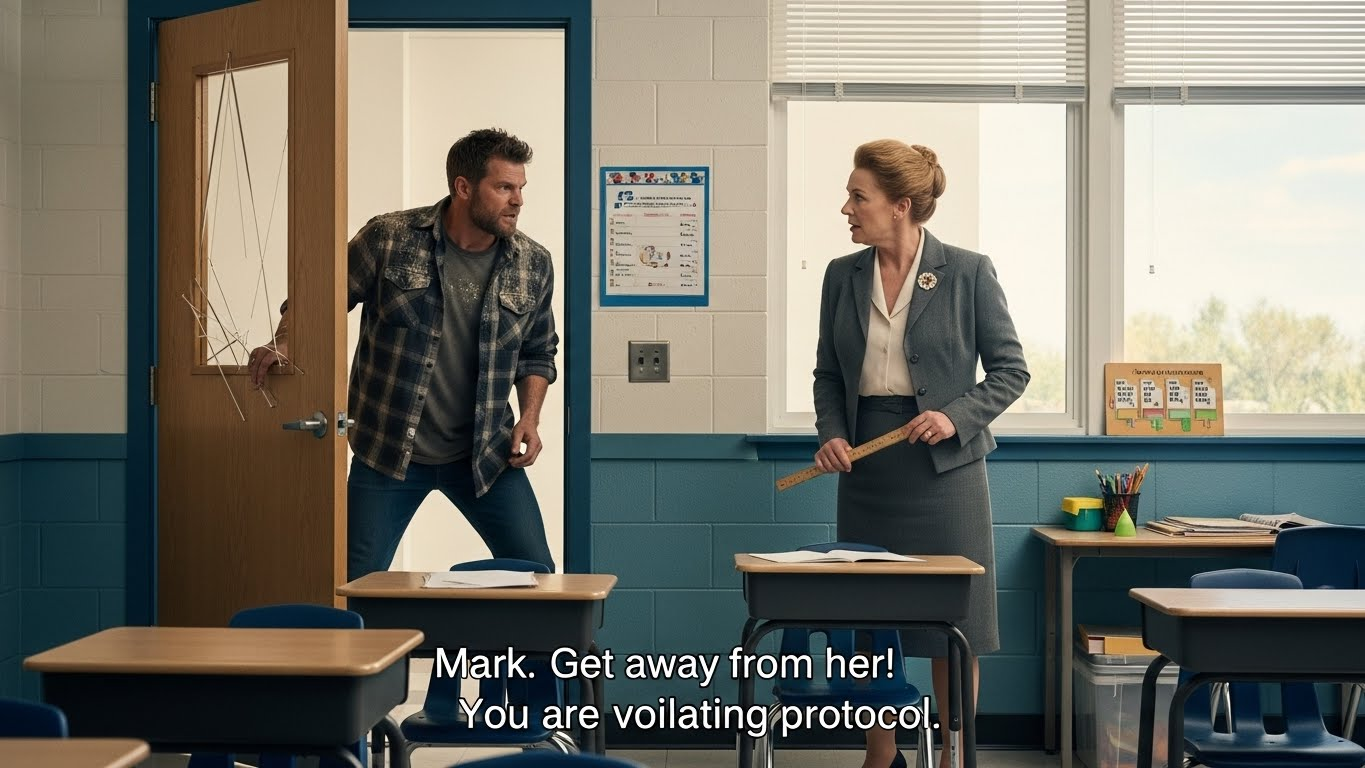
Mrs. Gable was pacing the front of the room, holding a ruler. She wasn’t hitting anyone with it, but she was tapping it against her palm. Tap. Tap. Tap. The rhythm was hypnotic and threatening.
“Discipline,” her voice drifted through the glass, muffled but audible. “Discipline is what separates us from the animals. Some of you…” She paused, walking down the row of desks. “Some of you are struggling with this concept today.”
She stopped at a desk in the second row. A little boy, I think his name was Tyler, had dropped his crayon.
“Pick it up,” she hissed.
The boy scrambled to pick it up.
“Did I say you could move?” she barked.
The boy froze, halfway under the desk. “But… you said pick it up.”
“I said pick it up. I did not say leave your seat. There is a procedure, Tyler. Raise your hand. Ask for permission. Then retrieve. You are chaotic. You are messy.”
Tyler looked like he was about to cry. “I’m sorry, Mrs. Gable.”
“Sorry doesn’t fix the disruption you’ve caused to my lesson.”
My jaw clenched. This was boot camp, not kindergarten. But where was Lily?
I scanned the room. I finally found her. She was in the back corner, isolated from the other desks. Her “island of shame,” I realized with a surge of bile in my throat.
She had a piece of paper in front of her. She was drawing. Good. At least she was drawing.
Mrs. Gable turned her attention away from Tyler and marched toward the back of the room. Toward Lily.
I held my breath, pressing my hand against the brick wall for balance.
“Lily Hayes,” Mrs. Gable said, her voice dropping an octave, becoming dangerously sweet. “What are we working on?”
Lily didn’t look up. She kept coloring furiously. “The assignment,” she whispered.
“The assignment was to draw a house,” Mrs. Gable said, towering over my daughter. “A house consists of a square and a triangle. Basic geometry. Basic structure.”
Mrs. Gable reached down and snatched the paper from Lily’s desk.
“Hey!” Lily cried out, reaching for it. “Give it back!”
“Sit down!” Mrs. Gable snapped. She held the drawing up to the light, inspecting it like it was evidence of a crime.
From my vantage point, I could see the drawing. It wasn’t a house. It was a garden. A messy, beautiful explosion of colors—purples, yellows, greens. And in the middle, two stick figures holding hands. One big, one small. And above them, looking down from a blue cloud, a woman with bright yellow hair and a halo.
It was us. It was me, Lily, and Sarah.
“This is not a house,” Mrs. Gable announced to the class, turning around to display Lily’s work. “Class, look. Lily cannot follow simple instructions. Lily lives in a fantasy world.”
A few kids giggled nervously, clearly relieved the target wasn’t on them.
“It’s my Mommy,” Lily said, her voice shaking but louder this time. “Ideally, she watches us.”
Mrs. Gable looked at the drawing with disdain. “Your mother is dead, Lily. She isn’t watching anything. And you are not doing your work.”
The air left my lungs. It felt like I’d been punched in the solar plexus.
Mrs. Gable didn’t stop there. She took the paper in both hands.
“We do not reward disobedience,” she said.
Riiip.
She tore the drawing in half.
Lily screamed. It wasn’t a tantrum scream. It was a sound of pure heartbreak.
Riiip.
She tore it again. And again. Letting the pieces flutter down onto Lily’s desk like confetti at a funeral.
“Now,” Mrs. Gable said, dusting her hands off. “You will start over. You will draw a square. You will draw a triangle. And you will stop crying, or you will go to the Principal’s office for disrupting the learning environment.”
Lily put her head on the desk and sobbed into her arms, her small body shaking violently.
I didn’t think. I didn’t plan.
I stood up from the bushes. I sprinted around the side of the building to the nearest fire exit door, which led into the hallway just outside her classroom. It was locked from the outside.
I didn’t care. I ran to the front entrance. I burst through the double doors, ignoring the buzzer system, ignoring the startled receptionist who yelled, “Sir! Sir, you can’t go in there!”
I stormed down the hallway, my boots thudding heavy on the linoleum. The receptionist was chasing me, radioing for the Principal.
“Mr. Hayes! Stop!”
I reached Room 1B. I didn’t knock. I didn’t turn the handle gently.
I kicked the door open.
It slammed against the wall with a crack that sounded like a gunshot. The entire class jumped. Mrs. Gable spun around, clutching her chest, her face draining of color.
“What is the meaning of—” she started, her eyes widening as she saw me.
I stepped into the room. I must have looked insane. Covered in sawdust, chest heaving, eyes burning.
“Get away from her,” I growled, my voice low and vibrating with a rage I hadn’t felt in years.
Mrs. Gable took a step back, faltering. “Mr. Hayes? You are violating school protocol. You need to leave immediately or I will call the police.”
I walked right past her. I went straight to the back of the room. I knelt down beside Lily’s desk. She looked up, her face wet with tears, eyes red and swollen. She saw me and threw her arms around my neck, burying her face in my flannel shirt.
“Daddy,” she sobbed. “She ripped Mommy. She ripped Mommy.”
I held her tight, lifting her up into my arms. I stood up, holding my daughter against my chest. I turned to face Mrs. Gable.
The room was deadly silent. Twenty pairs of wide eyes watched us.
Mrs. Gable regained her composure, straightening her blazer. “Mr. Hayes, this is unacceptable behavior. You are traumatizing the children.”
I looked at the torn pieces of paper on the desk. I reached out and swept them into my hand, pocketing them.
“Traumatizing?” I stepped closer to her. She flinched. “You looked a five-year-old in the eye and told her her dead mother isn’t watching her, and then you tore up her tribute. You think I’m the one traumatizing them?”
“I was correcting behavior,” she sniffed, though her voice wavered. “She refused to follow the curriculum.”
“Curriculum?” I laughed, a harsh, dry sound. “You’re done.”
“Excuse me?”
“You’re done teaching. You’re done bullying. You’re done.”
“Is there a problem here?”
Principal Higgins appeared in the doorway, out of breath, his tie askew. The receptionist was behind him, looking terrified.
“Mr. Higgins,” Mrs. Gable said, pointing a shaking finger at me. “This man just broke into my classroom and threatened me. I want him removed.”
Higgins looked at me, then at Lily clinging to me, then at Mrs. Gable. “Mark? What is going on?”
“Ask her,” I said, staring Mrs. Gable down. “Ask her what she did to my daughter’s drawing. Ask her what she said about my wife.”
Higgins looked at Mrs. Gable. She raised her chin defiantly. “I held the standard, Principal Higgins. That is my job.”
I walked toward the door, stopping right in front of Higgins.
“I’m taking my daughter,” I said. “And I’m calling the school board. And then I’m calling a lawyer. And Mrs. Gable? You better pray that tenure protects you from what’s coming, because I promise you, I won’t stop until you’re nowhere near a child ever again.”
I walked out into the hallway, carrying Lily. But I didn’t leave the school. Not yet. I had one stop to make first. I needed witnesses. And I knew exactly who to find.
Chapter 3: The Broken Silence
My boots squeaked on the waxed floor of the hallway as I marched toward the main exit, Lily’s face still buried in the crook of my neck. I could feel her hot tears soaking into my collar. Every sob that racked her small body fueled the fire in my gut.
“Mark! Mark, wait!” Principal Higgins jogged after me, his voice echoing in the corridor. “You can’t just storm out with a student in the middle of the day without signing the release forms! And we need to discuss—”
I spun around so fast Higgins skidded to a halt.
“Discuss?” I spat the word out. “You want to discuss forms while that woman is back there terrorizing twenty kids? You think a piece of paper matters right now?”
Higgins wiped sweat from his forehead. “Mrs. Gable is… traditional. She has a strict style. We’ve had complaints before, yes, but she’s effective. Her test scores are—”
“I don’t give a damn about her test scores, Bob!” I yelled. The use of his first name made him flinch. We played softball in the same rec league years ago; he knew me. He knew I wasn’t a violent man. But he also knew I didn’t bluff. “She told my daughter her dead mother isn’t watching her. Is that part of the state curriculum?”
Higgins opened his mouth, then closed it. He looked genuinely shocked. “She said that?”
“Ask the class. Or better yet, ask the boy, Tyler. The one she was berating like a drill sergeant before she got to Lily.”
Just then, the double doors of the main office swung open. A woman stepped out, holding a forgotten lunchbox. It was Brenda, Tyler’s mom. I knew her from the neighborhood—a sweet, quiet woman who worked double shifts at the diner. She looked tired, her eyes rimmed with dark circles.
She stopped, looking between me, the red-faced Principal, and the sobbing child in my arms.
“Mark?” she asked tentatively. “Is Lily okay?”
I looked at Brenda. I saw the fatigue in her posture. I saw the worry line etched between her brows. And I realized suddenly why Tyler had been so terrified to move from his desk. It wasn’t just him. It was the whole class.
“Brenda,” I said, ignoring Higgins. “Does Tyler talk about Mrs. Gable?”
Brenda’s eyes darted to Higgins, then back to me. She clutched the lunchbox tighter. “I… well, you know how boys are. He says she’s strict.”
“Strict?” I stepped closer, lowering my voice but keeping the intensity. “Does he cry before school? Does he beg to stay home?”
Brenda’s face crumbled. The mask of the ‘fine suburban mom’ slipped. She nodded, tears instantly springing to her eyes. “He… he started wetting the bed again last month. He’s six, Mark. He hasn’t done that since he was three. He tells me he’s ‘bad.’ He says Mrs. Gable tells him he’s ‘broken’ because he can’t sit still.”
“Mrs. Miller,” Higgins interjected, his voice pleading. “If you have concerns, you should schedule a formal meeting. Let’s not air this in the hallway.”
“We are done with formal meetings,” I said, my voice rising again. “Brenda, she tore up Lily’s drawing of Sarah. Right in front of her face. Called it garbage.”
Brenda gasped, her hand flying to her mouth. “Oh my god. Mark, I’m so sorry.”
“I’m going to the School Board meeting tonight,” I announced. I didn’t even know if there was a meeting tonight, but I was going to find out, and I was going to be there. “I’m going to tell them everything. Are you with me?”
Brenda looked at Higgins, who was shaking his head subtly, a silent warning to not rock the boat. Then she looked at the lunchbox in her hand—a Spider-Man lunchbox for a little boy who thought he was ‘broken.’
She straightened her spine. The tired waitress disappeared, replaced by a mother bear.
“I’m with you,” she said, her voice trembling but clear. “And I know three other moms who will be too. We talk, Mark. We all talk. We were just… scared. She’s been here thirty years. Everyone says she’s untouchable.”
“Nobody is untouchable,” I said, hoisting Lily up a little higher. “Not when they hurt our kids.”
I turned back to Higgins. “You have until tonight to decide whose side you’re on, Bob. The tenure track, or the truth.”
I pushed through the main doors, stepping out into the fresh air. The sun was still shining. The birds were still singing. But everything had changed.
I buckled Lily into her car seat. She had stopped crying, but she was hiccuping softly.
“Daddy?” she asked as I climbed into the driver’s seat.
“Yeah, bug?”
“Are you in trouble?”
I started the truck and looked at her in the rearview mirror. I gave her the most reassuring smile I could muster.
“No, honey. Daddy’s not in trouble. Daddy’s just getting started.”
I pulled out of the school lot, my phone already in my hand. I needed a lawyer. And not just any lawyer. I needed someone who hated bullies as much as I did. I dialed the number of an old friend I hadn’t spoken to in years—a man who owed me a favor for remodeling his kitchen for free when he was fresh out of law school.
“Hello?” a sharp voice answered.
“Dave,” I said. “It’s Mark Hayes. I need you. And you’re going to want to hear this.”
The war had begun. But I had no idea that Mrs. Gable wasn’t just a mean teacher. She was protected by something—or someone—much bigger than the PTA. And kicking that door open was about to bring the whole house down on top of us.
Chapter 4: The War Room
The neon “OPEN” sign of Dave’s law office flickered with a buzzing sound that set my teeth on edge. It was tucked into a strip mall between a dry cleaner and a failing vape shop—humble surroundings for the smartest man I knew.
Dave Miller wasn’t a “billboard lawyer.” He didn’t have a smile that gleamed on bus benches. He was a pitbull in a cheap suit, a man who had clawed his way out of the same blue-collar mud I grew up in. He looked up from a stack of files as I barged in, Lily holding my hand tightly.
“You look like hell, Mark,” Dave said, leaning back in his creaky leather chair. He took off his glasses and rubbed the bridge of his nose. “And based on the voicemail you left me, you’re about to drag me into hell with you.”
“She tore up her drawing, Dave,” I said, my voice raw. I sat Lily down on the small couch in the corner and handed her my phone to play a game. I turned back to Dave, lowering my voice. “She looked my five-year-old in the face, told her that Sarah was dead and gone, and ripped up a picture of her. In front of the whole class.”
Dave’s expression shifted. The cynical lawyer mask dropped, replaced by the look of a friend. He glanced at Lily, then back to me, his jaw tightening. “That miserable old bat. Gable?”
“You know her?”
“Mark, this is a small town. Everyone knows Eleanor Gable. She taught my older brother. She’s been at Oak Creek since the tectonic plates shifted. She’s not just a teacher; she’s a monument.” Dave sighed, opening a fresh legal pad. “And that’s the problem. You want to go after her? You’re not just fighting a teacher. You’re fighting the Institution.”
“I don’t care,” I said, pacing the small office. The smell of stale coffee and old paper was suffocating. “She’s hurting kids. It’s not just Lily. I met another mom, Brenda. Her son is wetting the bed. The class is terrified. It’s a reign of terror in Room 1B.”
Dave clicked his pen, the sound sharp in the small room. “Okay. Legally, we have a few angles. Intentional Infliction of Emotional Distress. Maybe a hostile educational environment claim. But Mark, listen to me. The School Board President is deeply connected to the teachers’ union here. And the Superintendent, Elias Thorne? He and Gable go way back. They play bridge on Sundays. You go into that Board meeting tonight, and they are going to try to bury you.”
“Let them try,” I said. “I’m not going alone.”
That evening, my living room looked like a refugee camp for exhausted parents.
I had spent the afternoon making calls. Brenda had called her friends. The suburban grapevine, usually reserved for gossip and casserole recipes, had turned into a tactical network.
There were five of them. Brenda sat on the edge of the sofa, looking anxious. Next to her was Mike, a burly guy who worked at the auto plant, looking uncomfortable in his skin. Then there was Jessica, a young, single mom who looked like she hadn’t slept in a week. And the Patels, a quiet couple who owned the local hardware store.
The air was thick with tension and the smell of the pizza I’d ordered for the kids, who were playing quietly in the basement.
“Thanks for coming,” I started, standing by the fireplace. Sarah had designed this living room. She picked the paint color—’Warm Embrace.’ It felt cold tonight. “I think we all know why we’re here.”
“She taped my son’s mouth shut,” Jessica whispered.
The room went dead silent.
I looked at her. “What?”
Jessica’s hands were shaking as she clutched a cup of tea. “Last year. My son, Noah. He’s a talker. He gets excited. Mrs. Gable… she used scotch tape. She told the class it was a ‘silence seal.’ She left it on for ten minutes. Noah came home with red marks on his lips. When I complained to Principal Higgins, he told me I was overreacting, that it was a ‘playful lesson on volume control.'”
“That’s assault,” Mike grumbled, his fists clenching on his knees. “That’s straight-up assault.”
“Why didn’t you go to the police?” Dave asked gently from the corner of the room.
“I was scared,” Jessica admitted, tears spilling over. “I’m a single mom. Higgins hinted that if I made a fuss, Social Services might get a call about an ‘unstable home environment.’ He gaslighted me.”
“My daughter,” Mr. Patel spoke up, his voice soft but laced with fury. “Priya. She has a slight lisp. Mrs. Gable makes her stand in front of the class and repeat words until she says them ‘perfectly.’ ‘Sally sells seashells.’ Over and over. While the other kids watch. Priya stopped speaking at home for three months. We thought she had a neurological disorder. It was just… fear.”
I looked around the room. This wasn’t just strict teaching. This was systematic abuse. It was a power trip fed by the vulnerability of children who didn’t have the language to defend themselves.
“We have to stop her,” I said, feeling a weight settle in my chest—the weight of responsibility. “Tonight. The School Board meeting is at 7:00 PM. We aren’t just going to complain. We are going to testify.”
“They won’t listen,” Brenda said, wringing her hands. “Thorne runs that board like a dictatorship.”
“They’ll listen,” I said, looking at the photo of Sarah on the mantelpiece. Her smile seemed to challenge me. Do the right thing, Mark. “Because we’re not going to let them look away. We’re going to be loud. And we’re going to be together.”
Dave stood up, closing his notepad. “I’ll draft the formal complaints. But remember, the moment we walk into that auditorium, we are declaring war. They will come after you. They will dig into your past. They will try to paint you as hysterical, incompetent, or vindictive. Are you ready for that?”
I looked at Lily’s backpack sitting by the door. The image of the torn drawing burned in my mind.
“I’ve lost the most important thing in my world already,” I said, thinking of Sarah. “I have nothing left to fear but failing my daughter. Let’s go.”
Chapter 5: The System Fights Back
The retaliation didn’t wait for the meeting. It started two hours before.
I was at my current job site—a custom deck build for the Millers on the north side of town. It was a big job, one that was going to pay the mortgage for the next three months. I was packing up my tools, my mind rehearsing what I was going to say to the Board, when a white city truck pulled into the driveway.
A man I didn’t recognize stepped out. Clipboards. Sunglasses. The universal uniform of bureaucracy.
“Mark Hayes?” he asked, not looking up from his paper.
“That’s me.”
“I’m from Code Enforcement. We received an anonymous tip about unsafe working conditions and unpermitted structural modifications.”
I laughed, wiping sweat from my forehead. “You’re kidding, right? I pulled every permit myself. Signed by the city three weeks ago. And this is a deck. What unsafe conditions?”
The inspector walked past me, kicking at a stack of pressure-treated lumber. “Debris management. Improper storage of combustibles. And I need to verify the depth of these footings. You might have to dig them up so I can measure.”
“Dig them up?” I stepped in front of him. “Concrete is poured and set. I have the sign-off from the pre-pour inspection right here in my truck.”
The man finally looked at me over his sunglasses. His eyes were cold, dead things. “Paperwork gets lost, Mr. Hayes. Errors happen. Until this is resolved, I’m issuing a Stop Work Order. Effective immediately.”
He slapped a bright red sticker on the framing of the deck.
My blood ran cold. A Stop Work Order could drag on for weeks. It meant I couldn’t get paid. It meant the Millers would get angry and likely fire me. It was a direct shot at my wallet.
“Who called it in?” I asked, my voice dangerously low.
“Anonymous,” the inspector said, turning back to his truck. “Have a nice day.”
As he drove away, my phone buzzed. It was Brenda.
“Mark,” she sounded breathless. “Don’t go on Facebook.”
“What? Why?”
“Just… don’t. The neighborhood group. Someone posted about you.”
I hung up and immediately opened the app. My hands were shaking, not from fear, but from adrenaline.
There it was. A post on the “Oak Creek Parents & Neighbors” page. Posted by a profile with no photo named “Concerned Citizen.”
“Parents, be careful who you trust. There’s a father trying to rally people against our beloved Mrs. Gable today. Before you join his mob, you should know that this man has been unstable since his wife passed. There were rumors of anger issues even before. Is this who we want disrupting our children’s education? We need to protect our teachers from violent men.”
Underneath, the comments were already rolling in. “Is this the carpenter guy? He always seemed intense.” “Mrs. Gable taught my kids. She’s a saint. This is disgusting.” “I heard he screamed at the principal today. Unhinged.”
They were painting me as the villain. The grieving, crazy widower taking out his pain on a sweet old lady. It was a masterclass in manipulation.
I threw my phone onto the passenger seat of my truck. I wanted to scream. I wanted to punch the dashboard. This was how they did it. This was how they kept people silent. They didn’t just defend themselves; they destroyed the accuser.
I sat there for a long moment, watching the wind rustle the trees. I thought about turning back. I could call Dave, tell him to drop it. I could apologize to Higgins, beg Mrs. Gable for forgiveness, maybe switch Lily to a private school I couldn’t afford.
Then, I looked at the red Stop Work sticker.
It fluttered in the wind, a symbol of their petty power.
“No,” I whispered to the empty truck.
If they were coming at me this hard, it meant they were scared. You don’t launch a smear campaign against a nobody unless that nobody is a threat. You don’t shut down a job site unless you’re trying to cut off the enemy’s supply lines.
They had made a tactical error. They thought taking away my money and my reputation would break me. But they forgot one thing. I was a carpenter. I built things from the ground up. And I knew how to demolish things that were rotten.
I picked up my phone and dialed Dave.
“They just red-tagged my job site,” I said. “And they’re smearing me online.”
“I saw the post,” Dave said, his voice grim. “They’re playing dirty, Mark. This is Elias Thorne’s playbook. Are you out?”
“I want you to bring a tape recorder to the meeting tonight,” I said. “And I want you to look up the city inspector roster. Find out who is related to who.”
“Mark—”
“I’m not out, Dave. I’m just getting warmed up. I’ll see you in an hour.”
I drove home, showered the sawdust off, and put on my Sunday best—a charcoal suit I hadn’t worn since Sarah’s funeral. I tied the tie, looking at myself in the mirror. I looked older than thirty-two. I looked tired. But my eyes… my eyes were Sarah’s.
I went downstairs. Lily was with the babysitter, a nice teenager from next door. I knelt down and hugged my daughter.
“Where are you going, Daddy?” she asked, touching my tie.
“I’m going to a meeting to talk about your drawing,” I said.
Her eyes widened. “Are you going to get in trouble?”
“No, baby,” I kissed her forehead. “I’m going to make sure nobody ever tears up your drawings again.”
I walked out the door into the cool evening air. The sun was setting, casting long shadows across the driveway. I got into my truck, the engine roaring to life. I wasn’t driving a luxury sedan like the school board members. I was driving a work truck, filled with tools and grit.
I drove to the school. The parking lot was already full. I saw expensive cars—Mercedes, BMWs, Lexus. The Board members were here.
I parked in the back. As I walked toward the lit-up gymnasium, I saw them waiting for me by the entrance. Brenda, Mike, Jessica, the Patels. And behind them, three other parents I didn’t recognize.
Brenda stepped forward. She looked terrified, but she was there.
“We saw the Facebook post,” she said.
“And?” I asked, bracing myself.
“And Mike posted a comment,” she smiled weakly. “He said if anyone calls you unstable, they’ll have to say it to his face.”
Mike nodded grimly. “I got your back, Mark.”
I felt a lump in my throat. I wasn’t alone.
“Let’s go,” I said.
We pushed open the heavy double doors of the gymnasium. The noise inside died down instantly. Heads turned.
The Sleeping Giant had arrived.
Chapter 6: The Lion’s Den
The gymnasium smelled of floor wax and old sweat—the universal scent of public education. Rows of metal folding chairs were set up on the basketball court, facing a long table draped in blue velvet cloth on the stage.
Sitting there, elevated above us like high priests, were the five members of the School Board.
In the center sat Superintendent Elias Thorne. He was a man who looked like he was carved out of expensive ham—pink-faced, jowly, wearing a suit that cost more than my truck. He had a smile that didn’t reach his eyes, which were scanning the room with bored detachment.
To his right sat Eleanor Gable.
She wasn’t on the Board, but she had a special chair set up next to the podium. She looked frail tonight. Smaller. She had wrapped a shawl around her shoulders and was dabbing at her eyes with a tissue. It was a performance worthy of an Oscar. The Iron Maiden had transformed into the grieving grandmother.
The room was packed. Teachers, parents, concerned citizens. The “Concerned Citizen” post had done its job; the mob was here. But as we walked down the center aisle, the whispers started.
“That’s him.” “The carpenter.” “He looks normal.”
We took our seats in the second row. Dave was already there, his briefcase open.
“Thorne is going to try to shut public comment down early,” Dave whispered. “He’s citing a ‘full agenda.’ We have to be aggressive.”
Thorne tapped the microphone. Thump. Thump. The sound boomed through the speakers.
“I call this meeting of the Oak Creek School Board to order,” he drawled. “We have a lot to get through tonight regarding the budget for the new football stadium lights. So let’s keep public comments brief. Three minutes per person. Strictly enforced.”
He smiled, a shark baring its teeth. “And let’s remember to keep things civil. We are a community of excellence.”
The first thirty minutes were a blur of budget spreadsheets and self-congratulatory speeches about the football team. I sat there, leg bouncing, watching Mrs. Gable. She kept her head down, looking like a martyr.
Finally, Thorne cleared his throat. “We now move to Public Comment. I have a request card here from… Mr. Mark Hayes.”
He said my name with a tone of distaste, like he had stepped in something unpleasant.
I stood up. My knees felt weak, but my hands were steady. I walked to the microphone stand in the center of the aisle. It was too short for me. I had to lean down.
“State your name and address,” Thorne said, looking at his watch.
“Mark Hayes. 1402 Elm Street.”
“You have three minutes, Mr. Hayes.”
I looked at the Board. Then I looked at Mrs. Gable. She finally looked up. Her eyes weren’t sad. They were cold. Hard as flint.
“I’m here to talk about what happened in Room 1B this morning,” I began. My voice echoed slightly. “And what has been happening for years.”
“Mr. Hayes,” Thorne interrupted immediately. “Personnel matters are not to be discussed in open forum. There are privacy laws. If you have a complaint about a specific teacher, you must file a form 104-C and submit it to the administration.”
“I’m not talking about personnel,” I said, my voice rising. “I’m talking about culture. I’m talking about a five-year-old girl who was told her dead mother isn’t watching her because she colored outside the lines.”
A gasp rippled through the room. Thorne’s face turned a shade darker pink.
“That is hearsay and inflammatory,” Thorne snapped. “Mrs. Gable is a pillar of this institution. She has served—”
“She tore up my daughter’s drawing!” I yelled, cutting him off. I reached into my pocket and pulled out the taped-together pieces of the picture I had salvaged. I held it up. “This is what your ‘pillar’ did. She ripped a child’s grief into pieces.”
“Cut his mic,” Thorne barked to someone off-stage.
The microphone went dead.
I didn’t stop. I have a carpenter’s voice—loud enough to be heard over buzz saws and hammers. I projected to the back of the gym.
“You want to silence me?” I shouted. “Fine! But you can’t silence the rest of them!”
I turned to the crowd. “Stand up! If Mrs. Gable has ever hurt your child, stand up!”
For a second, nobody moved. The fear in the room was palpable. Thorne was glaring, hammering his gavel. “Order! Order or I will have this room cleared!”
Then, a chair scraped.
Brenda stood up. She was trembling, but she stood.
Then Mike stood up.
Then Jessica.
Then the Patels.
And then, slowly, throughout the gymnasium, others began to rise. A mother in the back row. A father near the door. A teenager wearing a varsity jacket—one of her former students.
One by one, they stood. Ten. Twenty. Thirty people.
The silence that followed was deafening. It wasn’t just a few complaints. It was an epidemic.
I turned back to Thorne. He looked pale. He looked at the standing crowd, and for the first time, he looked afraid.
“That,” I said, my voice ringing in the quiet gym, “is not a personnel issue, Mr. Thorne. That is a failure of leadership.”
Thorne looked at Mrs. Gable. She had stopped acting. She was gripping the arms of her chair so hard her knuckles were white.
“This meeting is adjourned!” Thorne yelled, slamming the gavel down. “Security! Clear the room!”
Two uniformed security guards started moving toward me.
But before they could reach me, Dave stepped up. He didn’t need a microphone. He had his legal voice.
“Mr. Thorne!” Dave bellowed. “Before you clear the room, you might want to know that I have filed a request for discovery regarding the ‘Gable Trust’ and its donations to your reelection campaign!”
The room froze. Even the security guards stopped.
Thorne froze.
“What did you say?” Thorne whispered, his voice barely audible even without the mic.
“The Gable Trust,” Dave repeated, walking toward the stage, holding a file folder high. “Eleanor Gable isn’t just a teacher, is she? Her family owned the land this school sits on. And according to public records, the lease renewal is coming up next month. A lease that you, Mr. Superintendent, are personally negotiating.”
A murmur of shock went through the crowd. This wasn’t just bullying. It was business.
Mrs. Gable stood up then. She wasn’t frail anymore. She stood tall, her eyes blazing with hatred.
“You ungrateful little peasants,” she hissed. It was quiet enough that only the front rows heard, but the venom was clear. “I built this school. My family built this town. You think you can touch me?”
I stepped closer to the stage, looking up at her.
“I don’t care who you are,” I said. “You touched my daughter. And now, I’m going to bring your whole house down.”
Thorne looked like he was about to have a stroke. “Security! Get them out! Now!”
Chaos erupted. People were shouting. The security guards grabbed my arms. I didn’t resist. I let them lead me out, my head held high.
As I was shoved through the double doors into the cool night air, I looked back. The meeting was in shambles. The parents were shouting at the Board. The illusion of order was shattered.
I stood in the parking lot, adrenaline crashing, my hands shaking. Brenda and the others came out behind me.
“We did it,” Brenda breathed. “We actually stood up.”
“We’re not done,” I said, looking at the lit windows of the gym. “Dave just dropped a bomb. Now we have to survive the explosion.”
My phone buzzed again. It was a text from an unknown number.
“You have no idea what you’ve just started. Watch your back, carpenter.”
I looked at the text, then at the moon hanging over the school.
“Bring it on,” I whispered.
But as I walked to my truck, I noticed something. The back tire was slashed. Flat against the pavement.
It had begun.