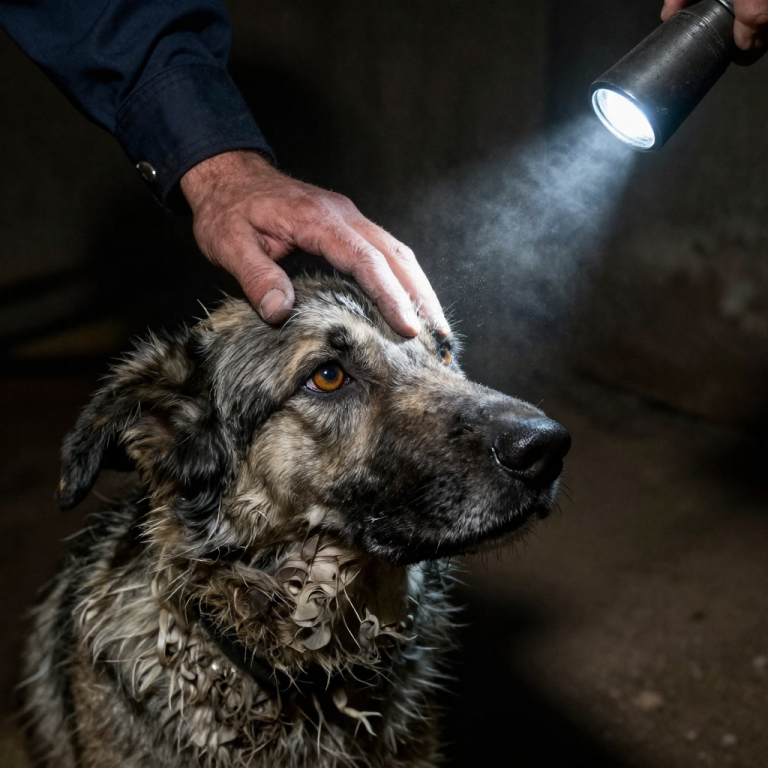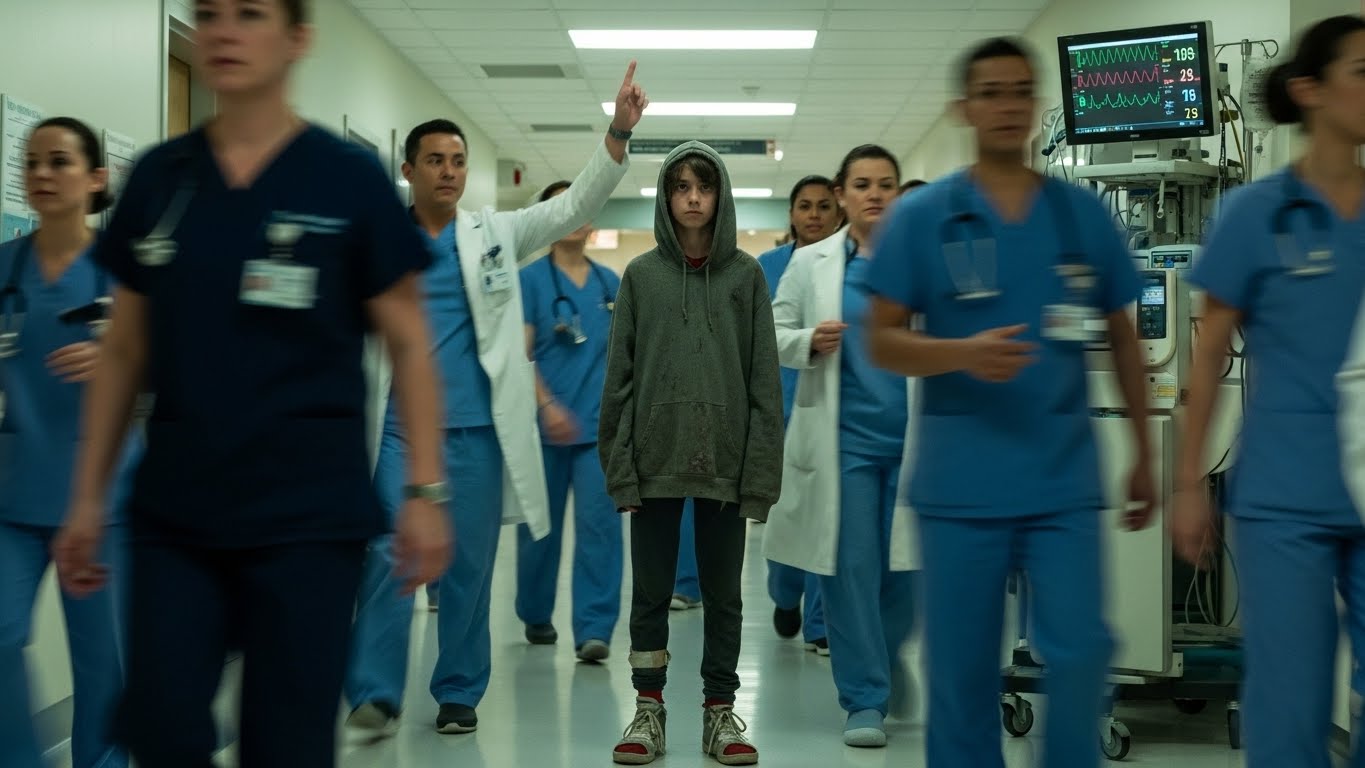
I Was About To Call Security On The Dirty Kid Staring At The Trauma Monitors, But Then He Pointed A Shaking Finger At The Screen And Whispered The One Word That Saved My Daughter’s Life.
Chapter 1: The Invisible Boy
The waiting room of St. Jude’s Memorial smelled like wet wool, rubbing alcohol, and panic. It was a Tuesday night in Chicago, which meant the ER was overflowing with the usual cocktail of bad luck: slip-and-falls from the black ice on Michigan Avenue, flu fevers spiking too high, and the overflow from the darker, desperate corners of the city.
I was three hours past the end of my shift. My feet throbbed in my Nikes, a dull, rhythmic ache that traveled all the way up my shins and settled in my lower back. I should have been home, buried in a glass of cheap Merlot and watching a mindless reality show. Instead, I was pulling a double because two nurses called out sick and the city never stopped bleeding.
“Move it,” I snapped, brushing past a kid standing near the triage desk.
He flinched, shrinking into himself like a stray dog expecting a kick. He couldn’t have been more than twelve. He was wearing a hoodie that was three sizes too big, the charcoal fabric stained with grease, the cuffs frayed into strings that dangled over his dirty fingernails. His sneakers were held together by layers of gray duct tape, wet from the slush outside.
“I said move,” I repeated, sharper this time. I wasn’t usually this mean—I became a nurse to help people, after all—but the noise level in the ER was deafening, a cacophony of coughing and crying babies, and my patience had evaporated six hours ago. “You can’t loiter here. If you aren’t waiting to be seen, you need to get out.”
The boy didn’t look at me. His eyes were glued to the large LCD board mounted on the wall behind the nurses’ station—the central telemetry unit that tracked vitals for the trauma bays.
“I’m just looking,” he whispered. His voice was scratchy, like he hadn’t used it in days.
“Look outside,” I said, pointing to the automatic doors where the Chicago wind was rattling the glass. “This isn’t a library, and it definitely isn’t a shelter. Security does rounds in five minutes. You don’t want to be here when they do.”
He finally looked up. His eyes stopped me cold. They were startlingly clear, a piercing hazel amidst the grime on his face. There was no defiance in them, no teenage attitude. Just a terrifying level of intelligence that looked completely out of place on a kid who looked like he slept under the Wacker Drive bridge.
“Bay 4,” he said softly.
I frowned, adjusting the stethoscope around my neck. “What?”
“Bay 4,” he said again, raising a trembling finger to point at the digital board. “The heart rate is compensating. But the oxygen saturation is lagging by three seconds. It’s not a blockage.”
I blinked, confusing washing over me. “Excuse me?”
“You’re treating him for a blockage,” the boy said, his voice gaining a weird, flat confidence. He sounded less like a child and more like a tired professor. “But the rhythm… look at the interval between the beats. It’s electrical. If you give him the clot-busting drugs, you’re going to kill him.”
My jaw dropped slightly. I looked at the board. Bay 4 was a fifty-year-old male, chest pains, suspected myocardial infarction. Standard protocol was TPA—tissue plasminogen activator. It was a routine “code heart.”
“Get out,” I hissed, a sudden chill running down my spine. It felt unnatural. “Now.”
“He has Wolff-Parkinson-White syndrome,” the boy mumbled, turning back to the screen, his eyes darting across the data streams. “Look at the Delta wave. It’s hiding in the QRS complex.”
“Security!” I yelled, waving down the burly guard near the entrance. “I need this kid escorted out. Now!”
Chapter 2: The Crash
The guard, a man named Marcus who had the build of a linebacker and the patience of a saint, walked over. He looked at the kid, then at me.
“Come on, son,” Marcus said gently, putting a massive hand on the boy’s shoulder. “You know the rules. Unless you’re sick, you can’t be blocking the hallway.”
The boy didn’t resist. He just kept staring at that screen, his eyes darting back and forth like he was reading a book written in invisible ink. “They’re going to kill him,” he said, not to Marcus, not to me, but to the air. “Dr. Evans is going to push the meds and his heart is going to stop.”
I felt a flash of defensive anger. How dare this street kid question Dr. Evans? Evans was the attending tonight, a man with twenty years of experience and an ego the size of the Willis Tower. He didn’t make mistakes.
“Take him,” I said, turning my back on the pathetic scene.
I walked toward the trauma bays, needing to check the inventory on the crash carts. But as I passed the curtain of Bay 4, the air shattered.
BEEP-BEEP-BEEP-BEEP!
“V-Fib!” a nurse screamed from inside. “We’re losing him!”
My stomach dropped. I ran to the curtain. Dr. Evans was sweating, holding the paddles. “Clear!”
Thump. The body on the gurney jerked violently.
“No rhythm,” the tech shouted, staring at the bedside monitor. “Still flatlining.”
“Push 1mg Epinephrine,” Evans barked, his voice tight. “Get the TPA ready. It’s a massive blockage, we need to dissolve it immediately.”
I froze. The kid’s voice echoed in my head. If you give him the clot-busting drugs, you’re going to kill him.
I looked at the monitor strip printing out the history of the last few minutes. I’m not a doctor, I’m a nurse, but I’ve seen thousands of EKGs. I squinted. Right before the crash, there was a tiny, slurred upstroke on the QRS complex.
A Delta wave.
The kid was right. It wasn’t a heart attack. It was an electrical short-circuit in the heart’s wiring.
“Doctor!” I shouted, stepping forward. “Wait on the TPA!”
Evans whipped his head around, his eyes wild. “Get out of my way, Brenda! He’s coding!”
“It’s WPW!” I screamed, realizing how insane I sounded. “It’s not a blockage! If you push TPA, he’ll bleed out before you can stabilize the rhythm!”
Evans hesitated for a fraction of a second. “Don’t be stupid. He’s fifty, he’s overweight, it’s a heart attack.”
“Look at the strip!” I pointed.
Evans ignored me. He turned back to the tech. “Push the TPA. Now!”
The tech moved the syringe to the IV line.
Suddenly, a commotion erupted behind me. I heard a grunt, the squeak of rubber soles, and I turned to see Marcus struggling. The scrawny kid had broken free. He didn’t run for the exit. He ran for us.
He ducked under Marcus’s arm, slid across the polished floor in his duct-taped sneakers, and burst into the trauma bay like a feral cat.
“Don’t!” the boy shrieked, his voice cracking. He lunged, not at the doctor, but at the IV line. He slapped the syringe out of the tech’s hand. It clattered to the floor, shattering instantly.
The room went silent. Dead silent. The only sound was the high-pitched whine of the flatline monitor.
Dr. Evans turned purple. “What the hell is going on? Get this trash out of here! Security!”
The patient on the table was turning blue.
The boy stood there, chest heaving, hands raised in surrender. He looked at Evans, tears streaming down his dirty cheeks. He was trembling so hard his teeth chattered.
“Adenosine,” the boy sobbed. “Give him Adenosine. 6 milligrams. Rapid push. Please. Just look at the screen.”
Evans looked at the boy, then at the shattered vial of TPA on the floor, then at the monitor. We had seconds. Maybe less.
“If you’re wrong,” Evans growled, his voice low and terrifying, “I will personally ensure you spend the rest of your life in juvenile detention.”
Then, the Doctor looked at me. He saw the terror in my eyes. He saw the conviction in the boy’s.
“Adenosine,” Evans whispered to the tech. “Push it.”
Chapter 3: The Book Thief
The next six seconds were the longest of my life.
The tech pushed the Adenosine. The drug essentially stops the heart for a moment to reset the electrical rhythm. The monitor went completely black. A flat line. Silence.
One second. Two seconds. Three.
“Come on,” the boy whispered, his eyes squeezed shut. “Come on.”
Beep.
Then another. Beep.
Then, a steady, rhythmic cadence filled the room. Beep… Beep… Beep.
The patient gasped, his back arching off the table as air rushed back into his lungs. His color shifted from cyanotic blue to a pale pink.
“Sinus rhythm,” the tech breathed, disbelief washing over his face. “He’s back. Stable.”
Dr. Evans slumped against the wall, exhaling a breath he seemed to have been holding for a year. He looked at the patient, then slowly turned his head toward the boy.
The kid didn’t celebrate. He just wiped his nose on his greasy sleeve, looked at Marcus, and held out his wrists. “You can take me now,” he said quietly.
“Not yet,” I said, stepping between Marcus and the boy. My heart was still hammering against my ribs. “Doctor Evans?”
Evans looked at the shattered glass on the floor, then at the boy. “Let him go, Marcus. But bring him to the break room. Don’t let him leave the hospital.”
Ten minutes later, I walked into the staff break room. The boy was sitting at the small round table, staring at a vending machine sandwich I’d bought him. He hadn’t touched it yet.
“Eat,” I said, sitting opposite him. “It’s turkey. It’s not great, but it’s food.”
He hesitated, then unwrapped it slowly, taking a small, polite bite.
“What’s your name?” I asked.
“Toby,” he mumbled, his mouth full.
“Okay, Toby. I’m Brenda.” I leaned forward, resting my elbows on the table. “I need you to tell me the truth. Are you some kind of Doogie Howser genius? Did you go to med school?”
He shook his head, looking down at his taped-up shoes. “No, ma’am.”
“Then how?” I pressed. “How did you know about the Delta wave? Most interns miss that.”
Toby swallowed hard. He reached into his oversized hoodie and pulled out a thick, battered book. The cover was torn, and the spine was held together with the same duct tape that was on his shoes.
I squinted at the title. Harrison’s Principles of Internal Medicine, 19th Edition.
“I found it,” he said softly. “In the dumpster behind the Northwestern medical library. And some others. I just… I read them.”
“You read them?” I asked, incredulous. “That’s a three-thousand-page textbook, Toby. It’s dense. It’s boring.”
He looked up at me, and for the first time, I saw the pain behind those hazel eyes. It was a deep, ancient kind of hurt.
“My mom,” he whispered. “She got sick last year. The doctors… they kept saying they didn’t know what it was. They sent her home with Tylenol. She died three days later.”
My heart broke. “I’m so sorry, Toby.”
“I wanted to know why,” he said, his voice trembling. “I wanted to know what they missed. So I started reading. I read everything I can find. I come here to watch the monitors because… because I want to see if I can spot it before you guys do.”
I sat back, stunned. This kid was a sponge. A traumatized, brilliant sponge soaking up medical data to process his grief.
“Toby,” I said softly, “you saved a man’s life tonight. You know that, right?”
He shrugged, taking another bite of the sandwich. “He had a daughter. I saw her in the waiting room earlier. She was crying. I didn’t want her to be alone.”
I felt a lump form in my throat. I reached for my phone to check the time, planning to call social services—not to report him, but to find him a bed for the night.
But as I touched the screen, my phone lit up.
INCOMING CALL: HOME
My blood ran cold. It was 11:30 PM. My sitter never called this late.
I answered, my hand shaking. “Hello?”
“Brenda? It’s Sarah,” the babysitter’s voice was high-pitched, bordering on hysterical. “You need to get home. Now.”
“What?” I stood up, the chair scraping loud against the linoleum. “What happened?”
“It’s Maya,” Sarah sobbed. “She… she just collapsed. She’s seizing, Brenda. She won’t stop shaking. The ambulance is on the way.”
The phone slipped from my fingers and hit the table with a clatter. My world, which had just righted itself, tilted on its axis.
Maya. My seven-year-old daughter. My life.
I looked at Toby. He was watching me, that eerie, analytical focus back in his eyes.
“She’s sick?” he asked.
I didn’t answer. I grabbed my purse and ran for the door.
I didn’t know it then, but as I sprinted toward the exit, Toby was right behind me.
Chapter 4: The Longest Mile
I don’t remember the drive back to the hospital. I don’t remember parking my beat-up Civic in the staff lot or sprinting through the automatic doors I had walked out of only twenty minutes earlier.
All I remember is the sound of my own breathing, ragged and sharp, tearing at my throat.
When I burst into the ER, it was chaos. But this time, I wasn’t the nurse running the show. I was the mom on the other side of the glass.
“Where is she?” I screamed, grabbing the arm of the triage nurse, a girl named Sarah who I’d trained myself. “Where is Maya?”
“Trauma One,” Sarah said, her face pale. “Dr. Evans is with her. Brenda, she’s… she’s actively seizing.”
I ran. I didn’t scrub in. I didn’t care about protocol. I burst into Trauma One.
My little girl, my seven-year-old Maya with her curly pigtails still messy from sleep, was arching off the gurney. Her small body was vibrating violently, her eyes rolled back into her head showing only the whites. Foam was gathering at the corners of her mouth.
“Push 2mg Ativan!” Evans was shouting. He looked up and saw me. “Brenda, get out! You can’t be in here!”
“That’s my daughter!” I roared, lunging for the bedside. I grabbed Maya’s cold, clammy hand. “Baby, Mommy’s here. Mommy’s here.”
“She’s been seizing for twelve minutes,” the tech said, his voice grim. “Status epilepticus. We can’t break it.”
“Intubate,” Evans ordered. “We need to secure her airway before she aspirates. Get the RSI kit.”
I felt a hand on my back. I spun around, ready to fight security again.
It was Toby.
He had followed me. I didn’t know how—maybe he ran the whole way, maybe he jumped on a bus—but he was there, panting, his oversized hoodie soaked with sweat. He wasn’t looking at me. He was looking at Maya.
“Get him out of here!” Evans yelled, snapping a laryngoscope open. “Brenda, take your street rat and get to the waiting room, or I swear to God I’ll have you fired!”
“Look at her neck,” Toby whispered, pointing a dirty finger at my daughter.
“What?” I choked out.
“Her neck,” Toby said, his voice gaining that weird, detached intensity again. “The muscles. They aren’t rigid. She’s flaccid between the convulsions. It’s not epilepsy.”
“Security!” Evans bellowed.
Two guards rushed in. They grabbed me by the arms. They grabbed Toby by the scruff of his neck.
“No! Maya!” I screamed as they dragged us backward. The last thing I saw before the doors swung shut was Evans sliding the tube down my daughter’s throat, silencing her tiny, choked gasps.
Chapter 5: The Old Ghost
They threw us into the family consultation room—a small, windowless box with beige walls and a box of tissues on the table. It was the room where we delivered bad news. I had sat in that room a hundred times holding the hands of weeping strangers. I never thought I’d be the one sitting in the chair.
I paced the floor, my nails digging into my palms. Toby stood in the corner, hugging his battered medical book to his chest.
“Why is this happening?” I sobbed. “She was fine this morning. She had cereal. She went to school.”
The door opened. Dr. Evans walked in. He looked tired, but more than that, he looked angry. He didn’t sit down.
“She’s on a ventilator,” he said abruptly. “We stopped the seizures with a Propofol drip.”
“Thank God,” I breathed, collapsing into a chair.
“Don’t thank anyone yet,” Evans said, his voice ice cold. He crossed his arms. “We ran a tox screen, Brenda.”
My head snapped up. “A tox screen? Why? She’s seven.”
“Because her pupils are pinpoint,” Evans said. “And her respiratory drive was non-existent before the seizure. Those are classic signs of opioid overdose.”
The room spun. “What?”
“We found this in her backpack,” Evans reached into his pocket and slammed a small orange pill bottle onto the table.
My stomach dropped. It was an old prescription bottle. Oxycodone. My name was on the label. Date: Six years ago.
“I keep that for emergencies!” I stammered, panic rising in my throat. “I had a root canal years ago! I haven’t touched them!”
“The bottle is empty, Brenda,” Evans said, his eyes filled with judgment. “And we know about your history. We know about the rehab stint in 2018.”
“I have been clean for six years!” I screamed, standing up. “I am a nurse in this hospital! I save lives here! You think I fed my daughter Oxy?”
“I think you slipped,” Evans said, his voice lowering to a harsh whisper. “I think you left your stash out, and your kid thought it was candy. I’ve already called CPS. They’re on their way to take custody if she wakes up.”
“If?” I whispered.
“She’s in a coma, Brenda. If it is an overdose, the hypoxia might have already caused brain death.”
I fell back against the wall, sliding down until I hit the floor. I couldn’t breathe. My past—the shadow I had outrun, the ghost I thought I had buried—had come back to destroy me.
“It wasn’t the pills,” a small voice said.
Evans rolled his eyes. “You again. I thought I told security to toss you.”
Toby stepped out of the corner. He walked to the table and picked up the empty pill bottle. He sniffed it.
“There’s dust in here,” Toby said. “If the pills were fresh, or if she just ate them, there wouldn’t be dust caked at the bottom. These pills have been gone for a long time.”
“Shut up,” Evans snapped.
“And her skin,” Toby continued, ignoring him. “Brenda, did you touch her skin?”
I looked up through my tears. “It was… wet. Clammy.”
“Not just clammy,” Toby said. “She was sweating. Profusely. And crying. I saw tears running into her ears. And the foam… that was saliva. Excessive saliva.”
“So?” Evans spat. “She was seizing.”
“Opioids dry you out,” Toby said, looking Evans dead in the eye. “Pinpoint pupils, yes. But dry mouth. Dry skin. Constipation. Maya is leaking fluid from everywhere. Tears, sweat, saliva, and…” He pointed to Evans’s shoes. “She wet herself on the table, didn’t she? I see the spot on your shoe.”
Evans looked down. There was a small damp spot on his expensive loafer.
“SLUDGE,” Toby said.
“What?” I asked.
“It’s an acronym,” Toby said, tapping the cover of his book. “S-L-U-D-G-E. Salivation, Lacrimation, Urination, Defecation, GI upset, Emesis. It’s the mnemonic for Cholinergic Crisis.”
Evans froze.
Chapter 6: The Exterminator
“That’s impossible,” Evans muttered, but his arrogance was wavering. “That’s… that’s nerve gas symptoms. Sarin. VX. We’re in Chicago, not a war zone.”
“Or,” Toby said, his voice trembling slightly, “it’s Organophosphates. Pesticides.”
I gasped. “The landlord…”
Both of them looked at me.
“My apartment building,” I said, the memory flashing like a strobe light. “The landlord sent an exterminator yesterday. For the roaches. He said he was using a ‘heavy duty’ fogger in the basement unit. We live on the first floor.”
“Did Maya play in the basement?” Toby asked urgently.
“No,” I shook my head. “But the vents… the heating vents connect the floors.”
Toby turned to Evans. “She didn’t overdose on Oxy. She’s being poisoned by the air in her own bedroom. Her acetylcholinesterase is inhibited. Her body is drowning in its own neurotransmitters.”
Evans stood there, paralyzed. If he was wrong—if he treated her for an overdose with Narcan—it wouldn’t help. But if he didn’t treat the poisoning…
“Atropine,” Toby said. “You need to give her Atropine. Massive doses. Until her secretions dry up.”
“If you’re wrong,” Evans hissed, “Atropine will accelerate her heart rate and kill her instantly given her stress levels.”
“And if you’re wrong,” I said, standing up and wiping my face, my voice turning into steel, “you’re letting my daughter die because you’re too proud to listen to a homeless kid and a recovering addict.”
I got in Evans’s face. “Smell her hair, Doctor. If it’s pesticides, she’ll smell like garlic or sulfur. Go smell her hair.”
Evans stared at me for a long beat. Then, without a word, he spun on his heel and marched out of the room.
I ran after him. Toby ran after me.
We burst back into Trauma One. The nurses were prepping a Narcan drip.
“Stop!” Evans barked.
He leaned over Maya. He grabbed a lock of her sweaty, matted hair and brought it to his nose. He inhaled deeply.
He flinched back, his nose wrinkling.
“Garlic,” he whispered.
He looked at the monitor. Maya’s heart rate was dropping. 40… 38…
“She’s bradycardic!” the tech yelled. “Heart block!”
“It’s the poison,” Toby screamed from the doorway. “It’s stopping her heart!”
Evans didn’t hesitate this time. “Dump the Narcan! Get me Atropine! 2 milligrams IV push! Repeat every 5 minutes until her chest clears! Get the Pralidoxime ready! Move!”
The team scrambled. I stood at the foot of the bed, holding Toby’s hand so tight I thought I’d break his fingers.
“Please,” I whispered. “Please.”
They pushed the drug. We watched the monitor.
Nothing happened.
“Heart rate 30,” the tech said. “She’s not responding.”
“Give her more!” Toby yelled. “The book says you have to double the dose! It’s resistant!”
Evans looked at the kid. Then he looked at the vial. “Give her 4 milligrams.”
“Doctor, that’s a lethal dose for a child!” the nurse protested.
“DO IT!” Evans roared.
Chapter 7: The Breath of Life
The nurse jammed the plunger down. The clear liquid disappeared into Maya’s IV line.
The room held its collective breath. The only sound was the jagged, irregular beep… beep… of the monitor, sounding like a countdown to the end of my world.
“Come on, baby,” I whispered, squeezing her hand so hard my knuckles turned white. “Fight.”
Ten seconds. Nothing. Twenty seconds. The heart rate dipped lower. 28.
“It’s not working,” the nurse cried out. “She’s flatlining!”
“Wait,” Toby said. He wasn’t looking at the monitor. He was looking at Maya’s chest. “Look at the rise and fall. It’s changing.”
Suddenly, the monitor screeched—not the flatline tone, but a rapid, high-pitched alarm.
Beep-beep-beep-beep-beep!
“Heart rate spiking!” the tech shouted. “120… 140… 160!”
“Tachycardia,” Evans said, his eyes glued to the screen. “It’s the Atropine. It’s kicking the receptors open.”
He grabbed his stethoscope and pressed it against Maya’s small chest, listening intently over the chaos of the alarms. He moved the disc from her left lung to her right, his face a mask of concentration.
Then, for the first time in an hour, his shoulders dropped.
“The rales are clearing,” Evans breathed. “Her lungs are drying out. Air entry is improving.”
On the bed, Maya’s back arched. Her eyes fluttered open—not rolled back, but looking. Really looking. She took a massive, gasping breath, like a diver breaking the surface of the water.
“Mommy?” she croaked. Her voice was raspy, dry as sand.
I collapsed onto the mattress, burying my face in her neck, sobbing uncontrollably. The smell of garlic was fading, replaced by the sterile scent of the hospital and the sweet, undeniable smell of my daughter.
“I’m here, baby. I’m right here,” I cried.
Dr. Evans stepped back, wiping sweat from his forehead with the back of his hand. He looked at the empty vial of Atropine. He looked at the team of nurses who were now stabilizing the drip.
Then, he turned slowly to the corner of the room.
Toby was sliding down the wall, his legs finally giving out. He hugged his taped-up medical book to his chest, his eyes wide, watching Maya breathe.
Evans walked over to him. The arrogant, untouchable attending physician knelt down on the dirty linoleum floor until he was eye-level with the street kid.
“I was going to push Narcan,” Evans said quietly. “If I had done that, she would be dead right now.”
Toby didn’t say anything. He just picked at the fraying cuff of his hoodie.
“Where did you learn about the SLUDGE mnemonic?” Evans asked. “Really.”
“Page 2,415,” Toby whispered. “Chapter on Environmental Toxins.”
Evans nodded slowly. He reached into his white coat pocket and pulled out his own stethoscope—a Litmann Cardiology IV, the kind that costs three hundred dollars. He placed it gently on top of Toby’s battered book.
“Good consult, Doctor,” Evans said.
Chapter 8: The Resident
Two weeks later, the snow had turned to gray slush, but the sun was finally shining over Chicago.
I signed the last form on the clipboard and handed it back to the caseworker. She smiled, a genuine, warm smile that reached her eyes.
“Everything looks to be in order, Brenda,” she said. “The background check cleared. Your employment status is verified. And Dr. Evans wrote a… very compelling letter of recommendation.”
I looked over at the waiting room chairs. Maya was there, coloring in a coloring book, looking almost completely back to normal, though she still tired easily.
Sitting next to her was Toby.
He wasn’t wearing the dirty gray hoodie anymore. He was wearing a new navy blue sweater and jeans that actually fit, without duct tape on the shoes. He was reading to her, pointing at pictures in a book—not a medical text this time, but Harry Potter.
“Are you sure you’re ready for this?” the caseworker asked softly. “Taking in a foster child is a lot of work. Especially one with his… history.”
“His history?” I looked at the boy who had saved my daughter’s life when the experts couldn’t. “His history is that he survived. Just like us.”
I walked over to them. Toby looked up, that old wariness still lingering in the corners of his hazel eyes, waiting for the other shoe to drop. Waiting for me to tell him it was time to go back to the shelter.
“Pack it up,” I said, grabbing my purse.
Toby froze. “Where are we going? The shelter doesn’t open until five.”
“We aren’t going to the shelter, Toby,” I said, reaching out a hand.
He stared at my hand. Then he looked at Maya.
“Mom bought bunk beds!” Maya chirped, grabbing Toby’s arm. “You get the top one because you’re tall. And Dr. Evans said you have to help me with my science homework because you’re a genius.”
Toby stood up slowly. “Bunk beds?”
“And a desk,” I added. “For your books. I think we’re going to need a bigger bookshelf.”
Toby’s chin trembled. He looked at the automatic doors, then back at me. For the first time since I met him, he looked like a twelve-year-old boy, not a miniature adult carrying the weight of the world.
“I don’t have any money for rent,” he whispered.
“I know a guy,” I smiled, fighting back tears. “He thinks you might make a pretty good doctor one day. He says you can pay us back when you’re Chief of Medicine.”
Toby took my hand. His grip was strong. Warm.
We walked out of the hospital doors, not into the cold night, but into the bright, blinding afternoon.
I had almost lost everything that night. My job, my reputation, my daughter. But because of a boy the world wanted to throw away, I didn’t just get my life back.
I got a son.
And somewhere, in a dumpster behind a library, there’s an empty space where a medical textbook used to be—proof that sometimes, the things we throw away are the very things that save us.
Do you think our system overlooks brilliance just because of how someone looks or where they come from?
Read More Stories I Wrote With This Link : https://de.ps3jp60s.com/hcm1