Everyone Watched the Mother Scream at Her Toddler, But When a Scarred Veteran Dropped His Cane, The Whole Park Held Its Breath.
Chapter 1: The Enemy in the Playground
The sound wasn’t a firecracker. It was the sharp, sickening crack of a palm striking a small, soft cheek.
Then came the silence.
It rippled through Oak Creek Park instantly, freezing the Saturday afternoon chaos. The squeak of swing sets stopped. The chatter of parents holding iced lattes died in their throats. Even the birds seemed to hold their breath.
Arthur Vance sat on his usual bench under the elm tree, a folded newspaper on his knee that he hadn’t read in an hour. At seventy-two, with a stiff left leg from Vietnam and a scar that ran from his jaw to his earlobe, Arthur was used to people avoiding his gaze. He was the ghost of the neighborhood—the old man who trimmed his hedges with military precision and never waved back.
But today, Arthur wasn’t looking at the hedges. He was looking at a woman in pink yoga pants standing over a crumpled heap on the pavement near the sandbox.
“Get up!” the woman screeched. Her voice was like grinding glass, tearing through the humid air. “You are absolutely useless! Look at you! You spilled it all over yourself!”
The “heap” was a little girl. Maybe three years old. She was wearing a dress with cartoon strawberries on it, now stained dark with grape juice. She wasn’t crying. That was the part that made Arthur’s stomach twist into a knot he hadn’t felt since the siege of Khe Sanh.
She wasn’t crying because she was too terrified to breathe. She lay curled in a ball, her tiny hands covering her head, waiting for the next strike.
“I bought you that dress five minutes ago!” The mother grabbed the child by her upper arm, yanking her off the ground with enough force to pop a shoulder socket. The little girl dangled like a ragdoll, feet scrambling for purchase. “I should have left you with your dad. He was right. You’re just a burden. A useless, clumsy little mistake!”
The park was full of adults. Big, strong fathers pushing strollers. Mothers chatting in groups. Teenagers skateboarding.
No one moved.
They all looked down at their phones, or turned their strollers away, terrified of getting involved in a “domestic situation.” The bystander effect was a heavy, suffocating blanket over the playground.
Arthur watched the mother raise her hand again.
The tremor in Arthur’s hands—the Parkinson’s he hid from his doctor—stopped instantly. The fog that had clouded his brain since his wife, Martha, died three years ago evaporated.
He didn’t see a mother disciplining a child. He saw a threat.
He stood up. His cane, usually his crutch, became a baton in his grip. He didn’t walk; he marched. The limp was gone.
Chapter 2: The Wall of Iron
Brenda felt the heat of eyes on her, but she didn’t care. The stress of the eviction notice in her glove box and the heat of the sun had snapped something inside her. She needed to hit something, and Mia was right there.
“Stop crying!” she hissed, though Mia was silent. She raised her hand to slap the child’s leg.
A shadow fell over her. A shadow so large it blocked out the sun.
“Ma’am,” a voice rumbled. It wasn’t loud. It sounded like gravel crunching under a tank tread. Low. Vibrating. Dangerous. “I suggest you let go of that officer.”
Brenda froze. She spun around, ready to scream at some nosey soccer mom.
Instead, she found herself looking up—way up—into the chest of a man who looked like he was carved out of granite and regret. Arthur Vance stood six-foot-two, wearing a faded button-down tucked perfectly into trousers. His eyes were the color of steel, and they were drilling a hole straight through her skull.
“Excuse me?” Brenda stepped back, dragging Mia with her. “This is my daughter. Mind your own business, old man.”
“I said,” Arthur took one step forward. The crowd that had been pretending not to look was now forming a circle, phones raised, recording. “Let go of the child.”
“She spilled juice on a forty-dollar dress!” Brenda yelled, her voice cracking as she tried to regain dominance. “I’m disciplining her! It’s my right!”
Arthur looked at the little girl. Mia was staring at his scar. She looked at his scary face, then at her mother’s pretty face. And then, she reached her free hand toward the scary man.
That small gesture broke Arthur’s heart wide open.
“Discipline is teaching,” Arthur said, his voice rising just enough to carry across the silent park. “Abuse is breaking. You aren’t teaching her anything, except that the person who is supposed to love her is the enemy.”
“You don’t know me! You don’t know what I go through!” Brenda shrieked, looking around for support from the crowd. “He’s threatening me! Someone call the cops!”
“They’re already on their way,” Arthur said calmly.
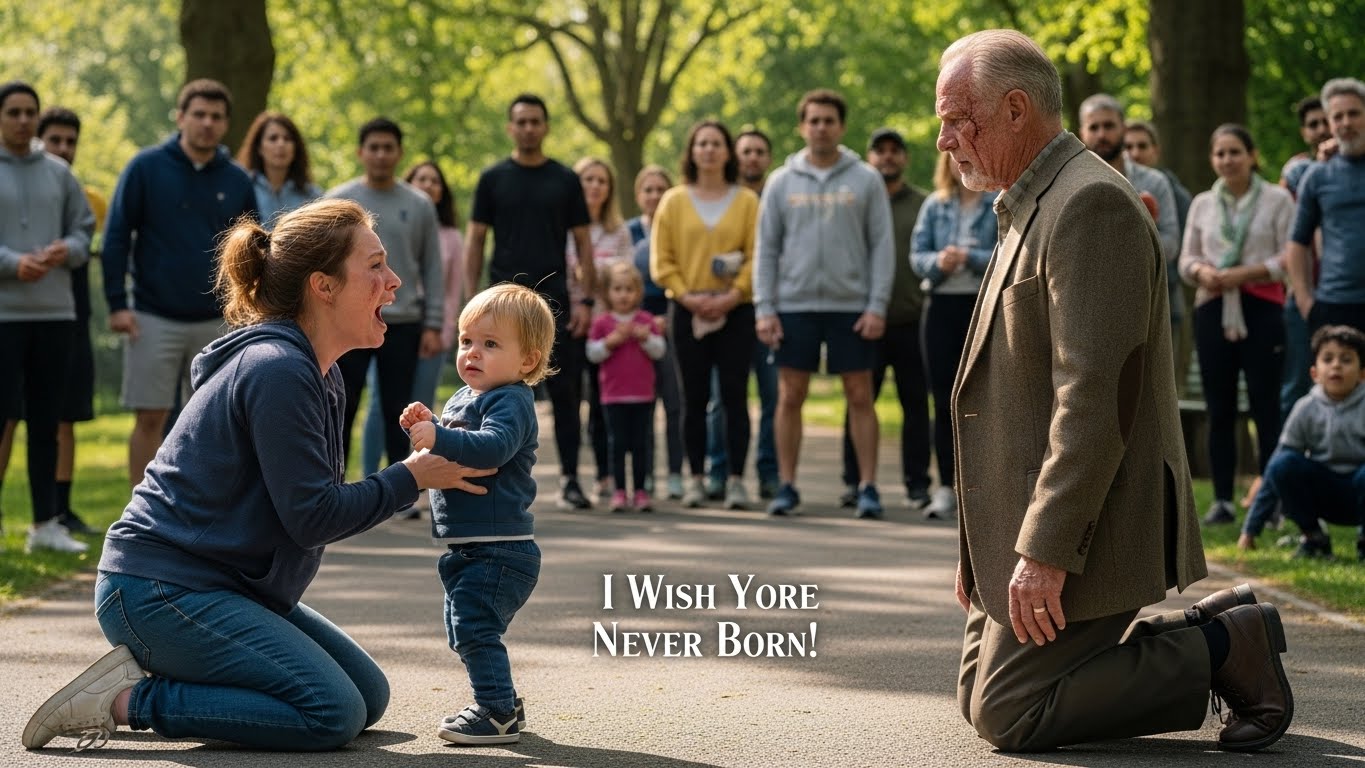
He dropped his cane. It clattered loudly on the concrete.
Disregarding his bad knee, the retired General knelt on the hard pavement. He was now eye-level with Mia. He didn’t look at the mother anymore. He treated her like she had ceased to exist.
“Hi,” Arthur whispered, his voice softening into something unrecognizable. “My name is Art. That’s a nice strawberry dress.”
Brenda stood there, hand raised, trembling. She realized she had lost the room. She realized the camera phones were capturing her face, her rage, her failure.
“Let go of her arm,” Arthur said to the air, not looking up. “Or I will break yours. And that is a promise, not a threat.”
Brenda’s fingers sprang open.
Mia stumbled forward. She didn’t run away. She didn’t run to her mom. She fell forward into the chest of the old stranger.
Arthur wrapped his large, calloused arms around the tiny frame. She smelled like grape juice and baby shampoo. She was shaking so hard his own bones rattled.
“I got you,” Arthur whispered into her hair, closing his eyes as a single tear tracked through the scar on his cheek. “You’re safe. You aren’t useless. You’re the mission.”
“Get away from him, Mia!” Brenda lunged forward, panic setting in as she realized she was losing control of her possession.
Arthur looked up. The look on his face stopped Brenda dead in her tracks. It was the look of a man who had walked through hell and was perfectly willing to send someone else there.
Then, the wail of sirens cut through the air.
Chapter 3: The System’s Cold Grip
The police cruiser skidded to a halt against the curb, lights flashing red and blue, painting the terrified faces of the crowd in alternating shades of violence.
Two officers stepped out. One was young, rookie-fresh with a buzzcut. The other was older, heavy-set, with a mustache that had seen too many domestic disputes—Officer Miller.
“He kidnapped my daughter!” Brenda screamed instantly, her demeanor shifting from aggressor to victim in a split second. She pointed a shaking finger at Arthur. “That crazy old man! He attacked me and grabbed Mia! Look, he’s holding her hostage!”
Brenda’s performance was Oscar-worthy. She squeezed out tears, her voice trembling with manufactured hysteria. “Please, Officer! He’s dangerous! Look at his face!”
Arthur didn’t move. He remained kneeling on the concrete, his bad knee screaming in protest, but he refused to break the protective circle he had formed around Mia. The little girl had buried her face in the crook of his neck, her tiny fingers clutching the collar of his shirt so tightly her knuckles were white.
Officer Miller walked up, hand resting cautiously on his holster. He looked at the screaming woman, then down at the old man.
Miller paused. He recognized the posture. The straight back. The calm amidst chaos.
“Sir,” Miller said, his voice firm but respectful. “I need you to release the child.”
“She’s terrified, Officer,” Arthur said. His voice was steady, a stark contrast to Brenda’s shrieking. “The mother was striking her. Closed fist. Multiple witnesses.”
Arthur nodded his chin toward the crowd of bystanders holding phones. “Check the tapes.”
“He’s lying!” Brenda lunged forward, trying to grab Mia’s leg.
Arthur shifted his body, putting his wide back between Brenda and the girl. “Don’t touch her.”
“Back up, Ma’am!” Miller barked, stepping between them. “Sit on the curb. Now!”
He turned back to Arthur. “Sir, I appreciate the help. But you have to let go. We have protocol. We can’t let a stranger hold a minor.”
Arthur looked down at Mia. She felt it—the tension shifting. She pulled back slightly to look at him, her big brown eyes swimming with a fear that crushed Arthur’s soul.
“Don’t go,” she whispered. It was the first time she had spoken. Her voice was raspy, broken.
“I have to, little one,” Arthur whispered back, his throat tight. “But these are the good guys. They’re going to help.”
“No,” she whimpered, clinging tighter.
“Sir,” Miller’s voice hardened. “Do not make me ask again.”
Arthur slowly unpeeled Mia’s fingers from his shirt. It felt like tearing off his own skin. “Go to the officer, Mia. Be brave. Soldiers are brave, remember?”
As Officer Miller lifted Mia into his arms, the dam broke.
Mia didn’t just cry. She screamed.
It was a primal, gut-wrenching shriek of abandonment. She reached out for Arthur, her legs kicking, her arms stretching toward the only safety she had known all day.
“ART! ARRRTT!” she wailed.
Arthur stood up, his knee buckling slightly. He reached for his cane, his hands shaking again. He watched as they carried her toward the ambulance that had just arrived. Brenda was being questioned by the rookie, but she was already smoothing her hair, her eyes darting around, calculating her next lie.
Arthur knew that look. He had seen it in politicians and warlords. She wasn’t sorry. She was just sorry she got caught.
Officer Miller walked back over to Arthur after handing Mia to the EMTs. “I need your ID, sir. And a statement.”
Arthur handed over his driver’s license. Miller looked at it, then at the veteran identifier, then back at the scar.
“General Vance?” Miller’s eyebrows shot up. “I… I didn’t know you lived in the district.”
“Retired,” Arthur grunted. “Is she going to be okay?”
Miller sighed, lowering his voice. “CPS will be called. But… look, General. Without physical marks—bruises, blood—it’s her word against yours until we see those videos. And she’s the mother. The system… it leans toward the mother. Usually, they cool off and go home.”
“She called the child a ‘mistake’,” Arthur said, his voice dropping to a dangerous growl. “She was going to break that girl’s arm.”
“I believe you,” Miller said, looking tired. “But unless CPS finds immediate danger, she goes home with mom tonight. Maybe with a warning. That’s the law.”
Arthur watched the ambulance doors close. The scream had stopped, replaced by the muffled silence of separation.
He looked at Brenda, who was now crying softly to the rookie cop, playing the role of the stressed, overwhelmed mother perfectly.
Arthur realized then that the war wasn’t over. He hadn’t saved Mia. He had just bought her a ceasefire.
“The law is wrong,” Arthur said, turning to pick up his newspaper. “And I don’t lose wars, son.”
He turned and walked away, the limp returning, but his mind was racing. He had a new mission. And Arthur Vance never abandoned a mission.
Chapter 4: The War Room
Arthur’s house was a time capsule of a happier life, preserved in amber and dust.
He sat in his leather armchair, the one with the cracked armrest where his German Shepherd used to chew, and stared at the silent phone on the side table. The house was too quiet. It had been too quiet for three years, ever since Martha’s lungs gave out, but tonight the silence felt heavy. It felt like an accusation.
He poured himself a glass of whiskey—cheap stuff, the kind that burned on the way down—and looked at the framed photo on the mantle. Martha, smiling in her garden, holding a bouquet of hydrangeas. And next to it, a smaller frame, facedown.
Arthur reached out with a trembling hand and flipped it up.
A little girl. Seven years old. Pigtails. Missing front tooth.
Sarah.
She would have been forty now. If the leukemia hadn’t taken her in ’85. If he hadn’t been deployed when she got sick. If, if, if. The ghosts of his past were always loudest at night.
He took a sip of whiskey, the burn settling in his chest. Today, in the park, when that little girl—Mia—had reached for him, it wasn’t just a child reaching for help. It was Sarah. It was every innocent thing he had failed to protect in a life defined by violence.
“I can’t let this one go, Martha,” he whispered to the empty room. “I can’t just watch.”
He didn’t go to bed. Instead, Arthur went to his study. He opened a locked drawer in his mahogany desk and pulled out a notebook and an old Rolodex. He might be retired, and his legs might be shot, but Arthur Vance still knew people. You don’t spend thirty years in military intelligence without making friends in low places.
He dialed a number. It was late, but the man on the other end never slept.
“Sulley,” Arthur said, his voice dropping into that command cadence he hadn’t used in a decade. “I need a run on a plate. And a name. Brenda Miller. Local. I need to know everything. Debts, boyfriends, priors. Especially the priors.”
“General?” The voice on the other end was raspy, surprised. “I thought you were dead.”
“Not yet,” Arthur said. “And I’m on a clock.”
By 4:00 AM, the fax machine in the corner—an ancient relic Arthur refused to replace—whirred to life.
Arthur read the report under the harsh light of his desk lamp. It was a dossier of disaster. Brenda wasn’t just a stressed mom. She was a woman drowning. Two DUIs. Eviction notices from three different apartments in five years. A restraining order filed against her by her own mother.
And the kicker: The father, a man named David, had filed for custody six months ago. But Brenda had vanished with the kid. She was running.
Arthur looked at the address listed on her most recent utility bill. It was a duplex on the south side of town, near the railyards. A place where the streetlights were broken and the cops didn’t hurry.
Arthur stood up. His knee popped, a sharp reminder of his age. He walked to the hall closet and pulled out his old field jacket. He put the whiskey away.
He wasn’t a vigilante. He was a soldier conducting recon. And he knew that in a war, the most dangerous time wasn’t the battle—it was the night before.
Chapter 5: The Silent Scream
Two days passed. Arthur spent them in the shadow of a gray sedan he had rented to avoid being recognized.
He parked three houses down from the peeling beige duplex where Brenda lived. He watched. He waited. He took notes.
He saw the pattern, and it was more chilling than the slap in the park.
Violence is loud. Neglect is silent.
He watched Brenda leave at 8:00 AM for her shift at a diner, dragging Mia by the wrist to a daycare that looked more like a holding cell. He watched them come home at 6:00 PM.
He saw the boyfriends. One night it was a guy in a truck with a loud muffler. The next night, a different guy in a suit who didn’t stay long.
But what broke Arthur was the grocery store.
On Tuesday afternoon, he followed them to the Super-Mart. He pushed his cart two aisles behind them, feigning interest in canned peaches.
“Can I have the cereal? The one with the tiger?” Mia asked. Her voice was small, tentative.
“No,” Brenda snapped, scrolling on her phone. She threw a box of generic bran flakes into the cart. “Too expensive.”
In the next aisle, Arthur watched Brenda throw three bottles of wine and a carton of cigarettes into the basket. The total cost was fifty dollars. The tiger cereal was four dollars.
Mia didn’t cry. She just held onto the side of the cart, her eyes dull. She had learned the lesson of the survivor: Don’t ask. Don’t want. Don’t exist.
Arthur gripped the handle of his cart so hard the plastic cracked. He wanted to walk over there, pay for the cereal, and tell Brenda exactly what he thought of her budget. But he knew—he knew—that would only make it worse for Mia behind closed doors. An humiliated enemy is a dangerous enemy.
He had to be smart. He had to build a case.
He drove home that night feeling heavier than he ever had carrying a rucksack. He called Officer Miller again.
“I saw them,” Arthur said into the phone, skipping the pleasantries. “She’s neglecting the kid, Miller. Malnutrition. Verbal abuse. I’m tracking it.”
“Arthur,” Miller sighed. “You’re stalking her? You can’t do that. If she spots you, she gets a restraining order, and then you can’t help the girl at all. You have to let CPS handle it. They have a visit scheduled for Friday.”
“Friday is three days away,” Arthur growled. “A lot can happen in three days.”
“It’s the system, Art. It’s broken, but it’s all we got. Stay away from the house.”
Arthur hung up. He looked at the empty photo frame of Sarah.
“The system didn’t save you,” he whispered.
He didn’t stay away.
Chapter 6: The Glass Wall
Friday night brought a thunderstorm. The kind of summer storm that turns the suburban streets into rivers and makes the power lines hum with menace.
Arthur was parked in his spot, windshield wipers fighting the deluge. It was 9:00 PM.
The lights in the duplex were on.
A black Camaro pulled into the driveway. A man got out—tall, muscular, wearing a tight t-shirt. He ran to the porch.
The door opened. Brenda stepped out. She was dressed up—tight red dress, heels, hair done. She laughed, a sound that carried over the rain, and jumped into the man’s arms. They kissed, messy and long.
Then, they ran to the car.
Arthur sat up straighter. Where is the kid?
He waited for the babysitter to arrive. He watched the taillights of the Camaro fade down the street.
Five minutes.
Ten minutes.
No other car came. No teenager on a bike. No grandma.
The house sat dark, except for the flickering blue light of a television in the front window.
“No,” Arthur breathed. “You didn’t.”
He waited another ten minutes, his heart hammering a frantic rhythm against his ribs. She wouldn’t leave a three-year-old alone. Not even she is that broken.
But the house remained silent. The storm raged outside.
Arthur opened his car door. The rain soaked him instantly, plastering his white hair to his skull. He didn’t grab his cane. Adrenaline was a hell of a drug; he moved across the street with the fluidity of a man half his age.
He crept up to the front porch of the duplex. He could hear the TV inside. Cartoons.
He moved to the window. The blinds were drawn, but one slat was broken.
Arthur put his eye to the gap.
His breath fogged the glass.
Mia was there.
She was sitting on the floor in the middle of the living room. The TV was blaring, casting frantic shadows on the walls. She was holding a box of crackers, trying to open the plastic bag with her teeth. She couldn’t do it.
She looked around the empty room. “Mama?” she called out.
Arthur could hear her through the thin glass.
“Mama?”
She stood up and walked to the kitchen. Arthur shifted his position to the kitchen window.
What he saw stopped his heart.
Mia had pulled a chair over to the counter. She was climbing up. On the counter sat a knife block and an open bottle of pills Brenda had left out. But Mia wasn’t reaching for those.
She was reaching for the microwave. She was trying to reach a cup of noodles sitting on top of it.
The chair wobbled.
“Don’t do it, honey,” Arthur whispered, pressing his hand against the cold glass. “Get down.”
Mia stretched. Her tiny toes gripped the edge of the chair.
The chair slid on the linoleum.
It happened in slow motion. Mia fell backward. Her head struck the edge of the counter with a sickening thud before she hit the floor.
She didn’t move.
Arthur didn’t think. He didn’t weigh the legal consequences. He didn’t think about prison or restraining orders.
He pulled back his elbow and drove it through the window pane.
Glass shattered, exploding inward like diamonds. The alarm system didn’t go off—Brenda hadn’t paid that bill either.
Arthur reached through the jagged hole, unlocked the latch, and shoved the sash up. He vaulted over the sill, landing in the kitchen with a grunt of pain as his bad knee hit the floor.
He scrambled to the little girl.
“Mia!”
She was unconscious. A small trickle of blood was matting her hair near her temple.
Arthur scooped her up. She was so light. Too light.
“I’ve got you,” he growled, his voice shaking with a rage that could burn the world down. “I’ve got you, soldier. Stay with me.”
He turned to the front door, kicking it open.
He wasn’t waiting for the ambulance. He wasn’t waiting for the cops.
He ran into the rain, shielding her body with his own, his war finally finding its purpose.
But as he reached his car, headlights blinded him.
The Camaro was back. Brenda had forgotten her wallet.
The car screeched to a halt, blocking Arthur in. Brenda jumped out, seeing the broken window, the blood, and the old man holding her daughter.
“You!” she screamed, her face twisting into a demonic mask. “You kidnapped her! HELPPPP! HE’S STEALING MY BABY!”
The boyfriend stepped out of the driver’s seat. He was big. He had a tire iron in his hand.
Arthur looked at the boyfriend. Then he looked down at the bleeding, unconscious child in his arms.
He gently placed Mia in the passenger seat of his car and locked the door.
Then, Arthur Vance turned around to face the two of them. He didn’t have a weapon. He didn’t have his cane.
But he smiled. A cold, terrifying smile.
“Come on then,” Arthur said. “Let’s finish this.”
Chapter 7: Old Dog, New War
The rain was torrential now, washing over the driveway like a biblical flood.
The boyfriend—Kyle, according to the dossier—stepped forward, swinging the tire iron lazily. He saw an old man. He saw gray hair and a bad leg. He saw an easy target.
“You’re dead, old man,” Kyle spat, stepping into the light of the streetlamp. “Give me the keys.”
Arthur stood his ground. The pain in his knee was a white-hot spike, but his mind was crystal clear. It was a clarity he hadn’t felt since the jungle. The world slowed down. He noted the way Kyle held the iron—too loose, too arrogant. He noted the slick pavement. He noted Brenda screaming in the background, her voice a shrill siren of chaos.
“Walk away, son,” Arthur said. His voice wasn’t loud, but it cut through the storm. “You don’t want to do this.”
“Shut up!” Kyle lunged.
He swung the iron in a wide, clumsy arc aimed at Arthur’s head.
It was a fatal mistake. You don’t swing wide against a man trained in close-quarters combat.
Arthur didn’t back up. He stepped in.
He took the blow on his left forearm—a sickening crack echoed as his ulna fractured—but he didn’t flinch. He used the momentum, trapping Kyle’s arm with his good hand and driving his right shoulder into the younger man’s chest.
It wasn’t a brawl. It was geometry.
Arthur twisted. Kyle’s feet slipped on the wet asphalt.
With a grunt of exertion that tore at his old muscles, Arthur swept Kyle’s leg. The big man went down hard, face-first onto the concrete. The tire iron skittered away into the darkness.
Before Kyle could scramble up, Arthur was on him. He pressed his knee—the bad one—into the center of Kyle’s spine, pinning him to the ground.
Arthur panted, the adrenaline fading, replaced by the screaming agony in his broken arm. Rain mixed with the blood dripping from his nose.
“Get off him!” Brenda shrieked, clawing at Arthur’s jacket. “You crazy psycho!”
“Stay down!” Arthur roared at her, a command so full of authority that Brenda actually stumbled back, tripping over her own high heels.
“Police! Drop it! Get on the ground!”
The shout came from the street. Blue lights flooded the driveway. Officer Miller was running toward them, gun drawn, with two other cruisers screeching to a halt behind him.
Miller saw the scene: The shattered window. The bleeding veteran pinning a thug. The hysterical mother. And the child locked in the car.
“It’s okay, Miller,” Arthur wheezed, raising his good hand slowly. “I secured the hostile. The girl… she’s in the car. Head trauma. She needs a medic. Now.”
Miller Holstered his weapon and rushed to the car. He shone his flashlight through the window. He saw Mia, slumped in the passenger seat, unconscious.
He looked back at Brenda, who was now trying to hide the pill bottle she had grabbed from her purse.
“Cuff them both,” Miller barked to the rookies. “Get the paramedics!”
Arthur tried to stand up, but his world tilted sideways. The pain, the shock, and the exhaustion finally collected their debt. He collapsed onto the wet driveway, looking up at the rain.
As the darkness took him, the last thing he heard was the click of handcuffs on Brenda’s wrists.
Chapter 8: The Guardian
The beeping of the monitor was steady. Rhythmic. Reassuring.
Arthur opened his eyes. The hospital room was bright. His left arm was in a heavy cast, and his chest felt like it had been kicked by a mule.
“You’re awake,” a voice said.
Arthur turned his head. Officer Miller was sitting in the chair next to the bed, holding a cup of lukewarm coffee.
“Mia?” Arthur croaked. His throat was like sandpaper.
“She’s okay,” Miller smiled, a genuine, tired smile. “Mild concussion. Four stitches. They found… other things, Art. Malnutrition. Old fractures that healed wrong. The doctors documented everything.”
Arthur closed his eyes, exhaling a breath he felt like he’d been holding for forty years. “And the mother?”
“In custody,” Miller said grimly. “Child endangerment, assault, possession. And thanks to your… aggressive entry… we found enough drug paraphernalia in that house to put her away for a long time. She lost custody an hour ago.”
“Good,” Arthur whispered. “So… foster care?”
“No.”
The door opened.
A man walked in. He was in his thirties, wearing a wrinkled suit that looked like he had slept in it. He looked exhausted, terrified, and hopeful all at once.
“General Vance?” the man said, his voice trembling.
“This is David,” Miller explained, standing up. “Mia’s father. We tracked him down in Chicago. He drove all night.”
David walked to the bedside. He looked at the old man—the scarred face, the broken body, the cast. Tears welled up in his eyes.
“Officer Miller told me what you did,” David said, his voice cracking. “He told me you watched over her. He told me you took a tire iron for her.”
Arthur tried to sit up, wincing. “She’s a good kid. She likes strawberry dresses.”
David broke down. He grabbed Arthur’s good hand and squeezed it, burying his face in the bedsheet. “Thank you. Thank you for saving my baby. I tried to find her… I didn’t know… thank you.”
“Go to her,” Arthur said gently. “She needs her dad.”
Two weeks later.
The sun was shining on Oak Creek Park. The leaves were turning gold.
Arthur sat on his bench. His arm was in a sling, and he had a new cane. The scar on his face seemed less angry in the autumn light.
He wasn’t reading the newspaper. He was watching the playground.
A car pulled up. David got out, holding the hand of a little girl.
Mia was wearing a blue coat and sturdy shoes. Her hair was brushed into neat pigtails. She looked different. Heavier. Brighter.
She saw the man on the bench.
She let go of her father’s hand and ran.
She didn’t run with fear. She ran with joy.
“ART!” she yelled.
She slammed into his good leg, wrapping her arms around his knee. Arthur chuckled, the sound rusty but warm. He reached down with his good hand and patted her head.
“Hello, soldier,” he whispered.
“Daddy says we’re moving,” Mia said, looking up at him with those big brown eyes. “But I wanted to say bye-bye.”
“You be good, okay?” Arthur said, his voice thick. “You be brave.”
“I will,” she nodded solemnly. Then she reached into her pocket and pulled out something.
It was a plastic medal. Gold painted, with a red ribbon. Something from a gumball machine.
“For you,” she said, placing it in his large, calloused palm. “Because you’re the hero.”
She kissed his cheek, right over the scar, and ran back to her father. David waved, mouthing a silent thank you, and they walked away, hand in hand, into a future that Arthur had bought for them with his blood.
Arthur looked down at the plastic medal. It glinted in the sun, brighter than the Purple Heart sitting in his drawer at home.
He took a deep breath. The air smelled crisp and clean.
For the first time since Vietnam, for the first time since Sarah died, the war inside his head was silent.
Arthur Vance leaned back on the bench and closed his eyes. He wasn’t a ghost anymore. He was just a man who had completed his final mission.
And it was a complete success.