He Defended Me From His Own Brother, But The War He Brought Home Was More Dangerous Than The Bullies.
Chapter 1: The Armor of Grey Wool
The morning sun in suburban Ohio doesn’t forgive anyone. It highlights the cracks in the pavement, the dust on the mailboxes, and, if you’re me, the hollow feeling in your stomach that starts the moment you open your eyes.
My alarm blared at 6:00 AM—a generic, electronic pulse that signaled the beginning of another twelve-hour shift of hiding. I didn’t get out of bed immediately. I lay there, staring at the ceiling fan cutting through the stagnant air, counting the rotations. One, two, three. If I counted to a hundred, maybe the day would disappear. Maybe I would disappear.
But the day never disappeared.
I swung my legs out of bed and walked to the bathroom mirror. This was the hardest part of the day. The ritual. I avoided my reflection as I reached for the wide-toothed comb. I didn’t need to look to know what was happening. I could feel it—the smoothness of the patches on my scalp, the way the remaining hair felt brittle, like dead grass in a drought. Alopecia Areata. The doctors said it was stress, or genetics, or just bad luck. I called it my body rejecting itself.
I carefully placed the oversized gray beanie over my head. It was thick, wool, and completely inappropriate for the late May heat wave that had settled over Northwood like a wet blanket. But it was my armor. Without it, I was just the sick girl, the freak, the chemo patient (even though I wasn’t). With it, I was just Mia, the weird girl who dressed like it was winter in July. I preferred weird to pitied.
Downstairs, the house was quiet. My mom had already left for her double shift at the diner, leaving a sticky note on the fridge: “Leftover pasta for dinner. Love you, sweetie. Keep your chin up.”
I crumpled the note. Keeping my chin up was dangerous. It exposed my neck.
Northwood High School was a ecosystem built on predation. You had the apex predators—the varsity athletes, the legacy kids with shiny cars and shinier teeth. Then the scavengers, the floaters, and at the bottom, the prey. I parked my beat-up 2008 Honda Civic in the furthest lot, the one near the dumpsters, hoping to slip in through the side doors near the band room.
I almost made it.
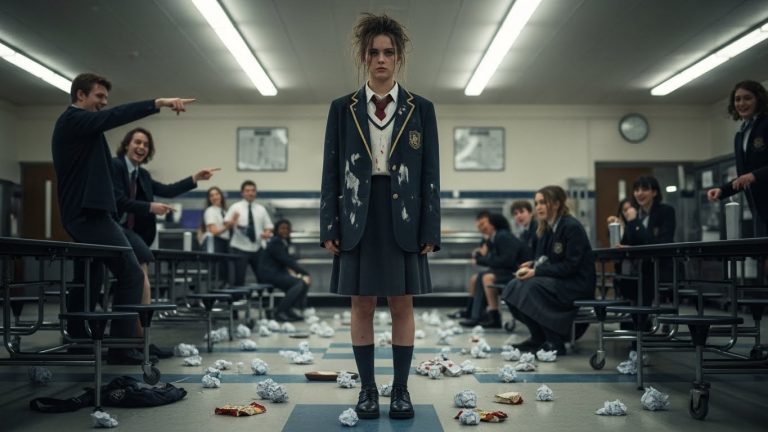
The cafeteria at lunch was a sensory nightmare. The smell of industrial cleaner mixed with pepperoni grease and cheap deodorant. The roar of three hundred voices bouncing off concrete walls. I navigated the sea of plastic trays with my head down, my gaze fixed on the scuffed linoleum. I found my usual spot—a wobbly table near the janitor’s closet, wedged between a vending machine and a pillar.
I sat down, pulling my knees to my chest, shielding myself. I stirred my lukewarm corn chowder, watching the steam rise, wishing I could dissolve into it.
“Hey, nice lid, Mia.”
The voice was loud, projected for an audience. My blood ran cold. I knew that voice. It belonged to Brad Miller.
Brad was Northwood royalty. Quarterback, prom king front-runner, and the kind of guy who had ‘future domestic dispute’ written all over his charming smile. He smelled like expensive cologne and arrogance.
I didn’t look up. “Leave me alone, Brad.”
“No, seriously,” Brad continued, stepping closer. I could see his varsity jacket in my peripheral vision. He leaned on my table, causing my soup to ripple. “It’s ninety degrees, Mia. You hiding a bird’s nest under there? Or maybe a bomb?”
A ripple of laughter moved through the nearby tables. The ecosystem was reacting. The predator had cornered something; the scavengers were gathering to watch.
“It’s just a hat,” I whispered, my voice trembling despite my best efforts.
“I think it’s a health hazard,” Brad announced, looking around at his friends. “School policy says no headgear indoors. I’m just enforcing the rules. I’m a good citizen like that.”
“Don’t touch me,” I said, gripping the edge of the table.
“Come on, let’s see the new hairdo. I heard you’re trying out for the punk rock look.”
He reached out. His hand was fast, practiced in grabbing what he wanted.
I tried to duck, to slide away, but I was trapped between the table and the wall. His fingers hooked under the rim of the gray wool.
“No!” I shrieked, a sound that tore out of my throat before I could stop it.
He yanked.
The sensation was physical pain—not from the hat leaving, but from the air hitting my skin. It felt like cold water thrown on a burn. The beanie dangled from Brad’s fingers like a dead rat.
The cafeteria went silent. It wasn’t the silence of anticipation; it was the silence of repulsion.
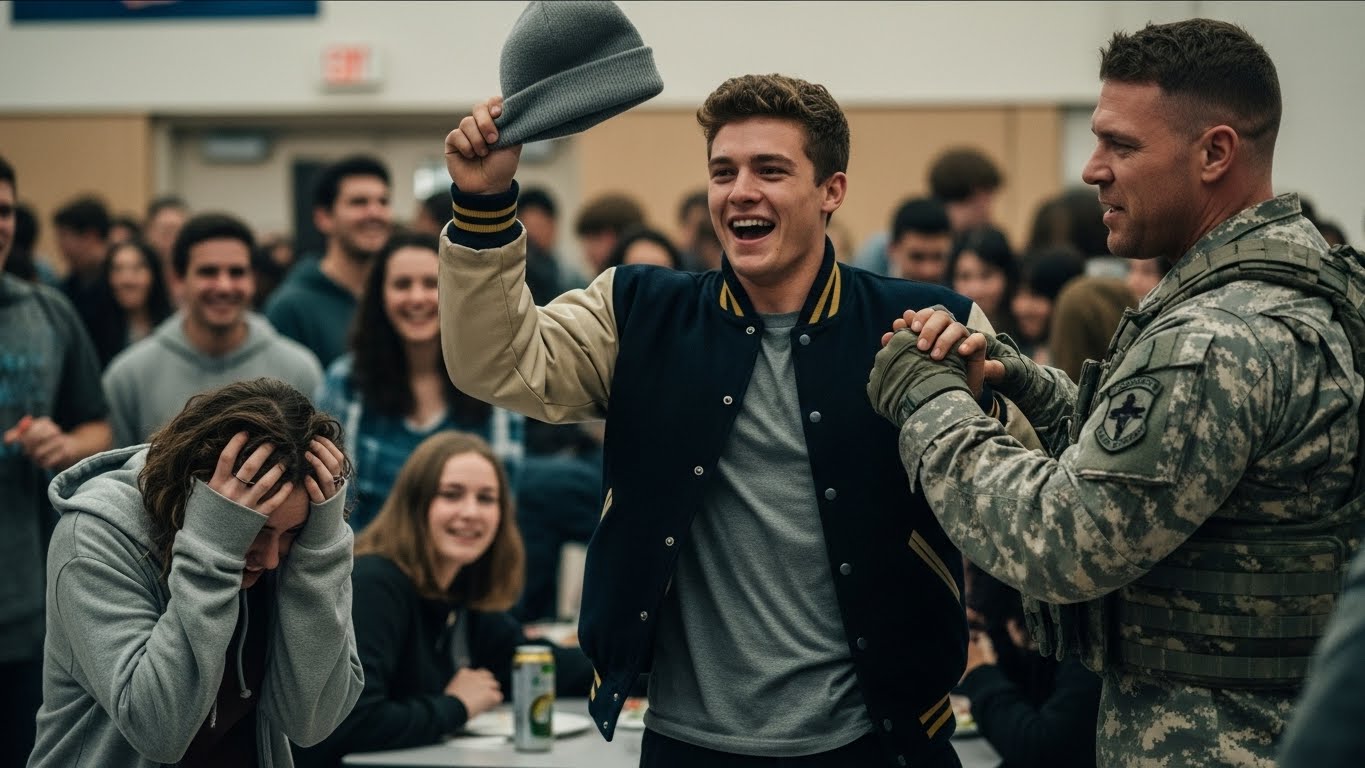
My hands flew up to cover my head, but I wasn’t fast enough. They saw. Everyone saw. The large, smooth patches of skin where hair used to be. The wispy, uneven strands that remained. I looked like a failed science experiment. I saw Sarah, a girl I used to have sleepovers with in middle school, cover her mouth in shock. I saw the disgust on the faces of the cheerleaders.
“Whoa,” Brad sneered, stepping back as if I were contagious. He held the hat high, out of my reach. “Freak show came early this year. Look at that. You look like Gollum.”
The tears came instantly, hot and blinding. I scrambled to stand up, to grab my hat, but Brad tossed it to one of his friends, who tossed it back. Keep-away. They were playing keep-away with my dignity.
“Please,” I sobbed, the word choking me. “Just give it back.”
“Beg for it,” Brad laughed. He was enjoying this. He was feeding on it.
He turned his back to me to high-five his teammate, soaking in the cruelty of the moment. He was the king of the world.
He didn’t see the double doors of the cafeteria swing open. He didn’t see the figure that walked in—not with the shuffle of a student, but with the rhythmic, heavy stride of a soldier.
Brad didn’t notice the shadow that engulfed him until the laughter in the room died completely.
A hand—large, tan, and scarred—shot out and clamped onto Brad’s shoulder. It wasn’t a friendly pat. It was a vice grip.
Brad flinched, spinning around. “Hey, get your hands off—”
The words died in his throat.
Standing there was a ghost. Liam Miller. Brad’s older brother. The one everyone talked about in hushed tones. The one who had been in the sandbox for eighteen months. He was still in his fatigues, dust on his boots, a duffel bag dropped carelessly on the floor behind him.
But it was his eyes that stopped the room. They weren’t the eyes of a high school graduate visiting home. They were the eyes of a man who had seen the world burn and hadn’t blinked. They were focused entirely on his little brother.
Chapter 2: Collateral Damage
The silence in the cafeteria was heavy, suffocating. It felt like the air before a tornado touches down.
“Liam?” Brad’s voice cracked. The arrogance evaporated, replaced by the whine of a child caught stealing from the cookie jar. “I… I didn’t know you were back. Mom said—”
“Is this what I’m doing it for?”
Liam’s voice was low. It didn’t shout; it rumbled. It vibrated through the floorboards. He didn’t look at me. He didn’t look at the crowd. He was staring at Brad with a mixture of confusion and profound disappointment.
“What?” Brad stammered, trying to pull his shoulder away, but Liam’s grip was absolute.
“I’m over there,” Liam said, tightening his grip until Brad winced. “I’m eating sand. I’m watching my friends bleed out. I’m missing everything… so you can come here and act like a coward?”
“It’s just a joke, Liam! She’s… she’s just Mia. She’s weird. Look at her!” Brad gestured vaguely towards me.
I was still standing by the pillar, my arms wrapped around my head, shaking uncontrollably. I wanted the floor to open up and swallow me whole.
Liam turned his head slowly. For the first time, he looked at me.
I expected the same look everyone else gave me. The pity. The disgust. The what is wrong with you look.
But Liam’s eyes were different. They were dark, tired, and incredibly intense. He scanned me—from my trembling hands to the patches of scalp visible between my fingers. His expression softened. The rage didn’t leave his eyes, but it shifted direction.
“Give. Me. The. Hat.” Liam commanded, turning back to Brad.
“It’s right here,” Brad said hurriedly, snatching the beanie from his friend and shoving it toward Liam. “Take it. God, you’re acting crazy, man. It’s just high school.”
Liam took the beanie. Then, with a shove that looked effortless but sent Brad stumbling back five feet into a trash can, he released his brother.
“Go to the car,” Liam ordered. “Now.”
“But I have fourth period—”
“I said, go to the damn car, Brad.”
Brad looked at the crowd, his face burning red with humiliation. The King had been dethroned. He muttered a curse, kicked the trash can, and stormed out the side exit.
Liam stood alone in the center of the cafeteria. He took a breath, his chest rising and falling heavily against his uniform. Then, he walked toward me.
Every instinct in my body told me to run. Men with that much anger inside them were dangerous. But my legs wouldn’t move.
He stopped two feet in front of me. Up close, he smelled like stale tobacco, airplane air, and something metallic—like old pennies. He was tall, looming over me, but he hunched his shoulders slightly, making himself smaller.
“Hey,” he said softly. The gravel in his voice was still there, but the edge was gone.
I couldn’t speak. I just hiccuped, a pathetic sound of distress.
Liam held out the beanie. He didn’t shove it at me. He held it with both hands, open, like an offering.
“I’m sorry,” he said. “About him. About… this.”
I slowly lowered one hand to take it, but my fingers were shaking so badly I fumbled.
Liam didn’t pull away. Instead, he did something that made my breath hitch. He took a half-step closer, raised the beanie, and gently—so gently it felt like a hallucination—pulled it over my head.
His rough fingers brushed against my forehead. He adjusted the rim until it covered my ears, until I was safe again.
“You keep your head up,” Liam said, his eyes locking onto mine. There was a desperate intensity in them, like he was trying to tell me a secret he couldn’t speak. “You’re fighting a battle they don’t know anything about. That makes you braver than anyone in this room.”
He paused, looking around the silent cafeteria, his lip curling slightly. “Including me.”
He nodded once, a sharp military movement, and then turned on his heel. He picked up his duffel bag and walked out the way he came, leaving a room full of stunned teenagers and one girl who felt, for the first time in six months, like she could breathe.
The rest of the day was a blur. Mr. Henderson, the principal, called me into his office. He gave me the usual speech—”Zero tolerance for bullying,” “We’ll talk to Brad,” “Maybe you should consider a wig to avoid distractions.”
I sat there, numb, nodding at the right times. They didn’t get it. They thought the problem was the hair. The problem was the world.
I drove home in silence. The radio was off. All I could hear was the hum of the tires and the echo of Liam’s voice. Braver than anyone in this room.
When I got home, the house was empty. Mom was still at the diner. I walked into my room and locked the door. I sat on the edge of my bed, still wearing the beanie. I reached up and touched the wool where Liam’s hands had been.
It felt different now. It didn’t feel like a bandage anymore. It felt… protected.
Chapter 3: The Shadow on the Porch
Evening in the suburbs brings a specific kind of blue light. The streetlamps flicker on, buzzing with electricity, and the sprinklers start their rhythmic chk-chk-chk hissing across the lawns.
I was in the kitchen, pretending to do homework, but really I was just staring at a math problem I couldn’t solve. My mom had come home for an hour between shifts to heat up a casserole. She was moving frantically, wiping counters, asking me about my day without waiting for an answer.
“So, Mrs. Gable said she saw you talking to the Miller boy? The older one?” Mom asked, pausing with a dishrag in her hand. “Is he back? I thought he had another three months.”
“He’s back,” I said, keeping my eyes on the textbook. I hadn’t told her about the cafeteria. I couldn’t bear to see her face crumble. She already carried so much guilt about my condition, blaming herself for not having the money for better specialists.
“Well, stay away from that family,” she sighed, tossing the rag into the sink. “Brad is a terror, and the dad drinks too much. I can’t imagine the army fixed the older one. Usually just makes ’em worse.”
Makes them worse.
I thought about Liam’s eyes. The anger, yes. But the kindness, too. The control.
“He’s not Brad,” I murmured.
“What?”
“Nothing.”
Mom kissed the top of my beanie—she never asked me to take it off anymore—and rushed out the door for the night shift.
The house settled into silence. I washed the dishes, the warm water soothing my hands.
Then, the doorbell rang.
It wasn’t a tentative ring. It was a solid, singular press.
My heart hammered against my ribs. No one visited us. We weren’t the “drop-in” kind of family.
I walked to the front door, peering through the peephole. The porch light was dim, but I recognized the silhouette immediately. Broad shoulders. Short hair. The posture of a statue.
Liam.
I unlocked the deadbolt and opened the door a crack.
He was standing on the welcome mat. He had changed out of his uniform. He was wearing faded jeans and a black t-shirt that was tight across his chest. He held a lit cigarette in one hand, down by his side, hiding it from view out of politeness.
“Hi,” he said. His voice was rougher now, stripped of the adrenaline from the afternoon.
“Hi,” I whispered, clutching the doorframe.
“I… uh…” He looked uncomfortable. He looked down at his boots, then out at the street, then back at me. This wasn’t the commanding soldier from the cafeteria. This was a guy who didn’t know what to do with his hands. “I wanted to check on you. Brad told me where you lived. I made him tell me.”
“I’m fine,” I lied.
“You’re not,” he said bluntly. “You were shaking.”
He took a drag of the cigarette, the cherry glowing bright orange in the twilight, then exhaled a plume of smoke away from me.
“Can I… can I sit for a minute?” he asked, gesturing to the wooden swing on our porch. “I can’t go home yet. My dad’s throwing a ‘Welcome Home’ party. Too many people. Too much noise.”
He looked at me with a vulnerability that knocked the wind out of me. He was hiding, too.
I stepped out onto the porch, closing the door behind me. The air was thick with humidity and the sound of crickets.
“Okay,” I said.
He sat on one side of the swing. I sat on the other, leaving two feet of empty space between us. The chains of the swing creaked as we settled.
For a long time, neither of us spoke. We just watched the cars pass by on the main road, two blocks away.
“Why did you do it?” I asked finally. My voice felt small in the open air.
Liam flicked the ash off his cigarette. He didn’t look at me. He watched the smoke curl up into the darkness.
“Do what? Stop my brother from being a sociopath?”
“No. Why did you help me? You don’t know me. I’m just…” I gestured to my head.
Liam turned to me then. The porch light cast shadows across his face, highlighting the sharp angle of his jaw and the dark circles under his eyes. He looked older than twenty-four. He looked ancient.
“I know what it’s like,” he said quietly.
“To be bald?” I tried to joke, but it fell flat.
A small, dry smile touched his lips. “No. To be exposed. To have everyone looking at you, judging you for something you can’t control.”
He leaned forward, resting his elbows on his knees. “Over there… you lose pieces of yourself. Every day. And you come back, and everyone expects you to be whole. They want the hero. They don’t want the parts that are broken.”
He looked at my beanie.
“You wear that hat to hide the broken parts,” he said. “I wear this uniform to hide mine. We’re the same, Mia.”
The sentence hung in the air between us. We’re the same.
I looked at this man—this warrior who could crush a wrist with one hand—and I realized he was trembling. Just slightly. A microscopic vibration in his hands.
“Does it ever stop?” I asked. “The feeling that everyone is staring?”
“I don’t know,” Liam admitted. “I just got back today. But I think… I think it’s easier when you’re not facing it alone.”
He dropped the cigarette butt and crushed it under his boot. Then he looked at me, really looked at me, with an intensity that made my skin prickle.
“Brad won’t touch you again,” he promised. “I made that clear.”
“Thank you.”
“Don’t thank me. I didn’t do it for you. I did it because I needed to know that there’s still something decent left in this world worth fighting for.”
I didn’t know what to say to that. So we just sat there, swinging gently in the humid Ohio night, two broken people finding a strange, terrifying comfort in the silence.
But as I looked at him, I noticed something else. His eyes kept darting to the treeline across the street. He was scanning for threats. He was home, but he wasn’t safe.
And for the first time, I didn’t feel like the victim. I felt like the only person in the world who could see the invisible wound bleeding out in the man beside me.Chapter 4: The Noise of Normalcy
The following Tuesday, the world hadn’t ended, but the atmosphere at Northwood High had shifted. The predators were confused. Brad Miller, the king of the hallway, was avoiding eye contact with me. When I walked to my locker, the sea of students parted—not out of disgust this time, but out of caution. I was no longer just the “bald girl.” I was the girl under Liam Miller’s protection.
It felt like walking around with a loaded gun in my pocket. Safe, but volatile.
After school, I went to The Iron Skillet, the diner where my mom worked double shifts. It was a chrome-and-neon relic from the 50s that smelled perpetually of burnt coffee and maple syrup. I usually sat in the back booth, doing homework until Mom’s shift ended at six.
That’s when I saw him.
Liam was sitting in a booth near the window, staring at a menu like it was a tactical map he couldn’t decipher. He looked out of place among the retirees eating pie and the families with screaming toddlers. He was wearing a gray hoodie with the hood up, shoulders hunched tight.
I hesitated, then walked over. “The meatloaf is dry,” I said softly. “Go for the burger.”
Liam’s head snapped up. For a split second, his eyes were wide, feral—the eyes of a cornered animal. Then recognition washed over him, and the tension drained from his face, leaving him looking exhausted.
“Mia,” he breathed. “Hey.”
“Mind if I sit?”
He slid over. “Please. I feel like everyone is watching me eat.”
I sat down. Up close, I saw the tremor in his hands was worse. He was shredding a paper napkin into tiny, snowy piles.
“How’s the hero’s welcome?” I asked, trying to keep it light.
“Suffocating,” Liam muttered. “My dad has had people over every night. Uncles I haven’t seen in ten years. Neighbors who used to call the cops on me for skating on their curbs are now shaking my hand, thanking me for my service. They want war stories. They want me to tell them it was like the movies.”
“And was it?”
He looked out the window at the parking lot. A muscle feathered in his jaw. “It was mostly boring. Until it wasn’t. And when it wasn’t… it was just loud.”
Just then, a busboy three tables away tripped. A tray load of ceramic plates and silverware crashed onto the tile floor.
The sound was explosive in the small diner.
In a heartbeat, Liam was gone.
He didn’t scream. He didn’t run. He simply vanished from the seat beside me. I looked down and saw him crouched under the table, his hands clamped over his ears, his body curled into a tight, defensive ball. His eyes were squeezed shut, his chest heaving in silent, gasping panic.
The diner went quiet. People stared. The whispers started. “Is that the Miller boy?” “What’s wrong with him?”
My heart broke. I saw the shame he had talked about. The hero, reduced to a trembling child by a stack of dirty dishes.
I didn’t think. I slid off the bench and crawled under the table with him.
The space was cramped and smelled of floor cleaner and old gum. I knelt in front of him, blocking the view of the staring crowd.
“Liam,” I whispered. “Liam, look at me.”
He was rocking back and forth, muttering something unintelligible. Coordinates. He was muttering coordinates.
I reached out and took his hands. They were cold and clammy. I squeezed them hard.
“You’re at The Iron Skillet,” I said firmly. “You’re in Northwood. It’s Tuesday. You ordered a burger. I’m Mia.”
He gasped, his eyes flying open. They were unfocused, wild. He looked at me, but I knew he wasn’t seeing me yet. He was seeing sand.
“Look at the beanie,” I commanded, tilting my head. “Look at the gray wool. Focus on the texture. Come back.”
He blinked. Once. Twice. His gaze latched onto my hat—the symbol of my own weakness—and used it as an anchor. His breathing hitched, then slowed. The grip on my hands loosened.
“Mia?” he croaked.
“Yeah. I’m here.”
“Did I…” He looked around the confined space under the table. “Did I freak out?”
“Just a little,” I lied. “But the floor needed cleaning anyway.”
He let out a shaky, self-deprecating laugh that sounded more like a sob. “God, I’m pathetic.”
“No,” I said fiercely. “You’re human. Now, we’re going to crawl out of here, and we’re going to walk out the front door, and you are not going to look at anyone. You look at me. Just me.”
And that’s what we did. We emerged from the table. I grabbed his hand—a bold move in a small town—and pulled him toward the exit. I felt the eyes on us. I felt the judgment. But for the first time in my life, I didn’t care about them judging me. I was too busy protecting him.
Chapter 5: Fractured Reflections
Things changed after the diner. We became a strange, codependent unit. Liam would pick me up from school in his dad’s old truck, and we’d drive. Just drive. To the reservoir, to the edge of the cornfields, anywhere where it was quiet.
He didn’t talk much about the war, and I didn’t talk much about the hair loss. We existed in the silence between the traumas.
But the real world has a nasty habit of breaking in.
It was Friday night. Liam had promised to come over for a movie—my mom was actually excited to meet him, having decided he was “a good influence” despite her earlier warnings. I was sitting on my porch, waiting.
A car pulled up. It wasn’t the truck. It was a shiny red Mustang.
Brad.
My stomach tightened. I hadn’t spoken to Brad since the incident. He walked up my driveway, but he didn’t have his usual swagger. He looked agitated. He was wearing a polo shirt, heading to some party, but he stopped at my steps.
“He’s not coming,” Brad said abruptly.
I stood up, crossing my arms. “What do you want, Brad?”
“Liam. He’s not coming. He’s at the bar on Main. He’s been there since three.”
I felt a cold prickle of worry. “Why are you telling me this?”
Brad kicked at a loose stone on the walkway. He looked up, and for the first time, I saw a resemblance to Liam. The same jawline, but softer. The same eyes, but instead of haunted, they were resentful.
“You think he’s some kind of saint, don’t you?” Brad sneered, but there was no heat in it. “Captain America saving the bald girl.”
“He’s a good person,” I defended. “Which is more than I can say for you.”
“You don’t know him, Mia. You know the version who came back. You didn’t know him before.” Brad took a step closer, his voice dropping. “Liam was mean. He was angry way before the Army gave him a rifle. He didn’t join up to serve his country. He joined up because Dad gave him a choice: enlist or go to jail.”
I froze. “What?”
“He beat a guy up,” Brad said, the words rushing out. “Junior year. Put a kid in the hospital because the guy scratched his car. Liam has a violence in him, Mia. Always has. The war just… uncorked it.”
“You’re lying,” I said, though a seed of doubt sprouted in my chest. I remembered the way Liam had gripped Brad’s wrist. The terrifying calmness.
“Go see for yourself,” Brad said, turning back to his car. “But don’t say I didn’t warn you. He’s a ticking time bomb, and you’re standing right next to the blast zone.”
Brad drove off, leaving me shivering in the warm evening air.
I borrowed my mom’s car and drove to the bar. It was a dive, dark and smelling of sawdust. I found Liam in the back corner. He wasn’t alone.
He was surrounded by three men—older, rough-looking types. They were laughing, but Liam wasn’t. He was staring at a shot glass of whiskey like it was poison he had to drink.
I walked up to the table. “Liam?”
He looked up. His eyes were glassy. Not drunk, exactly, but detached. The chemical wall he put up to numb the noise.
“Mia,” he slurred slightly. “What are you doing here?”
“We had plans,” I said, trying to ignore the leers of the men around him. “Movie night. Remember?”
“Go home, Mia,” he said, his voice hardening. “This isn’t a place for kids.”
“I’m not a kid. And you’re not supposed to be doing this.” I reached for his arm.
He jerked away. Fast. Too fast. His elbow clipped my shoulder—hard. I stumbled back, knocking into a waitress carrying a tray of beer.
Glass shattered. Beer sprayed everywhere.
Liam stood up so abruptly his chair fell backward. The bar went silent.
He looked at me, then at the broken glass, then at his own hands. The anger that flashed across his face wasn’t at me. It was at himself. But it was terrifying. It was the face of the monster Brad had warned me about.
“I told you to leave me alone!” he roared. The sound was guttural, raw.
I backed away, clutching my shoulder. Tears pricked my eyes—not from pain, but from fear. For the first time, I was afraid of Liam.
He saw the fear in my eyes. It hit him like a physical blow. The color drained from his face.
“Mia,” he whispered, reaching out.
“Don’t,” I gasped. I turned and ran out of the bar, the sound of his voice calling my name drowned out by the blood rushing in my ears.
Chapter 6: The Breaking Point
I didn’t see Liam for two days. He called a dozen times. He texted. I’m sorry. I didn’t mean it. Please.
I ignored them all. I stayed in my room, staring at the ceiling fan, wondering if Brad was right. Was I just a project? A way for a violent man to feel like a protector?
Sunday night was the Senior Bonfire at the Quarry. It was a tradition. A massive fire, illegal drinking, loud music. I never went to these things. But staying in my room felt like admitting defeat. I wanted to prove to myself that I didn’t need Liam Miller to exist in this town.
I wore my beanie, but I put on a little makeup. I drove to the Quarry.
The fire was roaring, shooting sparks into the black sky. Shadows danced on the limestone walls. The air smelled of woodsmoke and cheap beer.
I stood on the periphery, watching. People ignored me, which was an improvement from the bullying. I was nursing a soda, thinking about leaving, when the music cut out.
A hush fell over the crowd near the fire.
I pushed forward, curious.
Liam was there.
He shouldn’t have been. He was twenty-four, too old for this high school ritual. But he was standing by the fire, looking for someone. He looked wreck—unshaven, wearing the same clothes from Friday.
He spotted me. Relief washed over his face, and he started walking toward me.
“Mia!”
But before he could reach me, Brad stepped into his path. Brad had been drinking. He was swaying, holding a red solo cup, surrounded by his football buddies.
“Get lost, Liam,” Brad spat. “She doesn’t want to talk to you. You scared her off, just like you scare everyone off.”
“Move, Brad,” Liam warned. His voice was low, dangerous.
“Or what?” Brad laughed, emboldened by his audience. “You gonna break my arm? You gonna have another meltdown? Maybe cry under a table?”
The crowd gasped. I froze. How did Brad know about the diner?
I realized then: I was the leak. I hadn’t told Brad, but people at the diner had seen. Rumors in a small town travel faster than light.
Liam went rigid. “Shut up.”
“Everyone knows you’re broken, Liam!” Brad shouted, throwing his hands up. “You’re a psycho! Dad says it, Mom says it. You think protecting the bald freak makes you a hero? It just makes you a charity worker!”
The word hung in the air. Freak.
Something inside Liam snapped. It wasn’t a gradual break; it was an explosion.
He lunged.
He tackled Brad into the dirt. It wasn’t a brotherly scuffle. It was an assault. Liam rained punches down on Brad’s face—one, two, three. Brutal, efficient, military-grade violence.
“Liam! Stop!” I screamed, pushing through the crowd.
Brad was bloody, trying to cover his head. Liam pulled back his fist for a strike that would have shattered Brad’s jaw.
“Liam!” I threw myself on Liam’s back, wrapping my arms around his neck. “Stop it! You’re killing him!”
Liam froze. The feeling of my arms around him seemed to pierce through the red haze. He paused, his fist trembling in the air.
He looked down at his brother’s bloody face. He looked at his own knuckles, split and raw. Then he looked up at the circle of terrified teenagers watching him.
Slowly, he lowered his hand. He stood up, shaking me off gently. He was breathing hard, his chest heaving.
Brad rolled over, coughing, spitting blood into the dust.
Liam turned to me. His eyes were wide with horror. Not at Brad. At himself.
“I…” Liam started, reaching a bloody hand toward me.
I took a step back. I couldn’t help it. The image of his fist coming down was seared into my retinas.
Liam saw the flinch. It broke him more than the war ever had.
He lowered his hand. “You were right,” he whispered, his voice dead. “I am the monster.”
He turned and walked away into the darkness, past the fire, past the cars, disappearing into the black woods beyond the Quarry.
“Liam!” I called out, but my voice was weak.
I looked down at Brad, who was groaning. I looked at the fire. And I realized that in trying to save me, Liam had just destroyed the last shred of himself.Chapter 7: The Monster and the Mirror
The emergency room waiting area at Northwood General was a wash of fluorescent light and hushed conversations. I sat in a plastic chair, my knees bouncing nervously.
Brad was in getting stitches. Liam was gone.
I hadn’t chased Liam into the woods. I couldn’t. My legs had given out. I had stayed until the ambulance came for Brad, answering the paramedics’ questions with half-truths. “A fight. Just a fight.”
When Brad finally walked out, he looked like a patchwork doll. His lip was swollen to twice its size, and a butterfly bandage held his eyebrow together. He saw me sitting there and stopped.
I stood up, expecting him to yell. To blame me. To call the police.
Instead, Brad just sighed. A wet, painful sound. He sat down two seats away from me, leaning his head back against the wall.
“He hits hard,” Brad mumbled, gingerly touching his jaw.
“I’m sorry,” I whispered. “I’m so sorry, Brad.”
“Don’t be,” he said, staring up at the ceiling tiles. “I pushed him. I knew what buttons to press. We grew up together, Mia. I know exactly where his landmines are buried.”
I looked at him, surprised by the lack of malice in his voice. “Why? Why did you want him to snap?”
Brad closed his eyes. “Because when he came back… he was a ghost. He wouldn’t talk. He wouldn’t yell. He was just… dead inside. I thought if I made him mad, he’d be here. He’d be Liam again.”
He laughed bitterly, wincing at the pain. “Turns out, Liam isn’t here anymore. Just the soldier.”
He turned his head to look at me. His eyes were swollen, but clear. “He didn’t hit me because I called him crazy, Mia. He took all of that. He only snapped when I called you a freak.”
The realization hit me harder than any physical blow. Liam hadn’t lost control because of his own ego. He had lost control because he was trying to protect me from the very thing that hurt me most: the cruelty of the world.
“Where would he go?” I asked, standing up. The urgency was clawing at my throat.
“The reservoir,” Brad said quietly. “It’s where he used to go before he deployed. The old dock on the north side. It’s the only place in town where you can’t hear the highway.”
I turned to leave, but Brad called out one last time.
“Mia?”
I stopped.
“Tell him… just tell him I’m not pressing charges. Tell him to come home.”
I nodded, clutching my car keys, and ran out into the night.
Chapter 8: No More Hiding
The drive to the reservoir was treacherous. The road was unpaved, winding through dense woods that swallowed the headlights. My heart was pounding in rhythm with the tires crunching over gravel.
I parked my car at the trailhead and walked the rest of the way. The air here was cooler, smelling of pine needles and stagnant water. The moon was a thin sliver, offering barely any light.
I saw the silhouette of his truck first. It was parked near the water’s edge, engine off, windows down.
And then I saw him.
Liam was sitting on the end of the rotting wooden dock, his legs dangling over the black water. He was still wearing his blood-stained t-shirt. He was smoking a cigarette, the orange cherry the only bright thing in the darkness.
I walked onto the wood. It creaked under my weight.
Liam didn’t turn around. “Go away, Mia.”
His voice was dead. Flat. It scared me more than the yelling had.
“No,” I said, stepping closer.
“I’m dangerous,” he said, taking a drag. “You saw it. Brad was right. I’m a ticking bomb. I need to leave this town before I hurt someone else. Before I hurt you.”
“You won’t hurt me.”
“You flinched,” he countered. The pain in his voice was jagged. “At the bonfire. When I reached for you… you flinched. You looked at me like I was the enemy.”
I stopped a few feet behind him. “I flinched because I was scared of the situation. Not of you.”
“It’s the same thing,” he whispered. He flicked the cigarette into the water. It hissed and died. “I’m broken, Mia. I tried to be normal. I tried to put on the costume and go to the diner and watch the movies. But the noise… it never stops. And the anger… it’s always right there, under the skin.”
He stood up and turned to face me. In the moonlight, he looked ravaged. His knuckles were split and bleeding. His eyes were filled with tears he refused to shed.
“You need to stay away from me,” he choked out. “I’m not the hero. I’m just the guy who knows how to break things.”
I looked at him—really looked at him. I saw the fear behind the rage. I saw the boy who had been sent to war to avoid jail, and the man who had come back with a soul full of shrapnel.
He was right. He was broken. But so was I.
I reached up. My hands were trembling, but not from fear.
I grabbed the rim of my gray wool beanie. The armor he had given back to me. The shield that hid my shame.
Slowly, deliberately, I pulled it off.
I let it drop to the wooden dock between us.
The night air hit my scalp—cool, exposing, terrifying. I stood there in the moonlight, my patchy, bald head visible. I didn’t look down. I looked straight into his eyes.
Liam froze. He stared at me, his breath catching in his throat. He knew what this cost me. He knew that for me, this was more terrifying than a fistfight.
“I’m broken too, Liam,” I said, my voice shaking. “Look at me. I’m a mess. I’m scared every single day. I hide under that hat because I can’t stand the way the world looks at me.”
I took a step toward him. He didn’t back away.
“We don’t have to be whole,” I whispered, stepping into his space. “We just have to be here. You defended me when I couldn’t defend myself. Let me do the same for you.”
Liam looked at my face, then at my hair, then back to my eyes. The tension in his shoulders began to crumble. The soldier melted away, leaving just a man in pain.
He reached out with his damaged hands. He didn’t touch my face. He gently placed his palms on my shoulders, as if anchoring himself to the earth.
“I don’t know how to fix this,” he confessed, his voice breaking.
“We don’t fix it,” I said, covering his hands with mine. “We just carry it. Together.”
He let out a sound—half-sob, half-sigh—and pulled me into his chest. He hugged me tightly, burying his face in the crook of my neck. I felt the wetness of his tears against my skin. I held him back, holding the pieces of him together while he shook apart.
We stood there on the dock for a long time, surrounded by the silence of the woods. Two broken things that, when pressed together, made something sturdy.
He didn’t put the beanie back on my head. And for the first time in six months, I didn’t pick it up.
The wind blew across the water, cold and biting, but I didn’t feel the chill. I felt the warmth of the soldier who had come home, and the weight of the hand that was no longer a fist, holding onto mine for dear life.
(The End)