My Husband Died a Hero. Two Years Later, a Stranger with Cold Eyes Knocked on My Door and Said: “I’m Here to Finish His Job.”
Chapter 1: The Circle of Wolves
The asphalt of the Lincoln Elementary playground always smelled like burning rubber in September. For ten-year-old Leo Miller, that smell was the scent of fear. It was the smell of sneakers skidding on grit, of scraped knees, and of the heat rising off the blacktop in shimmering waves that made the chain-link fences look like they were melting.
Leo sat on the far edge of the bleachers, the metal searing hot against his jeans. He had pulled his knees up to his chest, trying to make himself physically smaller, a trick he had learned early in the third grade. If you take up less space, maybe the universe will forget you’re there. Maybe they will forget you’re there.
In his lap sat a sketchbook, its corners dog-eared and soft like felt from constant handling. He wasn’t drawing superheroes or fast cars like the other boys in the fifth grade. He was shading the graphite curve of a jawline, trying to remember exactly how the stubble looked on a face he hadn’t seen in two years. He worked with obsessive precision, his tongue poking from the corner of his mouth. If he got the shading right, if he captured the exact crinkle of the eyes, maybe it would feel like he was back.
“Check it out. The lungs are wheezing again.”
Leo’s pencil snapped. He didn’t look up. He didn’t have to. He knew that voice—gravelly, cracking with early puberty, and dripping with the specific kind of malice that only thrives in the suburbs. Tyler.
A shadow fell over the sketchbook. Then another. Then three more. The sun was blocked out, replaced by the looming silhouettes of boys who had grown too fast this summer, fed on protein shakes and a lack of supervision.
Leo’s chest tightened instantly. It wasn’t just fear; it was a physical defect. His bronchial tubes clamped shut like a rusty bear trap. It was a reaction as automatic as blinking. He reached into his pocket, his fingers brushing the cool, familiar plastic of his Albuterol inhaler.
“Don’t,” Tyler sneered.
Before Leo could secure his grip, Tyler’s hand shot out. He snatched the sketchbook.
“Give it back,” Leo whispered. His voice was thin, reedy, barely audible over the screaming laughter of a kickball game nearby.
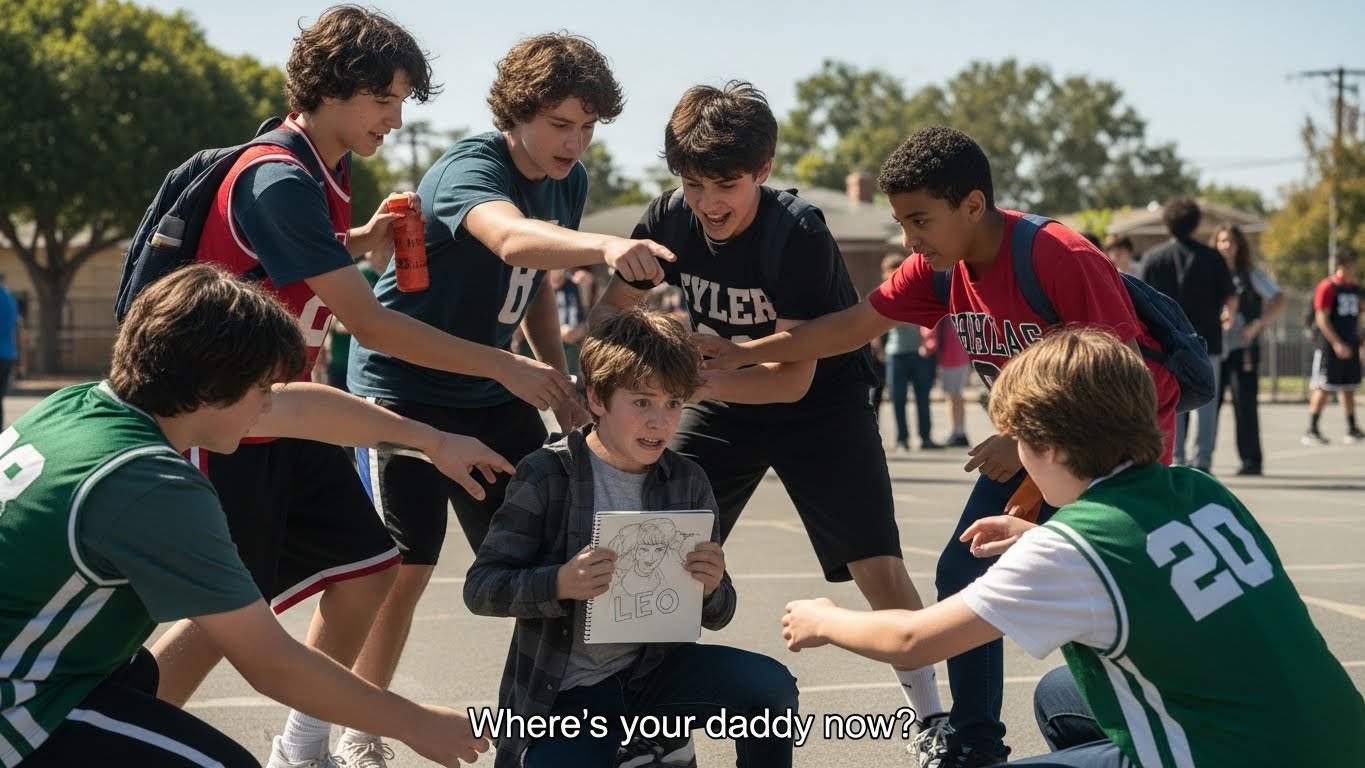
“What is this?” Tyler flipped the pages, carelessly crinkling the paper. He laughed, a jagged sound, showing the drawings to his entourage—four boys in matching basketball jerseys who functioned as a single organism, mimicking everything Tyler did. “Look at this trash. It’s just some old guy. Is this your daddy? The one who ran away?”
Leo stood up. His legs were shaking, but a hot flush of anger rose up his neck, overriding the fear for a fleeting second. “He didn’t run away,” Leo said, his voice trembling but clear. “He died. He was a hero.”
“Dead. Ran away. Same thing,” Tyler laughed. He shoved Leo hard in the chest.
Leo stumbled back. His sneakers slipped on the loose gravel. He hit the ground hard, the impact jarring his spine. The air rushed out of his lungs in a painful whoosh, and refused to come back in. The panic set in immediately—cold and sharp. He scrambled for the inhaler in his pocket, pulling it out, desperate for the relief of the mist.
Tyler kicked his hand.
The blue plastic device skittered across the asphalt, spinning wildly until it landed under the bleachers, deep in the shadows, amidst old candy wrappers and dead leaves. Just out of reach.
“Go get it, Wheezer,” one of the other boys taunted.
They formed a circle around him. Tight. Impenetrable. To a ten-year-old, five boys feels like an army. It feels like the end of the world. The noise of the rest of the playground seemed to fade into a dull hum, miles away. The teachers were clustered by the swings, sipping iced coffees from thermal cups, looking the other way, exhausted by the heat and the job.
Leo gasped, a high-pitched, whistling sound escaping his throat. Eeeeehh-hup. His vision started to blur at the edges, dark spots dancing in the bright sunlight. He clawed at the gravel, his fingernails breaking. He needed air. He needed just one breath.
“Cry,” Tyler commanded, stepping closer, his expensive sneakers kicking dust into Leo’s face. “Cry for your daddy. Maybe he’ll come down from the clouds and save you.”
Leo curled into a ball, hiding his face in his arms. He squeezed his eyes shut. The lack of oxygen was making his head spin, a dark tunnel closing in. In the darkness behind his eyelids, he tried to summon the image from his sketchbook—the strong jaw, the kind eyes of Staff Sergeant David Miller.
Help me, Leo thought, the plea screaming in his mind. You said you’d always be here. You promised.
But the sky remained empty, blue and indifferent. There was only the heat, the dust, and the laughter of wolves.
Chapter 2: The Green Giant
The laughter above Leo was loud, jagged, and cruel. It was the sound of power unchecked.
Then, abruptly, the air pressure on the playground changed.
It wasn’t a sound. It was a silence.
It started at the edge of the playground, near the faculty parking lot, and rolled inward like a tsunami wave. The kickball game stopped mid-pitch. The girls by the swings went quiet, the chains ceasing their rhythmic creak. The silence was heavy, oppressive, and commanding. It was the kind of silence that happens when a predator enters a clearing.
Tyler stopped laughing. The smirk slid off his face like wet clay. He looked up, confused, scanning the faces of his friends. They weren’t looking at Leo anymore. They were looking past him, over his shoulder, their mouths hanging slightly open, eyes wide with a mixture of awe and primal terror.
Leo heard the crunch of boots on gravel.
Heavy. Rhythmic. Crunch. Crunch. Crunch.
It wasn’t the principal’s soft loafers. It wasn’t a teacher’s squeaky sneakers. This was the sound of purpose.
Through his blurred, watery vision, Leo saw a pair of boots stop inches from his face. They were tan, suede, laced tight in a crisscross pattern that looked unbreakable. They were dusted with actual dirt—red clay that didn’t belong in this suburb.
Leo looked up. And up. And up.
The man was a mountain. He stood six-foot-four, blocking out the sun, casting a long, cool shadow over Leo. He was dressed in full OCPs—Operational Camouflage Pattern. The American flag patch on his right shoulder seemed to glow in the sunlight, vibrant against the muted green and tan of the uniform. His face was weathered, carved from granite, with a thick, jagged scar running through his left eyebrow, interrupting the stoic geometry of his features. He wore a green beret tucked perfectly under his epaulet, a splash of color that signaled something dangerous and elite.
Sergeant First Class Marcus Hayes didn’t yell. He didn’t have to. He just stood there, radiating a kind of dangerous calm that most people in this soft, suburban town would go their whole lives without ever witnessing.
“You dropped this,” the soldier said.
His voice was a low rumble, like distant thunder rolling over a valley. He knelt down—a slow, deliberate movement that spoke of immense controlled power—and reached under the bleachers. His arm was thick with muscle, roped with veins. He picked up the inhaler, dusted it off with a massive hand, and held it out to Leo.
Leo took it, his hands shaking so hard he almost dropped it again. He brought it to his lips and pressed the canister. Pffft. He took a deep, shuddering breath, the medicine opening his airways, flooding his starving lungs with sweet, cool oxygen.
Marcus watched him take the breath, his eyes narrowing slightly, assessing the boy’s vitals with a medic’s precision. Then, satisfied Leo wasn’t going to pass out, Marcus stood back up and turned to the circle of boys.
Tyler, usually so loud, looked like he was about to wet his pants. He took a step back, bumping into his friends. The circle broke. The wolves were suddenly just children again.
“Which one of you is holding the book?” Marcus asked. He spoke softly, but the words carried across the yard with the weight of a gavel.
Tyler’s hands trembled as he held out the sketchbook. “I… we were just… we found it…”
Marcus stepped forward. The boys flinched as if he had raised a hand, but he hadn’t moved a muscle above his waist. Marcus gently took the book from Tyler’s hand. He looked at the drawing on the open page. His stone face softened for a fraction of a second. A flicker of raw, unpolished pain passed through his steel-grey eyes before the shutters came back down.
“That’s a good likeness,” Marcus said, looking at Tyler. “You know who this is?”
Tyler shook his head, mute.
“That’s Staff Sergeant David Miller. My best friend,” Marcus said, his voice hardening again, turning into cold iron. “And he didn’t run away. He stood his ground in a valley in Kandahar so that little punks like you could stand on this playground and be safe.”
He leaned in, looming over the bully.
“He was a better man than me. And definitely a better man than you are acting right now.”
Marcus stared at Tyler for three long seconds. In those three seconds, Tyler seemed to shrink, his ego dissolving into the gravel.
“Get lost,” Marcus whispered.
The boys scattered like roaches when the lights turn on, running toward the school building without looking back.
Marcus turned his back on them—the ultimate sign of dismissal—and looked down at Leo. The scary face was gone, replaced by something awkward, almost gentle. He extended a hand. It was the size of a baseball mitt, rough and calloused.
“Up you get, trooper,” Marcus said.
Leo grabbed the hand. He was hoisted up effortlessly, as if he weighed nothing. For the first time in two years, Leo felt safe. He felt… protected.
“Who… who are you?” Leo wheezed, clutching his sketchbook to his chest like a shield.
Marcus adjusted his beret, a sad smile touching his lips. “I’m the guy who promised your dad I’d check your six. I’m sorry I’m late, Leo. Traffic coming back from Bragg was a nightmare.”
The school bell rang, piercing the silence. Mrs. Gable, the playground monitor, was finally rushing over, looking flustered.
“Excuse me! Sir! You can’t be on school grounds!” she chirped, her voice shrill.
Marcus turned to her. He didn’t look aggressive, just tired. “I’m escorting this young man to the principal’s office to discuss an assault I just witnessed. Unless you want to discuss why five students were beating on a kid with a medical condition while you were drinking coffee?”
Mrs. Gable’s mouth snapped shut.
Marcus looked back at Leo and winked. “Come on. Let’s go sort this out. Then, I’m buying you a burger. I hear you like extra pickles. Your dad told me that.”
Chapter 3: The Ghost at the Dinner Table
The burger at O’Malley’s Diner was greasy, towering, and exactly what Leo needed.
Marcus sat across from him in the red vinyl booth, a stark contrast to the retro neon decor. The soldier took up too much space. His shoulders extended past the edge of the booth, and his long legs were cramped under the small table. He hadn’t touched his food—black coffee and a side of dry toast. He just watched Leo eat.
“You eat like him,” Marcus said suddenly.
Leo paused, a pickle slice hanging from his mouth. He swallowed quickly. “Like my dad?”
“Yeah. Fast. Like someone’s gonna take the plate away if you slow down.” Marcus smiled, but it didn’t reach his eyes. His eyes were constantly moving, scanning the entrance of the diner, the windows, the parking lot. Scanning for threats, Leo realized. It was cool, like a movie, but also made Leo feel a strange prickle of anxiety.
“Did you… were you there?” Leo asked. He put the burger down. “When it happened?”
The diner noise—clattering plates, the sizzle of the grill, the low hum of conversation—seemed to drop away.
Marcus stopped scanning the room. He looked directly at Leo. For a moment, he looked incredibly old. Not in years, but in mileage.
“I was there,” Marcus said softly.
“Did it hurt?” Leo asked. The question had been burning a hole in his stomach for two years. His mom always said Daddy went to sleep peacefully. But Leo knew soldiers didn’t go to sleep.
Marcus looked at his coffee cup. He traced the rim with a thick finger. He was faced with a choice. The truth was a jagged piece of shrapnel: the ambush, the RPG, the chaos, the three hours they spent pinned down, the way David had bled out in Marcus’s arms while screaming for his wife.
Marcus looked up at the boy. “No,” he lied. “It was quick. He didn’t feel a thing. The last thing he talked about was you. He was worried you wouldn’t finish your science fair project.”
Leo let out a breath he didn’t know he was holding. His shoulders dropped. “I did finish it. I got second place.”
“I know,” Marcus said. “He’d be proud.”
“Are you staying?” Leo asked, hope creeping into his voice.
Marcus stiffened. “I’m… passing through. I have a mission to complete. A promise to keep.”
“What promise?”
“To deliver something to your mother.”
Marcus signaled the waitress for the check. He paid in cash, leaving a tip that was larger than the bill. “Come on. Let’s get you home. Your mom is probably worried sick.”
They drove in Marcus’s truck—a battered black Ford F-150 that smelled of old canvas and gun oil. The ride was quiet. Leo stared out the window as they turned into his neighborhood.
It was a lower-middle-class suburb that had seen better days. The lawns were patchy. The fences leaned. When they pulled up to Leo’s house, Marcus killed the engine and just sat there for a moment, gripping the steering wheel so hard his knuckles turned white.
The house was a small ranch-style. The paint was peeling around the window frames. The gutters were clogged with leaves from last autumn. It looked like a house that was tired. It looked like a house that was missing a pair of hands to fix things.
“Ready?” Marcus asked.
“Yeah.”
They walked up the cracked concrete path. Leo opened the door.
“Mom! I’m home!”
Sarah Miller came out of the kitchen wiping her hands on a dish towel. She was thirty-four but looked forty. She was still beautiful, but grief had etched fine lines around her mouth and eyes, and exhaustion had painted dark circles under them. She was wearing her nurse’s scrubs—blue, stained with something that looked like iodine.
“Leo, you’re late, I was about to—”
She stopped.
She saw the uniform first.
The color drained from her face instantly. She dropped the dish towel. Her hand flew to her mouth, stifling a gasp. For a military widow, seeing a uniformed officer at the door is the worst trauma of their life replaying on a loop. It brings back the notification officer. The folded flag. The Taps.
“Mrs. Miller,” Marcus said, removing his beret. He stepped into the light of the hallway.
Sarah blinked, her eyes adjusting. She realized it wasn’t the notification officer. It was just… a man. A giant, terrifying man.
“Who are you?” Her voice was sharp, defensive. She moved instinctively between Marcus and Leo, pulling her son behind her. “Leo, get in your room.”
“Mom, wait, he saved me!” Leo protested. “Tyler and the guys were—”
“Leo. Room. Now,” she snapped, her eyes never leaving Marcus.
Leo huffed, shot an apologetic look at Marcus, and retreated down the hall, leaving the door cracked open to listen.
Sarah glared at Marcus. “You have five seconds to explain why you’re in my house before I call the cops. I don’t care about the uniform.”
Marcus stood at attention. He didn’t seem intimidated by her anger; he seemed to respect it.
“I’m Sergeant First Class Marcus Hayes, Ma’am. I served with David. We were… we were brothers over there.”
Sarah’s aggression faltered. The name David hung in the air like smoke. She leaned against the doorframe, suddenly looking very frail.
“David never mentioned a Marcus,” she whispered.
“No. He wouldn’t have,” Marcus said. His voice was heavy with a guilt Sarah couldn’t understand yet. “I was the guy he had to clean up after. I was the trouble.”
He reached into his breast pocket. Sarah flinched. But he only pulled out a small, tarnished metal object. A dog tag. Not David’s.
“He made me take this,” Marcus said, holding it out. “He made me promise that if he didn’t make it back, and I did… that I would come here. He made me swear I wouldn’t just send a letter.”
Sarah stared at the dog tag. She didn’t take it. “What do you want, Sergeant Hayes?”
“I don’t want anything,” Marcus said. He looked around the run-down hallway, at the pile of overdue bills on the side table, at the sadness permeating the wallpaper. “I’m here to report for duty.”
“Duty?” Sarah laughed, a bitter, hollow sound. ” The war is over for us, Sergeant. My husband is dead. There is no duty left.”
“There is for me,” Marcus said. He took a step closer, his presence overwhelming the small entryway. “David saved my life three times. I owe him a life. Since he can’t be here to live his… I’m here to make sure his family is okay.”
“We don’t need charity,” Sarah hissed, tears finally welling in her eyes. “We are doing fine.”
“With all due respect, Ma’am,” Marcus said, looking pointedly at the eviction notice peeking out from the pile of mail, “You’re not. And David knew you wouldn’t ask for help. That’s why he sent me.”
Sarah trembled. She looked at this stranger—this dangerous, broken-looking man standing in her foyer. She wanted to scream at him to leave, to take his uniform and his memories and get out. But then she looked at the door where Leo was hiding. She remembered the bruises Leo came home with last week. She remembered the empty bank account.
“I can’t pay you,” she whispered, her pride crumbling.
“I’ve already been paid,” Marcus said. “David paid in full.”
He placed a card on the table.
“I’m staying at the motel on Route 9. I’ll be back at 0600 to fix that gutter. It’s going to rain tomorrow.”
He turned and walked out the door, closing it softly behind him.
Sarah stood there for a long time, staring at the wood grain of the door, listening to the engine of the truck fade away. She slid down to the floor, buried her face in the dish towel, and finally, for the first time in months, she wept—not from grief, but from the terrifying realization that she might not be alone anymore.Chapter 4: The Fixer
The rain came as promised. It hammered against the siding of the Miller house, a relentless grey curtain that usually meant a flooded basement and a sleepless night for Sarah.
But this time, the gutters didn’t overflow. The water was channeled away, gushing cleanly out of the downspouts Marcus had cleared and re-hung at dawn.
Marcus didn’t come inside. He worked through the rain. He fixed the loose step on the porch. He planed the door that always stuck. He moved with the tireless, mechanical efficiency of a machine designed for war, repurposed for suburbia.
Leo watched him from the living room window. The condensation fogged the glass, and Leo wiped it away with his sleeve, sketching the scene in his mind. The way Marcus’s wet T-shirt clung to a back that was a roadmap of scars. The way he handled a hammer like a weapon—precise, lethal, controlled.
“Mom, can I go out?” Leo asked.
Sarah was at the kitchen table, surrounded by a fortress of paperwork. “No. It’s pouring, Leo.”
“He’s out there.”
“He is… different,” Sarah murmured, rubbing her temples. She watched Marcus through the blinds. He terrified her. Not because she thought he would hurt them, but because he was a stark, living reminder of the world that had taken David. He was the violence that David had tried to shield them from, now standing on her front lawn with a toolbelt.
By afternoon, the rain broke. The sun pierced through the clouds, steaming the wet asphalt.
Marcus was sitting on the tailgate of his truck, wiping grease from his hands with a rag. Leo finally slipped out the front door. He walked slowly, holding his sketchbook.
“You missed a spot,” Leo said, pointing at the porch railing.
Marcus looked up. He didn’t smile, but his eyes crinkled. “That’s rot, kid. Needs to dry out before I paint it. You don’t paint over rot. You cut it out or you let it heal.”
Leo sat on the tailgate beside him. His feet didn’t touch the ground. “Did my dad know how to fix stuff?”
“David?” Marcus snorted softly. “Your dad couldn’t hammer a nail straight to save his life. He was the intel guy. The thinker. I was the sledgehammer. He pointed, I hit.”
“He drew too,” Leo said, opening his sketchbook. He flipped past the superheroes to a page near the back. “He sent me this.”
It was a letter, folded and refolded a hundred times. On the back, a crude, shaky drawing of a tank.
Marcus looked at it, and for a moment, his hand shook. He recognized the paper. He recognized the stain on the corner. It was coffee. Camp coffee. They had sat on an ammo crate at 0300 hours while David drew that.
“Yeah,” Marcus rasped. “He drew that for your birthday.”
“Can you teach me?” Leo asked.
“To draw? No. You’re already better than I’ll ever be.”
“No,” Leo looked down at his sneakers. “Teach me how to not be scared. Tyler said he’s going to catch me tomorrow behind the gym.”
Marcus went still. The air around him seemed to drop ten degrees. He turned to Leo, his face serious.
“I can’t teach you not to be scared, Leo. Fear is biology. It keeps you alive.” Marcus held up his hand. It was steady as a rock. “But I can teach you what to do with it.”
“What do you do with it?”
“You swallow it,” Marcus said, his voice dropping to a whisper. “You swallow it down until it turns into fuel. And then you burn it.”
He hopped off the tailgate. “Stand up.”
“What?”
“Stand up. Put your hands up. No, not like that. elbows in. Protect the ribs. Protect the chin.”
For the next hour, the front lawn became a training ground. Sarah watched from the window, her heart in her throat. She wanted to stop it—her instinct was to wrap Leo in cotton wool. But she saw the look on Leo’s face. He wasn’t wheezing. He wasn’t cowering. He was focused.
He looked, for the first time in two years, like a boy who believed he could survive.
Chapter 5: Predators in Suits
The peace didn’t last. It never does when you’re poor in America.
Two days later, a silver BMW pulled into the driveway. It parked aggressively, blocking Marcus’s truck. A man in a sharp navy suit stepped out. Mr. Vance. The property manager for the investment firm that had bought the mortgage debt three months ago.
Sarah was in the garden, weeding. She froze.
“Mrs. Miller,” Vance called out, not bothering to close his car door. He checked his watch. “I see the gutter is fixed. Shame the payments aren’t.”
Sarah wiped her dirty hands on her jeans, standing up. Her dignity was a fragile armor. “Mr. Vance. I told you on the phone. The insurance payout from the hospital is coming on the 15th. I just need—”
“We don’t do ‘need’, Mrs. Miller. We do contracts,” Vance interrupted, walking onto the grass. He held a manila envelope. “This is a Notice to Quit. You have 72 hours to vacate, or the Sheriff comes to put your things on the curb.”
“72 hours?” Sarah’s voice cracked. “I have a child. You can’t just—”
“I can, and I am. This property is an underperforming asset.” Vance extended the envelope, his face bored, detached. To him, this wasn’t a tragedy; it was a Tuesday.
Sarah reached for the envelope, her hand trembling. She felt small. She felt failed. David had died for his country, and his country was evicting his wife for being three weeks late on a check.
The envelope never reached her hand.
A massive, tanned hand intercepted it mid-air.
Vance blinked. He hadn’t heard anyone approach. He looked up, and up, into the face of Marcus Hayes.
Marcus was wearing a tight grey t-shirt covered in sawdust. He smelled of sweat and old violence. He didn’t look like a tenant. He looked like a consequence.
“Who are you?” Vance demanded, stepping back. “This is private property.”
“Is it?” Marcus asked. His voice was terrifyingly polite. He looked at the envelope, then at Vance. “72 hours seems short.”
“It’s the law,” Vance squeaked, his confidence evaporating as Marcus stepped into his personal space.
“The law,” Marcus repeated. He leaned down. He was so close Vance could see the white scars in his stubble. “There’s the law, Mr. Vance. And then there’s what’s right. Evicting a Gold Star widow while she’s waiting for a check? That falls under ‘wrong’.”
“I’m just doing my job,” Vance stammered, looking toward his car.
“I know,” Marcus said. He slowly crumpled the thick manila envelope in his fist. The paper crunched loudly. “I used to have a job too. My job was removing threats. You’re starting to feel like a threat, Mr. Vance.”
“Are you threatening me?” Vance’s voice went up an octave.
“No,” Marcus said. His eyes went dead. The shark eyes. The eyes that had seen things in the Korengal Valley that would make Vance vomit. “I’m educating you. You’re going to get in your car. You’re going to give Mrs. Miller thirty days. And if you come back here before then… I won’t be this polite.”
He shoved the crumpled ball of paper into the breast pocket of Vance’s expensive suit. He patted it gently. The pat was harder than it needed to be. A warning tap.
Vance looked at Sarah, then at the giant looming over him. He did the math. He turned, practically ran to his BMW, and reversed out of the driveway so fast he clipped the curb.
Silence returned to the lawn.
Sarah let out a long, shaky breath. She looked at Marcus. She should have been relieved. But she wasn’t. She was shaking.
“You can’t do that,” she whispered.
Marcus turned to her, the aggression fading from his face, replaced by confusion. “I bought you time.”
“You threatened him! This isn’t a war zone, Marcus! You can’t just bully people!” Sarah yelled, the stress finally breaking her. “What happens when you leave? What happens when the police come because you assaulted a property manager? You’re making it worse!”
Marcus stood there, taking her anger like he took the rain. He didn’t argue. He didn’t defend himself. He just nodded, once.
“Thirty days,” he said softly. “I’ll have the money by then.”
“How?” Sarah demanded.
“Don’t worry about it,” Marcus said. He turned and walked back to the unfinished porch, picking up his hammer.
Sarah watched him. She realized then that he wasn’t just a soldier. He was a weapon that didn’t know how to be a tool anymore. And she had let him into her home.
Chapter 6: Night Terrors
The scream woke the house at 3:00 AM.
It wasn’t a human sound. It was raw, guttural—the sound of an animal caught in a trap.
Leo sat bolt upright in bed, clutching his blankets. “Mom?”
Sarah was already in the hallway, grabbing a baseball bat from the closet. Her heart was hammering against her ribs. The sound came from outside. From the driveway.
She unlocked the front door and ran out into the cool night air.
The interior light of the Ford F-150 was on. Inside, a war was happening.
Marcus was thrashing in the driver’s seat. He was asleep, but his body was fighting for its life. He slammed his fist against the dashboard, cracking the plastic. He was shouting words that made no sense—coordinates, names, orders.
“GET DOWN! DAVID, LEFT! LEFT!”
Sarah froze at the sound of her husband’s name.
Marcus let out a sob that tore through the quiet suburban night. It was a sound of such profound agony that Sarah lowered the bat.
She moved closer to the truck. “Marcus?”
He didn’t hear her. He was gasping for air, clutching his own throat. He was back there. In the dust. In the blood.
Sarah opened the truck door. “Marcus! Wake up!”
He snapped awake instantly.
His hand shot out, grabbing Sarah by the throat.
It was pure reflex. Muscle memory. He pinned her against the open door frame, his eyes wide, unseeing, dilated with adrenaline. He snarled, his other hand reaching for a phantom knife at his belt.
“Marcus!” Sarah choked, dropping the bat.
The sound of her voice pierced the fog. Marcus blinked. The feral rage in his eyes cleared, replaced by horror.
He released her instantly. He scrambled back into the cab, pressing himself against the passenger door, shaking violently. He looked at his hands—the hands that had just tried to crush her windpipe.
“Oh god,” he whispered. “Oh god, Sarah. I didn’t… I thought…”
Sarah rubbed her neck. There would be bruises. She coughed, trying to catch her breath. She should run. She should call 911. This man was unstable. He was dangerous.
But she looked at him. He was curled into a ball on the seat, weeping silently, his massive shoulders heaving. He looked like a child.
“You were calling his name,” Sarah said, her voice raspy.
Marcus looked up, tears streaming down his scarred face. “I see it every night, Sarah. Every single night.”
“What do you see?”
“The choice,” Marcus choked out. “The ambush. We were pinned. I took the shot… I took the shot, but I was too slow. I was too slow.” He looked at her, his eyes begging for forgiveness she couldn’t give. “It should have been me. The RPG… it was meant for the lead vehicle. I was lead. David drove around me to clear the road. He took it for me.”
Sarah covered her mouth. The official report said Improvised Explosive Device. It said Heroic Action. It didn’t say David died because he cut in line to save his friend.
“He died for me,” Marcus whispered, hitting his chest. “For this. For this broken, useless piece of machinery. And now I’m here, and I almost hurt you.”
He reached for the keys in the ignition. “I have to go. I can’t be here. It’s not safe.”
Sarah reached out. She placed her hand over his on the keys.
“No,” she said.
Marcus looked at her, stunned. “Sarah, I just choked you.”
“You were dreaming,” she said firmly, though her hand was shaking. She looked at the bruising on her neck, then at the broken man in front of her. “You’re not leaving, Marcus. You owe him a life, remember? You don’t get to run away because it gets hard. That’s the easy way out.”
“I’m dangerous.”
“You’re wounded,” she corrected. “There’s a difference.”
She stepped back from the truck.
“Come inside. You can’t sleep in a truck. We have a couch. And Leo… Leo needs you tomorrow. He’s taking his sketchbook to school.”
Marcus wiped his face, taking a shuddering breath. He looked at Sarah Miller—this woman who was stronger than any soldier he’d ever served with.
“Okay,” he whispered. “Okay.”
From the dark window of the house, a small face watched them. Leo had seen it all. He saw the choke. He saw the tears. He saw his mom stop the monster from running away.
Leo touched his own neck, feeling a strange mixture of fear and understanding. The Green Giant wasn’t invincible. He was just as scared as Leo was.
And that, somehow, made him brave.