The Soldier Who Kneeled in the Spaghetti Sauce: A Stranger Came Home to Pay a Debt to a Dead Man, and He Started by Taking Down the High School Bully.
Chapter 1: Gravity and Other Enemies
I learned about gravity the hard way. Most kids learn it in physics class with apples and equations. I learned it on a rainy Tuesday two years ago when a drunk driver ran a red light and T-boned our sedan. Gravity is what pinned me to the ceiling of the overturned car. Gravity is what took my dad away before the paramedics could even cut the seatbelts.
And now, two years later, gravity was still my biggest enemy.
I’m Leo. I’m fourteen, though I feel forty. My left leg is a map of surgical scars and titanium rods, encased in a heavy brace that makes a rhythmic clack-clack-clack sound against the linoleum floors of Oak Creek High. That sound is like a dinner bell for the predators.
It was Wednesday, “Pizza Day,” which meant the cafeteria smelled of yeast, cheap tomato sauce, and teenage aggression. To get to the safe zone—a wobbly table in the far back corner near the janitor’s closet—I had to cross the “DMZ.” The Dead Zone. The center aisle where the Varsity table sat like a throne room.
I took a deep breath, tightening my grip on my aluminum crutches. The plastic cafeteria tray was balanced precariously on my right forearm, a trick I’d spent months perfecting. It held a slice of pepperoni pizza, a carton of chocolate milk, and a cup of diced peaches. My entire nutritional intake for the next six hours.
“Don’t look at them. Just walk,” I muttered to myself. Clack. Step. Drag. Clack. Step. Drag.
I was halfway there. I could see the safety of the empty table.
“Hey, Gimpy.”
The voice was low, lazy, and terrifying. It belonged to Brad Calloway. Brad was the starting quarterback, the prom king in waiting, and the owner of a smile that could charm teachers while his eyes promised violence. He was sitting with his legs sprawled out into the aisle, his pristine white Nikes creating a blockade.
I stopped. My heart hammered against my ribs like a trapped bird. “Can I get by, Brad?”
“I don’t know,” Brad mused, taking a bite of a shiny red apple. He looked at his friends—the offensive line—who all chuckled on cue. “Can you? You take up a lot of space with all that… hardware.”
“Please,” I whispered. “I just want to eat.”
“Then fly over me, Peter Pan.”
I tried to maneuver around his feet. I calculated the distance. If I moved my left crutch six inches to the right, I could squeeze through the gap between his sneaker and the next table. I shifted my weight. I planted the rubber tip of the crutch.
That was the mistake. I took my eyes off Brad to look at the floor.
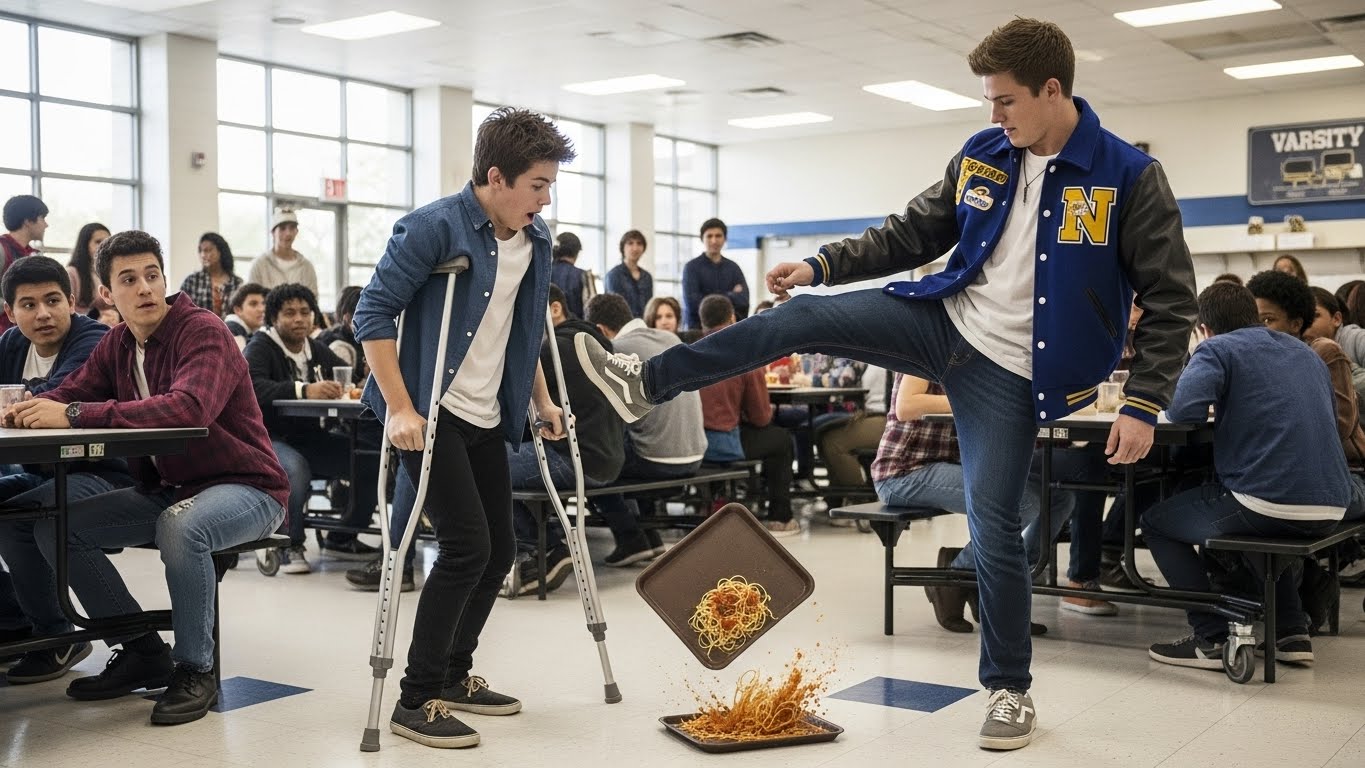
I didn’t see the kick coming. It wasn’t a violent stomp; it was subtle. A quick, calculated hook of his foot behind my good ankle. Just enough to disrupt the delicate physics holding me upright.
The world tilted.
“Whoa!” someone shouted, mocking concern.
I tried to save it. I flailed, my arm jerking out. The tray went airborne.
CRASH.
Time seemed to freeze. I hit the floor hard, my bad leg twisting in a way that sent a bolt of white-hot lightning up my spine. I gasped, the air knocked out of me. Then came the rain. The carton of chocolate milk exploded on impact. The pizza landed face down on my chest. The diced peaches scattered like sticky yellow gems across the floor.
Silence.
For three heartbeats, the cafeteria was dead silent. Then, a snort. Then a giggle. Then, the dam broke. Laughter washed over me, a tidal wave of humiliation. It wasn’t just Brad’s table; it was everywhere. People I didn’t even know were laughing. Some had their phones out, the camera lenses staring at me like unblinking eyes.
“Clean it up, cripple,” Brad laughed, leaning over me. He kicked my crutch, sending it spinning out of reach under a nearby vending machine. “You’re making a mess of my cafeteria.”
I lay there, covered in sauce and shame, staring at the fluorescent lights buzzing overhead. My dad used to tell me, “Leo, a man isn’t defined by how he stands, but by what he stands for.”
Well, Dad, I couldn’t stand at all.
I squeezed my eyes shut, fighting back the tears that burned like acid. I just wanted to dissolve. I wanted to be anywhere but here.
Chapter 2: The Ghost from the Sand
The laughter was at its peak—a crescendo of cruelty—when it was suddenly suffocated.
It didn’t taper off. It was strangled.
I opened my eyes, confused by the sudden drop in volume. Brad, who had been leaning over me with that shark-like grin, was no longer looking at me. He was looking past me, toward the double doors at the entrance of the cafeteria. His smile faltered, then vanished.
The floor vibrated. Thump. Thump. Thump.
It wasn’t the squeak of sneakers or the click of dress shoes. It was the heavy, dull impact of combat boots.
I craned my neck, trying to see from my position on the floor.
A man was walking down the center aisle. He didn’t walk like a high schooler, all loose limbs and posturing. He moved with a terrifying economy of motion. Every step was planted with purpose. He was a mountain of a man, dressed in desert camouflage fatigues that looked worn, stained with dust that wasn’t from Ohio. A faded green duffel bag was slung effortlessly over one massive shoulder.
He looked like a glitch in the matrix. A piece of a war zone dropped into a suburban lunchroom.
He stopped two feet from where I lay. Up close, he smelled of diesel fuel, old sweat, and peppermint gum. He looked down at me. His face was a landscape of harsh lines, tanned leather skin, and a jagged scar cutting through his left eyebrow. But his eyes… his eyes were a piercing, electric blue.
They scanned me, assessing the damage in a microsecond. No pity. Just assessment.
“Situation report,” he rumbled. His voice was gravel grinding on concrete.
“I… I fell,” I stammered, my voice cracking.
“You were pushed,” he corrected. It wasn’t a question.
He dropped his duffel bag. The heavy thud it made against the floor told me it was packed with more than just clothes. He extended a hand. It was the size of a catcher’s mitt, the knuckles scarred and rough.
“Grab hold, son.”
I reached up. His grip locked onto my forearm. He didn’t pull me; he hoisted me. It felt like being lifted by a construction crane. One moment I was in the spaghetti sauce; the next, I was vertical. He held me steady, his other hand gripping my shoulder to ensure I had my balance.
“Stay here,” he ordered softly.
He turned to the vending machine, retrieved my crutch, and handed it to me. Then, he turned slowly, like a tank turret, to face Brad.
The cafeteria was so quiet I could hear the hum of the refrigerator units.
Brad was standing now, but he looked small. He puffed out his chest, trying to summon the arrogance that usually protected him. “Excuse me? Who are you? You can’t just walk in here.”
The soldier took one step forward. Just one. But it invaded Brad’s personal space so aggressively that the quarterback flinched.
“I asked you a question,” Brad squeaked, his voice an octave higher than usual.
The soldier ignored the question. He looked at the mess on the floor—the milk, the pizza, the peaches. Then he looked at Brad’s white shoes.
“You made a mess,” the soldier said. His voice was calm. eerily calm. It was the voice of a man who had screamed over mortar fire and didn’t need to shout to be heard.
“He tripped,” Brad lied, pointing at me. “The clumsy idiot tri—”
“Pick it up.”
Brad blinked. “What?”
“The tray. The food. Pick. It. Up.”
“I’m not the janitor,” Brad scoffed, looking to his friends for backup. But the offensive line was suddenly fascinated by the grain of the wood on their table. No one moved.
The soldier leaned in. He didn’t touch Brad. He didn’t have to. He projected an aura of absolute, unyielding authority. “In my unit, we don’t leave men behind, and we don’t leave messes for others to clean. Now, you have three seconds to get on your knees, or I will teach you the difference between being a tough guy and being a man.”
“One.”
Brad’s face turned red, then pale.
“Two.”
The soldier’s eyes narrowed. The air in the room felt electric, like a thunderstorm about to break.
Brad broke first. His knees bent. The golden boy of Oak Creek High sank down into the puddle of chocolate milk and tomato sauce. His expensive jeans soaked up the filth. With trembling hands, he began to pile the ruined food back onto the tray.
A camera shutter clicked somewhere. Then another. The tables had turned.
When the floor was clear, the soldier pointed to the trash can. Brad walked the walk of shame, dumped the tray, and stood there, humiliated, waiting for permission to sit.
The soldier turned his back on him, dismissing him as a threat. He looked at me again, his expression softening just a fraction. He reached into the breast pocket of his uniform and pulled out a silver chain.
Dangling from it was a dog tag. It was old, tarnished, and dented.
“Leo Miller?” he asked.
I nodded, unable to speak.
“My name is Sergeant First Class Elias Holloway,” he said, his voice carrying to the back of the room. “I served with your father in Kandahar. I’m here because I owe him a debt I can never fully repay.”
He held the tag out. “And I’m not leaving until I do.”
Chapter 3: The Weight of Silver
The walk out of the cafeteria felt like a dream sequence. Or maybe a hallucination.
Sergeant Holloway grabbed his duffel bag with one hand and placed his other hand gently but firmly on the center of my back, guiding me toward the exit. It was a protective gesture, a shield against the hundreds of eyes boring into us.
“Chin up, Leo,” he murmured, his voice low enough that only I could hear. “Eyes forward. Never let them see you look down.”
I forced my head up. For the first time in two years, I wasn’t looking at my feet to check for tripping hazards. I was looking straight ahead. I saw the faces of my classmates—shocked, awed, whispering. I saw Mr. Henderson, the principal, bustling toward us from the teachers’ lounge exit, his face a mask of flustered bureaucracy.
“Excuse me! Sir! Excuse me!” Mr. Henderson waved a clipboard. “You can’t just barge onto a closed campus! This is a secure facility. I need to see some identification immediately, or I’m calling the police!”
Holloway didn’t stop. He didn’t even slow down. He just kept walking, forcing Mr. Henderson to trot alongside us to keep up.
“Sergeant Holloway. United States Army, 10th Mountain Division,” Holloway said, not breaking stride. “I’m escorting this civilian off the premises for the remainder of the day. Family emergency.”
“Family? You’re not listed on his file!” Henderson sputtered, looking at me. “Leo, do you know this man?”
I looked at Holloway. I looked at the scar on his brow, the grim set of his jaw, and the dog tag he was now clutching in his fist—my dad’s dog tag. I felt a strange, magnetic pull. A tether.
“Yes,” I lied. The word felt heavy, but right. “He’s… he’s a friend of my dad’s.”
Holloway glanced down at me, a flicker of approval in those icy blue eyes.
“We’re leaving, Mr. Principal,” Holloway said with finality. He pushed the double doors open, and the humid Ohio air hit us. “If you have an issue, you can call the recruiting office in downtown Dayton. Ask for Colonel Meyers. He’ll explain everything.”
We left Henderson standing on the sidewalk, mouth agape like a landed fish.
We walked in silence to the parking lot. My crutches clicked rhythmically, but now there was a counter-beat—the heavy crunch of Holloway’s boots. We stopped in front of a truck that matched its owner perfectly: a black, mid-2000s Ford F-150. It had rust around the wheel wells, a cracked windshield, and a bumper sticker that read ALL GAVE SOME, SOME GAVE ALL.
Holloway unlocked the passenger door and held it open for me. I had to hoist myself up, wincing as my bad leg dragged over the sill. He waited until I was settled before shutting the door with a solid thunk.
When he climbed into the driver’s seat, the cab shrank. He was just so… big. He tossed his duffel bag into the back seat and keyed the ignition. The engine roared to life with a throaty rumble.
He didn’t drive away immediately. He sat there, hands gripping the steering wheel at 10 and 2, staring out the windshield at the brick facade of the high school.
“I watched you for two days,” he said suddenly.
I blinked, startled. “What?”
“I got into town Monday. I parked across the street. Watched you get off the bus. Watched you walk in.” He turned to look at me, and the intensity in his gaze made me want to shrink into the upholstery. “I needed to know what kind of man John’s son was before I made contact.”
“John…” The name hung in the air. “You really knew him? You knew my dad?”
Holloway reached into his pocket and pulled out the dog tag again. He unclasped the chain and held it out.
“Take it.”
My hand trembled as I took the cold metal. I rubbed my thumb over the raised letters. MILLER, JOHN A. The metal was worn smooth in places, as if someone had rubbed it incessantly.
“He died two years ago,” I whispered. “Car accident. Here. Not… not in the war.”
“I know,” Holloway said. His voice dropped, thick with an emotion I couldn’t place. Guilt? Anger? “I was in Germany for rehab when I heard. I was in a hospital bed, learning how to walk again, while your father was being buried.”
I looked at his legs. “You were hurt?”
“IED. Kandahar Province. Three years ago.” Holloway tapped his left thigh. “Took a chunk of me. Would have taken all of me if your dad hadn’t dragged me into that alleyway.”
The air in the truck seemed to get thinner. My dad never talked about the war. He was just Dad. The guy who coached Little League and made terrible pancakes on Sundays.
“He saved you?”
“He took two bullets in his vest and shrapnel in his arm getting me to the extraction point,” Holloway said. “He never told you?”
I shook my head.
“Typical John.” Holloway let out a short, humorless laugh. “Humble to a fault.”
He put the truck in gear. “Where do you live, Leo?”
I hesitated. I didn’t want him to see. I didn’t want this superhero to see the run-down apartment complex on the south side, the peeling paint, the eviction notices my mom tried to hide in the kitchen drawer.
“It’s… it’s not far. But my mom is at work. She works double shifts at the diner.”
“Then we’ll wait,” Holloway said. “I need to speak to her, too.”
“Why?”
Holloway looked at me, and for a second, the hard soldier mask slipped. I saw a man who was tired. A man carrying a burden heavier than that duffel bag.
“Because your father made me promise something that night in the alley,” Holloway said, pulling out of the school parking lot. “He made me promise that if anything ever happened to him, I’d check in. I’m two years late, Leo. And from what I saw in that cafeteria today…”
He tightened his grip on the steering wheel until his knuckles turned white.
“…I’ve got a lot of work to do.”
As we drove away, leaving the school and Brad and the humiliation behind, I looked at the dog tag in my hand. For the first time since the accident, I didn’t feel invisible. I felt like I was part of something.
But as we turned onto the potholed street leading to my apartment, I felt a knot of dread. Holloway was here to pay a debt. But he had no idea just how broken the Miller family really was.Chapter 4: A House Built on Sand
The apartment complex was called “Sunnyvale Estates,” a name that was essentially a lie painted in peeling beige stucco. It sat on the edge of town, sandwiched between a rusted chain-link fence and the highway noise barrier.
I led Sergeant Holloway up the concrete stairs to unit 2B. My crutches echoed loudly in the narrow stairwell. Clack. Drag. Step. I was acutely aware of the smells—stale cigarette smoke from the neighbor, boiled cabbage, and damp carpet.
“It’s not much,” I mumbled, fumbling with my key.
“It’s a roof,” Holloway said. He wasn’t judging. His eyes were scanning the perimeter, checking the sightlines, the flimsy lock on the door. Always the soldier.
We stepped inside. The apartment was small, dim, but immaculately clean. My mom, Sarah, waged a constant war against the decay of this place. The cheap laminate furniture was dusted; the threadbare rug was vacuumed. But you couldn’t scrub away the feeling of desperation. It hung in the air like humidity.
On the kitchen counter, a stack of envelopes sat like a tombstone. FINAL NOTICE. PAST DUE. URGENT.
“Mom’s not back yet,” I said, checking the wall clock. “She picks up extra shifts at the diner whenever she can. To pay for…” I gestured vaguely at my leg. “The therapy. The brace.”
Holloway set his duffel bag down. He walked over to the mantle where a framed photo of my dad sat. It was taken before the deployment. Dad was smiling, holding a baseball bat, looking invincible.
“He talked about you guys every night,” Holloway said softly. “In the desert, when the mortars stopped, he’d talk about Sarah’s pot roast and Leo’s pitching arm.”
I felt a lump in my throat. “I don’t pitch anymore.”
“No,” Holloway turned to me. “Not right now, you don’t.”
The front door unlocked with a jiggle and a shove. My mom walked in. She looked exhausted, her waitress uniform stained with coffee, her hair escaping her bun. She froze when she saw the giant man in camouflage standing in her living room.
Her eyes went wide. She dropped her purse. Her hand went to her mouth, stifling a scream.
“Leo?” she gasped, rushing toward me, putting herself between me and the stranger. “Who is this? What’s happening?”
“Ma’am,” Holloway stood at attention, removing his cap. “I didn’t mean to startle you.”
“Mom, it’s okay,” I said quickly. “He… he knew Dad.”
My mom stopped. Her posture, usually slumped with fatigue, straightened. She looked at Holloway—really looked at him. She saw the uniform, the dust, the haunted eyes.
“John?” she whispered.
“Sergeant Elias Holloway, ma’am. 10th Mountain.” He held out the dog tag again. “I served with John. He… he saved my life.”
My mom stared at the dog tag. She didn’t take it. She just collapsed.
It wasn’t a faint; her legs just gave out. Holloway moved faster than a man his size should be able to. He caught her before she hit the floor, guiding her gently to the worn-out sofa.
For the next hour, the apartment was filled with stories. Holloway sat on our rickety chair, drinking a glass of tap water, telling my mom things she’d never known. He told her how Dad was the moral compass of the platoon. How Dad had given his rations to local kids. How Dad had dragged Holloway through a kill zone while bleeding out himself.
“I came to pay my respects,” Holloway said, his voice rough. “And to fulfill a promise. But looking around…” He gestured to the stack of bills on the counter. “I see I have other work to do.”
My mom wiped her eyes, her pride flaring up. “We’re fine, Sergeant. We’re managing.”
Holloway stood up and walked to the counter. He picked up an envelope with red lettering. “Eviction Warning,” he read. “This doesn’t look like ‘fine,’ Sarah.”
“It’s none of your business,” Mom snapped, though her voice shook. “You can’t just waltz in here two years later and judge us. You don’t know what it’s been like. The insurance company found a loophole. The driver who hit them… he had a good lawyer. We got nothing. John is gone, Leo is crippled, and I’m drowning.”
She broke down sobbing. It was a sound I hated. A sound of total defeat.
Holloway didn’t flinch. He walked over to her, knelt on one knee, and took her hand.
“You’re right,” he said. “I’m late. I should have been here two years ago. But I’m here now. I have a pension. I have two good hands. And I have a debt to John Miller that I intend to square.”
He looked at me.
“Starting with the boy.”
Chapter 5: The Art of Standing Still
The next morning, at 05:00, my door was kicked open.
“Up,” a voice barked. “Gear on. Let’s go.”
I groaned, looking at the glowing red numbers on my alarm clock. “It’s Saturday. It’s five in the morning.”
“War doesn’t sleep in on weekends, and neither does recovery. Move.”
Ten minutes later, I was standing in the empty parking lot behind the apartment complex. The air was cold, grey, and misty. My breath plumed in front of me. I leaned heavily on my crutches, shivering in my gym shorts.
Holloway was wearing a grey army PT shirt and shorts, looking like the cold didn’t even touch him. He had a piece of chalk in his hand. He drew a small circle on the asphalt, maybe two feet wide.
“Get in the circle,” he ordered.
I crutched over to it. “Okay. Now what?”
“Drop the crutches.”
I stared at him. “What? I can’t. My leg—”
“Your leg is weak because you baby it. The doctors put the metal in, the bone has healed. The rest is in your head. Drop. The. Crutches.”
I hesitated. The fear of falling was a constant companion, a shadow that never left me. But Holloway’s eyes were unrelenting.
I let them fall. Clatter. Clatter.
I stood there, wobbling on my left leg. The brace felt heavy. Pain shot up my thigh—a dull, throbbing ache. I instinctively shifted all my weight to my right leg.
“Two legs,” Holloway barked. “Distribute the weight. 50-50.”
“It hurts!”
“Good! Pain is information. It tells you you’re still alive. It tells you where the weakness is.” He circled me like a shark. “Brad pushed you because you were off balance. Not physically. Mentally. You were already falling before he touched you.”
He stepped in front of me and gave me a light shove on the shoulder.
I stumbled back, almost falling out of the circle.
“Reset!” he yelled. “Root yourself. Imagine your feet are growing into the concrete. You are a tree. You are a mountain. Push back against the earth.”
We did it for an hour. He shoved me. I stumbled. He shoved me. I fell. I scraped my palms. I cursed him. I cried.
“I can’t do this!” I screamed from the ground, sweat and tears mixing on my face. “I’m a cripple! Look at me!”
Holloway stopped. He squatted down, getting eye-level with me. The anger was gone from his face, replaced by a quiet intensity.
“You think you’re the only one broken, Leo?”
He rolled up the left leg of his shorts.
There was a scar there that looked like a crater. A mass of twisted, purple tissue where muscle used to be. It was ugly. It was brutal.
“I lost 40% of my quad muscle,” he said quietly. “Doctors said I’d walk with a cane for the rest of my life. They said I was done.”
He stood up and jumped. A vertical leap, landing solidly on both feet.
“They were wrong. Because I decided they were wrong.” He offered me a hand. “The world is going to push you, Leo. Brad is going to push you. Life is going to push you. You have two choices: You stay down and wait for someone to save you, or you stand up and make them move.”
I looked at his hand. Then I looked at the asphalt.
I didn’t take his hand.
Gritting my teeth, I rolled onto my stomach. I pushed up. My arms shook. My bad leg screamed in protest. I gasped for air. Slowly, agonizingly, I forced myself up. I wobbled. I swayed.
But I stood.
Holloway smiled. It was the first real smile I’d seen on him.
“Good,” he said. “Now, pick up your crutches. We’re going for a run.”
“A run?” I wheezed.
“I run. You ruck.” He pointed to his heavy rucksack. “Put it on.”
That morning, the neighbors of Sunnyvale Estates watched a strange parade: a giant soldier jogging slowly, and a teenage boy on crutches, carrying a heavy pack, struggling, sweating, but moving forward.
For the first time in two years, I wasn’t the victim. I was a recruit.
Chapter 6: The Wolf at the Door
By Monday, the dynamic in the apartment had changed. Holloway was sleeping on the couch. He had fixed the leaking faucet, re-caulked the bathtub, and organized the pantry. He paid for groceries with crisp twenty-dollar bills and refused to take a cent from Mom.
But the real world has a way of crashing the party.
I came home from school—where, miraculously, Brad had avoided me all day—to find a black luxury sedan parked in front of our building. It looked like a shark in a goldfish pond.
I heard shouting from inside our apartment.
I hurried up the stairs, my new confidence faltering. I pushed the door open.
My mom was standing by the kitchen table, clutching a dishrag, looking terrified. Holloway was standing between her and a man in a tailored suit.
The man was tall, silver-haired, with the same arrogant jawline as Brad. It was Mr. Calloway. Brad’s father. And, as I suddenly remembered, the owner of the management company that ran Sunnyvale Estates.
“I don’t care who you are,” Calloway was saying, his voice smooth and oily. “You’re not on the lease. You’re trespassing.”
“I’m a guest,” Holloway said, his voice dangerously low. “And you’re raising your voice at a lady.”
Calloway scoffed. He looked at me as I entered. “Ah, the son. I heard about the little incident at school, Leo. My son Brad tells me you were quite… disruptive. Throwing food?”
“He kicked me!” I blurted out.
“Perspective is a funny thing,” Calloway smiled coldly. He turned back to Mom. “Look, Sarah, I’ve been patient. But you’re three months behind. And now you have… vagrants staying here. It’s a violation of code.”
He pulled a folded paper from his inside pocket and tossed it onto the table.
“Notice to Quit. You have 72 hours to vacate the premises. If you’re not out by Thursday, the Sheriff comes to put your things on the curb.”
My mom made a small, wounded sound.
Holloway took a step forward. He towered over Calloway. “You can’t do that. She needs time. She’s working double shifts.”
“Not my problem,” Calloway sneered. He poked a finger into Holloway’s chest—a fatal mistake. “And you, G.I. Joe. If I see you near my son again, or if you threaten him like you did at school, I’ll have you arrested for assault. You think you’re a hero? You’re just a homeless vet with a violent streak. I know your type.”
The air in the room froze.
I saw Holloway’s hand twitch. I saw the vein in his neck pulse. For a second, I thought he was going to kill him. I saw the flash of the war in his eyes—the pure, unfiltered violence.
But then, he took a breath. He forced his hands open.
“Get out,” Holloway whispered.
Calloway straightened his suit jacket. “72 hours, Sarah. Tick tock.”
He brushed past me and walked out the door.
Silence descended on the room. Mom sank into a chair, burying her face in her hands. “What are we going to do? Where do we go?”
Holloway stared at the door where Calloway had exited. He looked shaken. Not by the threat of arrest, but by the restraint he had to exercise. He turned to me, and I saw something new in his eyes. Doubt.
He was a warrior. He could fight insurgents. He could endure pain. But he couldn’t fight a bank account. He couldn’t shoot an eviction notice.
“I…” Holloway started, then stopped. He looked at the Notice to Quit on the table.
“I need air,” he said abruptly.
He grabbed his jacket and stormed out of the apartment, leaving Mom and me alone in the silence.
I went to the window and watched him pace in the parking lot below. He was pacing back and forth, hitting his own head with his palms, arguing with ghosts I couldn’t see.
That night, I woke up to a sound coming from the living room.
It was a low, guttural whimpering.
I crept out of my bedroom. Holloway was thrashing on the couch, tangled in the blanket. He was soaked in sweat.
“Don’t… don’t go left…” he muttered in his sleep, his voice thick with panic. “John… watch the flank… NO!”
He sat up with a gasp, his eyes wide and unseeing, staring into the darkness. He was hyperventilating, his hand clutching at his chest as if checking for a wound.
He wasn’t the invincible statue from the cafeteria. He was a man broken by the same event that broke my family.
I stepped into the light. “Sergeant?”
Holloway jumped, his hand instinctively reaching for a weapon that wasn’t there. He focused on me, his breathing ragged. He wiped his face with a trembling hand.
“Sorry,” he rasped. “Bad dream.”
I walked over and sat on the coffee table across from him. “It was about him, wasn’t it? My dad.”
Holloway nodded slowly. “Every night. I see him. I see the truck. I see the flash.” He looked at me, his eyes wet. “I can teach you to walk, Leo. I can teach you to fight. But I don’t know how to save you from this.” He gestured around the apartment. “I don’t know how to fight a man like Calloway with empty pockets.”
“You stood up for me,” I said. “Nobody has done that in two years.”
“Standing up is easy,” Holloway murmured, looking at the eviction notice still on the table. “Staying standing… that’s the hard part.”
He looked at me, a sudden hardness returning to his jaw.
“But I’ll be damned if I let Calloway win. I need to make a call.”
“Who?”
” Colonel Meyers. The recruiter I told Henderson about. He owes me a favor.” Holloway stood up, the soldier returning to his body. “Leo, tomorrow we aren’t training at the park.”
“Where are we going?”
“We’re going to the City Hall,” he said grimly. “We’re going to find out who really owns this building. Because men like Calloway… they always have secrets. And I’m good at reconnaissance.”