“Are You Lost Too, Mister?” — The Question That Saved a Billionaire’s Life on Christmas Eve
Chapter 1: The Ghost in Terminal C
The announcement system at O’Hare International Airport chimed with a sound that had become a form of psychological torture for the thousands of stranded souls packed into Terminal C.
“Attention passengers. Flight 471 to Denver remains delayed due to severe weather conditions. We apologize for the inconvenience.”
Outside the floor-to-ceiling glass windows, the world had been erased. A white void of swirling snow hammered against the glass, turning the tarmac into a frozen wasteland. It was December 24th, Christmas Eve, and the worst blizzard in a decade had parked itself directly over Chicago.
Inside, the air was thick with the smell of wet wool, stale coffee, and rising panic. People were sleeping on their luggage, arguing with exhausted gate agents, or frantically refreshing weather apps on their phones.
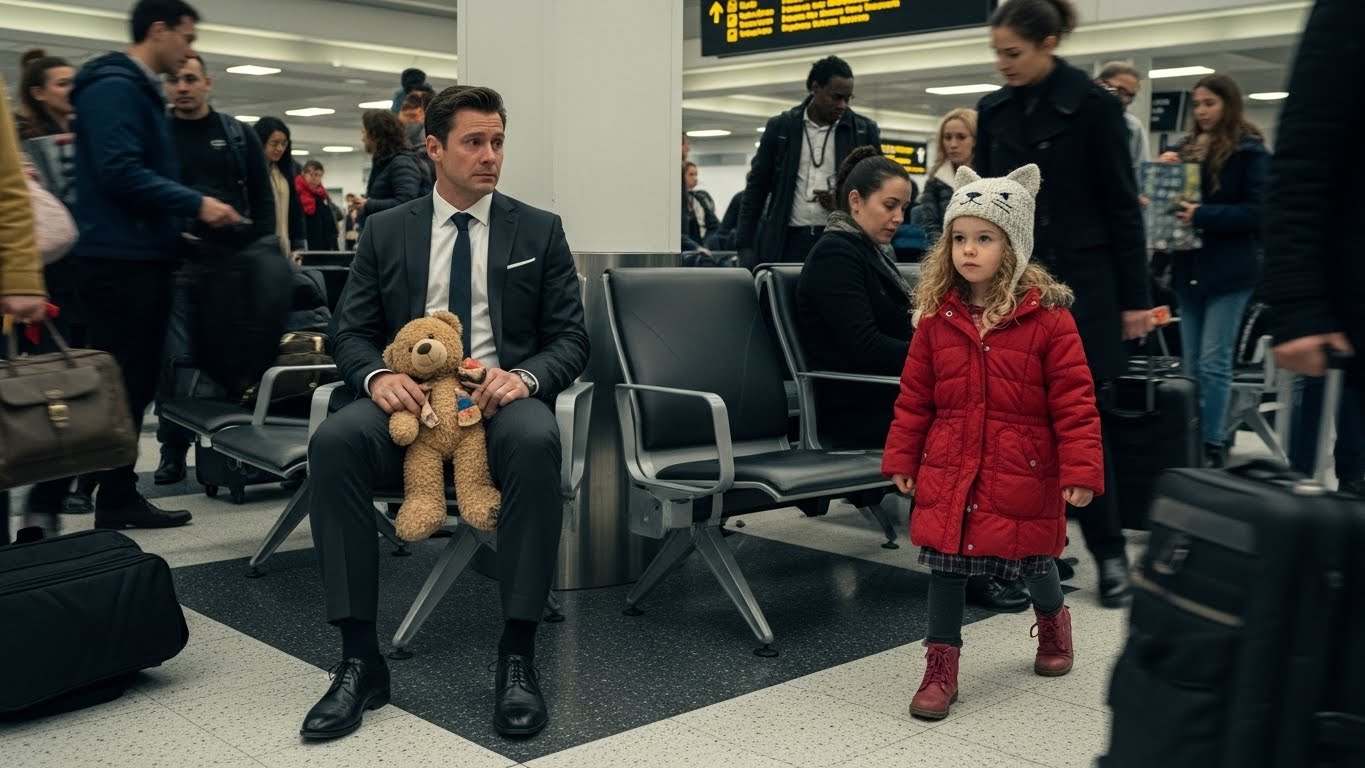
But in a secluded corner near Gate C12, away from the screaming toddlers and the angry businessmen, Graham Lockach sat in a silence so profound it felt like a force field.
Graham was forty-two years old, though his eyes looked a thousand. He wore a charcoal bespoke suit that cost more than the annual salary of the janitor sweeping the floors nearby. His shoes were Italian leather, his haircut was precise, and his posture was rigid. He looked like a man who controlled empires, a man who moved mountains with a signature.
But today, Graham Lockach controlled nothing.
He sat on the hard plastic airport chair, staring blankly at the swirling snow. On the empty seat next to him, incongruous and jarring against his pristine appearance, sat a teddy bear.
It was an ugly thing, by most standards. Its golden fur was matted and worn down to the fabric in patches. One ear was hanging by a few loose threads, flopping sadly to the side. Its left button eye was stitched slightly off-center, giving it a perpetually confused, lopsided gaze.
Graham’s hand rested on the bear’s head. His thumb moved rhythmically, stroking the worn fabric. Left, right. Left, right. It was the only sign of life in his body.
He wasn’t waiting for a flight. He had a private jet parked in a hangar three miles away, grounded just like everything else. But even if the sky were clear, Graham wouldn’t be flying. He came to the airport on Christmas Eve for the noise.
He came because his penthouse in Manhattan was too quiet. The silence there was heavy; it pressed against his eardrums until he thought they might burst. Here, amidst the chaos of strangers fighting to get home to their families, the noise drowned out the memories.
Five years.
It had been exactly five years since the phone call. Since the black ice on the highway. Since the police officer handed him a plastic bag containing a wallet, a set of keys, and this bear. It was supposed to be a birthday gift for his daughter, Emily. She never got to hold it.
Graham took a shaky breath, the air conditioning chilling the sweat on his neck. He was a ghost. A billionaire ghost haunting a terminal, watching people rush toward lives he no longer had. He closed his eyes, wishing he could just fade into the gray upholstery of the chair.
Then, he felt it.
A tug. Gentle, hesitant, but undeniable.
Graham didn’t open his eyes immediately. He assumed it was someone bumping into him with a carry-on. But the tug came again, stronger this time. A pull on the sleeve of his expensive jacket.
He opened his eyes and turned his head slowly, his expression set in a mask of cold indifference, ready to dismiss the intruder.
The mask shattered.
Standing there, barely tall enough to see over the armrest of his chair, was a little girl.
She was a riot of color in his gray world. She wore a puffy red coat that made her look like a festive marshmallow, pink mittens, and a knit hat with cat ears that had slipped down over her forehead. Her hair was a mess of soft brown curls, and her cheeks were flushed a deep, alarming crimson.
She was clutching a tiny, glittery backpack to her chest with both hands, her knuckles white. But it was her eyes that pinned Graham to the spot. They were huge, brown, and glistening with unshed tears. But they weren’t panicked. They were determined.
Graham stared at her. He felt a phantom pain in his chest, a hollow ache where his heart used to be. She looked so much like… her.
The girl sniffled, tilting her head to the side. She looked at Graham’s face, then down at the ragged teddy bear under his hand, and then back up to his eyes.
“Excuse me,” she whispered. Her voice was small, trembling, but clear.
Graham couldn’t speak. He just stared.
“Are you lost too, mister?” she asked earnestly.
The question hit him like a physical blow. Lost.
Was he? He knew his coordinates. He knew his bank balance. He knew his social security number. But looking at this child, he realized he hadn’t known where he was—really was—since the day the doctors turned off the machines.
She took a small step closer, her voice gaining a tiny bit of confidence. “Because I can help you find your mommy.”
Graham blinked, the stinging in his eyes sudden and sharp. He opened his mouth to say, “I’m not lost,” but the lie died on his tongue. He looked at the bear. He looked at the empty seat. He looked at the reflection of a hollow man in the dark window.
“I…” Graham croaked. He cleared his throat, trying to find the voice he used in boardrooms. “I am not… I don’t have a mommy to find.”
The little girl nodded solemnly, as if this made perfect sense. “That’s okay. I can’t find mine either.”
She pointed a pink mitten toward the chaotic sea of people in the main concourse. “She was right there. I just… I saw the candy shop. The one with the red jelly beans. Mommy says too much sugar makes you jumpy, but I just wanted to look. And then…”
She made a small exploding motion with her hands. “Poof. She was gone.”
Graham felt a cold spike of adrenaline. A child this age, alone in an airport like this? The dangers were endless. His CEO brain kicked in—assess risk, mitigate, execute protocol. He should call security. He should flag down an officer.
But then the girl did something that overrode every protocol.
She reached out and took his hand.
Her mitten was damp and sticky, probably from the candy she never got to buy. But her grip was firm.
“But it’s okay,” she said, her voice shaking slightly now, betraying the bravery she was trying so hard to project. “Mommy says if you get lost, you have to stay kind. And if you stay kind, the magic will find you.”
She looked up at him, her eyes searching his face for confirmation. “Do you want to come with me? We can look for them together. Maybe your… maybe whoever you’re missing is looking for you, too.”
Graham looked at his hand, engulfed by hers. He felt a warmth spreading up his arm, thawing the ice that had encased his veins for half a decade.
He looked at the bear. For five years, he had carried it as an anchor to the past. But this girl… she was pulling him into the present.
Slowly, stiffly, Graham Lockach stood up. He towered over her, a dark silhouette against the storm. He picked up the bear, tucked it securely under his left arm, and tightened his grip on her tiny hand.
“Okay,” he whispered, his voice rough. “Let’s go find her.”
Chapter 2: The Unlikely Alliance
They were an odd pair, cutting a path through the crowded terminal.
Graham, tall and imposing in his tailored wool coat, walked with a stride that usually commanded attention. But today, he shortened his steps, matching the hurried, bouncing pace of the five-year-old beside him.
Sophie—she had told him her name was Sophie within ten seconds of them starting their walk—was a chatterbox. It was a defense mechanism, Graham realized. As long as she was talking, she didn’t have to think about the fact that she was alone in a massive building with a stranger.
“Her name is Clara,” Sophie explained, swinging his hand as they walked. “She has hair like sunshine, yellow and bright. And she wears glasses when she writes. She’s writing a book, you know. About a turtle.”
Graham looked down, genuinely distracted from his own misery for the first time. “A turtle?”
“Yeah!” Sophie beamed, momentarily forgetting her fear. “A turtle who learns to fly. Not with wings, though. With a balloon. Mommy says anything is possible in stories. That’s why she likes them.”
Graham felt a twinge in his chest. Anything is possible in stories. In real life, turtles didn’t fly, and little girls didn’t get to grow up. But he pushed the thought away.
“We should check the candy shop first,” Graham said, taking charge. “Since that’s where you last saw her.”
“Good idea, Mister… what’s your name?”
“Graham.”
“Mr. Graham. That sounds like a cracker.” She giggled.
They navigated the throngs of people. The airport was a sensory overload—announcements blaring, babies crying, the smell of fast food and stress. Graham noticed the looks they were getting.
A woman in a heavy fur coat frowned at them as they passed. A security guard scanned them, his eyes lingering on Graham’s expensive suit and the battered teddy bear tucked under his arm. To the outside world, they looked like a father and daughter. Or perhaps something more confusing.
Graham pulled his shoulders back, his “CEO stare” returning just long enough to glare down anyone who looked at them with suspicion. He wasn’t letting go of this hand. Not until she was safe.
They reached the candy store. It was a brightly lit explosion of sugar and color. Graham knelt down, ignoring the dust on the floor that would ruin his trousers.
“Do you see her?” he asked gently.
Sophie scanned the crowd, standing on her tiptoes. Her eyes darted frantically from face to face. The hope in her expression began to crumble.
“No,” she whispered, her lip trembling. “She’s not here.”
She looked up at Graham, and the bravery finally cracked. A single tear rolled down her flushed cheek. “What if she left? What if the plane went without me?”
Graham felt a surge of protectiveness so fierce it almost knocked him over. He squeezed her hand.
“She didn’t leave, Sophie. No mother would leave you. The planes aren’t flying anyway. Look.” He pointed out the window at the wall of white snow. “Nobody is going anywhere. She’s here. And she is looking for you just as hard as we are looking for her.”
Sophie sniffled and wiped her nose on her mitten. “You promise?”
Graham hesitated. He was a man of data, of hard facts. He didn’t make promises he couldn’t guarantee. But looking at this terrified little girl, he realized facts didn’t matter. Hope mattered.
“I promise,” he said. “I’m good at finding things. It’s my job.”
“You find lost mommies for a living?”
“Something like that.”
They continued walking. They checked the bookstore. They checked the food court. They checked the waiting area by the restrooms.
As they walked, Sophie started humming. It was a shaky, off-key version of Silent Night.
“You’re not scared?” Graham asked, surprised by her resilience.
Sophie shook her head, though her grip on his hand tightened. “Not really. Mommy always says fear is just a shadow. If you turn on a light, it goes away.” She looked up at him. “You’re my light right now, Mr. Graham.”
Graham stumbled. He missed a step.
You’re my light.
He had been called a shark, a genius, a tyrant, a visionary. But nobody had called him a light. Not in five years. He looked down at the teddy bear in his arm—the symbol of his dead past—and then at the girl holding his hand—the symbol of a living present.
“Let’s check the Information Desk,” Graham said, his voice thick with emotion. “That’s where people go when they need answers.”
“Okay!” Sophie said, her optimism rebounding. “Maybe she’s there eating a pretzel. She loves pretzels.”
They turned a corner, heading toward the central hub of the terminal. The crowd was denser here. Graham used his body as a shield, creating a path for Sophie.
“Stay close,” he murmured.
“I am,” she said. “I’m holding on tight.”
And she was. But Graham realized, with a start, that he was holding on tighter. He wasn’t just guiding her anymore. She was pulling him. Pulling him out of the grave he had dug for himself.
“Mr. Graham?”
“Yes, Sophie?”
“Are you still sad?”
Graham looked ahead, his jaw tight. “Why do you ask?”
“Because your bear looks lonely. And you looked lonely too.”
Graham swallowed the lump in his throat. “I think…” He paused. “I think I’m a little less lonely now.”
Chapter 3: The Panic and the Reunion
Clara was vibrating.
It was a physical sensation, a hum of terror that started in the soles of her feet and rattled her teeth. She stood at the TSA Security checkpoint, her hands gripping the edge of the metal desk so hard her knuckles were turning blue.
“Please,” she begged the officer, her voice cracking. “She’s five. She’s wearing a red coat. A cat hat. She was right behind me.”
The officer, a tired woman named Brenda who had been dealing with angry travelers for twelve hours straight, looked sympathetic but calm. Too calm.
“Ma’am, take a breath. We’ve locked down the exits. No one is leaving the terminal. We have eyes on the cameras. It’s crowded. Kids wander off.”
“She doesn’t wander!” Clara snapped, then immediately regretted it. “I’m sorry. I’m just… she’s my whole world. We’re moving to Portland. She doesn’t know this city. She doesn’t know anyone.”
Clara turned around, scanning the sea of strangers for the thousandth time. Every flash of red made her heart leap, only to crash when she realized it was a suitcase or a scarf.
The guilt was eating her alive. She had just wanted to check the gate number. Just for a second. She had let go of Sophie’s hand to adjust her tote bag. One second. That’s all it took for the world to end.
“If you get lost, stay put or find a helper,” she had told Sophie a million times. But would she remember? Sophie was a dreamer. She lived in her head, in the stories Clara wrote for her. She was too trusting. She thought the world was a fairy tale where nothing bad happened.
Clara knew better. The world was hard. It took things from you. It had taken her husband, Sophie’s dad, three years ago. It had taken their house when the bills piled up. It couldn’t take Sophie. It just couldn’t.
“Attention passengers,” the intercom buzzed. Clara flinched. “If anyone has found a missing child matching the description: female, age five, red coat…”
Clara closed her eyes and prayed. Please let someone kind find her. Please.
Across the terminal, near the entrance to the G gates, Graham stopped. He heard the announcement echo off the vaulted ceilings.
“Did you hear that?” he asked Sophie.
Sophie looked up, her eyes wide. “That’s me! They’re talking about me on the big speaker!”
“That means your mom is at the security desk,” Graham said, a wave of relief washing over him, followed immediately by a strange, heavy sadness. The mission was ending.
“Let’s run!” Sophie yelled.
She tried to bolt, but Graham held her back gently. “No running. It’s too crowded. We walk fast. Stay with me.”
They moved with purpose now. Graham cut through the crowd like an icebreaker ship, his height and broad shoulders parting the sea of travelers. Sophie trotted beside him, her little legs working double time.
As they rounded the final corner near the security checkpoint, Graham saw her.
A woman with chaotic blonde hair, wearing a worn denim jacket and a scarf that had unraveled. She looked frantic, her head snapping back and forth, tears streaming freely down her face. She looked like she was about to collapse.
“Mommy!” Sophie screamed.
The sound cut through the airport noise like a siren.
Clara froze. She spun around. Her eyes locked on the small red figure running toward her.
“Sophie!”
Clara dropped to her knees, disregarding the hard tile floor. She opened her arms just as Sophie collided with her. The force of the impact almost knocked Clara over, but she held on. She buried her face in Sophie’s curls, sobbing openly, rocking back and forth.
“I’ve got you. I’ve got you. Oh my god, Sophie.”
Graham stood back, about ten feet away. He felt like an intruder on a sacred moment. He tightened his grip on the teddy bear, suddenly feeling very foolish holding a toy in his expensive suit. He took a half-step back, preparing to slip away into the crowd. That was his role, wasn’t it? The unseen helper. The ghost.
“I found a friend, Mommy!” Sophie said, pulling back from the hug but keeping her hands on Clara’s face. “He helped me. He has a bear!”
Clara looked up, wiping her eyes with the back of her hand. Her gaze followed Sophie’s pointing finger.
She saw him.
Graham Lockach stood there, looking uncomfortable. He was clearly a man of wealth—Clara had waitressed enough high-end events to recognize a suit that cost more than her rent. But he looked… disheveled. His tie was slightly crooked. He was clutching a ragged, broken teddy bear like a lifeline.
Clara stood up, holding Sophie’s hand tightly. She stepped toward him.
The initial instinct was defensive—who is this man with my daughter? But then she saw his eyes. They weren’t predatory. They were tired. Deeply, profoundly sad. And they were kind.
“You…” Clara started, her voice raspy from crying. “You found her.”
“She found me, actually,” Graham said, his voice low. “She asked if I was lost.”
Clara looked at Sophie, then back at Graham. She saw the way he stood, protective but respectful. She saw the bear.
“Thank you,” she breathed. The relief made her dizzy. “I don’t… I don’t know how to thank you. I was… I thought…”
“It’s okay,” Graham interrupted gently. “She’s safe. That’s all that matters.”
He extended his hand, then realized he was still holding the bear. He awkwardly shifted it to his other arm. “I’m Graham.”
Clara reached out and took his hand. Her grip was warm, calloused from work, and shaking. “Clara. This is Sophie.”
“I know,” Graham said. A small, genuine smile touched his lips—the first one in years. “She told me about the turtle. The one that flies.”
Clara laughed, a wet, breathless sound. “Oh. You heard about the turtle.”
“I did.” Graham looked down at Sophie. “She’s a brave kid, Clara. You raised a good one.”
“She’s my magic,” Clara whispered, looking down at her daughter.
Sophie tugged on Clara’s hand. “Mommy, look at his bear. It’s hurt. It has a boo-boo on its ear.”
Clara looked at the bear in Graham’s arm. It was clearly old, loved, and out of place. She looked at Graham’s face and saw the shadow behind his eyes. She recognized it because she saw it in the mirror every day since her husband died. Grief.
“It’s a very special bear,” Clara said softly to Sophie, her eyes locked on Graham. “It looks like it’s been waiting for a friend.”
Graham felt his throat tighten. He nodded, unable to trust his voice.
“Well,” Graham said finally, stepping back. “I should… let you get back to…”
He didn’t know how to finish the sentence. Back to what? Waiting?
“Wait,” Clara said. She looked around the chaotic terminal. The delay board flickered ominously. FLIGHTS CANCELLED. “We aren’t going anywhere. The flights are grounded for the night.”
She looked at Graham, standing alone in his expensive coat, holding his sad bear. She couldn’t let him just walk back into the grayness. Not after he brought her world back to her.
“We were going to find some food,” Clara lied. She wasn’t hungry, she was nauseous, but she pushed through. “Would you… would you like to join us? As a thank you?”
Graham froze. His instinct was to say no. To retreat to his silence. But then Sophie looked up at him and beamed.
“Please, Mr. Graham? We can pretend the bear is hungry too.”
Graham looked at the two of them. The mother who had lost everything but hope, and the girl who believed in magic.
“I…” Graham started. “I know a place. Upstairs. It’s quieter. My treat.”
Chapter 4: The Café Above the Chaos
The café was a sanctuary.
Located on the mezzanine level, tucked away behind the airline lounges, it was shielded from the madness of the main concourse. The lighting was soft and golden, jazz music played quietly in the background, and the smell of roasted coffee beans replaced the scent of panic.
Graham had navigated them there with the ease of someone who owned the place—which, Clara suspected, he might, given how the staff jumped to attention when he walked in.
They sat in a curved leather booth near the window. The snow was still falling outside, but in here, it felt like a snow globe—beautiful rather than threatening.
Sophie sat between them, happily demolishing a plate of macaroni and cheese that Graham had ordered for her before they even sat down.
Clara nursed a cup of hot tea, her hands still trembling slightly. She watched Graham. He was drinking black coffee, staring out the window, but every few seconds his eyes would flick to Sophie, checking on her.
“You didn’t have to do this,” Clara said quietly. “Bring us here. Pay for all this.”
Graham turned to her. He had taken off his coat, revealing the crisp white shirt underneath. The teddy bear sat on the table next to the sugar dispenser, watching them with its one good eye.
“I didn’t have to,” Graham agreed. “But I wanted to. The terminals are a mess. Sophie needs to rest.”
“So do you,” Clara noted. She studied his face. He was handsome, in a severe, architectural way. But he looked exhausted. Soul-tired. “You were alone down there. On Christmas Eve.”
It wasn’t a question. It was an observation.
Graham traced the rim of his coffee cup. “I prefer airports on holidays. Everyone is going somewhere. It feels… purposeful. Even if I’m not.”
“Where were you headed?”
“Nowhere. I live in New York. I just… sit.”
He said it so simply that it broke Clara’s heart. She knew about grief. She knew how it hollowed you out. But she had Sophie. Sophie forced her to get up, to make breakfast, to write stories about flying turtles. Graham had… a bear.
“That bear,” Clara said gently, nodding toward it. “Does he have a name?”
Graham looked at the toy. His expression softened, crumbling at the edges. “It was for my daughter. Emily. She would have been Sophie’s age.”
The air in the booth shifted. The silence wasn’t awkward anymore; it was heavy with shared understanding.
Clara reached across the table. She didn’t touch him, but she laid her hand palm up near his. An offer.
“I’m so sorry, Graham.”
“It was five years ago,” he said, his voice flat. “Today.”
“That doesn’t make it hurt less,” Clara said fiercely. “Time doesn’t heal everything. It just… teaches you how to carry it.”
Graham looked at her. Really looked at her. She was wearing a sweater that had seen better days, and her glasses were taped at the hinge. She was struggling—he could see the signs of financial stress written all over her. And yet, she was offering him comfort.
“You’re moving to Portland?” he asked, changing the subject before he broke down.
“Yeah,” Clara sighed, leaning back. “New start. I have a friend who offered us a room. I write children’s books at night, wait tables during the day. It’s been… a stretch. But we’re together.”
“A turtle who flies,” Graham mused. “I like that. It’s optimistic.”
“It’s about resilience,” Clara corrected. “The turtle is heavy. He shouldn’t be able to fly. But he finds a way. Because he has to.”
Just then, a waitress approached. She was carrying a fresh pot of coffee and, surprisingly, a soft fleece blanket.
“Here you go,” the waitress whispered, smiling at Sophie, who had started to nod off, her head drooping toward her mac and cheese.
“I didn’t order a blanket,” Clara said, confused.
The waitress nodded toward Graham. “The gentleman asked for it.”
Clara looked at Graham. He was studying his coffee again, avoiding her gaze.
“She looked cold,” he shrugged.
Clara felt a lump form in her throat. She took the blanket and wrapped it gently around Sophie, tucking the edges in. Sophie sighed contentedly, leaning her head against Clara’s side, instantly asleep.
Clara looked back at Graham.
“You noticed,” she said softly.
“Noticed what?”
“That we’re cold. That we’re… tired. Most people look right through us. Especially people like you.”
“People like me?” Graham raised an eyebrow.
“Rich. Powerful. You usually don’t see the people in the cracks.”
Graham looked at the sleeping girl. “I was in the cracks too, Clara. Until she pulled me out.”
He reached into his pocket and pulled out a leather wallet. He hesitated, then pulled out a business card. He didn’t hand it to her. He just placed it on the table.
“You’re a writer,” he said. “And you’re brave. You’re doing a good job, Clara. I hope someone has told you that lately.”
Clara felt the tears prick her eyes again. “Not recently.”
“Well,” Graham said, his voice firm. “Let me be the first. You’re doing a hell of a job.”
For the first time in years, sitting in a stranger’s kindness, Clara felt like she wasn’t just surviving. She felt seen.
“Graham?”
“Yes?”
“Are you still lost?”
Graham looked at Sophie sleeping. He looked at the bear. He looked at Clara’s warm, tired eyes.
“No,” he whispered. “I don’t think I am.”
Outside, the snow stopped falling. The storm was breaking. But inside the café, something else was just beginning.
Chapter 5: The Cookie and the Secret
The storm outside had finally exhausted itself, leaving the world wrapped in a heavy, silent blanket of white. Inside the café, the mood had shifted from desperate to peaceful.
Sophie began to stir. She stretched her arms, yawning loud and unselfconscious. She sat up, blinked her big brown eyes, and looked immediately at Graham.
“I’m hungry for a game,” she announced, the sleepiness vanishing instantly.
Graham blinked. “A game?”
Sophie reached into her glittery backpack and pulled out a travel-sized magnetic checkers set. It was missing a few pieces—replaced by buttons and a penny—but she set it up on the table with solemn dedication.
“We play for secrets,” Sophie declared. “Mommy and I always do. Loser has to tell a real secret. Not a fake one.”
Clara smiled apologetically at Graham. “You don’t have to. She’s a tyrant with board games.”
Graham unbuttoned his cuffs and rolled up his sleeves. He looked at Sophie with a playful intensity that surprised even him. “I accept the challenge. But be warned, I negotiate for a living.”
Sophie giggled. “I’m gonna win.”
She did.
Graham was a strategic genius who had outmaneuvered hostile takeovers, but he was no match for a five-year-old who made up rules as she went along (“Kings can fly now, Mr. Graham!”).
“Checkmate!” Sophie yelled (even though it was checkers). “Pay up, Mr. Graham. A secret.”
Graham leaned back, the leather booth creaking. He looked at Clara, then at Sophie. The easy answer was a joke. I like pineapples on pizza. But looking at them, he didn’t want to give the easy answer.
“When I was your age,” Graham started quietly, “I used to hide cookies under my bed. I was afraid that if I ate them, they’d be gone forever. So I saved them.”
Sophie’s eyes went wide. “Did you eat them later?”
“No,” Graham chuckled softly. “My mom found an ant colony having a feast. I learned that saving things too long just ruins them. Sometimes, you have to enjoy what’s in front of you.”
Clara watched him, her heart thumping a strange rhythm. She knew he wasn’t talking about cookies.
“Your turn, Mommy!” Sophie said.
Clara lost the next round on purpose. She took a breath. “I used to be afraid of flying,” she admitted, looking at Graham. “Terrified. I thought if I left the ground, I’d never come back down.”
“But we fly all the time!” Sophie said.
“I know,” Clara smiled sadly. “I had to learn that being afraid and being stuck feel the same. And I didn’t want to be stuck anymore.”
The air between Graham and Clara charged with electricity—a silent acknowledgment of two broken people trying to fix themselves.
Suddenly, Sophie reached into her backpack again. She pulled out a napkin. Inside was a crumbled, homemade chocolate chip cookie. It was definitely smashed, likely from the airport run.
She pressed it into Graham’s large hand.
“I saved this for later,” Sophie whispered. “But you said not to save things too long. So you should have it. Because you’re my friend.”
Graham stared at the broken cookie in his palm. It was a mess of crumbs and chocolate. To anyone else, it was trash. To Graham, it was the first gift he had received in five years that didn’t come with a contract or an expectation.
His throat tightened painfully. He carefully folded the napkin around the crumbs.
“Thank you, Sophie,” he said, his voice cracking. “I’ll treasure it.”
And he meant it. He placed the napkin gently into the inner pocket of his suit jacket, right next to his heart.
Chapter 6: The Silent Gift
Morning broke with a blinding glare of sun off the snow. The airport announcement system crackled to life, but this time, the tone was different. Urgent. Hopeful.
“Flight 828 to Portland is now boarding at Gate 17. All passengers please proceed immediately.”
Clara froze. She looked at her phone, then at Graham.
“That’s us,” she said. “We’re leaving.”
The bubble popped. The magical little world they had built in the upstairs café evaporated, replaced by the reality of schedules and separate lives.
“I’ll walk you,” Graham said immediately.
He insisted on carrying their bag. They walked through the terminal, which was now bustling with relieved travelers. The silence of the night before was gone, replaced by the roar of commerce and travel.
At Gate 17, the line was long. Graham stood awkwardly to the side as Clara handed her ticket to the agent.
She turned to him. The goodbye hung heavy in the air.
“I’m not good at this,” Clara said, tucking a loose strand of hair behind her ear. “But… thank you. For seeing us. For not walking away.”
Graham shook his head. “You saved me, Clara. You have no idea.”
Sophie tugged on Graham’s pant leg. He knelt down, ignoring the scuff it would leave on his Italian shoes.
“Will you be on the plane with us?” she asked.
“No, sweetie,” Graham said gently. “I have to stay here for a bit. But I’ll be thinking of you.”
Sophie threw her arms around his neck. It was a stranglehold of a hug, smelling of strawberry shampoo and childhood innocence. Graham closed his eyes and hugged her back, burying his face in her small shoulder for a brief second.
“Bye, Mr. Graham. Don’t be lonely,” she whispered.
“I won’t,” he promised.
Clara and Sophie turned to walk down the jet bridge. Graham watched them go. He stood there until they disappeared around the curve of the tunnel.
He felt the familiar coldness creeping back in, threatening to fill the space they had left. But then, he reached into his pocket and felt the crumbled cookie. He wasn’t empty. Not anymore.
As Clara settled into her seat on the plane—middle and window, cramped economy class—she went to stow Sophie’s backpack under the seat.
She felt something hard inside.
“Sophie, did you pack a toy?”
“No,” Sophie yawned.
Clara opened the bag. There, nestled on top of the coloring books, was the teddy bear.
Graham’s bear. The one with the torn ear and the missing eye.
Attached to its paw with a rubber band was a business card. On the back, in elegant, sharp handwriting, was a note:
“He needs a new girl to look after him. He’s been sad for too long. And so has his owner. Thank you for the reminder that magic is real. — G”
Clara stared at the bear, tears instantly flooding her eyes. She hugged the worn toy to her chest, feeling the ghost of the man who had given it up.
He hadn’t just given them a toy. He had given them his grief. He had let it go.
Chapter 7: The Manuscript
Three Months Later.
The email sat in Graham’s inbox.
From: [email protected] Subject: The Bear says Hello.
Graham, sitting in his corner office overlooking the Manhattan skyline, clicked it open faster than he had ever opened a board report.
“Hi Graham. Sophie insists the bear (she named him Barnaby) misses you. He’s currently attending a tea party with a dinosaur and a Barbie. He seems happy. I hope you are too. We’re settled in Portland. It rains a lot, but the coffee is good. I’m still writing. — C”
Graham typed a reply instantly.
“Tell Barnaby to behave. And tell the dinosaur I said hello. I’m… better. The silence isn’t so loud anymore.”
That was how it started. A slow drip of connection. Emails turned into weekly updates. Sophie sent drawings scanned by Clara—stick figures of a tall man in a suit holding a giant cookie.
Graham found himself leaving work earlier. He stopped staring at the wall. He started smiling at his secretary, which terrified her.
Six months later, an email arrived with an attachment.
Subject: I did a brave thing.
“Graham. I wrote this. It’s the story. The real one. Not about turtles. About us. About the airport. I haven’t shown it to anyone. I almost deleted it. But I thought… maybe you should read it first. If you hate it, I’ll burn it.”
The attachment was titled: “The Girl Who Got Lost But Found Everything.”
Graham cancelled his afternoon meetings. He sat in his office, loosened his tie, and read.
He read about a man made of ice and a girl made of fire. He read about a mother holding the world together with scotch tape and hope. He read about a bear that carried a thousand tears.
By the last page, Graham was weeping. Not the polite, single-tear kind of crying. He was sobbing, head in his hands, letting five years of pain wash out of him.
It was perfect.
He didn’t reply to Clara immediately. Instead, he picked up his phone and dialed a number he hadn’t used in years—a friend who was a senior editor at a major publishing house in New York.
“James? It’s Graham. I have a manuscript. No, I didn’t write it. But you’re going to publish it. And you’re going to give her the biggest advance you can justify. Or I’ll buy your company.”
“Graham? Is this a threat?”
“No. It’s a promise. Read the book, James.”
Two weeks later, Clara called him. She was screaming.
“Graham! A publisher called! A big one! They want the book! They want to fly us to New York! They said it’s the Christmas release of the year!”
Graham leaned back in his chair, twirling a pen. “That’s amazing news, Clara. You deserve it.”
“Did you…” She paused. “Did you do this?”
“I have no idea what you’re talking about,” Graham lied smoothly. “I just buy steel and microchips.”
“You’re a terrible liar,” she laughed, and the sound was the best thing he had heard all year.
Chapter 8: The Arrival
One Year Later. Christmas Eve.
The airport was exactly the same. The same chaotic noise, the same smell of cinnamon pretzels and stress, the same announcement echoing about delays.
But Graham Lockach was different.
He stood at the Arrivals gate, but he wasn’t wearing a suit. He wore a soft cashmere sweater and dark jeans. He didn’t have a briefcase. He held a bouquet of winter flowers—white roses and holly—and a hardcover copy of a book.
The cover featured a beautiful illustration of a little girl in a cat hat holding hands with a tall shadow of a man.
THE GIRL WHO GOT LOST BUT FOUND EVERYTHING By Clara Miller
He checked the screen. Landed.
The doors slid open. A stream of passengers poured out. Graham scanned faces, his heart hammering against his ribs in a way that had nothing to do with business stress.
Then he saw them.
Sophie was taller now, missing a front tooth, but still wearing the red coat (which was getting a little small). Clara was walking behind her, looking sharper, happier, glowing with a confidence that suited her.
Sophie saw him first.
“Mr. Graham!”
She dropped her suitcase and sprinted. This time, she didn’t ask if he was lost. She knew exactly who he was.
Graham dropped to one knee, ignoring the flowers, and caught her. She slammed into him, knocking the wind out of him, and he laughed—a loud, booming sound that made passersby smile.
“I knew you’d be here!” Sophie yelled. “Barnaby came too!” She held up the battered bear, who looked well-loved and happy.
Clara walked up, pulling her suitcase. She stopped a few feet away. She looked at Graham, kneeling on the floor of the terminal, holding her daughter.
He looked up at her. The shadows in his eyes were gone.
He stood up, brushing off his knees. He handed her the flowers.
“Hi,” he said.
“Hi,” Clara replied, her cheeks flushing pink. “You came.”
“I told you,” Graham said softly. “I don’t get lost anymore. I know exactly where I need to be.”
Clara stepped closer. The noise of the airport faded into a dull hum.
“The book is dedicated to you,” she whispered. “Did you see?”
“I saw,” Graham said. “To the man who needed to be found.”
“And?”
“And I think the sequel is going to be even better.”
Graham reached out and, for the first time, took Clara’s hand. Not to guide her, not to save her, but just to hold it.
“Are you hungry?” he asked. “I know a place. Upstairs. It has great mac and cheese.”
Sophie cheered. “And checkers!”
Clara squeezed his hand. “Lead the way, Graham.”
They turned and walked together through the crowd. A family, not by blood, but by a moment of kindness in a storm.
As they walked away, a new announcement chimed overhead.
“Flight 471 is now boarding.”
But Graham didn’t look back at the board. He didn’t look at the exit. He looked at the woman and the girl beside him, and for the first time in his life, he was finally, truly home.