“Ma’am, I Can’t Find My Daddy!” – She Slammed on the Brakes in a Blizzard, But What She Found Deep in the Woods Melted Her Frozen Heart Forever
Chapter 1: The Phantom in the Snow
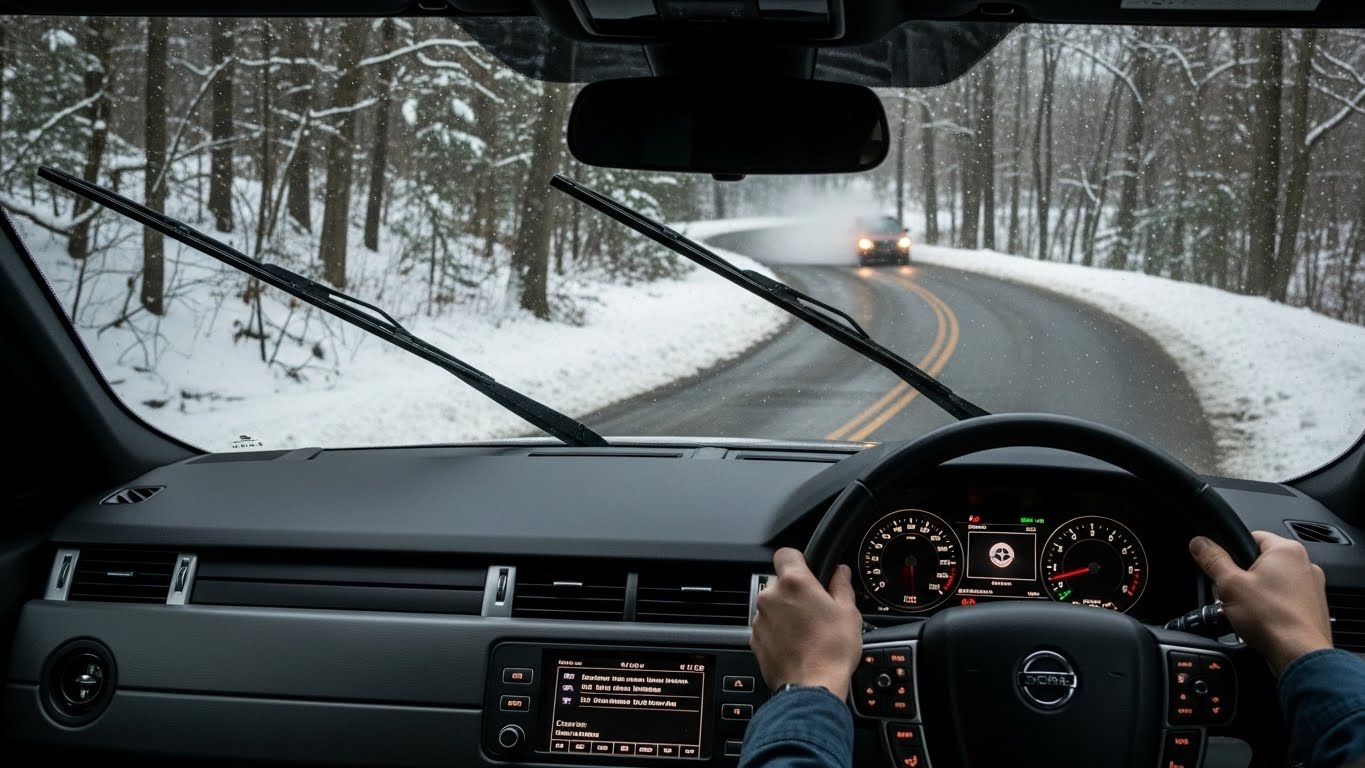
The wipers slashed back and forth against the windshield, fighting a losing battle against the thickening white curtain.
Sierra Langford gripped the leather steering wheel of her Range Rover until her knuckles turned as white as the snow piling up on the asphalt. The heating vents blasted warm air, but a chill had settled deep in her bones—a cold that had nothing to do with the temperature outside and everything to do with the life she was temporarily leaving behind.
This trip to the remote edges of the Catskills was supposed to be her escape. No board meetings. No shareholders screaming about quarterly margins. No ex-fiancé packing his bags while she was on a conference call, telling her she was “married to the portfolio.”
Just her, a bottle of expensive Cabernet, and a fireplace in a rental cabin that cost more per night than most people made in a month.
She checked the dashboard clock. 4:45 PM.
It was already pitch black. The winding mountain road was treacherous, a ribbon of ice coiling through the ancient pines. The silence outside was suffocating, broken only by the muffled crunch of expensive tires crushing fresh powder.
“Just two more miles, Sierra,” she muttered to herself, her eyes straining against the hypnotic swirl of snowflakes in her high beams. “Just get to the cabin, pour the wine, and forget the world exists for three days.”
She adjusted the rearview mirror, catching a glimpse of her own reflection. Even in the dim light, she looked exhausted. Her blonde blowout was perfect, her cream wool coat was impeccable, but her eyes held a hollow, haunted look. She was the CEO of Langford Dynamics, a woman who moved markets with a whisper, yet here she was, fleeing the city because she felt like she was drowning in her own success.
She took the curve a little too fast.
The heavy SUV drifted, tires losing their bite on the black ice. Sierra gasped, correcting the wheel with the reflex of someone used to controlling chaos. The car steadied, but her heart hammered a frantic rhythm against her ribs.
“Okay. Slow down. You’re not in Manhattan anymore. No one is timing you.”
She rounded the next bend, her foot hovering over the brake, her senses on high alert.
Then, out of nowhere—a flash of red.
It wasn’t a deer. It wasn’t a fox. It was small. It was upright. And it was right in the middle of her lane.
SCREECH!
Sierra slammed the brake pedal to the floor. The ABS system shuddered violently, a mechanical grinding sound that tore through the quiet night. The heavy vehicle slid, fishtailing sideways, the headlights sweeping across the trees like frantic searchlights.
Snow sprayed up in a blinding wall.
The SUV jolted to a halt inches—literally inches—from the small figure standing in the road.
For a heartbeat, there was only the sound of the engine idling and the wind howling against the glass. Sierra sat frozen, her hands trembling uncontrollably on the wheel. Did I hit them? Oh my God, did I hit them?
She threw the door open, ignoring the biting wind that instantly whipped her hair across her face. She stumbled out onto the icy road, her designer boots slipping on the slush.
“Hey!” she shouted, her voice cracking with panic. “Are you okay? I didn’t see you!”
In the glare of the headlights, the figure turned.
Sierra stopped dead in her tracks. The air left her lungs.
It was a little girl. She couldn’t have been more than five years old.
She was standing alone in the middle of a blizzard, wearing a tattered red dress that looked like it belonged in a summer thrift store, covered only by a thin, moth-eaten knit cardigan. Her legs were bare, her skin marbelized by the freezing cold. One of her boots was missing, leaving a sock-clad foot buried in the snow.
“Sweetheart?” Sierra’s corporate shark voice was gone, replaced by pure, instinctive horror. She rushed forward, dropping to her knees on the ice, uncaring of her cream wool trousers soaking up the slush. “What are you doing out here? Where are your parents?”
The girl was shaking so hard her teeth were audibly chattering. Her lips were a terrifying shade of pale blue. She looked at Sierra with eyes so wide and terrified they seemed to swallow her whole face.
“Ma’am…” the girl whimpered, a cloud of steam escaping her lips.
Sierra stripped off her heavy faux-fur coat instantly, wrapping it around the tiny, shivering frame. The girl felt fragile, like a bird made of hollow bones. “It’s okay, I’ve got you. You’re freezing. Come on, let’s get you in the car. It’s warm inside.”
The girl didn’t move. She planted her feet, staring back toward the dark, dense tree line where the forest swallowed the light.
“I can’t go,” the girl sobbed, the tears freezing on her cheeks.
“You have to,” Sierra urged, panic rising in her chest. “You’ll die out here, honey. What’s your name?”
“Maisie,” she hiccuped, clutching the expensive coat with dirty, frozen fingers.
“Okay, Maisie. I’m Sierra. We need to get warm. Now.”
Maisie shook her head violently, pulling away from the car, pointing a trembling finger toward the woods.
“Ma’am, I can’t find my daddy,” she cried out, her voice breaking into a high-pitched wail that cut through the wind. “He went in there to get wood. He said he’d be right back. But the snow got heavy… and he stopped answering me.”
Sierra looked into the woods. It was an abyss. A wall of black pine and swirling white death.
“He stopped answering?” Sierra asked, a pit forming in her stomach.
“I heard a noise,” Maisie whispered, gripping Sierra’s silk blouse beneath the coat. “Like a tree breaking. And then… nothing. Please, ma’am. You have to help him. He’s all I have.”
Sierra looked at the warm, safe interior of her Range Rover. Then she looked at the terrified child, and finally, at the unforgiving forest.
Every logical neuron in her brain fired a warning. She was a CEO. She solved problems from a distance. She mitigated risks. And the risk assessment here said: Don’t go into the woods. Call the police. Wait in the car.
But she looked at her phone. No Service.
She looked at Maisie’s desperate eyes, the way the child was physically vibrating with cold and terror.
Sierra Langford realized for the first time in years, she wasn’t the one in control. And she couldn’t walk away. She couldn’t be the person who sat in a heated car while a man died in the snow.
“Get in the car, Maisie,” Sierra commanded softly but firmly. “Sit in the passenger seat. Turn the seat warmer all the way up.”
“But Daddy—”
“I know,” Sierra said, reaching into her glove box and pulling out a heavy-duty tactical flashlight she kept for emergencies she never thought she’d face. She turned to the darkness, her breath hitching. “I’m going to get him.”
She didn’t know it yet, but she wasn’t just walking into the woods to save a stranger. She was walking toward the collision that would shatter her perfectly curated life.
Chapter 2: Into the Abyss
Sierra stepped away from the warm glow of the headlights and plunged into the darkness.
The transition was immediate and brutal. The moment she crossed the tree line, the wind changed. It wasn’t just blowing; it was screaming through the branches, a cacophony of groans and whistles that disoriented her instantly.
The beam of her flashlight cut a thin, pale slice through the falling snow, illuminating only a few feet ahead. Everything looked the same—endless trunks of pine, rough bark, heavy drifts of white.
“Hello!” Sierra screamed, her voice sounding small and pathetic against the roar of the forest. “Can you hear me?”
Silence returned, heavier than before.
She trudged forward. Her boots, designed for city sidewalks and après-ski fashion, were useless here. The snow was knee-deep in places, sucking at her feet with every step. Cold water seeped into her socks, numbing her toes.
“Think, Sierra. Think,” she panted, her breath coming in ragged bursts. “He was gathering wood. Look for fallen trees. Look for tracks.”
She swept the light back and forth. It felt like walking on the bottom of the ocean, the pressure of the dark pressing in on all sides. Five minutes passed. Then ten. The cold was beginning to gnaw at her exposed face, stinging her eyes.
Fear began to creep in. Real, primal fear. What if she got lost? What if she died out here, just a few hundred yards from her car, frozen solid next to some stranger?
“Daddy!” she heard a faint echo in her mind—Maisie’s voice. That terrified little girl waiting in her car.
Sierra grit her teeth. “No. Not tonight.”
She pushed through a thicket of sharp branches that tore at her cashmere sweater. She stumbled into a small clearing and swung the light wildly.
There.
About twenty yards to her left, the pristine white blanket of snow was disturbed. A jagged line, like something heavy had been dragged. And above it, a massive pine branch, snapped clean off, hanging precariously by a strip of bark.
Sierra ran, her heart lodging in her throat.
“Sir! Can you hear me?”
She reached the end of the drag marks. A pile of firewood was scattered in the snow—logs cut by hand, not bought in a bundle. And beneath the debris, half-buried in the drift, lay a man.
He was face down.
Sierra dropped the flashlight in the snow, the beam casting eerie long shadows upward. She fell to her knees beside him, her hands frantically brushing away the snow covering his back. He was wearing a worn flannel jacket that had seen better decades, let alone better days.
“Hey! Wake up!” She grabbed his shoulder and rolled him over.
He was heavy. Solid muscle and dead weight.
When the light hit his face, Sierra gasped. He was younger than she expected—maybe her age, early thirties. He had a strong jawline covered in a dark stubble, but his skin was terrifyingly pale, tinged with the blue of hypothermia. A gash on his forehead was oozing blood that had begun to crystallize in the cold.
“Oh god, oh god,” she stammered, stripping off her gloves to press her fingers against his neck.
Her own hands were shaking so badly she couldn’t tell if the pulse was his or hers. She pressed harder, holding her breath.
Thump… thump…
It was slow. Too slow. But it was there.
“Okay, you’re alive. You’re alive, but we have to move.”
She grabbed him under the arms. “Come on. Help me out here.”
She pulled. He didn’t budge.
He was easily six-foot-two, broad-shouldered, a man who built things with his hands. She was five-foot-seven of Pilates-toned muscle, but she was exhausted and running on adrenaline.
“I am not letting you die,” she grunted, digging her heels into the snow. “Maisie is waiting. Do you hear me? Your daughter is waiting!”
She heaved with everything she had. He slid a few inches.
Sierra screamed in frustration, a raw sound of exertion. She dragged him again. A foot. Then another. Her lungs burned as if she were inhaling glass. The snow provided a little slip, but the terrain was uneven, hidden roots snagging his boots.
She didn’t know how long she fought the forest. It might have been five minutes; it might have been an hour. Every muscle in her body screamed. She was sweating inside her clothes, which was dangerous in this cold, but she couldn’t stop.
Suddenly, a beam of light cut through the trees from the direction of the road.
“Hello? Is someone there?” A deep voice boomed.
Sierra let out a sob of relief. “Here! We’re here! Help us!”
A police officer came crashing through the brush, his high-powered flashlight blinding her for a second. He took in the scene instantly—the frantic woman in high-end clothes, the unconscious man in the snow.
“Jesus,” the officer muttered, holstering his light and rushing over. “Is that Caleb?”
“Yes! He’s barely breathing,” Sierra choked out, her legs finally giving way as the adrenaline crashed.
“Alright, ma’am, I got him. You light the way.”
The officer, a burly man who clearly knew the terrain, hoisted Caleb up in a fireman’s carry with a grunt of effort. Sierra grabbed her flashlight, her hands numb claws, and stumbled ahead, guiding them back toward the road.
When they burst out of the tree line, the sight of her Range Rover was the most beautiful thing Sierra had ever seen.
Maisie was pressing her face against the glass. As soon as she saw the officer carrying her father, she opened the door, screaming.
“Daddy!”
“Stay back, honey!” the officer yelled over the wind. “He’s hurt. We need to get him warm.”
“My car,” Sierra shouted, unlocking the back doors. “Put him in the back. I have blankets.”
They laid Caleb across the backseat. Sierra immediately climbed in beside him, heedless of the snow she was tracking onto the leather. She grabbed the emergency wool blanket from her trunk and layered it over him.
The officer looked at Sierra. “The ambulance is thirty minutes out in this weather. His cabin is just down that access road—it’s closer than the hospital, and if we wait here, he might freeze. I know him. He’s got a wood stove. We need to get his core temp up now.”
Sierra didn’t hesitate. “Show me the way.”
She jumped into the driver’s seat. Maisie climbed into the passenger side, sobbing quietly. Sierra reached out and squeezed the little girl’s hand.
“He’s tough, Maisie,” Sierra said, channeling a confidence she didn’t feel. “We’ve got him.”
She threw the car into drive, following the officer’s cruiser as it turned onto an unpaved, snow-covered track leading deeper into the dark.
Chapter 3: The Cabin in the Woods
The cabin looked like something out of a storybook, but not the Disney kind. It was the Brothers Grimm kind—ancient, dark, and smelling of pine resin and hardship.
The officer helped carry Caleb inside and laid him on a worn, sagging couch near the fireplace. The room was freezing. The fire had died down to embers.
“I have to get back on patrol, ma’am, tree down on Route 9 blocking the ambulance,” the officer said, looking apologetic. “I’ve radioed dispatch, but no one is getting up this driveway until the plows come through in the morning. Can you stay with them? Keep him warm? If he wakes up, keep him talking.”
Sierra looked at the unconscious man, then at the little girl clinging to his hand, and finally at the luxury hotel reservation on her phone.
“I’m staying,” she said. “Go.”
As the officer left, silence rushed back into the room, heavy and imposing.
Sierra went into crisis management mode. It was the only way she knew how to function. First: Heat.
She found the woodpile in the corner. She’d never built a real fire in her life—gas fireplaces in penthouses didn’t count—but she understood the physics of airflow. She stacked the logs, blew on the embers until her face was covered in ash, and cheered internally when a flame finally licked upward.
Next: The patient.
She turned to Caleb. He was shivering now, violent tremors racking his body. That was good; it meant his body was fighting.
“Maisie,” Sierra said softly. “I need you to help me. Can you find all the blankets in the house?”
Maisie nodded, wiping her nose on her sleeve, and ran to the back room.
Sierra knelt beside Caleb. She had to get the wet clothes off him. She unbuttoned his flannel shirt, her fingers brushing against skin that felt like marble. Beneath the flannel, he wore a thermal henley that was soaked through with sweat and melted snow.
She pulled it up over his head. His chest was broad, defined by hard labor, scarred in places. She tried to ignore the intimacy of it and focused on the medical necessity. She dried his skin with a towel Maisie brought, rubbing vigorously to stimulate circulation.
“You are not dying on my watch, Caleb,” she whispered.
They piled every blanket in the house on top of him. Maisie climbed onto the couch, curling into a ball against her father’s side, sharing her body heat.
“Is he going to wake up?” Maisie asked, her voice small.
“He will,” Sierra promised. She grabbed a first-aid kit from the bathroom—it was meager, just band-aids and old antiseptic. she cleaned the gash on his head. It wasn’t as deep as it looked, thank God. Head wounds just bled a lot.
Hours passed. The storm raged outside, rattling the single-pane windows.
Sierra sat in a rocking chair opposite them, still wearing her damp clothes, watching for the rise and fall of his chest. The adrenaline had faded, leaving her exhausted and strangely raw.
She looked around the cabin. It was small. The furniture was mismatched, clearly salvaged. There was no TV. No computer. But it was meticulously clean.
On the mantelpiece, there was a framed photo. Sierra stood up and walked over to examine it.
It showed Caleb, a few years younger, smiling—a genuine, eye-crinkling smile that transformed his face. His arm was around a woman with laughing eyes and dark curly hair. She was holding a baby.
Sierra felt a pang of sorrow so sharp it surprised her. He’s a widower.
She looked back at the couch. The man lying there wasn’t just a random victim. He was a father trying to keep a world together that had already shattered once. He was out in a blizzard, risking his life for firewood, just to keep that little girl warm.
Sierra thought about her own life. The penthouse overlooking Central Park. The closet full of clothes she wore once. The “friends” who only called when they needed an introduction to an investor.
She had everything money could buy, and yet, sitting in this drafty cabin with the wind howling like a banshee, she realized she had never felt so utterly useless—and so desperately needed—in her entire life.
Around 3:00 AM, Caleb groaned.
Sierra was at his side in an instant. “Caleb? Can you hear me?”
His eyes fluttered open. They were dark, confused, and filled with pain. He tried to sit up, but Sierra pushed him back gently.
“Easy. You hit your head. You were hypothermic.”
He blinked, trying to focus on her face. “Who… who are you?” His voice was a gravelly rasp.
“I’m Sierra,” she said softly. “I found Maisie on the road. We brought you home.”
His eyes widened. Panic flared. “Maisie? Is she—”
“She’s right here,” Sierra soothed, guiding his hand to rest on the sleeping girl’s back. “She’s safe. She’s warm. She saved you.”
Caleb let out a long, shuddering breath, his fingers curling weakly into his daughter’s sweater. He looked up at Sierra, his gaze piercing even in the dim light.
“Thank you,” he whispered.
“Don’t talk,” Sierra said, pulling the blanket up to his chin. “Just rest. I’m not going anywhere.”
And for the first time in ten years, she meant it. She wasn’t checking her email. She wasn’t thinking about the next merger. She was just sitting in the dark, watching a stranger breathe, guarding a fragile peace she didn’t quite understand.
Chapter 4: Strangers in the Light
Morning arrived not with a burst of sun, but with a pale, gray light that filtered through the frosted windowpanes. The blizzard had passed, leaving the world buried in silence and three feet of snow.
Sierra woke with a crick in her neck. She had fallen asleep in the rocking chair, huddled under her own coat.
She blinked, disoriented for a moment. The smell of woodsmoke and old wool brought the memories rushing back. The accident. The woods. The rescue.
She looked toward the couch. It was empty.
Panic spiked in her chest. She sat up straight. “Caleb?”
“I’m here.”
The voice came from the kitchen area.
Sierra turned. Caleb was standing by the stove, leaning heavily against the counter with one hand, a cast-iron skillet in the other. He had managed to change into a dry shirt, though he looked unsteady on his feet.
“What are you doing up?” Sierra demanded, standing up and smoothing her wrinkled clothes. “You were half-dead six hours ago.”
Caleb turned to look at her. In the daylight, he was even more striking. Rugged, yes, but there was a quiet intensity to him. His dark eyes swept over her—taking in the disheveled blonde hair, the stained designer trousers, the sheer incongruity of her presence in his kitchen.
“I have a daughter to feed,” he said simply. “And a guest, apparently.”
He gestured to the percolator on the stove. “Coffee’s almost ready. It’s not… whatever you’re used to. But it’s hot.”
Sierra walked over, crossing her arms defensively. “You shouldn’t be standing. You have a concussion.”
“I’ve had worse,” he muttered, cracking an egg into the pan with one hand. “The plow hasn’t come by. I heard the wind all night. Which means your car is probably snowed in at the bottom of the drive. You’re stuck here.”
Sierra looked out the window. He was right. Her Range Rover was a white mound in the distance.
“I can call a service…” she began, reaching for her phone.
“No cell reception in the valley after a storm,” Caleb interrupted, not unkindly. “Towers get iced over. Usually takes a day to fix.”
Sierra stared at her phone. No Service.
She let out a frustrated sigh, running a hand through her hair. “Great. Just great.”
Caleb turned off the stove and turned to face her fully. He studied her for a moment, his expression unreadable.
“Look,” he said, his voice low. “I remember bits and pieces. I remember the cold. I remember… dragging myself. And I remember you dragging me.”
He took a step closer. The air in the small kitchen suddenly felt very charged.
“You could have stayed in your car,” he said. “You could have called the cops and waited. But you came into the woods. Why?”
Sierra looked at him. She wanted to give a corporate answer. Risk mitigation. Humanitarian duty.
But looking at the bandage on his forehead and the raw honesty in his eyes, she couldn’t lie.
“She was screaming for you,” Sierra said softly. “And… I didn’t want her to be alone. I know what that feels like.”
Caleb held her gaze for a long beat. A flicker of understanding passed between them. He didn’t ask what she meant. He just nodded.
“Daddy!”
The moment broke as Maisie ran into the room, her hair a bird’s nest of tangles. She slammed into Caleb’s legs, hugging him fiercely.
He winced but didn’t pull away, dropping his hand to cup her head. “I’m okay, peanut. I’m okay.”
“Miss Sierra made the fire!” Maisie announced, looking up at Sierra with hero-worship in her eyes. “She fixed you!”
Caleb looked at Sierra, a small, crooked smile touching his lips. It transformed his face from stoic to devastatingly handsome.
“She did, didn’t she?” Caleb said. “Well, Miss Sierra, do you eat eggs? Or is that too pedestrian for a woman who drives a car worth more than my house?”
Sierra laughed. It was a rusty sound, surprised out of her. “I eat eggs. And for the record, I’m starving.”
They sat at the small, round wooden table. The chairs were mismatched. The plates were chipped. The coffee was bitter and strong.
But as Sierra watched Caleb cut Maisie’s toast into soldiers, and listened to Maisie chatter about the snow, she realized something terrifying.
She was sitting in a drafty cabin with no internet, no schedule, and no way out. She was eating scrambled eggs with a woodcutter and his daughter.
And she was happier than she had been in five years.
“So,” Caleb said, catching her staring. “What brought a woman like you to a road like this?”
Sierra swirled her coffee. “I was running away,” she admitted.
Caleb raised an eyebrow. “From what?”
“Everything,” she whispered.
“Well,” Caleb said, clinking his mug against hers gently. “You didn’t get very far. But I’m glad you landed here.”
Sierra looked at him, feeling a warmth bloom in her chest that had nothing to do with the coffee. She had a feeling that getting her car dug out was going to be the easy part. Leaving this cabin? That was going to be the hardest thing she’d ever do.
Chapter 5: The Wall Comes Down
The snow didn’t stop. It fell in heavy, silent sheets, wrapping the cabin in a cocoon of white. For Sierra, who lived her life by the minute—scheduled, alarmed, and calendar-blocked—the enforced stillness was agonizing.
At first.
By noon, the agony had dulled into a strange, restless curiosity.
Caleb was restless, too. He was a man used to working, and his concussion was keeping him grounded. He paced the small living room, checking the window every ten minutes.
“You’re going to wear a hole in the floorboards,” Sierra said from the couch, where she was pretending to read an old paperback Western she found on the shelf.
“I need to check the generator shed,” Caleb muttered, wincing as he touched his bandage. “If the lines stay down another night, we’ll need the backup power for the well pump.”
“You are not going out there,” Sierra said, standing up. She was still wearing her cashmere sweater, but she had rolled up the sleeves. “I’ll go.”
Caleb snorted. “You? In those boots? You’ll slip and break a hip.”
“I pulled a two-hundred-pound man through a blizzard last night,” she retorted, grabbing his heavy canvas coat from the hook by the door. It swallowed her frame, smelling of sawdust and diesel. “I think I can handle a switch.”
She walked out before he could argue.
The cold air hit her like a slap, but strangely, it felt invigorating. She trudged to the shed, flipped the breakers as Caleb had described, and listened to the generator hum to life.
When she came back in, cheeks flushed pink and snowflakes caught in her eyelashes, Caleb was watching her. Really watching her. Not as a guest, but as a woman.
“You’re full of surprises, Sierra Langford,” he said softly.
The afternoon melted away. Without wi-fi or reception, Sierra was forced to be present. She sat on the floor with Maisie, helping her build a castle out of old wooden blocks. They laughed when the towers fell. Sierra found herself giggling—a sound she hadn’t heard from herself in years.
Later, while Maisie napped, Sierra found Caleb in the kitchen, whittling a small piece of pine with a pocket knife.
“What are you making?” she asked, leaning against the counter.
“Just keeping my hands busy,” he said. He didn’t look up. “Tell me about the city. The real city. Not the postcards.”
Sierra hesitated. “It’s… loud. It’s fast. It’s a game of ‘who can shout the loudest.’ I have a penthouse I’m rarely in. I have a driver I speak to more than my own mother. I make deals that shift millions of dollars, and at the end of the day, I order takeout and eat it standing up over the sink.”
She paused, shocking herself with the honesty. “It sounds pathetic when I say it out loud.”
Caleb stopped whittling. He looked up, his dark eyes intense. “It doesn’t sound pathetic. It sounds lonely.”
The word hung in the air. Lonely.
“And you?” she asked, deflecting. “Are you lonely out here?”
Caleb looked toward the bedroom where Maisie was sleeping. “I have her. She’s my whole world. But…” He looked back at Sierra, his gaze dropping to her lips for a fraction of a second. “Yeah. Sometimes. When the quiet gets too loud.”
The tension between them shifted. It wasn’t just gratitude anymore. It was magnetic. Sierra took a step closer. Caleb didn’t move away.
“You don’t belong here, Sierra,” he whispered, a warning in his voice. “You’re a comet. You’re just passing through.”
” Maybe I’m tired of burning up in the atmosphere,” she replied, her voice barely a breath.
He reached out, his rough, calloused hand brushing a stray lock of hair from her face. His touch was electric. For a moment, Sierra thought he was going to kiss her. She wanted him to. She wanted to feel something real.
But then, a low rumble echoed from outside. Not thunder.
An engine.
Caleb pulled his hand back as if burned. He looked toward the window.
“The plow,” he said, his voice flat. “The road is open.”
Chapter 6: The Call of the World
The sound of the snowplow was the sound of reality crashing back in.
Within an hour, the silence of the woods was broken. First, the plow cleared the main road. Then, Sierra’s phone, sitting on the windowsill, lit up like a Christmas tree.
Ding. Ding. Ding.
Emails flooded in. Missed calls. Voicemails. The red notification bubbles multiplied by the second.
Sierra picked it up. Her assistant, Jessica.
“Miss Langford! Thank God. We’ve been trying to reach you for twenty-four hours. The Merger Vote was moved up. The board is meeting tomorrow morning at 9:00 AM. If you’re not there to cast the deciding vote, the takeover happens. You lose the company.”
Sierra felt the blood drain from her face. “Tomorrow? That’s… I’m four hours away.”
“The chopper is grounded due to weather, but the highways are clearing. You have to leave now, Sierra. Right now.”
She hung up, her heart racing with the familiar rhythm of panic and adrenaline. This was it. The moment she had worked ten years for. The company was her life. Her legacy.
She turned around. Caleb was standing in the doorway, holding Maisie’s hand. He had heard.
“You have to go,” he said. It wasn’t a question.
“I… It’s the board. If I don’t go, I lose everything,” Sierra stammered, feeling sick.
“I understand,” Caleb said. His face had closed up. The warmth from the kitchen scene was gone, replaced by a guarded wall. He was protecting himself. He knew this would happen.
Sierra packed her bag in three minutes. She threw on her coat, feeling like a traitor in her own skin.
She knelt down in front of Maisie. “I have to go back to work, sweetheart. But I need you to know… you are the bravest girl I’ve ever met.”
Maisie didn’t cry. She just looked sad, with the resignation of a child who is used to losing people. She reached into her pocket and pulled out a small, knitted mitten. It was red, faded, with a mismatching patch on the thumb.
“It has holes,” Maisie whispered. “But Daddy fixed it. It keeps you warm. You can have it.”
Sierra felt tears prick her eyes. She took the small, worn mitten and squeezed it tight. “Thank you, Maisie. I’ll keep it safe.”
She stood up and turned to Caleb. “Caleb, I…”
“Go,” he said, his jaw tight. “Don’t let us make you late.”
“I’m not just leaving,” she insisted, stepping toward him. “This… this meant something.”
“It was a snowstorm, Sierra,” he said, his voice hard. “It was an accident. You have a life to get back to. A big one. We’re just… we’re just the people you didn’t hit with your car.”
The words stung, but she knew he was saying them to make it easier for her to leave.
“Here,” she said, pulling a business card from her purse. She scribbled her personal cell number on the back. “If you ever need anything. Anything at all.”
He took the card without looking at it. “Drive safe, Sierra.”
She walked out the door. The cold air didn’t feel invigorating anymore; it just felt cold. She climbed into her Range Rover, the engine roaring to life.
As she drove down the newly plowed driveway, she looked in the rearview mirror. Caleb and Maisie were standing on the porch, watching her go. Two small figures against the vast, white emptiness.
She turned onto the main road and floored the accelerator. She was going back to her life. Back to the top.
So why did it feel like she was driving off a cliff?
Chapter 7: The Empty Penthouse
The board meeting was a bloodbath, and Sierra won.
She walked into the conference room at 8:55 AM, still wearing the same clothes from the cabin, her hair windblown, dark circles under her eyes. The other board members, pristine in their Italian suits, stared.
She didn’t care. She delivered the speech of her career. She decimated the hostile takeover bid with a ferocity that terrified them. She saved the company.
By 6:00 PM, she was back in her penthouse.
It was silent.
Not the peaceful, living silence of the woods. This was a dead silence. The hum of the HVAC system. The distant sirens of the city thirty floors below.
She poured a glass of wine—a vintage that cost $500. She took a sip. It tasted like vinegar.
She walked to the floor-to-ceiling window overlooking Central Park. The city was a grid of golden lights, beautiful and indifferent.
“I won,” she whispered to the empty room. “I have everything.”
She looked at her reflection in the glass. She looked perfect again. Showered, changed into silk pajamas, makeup applied.
But the woman in the reflection looked miserable.
She walked over to the coffee table. There, sitting on the polished marble surface, was the red knitted mitten.
It was ugly. It was dirty. It smelled like woodsmoke and old yarn.
And it was the only real thing in the entire apartment.
Sierra picked it up, slipping her hand inside. It was too small, but she clutched it against her chest. She closed her eyes and she was back there. The smell of the pine. The sound of Maisie’s giggle. The way Caleb’s eyes softened when he looked at her.
“You don’t belong here. You’re just passing through.”
“He’s wrong,” she said aloud.
She thought about the next ten years of her life. More meetings. More takeovers. More empty wine glasses in empty rooms.
Then she thought about the look on Maisie’s face when they built the block tower. She thought about the feeling of Caleb’s hand brushing her hair.
She wasn’t running away from the work. She was good at the work. But the work wasn’t her. It was just what she did.
Who was she?
She was the woman who ran into the woods. She was the woman who kept the fire burning.
Sierra set the wine glass down. She picked up her phone. She didn’t call her assistant. She didn’t call the board.
She opened her calendar app and hit Delete All.
“I’m not passing through,” she whispered.
She ran to her bedroom. She didn’t pack a suit. She grabbed jeans. heavy sweaters. Hiking boots.
She was going back. And this time, she wasn’t bringing a return ticket.
Chapter 8: The Return
The drive back felt different.
The snow had stopped, and the roads were clear, but Sierra drove with a desperate urgency. She wasn’t fleeing this time; she was chasing.
It was late afternoon when she reached the mountain pass. The sun was setting, casting long purple shadows across the snow.
She turned onto the familiar winding road. Her heart was hammering in her chest, louder than the engine.
What if he turns me away? What if he was right, and we are just too different?
She pulled up to the clearing.
The cabin was there, smoke curling lazily from the chimney. It looked small, humble, and absolutely perfect.
She saw them.
Caleb and Maisie were in the front yard. Caleb was shoveling the walkway again, and Maisie was throwing snowballs at his back, laughing.
Sierra killed the engine. The silence returned.
She took a deep breath, grabbed the door handle, and stepped out.
The sound of the car door slamming made them both look up.
Caleb froze, his shovel mid-air. Maisie dropped her snowball.
For a long moment, nobody moved. The distance between the car and the porch felt like a canyon.
Then, Sierra smiled. It wasn’t her CEO smile. It was a nervous, hopeful, terrified smile.
“I forgot something!” she called out, her voice echoing off the trees.
Caleb slowly lowered the shovel. He took a step forward, his eyes narrowing as if he couldn’t believe what he was seeing. “You… you forgot something?”
“Yeah,” Sierra walked toward them, the snow crunching under her boots. “I realized I left the best part of me here.”
She stopped a few feet away from him.
“And,” she added, her voice trembling slightly. “I make terrible pancakes, but I’m really good at coffee.”
A slow, incredulous smile spread across Caleb’s face. The wall he had built—the one made of pride and fear—crumbled instantly.
“Is that so?” he asked, his voice thick with emotion.
“It is,” Sierra said. “And I was hoping… maybe you had room for a coffee drinker?”
“Daddy!” Maisie squealed, breaking the tension. “It’s her! She came back!”
Maisie ran and launched herself at Sierra. Sierra caught her, swinging her up into her arms, burying her face in the little girl’s cold, apple-scented hair.
Caleb closed the distance. He didn’t hesitate this time. He reached out and wrapped his arms around both of them, pulling them into a crush of wool and warmth.
“I thought you were a comet,” he whispered into her hair. “I thought you were gone.”
“I was,” Sierra whispered back, leaning into his chest. “But I realized… comets are cold. And I don’t want to be cold anymore.”
Caleb pulled back just enough to look at her. He reached into his pocket and pulled out a small wooden object.
It was a keychain. Freshly carved.
It showed three little figures under a roof. A man, a little girl… and a woman with long hair.
“I finished it this morning,” he said, his voice rough. “Maisie drew the design. I just carved it. I was going to mail it to your office, but…”
“But I’m here,” she finished for him.
“You’re here,” he agreed.
He leaned down and kissed her. It was soft at first, tasting of winter air and longing, and then it deepened, sealing a promise that no contract could ever rival.
Sierra Langford had spent her whole life climbing to the top of the world. But standing there in the snow, with a woodcutter and his daughter, she realized she had finally arrived.
She was home.