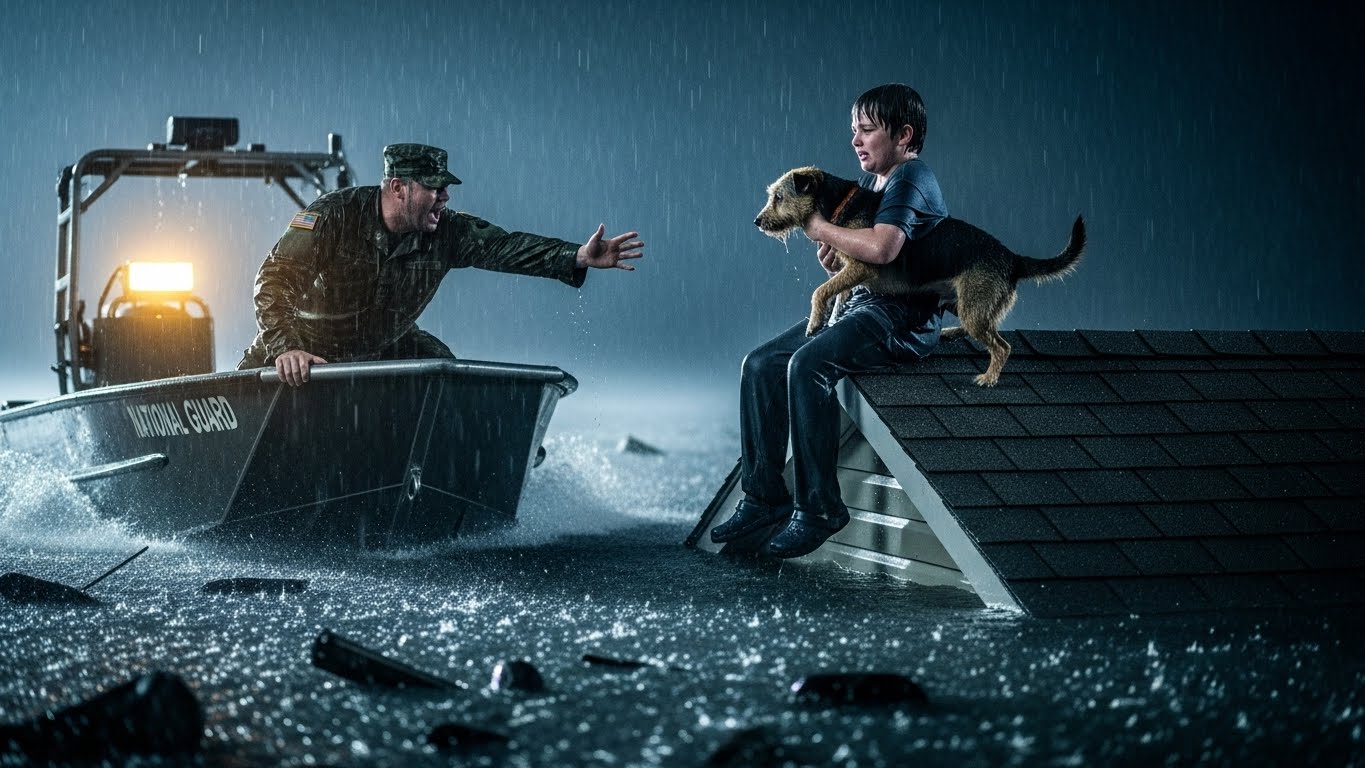
“MY DOG GOES OR I STAY!” — THE 10-YEAR-OLD ORPHAN WHO DEFIED A FLOOD AND TAUGHT THE NATIONAL GUARD A LESSON IN LOYALTY.
Chapter 1: The Black Water
The water didn’t look like water anymore. It wasn’t the blue stuff in the community pool or the clear stream that ran behind the Walmart in Pikeville. It was a living, breathing monster made of churned mud, broken fences, uprooted trees, and the shattered pieces of people’s lives. It smelled of gasoline and old earth, a thick, cloying scent that coated the back of ten-year-old Leo’s throat and made him want to gag.
Leo sat shivering on the shingled peak of the roof. It was the only dry spot left in his entire world.
The shingles were rough and gritty against his palms. His knuckles were white, gripping the sodden leather collar of a scruffy, three-legged terrier mix named Buster. The rain wasn’t just falling; it was hammering down, stinging Leo’s face like icy needles, relentless and cruel. It drummed a deafening rhythm against the roof, drowning out the sound of Leo’s own ragged breathing.
“It’s okay, buddy,” Leo whispered, though his teeth were chattering so hard the words came out broken, like gravel in a blender. “I got you. I promise I got you.”
Buster whined, a high-pitched, terrifying sound that vibrated through his ribs. He pressed his wet, trembling body against Leo’s chest. The dog was heavy, soaked to the bone, smelling of wet fur and fear, but Leo wouldn’t let go. He couldn’t.
Buster was the only thing in Leo’s life that hadn’t left him.
Leo closed his eyes tight, trying to block out the rising tide, but the memories flooded in faster than the river. He remembered the argument from three hours ago—or maybe it was a lifetime ago.
Mr. Kramer, his foster father of three months, had been screaming. “Get in the truck, Leo! Now! We have to go!”
“Not without Buster!” Leo had screamed back, standing his ground in the driveway as the rain slashed sideways.
“It’s a dog, dammit! There’s no room! The shelter won’t take him!” Mr. Kramer had grabbed Leo’s arm, his fingers digging in hard. “Leave the mutt!”
But Leo hadn’t left. When Mr. Kramer turned to throw a suitcase in the trunk, Leo had bolted. He ran back into the house, down the hallway, and into the laundry room where Buster was cowering under the sink. He heard the truck horn honk once, twice, long and angry. Then, the sound of tires screeching away.
They had left him. Just like his mom had left when the cancer took her two years ago. Just like his dad had left before he was even born. The three foster homes in the last eighteen months? They were just pit stops. Nobody kept a quiet kid who stared at the floor too much.
And nobody wanted a three-legged dog.
Leo had found Buster six months ago behind the school cafeteria, limping and starving. Buster was missing his back left leg, the scar tissue pink and jagged. They were the same. Unwanted. Broken. Damaged goods.
“We don’t need them, Buster,” Leo said now, opening his eyes. The water was higher. “We’re a team.”
The house groaned beneath them, a deep, structural moan that vibrated through Leo’s sneakers. A massive oak tree, roots and all, drifted by in the violent current. It smashed into the submerged front porch with a sickening crunch that sounded like bones breaking. The entire roof lurched forward.
Leo gasped, sliding a few inches down the slick shingles. He dug his heels into the gutter, which was already overflowing with black sludge.
“Don’t look down, Buster. Just look at me.”
The water was inches from his sneakers now. The cold was seeping into his bones, making his limbs feel like lead. Hypothermia was setting in; Leo felt strangely sleepy, his thoughts moving through syrup. He knew, with the terrifying clarity that only trauma gives a child, that they didn’t have much time. The house was coming off its foundation.
He hugged Buster tighter, burying his face in the dog’s neck. He thought about praying, but he wasn’t sure who was listening. The God Mr. Kramer talked about seemed to be the one sending the rain.
Then, he heard it. A low thrumming sound. Not thunder. Rhythmic. Mechanical.
Leo lifted his head. A light cut through the darkness.
Chapter 2: The Ultimatum
The spotlight was blinding, a sharp white lance piercing the gloom. It swept across the treetops, then the floating cars, before locking onto the boy and the dog on the roof.
Leo shielded his eyes, squinting against the glare. A flat-bottomed aluminum boat marked NATIONAL GUARD in bold black letters tore through the current, its engine roaring as it fought the debris.
“Hey! Kid! Wave your hands!” a voice boomed over the roar of the rain.
There were two men in the boat, dressed in camouflage fatigues that looked dark and heavy with rain. The one driving was wrestling with the tiller, his face a mask of concentration as he navigated around a floating refrigerator. The other one, a giant of a man with a gray beard and eyes that looked too tired for the rest of his face, was standing at the bow.
That was Sergeant Mike Miller. He’d been pulling people off roofs for twelve hours straight. His back ached, his boots were full of water, and he was running on nothing but caffeine and adrenaline. He had seen too much death today. He wasn’t about to let a kid be next.
“Grab my hand, son!” Mike shouted, the boat bumping hard against the gutters. The metal hull rang like a bell. “We gotta move! This house is unstable!”
Leo scrambled to his knees, his legs stiff and numb. He clutched Buster with both arms, hoisting the dog’s front paws onto his shoulder. He shuffled toward the edge of the slippery shingles.
Mike reached out, his big hand open, calloused and inviting. “Come on! Jump!”
Leo looked at Mike, then at the boat. It was small. Crowded with gear—sandbags, ropes, a medical kit, and another shivering survivor huddled in the back under a thermal blanket.
“Take him first!” Leo screamed, his voice raw. He lifted the sixty-pound wet dog toward the soldier.
Mike’s face hardened. He blinked, wiping rain from his eyes. He shook his head aggressively.
“No pets! Human life only! We don’t have room, kid! Drop the dog and get in the boat! Now!”
The order was sharp, military standard. It wasn’t cruelty; it was triage. Mike had orders. Every pound mattered in this current. A panic-stricken dog could capsize a small boat, or bite a rescuer. Protocol was clear: Humans first. Animals left behind.
Leo froze. The water lapped over the toes of his sneakers. He felt the house shift again, a terrifying slide of timber against mud.
“I said drop the dog!” Mike yelled, his voice cracking with desperation. He could see the chimney starting to tilt. “The house is shifting! You’re gonna die if you don’t jump right now!”
Leo pulled Buster back against his chest. The dog licked Leo’s chin, oblivious to the politics of rescue. Leo looked Mike dead in the eye. The fear in the boy’s face vanished, replaced by a stubbornness that looked like steel. It was the look of someone who had lost everything before and refused to lose one thing more.
“No,” Leo said. His voice was small, but it cut through the storm like a gunshot.
“What did you say?” Mike roared, leaning dangerously far over the gunwale.
“I said NO!” Leo screamed back, sobbing now, the tears hot on his freezing cheeks. “He’s all I have! If he doesn’t go, I don’t go! You leave us both!”
The words hung in the air between them.
Mike froze. He looked at the kid—skinny, soaking wet, shivering violently, wearing a t-shirt that was three sizes too big. He was ready to drown. He was actually ready to die right here on this roof rather than abandon a three-legged mutt.
Mike looked back at the driver, Corporal Higgins. Higgins shrugged, eyes wide with panic. “Sarge, the house is going!”
Mike looked back at the boy. He saw the terror. But he also saw the loyalty. The kind of loyalty grown men claim to have but rarely show when the chips are down. Mike thought of his own dog at home, a Golden Retriever named Sam. He thought of his son, safe in a dorm room in Ohio.
“Damn it!” Mike cursed. He threw the protocol book out into the muddy water.
He lunged forward, ignoring his safety tether. “Pass him here! Hurry!”
Leo didn’t hesitate. He shoved Buster into the soldier’s arms. Mike grunted under the weight, the wet fur smelling of swamp. He swung the dog into the boat floor, shoving him toward the center. Buster scrambled for footing on the metal.
“Now you! Jump!”
Leo leaped.
It was a clumsy, desperate jump. His foot slipped on the gutter as he pushed off. He flailed in the air.
Mike caught him.
He grabbed Leo by the back of his shirt and his arm, yanking him out of the sky just as the chimney of the house collapsed into the floodwaters behind them with a thunderous roar. A wave of black water surged up, rocking the boat violently.
“Go! Go! Go!” Mike screamed at Higgins.
The engine whined, the prop cavitating for a second before biting into the water. They shot away, riding the surge.
They landed in a heap on the metal floor of the boat—soldier, boy, and dog.
Safe. For now.
Leo didn’t look at the soldier who saved his life. He didn’t say thank you. He crawled over the ropes and gear, curled into a tight ball around Buster, and buried his face in the wet fur, sobbing uncontrollably. Buster rested his head on Leo’s shoulder, letting out a long, weary sigh.
Mike watched them from the tiller, his chest heaving. He wiped rain—and maybe a tear—from his eyes. He realized he hadn’t just saved a boy. He’d saved a family.
Chapter 3: The Gym
The boat ride was a blur of darkness and noise. Leo kept his eyes shut, his hands woven into Buster’s fur. He felt every bump, every turn, but he refused to look up. He was afraid that if he looked up, someone would realize a mistake had been made and throw Buster back into the water.
Twenty minutes later, the boat scraped against asphalt.
“End of the line,” Higgins announced.
They had reached the edge of the submerged zone. The highway rose out of the water here, transforming into a staging ground for emergency vehicles. Ambulances, fire trucks, and military transports were parked in chaotic lines, their lights painting the night in flashing red and blue.
Mike knelt down next to Leo. His voice was softer now, the command tone gone. “Hey, kid. You okay to walk?”
Leo nodded, though he wasn’t sure. He tried to stand, but his legs were like jelly. He stumbled. Mike caught him again, steadying him with a hand on his shoulder.
“I gotcha. What’s your name, son?”
“Leo,” he whispered.
“I’m Mike. And who’s this?” Mike gestured to the dog, who was shaking water off his coat, spraying the inside of the boat.
“Buster.”
“Well, Leo and Buster, let’s get you warm.”
They were loaded into the back of a deuce-and-a-half truck with a dozen other survivors. The ride was bumpy and silent. No one spoke. The shock was too fresh. People sat wrapped in gray wool blankets, staring at nothing. Leo kept Buster on his lap, covering the dog with his blanket so only the wet nose poked out.
They arrived at the County High School, which had been converted into a Red Cross shelter. The gymnasium was a sea of green cots and misery. The smell of wet clothes, instant coffee, and bleach hung heavy in the air.
As they shuffled toward the entrance, a woman with a clipboard and a high-vis vest stepped in front of them. She looked exhausted, her hair frizzed from the humidity. This was Brenda, the shelter coordinator.
“Name?” she asked, not looking up.
“Leo,” the boy said.
She looked up, scanning him. Then her eyes landed on the bundle in his arms. The blanket shifted, and Buster’s head popped out.
Brenda’s face tightened. “Whoa, hold on. No pets.”
Leo’s heart stopped. He stepped back, clutching Buster tighter. “What?”
“Health code,” Brenda said, her voice strained but firm. She pointed to a sign taped to the glass doors: NO ANIMALS ALLOWED. “We have people with allergies, we have food being served. The dog has to go to the animal control tent in the parking lot.”
“No,” Leo said, the panic rising in his throat like bile. “He stays with me.”
“Honey, I can’t let you in with him,” Brenda sighed, reaching for her radio. “I’ll call someone to come crate him.”
“No!” Leo shouted, backing away. “He’s not going in a crate! I’m not leaving him!”
People in the line started to stare. A few murmured in sympathy, others just looked annoyed. Leo felt the walls closing in. The animal control tent? That was where they took dogs to die. That’s what he thought. He looked around wildly for an exit. He would run. He would go back out into the rain.
“Is there a problem here?”
A heavy hand landed on Brenda’s shoulder. It was Mike. He had followed the truck in his jeep, wanting to make sure the kid got settled. He towered over the shelter coordinator, water still dripping from his beard.
“He’s got a dog, Sergeant,” Brenda said, intimidated but holding her ground. “You know the rules. No pets inside.”
Mike looked at Leo. He saw the boy trembling, his eyes wide with the same terror he’d shown on the roof. He saw the way the boy’s fingers were white-knuckled in the dog’s fur.
“Brenda,” Mike said, his voice low and rumbled. “This kid just lost his house. He lost his folks. He sat on a roof for three hours in a hurricane with that dog. That dog is the only reason he’s alive.”
“Rules are rules, Mike,” Brenda insisted, though she sounded less sure. “If I let him in, I have to let everyone in.”
“Then let everyone in,” Mike said. He stepped between Brenda and Leo. “But this boy and this dog? They’re with me. And I’m declaring this dog a… service animal.”
Brenda raised an eyebrow. “A service animal? That mutt?”
Buster chose that moment to sneeze, a loud, wet sound that shook his whole body. He licked his nose and looked at Brenda with big, soulful brown eyes.
“Emotional support,” Mike corrected, improvising. “Essential for the boy’s psychological stability. Army regulations. You want to file a complaint against the National Guard during a state of emergency, Brenda? Be my guest.”
It was a bluff. A massive, glaring bluff. Mike had no authority to declare a service animal, and Army regulations definitely didn’t cover stray mutts in high school gyms.
Brenda looked at Mike. She looked at the line of soaking wet people behind him. She looked at Leo, who was holding his breath.
She sighed, dropping her hand from her radio. “Fine. But if he poops on the gym floor, you’re cleaning it up, Sergeant.”
“Deal,” Mike grinned. He turned to Leo and winked. “Come on, kid. Let’s find you a cot.”
They walked into the gym together. The noise of the crowd washed over them, but Leo didn’t feel alone anymore. He had Buster. And, it seemed, he had Mike.
He found a cot in the corner, away from the main thoroughfare. A young woman in scrubs approached them. She had kind eyes and a messy bun.
“Hey there,” she said softly, crouching down to Leo’s eye level. “I’m Sarah. I’m a nurse. Can I check you out? Make sure you don’t have any cuts or bumps?”
Leo hesitated, then nodded. He sat on the cot. Buster hopped up beside him, curling into a circle on the thin army blanket.
Sarah checked Leo’s pulse, shone a light in his eyes, and listened to his lungs. “You’re cold, and you’re in shock, but you’re strong,” she smiled. She looked at Buster. “And who is this handsome patient?”
“Buster,” Leo said. It was the first time he’d spoken without his voice shaking.
“Well, Buster looks like he needs a checkup too,” Sarah said. She gently felt the dog’s ribs and checked his paws. She didn’t flinch at the missing leg. “He’s a survivor, just like you.”
Mike stood at the foot of the cot, arms crossed, watching them. He should have left. His shift was over. He had a warm bed waiting for him at the base. But his feet wouldn’t move.
“Where are your parents, Leo?” Sarah asked gently, clicking her pen. “We need to put their names in the registry so they can find you.”
Leo looked down at his sneakers. The mud was drying on the canvas.
“They aren’t here,” Leo said quietly.
“Did you get separated in the storm?” Sarah asked, pen poised.
“No,” Leo said. He stroked Buster’s ears. “My mom died. And the Kramers… they drove away.”
Sarah’s pen stopped moving. She looked up at Mike. Mike’s jaw tightened.
“They drove away?” Sarah whispered.
“They didn’t want Buster,” Leo said simply, as if stating a fact about the weather. “So I stayed.”
Sarah’s eyes filled with sudden tears. She blinked them back rapidly. She reached out and squeezed Leo’s hand. “Well, Leo. You’re safe here. I promise.”
Sarah stood up and walked over to Mike. Her voice was a fierce whisper. “Did you hear that? They abandoned him.”
“I heard,” Mike growled. The anger flared in his chest, hot and sharp. He wanted to find the Kramers. He wanted to have a very long, very loud conversation with Mr. Kramer.
“He’s in the system,” Sarah said, looking back at the boy. “Social services is swamped. It’ll be days before a caseworker can get here. He’s going to be alone in this gym.”
Mike looked at the kid. Leo had curled up on the cot, his arm draped over the dog. They were both asleep already, exhausted by the fight for survival.
Mike thought about his empty house. His wife had passed five years ago. His son was gone. It was just him and the silence.
“No,” Mike said, surprising himself. “He won’t be alone. I’m staying.”
“You’re off duty, Mike,” Sarah said.
“I’m staying,” Mike repeated, pulling up a metal folding chair. He sat down at the foot of Leo’s cot, folded his arms, and leaned back. “Somebody’s gotta make sure the dog doesn’t poop on the floor.”
Sarah smiled, a genuine, warm smile. “Okay, Mike. I’ll get you some coffee.”
Outside, the rain kept falling, but inside the gym, under the harsh fluorescent lights, a small, fragile circle of safety had formed around a boy and his three-legged dog.
Chapter 4: The Night Watch
The gymnasium at 3:00 AM was a symphony of sorrow.
It sounded like a restless ocean. The squeak of rubber soles on hardwood had been replaced by a chorus of snores, muffled coughs, the whimpering of children having nightmares, and the low, static murmur of the industrial fans trying to circulate the humid, stale air.
Mike sat on the metal folding chair, his arms crossed over his chest, his chin tucked into his collar. He wasn’t asleep. Soldiers learned early on how to rest without sleeping, a state of suspended animation where the eyes were closed but the ears were wide open.
He was listening to Leo’s breathing.
For the first three hours, the boy had been silent, a statue under the gray wool blanket. But now, the breathing was jagged. Short, sharp gasps.
Mike opened one eye. Under the dim security lights, he saw the boy thrashing. Leo’s hands were clawing at the air, fighting an invisible current.
“No… no… Buster…” Leo whimpered, the sound thin and terrified. “Don’t let go…”
Mike leaned forward, reaching out a hand, but stopped. He knew better than to grab a soldier having a flashback; he figured the same rule applied to a kid who’d just survived a flood.
“Leo,” Mike said softly. A command, but gentle. “Leo, wake up. You’re dry. You’re safe.”
Leo gasped, his eyes flying open. He sat bolt upright, his chest heaving. He looked around wildly, his pupils dilated in the gloom. He didn’t see the gym. He saw the black water. He saw the tree smashing the porch.
Then, a wet nose nudge his elbow.
Buster, who had been sleeping with one eye open at the foot of the cot, crawled up and licked the salt from Leo’s cheek. The dog let out a low rumble, a sound of pure reassurance.
Leo collapsed back against the pillow, burying his face in the dog’s neck. He was shaking so hard the cot rattled.
“It was the water,” Leo whispered, his voice trembling. “It was coming back.”
“The water’s gone, kid,” Mike said, keeping his voice low and steady, a deep baritone anchor in the night. “The rain stopped two hours ago. River’s cresting. It ain’t coming in here.”
Leo looked up at Mike. The giant man looked like a mountain sitting there in the semi-darkness. “How do you know?”
“Because I checked,” Mike lied. He hadn’t checked in an hour, but he knew the boy needed certainty, not meteorology. “And because I’m sitting right here. Nothing gets past me. Not the water. Not the nightmares.”
Leo wiped his nose on his sleeve. He looked at Buster’s missing leg. The scar was old, but in the harsh light, it looked jagged.
“Does it hurt him?” Leo asked suddenly. “His leg?”
Mike looked at the dog. “Phantom pain, maybe. Sometimes, when you lose a part of yourself, the brain forgets it’s gone. It still tries to send signals to toes that aren’t there.”
“He was born like that?” Leo asked.
“No,” Leo said, his voice hardening slightly. “Some boys… some bad boys behind the school… they threw rocks. Before I found him. They broke it so bad the vet had to take it off.”
Mike’s jaw clenched in the dark. He felt that familiar surge of anger, the protective instinct of a sheepdog guarding the flock. “People can be cruel, Leo. I’m sorry.”
“It’s okay,” Leo said, stroking the stump of Buster’s leg. “He runs faster on three legs anyway. He doesn’t know he’s broken.”
Mike chuckled, a dry, raspy sound. He rolled up the pant leg of his fatigues, revealing a long, ropey scar running down his calf, pink and ugly against his pale skin.
“See that?” Mike asked.
Leo leaned over, peering at the scar. “Whoa. What happened?”
“IED. Iraq. 2004,” Mike said simply. “Roadside bomb. Took a chunk of muscle and left me with six titanium screws and a plate in my ankle. Every time it rains—like tonight—it aches like a son of a gun.”
Leo looked from the scar to Mike’s face. “Does it make you slow?”
“Hell yes, it makes me slow,” Mike grinned. “Can’t run a marathon anymore. Can’t dance the tango. But it reminds me I made it home. Scars are just proof that you survived something that tried to kill you.”
Leo absorbed this. He looked down at his own small hands, then at Buster. “We have scars too. Just… you can’t see them.”
The wisdom of the statement hit Mike like a physical blow. Ten-year-olds shouldn’t know about invisible scars. They should know about Minecraft and baseball and homework. Not abandonment. Not survival.
“I know you do, son,” Mike said softly. “I know.”
They sat in silence for a long time. The gym settled back into its rhythmic noises.
“Mike?”
“Yeah, Leo?”
“Are you gonna leave when the sun comes up?”
It was the question Mike had been dreading. He had a shift. He had a commander. He had a life outside this gym. But looking at the kid—this skinny, brave, broken kid who loved a three-legged dog more than his own life—Mike knew the answer.
“No,” Mike said. “I ain’t going nowhere until we figure this out. I promise.”
“Okay,” Leo whispered. His eyes drooped. “Okay.”
Within minutes, Leo was asleep again, one hand gripping Mike’s pinky finger, the other resting on Buster. Mike sat there, staring into the darkness, realizing he had just made a promise he wasn’t sure he could keep, but knowing he would fight the whole damn US Army to keep it.
Chapter 5: The Morning After
Morning didn’t break; it shattered into the gym.
The sun glared through the high, narrow windows, illuminating the dust motes dancing in the air. The smell of bleach and body odor was stronger now, mixed with the aroma of watery powdered eggs and burnt coffee coming from the cafeteria line.
The shelter was waking up. The chaos of the night before had settled into a dull, aching reality. People were realizing they had nothing to go back to. The shock was wearing off, replaced by grief and anger.
Leo woke up to the sound of Buster barking.
He shot up, panic spiking. But Buster wasn’t barking in fear; he was barking at a little girl with pigtails who was offering him a piece of toast.
“Buster, sit!” Leo commanded, his voice raspy from sleep.
The dog sat immediately, his tail thumping against the cot. The little girl giggled and tossed the toast. Buster caught it mid-air.
“Morning, sunshine,” Mike’s voice rumbled.
Mike was walking back from the food line, carrying two Styrofoam trays. He looked worse than he felt—his uniform was rumpled, his beard was wild, and his eyes were red-rimmed—but he was smiling.
“Breakfast of champions,” Mike said, setting a tray on Leo’s lap. “Eggs that taste like cardboard and a biscuit that could double as a hockey puck. Eat up.”
Leo ate ravenously. He hadn’t realized how hungry he was. He broke off half the biscuit and gave it to Buster, who inhaled it in one bite.
“Hey! No feeding the wildlife!”
Leo froze. A volunteer in a red vest was walking by, carrying a trash bag. But he was smiling. “Just kidding, kid. That dog’s better behaved than half the people in here. I saw you guys come in last night. That was… quite an entrance.”
“Thanks,” Leo mumbled.
As the morning wore on, Leo noticed something strange. People were looking at them. Not just the glances from the night before, but pointing. Whispering.
A teenager with a phone walked by, stopped, and snapped a picture.
“Hey!” Mike barked, standing up. “Mind your own business, son.”
The teenager shrugged. “Sorry, man. It’s just… you guys are famous.”
“What?” Mike frowned.
“Facebook,” the kid said, turning his phone screen around. “Look.”
Mike squinted at the screen. It was a blurry photo taken from another boat, showing Mike pulling Leo and Buster from the roof. The caption read: National Guard hero saves boy and dog moments before house collapses. Faith in humanity restored! #KentuckyFlood #Hero.
It had 14,000 shares.
Mike felt a pit form in his stomach. He wasn’t a hero. He was a guy doing his job who had almost left the dog behind. But more importantly, publicity meant attention. And for a foster kid on the run from a family that abandoned him, attention was dangerous.
“Great,” Mike muttered. “Just great.”
“What is it?” Leo asked, sensing the tension.
“Nothing,” Mike said quickly. “Just… people talking. Don’t worry about it.”
But the worry was already there. Mike knew how the system worked. A viral photo would alert the authorities faster than any paperwork. Social Services would be scrambling to find the “mystery boy.” And once they found him, the gears of bureaucracy would start grinding.
Around noon, the inevitable happened.
The gym doors swung open. A woman walked in. She didn’t look like a flood victim. She wore a crisp beige raincoat, sensible shoes, and carried a thick leather briefcase. She had the harried, sharp-eyed look of someone who had too many cases and not enough time.
She scanned the room, ignoring the crying babies and the pleading families. She was looking for a specific target.
Her eyes locked on Leo and Buster.
She pulled a file from her bag, checked a photo, and started walking toward them. Her stride was purposeful. Official.
“Here we go,” Mike murmured, standing up and stepping in front of Leo. He squared his shoulders, making himself look as wide as a tank.
The woman stopped a few feet away. She looked up at Mike, unimpressed by his size or his uniform.
“Sergeant,” she nodded, her voice brisk. “I’m Patricia Halloway. Department for Community Based Services. I’m here for Leo Jenkins.”
Leo shrank back against the wall, his hand gripping Buster’s collar so hard his knuckles turned white. The name “Jenkins” sounded foreign. It was his father’s name, but he hadn’t used it in years.
“He’s eating lunch,” Mike said, crossing his arms. “He’s safe.”
“I can see that,” Ms. Halloway said, adjusting her glasses. “And I appreciate your assistance, Sergeant. But Leo is a ward of the state. We received a report that his foster parents, the Kramers, evacuated to Tennessee. They… declined to return for him.”
“Declined?” Mike’s voice rose, turning heads nearby. “They abandoned him. Like he was a piece of trash.”
“I am aware of the circumstances,” Halloway said, her tone softening just a fraction, though her face remained impassive. “It is a tragic situation. But my job is to ensure Leo’s safety. We have located an emergency placement for him at the St. Jude’s Group Home in Lexington. A van is waiting outside to transport him.”
Leo stood up. “No.”
Halloway looked at the boy. “Leo, honey, you can’t stay here. It’s not sanitary, and it’s not safe. St. Jude’s has warm beds, hot food, and other kids.”
“I’m not going without Buster,” Leo said, his voice trembling but defiant.
Halloway sighed. It was the sigh of a woman who had had this conversation a thousand times. “Leo, St. Jude’s is a group facility. They have strict liability rules. No animals allowed.”
“Then I’m not going,” Leo said.
“This isn’t a negotiation, Leo,” Halloway said firmly. “You are a minor. I have a court order to take you into custody.” She looked at Mike. “And the dog… Animal Control is set up in the parking lot. They will take him. If he’s healthy, he’ll be put up for adoption.”
“And if he’s not?” Mike asked, his voice dangerous. “He’s got three legs and he’s old. You know what happens to dogs like that in a kill shelter during a disaster overflow.”
Halloway didn’t answer. She didn’t have to.
“You aren’t taking him,” Mike said. “Over my dead body.”
Chapter 6: The System Strikes Back
The tension in the corner of the gym was palpable. A small circle of onlookers had formed—the nurse Sarah, the volunteer with the trash bag, and a few other refugees. They sensed the conflict.
“Sergeant,” Halloway said, her voice dropping to a warning whisper. “Do not interfere with a state official. You are obstructing the welfare of a child. I can have the MPs here in five minutes.”
“Call ’em,” Mike challenged. “I outrank the MPs guarding this sector.”
“Mike,” Sarah the nurse stepped in, putting a hand on his arm. “Mike, stop. She has the law.”
“The law is wrong,” Mike snapped. He turned to Leo. “I won’t let them take Buster. I promised.”
“Sergeant Miller,” Halloway said, opening her folder. “Let’s be reasonable. You are a single male, living in base housing or off-base rental, deployed to a disaster zone. You have no standing here. You cannot keep this boy. You know that. Even if you wanted to foster him, the background checks take weeks. The home study takes months. Right now, this boy needs to go.”
Mike looked at Leo. The kid looked like he was about to shatter. The defiance was crumbling into pure, unadulterated panic.
“I can take the dog,” Mike said suddenly. “I’ll take Buster. You take Leo to the home. I’ll keep the dog until… until we figure it out.”
Leo looked at Mike, tears streaming down his face. “No! He needs me! He gets scared at night! You don’t know how to hold him!”
“I’ll learn, Leo,” Mike said, crouching down, his heart breaking. “I promise I’ll take care of him. But you have to go with the lady. Just for a little while.”
“You’re lying!” Leo screamed. “Everyone lies! You’re just going to give him away!”
“Leo, please—”
“No!”
Leo bolted.
It happened in a split second. Leo saw a gap between two cots and took it. He didn’t run toward the door; he ran deeper into the gym, weaving through the maze of refugees.
“Buster, come!” Leo shrieked.
The three-legged dog scrambled after him, claws clicking frantically on the floor.
“Leo! Stop!” Mike roared, taking off after them.
“Security!” Halloway yelled.
The chase was short. Leo cornered himself against the bleachers. He grabbed a metal folding chair and held it up like a shield, Buster cowering behind his legs.
Two police officers stationed at the entrance came running over, hands on their belts.
“Easy, kid,” one officer said, raising his hands. “Put the chair down.”
“Stay back!” Leo screamed. He looked like a wild animal. “Don’t touch my dog!”
Mike pushed past the officers. “Stand down! Let me talk to him!”
“He’s armed, Sergeant,” the cop said.
“He’s holding a chair, for God’s sake, he’s ten years old!” Mike shoved the officer aside. He walked slowly toward Leo.
“Leo,” Mike said, his hands open. “Put the chair down.”
“You promised,” Leo sobbed, his chest heaving. “You promised you wouldn’t leave us.”
“I’m not leaving you,” Mike said. “But we can’t fight the police, kid. We can’t win this way.”
“I don’t care!” Leo cried. “I’d rather be in the flood! I’d rather be dead!”
The words hung in the air, heavy and terrible.
Ms. Halloway stepped forward, her face pale. She realized this wasn’t just a tantrum. This was a complete psychological break.
“Grab him,” Halloway signaled the officers. “Before he hurts himself.”
“No!” Mike shouted, but it was too late.
The officers lunged. One grabbed the chair, wrenching it from Leo’s grip. The other grabbed Leo’s waist. Leo kicked and screamed, thrashing with a strength born of pure adrenaline.
Buster barked—a deep, protective warning—and lunged at the officer holding Leo. He snapped at the man’s pant leg.
“Get the dog off me!” the officer yelled, kicking out. His boot connected with Buster’s ribs.
Buster yelped and skittered back, whimpering.
“NO!” Leo screamed, a sound that tore at Mike’s soul.
Mike didn’t think. He reacted. He tackled the officer who had kicked the dog.
It was a chaotic swirl of limbs. Mike slammed the cop into the bleachers, pinning him. “Don’t you touch that dog!” Mike roared in his face.
For a second, the entire gym went silent. A National Guard Sergeant was pinning a police officer. This was a court-martial offense. This was jail time. This was the end of Mike’s career.
Mike realized what he had done. He slowly let go of the officer and stood up, raising his hands.
“I’m sorry,” Mike panted. “I’m sorry. Just… don’t hurt the dog.”
The officer stood up, dusting himself off, his face red with rage. He reached for his handcuffs. “Sergeant Miller, you are under arrest for assaulting an officer.”
Mike nodded. He didn’t fight. He looked at Leo, who was now being held by the other officer, sobbing quietly, defeated.
“Leo,” Mike said, staring into the boy’s eyes as the cuffs clicked around his wrists. “Listen to me. I am not done. You hear me? I am not done fighting for you.”
But Leo didn’t look up. He watched them drag Mike away. Then he watched the Animal Control officer enter with a catch-pole, heading for Buster.
Leo closed his eyes and let the darkness take him. The water had won after all.
Chapter 7: The Court of Public Opinion
The holding cell at the county precinct smelled of stale cigarettes and floor cleaner. Mike sat on the wooden bench, his head in his hands. His wrists still stung from the cuffs.
It had been six hours. Six hours of silence. Six hours to think about how he had thrown away a twenty-year military career for a kid he met yesterday.
He closed his eyes and saw Leo’s face. The betrayal. The devastation. He had promised the boy he wouldn’t leave, and then he had watched from the back of a squad car as they dragged the kid one way and the dog the other.
I failed him, Mike thought. Just like everyone else.
The heavy steel door clanked open. Mike didn’t look up. “Lawyer?”
“Better,” a familiar voice barked.
Mike looked up. Standing in the doorway was Colonel Vance, his battalion commander. And he didn’t look happy. But behind him was the frantic-looking police chief.
“On your feet, Sergeant,” Vance ordered.
Mike stood up, bracing himself for the court-martial notification. “Sir. I accept full responsibility for—”
“Shut up, Miller,” Vance said, tossing a smartphone onto the bench. “Watch that.”
Mike picked up the phone. It was a video on Twitter.
It was shaky footage, taken by the teenager in the gym. It showed everything. The terrified boy with the chair. The dog protecting him. The cop kicking the three-legged dog. And then, Mike—a blur of camouflage—tackling the officer to protect the animal.
The caption read: Police kick 3-legged dog of flood orphan. National Guard hero arrested for protecting them. THIS IS AMERICA? #FreeMike #SaveBuster.
Mike looked at the view count. 4.2 million views.
“It’s trending #1 globally,” Colonel Vance said, rubbing his temples. “The Governor’s phone has been ringing off the hook. The White House press secretary just got asked about it. We have people protesting outside the police station right now, Mike. They’re demanding your release and the return of the dog.”
Mike looked at the Police Chief. The man looked like he’d swallowed a lemon.
“The charges are being dropped,” the Chief muttered, clearly under immense political pressure. “In the interest of… community healing.”
“Grab your gear, Mike,” Vance said. “You’re walking out of here. But don’t think you’re off the hook with me. You assaulted a civilian officer.”
“I protected a helpless animal and a traumatized child, Sir,” Mike said, his voice steady.
Vance stared at him for a long moment. Then, the hard lines of his face softened. He sighed. “The shelter. Animal Control tent. Go.”
“Sir?”
“My wife saw the video,” Vance muttered, looking away. “If I don’t help you get that damn dog back, she’s gonna divorce me. Get moving.”
Mike didn’t salute. He just nodded, grabbed his ruck, and ran.
He didn’t go to the gym. He went straight to the Animal Control tent in the parking lot. The rain had finally stopped, leaving the world wet and grey.
A young vet tech was sitting out front, looking terrified of the mob of reporters gathering at the chain-link fence.
“I’m here for the dog,” Mike said, breathless. “Buster. Three legs. Terrier mix.”
“You’re him,” the tech said, eyes wide. “The guy from the video.”
“Where is he?”
“He’s back there. Row 4. He… he hasn’t stopped howling.”
Mike sprinted down the rows of cages. He heard it before he saw it—a mournful, broken sound.
“Buster!” Mike called.
The howling stopped. A scruffy head popped up in cage 4B.
Mike fumbled with the latch, ignoring the protocol. He swung the door open. Buster didn’t run out. He cowered in the back, shaking. He was traumatized.
“Hey, buddy,” Mike whispered, kneeling in the mud. “I’m sorry. I’m so sorry. I’m here.”
He reached out a hand. Buster sniffed it, then slowly, painfully, crawled forward and licked Mike’s palm.
Mike scooped the dog up. “Let’s go find your boy.”
Chapter 8: The Pack
St. Jude’s Home for Boys was a brick building on the other side of town, untouched by the floodwaters but drowning in silence.
Mike pulled his muddy Jeep up to the curb. Buster was riding shotgun, his head sticking out the window, ears perked. He knew. Dogs always know.
Mike walked up the steps, Buster limping loyally at his heel. He didn’t care about the rules anymore. He didn’t care about “No Pets” signs. He had 4 million people on Twitter watching his back.
He rang the bell. A weary-looking administrator opened the door. She took one look at Mike’s uniform and the dog.
“Sergeant Miller,” she said. She didn’t look surprised. “We’ve had news trucks on the lawn all morning. I figured you’d show up.”
“Where is he?” Mike asked.
“He’s in the common room,” she said, stepping aside. “He hasn’t spoken a word since he got here. He won’t eat. He just stares at the window.”
Mike walked down the polished hallway. The smell of floor wax reminded him of the holding cell. It was the smell of institutions. The smell of being alone.
He turned the corner into the common room.
Leo was sitting on a beanbag chair in the corner, his knees pulled up to his chest. He looked smaller than he had on the roof. Defeated. Hollow.
“Leo,” Mike said softly.
The boy didn’t move. He didn’t blink. He had checked out. He had learned the lesson the world kept teaching him: Love is temporary. Loss is permanent.
Mike nudged Buster. “Go on.”
Buster trotted across the linoleum, his claws clicking—click, click, drag, click.
He reached the beanbag chair and nudged Leo’s hand with his wet nose. He let out a soft woof.
Leo froze. A tremor went through his body.
He turned his head slowly. When he saw the dog, his eyes widened as if he were seeing a ghost.
“Buster?” he whispered.
Buster yipped and jumped onto the beanbag—clumsy, heavy, and wet. He licked Leo’s face frantically, his tail thumping a rapid-fire beat against the boy’s ribs.
“Buster!” Leo screamed, throwing his arms around the dog. “You came back! You came back!”
The dam broke. Leo buried his face in the dog’s fur, sobbing. But these weren’t the silent, hopeless tears of the shelter. These were loud, messy tears of relief.
Mike walked over and knelt beside them.
Leo looked up, his face streaked with tears. “You… you got out of jail?”
“Yeah,” Mike smiled. “Turns out, people really like your dog.”
“You brought him back,” Leo said, looking at Mike with awe. “You really brought him back.”
“I told you,” Mike said, his voice thick with emotion. “I wasn’t done fighting.”
Ms. Halloway, the social worker from the gym, appeared in the doorway. She looked tired, but she was holding a stack of papers.
“Sergeant,” she said. “We need to talk.”
Leo tensed up, gripping Buster’s collar.
Mike put a hand on Leo’s shoulder. “It’s okay.” He stood up and faced Halloway.
“I know the rules,” Mike said before she could speak. “Single male. Deployment status. Background checks.”
“Typically, yes,” Halloway said. She tapped the papers against her hand. “However, given the… extreme public interest in this case, and the fact that the Governor himself just called my supervisor…”
She handed the papers to Mike.
“We are granting an Emergency Kinship Placement. It’s usually reserved for blood relatives, but under the disaster clause… we’re making an exception. You can take him home. Pending the full foster review in 30 days.”
Mike looked at the papers. Temporary Custody: Leo Jenkins.
He looked at Leo. “Did you hear that, kid?”
Leo stood up, Buster leaning against his leg. “I can go with you? To your house?”
“Yeah,” Mike said. “My house. It’s got a big yard. Not much furniture, and the fridge is mostly empty, but it’s dry.”
“And Buster?” Leo asked, the deal-breaker question.
Mike looked at Halloway.
She cracked a small smile. “The paperwork says ‘Leo Jenkins and dependants.’ I assume the dog counts as a dependant.”
Leo looked at Mike. For the first time since the flood began, the boy smiled. It was a real smile, bright enough to light up the gloom of the institution.
“Pack your stuff, Leo,” Mike said. “Let’s go home.”
One Month Later
The sun was setting over the Kentucky hills, painting the sky in purple and gold.
Mike sat on his back porch, a cold beer in his hand. His leg ached a little—the humidity was up—but he didn’t mind.
In the yard, a ten-year-old boy was throwing a frisbee. A three-legged dog was chasing it, tumbling over his own feet, barking with pure, unadulterated joy.
Leo caught the dog and wrestled him to the grass, both of them laughing.
Mike took a sip of his beer. He thought about the quiet house he had lived in for five years. He thought about the ghosts of his past. They were still there, but they were quieter now. They had been drowned out by the noise of a boy and a dog.
Leo looked up and waved. “Hey Mike! Watch this!”
Mike waved back.
He realized he hadn’t saved them. Not really. On that roof, in the middle of the black water, they had reached out and saved him.
We are not broken, Mike thought. We are just a jagged little puzzle that finally found the missing pieces.
“Good throw, son!” Mike called out. “Good throw.”
Buster barked, the sound echoing off the hills, loud and free.