The Coach Said It Was “Against Policy,” But the Truth Was, He Was Terrified of Losing. Then My Brother Picked Up His Crutch and Did This.
Chapter 1: The Weight of the Cleats
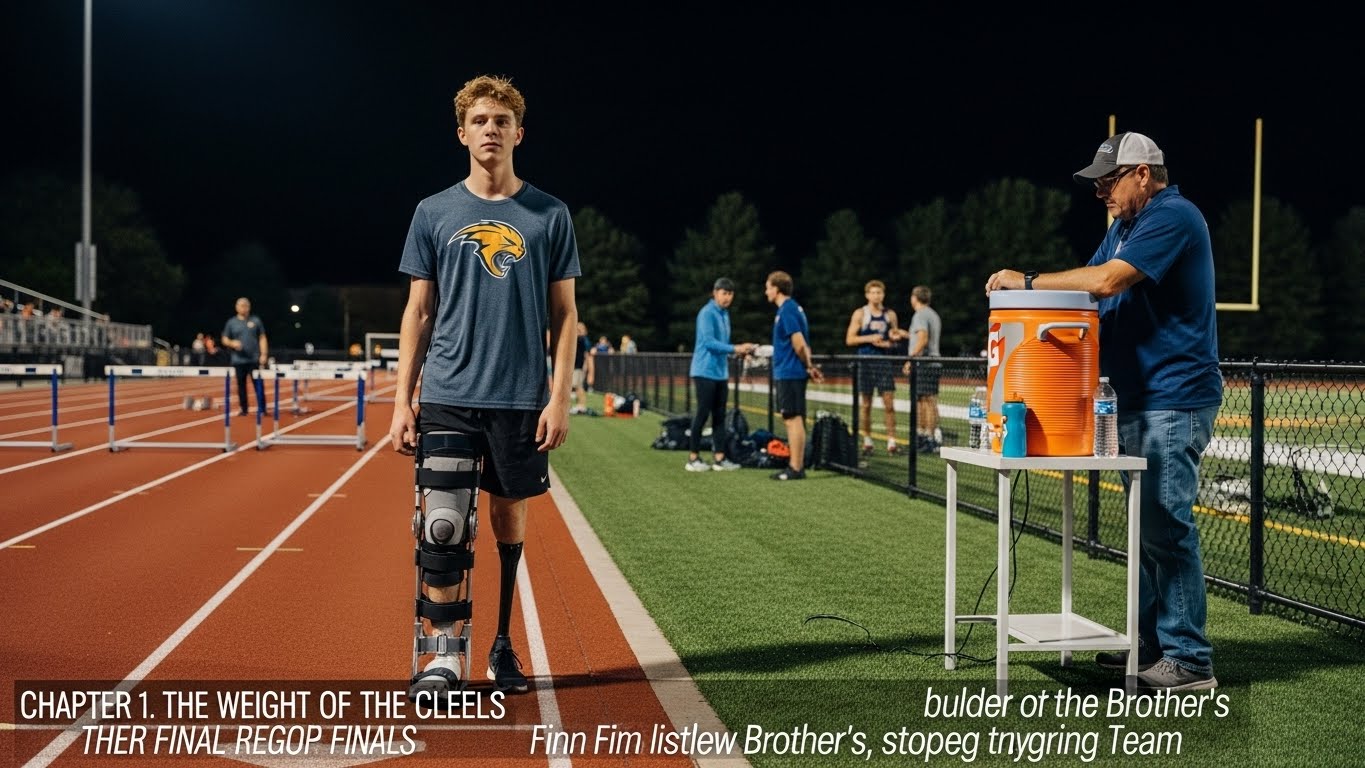
I remember the exact moment my little brother, Finn, stopped trying to hide the limp. It wasn’t on the playground or at physical therapy, but under the blinding Friday night lights of the Grandview High track. Finn was never supposed to be here. A freak accident at age seven—a simple fall from a backyard swing set that complicated a pre-existing condition, Legg-Calvé-Perthes disease, which had been misdiagnosed for months—had left his right leg severely compromised. He wore a custom, heavy-duty orthopedic brace under his jeans, a steel and plastic skeleton that whispered and clicked with every step. The sound was an audible demarcation between Finn and the rest of the world. He was fifteen, a freshman, and obsessed with the Grandview Panthers track team, not as an athlete, but as the meticulous, silent kid who filled the water bottles, wiped down the hurdles with obsessive care, and timed the sprinters with a stopwatch that felt too big for his hands. He knew the team’s splits, pacing, and potential failures better than anyone, almost as if he were trying to think his way onto the track.
Our older brother, Ethan, was the star. A natural-born speed machine—all lean muscle and fierce determination, standing six-foot-two with knees that worked like pistons. Ethan was the anchor runner for the varsity 4x400m relay, the one everyone expected to get a full-ride scholarship to the Big Ten next year. He carried the weight of our family’s hopes—hopes tied directly to his athletic prowess and the scholarship money that would follow. Ethan was Finn’s shadow, his fiercely protective older brother, but sometimes, he was Finn’s accidental tormentor, simply by being so effortlessly whole, so capable of flight. He saw the track as freedom; Finn saw it as a gilded cage he was trapped outside of.
Coach Miller, a man whose face was a roadmap of past championships and chronic caffeine jitters, didn’t see Finn. He saw a nuisance, a permanent piece of scenery who occasionally helped with logistics. Miller was a man driven by legacy and fear; his legacy was the state championships he’d won; his fear was the moment he stopped winning. His entire self-worth was strapped to the Panthers’ success.
It was the final, high-stakes practice before the Regional Finals, the biggest meet of the year. The atmosphere was thick with desperation and the metallic scent of damp earth and rubber. Ethan, pushing himself through the last 400-meter repeat, suddenly pulled up short near the 200-meter mark, his face twisting in a silent, agonizing scream that was somehow louder than any yell. A Grade 2 hamstring tear, the phys-ed teacher later confirmed. The sound of Ethan’s frustrated, primal roar echoed through the empty stands. I, sitting there as the unofficial team photographer—my own failed ambition to be a competitive swimmer now channeled into documenting their success—felt the air rush out of the moment, carrying our family’s financial future with it. We needed that scholarship; we needed this win. With Ethan out, the 4x400m team—the event that sealed the overall score—was dead. A guaranteed loss.
As the paramedics loaded Ethan onto a stretcher, I saw Finn, standing motionless by the water cooler, his gaze fixed not on his injured hero brother, but on the discarded, mud-caked baton lying forlornly near the spot where Ethan fell. That baton was the symbol of everything he was excluded from, the key to the life he desperately craved. That night, sitting in the sterile, fluorescent-lit hospital waiting room, Finn didn’t cry about Ethan’s pain. He didn’t talk about the lost scholarship. He looked at me, his eyes an unsettling mix of pain and fire—the same fire I saw in Ethan’s eyes right before a race—and whispered, “I can run the third leg, Jess. I know the exchange. I know the pace. I can do it.”
The sheer audacity, the impossible, terrifying hope in his voice, hit me like a physical blow. A boy who relied on a heavy crutch just to walk a straight line, wanted to run the most critical, high-pressure leg of the most important race of the season. It wasn’t a request; it was a desperate, almost manic demand for inclusion.
Chapter 2: The Unspoken Policy
Coach Miller’s office smelled like stale coffee, cheap aftershave, and the faint, dusty scent of old victory banners. It was suffocating. The next morning, I drove Finn to the track. The crutch—a lightweight aluminum one he preferred for speed, rather than the heavier steel brace—tapped nervously against the floor of my beat-up ’98 Ford Taurus. The new third-leg runner, a junior named Marcus “The Choker” Reynolds, a kid with speed but the mental fortitude of wet tissue paper, was already struggling in practice, dropping the baton twice in the first ten minutes. The anxiety was a palpable, living thing, clinging to the air.
Finn stood there, silent, his customized aluminum crutch tucked securely under his arm, watching every stuttered hand-off, every dropped baton. He had a look that was part defiance, part plea, like a starving dog staring through a bakery window.
Finally, Finn didn’t wait to be called. He walked right up to the coach, his leg brace scraping audibly on the rough asphalt as if demanding attention. “Coach, with all due respect, I know the splits better than anyone. I’ve timed this race a thousand times in my head. I can run it. My leg is compromised, yes, but I’ve been training privately. I’m faster than you think.”
Miller didn’t even look up from his clipboard, tracing an X over Marcus’s most recent abysmal split time. “Finn,” he said, his voice flat, exhausted, and devoid of warmth. “I appreciate the enthusiasm. But this is varsity. This is Regional Finals. It’s too important. It’s… against policy.” He dismissed it with a tired wave of his hand, a casual brutality that felt deliberate, rehearsed.
But the ‘policy’ was a flimsy, cowardly excuse, and we all knew it. There was no actual rule against a junior manager participating if they were on the roster—and Finn had technically been registered as an ‘alternate’ at the start of the season, a meaningless title until now. The truth was written all over Miller’s face: Fear.
Fear of a public relations nightmare (“Coach puts crippled kid in key race”), fear of the catastrophic loss, and worst of all, fear of the image. He couldn’t risk the spectacle. He wanted the win, clean, traditional, and predictable. He was terrified of the narrative of his star team being forced to rely on a kid with a crutch.
“What policy, Coach?” I interjected, stepping forward, unable to hold my peace. “Show us the section that says a team manager can’t step in when the entire relay is collapsing.”
Miller finally looked up, his eyes hard and cold. “The policy of winning, Jess. Go back to your camera.” He was prioritizing the optics over the boy’s heart, over Finn’s desperate, screaming need to prove his worth.
Finn just nodded, a slight, almost imperceptible movement that held a universe of crushed hope. But the way he gripped the crutch handle, his knuckles white, told me this wasn’t over. He was a creature of meticulous habit; he wouldn’t let this go. Later that afternoon, I caught him secretly timing himself, running a staggered sprint down a quiet suburban street, the heavy brace thudding against the pavement. He wasn’t using the crutch—he was running on sheer, painful will, favoring his good leg, pushing his physical limit to the breaking point. The pain on his face was raw, a mix of grimace and focus, but beneath it, there was a revolutionary kind of joy. He wasn’t just running a race; he was running against the policy, the fear, and the limitations placed upon him by the world. I knew then: if he got the chance, he wouldn’t just run the third leg; he would run the race of his life.
Chapter 3: The Secret Training Ground
Finn’s desperation didn’t just manifest as talk; it became a consuming physical obsession. After Coach Miller’s brutal rejection, Finn retreated, not into despair, but into a fierce, private training regimen. His biggest obstacle wasn’t the pain—it was the crutch itself. The moment he had to use it for support, he became a pedestrian. To run, he had to ditch it, and run like a crab, relying on the explosive power of his left leg and the minimal, grinding propulsion of his braced right leg. The motion was ugly, uneven, and utterly non-standard, but it was fast enough for a 100-meter dash in a pinch. The third leg of the 4x400m relay was a 100m sprint into the exchange zone, followed by a 300m bend. He knew he couldn’t run the bend, but he could run the first 100m like a freight train, pass the baton, and deal with the aftermath.
He chose the abandoned asphalt lot behind the old Grandview textile factory—a place hidden from the track team’s judgmental eyes. I became his accomplice. My ’98 Taurus became the pace car, the headlights cutting through the twilight like stadium lamps. Finn shed his pants, revealing the heavy-duty brace that looked like something out of a futuristic war movie. His body, though slight, was wire-taut with nervous energy.
His goal wasn’t just to match Marcus’s time; it was to shatter it. He needed a time so undeniable, so outrageously fast for a crippled kid, that Miller couldn’t use “policy” as a shield anymore. The first time he ran, his time for 100m was abysmal—18 seconds. He finished, collapsing onto the asphalt, the metal brace ringing out. He wasn’t just in physical pain; the emotional agony of failure was etched onto his young face.
“It’s no use, Jess,” he gasped, sweat plastering his hair to his forehead. “I’m a joke. I’m just a kid with a crutch.” This was his core wound: the constant, grinding feeling of being incomplete, of having his desire trapped in a failing body.
“No, you’re not,” I countered, my voice sharper than I intended. I was carrying my own burden of guilt: I’d always enabled Ethan, celebrated his talent, while Finn was often overlooked. “You just need to change the hand-off. You’re trying to run the whole thing. You need to focus on the explosive first hundred, ditch the crutch at the exchange, pass the baton, and then stop. It’s a tactical race, Finn. Not a marathon.”
His eyes, dark and intelligent, widened. He was a tactician, not an athlete. That night, he started timing his run with the crutch in his right hand. The crutch became an extension of his body, a temporary lever. The key was the exchange zone. He would run the 100m with explosive speed, the crutch acting as an awkward counterbalance. At the final checkpoint, he would drop the crutch, lean into the turn, and pass the baton, using the sudden loss of the crutch as a forward momentum trigger. It was insane, dangerous, and brilliantly calculated.
Two days before the Regionals, Finn hit his target. His 100-meter split, running with the crutch, was 12.8 seconds—faster than Marcus’s best time. The effort cost him: his good leg was screaming in protest, his braced leg was raw and blistered from the internal friction of the heavy plastic. But the timer didn’t lie.
“Now what?” I asked, holding the stopwatch, the number glowing ominously in the dark.
Finn didn’t answer. He just looked toward the lights of Grandview High, visible on the horizon. He wasn’t going to ask Coach Miller again. He was going to demand it, in the most painful, public way possible. He was going to use his biggest weakness—his disability—as his most powerful weapon. His motivation wasn’t just to win; it was to prove to himself, to Ethan, and to the world that his broken body wasn’t a barrier, but a definition of his unstoppable will.
Chapter 4: The Betrayal of a Brother
The day of the Regional Finals dawned heavy and gray, matching the mood in our house. Ethan was home, confined to the couch, his athletic future hanging precariously on physical therapy and a prayer. He wasn’t angry about his injury; he was consumed by the injustice of it all. He was also deeply uneasy about Finn’s sudden, manic secrecy.
“Where does he go every afternoon, Jess?” Ethan asked me, his voice raw with frustration as he watched Finn meticulously clean his crutch, preparing it for battle. “He looks like hell. He’s going to hurt himself permanently.”
The truth was, Ethan saw Finn’s reckless dedication not as courage, but as a dangerous act of self-harm, a perversion of the healthy, natural competition he understood. This was Ethan’s tragic flaw: his love for Finn was inextricably tied to his need to protect him from the harsh realities of physical failure. He couldn’t fathom that Finn might need the failure, the pain, to feel alive and seen.
I couldn’t reveal the secret training. “He’s just helping Miller with the roster, Eth. Trying to take his mind off things.”
Ethan didn’t believe me. He knew his little brother. Later that morning, Ethan found a crumpled, sweat-soaked piece of paper in Finn’s laundry basket. It wasn’t a homework assignment; it was a complex diagram of the relay exchange zone, marking a precise spot with the instruction: DROP CRUTCH HERE. EXPLODE. Below the diagram were the split times: 12.8s. A lightning bolt of realization hit Ethan: Finn wasn’t just managing. He was planning to run.
Ethan erupted. He dragged himself off the couch, hobbling on his own crutches, finding Finn in his room running through imaginary hand-offs with a rolled-up magazine.
“What the hell is this, Finn? Are you insane?” Ethan’s voice was shaky, torn between disbelief and fear.
Finn didn’t flinch. He just looked at his brother, the star athlete, the golden boy, and saw the embodiment of every limit placed on him. “It’s my time, Ethan. I’m fast enough.”
“Fast enough to what? Dislocate your hip? Embarrass the team? You’re not trained for this, Finn! You have a medical condition! You think I don’t know what Miller will do to you? I saw the split. It’s impossible, you must have fudged the timer.” The real wound surfaced: Ethan couldn’t accept that his physically broken brother could achieve a speed faster than some of his healthy teammates. It threatened his entire worldview.
Finn’s face hardened. “You’re scared I’ll lose your scholarship money, aren’t you? Or maybe you’re just scared I’ll prove that being broken isn’t the same as being useless.”
That line, the direct hit on Ethan’s deep-seated protective arrogance and his underlying fear of financial instability, drew blood. Ethan’s eyes flashed with real pain. “I’m calling Miller,” he declared, the ultimate betrayal of a brother. “I’m telling him you’re planning this stunt. I’m doing it for your own good!”
Finn didn’t plead. He just shrugged, a cold, empty gesture. “Go ahead. But if you call him, Ethan, you’ll be doing exactly what they expect: pushing the handicapped kid back to the sidelines. You’ll be proving Miller right.”
It was the ultimate moral choice: protect his brother from physical harm and public humiliation, or respect his desperate need for agency and risk. Ethan stood there, paralyzed, the phone heavy in his hand, the weight of his guilt and his love crushing him. The tension between the two brothers, the star and the ghost, was thick enough to choke on. The secret wasn’t just Finn’s plan; the secret was the deep, festering resentment Finn held against his brother’s perfection, and the secret was Ethan’s desperate attempt to control the chaos of his life by controlling Finn.
Chapter 5: The Lineup and the Lie
The Regional Finals were everything the pressure cooker of high school athletics promised: noise, chaos, and the relentless, pounding rhythm of drums. Grandview was leading by two points, making the 4x400m relay the decisive final event.
The crowd was enormous. We were surrounded by the sights and sounds of Americana: the smell of hot dogs, the roaring bleachers, the booming voice of the announcer. The atmosphere was so thick with expectation it felt like a single wrong move would shatter the glass.
Coach Miller, pacing like a caged tiger, watched Marcus Reynolds, the assigned third-leg runner, warm up. Marcus was clearly terrified. His hands were sweating, he was missing the exchange mark, and his eyes kept flicking to the starting gun. Miller was losing the psychological battle with his own runner.
Suddenly, a voice boomed over the public address system: “Attention all officials! Grandview High’s 4x400m team has submitted a last-minute roster change. Runner for the third leg will now be… Finn Taylor.”
A wave of confusion swept through the Grandview side. Miller froze, his head snapping toward the official table. He hadn’t authorized this. He hadn’t even seen Finn that day.
I hadn’t, either. But then I saw him: Finn, already positioned at the third exchange zone, wearing Ethan’s oversized uniform. He had used my camera bag to sneak his gear in, forging my signature on the roster change form I’d left on the passenger seat of the Taurus. He was already committed, the choice made for him by his own audacious hand.
Miller charged across the field, his face a mask of scarlet fury. “Finn! What the hell is this?! Get off the track! You think this is a joke?”
Finn just stood there, using his crutch as an anchor, steadying himself. The first runner took off, and Finn leaned down, placing his right hand on the track, the fingers of his left hand gripping the crutch. He was taking the starting position used by runners in the exchange zone.
“You can disqualify me, Coach,” Finn yelled over the roar of the crowd, “but you can’t replace me now without forfeiting the race. The official checked the roster. Either I run, or Grandview loses the entire meet. It’s your choice.”
This was the core dilemma: Miller could pull Finn out, but by doing so, he forfeited the relay and lost the championship title he desperately needed. The “policy” had been used against him. Finn had cornered him with the rules themselves.
Miller’s conflict was brutally visible: his legacy versus his rage. His eyes darted from Finn’s defiant, braced figure to the official checking his stopwatch. The clock was ticking. He had seconds to decide.
Finally, Miller let out a raw, guttural sound—a mix of defeat and sheer, terrified necessity. “Fine, Taylor! You run! But if you drop that baton, you are off this team forever! And you’re walking home!” He screamed the last part, the sheer tension of the moment causing him to lash out like a cornered animal.
The official blew the whistle. The race was on.
Chapter 6: The Inevitable Collision
The first runner, Danny, finished his lap well, but the second runner, a nervous sophomore named Kevin, fumbled the hand-off and lost precious ground. Grandview was now trailing the rival team, Crestview, by a punishing ten meters.
The crowd was roaring, but I couldn’t hear it. All I could hear was the frantic, pounding beat of my own heart and the distinctive clack-click of Finn’s customized brace.
Finn was ready for the pass. He ditched the crutch onto the infield rubber, a sound that was somehow drowned out yet deafeningly loud. He took off in a staggered, explosive burst, his left leg doing the work of two, his right leg dragging the heavy, plastic brace, providing a minimal, painful push. He wasn’t running smoothly; he was propelling himself forward in a violent, desperate lunge.
The sound of his heavy brace impacting the track with every step was an alien rhythm in the symphony of the race—thud-thud, drag-thud.
Kevin came flying down the straightaway, winded and panicked. The hand-off was messy, rushed, and dangerously close to the end of the exchange zone. Finn grabbed the baton, but the force of the pass sent him reeling, his balance, already precarious without the crutch, threatening to collapse.
He didn’t stop. He turned the corner, running the bend—the section he was never supposed to attempt. He was not only running his leg, but pushing himself into the critical, long curve, fighting the centrifugal force that threatened to throw his already compromised body onto the track.
The pain was visible. His face was pure agony, sweat pouring off him, but he was closing the gap. He wasn’t running with speed; he was running with will. He was gaining on the Crestview runner, the absurdity of the scene—a kid running with a heavy brace, his body screaming—riveting the entire stadium.
Then came the collision.
Just 50 meters from the final exchange zone, the Crestview runner, spooked by the strange, uneven gait and the sudden proximity of Finn, drifted slightly inward. Finn, leaning hard into the turn, didn’t have the micro-adjustments needed. Their elbows clipped.
Finn went down.
Not a graceful stumble, but a brutal, bone-jarring collapse. The baton flew forward and skittered onto the infield grass, landing impossibly far away. The sound of his heavy brace hitting the rubber was a sickening CRACK that silenced the stadium. Finn lay motionless, his body twisted awkwardly, his face pressed against the red track. The race—and the championship—was instantly over. Grandview had lost.
From the stands, I saw Ethan rise from his crutches, his face pale with terror and self-reproach, the look of a man who realized his betrayal had led to this painful, public end. Coach Miller stood frozen on the sideline, his championship dreams shattered, not by a rival, but by his own failure to either protect or believe in his weakest athlete.
Chapter 7: The Silence and the Crutch
The silence that fell over the Grandview track was profound, heavy, and absolute. It wasn’t the silence of anticipation; it was the silence of shared shock, the collective intake of breath from thousands of spectators witnessing a private tragedy unfold in the most public way.
Finn lay there, a crumpled heap of ambition and orthopedic steel. The pain was astronomical—a deep, searing throb in his compromised hip and the agonizing friction of the brace against raw skin. But the physical pain was secondary. What truly gutted him was the crushing, overwhelming shame. He had fallen. He hadn’t just lost the race; he had confirmed every single one of Coach Miller’s fears, validating the “policy” that kept him off the track. He had humiliated himself, wasted the team’s effort, and failed his brother.
Then, the wave of sound began, not a boo or a cheer, but a slow, rising tide of individual voices. People in the stands were rising, not to leave, but to applaud. Not for the winners, but for the boy who lay broken on the track. It was a standing ovation of pure, unfiltered empathy.
Suddenly, the silence was broken again, this time by the frantic, uneven sound of crutches striking the rubber. Ethan, ignoring the screams of the team trainers, was hobbling onto the track, moving faster than he should have, risking his own recovery. He reached Finn and dropped to his knees, disregarding the agony in his own hamstring.
“Finn! Finn, look at me. Are you okay? Don’t move.” Ethan’s voice was ragged with panic and a sickening, fresh wave of guilt.
Finn just squeezed his eyes shut. “I’m sorry, Eth. I lost. I failed everyone.” His voice was thin, choked with shame.
“No, Finn. No. You didn’t fail. You ran,” Ethan whispered, his hands trembling as he gently checked Finn’s brace. This was the moment of ultimate vulnerability, the stripping away of the golden boy persona. Ethan didn’t treat Finn like a problem or a fragile pet; he treated him like a warrior who had fought and fallen.
Then, Coach Miller arrived, not with the expected fury, but with a strange, drained resignation. His face, usually a roadmap of angry lines, was slackened, pale. The loss was total. But looking at the two brothers on the ground, one injured star and one injured hopeful, he saw the depth of his own failure. He hadn’t just lost the championship; he had nearly broken a human being with his professional cowardice.
“The baton,” Miller said quietly, his voice barely audible. He pointed to the infield grass where the baton lay. “The race is over, Finn. But the hand-off wasn’t technically completed. We’re disqualified.”
Finn looked at the baton, lying impossibly far away. It was over.
Then, a new figure entered the scene: Marcus Reynolds, the “Choker,” who had been replaced at the last minute. Marcus was not upset about being usurped; he was looking at Finn with an expression of profound respect and pity. Marcus slowly walked over, picked up Finn’s discarded aluminum crutch, and brought it to the boy.
He didn’t hand it to Finn. Instead, Marcus handed the crutch to Ethan. “He needs this more than the race right now, Ethan,” Marcus said, a simple statement that shifted the focus from winning back to humanity.
This act of compassion—the moment a sidelined competitor recognized a deeper victory in Finn’s attempt than in any win—was the ultimate twist. It was the moment the policy of winning died, replaced by the policy of heart.
Chapter 8: The Definition of Fastest
The next few days were a blur of doctor visits, ice packs, and silence. Finn hadn’t permanently injured himself, but he had severely strained the muscles around his hip, forcing him to rely heavily on the crutch again. The brace felt heavier than ever, a constant, physical reminder of his failure.
Ethan, however, had undergone a seismic shift. He hadn’t called Miller that day because he realized he couldn’t choose for Finn. Now, he chose to own the outcome.
He found Finn sitting on the back porch, staring at the suburban street where he had secretly trained.
“Miller didn’t kick you off the team,” Ethan said, sitting down, wincing slightly as he stretched his bad leg. “He tried. But the athletic board got a ton of emails. Apparently, your fall went viral. People were sharing clips of you running—the wobble, the speed, the fall.”
Finn looked up, startled. “They were laughing, right?”
“No. They weren’t. They were crying. They were sharing the clip with the caption: ‘The fastest runner isn’t the one who finishes first, it’s the one who risks everything just to start.’”
Ethan pulled out his phone and showed Finn the clip. It wasn’t a professional angle; it was a shaky, amateur video from the stands. The sound of the crowd’s sudden silence, followed by the applause, was chilling. Finn watched himself fall, the moment of pure agony, and then saw the outpouring of support. It was the public recognition he had desperately craved, not for his ability to win, but for his courage to try.
“Miller knows he’s getting fired next year,” Ethan continued, a grim satisfaction in his tone. “But he came by. He didn’t apologize, but he said this: He said he’d never seen a kid move with so much focus, so much commitment, even knowing the risk. He said you redefined the third leg for him.”
The greatest concession wasn’t the coach’s apology, but his professional respect. Miller had seen a flaw, but he had also witnessed an unstoppable will.
“What about us, Eth?” Finn asked, the real question—the deep, festering conflict between the whole brother and the broken brother—finally surfacing.
Ethan put his arm around Finn’s thin, tense shoulders. “I was scared of you, Finn. Scared of what it meant if you, with your bad leg, were as fast as me. I was terrified of losing the scholarship. But when I saw you fall, I didn’t care about the scholarship. I only cared about the pain in your eyes. My leg might heal, Finn. But my mind was the one that was crippled. I’m sorry I tried to stop you.”
It wasn’t just a simple apology. It was an acknowledgment of his own weakness, his own fear of losing control and status. The scar on Finn’s hip was physical; the scar on Ethan’s heart was his inability to truly see his brother’s strength.
Epilogue: The New Finish Line
A month later, the Grandview track team gathered for the annual banquet. Coach Miller was conspicuously absent, taking an early ‘sabbatical.’ Finn was there, walking slowly, but without the hesitant, apologetic gait he’d carried before.
The new interim coach presented the final award of the evening, a newly created one. He held up an aluminum crutch, Finn’s crutch, which had been polished and mounted on a dark wooden plaque.
“This year, we didn’t win the Regional title,” the coach announced, his voice surprisingly firm. “But this year, we redefined what winning means. This is the Finn Taylor Perseverance Award. Because true speed isn’t about the seconds you save, it’s about the obstacles you face. Finn Taylor ran the third leg not with two good legs, but with the heart of ten men.”
Finn walked up, took the heavy plaque, and held the mounted crutch. It was no longer a symbol of his deficiency, but a monument to his defiance.
He didn’t make a grand speech. He simply looked out at the team, at his brother Ethan, who was giving him a standing ovation with a fierce, proud smile, and at Marcus, who nodded respectfully.
The applause was louder, richer, and more honest than any cheer for a championship title. It was the sound of a community choosing compassion over competition.
Finn looked down at the plaque, feeling the smooth, cold metal of the mounted crutch under his fingers. He had lost the race, but he had won something far greater: the right to define his own limits.
He gave the plaque a tight squeeze, a small, weary smile crossing his face.
The last thought in his mind, as he walked off the stage, was the simplest, most profound truth he had ever known: I may have two legs, but only one heart. And that heart will never stop running.