He Poured Champagne on My “Cheap” Dress and Mocked My Scholarship — He Didn’t Know the Building Was Named After My Father
Chapter 1: The Stain of “Charity”
The air in the Grand Hall of Whitmore University didn’t smell like books or old parchment; it smelled of old money. It was a specific scent—a blend of expensive French cologne, starched linen, and the metallic tang of chilled oysters.
I stood near a towering marble pillar, trying to make myself as narrow as possible. My name tag, pinned slightly crookedly to my chest, read Maya Linley. To everyone in this room—the firm partners from New York, the illustrious alumni, and the wealthy donors—I was a nobody. I was a “statistic.” A scholarship student from the wrong side of the tracks who had somehow scraped enough GPA points together to breathe the same air as the sons and daughters of industry titans.
I smoothed the fabric of my navy dress. It was a vintage piece I’d found at a thrift store in Brooklyn for twelve dollars. I had spent three sleepless nights tailoring it on my roommate’s sewing machine, taking it in at the waist and fixing the hem, hoping to make the polyester blend look like silk.
“You look great, M,” a voice whispered beside me.
I turned to see Chloe, my roommate and best friend. She was holding two glasses of sparkling water, looking uncomfortable in her borrowed heels.
“I feel like an imposter, Chloe,” I admitted, keeping my voice low. “Look at them. They aren’t even looking at the student displays. They’re just… networking.”
“You’re not an imposter. You’re the best architect in the junior class,” Chloe said fiercely. “Your model, The Haven, is going to blow them away. Professor Vance said it was ‘visionary.'”
I looked toward the corner of the room where the student architectural models were displayed. My project—a sustainable, low-cost housing complex designed for urban displacement—sat proudly on its pedestal. It was my heart and soul. It was the reason I was here, hiding my true identity, living off a stipend, and refusing to touch the trust fund that had been waiting for me since I was eighteen.
I wanted to make it on my own. I needed to know that if I succeeded, it was because of my mind, not my father’s checkbook.
“Well, well, well,” a drawling voice cut through the ambient jazz music. “If it isn’t the charity case.”
My stomach tightened. I didn’t need to turn around to know who it was. The arrogance in the tone was a fingerprint.
Caleb Sterling.
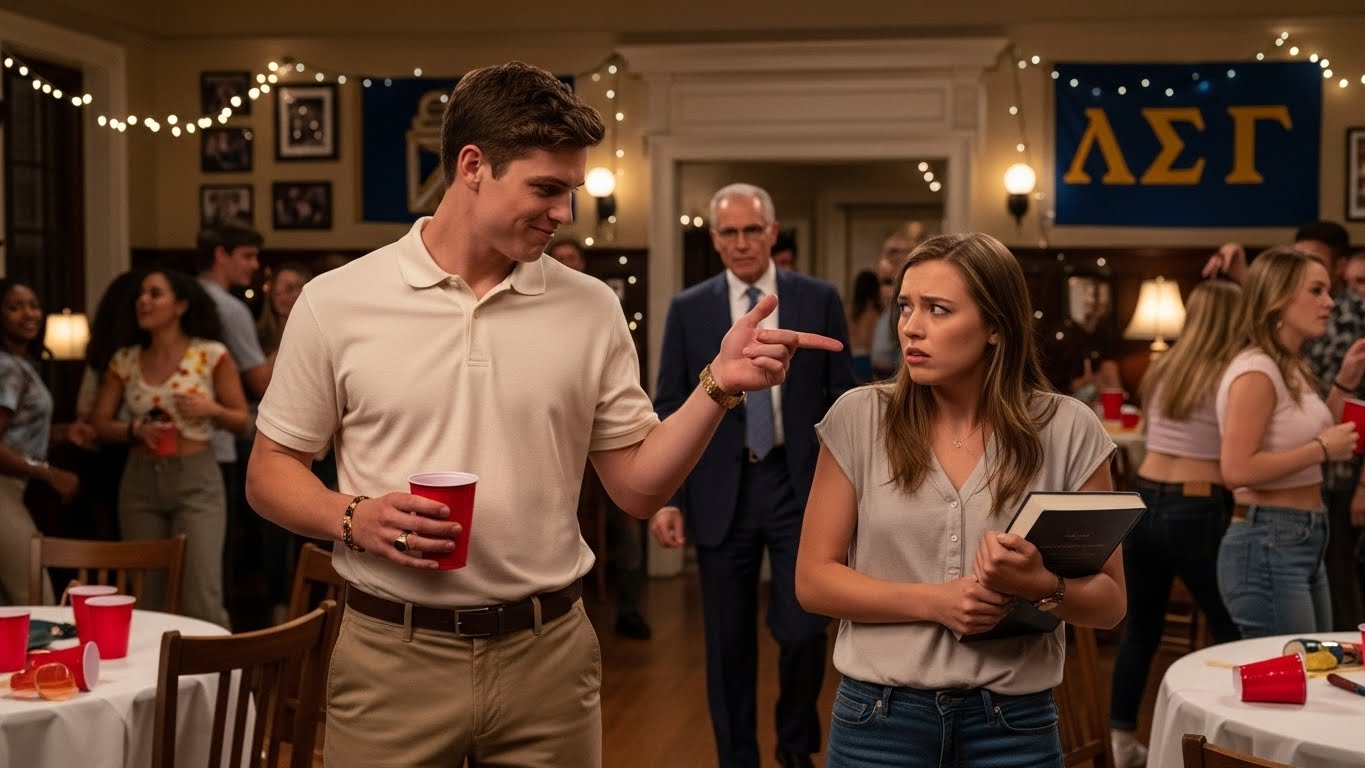
He sauntered into view, flanked by two of his Zeta Mu fraternity brothers. Caleb was handsome in that classic, cruel way—blonde hair perfectly coiffed, a jawline that could cut glass, and a tuxedo that cost more than my entire four-year education would have, had I been paying for it. His father, Richard Sterling, was a real estate mogul who sat on the university board. Caleb walked through Whitmore like he owned the pavement.
“Hello, Caleb,” I said, keeping my face neutral. “Enjoying the gala?”
“I was,” Caleb smirked, swirling a flute of golden champagne. “Until I smelled the distinct aroma of… desperation.” He stepped closer, invading my personal space. The scent of bourbon and sandalwood was overpowering. “Who let you in, Maya? I thought this event was for future leaders, not the help.”
“I have a project in the showcase,” I said, my voice steady despite the rapid thumping of my heart. “Just like you.”
Caleb laughed, a harsh, barking sound that drew the attention of a nearby group of alumni. “Like me? Oh, honey. You are nothing like me. My project is a sixty-story luxury high-rise. Your project is… what? A homeless shelter? How fitting. Designing homes for your own people?”
Chloe stepped forward, her eyes blazing. “Back off, Caleb. You’re just mad because Maya got the highest score on the midterms and you barely scraped a C.”
Caleb’s eyes narrowed. The mention of his academic mediocrity was the one button that always worked. His smile vanished, replaced by a cold, predatory sneer.
“A C means nothing when your name is on the library,” Caleb hissed. “And grades don’t matter in the real world, sweetheart. Connections do. Breeding does.”
He looked at me, his gaze traveling up and down my dress with undisguised disgust.
“Nice dress, by the way,” he said, his voice dripping with sarcasm. “What is that? Polyester? It shines under the lights. It looks… flammable.”
“It’s vintage,” I said, lifting my chin.
“It’s garbage,” Caleb corrected. “And it offends me.”
In a motion so casual it was almost terrifying, he tilted his wrist.
The champagne glass tipped.
It wasn’t a splash; it was a deliberate pour. The cold, sticky liquid cascaded down the front of my dress, soaking into the bodice, turning the navy fabric black and clinging to my skin.
I gasped, the shock of the cold hitting me like a physical blow.
“Oops,” Caleb deadpanned. He didn’t even blink. “My hand slipped. Hard to hold a glass when I’m laughing this hard.”
The circle of people around us went silent. A few students giggled nervously, but most of the adults—the professors, the donors—looked away. They saw it happen. They saw the humiliation. But nobody moved. Nobody spoke. Because he was a Sterling, and I was nobody.
I stood there, the champagne dripping onto the expensive marble floor, feeling the heat rise in my cheeks. It wasn’t just embarrassment; it was rage. A hot, molten rage that I had been suppressing for three years at this school.
“You did that on purpose,” I whispered.
“Prove it,” Caleb smiled, pulling a silk handkerchief from his pocket. For a second, I thought he was going to offer it to me. Instead, he wiped a speck of dust from his own lapel and tucked it back in. “Go clean yourself up, Scholarship. You look like a wet dog. You’re ruining the aesthetic of the evening.”
He turned his back on me, his friends chuckling as they merged back into the crowd.
I stood frozen, the sticky sugar drying on my skin, realizing that no matter how good my grades were, no matter how hard I worked, there was a glass ceiling here. And Caleb Sterling was standing on top of it, pouring champagne on my head.
Chapter 2: The Ultimatum
I burst into the ladies’ room, my vision blurred by tears I refused to let fall in public. The restroom was an opulent sanctuary of marble and gold leaf, a stark contrast to the dorm showers I was used to.
I moved to the sinks, grabbing handfuls of paper towels, frantically dabbing at my chest.
“No, no, no,” I muttered, my voice trembling.
The stain was setting. The navy fabric had darkened into an ugly, shapeless blotch right over my heart. I smelled like a brewery. How was I supposed to stand next to my model and present my thesis to the partners at H&M Architects looking like this?
Chloe came bursting in a moment later, breathless.
“That absolute psychopath!” she screamed, her voice echoing off the tiled walls. “I’m going to kill him. I don’t care if his dad sues me. I’m going to go out there and break a heel off in his eye.”
“Chloe, stop,” I said, taking a deep breath and staring at my reflection. My face was pale, my dark hair slightly frizzy from the humidity of the crowded hall. But my eyes… my eyes were hard. “Violence will just get us expelled. That’s what he wants.”
“So what? You’re just going to take it?” Chloe asked, handing me a wet paper towel. “Maya, he humiliated you.”
“I know,” I said, scrubbing at the fabric. “But if I leave now, he wins. If I hide, he wins. I need this internship, Chloe. H&M is the only firm that prioritizes sustainable urban planning. If I get this, I’m set. I won’t need the university stipend. I can be free of this place.”
“You’re too good for this school,” Chloe sighed, leaning against the counter. “I still don’t get why you act like you’re broke. I saw your sketchbook. The materials you know about… the way you understand construction costs… it’s like you grew up on a job site.”
I froze for a split second. Chloe didn’t know. Nobody knew.
“My dad was in construction,” I lied smoothly. It wasn’t a total lie. Arthur Thorne owned the biggest construction conglomerate in the hemisphere. He just didn’t hold a hammer anymore; he held the fate of economies in his hands.
“Right,” Chloe said. “Well, your dad taught you to be tough. But Caleb is dangerous, Maya. He’s not just a bully; he’s entitled. He thinks the world is his playground.”
I looked at the stain one last time. It wasn’t coming out.
“Fine,” I said, straightening my back. “Then I’ll wear it like war paint. Let them judge me for the stain. Once they see the design, it won’t matter.”
I marched out of the bathroom, Chloe trailing behind me like a bodyguard.
We re-entered the ballroom. The noise had increased. The presentation hour was beginning. I walked with my head high, ignoring the whispers and the side-eyes directed at my ruined dress. I navigated through the sea of tuxedos toward the student corner.
I needed to check my lighting. I needed to make sure the miniature solar panels on The Haven were aligned.
But when I reached my designated table—Table 14—I stopped dead.
The table was empty.
My breath hitched in my throat. I looked around wildly. Maybe they moved it? Maybe a professor took it for a closer look?
“Looking for something?”
The voice came from the balcony doors.
I spun around.
Caleb was leaning against the open French doors that led to the terrace. The night wind was blowing the curtains. In his right hand, he held The Haven.
He wasn’t holding it by the base. He was holding it by the delicate balsa wood trusses of the roof, dangling it over the hard marble floor.
“Caleb!” I screamed, forgetting decorum. “Put that down!”
The sharpness of my voice cut through the room. The jazz band faltered. Heads turned.
I ran toward him, but he took a step back, holding the model out over the threshold, where the stone steps dropped down to the garden below. One drop, and months of work—hundreds of hours of cutting, gluing, and calculating—would be shattered splinters.
“Don’t come any closer,” Caleb warned, his eyes gleaming with malicious delight.
I stopped, panting, my hands held up in surrender. “Caleb, please. That’s my semester grade. That’s my future.”
“Your future?” Caleb scoffed. He looked at the model, then back at me. “You know, I looked at this thing. It’s pathetic. ‘Affordable housing.’ You really think H&M Architects wants to build shacks for the poor? They want monuments, Maya. They want legacy. Like my tower.”
“Architecture is about serving people,” I said through gritted teeth. “Give it back.”
“I’ll make you a deal,” Caleb said, his voice dropping to a conspiratorial whisper that carried across the silent room. “You withdraw.”
“What?”
“You withdraw your application for the H&M internship,” Caleb said calmly. “And you drop out of the Honors program. Leave the spot open for someone who actually deserves it. Someone who can pay full tuition.”
“You’re crazy,” I whispered.
“I’m practical,” he countered. “My father is flying in tonight. If he sees that a scholarship student beat his son for the top spot, he’s going to be disappointed. and I really hate disappointing my father.”
He tilted his hand. A tiny, hand-painted tree fell from the model and clattered onto the floor.
“Decide, Maya,” he smiled. “Your dignity, or your project? Leave the gala now, and I’ll put it down gently. Stay, and I smash it.”
I looked around the room. Professor Vance was looking down at his shoes. The Dean was pretending to examine a painting on the wall. They were letting this happen. They were all afraid of the Sterling money.
I felt a cold clarity wash over me. I wasn’t just fighting for a grade anymore. I was fighting for my existence.
“No,” I said loudly.
Caleb blinked. “Excuse me?”
“I said no,” I stepped forward, my voice ringing with a power I didn’t know I possessed. “I’m not going anywhere. I earned my place here. And you? You’re just a sad, insecure little boy who has to break things to feel big.”
The insult hit its mark. Caleb’s face turned a violent shade of purple.
“You ungrateful little bitch,” he snarled.
He raised his arm high. He was going to spike it. He was going to destroy it right there in front of everyone.
I flinched, closing my eyes, waiting for the sound of the crash.
Chapter 3: The Revelation
BOOM.
The sound wasn’t shattering wood. It was the double oak doors at the main entrance being thrown open with such force that they banged against the walls.
The vibration seemed to shake the floorboards.
“MR. STERLING!”
The voice was a thunderclap. It was baritone, gravelly, and commanded absolute, terrified silence.
Caleb froze, his arm still raised, my model dangling precariously from his fingertips. He looked toward the entrance, annoyed. “Who the hell interrupts—”
His words died in his throat.
Standing in the doorway was a man who seemed to blot out the light. He was wearing a bespoke black tuxedo that fit his broad shoulders like armor. His silver hair was swept back, and his face—weathered, sharp, and intense—was set in a mask of cold fury.
Behind him, Dean Simpson was practically running to keep up, looking pale and sweating profusely.
“Mr. Thorne!” the Dean squeaked, his voice cracking. “Please, sir, we weren’t expecting—”
The man ignored him. He walked into the room. He didn’t walk; he prowled. The crowd parted instantly. It was like watching the Red Sea separate. These were wealthy people, powerful people, but this man was different. He was the kind of money that owned the banks the other people used.
He walked straight toward us. His steel-grey eyes were locked on Caleb.
Caleb lowered his arm slightly, confusion replacing his anger. “Who is that?” he muttered to one of his friends, but his friend had already backed away, disappearing into the crowd.
The man stopped ten feet away from us. He looked at Caleb. Then he looked at the model in Caleb’s hand.
Then, he looked at me.
The hard lines of his face softened instantly. The fury in his eyes melted into a pool of deep, pained concern. He looked at the champagne stain on my dress. He looked at my red-rimmed eyes.
“I’m sorry I’m late,” the man said, his voice deep and rumbling, directed solely at me. “The pilot had to route around a storm system over the Atlantic.”
I let out a breath I didn’t know I was holding. My shoulders slumped. “It’s okay,” I whispered. “You’re here now.”
Caleb looked between us, a nervous laugh bubbling up in his throat. “Excuse me? Sir? I don’t know who you think you are, but this is a private event for the university. I’m Caleb Sterling. My father is Richard Sterling. He’s on the Board of Directors.”
The man finally turned his gaze back to Caleb. It was like a lion looking at a mouse.
“Richard Sterling,” the man repeated slowly, tasting the name like it was sour milk. “Yes. I know him. He works for me.”
The room gasped. A collective intake of breath that sucked the oxygen out of the hall.
Caleb blanched. “What? No. My father owns Sterling Estates.”
“And Sterling Estates,” the man said, taking a step closer, “is a subsidiary of Thorne Global Industries. Which I own.”
Caleb’s hand began to shake. The model wobbled.
“Careful,” the man said. His voice dropped to a whisper, but it was more terrifying than a shout. “That model represents more talent in its foundation than you have in your entire bloodline. If you drop it… well, let’s just say your father’s employment status will become very fluid.”
Caleb’s eyes widened to the size of saucers. He looked at the model like it was a live grenade. He quickly, clumsily, placed it gently onto the nearest table, backing away with his hands up.
“I… I was just holding it,” Caleb stammered. “Helping her. We were just joking. Right, Maya? Just a joke.”
The man didn’t look at Caleb. He turned to me, offering his arm.
“Are you alright, sweetheart?”
“I’m okay,” I said, my voice gaining strength as I took his arm. I felt the familiar, sturdy wool of his jacket. “Just a little wet.”
“Sweetheart?” Caleb whispered, looking like he was about to vomit. “Wait… Maya… Thorne?”
The man turned to the room, raising his voice so every single person could hear.
“Dean Simpson,” he barked.
The Dean scurried forward. “Yes, Mr. Thorne? Anything you need, sir.”
“I seem to recall,” Arthur Thorne said, his voice echoing off the vaulted ceiling, “that when I donated forty million dollars to build this hall—the Arthur Thorne Hall of Architecture—one of my stipulations was that it be a place of merit, not entitlement.”
He gestured to the champagne stain on my chest.
“Is this how Whitmore treats its top scholars? Or is this how it treats my daughter?”
The silence that followed was absolute. You could hear a pin drop.
I looked at Caleb. His face had gone completely white. He looked at me, then at the name etched in gold above the main entrance—The Arthur Thorne Hall—and then back at me.
“Your… daughter?” Caleb squeaked.
“Yes,” I said, stepping forward, the shame of the stained dress vanishing, replaced by cold pride. “I didn’t want to use his name, Caleb. I wanted to see if I could make it on my own. And I did. I earned my spot.”
I took a step closer to him.
“But you? You just lost yours.”
Chapter 4: The Masquerade Drops
The silence in the ballroom was shattered by a sudden, frantic energy. It was as if the air pressure had dropped and everyone was scrambling to find an oxygen mask.
Dean Simpson was the first to recover, though his composure was as shaky as a newborn colt. He practically sprinted over to us, his face glistening with a sheen of cold sweat.
“Miss… Miss Thorne,” he stammered, his eyes darting between me and my father. He looked like a man trying to defuse a bomb with a hammer. “I… I had absolutely no idea. If we had known you were the Thorne, we would have—”
“You would have what?” I interrupted, my voice calm but laced with a chill that matched the champagne drying on my skin. “Treated me with basic human decency? Or just made sure nobody spilled drinks on the donor’s daughter while letting them torment the scholarship students?”
The Dean’s mouth opened and closed like a fish out of water. He looked to my father for help, but Arthur Thorne was a statue of judgment. He stood with his hands clasped behind his back, his gaze fixed on the Dean with the intensity of a laser cutter.
“My daughter asked you a question, Dean Simpson,” my father rumbled.
“I… we…” The Dean swallowed hard. “We strive for a respectful environment for all students, of course.”
“Do you?” My father gestured to Caleb, who was currently being shielded by two nervous-looking fraternity brothers near the buffet table. “Because five minutes ago, I watched a young man attempt to destroy academic property as a bargaining chip to force a student to drop out. Is that the curriculum here? Extortion 101?”
Around us, the atmosphere had shifted entirely. The same students who had laughed when Caleb mocked my dress were now whispering in hushed, reverent tones.
“Did you know?” “I had no idea. She drives a Corolla.” “She’s worth billions.”
I felt a wave of nausea. This was exactly what I had spent three years avoiding. I didn’t want their fear, and I certainly didn’t want their sycophancy. I looked at Chloe. She was the only one looking at me, not the name. Her jaw was dropped, but her eyes were full of shock, not calculation.
“Maya,” she mouthed. “What the hell?”
I stepped away from my father’s protective orbit and walked over to her. “I’m sorry,” I whispered. “I wanted to tell you. I just… I wanted one thing in my life that was mine.”
Chloe stared at me for a long second, then let out a breathy laugh, shaking her head. “Girl, you let me buy you ramen for three years. You let me use my coupon codes for your birthday gift.”
“And I loved those gifts,” I said earnestly. “Because they were real.”
Chloe’s expression softened. She grabbed my hand. “Well, ‘Real Maya’, we have a problem. Caleb is on the phone. And he looks like he’s calling in the cavalry.”
I looked over. Caleb was pressed into a corner, his phone glued to his ear, his hand gesturing wildly. His face was pale, but there was a new glint in his eye—desperation mixed with the promise of reinforcements.
“Let him call,” my father said, appearing at my shoulder. He placed a warm hand on my back. “Richard Sterling is a bully, and he raised a bully. But they forget who built the playground.”
“Dad,” I said quietly, turning to him. “I need you to promise me something.”
“Anything.”
“Don’t fire his dad. Don’t pull the funding. Don’t destroy them.”
My father frowned, his thick eyebrows knitting together. “Maya, he humiliated you. He assaulted you.”
“If you destroy them with money, then I’m just ‘Daddy’s Little Girl’ who needed rescuing,” I said, my voice hardening. “I need to beat him. Me. Tomorrow, at the H&M presentation. I need to win that internship because I’m better than him, not because you own his mortgage.”
My father studied my face. He saw the same stubbornness he saw in the mirror every morning. Slowly, a proud smile tugged at the corner of his mouth.
“You really are your mother’s daughter,” he murmured. “Fine. I’ll keep the sword in the sheath. But I’m staying for the presentation.”
“Deal.”
The rest of the night was a blur of hypocritical apologies. People who had never learned my name were suddenly complimenting my “avant-garde” dress choice. Professors who had graded me harshly were suddenly offering to “review my portfolio for extra credit.”
I left as soon as I could, clutching my rescued model to my chest.
As I walked out of the heavy oak doors into the cool night air, I heard footsteps behind me.
“Maya! Wait!”
It was Caleb. He had run after me, looking disheveled. His tie was loosened, and the arrogance was gone, replaced by a frantic, oily charm.
“Maya, hey,” he panted, stopping a few feet away. “Look, back there… things got heated. You know how it is. Zeta Mu initiation stress, the gala… I just wanted to say, no hard feelings, right?”
I stared at him. He wasn’t sorry. He was terrified.
“No hard feelings?” I repeated incredulously. “You poured alcohol on me and tried to smash my thesis.”
“It was a joke!” Caleb forced a laugh, running a hand through his blonde hair. “Just a prank. Look, now that we know… you know, that we’re from the same… world… we should stick together. Us elites need to watch out for each other, right?”
He reached out to touch my arm.
I recoiled as if he were radioactive. “We are not from the same world, Caleb. You’re from a world where you think you can buy people. I’m from a world where I work for what I have.”
“Oh, come on,” Caleb sneered, the mask slipping for a second. “Don’t play the saint. You’re a Thorne. You’re the 1%. You could buy this whole university and turn it into a parking lot. Stop pretending you’re one of the peasants.”
“I might be a Thorne,” I said, stepping into the waiting town car my father had summoned. “But tomorrow morning, inside that presentation room, I’m just the girl who is going to take your spot.”
I slammed the door. As the car pulled away, I watched Caleb standing on the curb, his face twisted in a look of pure, venomous hatred. He wasn’t done. I knew he wasn’t done.
Chapter 5: Glass Towers and Paper Houses
The next morning, the conference room on the top floor of the Architecture building was bathed in harsh, unforgiving sunlight. The walls were glass, overlooking the campus, a visual metaphor for the transparency and height we were all supposed to aspire to.
The partners from H&M Architects sat at a long mahogany table. There were three of them: two men and a woman, all dressed in severe grey suits, their faces unreadable.
I sat on one side of the waiting area. Caleb sat on the other.
But Caleb wasn’t alone.
Sitting next to him, taking up two chairs with his sheer physical presence, was Richard Sterling.
Caleb’s father was a large man, tanned to the color of roasted leather, with teeth that were too white and a suit that was too shiny. He was talking loudly on his phone, ignoring the “Quiet Please” signs.
“…absolutely. I want the east wing renamed. And tell the Dean I’ll be doubling the endowment for the sports complex, provided we see some loyalty.”
He hung up and looked at me. His eyes were cold, calculating marbles. He didn’t see a person; he saw an obstacle to be removed.
“So,” Richard boomed, his voice filling the room. “You’re the Thorne girl.”
I looked up from my notes. “My name is Maya.”
“Right. Maya,” Richard chuckled dismissively. “Cute little hobby you have here. Pretending to be poor. It’s very… Marie Antoinette.”
“It’s called an education, Mr. Sterling,” I replied coolly.
Richard leaned forward, resting his elbows on his knees. “Let me give you a real education, sweetheart. My son needs this internship. It’s a stepping stone for his role at Sterling Estates. You? You don’t need anything. Your daddy can buy you an architecture firm tomorrow.”
“I want to earn it,” I said.
“Earn it?” Richard laughed, a dry, rasping sound. “Nobody earns anything at this level. It’s about alliances. Tell you what. You withdraw, and I’ll make a donation to a charity of your choice. Five hundred grand. Save some whales. Feed some orphans. Whatever makes you feel warm and fuzzy.”
My stomach churned. It was a bribe. Plain and simple.
“My integrity isn’t for sale,” I said.
Caleb scoffed from beside his father. “God, she’s so self-righteous.”
The door to the inner chamber opened. A clerk with a clipboard stepped out.
“Caleb Sterling. The partners are ready for you.”
Caleb stood up, straightening his jacket. Richard stood up too, clapping a heavy hand on his son’s shoulder. “Go get ’em, tiger. Remember, mention the stadium project.”
Caleb walked in. Richard stayed in the waiting room, staring at me. For twenty minutes, I sat under his glare. He typed furiously on his phone, occasionally shooting me smirks that said, You’ve already lost.
When Caleb came out, he looked triumphant. He was beaming.
“Crushed it,” he whispered to his dad. “They loved the render of the spire.”
“Maya Linley?” the clerk called.
I stood up. My legs felt like lead, but I forced myself to walk steadily. I carried The Haven with both hands.
Inside, the room was cool. The three partners were reviewing papers.
“Miss Linley,” the lead partner, a woman named Elias, said without looking up. “Or is it Miss Thorne? We’ve heard some interesting rumors this morning.”
“My name is Maya Linley Thorne,” I said, setting my model down. “But my work is signed Linley. I’d like it to be judged as such.”
Elias looked up, her glasses flashing in the light. “Fair enough. Proceed.”
I began my presentation. I didn’t talk about skylines or monuments. I talked about people. I showed them the ventilation systems designed to cut energy costs for low-income families. I showed them the communal gardens meant to reduce urban isolation. I poured three years of passion into that room.
By the end, the room was silent. Elias was leaning forward, studying the tiny balsa wood figures in the courtyard of my model.
“This is… remarkably detailed,” one of the male partners muttered. “The cost-efficiency analysis is professional grade.”
“It’s not just a building,” I said, my voice trembling slightly. “It’s a solution.”
Elias took off her glasses. “Thank you, Maya. Please wait outside.”
I walked out, feeling a surge of adrenaline. I had done it. I had actually done it.
But when I returned to the waiting room, the atmosphere had turned poisonous.
My father had arrived.
Arthur Thorne stood by the window, looking out. Richard Sterling was standing near the door, his face red, his veins bulging in his neck. They weren’t fighting physically, but the air between them was crackling with enough tension to power a city.
“Dad?” I asked, stepping into the crossfire.
“It’s done,” Richard Sterling spat, buttoning his jacket. “The board knows. It’s over.”
He grabbed Caleb by the arm. “Come on. We’re leaving.”
Caleb looked confused. “But Dad, the decision—”
“There won’t be a decision today,” Richard growled, glaring at my father. “Not until the investigation is complete.”
They stormed out.
I looked at my father. He looked tired.
“What happened?” I asked. “What investigation?”
My father turned to me, his eyes full of sorrow.
“They didn’t just present a project, Maya,” he said softly. “They filed a formal complaint with the Ethics Committee.”
“For what?”
“Plagiarism,” my father said. “Caleb claims The Haven was his idea. And he has proof.”
Chapter 6: The Serpent’s Last Strike
The word hung in the air like a guillotine blade. Plagiarism.
In the academic world, it was a death sentence. It meant expulsion. It meant a black mark that no amount of money could scrub away.
“That’s a lie!” I shouted, the injustice burning my throat. “I have my sketchbooks. I have my search history. I’ve been working on this for six months!”
“I know,” my father said calmly. “But Richard Sterling is a smart man. He didn’t just make an accusation. He produced digital files.”
My father pulled out his tablet and showed me an email chain. It was forwarded from the Dean’s office.
There, on the screen, were PDF files of drawings that looked almost identical to The Haven. The layout, the solar orientation, the communal gardens. They were crude, but they were definitely my design.
And the timestamp on the files was dated two weeks before I had submitted my preliminary proposal.
“How?” I whispered, my knees giving way. I sank into a plastic chair. “How did he get these?”
“Think, Maya,” my father urged. “Who had access? Who saw your work early?”
My mind raced. I worked in the studio. I worked in the dorms. Chloe saw it. Professor Vance saw it.
And then, it hit me. A cold memory from two months ago.
I had left my laptop in the studio while I went to get coffee. It was only for ten minutes. When I came back, Caleb was at the next desk, joking with his friends. He had smiled at me. A weird, knowing smile.
“He hacked me,” I realized, horror dawning on me. “Or he just copied the files from my desktop when I wasn’t looking. The timestamps… they can be faked if you change the system clock before saving.”
“Technically true,” my father agreed. “But proving that to a disciplinary board that Richard Sterling practically owns? That’s the challenge.”
The door to the conference room opened. Elias, the H&M partner, stepped out. She looked grim.
“Miss… Thorne,” she said, the warmth gone from her voice. “In light of the new evidence submitted by Mr. Sterling regarding the intellectual property of the design, we are suspending the internship decision.”
“He stole it from me!” I pleaded, standing up. “Please, you have to look at the quality of the work. He can’t explain the engineering behind it. I can!”
“The Ethics Committee will meet tomorrow morning,” Elias said formally. “Until then, both you and Mr. Sterling are suspended from all faculty events. I’m sorry.”
She went back inside and closed the door.
I stood there, shaking. Caleb hadn’t just tried to break my model. He had waited until the perfect moment to break my reputation. If I was expelled for plagiarism, H&M wouldn’t touch me. No firm would.
“He wants a war,” I said, tears of frustration stinging my eyes. “He knows he can’t beat me on talent, so he’s using cheats.”
My father stood up straight, buttoning his jacket. The “Dad” look was gone. The titan of industry was back.
“He wants a war,” Arthur Thorne said, his voice dropping to that terrifyingly low register. “But he forgot one thing.”
“What?”
“He’s fighting a Thorne.” My father looked at me. “Maya, I promised you I wouldn’t fight your battles for you. And I won’t. I won’t call the board. I won’t pull the funding.”
I looked at him, confused. “Then what are we going to do?”
“We’re going to use the one thing they don’t have,” my father said, checking his watch. “Truth. You said he can’t explain the engineering? That’s his weak point.”
“But the board won’t listen to me.”
“They won’t have a choice,” my father said. “Because we’re not going to argue about timestamps. We’re going to set a trap.”
He pulled out his phone and dialed a number.
“Get the jet ready,” he barked into the phone. “And get me the best forensic IT team in the country. I want them here in three hours. And find out everything you can about Caleb Sterling’s ‘consultants’.”
He hung up and turned to me.
“Go back to your dorm. Gather every scrap of paper, every napkin sketch, every timestamped photo you have of that project. Tomorrow, we don’t just defend you. We dismantle him.”
I nodded, wiping my eyes. The sadness was gone.
I went back to the dorms, but I didn’t just gather papers. I called Chloe.
“I need a favor,” I told her. “A big one.”
“Name it,” she said instantly.
“I need you to find the janitor who works the night shift in the studio. The one Caleb ignores.”
“Mr. Henderson? Why?”
“Because,” I said, a plan forming in my mind, “rich kids like Caleb think they’re invisible when the ‘help’ is around. But the help sees everything.”
As I hung up, I looked at the stained dress hanging on my closet door. I wasn’t going to wash it. I was going to keep it as a reminder.
The gala was the skirmish. Tomorrow was the slaughter.