My Brother Called My Rescue Dog ‘Trash’ and Kicked Us Out of His Perfect Party—But When His Son Stopped Breathing, That ‘Trash’ Was the Only One Who Saw the Invisible Killer.
Chapter 1: The Uninvited Guest
The silence in my brother’s backyard was heavy enough to crush bones.
It was supposed to be a celebration—my nephew Leo’s seventh birthday. The lawn was manicured to within an inch of its life, the kind of vibrant green you only see in magazines or on golf courses. The air smelled of expensive hickory smoke from a grill that probably cost more than my car. And standing in the middle of it all, looking like a grease stain on a silk sheet, was me. And Buster.
“I thought I made myself clear, Liam,” Mark said. He didn’t shout. Mark never shouted. He just used that low, disappointed tone that our father used to wield like a weapon. He was holding a glass of Chardonnay, and not a drop spilled, despite the tension radiating off him. “No dogs. Especially not… that thing.”
He pointed a manicured finger at Buster.
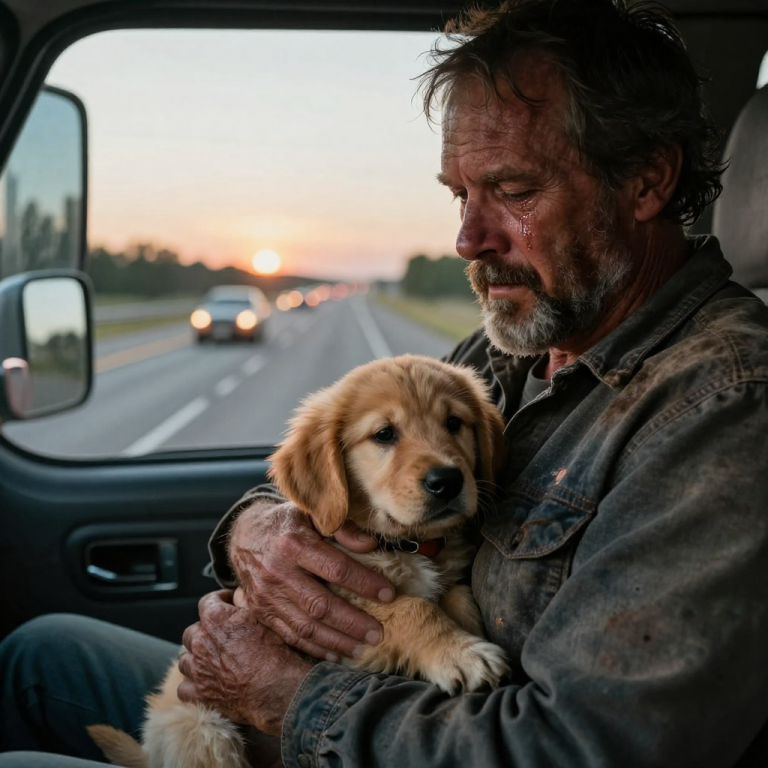
To be fair, Buster was hard to look at. He was a terrier mix I’d pulled out of a dumpster behind a diner in Jersey two years ago. He had a jagged scar running down his snout, one ear that looked like it had been chewed on by a coyote, and a coat that was permanently wiry and chaotic. He wheezed when he got excited. He was ugly, anxious, and smelled faintly of wet corn chips.
But he was mine. And he was the only reason I was still sober.
“I couldn’t leave him, Mark,” I said, trying to keep my voice steady. The guests were staring. I saw Sarah, Mark’s wife, looking nervously at her shoes. She looked exhausted, her smile tight and brittle. “The sitter canceled. He’ll stay on the leash. He won’t make a sound.”
“He’s already shedding on the patio,” Mark snapped, his patience fraying. “Look at this place, Liam. My boss is here. The HOA president is here. This isn’t one of your… situations. This is my life. I don’t need your chaotic baggage ruining Leo’s day.”
Leo was sitting on the swing set, legs dangling, looking small and pale. He gave me a shy wave. I waved back. I loved that kid. He was the only one in the family who didn’t look at me like a charity case.
“Just let him stay in the car then,” Mark said, turning his back on me. “Or leave. Honestly, Liam, I don’t care which. Just get that animal out of my sight.”
Buster whined, a high-pitched, rusty sound. He pressed his side against my leg, trembling. He picked up on vibes faster than any human I knew. He knew he wasn’t wanted.
“Fine,” I muttered, my face burning with shame. “We’re leaving.”
I tugged on the leash. “Come on, buddy. Let’s go.”
I turned to walk away, the humiliation stinging my eyes. I was the screw-up brother. The ex-addict. The guy with the dumpster dog. Mark was the golden boy with the perfect house and the perfect life.
I was halfway to the side gate when the music stopped.
It wasn’t a fade-out. Someone had knocked the speaker over. Then, the glass shattering.
Then, the scream.
Chapter 2: The Silent Suffocator
It was Sarah.
That scream wasn’t social or polite. It was the raw, jagged sound of a mother watching her world end.
I spun around.
Near the dessert table, Leo was on the ground.
At first, it looked like he had just tripped. But he wasn’t moving right. He was thrashing, his heels drumming a frantic, silent rhythm against the expensive flagstone patio.
“Leo!” Mark dropped his wine glass. It shattered, shards glittering in the sun, but no one cared. He rushed over, falling to his knees.
I dropped Buster’s leash and ran.
By the time I pushed through the circle of frozen, terrified adults, Leo’s face was already turning a color that shouldn’t exist on a human being—a deep, terrifying violet.
“He’s choking!” someone yelled. “He ate a grape! Do the Heimlich!”
“No, it’s a seizure!” another voice screamed. It was Mark’s boss, looking useless and pale.
Mark was in a panic, shaking Leo. “Breathe, buddy! Breathe for Dad! Sarah, call 911!”
“I’m calling! I’m calling!” Sarah was hyperventilating into her phone, her hands shaking so hard she dropped it twice.
I dropped to my knees beside Mark. “Mark, move. Let me look.”
“Get away from him!” Mark shoved me, his eyes wide and wild. “You don’t know what you’re doing!”
“He’s not choking on food!” I yelled back, grabbing Leo’s wrist. It was clammy. His eyes were rolled back, showing only the whites. His mouth was clamped shut, jaw locked tight. He wasn’t taking in air. His chest wasn’t rising. He was suffocating, but not from a grape.
“It’s anaphylaxis!” a woman in a floral dress shouted. “Does he have an EpiPen?”
“He’s not allergic to anything!” Sarah screamed, sobbing now.
Leo’s movements were slowing down. That was worse than the thrashing. The oxygen was running out. The blue in his lips was turning gray.
I tried to pry his jaw open to check his airway, but it was locked like a vice. “He’s locked up! We need to clear the airway!”
“Don’t touch him!” Mark roared, panic making him irrational. He was trying to do CPR, pumping on Leo’s chest, but he was doing it wrong—too fast, too shallow, and without an airway, he was just compressing dead air.
“You’re breaking his ribs, Mark! Stop!”
“He’s dying, Liam! He’s dying!” Mark was crying now, snot running down his face, the golden boy facade completely shattered.
The sirens were a distant wail, miles away. Suburban sprawl meant safety, but it also meant the fire station was ten minutes out. Leo didn’t have ten minutes. He didn’t have two.
The crowd was a wall of noise—useless advice, prayers, screams. The pressure was immense.
And then, a blur of grey fur shot through the legs of the HOA president.
It was Buster.
He didn’t bark. He didn’t growl. He hit the patio stones with a low, intense center of gravity. He barreled straight into Mark, knocking my brother off balance just enough to break his chaotic rhythm.
“Get that thing away!” Mark screamed, swinging his arm to hit the dog.
But Buster didn’t retreat. He ignored Mark completely. He ignored the screaming mother. He lunged straight for Leo’s face.
“No!” Sarah shrieked. “He’s going to bite him!”
Buster didn’t bite. He did something that made the entire party go silent in horror. He buried his snout right into the crook of Leo’s neck and started digging at the boy’s chest with frantic, terrifying precision.
Chapter 3: The Invisible Killer
The sound of Mark’s expensive loafer connecting with Buster’s ribs was sickening—a dull, wet thud.
Buster yelped, a high-pitched cry of pain that cut through the chaos, and skidded across the flagstones. But he didn’t run. He didn’t cower. With a desperate scramble of claws, he launched himself right back at the dying boy.
“I’m going to kill that dog!” Mark roared, raising his foot again.
“Stop!” I threw myself over Buster, taking the blow meant for the dog on my shoulder. I grabbed Mark’s ankle and shoved him back. “Look at him, Mark! Look at the dog!”
“He’s attacking my son!”
“He’s not attacking! He’s showing you!” I screamed, my voice cracking.
Buster wasn’t biting. He was frantically licking and pawing at a specific spot on Leo’s neck, right under the jawline. He was whining—not an aggressive growl, but the specific, urgent whine he used when he found a dead rat in the walls of my apartment. It was his alert noise.
I grabbed Leo’s chin, forcing his head back.
Buster licked the side of Leo’s neck again, his tail tucked between his legs, eyes wide with fear.
And then I saw it.
Right where Buster was focusing, there was a tiny, red puncture mark. It was almost invisible against the flushing skin, but around it, the white flesh was swelling rapidly, ballooning outward like rising dough.
“A sting,” I whispered.
My eyes darted to the overturned can of soda near the swing set where Leo had been sitting. A yellowjacket was crawling on the rim, sluggish and sticky with sugar.
“He swallowed a bee,” I said, the realization hitting me like a physical blow. “Mark, he drank a bee. It stung him in the throat.”
The color drained from Mark’s face. “What?”
“It’s not a seizure. It’s not a grape. The swelling is inside,” I shouted, checking Leo’s mouth again. The tongue was swollen to twice its size, blocking the back of the throat completely. The airway wasn’t just blocked; it was gone. “His throat is closing up from the inside out.”
“EpiPen!” Mark yelled at the crowd. “Who has an EpiPen?”
The guests looked at each other terrified. Heads shook. Purses were dumped out. Nothing.
“Paramedics are five minutes out!” someone yelled from the driveway.
“He doesn’t have five minutes!” I put my ear to Leo’s chest. The heart rate was erratic. Faint. The lack of oxygen was shutting his systems down. His eyes were fixed, staring at the sky.
Buster nudged my hand with his wet nose, then looked at Leo, then back at me. He gave a soft woof.
Do something, Liam.
I looked at Mark. My brother—the CEO, the man who had a plan for everything—was frozen. He was holding his son’s hand, sobbing quietly. He had given up. He was waiting for the end.
I felt a cold calm wash over me. It was the same calm I used to feel right before a bad deal went down, or when the cops kicked down the door. The adrenaline focus.
“I need a knife,” I said.
The crowd went silent.
“What?” Mark whispered.
“I need a sharp knife. A steak knife. A box cutter. Anything. And I need high-proof alcohol. Vodka, whiskey, whatever.”
“Liam, no,” Sarah sobbed, understanding dawning on her face. “You can’t. You’re not a doctor.”
“If we wait, he dies, Sarah!” I roared, standing up. “His throat is shut. We have to bypass it.”
I reached into my pocket. I didn’t have a medical kit. But I had my EDC (Everyday Carry)—a folding pocket knife I used to cut boxes at the warehouse. It wasn’t sterile. It wasn’t surgical steel. It was a tool for a rough life.
I flicked the blade open. The metallic click echoed in the yard.
“Liam, don’t you dare,” Mark stood up, blocking me. His face was a mask of terror and rage. “You are a junkie ex-con. You are not cutting my son’s throat with a dirty pocket knife.”
“I’ve been clean for four years, Mark,” I said, my voice dangerously low. “And right now, I’m the only chance he has.”
I looked down at Leo. His chest had stopped moving entirely.
“Move, Mark.”
“No!”
I didn’t have time to argue. I didn’t have time to explain that I’d seen a guy get stabbed in the neck in prison and survive because the medic knew exactly where to put the pressure. I didn’t have time to explain that I’d spent nights reading medical textbooks in rehab because I had nothing else to do.
I looked at Buster. “Guard.”
Buster snarled. He stepped between me and Mark, teeth bared. He didn’t lunge, but he held the line. For the first time in his life, my brother looked afraid of the dog he called trash.
I dropped to my knees beside Leo. I poured the remnants of Mark’s expensive Chardonnay over the blade—it was only 13% alcohol, useless for sterilization, but it washed off the lint. It had to be enough.
I palpated Leo’s neck. I felt for the cricothyroid membrane—the soft spot between the Adam’s apple and the cartilage ring below it.
My hands were shaking. I closed my eyes for a split second, taking a breath.
Don’t miss. God, please, don’t miss.
I pressed the tip of the knife against the skin.
“Liam!” Mark screamed, lunging forward.
I didn’t stop. I pushed down.
Chapter 4: The Red Ink
The skin of a seven-year-old boy is tough. That’s something they don’t tell you in movies. In movies, skin parts like water. In reality, it resists. It fights back.
I pressed the blade down. A thin, bright red line appeared instantly against the pale throat, blooming outward with terrifying speed.
“Oh god, oh god!” Sarah was retching, turning away, burying her face in the grass.
Mark roared—a primal, animalistic sound—and lunged. But Buster snapped. A vicious, decisive bark that was less about aggression and more about authority. He stood his ground, chest heaving, a barrier of grey fur and jagged teeth between a father’s panic and his son’s only chance. The HOA president, a large man named Dave, finally snapped out of his trance and grabbed Mark from behind.
“Let him work, Mark! He knows what he’s doing!” Dave yelled, though his voice shook. He didn’t know if I knew what I was doing. He just knew Leo was already dead if I didn’t.
I blocked them out. The world narrowed down to a single square inch of flesh.
I cut through the skin. There was blood—too much of it, slippery and warm on my fingers—but I ignored it. I needed the membrane. I felt for the gap in the cartilage rings again. It was harder now, slick with blood.
Focus, Liam. Just like the diagram. Cricothyroid membrane. Avascular zone. minimal bleeding. Bullshit, there’s blood everywhere.
I pushed the blade deeper. There was a sickening pop—a subtle release of tension as the tip punched through the airway wall.
Air.
I heard it before I saw the result. A faint, wet hiss. Like a tire slowly deflating.
But the slit was too small. The tissue would close back up the moment I removed the knife. I needed a cannula. A tube.
“A pen!” I screamed, not looking up. “I need a ballpoint pen! Now!”
“I have one!” Mark’s boss shouted. He scrambled over, practically sliding on the grass in his Italian loafers, and thrust a silver Montblanc pen at me.
“Take it apart!” I yelled, my hands occupied holding the incision open with the knife blade. “Gut it! I just need the barrel!”
The man’s hands were shaking so hard he dropped it. “I… I can’t…”
“Give it to me!” Mark broke free from Dave’s grip. He snatched the pen from the ground. For a second, our eyes locked. The rage was gone from his face, replaced by a hollow, haunting terror. He wasn’t the CEO anymore. He was just a dad.
He twisted the expensive pen, ripping the ink cartridge and the spring out with a violence that sent pieces flying. He handed me the hollow silver tube.
“Do it,” Mark whispered. “Save him.”
I slid the tube into the incision, alongside the knife blade. I twisted it, forcing the hole to widen, feeling the cartilage grate against the metal. It was gruesome. It was barbaric.
I pulled the knife out and pushed the tube deeper.
“Come on, Leo,” I gritted out through clenched teeth. “Breathe.”
For three agonizing seconds, nothing happened. The chest remained still. The face remained purple.
Then, a sound.
Hhhhuuuuh.
A ragged, desperate suck of air through the silver tube.
Leo’s chest hitched. Then it rose.
Blood bubbled around the rim of the pen, but the air was moving. The vacuum was broken.
“He’s breathing,” I exhaled, my entire body slumping forward. “He’s getting air.”
I leaned over, putting my ear to the tube. It sounded like wind whistling through a cracked window in a storm, but it was the most beautiful sound I had ever heard.
“Keep him upright!” I ordered, my voice trembling now that the adrenaline was starting to curdle. “Don’t let the tube slip out. Hold it steady.”
I looked up. The backyard was a tableau of trauma. Sarah was sobbing on the ground. The guests were pale ghosts. And Buster…
Buster had stopped growling. He had moved to Leo’s feet. He laid his chin gently on the boy’s sneaker, his eyes closed, his tail giving a slow, exhausted thump against the patio stones.
I looked at my hands. They were covered in my nephew’s blood. I looked at the knife lying on the flagstone.
I had just performed surgery on a child with a warehouse box cutter.
The sirens finally grew loud enough to drown out the sound of Sarah’s weeping.
Chapter 5: The Blue Lights
The transition from “hero” to “suspect” happens faster than you’d think.
When the paramedics burst through the side gate, the scene they walked into was a nightmare. A child down, blood everywhere, a man with bloody hands, and a dog that looked like a scrapyard fighter.
“Move! Everybody back!”
A paramedic pushed me aside with enough force to topple me. I fell back onto the grass, my energy completely spent.
“What do we have?”
“Anaphylaxis. Airway obstruction,” Mark stammered, his voice thick. “My brother… he cut his throat.”
The lead paramedic, a woman with eyes like flint, froze for a split second. She looked at the pen protruding from Leo’s neck. She looked at the color returning to Leo’s cheeks.
She put her stethoscope to the tube. She listened.
She looked at me. There was no disgust in her eyes. Just pure, unadulterated shock.
“Airway is patent,” she called out to her partner. “Good air movement. Let’s get him on oxygen and stabilize that tube. We need to transport. Now.”
They moved with a synchronized efficiency that made my amateur surgery look like butchery. They taped the pen in place, put a collar on Leo, started an IV, and loaded him onto the stretcher.
As they lifted him, Leo’s eyes fluttered open. He looked groggy, confused. He saw me. He tried to speak, but the tube made it impossible. He just blinked.
“We’re going to Mercy General,” the paramedic told Mark and Sarah. “You can ride in the back.”
Mark climbed in. Sarah followed. Neither of them looked at me.
As the ambulance crew worked, a police cruiser pulled up. Two officers walked into the backyard. They saw the blood. They saw the knife on the ground.
“Who’s the guy with the knife?” one officer asked, his hand drifting toward his holster.
“That’s him,” the HOA president pointed at me. “But he saved the kid. He did the… the throat thing.”
The officer approached me. I was still sitting in the grass, wiping my hands on my jeans. Buster was sitting next to me, pressing his weight against my side. He growled low in his throat as the cop got close.
“Quiet, Buster,” I hushed him. “It’s okay.”
“Sir, I’m going to need you to stand up,” the officer said. He wasn’t aggressive, but he wasn’t friendly. He saw the tattoos on my arms. He saw the scar on Buster. He saw the jagged profile of a man who had been in the system. “Is that your knife?”
“Yeah,” I said, standing up slowly. “It’s mine.”
“You did the procedure?”
“I had to. He wasn’t breathing.”
The officer looked at the bloody box cutter, then back at me. “You a doctor?”
“No.”
“EMT?”
“No.”
“Then where did you learn to do a cricothyrotomy with a pocket knife?”
I hesitated. The truth was ugly. “I saw it done in prison. And I read a lot.”
The officer’s face hardened. The word prison changed the temperature of the conversation instantly. The “hero” narrative was suddenly complicated.
“Okay. I’m going to need your ID. And we’re going to need to take a statement. Don’t leave the premises.”
I watched the ambulance pull away, lights flashing, carrying the only person in this family who actually liked me.
The party guests were whispering. They weren’t looking at me with gratitude. They were looking at me with morbid curiosity. I was the freak show. The ex-con who cut open a kid at a birthday party.
I knelt down and hugged Buster. He licked a smear of blood off my thumb.
“We did good, buddy,” I whispered into his matted fur. “We did good.”
But as the police lights swirled around us, I didn’t feel like a hero. I felt like I was waiting to be punished.
Chapter 6: The Long Wait
The waiting room at Mercy General was a special kind of purgatory.
It smelled of antiseptic and stale coffee. The fluorescent lights buzzed with a headache-inducing frequency.
I wasn’t allowed inside. Not really. I mean, nobody stopped me from driving to the hospital, but I couldn’t go into the family waiting area. I didn’t want to see Sarah’s parents, who had arrived shortly after the ambulance. I didn’t want to hear their whispers about how “instability runs in the family.”
So, I sat in my beat-up Ford truck in the parking lot. The engine was off, ticking as it cooled. Buster was asleep on the passenger seat, his head resting on his paws. He was exhausted. The adrenaline dump had hit him just as hard as it hit me.
It had been four hours.
I stared at the hospital entrance. Every time the automatic doors slid open, my heart hammered.
I replayed the moment in the backyard over and over. Had I sterilized the knife enough? What about infection? Did I cut too deep? Did I nick the vocal cords? Would Leo ever speak again?
The doubt was eating me alive. I was a recovering addict; doubt was my default state. My brain was already looking for a reason to hate myself. You got lucky, Liam. You could have killed him. You’re reckless. You’re dangerous.
My phone buzzed.
It was Mark.
He’s out of surgery. Come up.
I stared at the text. Come up. Not “thank you.” Not “he’s okay.” Just a command.
I looked at Buster. “You stay here, pal. Guard the truck.”
Buster opened one eye, thumped his tail once, and went back to sleep.
I walked into the hospital. I felt dirty. I was still wearing the jeans with the grass stains and the blood smears. People in the lobby stared. I kept my head down.
I took the elevator to the fourth floor: Pediatric ICU.
Mark was standing in the hallway, outside a glass door. He looked ten years older than he had this morning. His polo shirt was wrinkled, and there was a dried spot of Leo’s blood on his collar that he hadn’t noticed.
He saw me coming. He didn’t smile. He didn’t open his arms for a hug. He just stood there, arms crossed, staring at me with an expression I couldn’t read.
I stopped five feet away.
“How is he?” I asked. My voice sounded raspy, like I was the one who had been choked.
“He’s stable,” Mark said. “The doctors… they said the swelling was massive. The bee stung him right on the glottis.”
“The tube?”
“They removed it. They put in a proper trach, but they think they can close it up in a few days. No permanent damage to the vocal cords.”
I let out a breath I felt like I’d been holding since 2015. “Thank God.”
Silence stretched between us. The hospital machinery beeped rhythmically in the distance.
“The surgeon came out to talk to us,” Mark said, his voice quiet.
“Yeah?” I braced myself. Here it comes. The lecture about hygiene. The legal threats.
“He asked who put the tube in.” Mark looked down at his shoes, then back at me. “He said that in thirty years of medicine, he’s never seen a field cric done that cleanly by a civilian. He said Leo would have been brain-dead two minutes before the ambulance arrived if you hadn’t done it.”
I swallowed hard. “I just… I did what I had to do.”
Mark uncrossed his arms. He took a step toward me. His eyes were wet.
“You had a box cutter in your pocket at my son’s birthday party,” Mark said. It wasn’t an accusation, just a statement of fact.
“I came straight from the warehouse shift,” I defended weakly.
“And you brought that dog.”
“Mark…”
“I tried to kick you out,” Mark said, his voice cracking. “I called you trash. I tried to kick you out, and five minutes later, you were the only person on earth who could save my son.”
He covered his face with his hand, his shoulders shaking.
“I’m sorry, Liam,” he choked out. “I am so sorry.”
It was the first time my brother had apologized to me since we were kids. Since before the drugs. Since before mom died.
I didn’t know what to do. So I did what we never did. I stepped forward and hugged him.
He collapsed into me, sobbing into my dirty leather jacket. The golden boy, the CEO, the success story—he was just a frightened man holding onto his screw-up little brother.
“It’s okay,” I said, patting his back awkwardly. “He’s safe.”
Mark pulled back, wiping his eyes. He took a deep breath, trying to regain his composure.
“Sarah wants to see you,” he said. “And… she wants to see Buster.”
I blinked. “Buster? He’s in the truck. They won’t let a dog in here.”
Mark reached into his pocket and pulled out his phone. He dialed a number.
“Hello? Dr. Evans? Yes, this is Mark Reynolds. I’m going to make a substantial donation to the pediatric wing next week. Yes. But right now, I need a favor. I need a service dog cleared for entry. Yes. Immediately. Thank you.”
He hung up and looked at me. A faint glimmer of the old, commanding Mark was back.
“Go get him,” Mark said. “Leo is waking up, and he’s going to want to see the dog that saved his life.”
Chapter 7: The Only Doctor That Mattered
Walking a scruffy, scarred terrier mix through the pristine corridors of a private hospital wing feels a lot like walking a criminal into a church.
Nurses stopped at their stations. Orderlies paused with their carts. I kept the leash short, my hand sweating against the leather loop. Buster, for his part, walked with a strange, dignified clip. He didn’t pull. He didn’t sniff the floor. He seemed to understand that this was a mission.
“Is that…?” I heard a nurse whisper as we passed.
“Yeah. That’s the dog. The one from the backyard.”
The whispers weren’t hostile anymore. They were awestruck. The story had traveled faster than we did. By the time we reached Room 412, Buster wasn’t a nuisance; he was a celebrity.
Mark was waiting at the door. He held it open, and for the first time in my life, he didn’t look at my boots to see if they were muddy. He just looked at me.
“He’s awake,” Mark said softly. “He can’t talk much because of the throat, but he’s awake.”
I stepped inside.
The room was dim, lit only by the glowing monitors and a small reading lamp. Sarah was sitting in the chair next to the bed, holding Leo’s hand. She looked wrecked—makeup streaked, hair a mess, eyes swollen. She looked like a real person, not the suburban Stepford wife she usually tried so hard to be.
When she saw me, she stood up.
My stomach tightened. I braced myself for a thank you, or maybe a lecture on how I shouldn’t have brought the dog inside the room.
Sarah didn’t speak. She crossed the room in two strides and wrapped her arms around my neck. It wasn’t a polite, social hug. It was a desperate, bone-crushing embrace. She buried her face in my shoulder and just wept.
“I’m sorry,” she sobbed into my jacket. “I’m so sorry, Liam. I judged you. I judged him. I’m so sorry.”
I stood there, awkward and stunned, patting her back. “It’s okay, Sarah. It’s over.”
She pulled back, wiping her eyes, and looked down.
Buster was sitting patiently at my feet, his mismatched ears perked up, looking past her toward the bed.
Sarah knelt down. This woman, who freaked out if a drop of red wine hit her coaster, knelt on the hospital floor in her designer dress. She reached out trembling hands and took Buster’s scarred, ugly face in her palms.
“Hi, buddy,” she whispered, tears dripping onto his nose.
Buster didn’t pull away. He leaned into her touch, closing his eyes, and licked a tear off her cheek.
“Thank you,” she whispered to the dog. “Thank you for seeing him.”
“Can… can he?” a rasping voice came from the bed.
We all turned. Leo was propped up on pillows, a gauze pad taped over the incision site on his neck, an IV line snaking into his arm. He looked small and fragile, but his eyes were bright.
“Liam?” he croaked.
“Hey, kiddo,” I said, my throat tight. “Don’t try to talk too much.”
Leo lifted his hand and patted the mattress.
I looked at Mark. Mark nodded.
“Up, Buster,” I commanded softly. “Gentle.”
Buster didn’t need the instruction. He hopped onto the bed with the lightness of a cat. He didn’t trample the tubes. He didn’t jostle the legs. He army-crawled up the sheet until he was level with Leo’s chest.
He didn’t try to lick Leo’s face. He just laid his head down right next to Leo’s shoulder, letting out a long, heavy sigh.
Leo wrapped his arm around the dog’s neck, burying his nose in the wiry, grey fur.
“He smells like corn chips,” Leo whispered, a smile touching his lips.
“Yeah,” I laughed, wiping a sudden tear from my own eye. “He always does.”
The room fell into a peaceful silence. The beep of the heart monitor slowed down, settling into a calm, steady rhythm. It was syncing with the dog. I watched my nephew—the boy who had almost died in a manicured backyard surrounded by people who loved him but couldn’t save him—finding comfort in the one creature everyone had wanted to throw away.
“You know,” Mark said, his voice low as he stood beside me. “I spent five thousand dollars on that party. Caterers. Decorators. The best wine.”
He looked at Buster, who was now snoring softly against Leo.
“And the most valuable thing there was the one thing I tried to kick out.”
“He’s a good boy,” I said simply.
“He’s not a good boy,” Mark corrected, putting a hand on my shoulder. “He’s family.”
Chapter 8: The Table Set for Four
Three months later.
The seasons had turned. The vibrant green of summer had given way to the crisp, burnt orange of a New England autumn.
I pulled my truck into Mark’s driveway. This time, I didn’t park down the street to avoid embarrassing him. I parked right next to his Tesla.
I got out, and Buster hopped down from the passenger seat. He was wearing a new collar—leather, with a custom engraved tag that Sarah had ordered. It didn’t just have his name and my number. It had a small medical cross engraved on the back.
The front door opened before I could knock.
“Uncle Liam!”
Leo came running out. The scar on his neck was just a thin pink line now, barely visible unless you knew where to look. He hit me at full speed, wrapping his arms around my waist.
“Easy, tiger,” I grinned, ruffling his hair. “How’s the throat?”
“Good. Dad says I can eat steak tonight.”
“Is that right?”
Mark appeared in the doorway. He was wearing an apron that said Grill Master, but he looked different. Relaxed. The frantic need to impress was gone.
“Get in here,” Mark said, grinning. “The game is on.”
We walked through the house. It was still perfect, still clean, but it felt different. There were dog toys scattered in the living room. A tug rope under the coffee table. A squeaky hedgehog near the TV stand.
We went out to the patio—the same patio where the nightmare had happened.
The stain from the wine and the blood had been power-washed away, but I could still see the ghost of it. I think Mark could too. Maybe that’s why he had moved the table. He didn’t want to sit in the exact same spot.
Sarah was setting the table. “Liam! Perfect timing. I made those jalapeño poppers you like.”
“You made fried food?” I teased. “What happened to the keto diet?”
“Life’s too short,” she smiled, placing a bowl down. She bent down and scratched Buster behind the ears. “Hi, hero.”
We sat down to eat. It wasn’t a party. No HOA president. No boss. Just us.
Mark raised a glass of beer. “To Leo.”
“To Leo,” we echoed.
“And,” Mark turned to me, his expression serious. “To my brother. Who I don’t give enough credit to.”
I looked down at my plate, feeling the heat rise in my cheeks. “Mark, don’t.”
“No, I’m serious,” Mark said. “I offered you money, Liam. You turned it down. I offered to buy you a new truck. You said yours runs fine. You’re a stubborn son of a bitch.”
“It runs fine,” I insisted.
“I know,” Mark smiled. “But I wanted to give you something. Not money. Something you actually want.”
He reached under the table and pulled out a large, flat envelope. He slid it across the table.
I wiped my hands on a napkin and opened it.
Inside were legal documents. A deed. And a business registration.
“What is this?” I asked, squinting at the paper.
“It’s the old warehouse on 5th Street,” Mark said. “The one my company was going to demolish for a parking lot. It’s yours now.”
“I… I can’t afford a warehouse, Mark.”
“It’s paid for. And so are the renovations,” Mark pointed to the second document. ” ‘Buster’s Place: K9 Training and Rehabilitation Center.’ “
I stared at the words. The letters swam in front of my eyes.
“You have a gift, Liam,” Mark said, his voice thick with emotion. “You understand broken things. You understand how to fix them because you’ve had to fix yourself. There are a lot of dogs like Buster out there. And there are a lot of people who need them. You should be doing this for a living.”
I looked up at him. I couldn’t speak. I had spent so many years thinking I was the mistake in the family design. The flaw.
“Take it,” Sarah said softly, reaching across to squeeze my hand. “Please.”
I looked down at Buster. He was sitting under the table, waiting for a piece of steak to “accidentally” fall. He looked up at me, his tail giving a soft thump against the floor.
He was trash. I was a junkie. We were the throwaways.
But looking around this table, at the family that was finally whole, I realized the truth.
Diamonds are just chunks of coal that stuck to their job when the pressure got heavy. And sometimes, the most valuable thing in the world is the one thing nobody else wanted.
I picked up a piece of steak from my plate and dropped it under the table.
“Deal,” I said.
Mark smiled. Leo cheered. And from under the table came the contented, crunching sound of a very good boy enjoying the best meal of his life.