THE SILENT GUARDIAN OF ELM STREET: A Boy, A Dog, and The Sacrifice That Stunned the World
CHAPTER 1: THE GHOSTS OF SUBURBIA
The heater in the Ford Crown Victoria was broken. It had been broken since October, and now, in the dead heart of a brutal Ohio November, it felt like a personal insult from the universe. Detective Mark Russo rubbed his gloved hands together, trying to friction some life back into his stiff knuckles. He was fifty-two years old, and days like this made him feel seventy.
“You check the address again, Jenkins?” Russo asked, his voice gravelly from too much coffee and too many years of shouting over sirens.
Officer Paul Jenkins, a rookie with a face so fresh it looked like he still got carded for buying milk, glanced at the glowing terminal. “Yes, sir. 404 Elm Street. Dispatch says the neighbor, a Mrs. Higgins, called three times. She says she hasn’t seen the mother, Sarah Miller, in five days. Mail is piling up. No movement inside.”
Russo nodded, turning the cruiser onto Elm Street. He knew this neighborhood. Ten years ago, it was a place where factory workers bought their first homes, planted oak trees, and raised families. Now, the factory was a hollow shell three miles east, and Elm Street was a graveyard of the American Dream. The lawns were overgrown with crabgrass, the siding on the houses was peeling like sunburned skin, and the silence that hung over the street wasn’t peaceful—it was heavy.
“Welfare checks,” Russo muttered, more to himself than Jenkins. “I hate welfare checks.”
“Why’s that, Detective?” Jenkins asked, adjusting his seatbelt. He was eager, still thinking the badge was a magic wand that fixed things.
“Because, kid, people don’t just disappear for five days in a neighborhood like this because they won the lottery,” Russo said, his eyes scanning the house numbers. “Usually, when the neighbors call, it’s already too late.”
They pulled up to Number 404. It was a two-story colonial that looked like it was sighing under the weight of its own neglect. The gutters were choked with dead leaves, and a blue plastic tarp covered a patch of the roof, flapping listlessly in the icy wind. The driveway was empty, save for an oil stain that looked like a Rorschach test for bad decisions.
Russo killed the engine. The silence rushed back in.
Waiting on the sidewalk was Mrs. Higgins. She was a small, bird-like woman wrapped in a coat three sizes too big, clutching a trembling chihuahua against her chest. Her face was gray with cold and worry.
Russo stepped out, the wind immediately finding the gap between his scarf and his collar. “Mrs. Higgins?”
She nodded, her eyes darting toward the dark windows of Number 404. “Detective. Thank God. I… I didn’t want to be a bother. I know you’re busy.”
“You did the right thing,” Russo said, walking up to her. “Tell me exactly what you saw.”
“It’s not what I saw,” she whispered, shivering. “It’s what I haven’t heard. Sarah… she’s had a rough go of it. The husband left a year ago. She lost her job at the diner last month. But she loves that little boy, Leo. He’s three. He’s usually out in the backyard, banging pots and pans, running with that scruffy dog of theirs. But since Friday… nothing. Not a sound. And last night, I thought I heard the dog howling. But it sounded… weak. Like it was crying.”
Russo’s stomach turned over. A quiet house with a child inside was never a good sign.
“Stay here, Mrs. Higgins,” Russo commanded gently. He signaled to Jenkins. “Let’s go.”
They walked up the cracked concrete path. The mailbox was indeed overflowing—flyers for pizza, final notices from the electric company, soggy coupon books. The detritus of a life unraveling.
Russo stepped onto the porch. The wood groaned under his boot. He pounded on the door, the sound sharp and intrusive in the cold air.
“Police! Sarah Miller? Is anyone home?”
He waited. He listened.
The wind whistled through a loose screen. A squirrel chattered from the oak tree. But from inside the house? Nothing.
He knocked again, harder this time, using the meaty part of his fist. “Sarah! We need you to come to the door!”
Russo moved to the front window. The blinds were drawn, but they were cheap plastic, bent and broken in places. He cupped his hands against the glass and peered through a sliver of space.
It was too dark to see much, but his senses were already firing warnings. He sniffed the air near the door jamb. It was faint, masked by the cold, but it was there. That cloying, sweet smell of rot. Beneath it, the sharp tang of ammonia.
“Jenkins,” Russo said, his voice dropping to a flat, professional monotone. “Kick it.”
The rookie blinked, his eyes widening. “Sir? Do we have prob—”
“I smell decomp, Jenkins. Exigent circumstances. Kick the damn door before I do it myself.”
Jenkins swallowed hard. He squared his hips, took a breath, and drove his heel into the lock plate. The dry wood splintered with a loud CRACK. He kicked again, and the door swung inward, banging against the interior wall.
The smell rolled out like a physical wave. It was the stench of stagnant air, dirty diapers, and death. Jenkins gagged, turning his head away and covering his nose with his sleeve.
“Flashlights,” Russo ordered, pulling his heavy Maglite from his belt. “Watch your step. Don’t touch anything you don’t have to.”
They stepped into the gloom.
CHAPTER 2: THE TOMB
The hallway was a tunnel of shadows. Dust motes danced in the beams of their flashlights, swirling in the disturbed air. The house felt suspended in time, like a clock that had stopped ticking days ago.
To the left, the living room was a disaster zone. Couch cushions were overturned, toys were scattered like shrapnel—plastic trucks, building blocks, a headless doll. It didn’t look like play; it looked like a struggle, or a frantic search.
“Police! Anyone here?” Russo’s voice echoed, sounding hollow and wrong.
He moved toward the kitchen. The smell was stronger here.
“Over here, boss,” Jenkins whispered, his voice trembling.
Russo swung his light. In the center of the linoleum floor, amidst a scattering of spilled cereal and broken ceramic, lay Sarah Miller.
She was face down. She wore a faded bathrobe and one sock. Her skin was the color of old parchment, gray and waxy. One arm was outstretched, her fingers curled as if she had been trying to crawl toward the counter. A few inches from her hand lay an orange prescription bottle, its cap off, pills scattered like confetti.
Russo knelt, placing two fingers on her carotid artery, though he knew it was pointless. She was stone cold. Rigor had come and gone.
“OD,” Russo muttered, standing up. “Looks like maybe three, four days. Poor kid.” He looked at the chaos around her. “She probably didn’t feel a thing.”
“Detective…” Jenkins was standing by the fridge, looking at a child’s drawing held up by a magnet. It was a crayon scrawl of a stick figure boy and a stick figure dog, under a yellow sun. “If she’s been here for four days… where is the boy?”
The question hung in the foul air.
Russo felt a spike of adrenaline. He spun around, shining his light into the dark corners of the kitchen. “Leo! Leo, can you hear me?”
Silence.
“Check the basement,” Russo barked. “I’ll take the upstairs.”
He took the stairs two at a time, ignoring the creaking wood and the pain in his knees. The air on the second floor was hotter, stifling. The heating must have been left on, baking the smell into the walls.
He checked the bathroom. Dry tub, dirty towels. He checked the master bedroom. An unmade bed, clothes everywhere. Empty.
There was one door left at the end of the hall. It was painted a bright, hopeful blue, chipped at the edges. A sticker of a cartoon race car was plastered in the center.
But what stopped Russo cold was the hardware.
A heavy-duty steel slide bolt had been installed on the outside of the door, near the top frame. It was high—too high for a child to reach. It was locked.
Russo stepped closer. The silence from behind the door was absolute.
“Leo?” he called out softly.
He pressed his ear to the wood.
Scritch.
It was the sound of a claw on carpet. Then, a low, rasping whine. Not a bark. A plea.
Russo didn’t wait for Jenkins. He holstered his flashlight and slammed the palm of his hand against the bolt, forcing the rusted metal to slide back. It shrieked in protest. He grabbed the knob and turned.
The door didn’t budge. It was blocked from the inside.
“Leo, buddy, I’m coming in,” Russo said, putting his shoulder to the wood. He shoved. Something heavy on the other side slid across the floor with a drag.
Russo squeezed through the gap. The smell in this room was different. Concentrated. It smelled of urine, desperation, and the unmistakable musk of an animal.
The room was dim, lit only by the gray winter light filtering through filthy blinds. Russo grabbed his flashlight again and swept the room.
It was sparse. No bed frame, just a stained mattress on the floor. A pile of toys in the corner.
And on the mattress, a tableau that would haunt Mark Russo for the rest of his life.
A small boy, wearing only a diaper and a dirty t-shirt, was curled into a tight ball in the center of the bed. He was so still Russo thought he was gone.
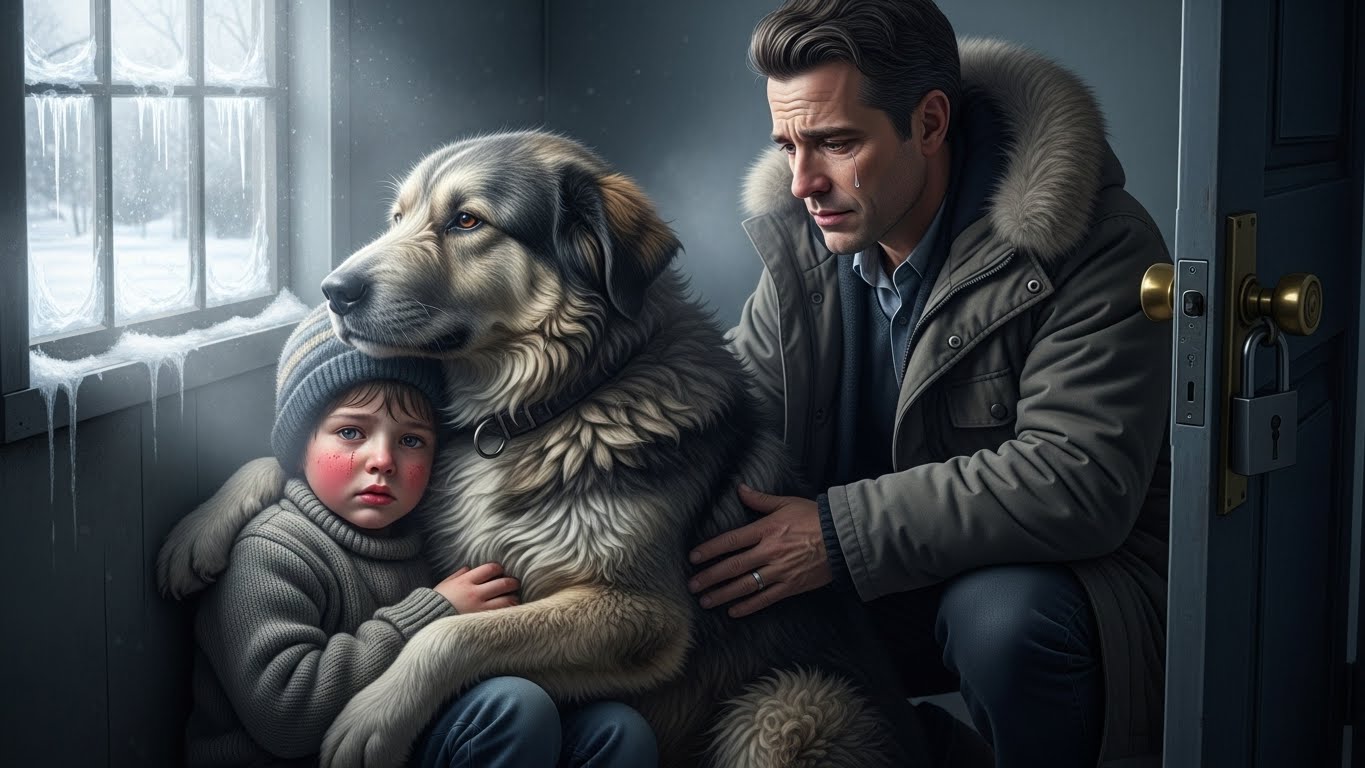
But wrapped around the boy, molding its body into a perfect protective “C,” was a dog.
It was a mutt—some kind of terrier mix, maybe forty pounds on a good day. But today, it wasn’t forty pounds. It was a skeleton draped in tawny fur. Its ribs were stark ridges against its skin. Its hip bones jutted out like knife blades.
As the light hit them, the dog tried to lift its head. It managed to raise it two inches before gravity reclaimed it. It let out a growl, but there was no power in it, only a dry rattle in its throat. It bared its teeth, its eyes glassy and wild with fear, trying to shield the boy from the intruder.
“Easy… easy, boy,” Russo whispered, his heart breaking in his chest. “I’m not gonna hurt him.”
Jenkins appeared in the doorway, panting. “Basement is clea— oh my god.”
“Quiet,” Russo hissed.
He moved slowly toward the mattress. The dog watched him, its body trembling violently. Not from cold—the room was warm—but from sheer, metabolic exhaustion. It was literally starving to death.
Russo knelt by the mattress. The dog’s eyes followed him, pleading. Help him. Don’t touch him. Help him.
Then, Russo saw it.
Right in front of the dog’s nose, lying on the soiled sheet, was a granola bar. It was unwrapped, the wrapper chewed to shreds nearby. It was a peanut butter bar.
The dog was starving. Its body was eating its own muscle to survive. The instinct to eat should have been overpowering. Uncontrollable.
But the bar was untouched.
Russo felt tears prick his eyes. “Jenkins… look at this.”
“He didn’t eat it,” Jenkins whispered, horrified awe in his voice. “Why didn’t he eat it?”
“Because it wasn’t for him,” Russo choked out. “He brought it to the boy. He’s been guarding it.”
Russo reached out a trembling hand. The dog let out one last, soft whimper, and then its eyes rolled back. Its head slumped onto its paws. It had nothing left. It had held on until help arrived, and now, the watch was over.
Russo quickly checked the boy. His skin was pale and tacky, his breathing shallow and rapid. But he was warm. The dog’s body heat had acted as a living radiator.
“He’s alive,” Russo said, his voice cracking. “Jenkins, radio the medics! Tell them we have a pediatric critical and… and a canine critical. Tell them to hustle!”
Russo scooped the boy up. He weighed nothing, light as a bird. As he lifted the child, the dog’s head lolled to the side, limp.
“I’ve got you too, buddy,” Russo muttered. He tucked the boy into his left arm and, with a grunt of effort, scooped the frail dog up with his right arm. The animal was dead weight, a sack of bones and fur.
Russo ran. He ran out of the room, down the stairs, past the body of the mother who had lost her battle, and out into the biting cold of the world that had forgotten them.
CHAPTER 3: THE SPLIT
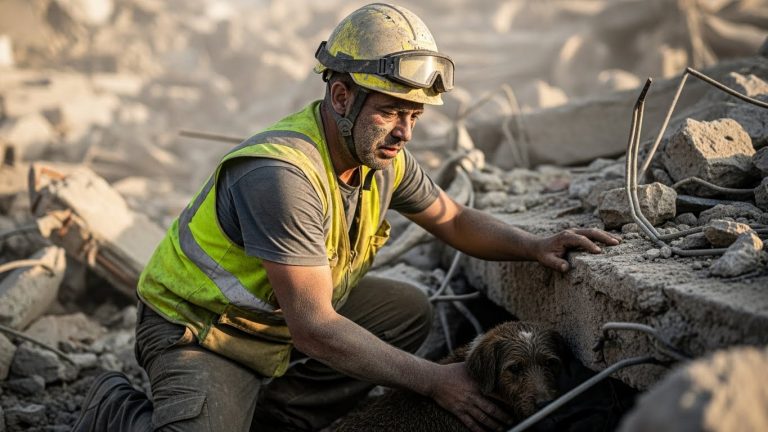
The ambulance bay at St. Mary’s Hospital was a chaotic symphony of slamming doors, shouting voices, and the rhythmic beeping of reversing trucks. Russo stood near the intake doors, his leather jacket smeared with dirt and dog hair, his breath pluming in the cold air.
He watched as the gurney carrying little Leo disappeared behind the sliding glass doors of the Emergency Room. A team of nurses and a doctor were already working on him, shouting out vitals. “BP is 70 over 40! Severe dehydration! Get an IV line, pediatric gauge, now!”
Russo felt a phantom weight still in his arms. The boy was in the system now. He had a chance.
But the dog.
Russo turned to look at the second ambulance—the one he had bullied the paramedics into using. The back doors were open. A young EMT was standing there, looking uncomfortable.
“Detective,” the EMT said, gesturing to the stretcher where the dog lay motionless, wrapped in a thermal blanket. “We can’t take him inside. You know the protocol. This is a human hospital. We checked his vitals, he’s barely hanging on, but we need to call Animal Control. They’ll come pick him up.”
Russo’s face darkened. He stepped forward, invading the EMT’s personal space. “Animal Control? You mean the pound? You think I’m going to let them toss this hero into a cage in the back of a van after what he just did?”
“Look, I get it,” the EMT said, holding up his hands. “But he needs a vet. We don’t have the equipment. We don’t have the drugs.”
“Where is the nearest emergency vet?” Russo demanded.
“There’s the Northside Animal Clinic,” the EMT said. “About ten minutes out. But Detective, that dog… his heart rate is in the thirties. He’s in hypovolemic shock. He might not make the trip.”
Russo didn’t hesitate. He reached into the ambulance and gathered the dog into his arms. The animal was limp, its body temperature frighteningly low.
“Jenkins!” Russo shouted across the parking lot.
The rookie was talking to a patrol sergeant, filling out paperwork. He looked up, startled. “Sir?”
“Stay here with the boy. Don’t leave his side. If he wakes up, if he asks for his mom, or the dog… you handle it. I’m going to Northside.”
“But… the report—”
“To hell with the report!” Russo roared, moving toward his cruiser. “Just do it!”
He laid the dog gently on the passenger seat of the Crown Victoria, cranking the heat up as high as it would go. He flipped on his lights and sirens.
The drive to Northside was a blur of red lights running and cars parting like the Red Sea. Russo kept one hand on the steering wheel and the other on the dog’s chest, feeling for the faint thump-thump of life.
“Don’t you quit on me,” Russo said to the unconscious animal. “You did the hard part. You kept him alive for four days. You don’t get to check out now.”
He thought about the scene in the room. The lock on the outside. Sarah Miller had locked the child in. Why? To protect him while she got high? Or had she locked him in, taken the pills, and forgotten? The anger boiled in Russo’s gut, hot and acidic. But looking at the dog, the anger subsided into a profound sadness.
Humans had failed that boy. His father left. His mother crumbled. The neighbors turned a blind eye. The system missed the signs.
Only the dog had stayed.
Russo screeched into the parking lot of the Northside Animal Clinic. He didn’t wait to park properly; he left the cruiser at a crooked angle near the entrance and kicked the door open.
He burst into the reception area carrying the dog. A young woman behind the desk looked up, eyes wide. A woman in the waiting room clutching a cat carrier gasped.
“I need a vet! Now!” Russo yelled. “This is an emergency!”
A door swung open and a woman in blue scrubs appeared. She was tall, with graying hair tied back in a severe bun. This was Dr. Claire Gallo. Russo knew her; she had treated his K-9 partner years ago. She was tough as nails.
She took one look at the limp bundle in Russo’s arms and didn’t ask a single question.
“Room One,” she commanded. “Susan, get the crash cart. Get a heating pad and warm fluids. Stat.”
Russo laid the dog on the stainless steel table. Under the harsh fluorescent lights, the animal looked even worse. The ribs were terrifyingly prominent. The fur was matted with filth.
Dr. Gallo put a stethoscope to the dog’s chest. Her face was grim. She lifted the dog’s lip, checking the gums. They were porcelain white.
“He’s in critical starvation mode,” Dr. Gallo said, her voice clipped and professional. “Severe dehydration. His body has started shutting down non-essential organs to keep the brain and heart going. How long was he without food?”
“At least four days,” Russo said, watching the rise and fall of the dog’s chest. “Maybe five. But Doc… there was food. There was a granola bar right in front of his face. He didn’t touch it.”
Dr. Gallo paused. She looked up at Russo, her eyes softening for a fraction of a second. “He was guarding it?”
“Yeah. For the kid.”
She shook her head, a mixture of disbelief and reverence. “I’ve been a vet for twenty years, Mark. The survival instinct is usually absolute. To override that… to choose to starve…” She trailed off, turning back to her patient. “Susan, I can’t find a vein in the leg. It’s collapsed. We need to go for a jugular catheter. Hurry.”
Russo stood in the corner, feeling useless. He watched them work—inserting needles, hanging bags of fluids, checking monitors. The room smelled of antiseptic and fear.
“Does he have a name?” Dr. Gallo asked as she taped the IV line to the dog’s neck.
Russo realized he didn’t know. Sarah Miller hadn’t exactly left a note introducing the pets.
“I don’t know,” Russo said. He looked at the dog—this warrior who had fought a silent battle in the dark against hunger and cold. “But we can’t just call him ‘Dog’.”
He thought about the boy, Leo. He thought about the locked door.
“Chief,” Russo said suddenly. “His name is Chief.”
“Okay, Chief,” Dr. Gallo whispered, stroking the dog’s bony head. “Let’s get some fluids in you.”
The heart monitor began to beep a little steadier. Beep… beep… beep.
“Is he going to make it?” Russo asked.
Dr. Gallo sighed, stripping off her gloves. “He’s young, maybe four or five years old beneath the malnutrition. That helps. But Mark… look at this.”
She pointed to the X-ray screen that had just popped up on the monitor.
“His stomach is full of foreign objects,” she explained, tracing a cloudy mass on the screen. “See these shapes? That’s plastic. And pieces of fabric.”
Russo squinted. “What is it?”
“It looks like he was eating toys,” Dr. Gallo said, her voice thick with emotion. “He was so hungry, Mark. His stomach was screaming at him. So he ate pieces of plastic toys to stop the pain… but he saved the actual food for the child.”
Russo felt the breath leave his lungs. The image of the dog, gnawing on a plastic truck in the dark, his stomach cramping, while pushing the real food toward the sleeping boy… it was too much.
“Do whatever it takes, Claire,” Russo said, his voice trembling. “I don’t care what it costs. Put it on my card. Just save him.”
“We’re going to try,” she said. “But the next twenty-four hours are critical. If his kidneys fail, we lose him.”
Russo nodded. He walked over to the table and rested his hand gently on Chief’s shoulder. The dog was unconscious, deep in a drug-induced rest, but he was warm now.
“I have to go check on the boy,” Russo whispered. “But I’ll be back. I promise.”
He walked out of the clinic into the freezing night. The wind had picked up, howling through the trees. But Russo didn’t feel the cold anymore. He felt a burning resolve.
He pulled out his phone and dialed Jenkins.
“Jenkins. Status.”
“The kid is stable, boss,” Jenkins’ voice came through, sounding relieved. “He’s awake. He’s… he’s asking for ‘Buh-buh’.”
“Buh-buh?” Russo asked.
“Yeah. We think he means the dog. He won’t sleep. He keeps crying for Buh-buh.”
“Tell him Buh-buh is fighting,” Russo said, starting the car. “And Jenkins? Call the station. Tell the Captain I’m taking personal leave starting tomorrow. I’m not leaving these two until I know they’re going to be okay.”
“Roger that, Detective.”
Russo put the car in gear. He was exhausted, he was hungry, and he had seen a dead body today. But as he drove back toward the hospital, all he could think about was the plastic in that dog’s stomach, and the love that had been strong enough to conquer hunger itself.
The story of the boy and the dog was just beginning. And Russo was going to make sure it had a different ending than the one on Elm Street.
CHAPTER 4: THE BOY WHO HID BREAD
The pediatric ward of St. Mary’s was painted with murals of smiling giraffes and monkeys holding balloons. To Detective Mark Russo, staring through the observation glass at 2:00 AM, the cheerful art looked grotesque against the reality of the situation.
Inside the room, Leo was awake.
The three-year-old was sitting up in the hospital crib, the metal bars raised high. He was hooked up to an IV that was pumping fluids and electrolytes into his tiny, battered system. A nurse, a kind-faced woman named Brenda whom Russo had known for years, was trying to get him to eat some warm oatmeal.
Russo watched as Leo took a bite, chewed slowly, and then—when he thought Brenda wasn’t looking—spit a portion of it into his palm. With a quick, practiced movement, he shoved the mushy lump under his pillow.
Russo tapped on the glass. Brenda looked up, saw him, and stepped out into the hallway.
“He’s hoarding,” Brenda whispered, her eyes red-rimmed. “He eats half, hides half. I tried to take the pillow away to change the case, and he screamed, Mark. I mean, a sound like an animal being skinned. He thinks the food is going to disappear.”
Russo rubbed his face, feeling the sandpaper stubble on his jaw. “He learned it,” he said, his voice raspy. “Or maybe… maybe he’s saving it.”
“Saving it for what?”
“For the dog,” Russo said. “That’s what the dog did for him. The kid is mimicking the only survival behavior he knows.”
Brenda sighed, leaning against the wall. “Social Services is here. Ms. Vance. She’s in the waiting room filling out the intake forms for foster care. She says there’s no next of kin listed in the mother’s records.”
Russo felt a surge of protective anger. “Foster care? He’s been out of that house for six hours and they already want to ship him off to strangers?”
“It’s protocol, Mark. You know that.”
“He doesn’t speak, Brenda. Not a word since ‘Buh-buh’. If you put him in a strange house right now, he’s going to break.”
Russo pushed past her and walked into the room. Leo froze, his hand still under the pillow. He looked at Russo with wide, terrified blue eyes. They were his mother’s eyes, but they held an ancient, hollow look that no toddler should possess.
Russo pulled up a plastic chair and sat down. He didn’t try to touch the boy. He just sat at eye level.
“Hey, Leo,” Russo said softly. “I’m Mark. I’m the one who took you out of the room.”
Leo stared. He didn’t blink.
“I saw your friend,” Russo continued, watching the boy’s reaction closely. “Buh-buh. His name is Chief, right?”
At the mention of the name—or the sound—Leo’s posture changed. He leaned forward slightly, his tiny fingers gripping the hospital blanket.
“Buh-buh?” Leo whispered. It was a rasp, unused and dry.
“Yeah. Chief is at a doctor’s office. A special doctor for dogs. He’s sick, Leo. Because he gave all his food to you.”
Leo’s lip trembled. He reached under the pillow and pulled out the handful of sticky oatmeal. He held it out to Russo, his arm shaking.
Russo felt his heart shatter. The boy was offering the food to send to the dog.
Russo gently took the oatmeal, not caring about the mess. “I’ll make sure he gets it, buddy. I promise. But you have to eat the rest. Chief wants you to be strong. Okay?”
Leo stared at him for a long moment, assessing the truth in the Detective’s face. Then, slowly, he nodded and put the spoon back in his mouth.
Russo stood up, his legs heavy. He had to go back to the clinic. He had to make sure the lie he just told wasn’t going to be the last thing he ever said to this kid.
CHAPTER 5: PLASTIC AND PRAYERS
The Northside Animal Clinic was quiet, save for the hum of the refrigerator and the rhythmic whoosh-click of a ventilator.
When Russo walked back in at 4:00 AM, the waiting room was empty. The receptionist had gone home. Only the night lights were on.
Dr. Gallo came out from the back. She looked exhausted. Her surgical cap was pulled off, revealing messy gray hair, and her scrubs were stained with something dark.
Russo stopped in his tracks. “Is he…?”
“He’s alive,” Gallo said, anticipating the question. She walked over to the coffee machine and poured two cups of sludge that had been sitting there for hours. She handed one to Russo. “But it was messy, Mark.”
“The plastic?”
“We went in endoscopically first, hoping to pull it out,” she said, taking a sip and grimacing. “But there was too much. We had to open him up.”
She reached into her pocket and pulled out a clear biohazard bag. She tossed it onto the reception desk. It landed with a heavy clatter.
Russo looked at the bag. Inside were pieces of jagged blue plastic, a red rubber wheel, and the chewed remains of what looked like a superhero action figure.
“Legos,” Gallo said, pointing. “He ate Legos. And pieces of a rubber ball. And foam from the mattress.”
Russo stared at the debris. “Why didn’t it kill him sooner?”
“It almost did. He has a blockage in his small intestine. We removed it. But the damage to the tissue… it’s severe. And because he’s so malnourished, his healing factor is practically zero. We’re worried about sepsis. If those sutures leak, even a little bit…”
She didn’t finish the sentence. She didn’t have to.
“Can I see him?”
“He’s in recovery. He’s waking up from the anesthesia. He’s confused and he’s in pain, even with the meds.”
Russo followed her into the back. The kennel area was dim. In the largest cage on the bottom row, Chief lay on a pile of thick blankets. He was hooked up to three different machines. A heating lamp cast a warm orange glow over his shaved belly, which was now crisscrossed with staples.
As Russo approached the cage, Chief’s nose twitched. The dog let out a low whine, his tail giving a microscopic thump against the bedding.
“Hey, pal,” Russo whispered, kneeling on the hard tile floor. He stuck his fingers through the wire mesh.
Chief shuffled forward, dragging his IV lines. He pressed his wet nose against Russo’s fingers and let out a long sigh.
“He knows you,” Gallo observed quietly from the doorway. “He knows you’re the one who got them out.”
“He’s looking for the boy,” Russo said. “I can feel it. He’s checking to see if I brought him.”
Russo looked at the dog’s eyes. They were clearer now, less wild, but filled with a profound sadness. This dog had spent every hour of the last five days on high alert, fighting a war against death in a locked room. Now, stripped of his charge, he looked lost.
“I need you to fight, Chief,” Russo told the dog. “You survive this, and I promise you, you’ll never sleep on a floor again. I’ll cook you steaks every night. Just don’t quit.”
Russo’s phone buzzed in his pocket. It was Jenkins.
“Boss, you need to see Facebook. Now.”
“I’m a little busy, Jenkins.”
“No, sir. Seriously. The department press release went out an hour ago. Just the basics—welfare check, mother deceased, child found. But someone… maybe a neighbor, maybe a paramedic… someone leaked the details about the dog. About the granola bar.”
Russo felt a cold prickle on his neck. “And?”
“And it’s gone nuclear, Boss. ‘The Dog Who Didn’t Eat.’ That’s what they’re calling him. My niece in California just shared it. People are going crazy. They want to know if the dog is alive.”
Russo looked down at Chief, who was resting his chin on Russo’s fingers, eyes drifting shut.
“He’s alive,” Russo said into the phone. “But tell them to pray. Because he’s got a hell of a fight left.”
CHAPTER 6: THE WORLD WAKES UP
By 7:00 AM, the parking lot of the Northside Animal Clinic looked like a crime scene, but instead of police tape, it was surrounded by news vans.
Russo had fallen asleep in the waiting room chair, his head lolled back against the wall. He woke up to the sound of pounding on the glass front door.
He shook himself awake, his neck stiff, and walked to the entrance. A reporter with a microphone and a cameraman were trying to peer through the blinds.
Dr. Gallo emerged from the back, looking even more haggard than before. “Mark, the phone hasn’t stopped ringing. I had to unplug it. Who are these people?”
“The world loves a hero, Claire,” Russo said, rubbing his eyes. “And they just found a pure one.”
He opened the door and stepped out. The cold morning air hit him like a slap. Microphones were instantly thrust into his face.
“Detective! Detective! Is the dog here?” “Is it true he starved himself to feed the child?” “What’s the boy’s condition?”
Russo held up a hand. The chatter died down. He looked into the camera lenses, his face grim and unpolished. He wasn’t a media liaison. He was a tired cop.
“The dog’s name is Chief,” Russo said, his voice carrying over the wind. “He’s in critical condition. He underwent emergency surgery last night to remove plastic toys from his stomach because he was eating them to manage his hunger pains while he saved the real food for a three-year-old boy.”
A collective gasp went through the group of reporters. A young woman from Channel 5 put her hand over her mouth.
“He’s fighting,” Russo continued. “But he needs help. This clinic is small. They need blood plasma for transfusions. They need resources. If you people want a story, don’t film me. Film the list of supplies Dr. Gallo needs.”
He turned to go back inside, but a question stopped him.
“Detective! What about the boy? Social Services says he’s going into the foster system today. Will he be separated from the dog?”
Russo froze. He turned back slowly.
“What did you say?”
“The state intends to place Leo Miller in a temporary foster home in Columbus. That’s two hours away. The dog can’t go with him.”
The anger that had been simmering in Russo’s gut since yesterday finally boiled over. It was a cold, lucid rage.
He walked right up to the Channel 5 camera, staring into the lens as if he were staring down a suspect.
“You tell the state,” Russo growled, “that this boy and this dog just went through hell together. They are the only family they have left. You tell the bureaucrats that if they try to separate them, they’ll have to go through me. And now… they’ll have to go through all of you.”
He turned and slammed the clinic door shut.
Inside, Dr. Gallo was staring at him. “You just threatened the Department of Child and Family Services on live TV.”
“Yeah,” Russo muttered, pouring another cup of coffee. “I guess I did.”
“Mark,” Gallo said softly. “Come here. You need to see this.”
She led him back to the recovery room.
Chief was awake. He was standing up. It was a wobbly, trembling stance, his back legs shaking like leaves in the wind, but he was on his feet. He was staring at the door, his ears perked forward.
“He heard your voice,” Gallo whispered. “He heard you yelling outside. He thinks you’re fighting for him.”
Russo knelt down again. Chief took a staggering step forward and licked Russo’s hand through the bars.
“I am, buddy,” Russo said, his voice thick with emotion. “I am.”
Suddenly, the clinic’s back door buzzer rang. It was the delivery entrance.
Gallo frowned. “I didn’t order anything.”
She went to open it. Russo followed, hand near his holster instinctively.
When the door opened, they weren’t met by a delivery truck. They were met by a line of people. Ordinary people. A woman in a parka holding a bag of high-grade dog food. A man in a suit holding a checkbook. A teenager holding a blanket.
“We saw the news,” the woman in the parka said, tears streaming down her frozen cheeks. “We heard you needed help. I have a Golden Retriever… I… is there anything we can do?”
Russo looked past her. Cars were pulling up all along the street. It wasn’t just a news story anymore. It was a movement.
“Yeah,” Russo said, his throat tight. “Yeah, there is.”
But as the community rallied, Russo knew the real battle was just starting. The medical danger was high, but the legal danger was higher. The system was a cold machine, and it didn’t care about viral stories or heroic dogs. It followed rules.
And the rules said Leo was going away.
Unless Russo could find a loophole. Or a miracle.
Or a grandmother.
His phone rang again. It wasn’t Jenkins. It was an unknown number with an Arizona area code.
“Detective Russo?” A woman’s voice. Sharp, elderly, but shaking.
“Speaking.”
“My name is Eleanor Miller. I’m… I was Sarah’s mother. I just saw my grandson on the television. Tell me… tell me he’s okay.”
Russo closed his eyes. The next piece of the puzzle had just clicked into place. But was she a savior, or another obstacle?
“He’s alive, Mrs. Miller,” Russo said. “But we need to talk.”
CHAPTER 7: BLOOD AND RED TAPE
The conference room at St. Mary’s Hospital smelled of stale coffee and bureaucratic dread.
Detective Russo sat on one side of the table, his arms crossed, his eyes bloodshot. On the other side sat Ms. Vance from Child Protective Services, looking crisp and unyielding. Beside her was the hospital legal counsel.
“Detective Russo,” Ms. Vance began, tapping a file folder. “While we appreciate your… passion… the fact remains that Leo Miller is a ward of the state. We have found a qualified foster placement in Columbus. They are ready to receive him this afternoon.”
“He’s not a package you just ship via FedEx,” Russo growled. “He’s a traumatized child who just started speaking again. You move him now, you strip away the only stability he has left.”
“We have no other option,” Vance said, her voice softening slightly. “There is no family. The mother is deceased. The father is unknown. Unless a blood relative steps forward and passes an emergency background check within the next hour, he goes to Columbus. And the dog… well, the dog is an animal control issue.”
Russo opened his mouth to argue, to threaten, to beg—he wasn’t sure which—when the door opened.
A woman stood there. She was in her late sixties, dressed in a sensible wool coat that had seen better days, clutching a handbag with white-knuckled intensity. She had Sarah Miller’s eyes, but where Sarah’s had been hollowed out by addiction, this woman’s eyes were steel.
“I am the option,” she said, her voice shaking but clear.
Russo stood up. “Mrs. Miller?”
Eleanor Miller walked into the room. She didn’t look at the lawyers. She looked straight at the photo of Leo that was clipped to the file on the table. She reached out a trembling hand and touched it.
“I’m his grandmother,” she said. “I’m Sarah’s mother.”
Ms. Vance sat up straighter. “Mrs. Miller, we ran a search. Sarah’s file said she was estranged. No contact for five years.”
“She was,” Eleanor said, tears welling in her eyes. “My daughter… she fell into a hole I couldn’t pull her out of. I tried. God knows I tried. She stole from me, she lied to me, and eventually, she ran away to keep me from seeing her like that. I didn’t even know she had a son until I saw the news report this morning.”
She turned to Russo. “I saw the police officer holding a little boy. And I saw the dog.”
Eleanor took a deep breath, composing herself. “I failed my daughter, Detective. I wasn’t there when she died alone in that kitchen. I will carry that shame to my grave. But I will be damned if I fail her son.”
Ms. Vance looked skeptical. “Mrs. Miller, this is complicated. You live in Arizona. You’re retired. Taking on a three-year-old with severe trauma is a massive undertaking.”
“I have a pension,” Eleanor said firmly. “I have a three-bedroom house with a fenced yard. And I have a flight booked back to Phoenix for tomorrow morning. I am taking my grandson home.”
“And the dog?” Russo interrupted.
The room went silent. Ms. Vance sighed. “Mrs. Miller, the dog is in critical condition. It will require expensive medical care. It’s a burden. We can arrange for a humane—”
“Don’t you use that word,” Eleanor snapped, her eyes flashing fire. “That dog did my job when I wasn’t there to do it. That dog is not a ‘burden.’ He is family.”
She looked at Russo, pleading. “Is he going to make it, Detective?”
“He’s tough,” Russo said. “But he needs a reason to keep fighting. He needs his boy.”
Eleanor turned back to the social worker. “I am applying for emergency custody. I am the next of kin. And I am adopting the dog. If you try to send that boy to Columbus, I will call every news station that is currently parked outside that vet clinic and tell them you are tearing apart a miracle.”
Ms. Vance looked at the lawyer. The lawyer looked at the PR nightmare waiting outside.
“Fine,” Ms. Vance said, closing the folder. “We’ll fast-track the background check. If you clear, you get temporary custody. But the dog… that’s on you.”
Eleanor nodded. “I wouldn’t have it any other way.”
CHAPTER 8: THE LAST CRUMB
Two days later.
The snow had stopped falling, leaving Ohio blanketed in a blinding white silence. But inside the Northside Animal Clinic, the air was warm.
Russo stood in the corner of the recovery room, watching. He felt like an intruder on a holy moment, but he couldn’t tear himself away.
Chief was lying on a soft orthopedic bed in a private run. He was still bandaged, still impossibly thin, and hooked up to fluids. But his eyes were open. He was alert.
The door opened, and Eleanor Miller walked in. She was holding Leo’s hand.
The boy was dressed in new clothes—a thick winter coat and corduroy pants. He looked small, fragile, but his eyes were scanning the room with frantic intensity.
“Buh-buh?” Leo whispered.
Chief’s head snapped up.
The dog tried to rise. He whimpered, his front paws scrabbling against the bedding. The pain must have been immense, but he didn’t care.
“Let him go,” Russo said softly to Eleanor.
Eleanor let go of Leo’s hand.
The boy ran. He didn’t run with the clumsy gait of a toddler playing tag; he ran with the desperation of a soldier returning from war. He threw himself onto the dog bed, wrapping his small arms around the terrier’s neck.
“Buh-buh!” Leo cried, burying his face in the coarse fur.
Chief didn’t wince. He didn’t growl. He let out a long, shuddering exhale and rested his heavy head on the boy’s back. He closed his eyes, and for the first time in a week, his body completely relaxed. The tension of the watch was over.
Dr. Gallo stood beside Russo, wiping her eyes with the back of her hand. “Look at the monitor,” she whispered.
Russo looked. Chief’s heart rate, which had been erratic and elevated for days, was smoothing out. A steady, calm rhythm.
“He was waiting,” Gallo said. “He wouldn’t heal because he was still on duty.”
Eleanor walked over, kneeling beside the pair. She stroked the dog’s head, her tears falling onto his bandages. “Thank you,” she whispered to the animal. “Thank you for saving him.”
Russo reached into his pocket. He pulled out a granola bar. It was the same brand found in the house.
He walked over to the bed. Leo looked up, his eyes wide.
“Leo,” Russo said gently. “Chief is hungry now. The doctor fixed his tummy. Can you help him?”
Russo unwrapped the bar and broke off a small piece. He handed it to the boy.
Leo hesitated. He looked at the food, then at the dog. The old instinct to hide it, to save it, flickered in his eyes.
But then Chief nudged Leo’s hand with his wet nose. He gave a soft woof.
Leo smiled—a real, genuine smile that broke through the trauma. He held the piece of food out flat on his palm.
“Eat, Buh-buh,” the boy whispered.
Chief looked at the boy, then at the food. Slowly, gently, with a mouth that had chewed on plastic to suppress the pain of starvation, the dog took the crumb from the boy’s hand.
He chewed. He swallowed. And he licked the boy’s palm.
Russo turned and walked out of the room, into the cold winter air. He sat in his cruiser and cried for ten minutes straight.
He knew he would see dead bodies again. He knew the world was cruel. But as he drove away from Elm Street, Mark Russo knew one thing for sure.
Love doesn’t just survive in the dark. It hunts the dark down and kills it.