I Returned From Overseas To Surprise My Little Brother At School, But I Found Him Face-Down In The Mud Surrounded By Bullies—So I Showed Them The Difference Between A Schoolyard Tough Guy And A Soldier Who Has Nothing Left To Lose.
Chapter 1: The Ghost on the Greyhound
The air inside the Greyhound bus smelled of stale coffee, diesel fumes, and the distinct, metallic scent of strangers who had been sitting too close together for too long. I shifted in my seat, the worn fabric scratching against the back of my neck, and checked my watch for the tenth time in the last hour.
2:15 PM.
We were crossing the county line. The sign flashed past the window, smeared with grime: Welcome to Oak Creek.
My stomach did that thing it used to do right before a patrol in the sandbox—a cold, heavy drop, like swallowing a stone. I had spent the last three years dreaming of this moment, replaying it in my head while staring at the canvas ceiling of a tent in the middle of nowhere. But now that it was here, now that the familiar silhouette of the water tower was rising above the tree line, I wanted to tell the driver to turn around.
I wasn’t Jack Miller, the high school dropout who worked at the auto shop and got into shouting matches with his dad on the front lawn anymore. I was Sergeant Miller. I had stripes on my sleeve and scars on my back. I had changed.
But looking out the window at the peeling paint of the row houses and the rusted skeletons of the old steel mills, I realized Oak Creek hadn’t changed at all. It was exactly as I left it: gray, tired, and holding its breath.
I adjusted the duffel bag at my feet. Inside were a few changes of civilian clothes, a folded flag I hoped I’d never have to hand to anyone, and a box of Turkish delight—the real stuff—for Leo.
Leo.
The guilt hit me then, sharper than shrapnel. I had left him. I had to leave—to save myself from becoming my father—but I had left him alone. He was ten then. A skinny kid with eyes too big for his face and a sketchbook he carried like a holy relic. He was the softest thing in a town made of iron and concrete. I used to be his shield. When I left, I took the shield with me.
The bus hissed to a halt in front of the drug store that served as the station. I stepped off, the autumn chill biting through my fatigues. I had decided to wear the uniform. Not for vanity—I hated the stares—but for Leo. He loved the idea of me being a soldier. In his letters, I was Captain America. I wasn’t going to show up looking like just another unemployed guy with a duffel bag.
I threw the bag over my shoulder and started walking.
My parents didn’t know I was coming. Mom was working the double shift at the diner; she wouldn’t be home until the streetlights came on. Dad… well, if Dad was home, he was probably three beers deep and watching reruns of games played ten years ago. I wasn’t ready for them.
I was here for Leo.
The middle school was a mile walk, past the park where the swings were still broken, and the corner store where we used to buy slushies with change stolen from the couch cushions. The neighborhood felt smaller now. Or maybe I just felt bigger. My boots struck the pavement with a heavy, rhythmic cadence that felt out of place here. Left, right, left.
I checked the time again. 2:50 PM. The final bell would ring in ten minutes.
I reached the perimeter of Oak Creek Middle School just as the buses were lining up, their yellow bodies idling like sleeping beasts. I didn’t go to the front entrance. I knew Leo’s routine. He hated the chaos of the main doors. He always slipped out the side exit near the gymnasium, walking along the fence line to avoid the crowds.
I found a spot under an old oak tree, its leaves turning the color of rust. From here, I had a clear view of the side exit, but the shadows of the branches kept me hidden. I leaned against the rough bark, my heart hammering against my ribs harder than it ever had in a firefight.
What if he doesn’t recognize me? What if he’s angry?
Then, the bell rang. A shrill, piercing sound that sent a flock of crows scattering from the telephone wires.
The doors burst open. A flood of noise spilled out—shouts, laughter, the slamming of lockers echoing from inside. Kids poured out in waves. I scanned the faces, looking for a familiar feature.
And then I saw him.
He was the last one out. He moved slowly, keeping his head down, hugging the brick wall of the gym. He had grown, but not enough. He was still small for thirteen, his shoulders hunched forward as if he were bracing for a blow that hadn’t come yet.
He was wearing my old navy blue hoodie. The one with the bleach stain on the cuff. It was miles too big for him; the sleeves swallowed his hands completely. He clutched his sketchbook to his chest, his eyes darting left and right, scanning the perimeter.
It wasn’t the look of a kid excited for the weekend. It was the look of a prey animal checking for predators.
My chest tightened. God, Leo. What have they done to you?
He made it to the concrete benches near the edge of the playground and sat down. He didn’t walk to the buses. He didn’t meet up with friends. He just sat, opened his book, and disappeared into it. I watched him for a moment, just breathing him in. He was safe. He was okay.
I pushed off the tree, a smile forming on my face. I was about to whistle—our secret whistle, the two-note call of a mockingbird—when I saw them.
Three boys. They came around the corner of the gym, not with the chaotic energy of the other kids, but with purpose. They were prowling.
The leader was tall, wearing a varsity jacket that he probably hadn’t earned, with a buzzcut and a sneer that looked practiced in a mirror. He spotted Leo instantly. The look on his face made my blood run cold. It was a look of pure, unadulterated malice.
I stopped. The soldier in me took over. Assess the threat.
I watched as they approached Leo from behind. Leo didn’t hear them. He was too lost in his drawing.
The leader kicked the bench hard.
Leo jumped, his pencil skittering across the concrete. He scrambled back, pressing himself against the cold metal of the bench, clutching the book.
I didn’t step out yet. I needed to know. I needed to see if Leo would stand. Stand up, little brother, I whispered. Show them your teeth.
But Leo didn’t stand. He shrank. He folded in on himself like a collapsing star.
And in that moment, I realized that the war I left overseas was nothing compared to the war my brother was fighting every single day, alone.
Chapter 2: The Kill Zone
Distance is a funny thing. I was only fifty yards away, separated by a chain-link fence and a stretch of dying grass, but it felt like I was watching from the moon. I could see the mechanics of the cruelty unfolding, frame by agonizing frame.
The wind carried their voices. It was a cold day, and the sound traveled sharp and clear.
“Hey, Da Vinci,” the leader said. His voice had that crackly, mid-puberty depth that tried too hard to sound masculine. “I thought I told you this was my bench.”
Leo didn’t look up. He stared at his sneakers—ratty converse held together by duct tape. “There are five other benches, Tyler,” Leo mumbled. His voice was thin, trembling.
“Yeah, but I want this one,” Tyler said. He sat down right next to Leo, crowding him, invading his space. The other two boys, hulking shadows in expensive streetwear, flanked them, cutting off Leo’s escape route.
“What are you drawing today?” Tyler asked, his tone mocking in a way that was worse than shouting. It was a fake friendliness, a trap. He reached out and snatched the sketchbook.
“No! Give it back!” Leo lunged, a desperate, jerky motion.
Tyler stood up, holding the book high above his head. He was a good six inches taller than Leo. “Relax, freak. I’m just appreciating the art.”
I gripped the chain-link fence. The metal diamonds dug into my palms, cutting off the circulation. My knuckles turned white. Do something, Leo. Kick him in the shin. Scream. Anything.
Tyler flipped through the pages. “Look at this,” he laughed, turning the book to show his goons. “It’s… what is this? A dragon? It looks like a deformed lizard.”
“It’s a Wyvern,” Leo said, tears thick in his voice. “Please, Tyler. It took me a week.”
“A Wyvern,” Tyler mocked. “You hear that, boys? A Wyvern.”
Riiip.
The sound was small, but it hit me like a gunshot. Tyler tore the page out. He crumpled it slowly, maintaining eye contact with Leo, enjoying the devastation on my brother’s face.
“Oops,” Tyler said.
He tore another page. Then another.
Leo was crying now. Silent, shaking sobs that wracked his small frame. He looked so incredibly lonely. Around them, other kids had stopped. But they didn’t help. They pulled out phones. I saw the glint of camera lenses. They were documenting the slaughter, feeding the content machine.
“Stop it,” Leo whispered.
“What are you gonna do?” Tyler challenged, stepping closer. He loomed over Leo, drunk on his own petty power. “You gonna cry to your mommy? Oh wait, she’s busy slinging hash browns, right? And your brother? The loser who ran away?”
The world narrowed down to a tunnel. My vision tinted red at the edges.
Tyler wasn’t just bullying him; he was dismantling him. He was picking at the scabs of our family’s failures and using them as weapons.
Leo tried to grab the book again. Tyler stepped back, effortlessly shifting his weight, and stuck out a leg.
It was a classic trip. Simple. Brutal.
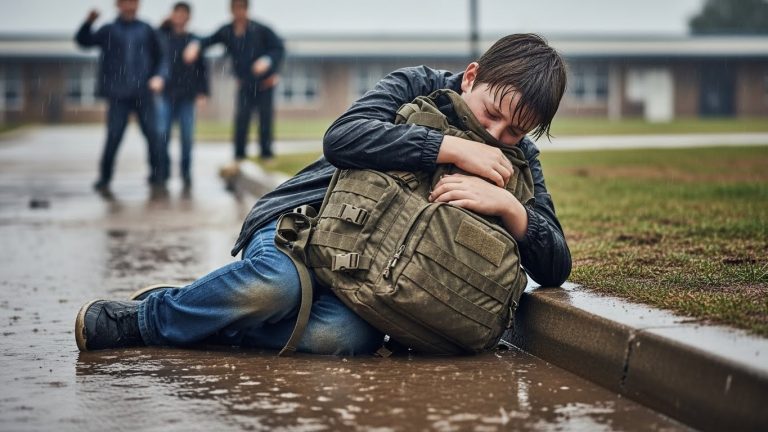
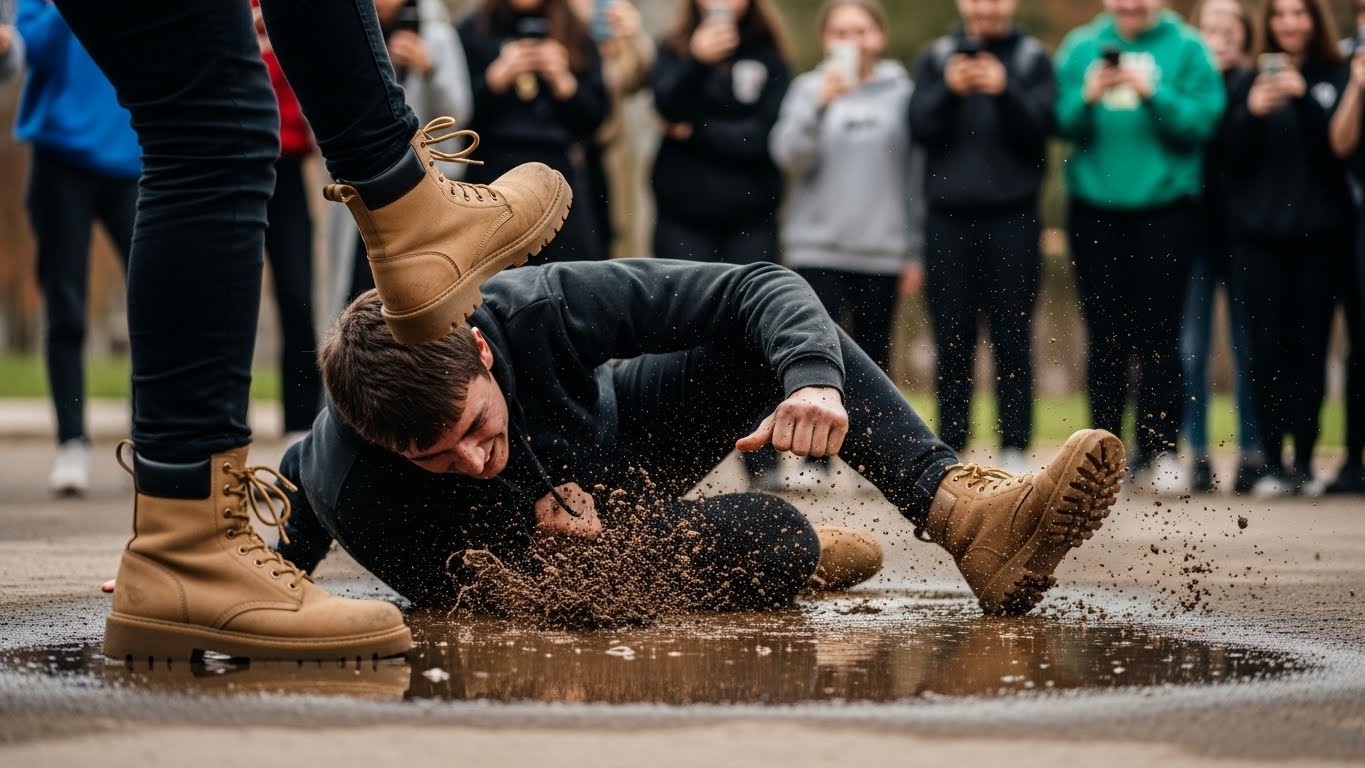
Leo went down hard. He didn’t have time to catch himself. He slammed face-first into the mud puddle that had formed in the depression of the grass from last night’s storm.
The splash was audible.
Leo lay there for a second, stunned. When he pushed himself up, his face was coated in thick, black slime. It dripped from his chin, matted his hair, and stained the front of my old navy hoodie.
The laughter erupted. It wasn’t just the three boys now. It was the crowd. A circle of jeering faces, glowing screens, and open mouths.
“Look at the mud rat!” someone shouted.
Tyler laughed, a barking, cruel sound. He walked over to where Leo lay, struggling to get traction in the slippery mud. Tyler raised his foot, hovering his sneaker over Leo’s head.
“Stay down, trash,” Tyler spat. “You dirty up the air up here.”
That was the breaking point. The levee in my mind broke.
I didn’t think. I didn’t plan. I dropped my duffel bag. It hit the ground with a heavy thud, the sound swallowed by the laughter.
I took three running steps and launched myself at the fence.
I hit the chain-link high, my boots finding purchase in the metal mesh. I vaulted over the top in one fluid motion, the barbed wire at the top missing my thigh by an inch. I landed on the other side in a crouch, the impact jarring my knees, but I didn’t feel it.
I stood up.
I was six foot two. Two hundred pounds of lean muscle honed by forced marches and sandbag drills. I was wearing full desert fatigues and combat boots that had walked through hell.
I started walking.
I didn’t run. Running is for panic. I marched. A predator’s walk. Smooth. Direct. Inevitable.
The kids on the edge of the circle noticed me first. The laughter on the periphery died out, replaced by confused whispers. They lowered their phones. They parted ways for me like the Red Sea, their eyes going wide as they took in the uniform, the size of me, the look on my face.
Tyler didn’t see me. He was too busy kicking dirt onto my brother’s back.
“You hear me, Leo?” Tyler shouted. “I said stay—”
I stopped three feet behind him. My shadow fell over him, swallowing him whole.
The silence that fell over the playground was absolute. It was heavy, suffocating. Even the wind seemed to stop.
“I wouldn’t do that,” I said.
My voice wasn’t loud. It was a low rumble, vibrating from the bottom of my chest. It was the voice of a man who knows exactly what he is capable of and is trying very hard not to do it.
Tyler froze. His foot hovered in the air for a fraction of a second before he put it down. He turned around slowly, annoyance on his face, ready to tell off a teacher or a parent.
“Who do you think you—”
The words died in his throat.
He looked up. And up. And up.
He found himself staring into the center of my chest. He had to crane his neck back to look me in the eye.
I looked down at him. I let him see it. The anger. The discipline. The violence held back by a single thread.
“You dropped something,” I said.
Chapter 3: The Rules of Engagement
Tyler stumbled back. It was instinctual, a recoil from the heat coming off me. He nearly tripped over his own expensive sneakers. His face, which had been flushed with the arrogant high of bullying moments ago, drained of color instantly. He looked like a sheet of paper.
“I… I…” Tyler stammered. His eyes darted to his two friends for backup.
But his friends were gone. The moment I had appeared, the two hulking boys had dissolved into the crowd, suddenly very interested in their shoes. Tyler was alone on his island.
I didn’t look at him anymore. He wasn’t the priority.
I crouched down, ignoring the mud that instantly soaked into the knee of my fatigues.
“Leo,” I said softly.
Leo was still on his hands and knees, trembling. He was wiping mud from his eyes, his breathing coming in ragged, hyperventilating gasps. He flinched when I spoke, expecting another insult.
“Leo, look at me.”
He turned his head slowly. The mud covered half his face, looking like war paint gone wrong. His eyes were red-rimmed and terrified. He blinked, trying to clear his vision.
“Jack?” he whispered. The word was so quiet I barely heard it. It sounded like a prayer.
“Yeah, buddy. It’s me,” I said, my throat tightening. Seeing him like this—broken, dirty, scared—hurt more than any physical blow I’d ever taken. I wanted to scoop him up and carry him away, protect him from the world.
But I couldn’t do that. Not here. If I carried him away now, he’d be the victim forever. He needed to stand.
“Get up, Leo,” I said, extending a hand. “We don’t stay in the dirt.”
Leo looked at my hand—calloused, scarred, steady. Then he looked at his own muddy fingers. He hesitated.
“Take my hand,” I commanded gently.
He reached out. As soon as his small, cold hand gripped mine, I pulled. I didn’t just help him up; I hoisted him. I pulled him to his feet and steadied him until he found his balance.
I reached out and brushed a clump of mud off his shoulder. “You okay?”
Leo nodded, staring at me as if I were a hallucination. “You’re… you’re really here.”
“I’m here.” I turned him slightly so he was facing Tyler. “And we’re not done.”
I stood up to my full height again and turned back to the bully. Tyler was edging away, looking for an exit.
“Stand still,” I barked. It was my NCO voice. The voice that cuts through noise and panic.
Tyler froze. “Look, man, it was just a joke. We were just playing.”
“Playing,” I repeated, tasting the word like poison. I took one step forward. Tyler took two steps back.
“Does he look like he’s laughing?” I gestured to Leo, who was shivering, clutching his muddy arms.
“I… I didn’t mean to…”
“Pick it up,” I said, pointing to the sketchbook lying face down in the muck.
Tyler looked at the mud. He looked at his pristine Jordans. He looked at the crowd watching him. He was calculating the cost of his dignity.
“I said, pick. It. Up.” I stepped into his personal space. I could smell the fear on him—it smelled like cheap body spray and sweat. “And the pages. Every single piece of paper you tore out. You’re going to pick them up, wipe them off, and hand them back to him.”
“You can’t touch me,” Tyler squeaked, his voice cracking. “My dad is a lawyer. If you touch me, he’ll sue you.”
I leaned in close, until my face was inches from his. I lowered my voice so only he and Leo could hear.
“Kid, I just spent three years in a place where people don’t sue each other. They solve problems differently. You think I’m scared of a lawyer? I’m scared of what I’ll do if you don’t start showing some respect to my brother.”
It was a bluff—mostly. I wasn’t going to hurt a thirteen-year-old. But Tyler didn’t know that. Tyler saw a man who had walked out of the desert and jumped a six-foot fence to get to him.
Tyler broke.
He dropped to his knees.
A gasp went through the crowd. The king of the playground was kneeling in the mud.
Tyler picked up the sketchbook. His hands were shaking. He reached for the crumpled balls of paper, his fingers digging into the wet earth. He gathered them all, getting mud on his varsity jacket, on his hands, on his soul.
He stood up, holding the ruined pile of art. He wouldn’t look at me. He held them out to Leo.
“Apologize,” I said.
“I’m sorry,” Tyler mumbled to the ground.
“Look at him,” I snapped. “Look him in the eye and tell him you’re sorry.”
Tyler looked up at Leo. For the first time, Leo wasn’t looking down. He was looking at Tyler. And in Leo’s eyes, the fear was receding, replaced by something else. Shock? Awe? Maybe a glimmer of confidence.
“I’m sorry, Leo,” Tyler said clearly.
Leo took the book and the crumpled pages. He held them tight. He didn’t say anything. He just nodded.
“Hey! What is going on here?”
The voice boomed from the school doors. I looked over to see a man in a cheap suit running towards us, flanked by a security guard. The Principal.
The spell broke. The crowd started to murmur again. Tyler took the opportunity to scramble back, wiping his hands on his pants, his face burning red with humiliation.
“You!” The Principal pointed at me. “Who are you? You can’t just come onto school property and threaten students!”
I looked at the Principal, then down at Leo. I put my hand on Leo’s shoulder, feeling the thin bone beneath the wet hoodie.
“I’m his brother,” I said, loud enough for everyone to hear. “And I’m taking him home.”
I didn’t wait for permission. I guided Leo toward the gate, toward my duffel bag. We walked past the crowd of kids. They parted for us again, but this time, they weren’t looking at me. They were looking at Leo. They were looking at the kid who had the soldier at his back.
“Jack?” Leo asked as we walked away from the school, leaving the stunned silence behind us.
“Yeah, bud?”
“You’re in so much trouble.”
I looked down at him. A small smile cracked through the mud on his face.
I laughed, wrapping my arm around his dirty shoulders. “Yeah, well. I’m used to it. Let’s go get some ice cream. You look like you could use a win.”Chapter 4: Collateral Damage
We didn’t go straight home. I couldn’t take him to Mom looking like a swamp creature. We went to Sal’s Diner, the same spot where Mom worked the morning shift. It was empty at three in the afternoon, save for a trucker nursing a coffee in the corner.
I took Leo into the bathroom. I wet a stack of brown paper towels and started cleaning him up.
“Hold still,” I murmured, wiping the drying mud from his neck.
“It’s cold,” Leo hissed, flinching.
When I wiped away the grime on his cheek, I saw it. A bruise, blooming purple and yellow, right along his jawline. It wasn’t fresh. It was a few days old.
I froze, the wet paper towel hovering in my hand. “Leo. Did he hit you?”
Leo looked away, staring at the cracked tiles of the bathroom wall. “It wasn’t Tyler. It was Marcus. One of his friends.”
“How long?”
“Since school started,” he whispered.
My grip tightened on the sink until the porcelain groaned. I looked at myself in the mirror. The desert fatigues, the high-and-tight haircut, the eyes that had seen too much. I thought I was fighting for freedom, or safety, or whatever the politicians said on TV. But while I was halfway around the world protecting strangers, my little brother was getting used as a punching bag in my own backyard.
“Why didn’t you tell Mom?”
“She’s tired, Jack,” Leo said, looking at me through the mirror. “She’s always tired. And Dad… you know Dad. He’d just say I need to toughen up.”
That hit me harder than a bullet. Toughen up. The Miller family motto. Swallow the pain until it poisons you. It was why I left. It was why Dad drank. And now, it was why Leo was bleeding in silence.
I finished cleaning him up. I threw the muddy paper towels in the trash—a dull, wet thud.
“We’re getting milkshakes,” I said. “Chocolate. Extra malt.”
We sat in a booth by the window. Leo nursed the shake, his hands still trembling slightly. He had his sketchbook open again, trying to flatten the crinkled, muddy pages I’d forced Tyler to pick up.
“Is the army hard?” Leo asked suddenly, looking at the stripes on my sleeve.
“Yeah. It’s hard.”
“Did you… you know.” He made a vague gesture with his hand. “Shoot bad guys?”
I looked out the window at the sleepy town of Oak Creek. “I did a lot of waiting, Leo. A lot of standing around in the heat. Mostly, I just missed home.”
“I missed you too,” he said quietly. He pushed the sketchbook toward me. “I drew you. While you were gone.”
I looked down. On a page stained with faint mud spots, there was a drawing of a soldier. He was standing on a hill, holding a shield. The perspective was a little off, but the detail was incredible. The soldier wasn’t holding a gun. He was holding a shield over a smaller figure.
“It’s good, Leo. Really good.”
He shrugged, but a small, proud smile tugged at the corner of his mouth.
For a second, things felt normal. But I knew the peace was temporary. I had kicked a hornet’s nest at the school. In a town like Oak Creek, where everybody knows everybody’s business, echoes last longer than the shout.
Chapter 5: The Home Front
The sun was setting when we walked up the driveway of our small, siding-clad ranch house. The porch light was flickering—Dad still hadn’t fixed it.
My heart hammered against my ribs. Facing the Taliban was one thing; facing Frank Miller was another.
We walked in. The house smelled the same: stale cigarette smoke, lemon cleaner, and pot roast.
“Leo? Is that you? You’re late,” Mom’s voice called from the kitchen. She sounded exhausted.
“I brought a stray,” Leo said, his voice lighter than it had been all day.
Mom walked out of the kitchen, wiping her hands on a dish towel. When she saw me standing in the entryway, filling the frame with my uniform and duffel bag, she dropped the towel.
“Jack?”
Her voice broke.
“Hey, Ma.”
She crossed the distance in two seconds, slamming into me with a force that nearly knocked the wind out of me. She buried her face in my camo chest, sobbing. I wrapped my arms around her, breathing in the scent of her cheap perfume and cooking oil. It was the smell of safety.
“You’re home. You’re actually home,” she cried.
“I’m home, Ma.”
Then, the heavy tread of boots on the stairs.
Dad came down. He was wearing his work shirt, stained with grease from the plant. He looked older. More gray in the beard, more lines around the eyes. He held a beer in one hand.
He stopped on the bottom step. He looked me up and down, his eyes lingering on the rank on my chest, then the boots, then my face. There was no run, no hug. Just a stiff nod.
“So,” Dad grunted. “The prodigal son returns.”
“Frank,” Mom scolded, pulling away to look at me. “Don’t start.”
“I’m just saying,” Dad took a sip of his beer. “Didn’t call. Just showed up. Typical Jack.”
“I wanted to surprise you,” I said, keeping my voice even.
“Well, surprise,” Dad said flatly. He looked at Leo. “Why are you muddy? And why is my phone blowing up with texts from the school board president?”
The room temperature dropped ten degrees.
“What?” Mom asked, looking between us.
“Your son,” Dad pointed a calloused finger at me, “apparently decided to storm the middle school and threaten a student. Tyler Vance. You know who his daddy is, Jack? Councilman Vance.”
“He was hurting Leo,” I said, my voice hardening. “He had him face-down in the mud.”
“So you attacked a thirteen-year-old?” Dad scoffed. “Real hero.”
“I didn’t touch him,” I snapped. “I made him apologize. Something the teachers should have done months ago.”
“You don’t get it, do you?” Dad walked closer, the smell of beer strong on his breath. “You think you can just waltz back in here with your combat boots and fix everything by puffing your chest out? This is the real world, Jack. Not the sandbox. You humiliated the Councilman’s kid. You think that just goes away?”
“I don’t care who his father is,” I said, stepping between Dad and Leo. “Nobody touches my brother.”
“You’re going to leave again!” Dad shouted, his face reddening. “That’s what you do! You leave! And when you’re gone, who deals with the fallout? Hmm? Me. Your mother. Leo. You painted a target on his back today, boy.”
I opened my mouth to argue, to scream that I was staying, that I was different now.
But I looked at Leo. He wasn’t looking at me with the hero-worship anymore. He was looking at the floor, his shoulders hunched again.
Because he knew Dad was right about one thing. The war wasn’t over. I had just started a new one.
Chapter 6: The Citation
The fallout didn’t wait. It arrived the next morning at 8:00 AM in the form of a phone call.
I was sitting at the kitchen table, drinking coffee out of a chipped mug, watching Leo eat his cereal. He was wearing a fresh hoodie, but he looked tired. He hadn’t slept well. Neither had I. I spent the night on the pull-out couch, listening to the house settle, waiting for an attack that wouldn’t come.
The landline rang. A shrill, old-school sound.
Mom picked it up. “Hello? Yes, this is Sarah Miller.”
Her face went pale. She looked at me, then at Leo.
“But… he was the one being bullied… No, I understand, but… Suspending him? That doesn’t seem…”
She went silent, listening. Her hand gripped the cord tight. “Yes. I understand. We’ll come in.”
She hung up. The silence in the kitchen was heavy enough to crush bone.
“What happened?” I asked.
“Leo is suspended,” Mom whispered. “Three days.”
“What?” I stood up, the chair scraping loud against the linoleum. “For what?”
“Fighting,” Mom said, tears welling in her eyes. “And… ‘soliciting unauthorized intervention.’ They said he brought a dangerous individual onto campus to incite violence.”
“Dangerous individual?” I laughed, a bitter, sharp bark. “I’m his brother! I’m a Sergeant in the United States Army!”
“They said Tyler’s parents are threatening to press charges for assault,” Mom said, her voice trembling. “They said you traumatized him.”
“Traumatized him?” I paced the small kitchen. “He was stomping on Leo’s head!”
“They have witnesses, Jack,” Mom said. “All those kids… they told the Principal that you jumped the fence and threatened to kill him.”
“I never said that!”
“It doesn’t matter what you said!” Dad walked into the kitchen, buttoning his work shirt. He looked tired, vindicated, and defeated all at once. “It matters what the Vances say. And the Vances run this town.”
Dad poured himself a coffee, not looking at me. “I told you. You came in hot, thinking you were saving the day. All you did was get your brother kicked out of school.”
I looked at Leo. He had stopped eating. He pushed his bowl away.
“It’s okay,” Leo said quietly. His voice was hollow. “I didn’t want to go back anyway.”
“It’s not okay, Leo,” I said, crouching down next to him. “It’s not right.”
“It’s how it is,” Leo said. He looked at me, and for the first time, I saw the anger behind the sadness. “You shouldn’t have come to the school, Jack. You made it worse.”
He got up and walked out of the kitchen. I heard his bedroom door click shut.
I stood there, feeling helpless in a way I never felt under enemy fire. In the desert, the enemy was clear. You knew where the line was. Here? The enemy was a lawyer in a suit, a spineless Principal, and a story twisted by rumors.
“Fix it,” Dad said, grabbing his keys. “You broke it. You fix it. Or get out of my house.”
He slammed the front door.
I looked at Mom. She was crying silently over the sink.
I walked to the window and looked out at the driveway. My reflection ghosted over the glass. I looked like a soldier. I felt like a failure.
Dad was right about one thing: brute force wasn’t going to win this battle. Tyler Vance and his father used fear and influence to get what they wanted. They used the system.
Well, I had learned a few things about systems in the military.
I wasn’t going to punch my way out of this. I was going to have to outmaneuver them.
I went to the hall closet and pulled out my dress blues—the formal uniform. The one with the medals. The one that demanded respect, not just fear.
“Mom,” I said, turning to her. “Don’t worry about the suspension.”
“Where are you going?” she asked, wiping her eyes.
“I’m going to school,” I said. “And I’m not going alone.”
I pulled out my phone. I hadn’t kept in touch with many people from my old life, but I had a new family now. The brotherhood. And I knew for a fact that three of the guys from my platoon were stationed at the recruitment center in the next town over.
Tyler Vance wanted a show? I was going to give him a production.