He Threw My Heart Meds Down The Stairs And Called Me “Trash.” He Didn’t Know My Dad Is The Warlord Of The Bandidos Biker Gang—Now The Whole Town Is About To Pay.
CHAPTER 1: THE TOLL ROAD
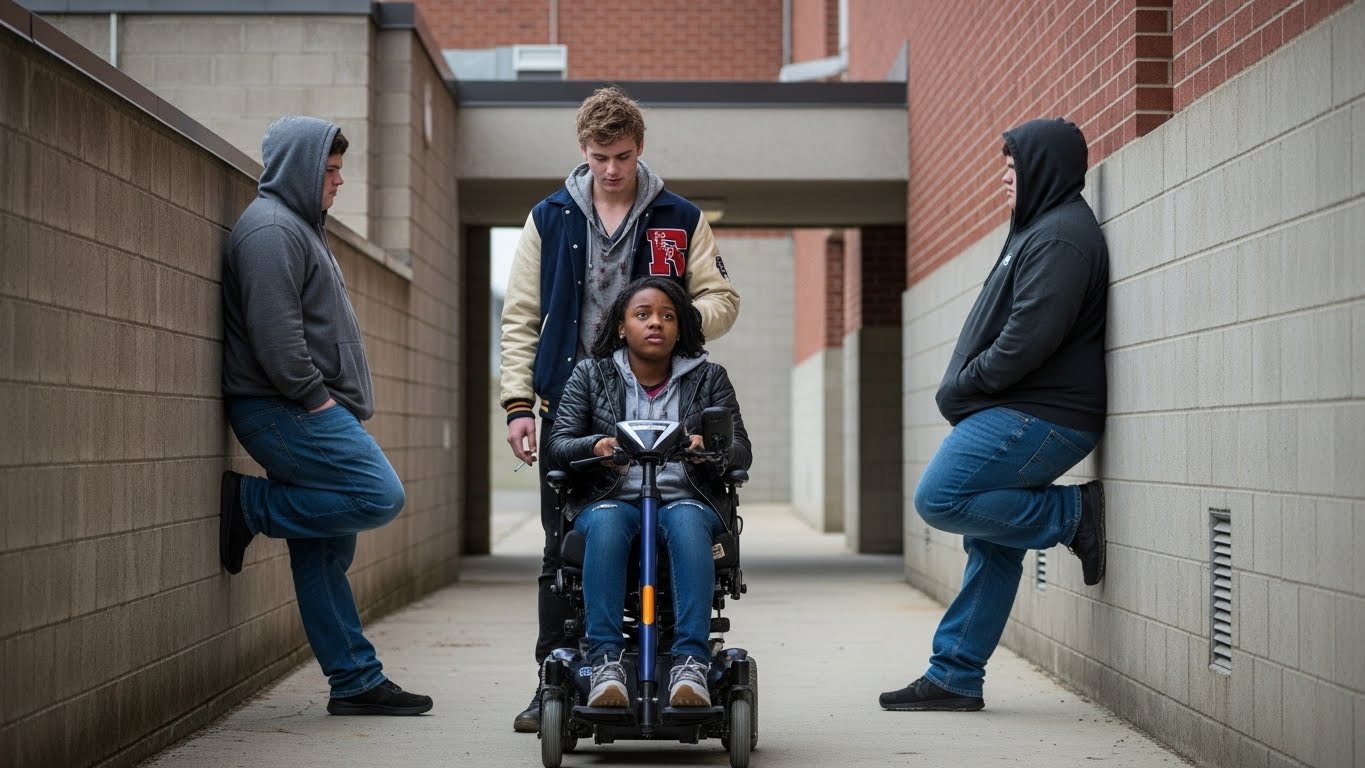
The concrete ramp behind Crestview High’s old gymnasium was never designed to welcome students like me. It rose like a towering, gray triangle against the weathered brick of the main building—an ugly, utilitarian scar on the architecture. One side was a long, narrow, steep slope meant for deliveries and wheelchairs; the other was a set of unforgiving concrete steps that dropped sharply down to the faculty parking lot.
It was the only accessible pathway, a shaky bridge between the main academic building where the honors classes were held and the lower annex, a damp, forgotten place where they shoved the remedial math classes and the woodshop. For me, sixteen-year-old Sophia King, this shadowed corridor wasn’t just a piece of infrastructure. It was a daily gauntlet.
I brought my motorized wheelchair to a halt about ten feet back from the entrance. My hand rested lightly on the joystick, the controller cool and slick under my palm. My dark skin contrasted sharply against the cold gray of the cinder block walls, and I could feel the dampness of the shade seeping into my jeans.
I was a girl who had learned to navigate a world built for legs I couldn’t use. I did it with a quiet, lonely resilience that most people in this town mistook for shyness. I kept my head down. I did my work. I tried to be invisible. But today, the path was blocked, and invisibility was no longer an option.
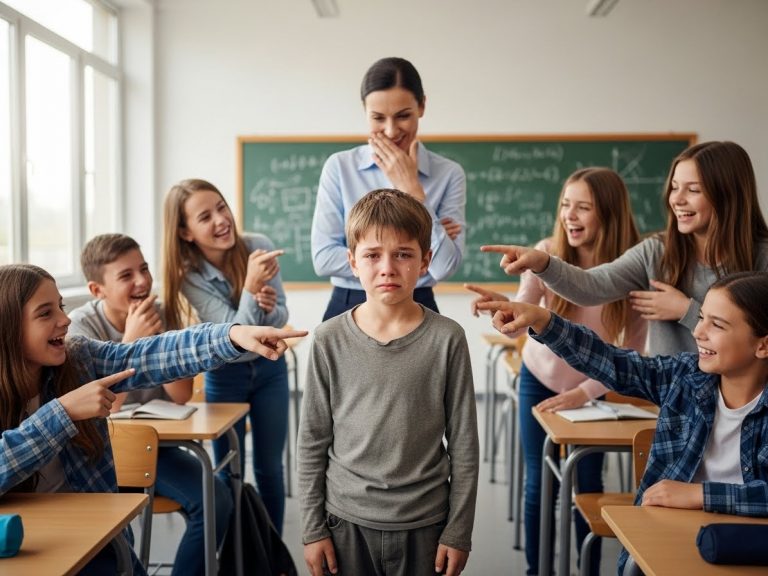
Three figures loomed in the shadows of the overhang, creating a wall of varsity wool and arrogance. In the center stood Jackson Lockach. He was seventeen, white, and wore his status like a suit of armor. His varsity jacket was expensive—black leather sleeves, wool body—but he wore it with a deliberate sloppiness, unbuttoned to reveal a stained white t-shirt underneath.
He wasn’t just a student. In his mind, he was the crown prince of this decaying rust-belt town. His father, “Big Mike” Lockach, owned Lock’s Tap, the dive bar that served as the unofficial town hall for the corrupt and the weary.
Flanking him were Brad and Kyle, two hulking offensive linemen who existed solely to amplify Jackson’s cruelty. They were smoking, leaning against the graffiti-covered wall like sentries at the gates of hell. The sharp, acrid scent of illegal tobacco hung heavy in the damp air trapped between the walls.
I checked the time on my phone. I had five minutes to get to my math class. If I was late, it was another detention, another strike against a record I fought desperately to keep clean. I couldn’t afford trouble. I had plans to get out of this town, to go to college, to be someone other than “the girl in the chair.”
“Excuse me,” I said. My voice was steady, practiced. I refused to let it tremble, even though my heart was already hammering a frantic rhythm against my ribs. “I need to get through, Jackson.”
Jackson didn’t turn around immediately. He took a long, slow drag from his cigarette, holding the smoke in his lungs as if he were savoring a fine vintage wine. He exhaled a thick plume toward the stained ceiling, watching it curl and dissipate. Then, slowly, painfully slowly, he pivoted on his heel.
His eyes were glassy and cruel. They were the eyes of a boy who believed consequences were things that happened to other people, never to him.
“Well, look who it is,” Jackson drawled, a smirk playing on his lips.
“The Rolling Stone,” Brad and Kyle snickered in unison, the sound bouncing off the concrete like gravel in a blender. It was an old joke, stale and stupid, but they laughed like it was the height of comedy.
“I have a class, Jackson,” I stated, my grip tightening on the joystick until my knuckles ached. “Please move.”
“Please?” Jackson mocked, his voice dripping with condescension. He stepped away from the wall and planted himself directly in the center of the narrow ramp. He spread his arms wide, claiming the space as his own personal kingdom. “You seem to forget who you’re talking to, Sophia.”
He took a step closer, gesturing with his cigarette as if conducting an orchestra. “You think this is just a school? This is my territory. My old man is Big Mike Lockach. He owns Lock’s Tap.”
He leaned in, his voice dropping to a boastful swagger, his breath smelling of smoke and peppermint schnapps. “You know what that means? It means Lock’s Tap isn’t just a bar. It’s the real City Hall. The Mayor drinks on my dad’s tab every Friday night. The Chief of Police? He owes my dad more money in gambling debts than he makes in a year. My dad snaps his fingers, and this whole town jumps.”
He puffed out his chest, fueled by the borrowed power of a man who sold cheap beer to sad locals. “So when I stand here,” Jackson whispered, “it’s the same as my dad standing here. I own the concrete you’re rolling on. Nothing here is free, especially for people who don’t belong.”
“This is a toll road now,” he continued, the smell of stale smoke washing over me, making my stomach turn. “You want to pass the King? You pay the tax.”
“I don’t have money,” I said, my chin lifting slightly. “And I don’t pay tolls to school bullies playing make-believe gangsters.”
Jackson’s smirk vanished. His face hardened. The playfulness evaporated, replaced by the ugly reality of his entitlement. He looked at the cigarette in his hand, the cherry burning bright orange. With a casual, almost bored flick of his wrist, he tapped the ash.
It didn’t fall on the ground. The hot gray flakes landed directly on my thigh, smearing against my jeans.
I flinched, brushing the hot ash away, my pulse skyrocketing. It was a violation. Dirty. Disrespectful. Physically aggressive.
“You missed a spot,” Jackson said coldly, watching me struggle.
“You are pathetic,” I said, my voice dropping to a low, intense register. “You’re just a sad little boy blocking a wheelchair ramp because it’s the only place you feel big.”
The insult hit its mark. Jackson’s eyes narrowed into slits. He stepped in until his heavy boots were touching the footrests of my chair. He loomed over me, using his height, using his ability to stand to make me feel small.
“You listen to me,” Jackson hissed. “You think you’re special because the school built you a little road? You think you matter?” He leaned down, his face inches from mine. “This ramp is for people, Sophia. It’s for functioning humans.”
He gestured to my paralyzed legs with a look of absolute disgust. “It is not for scrap metal. It is not for broken things that belong in a junkyard.”
The words hung in the air, sharper than any knife. It was the ultimate dismissal of my humanity. But Jackson had made a fatal error. He assumed that because I was sitting down, I was helpless. He assumed I was afraid. But I was raised by a man who taught me that dignity isn’t something you’re given; it’s something you keep.
My hand slid from the joystick and gripped the metal frame of my chair, preparing to do the one thing Jackson Lockach never expected: fight back with the truth.
CHAPTER 2: THE EDGE OF THE ABYSS
“What’s wrong, Sophia?” Jackson mocked, crowding my space, invading the small bubble of safety I tried to maintain. “Finally figured out this school’s not made for people like you?”
My voice cut through the smoke and swagger. “You talk a lot about your dad, like he’s some kind of king.”
My tone was calm, but there was a razor edge underneath. I looked him dead in the eye. “But everybody knows Lock’s Tap is just a dump where he serves cheap booze and watered-down lies to the same drunks every night. He’s not a boss. He’s a small-time hustler just like you.”
For a second, the world held its breath. Brad’s jaw dropped, his cigarette hanging loosely from his lip. Kyle’s eyes darted from me to Jackson, suddenly alert, realizing the script had flipped.
Jackson’s face went red, then pale. His smirk twisted, collapsing into pure rage. He didn’t care about the teachers, the school rules, or even the security camera above the door—he knew it hadn’t worked in months. All he cared about was that someone, especially someone like me, had dared to strip away his armor in front of his boys.
“Say that again,” he hissed, jaw clenched, fists trembling. “Say it. I dare you.”
I didn’t look away. I couldn’t afford to. “I said, you’re nothing without your daddy’s bar and your daddy’s debts. Take those away, and you’re just another coward with too much mouth and not enough backbone.”
Jackson’s nostrils flared. He turned, snapping at Brad and Kyle. “Block her in. Now.”
Obedient like trained dogs, Brad lumbered to the top of the ramp, crossing his arms, eyes fixed on the ground. Kyle slid to the bottom, his broad frame filling the narrow exit.
I was trapped. No way forward. No way back.
A fresh wave of anxiety rippled through the air. The late bell echoed in the distance, ringing out across the campus, but no one moved. Out here, in this forgotten corner, time froze. The normal order of school faded. Only this ugly little kingdom remained.
Jackson lowered his face until it was inches from mine. “You like running your mouth, don’t you?” he sneered. “Why don’t you beg, Sophia? Beg me for a pass. That’s what everyone else does.”
I didn’t blink. “I’d rather crawl than bow to you.”
His patience snapped. He kicked the front wheel of my chair, sending a violent shudder up the frame. The motion was sudden, violent. A message and a threat. My chair jerked sideways, nearly tipping, but I righted myself, jaw clenched.
“Watch yourself, Jackson!” I shouted, instinctively reaching for my bag.
“I can make life a lot worse for you,” he barked. “Nobody’s going to care. Not the teachers, not the cops, not even your own kind. You know why I get away with it? Because my dad makes the rules in this town. Because people like you don’t get a say.”
He reached for the strap of my backpack, fingers digging in. “You want to act tough? Let’s see what’s in here. Maybe you got something worth paying for.”
“If you touch my stuff, that’s stealing,” I warned, my voice cutting through the standoff. “You know that, right?”
Jackson’s grin was sharp and pitiless. “You gonna call a teacher? Go ahead. Let’s see who they believe. A cripple with a bad attitude or the son of this town’s finest?”
He yanked the backpack from the back of my chair, the contents rattling with each rough motion. Brad and Kyle hovered, no longer looking me in the eye. Whatever sympathy they might have had was buried beneath fear and loyalty. No one stepped in. No one spoke up.
Jackson unzipped the bag and began rifling through it—notebooks, a half-eaten granola bar, a water bottle. He tossed them aside with growing impatience. Then his hand closed around something small and soft. A blue zipper pouch, the kind given out in hospitals.
He dangled it by the drawstring, squinting at the faded writing.
“Well, well,” he said, his tone mock-curious. “What do we have here?”
He flipped the pouch over, reading the emergency card attached. “Nitroglycerin. Emergency Only. Heart Condition.” He looked at me, a cruel glint in his eye. “Didn’t know being pathetic was contagious.”
A fresh wave of humiliation stung my cheeks, but panic was rising faster. That wasn’t just medicine; it was my lifeline. My paralysis came with complications, a heart that sometimes forgot how to keep rhythm under stress.
“Give that back, Jackson,” I said, my voice rising. “It’s my medication. Without it—”
“Without it, what?” he cut me off with a harsh laugh. “You gonna fall over and die? Maybe you should have thought of that before running your mouth.”
He tossed the pouch to Kyle, who fumbled it before clutching it tight, looking uneasy.
“Man, come on,” Brad whispered. “That’s not cool. She needs that.”
“Don’t go soft, Brad. It’s just a little joke.” Jackson fished further into the backpack, pulling out a tarnished silver chain with a heavy pendant—a skull and crossbones wearing a sombrero.
The insignia of the Bandidos.
He sneered. “What’s this? Trying to play gangster now?” He dangled the necklace inches from my face, then spat on the floor. “Should have known you’d carry something this trashy.”
My eyes flared with cold warning. “You don’t know what you’re playing with. Give me the medicine and put the chain back.”
“Or what?” he laughed, the sound echoing off the empty corridor. “Who’s gonna make me? The Principal? He works for my dad. The cops? They drink at Lock’s Tap every Friday. Out here, you’re on your own.”
He turned to his crew, tossing the chain to Brad. “Look at this. Maybe we should pawn it for lunch money.”
He turned back to me, eyes narrowed, voice thick with spite. “Want your stuff back? Beg for it.”
I set my jaw, every muscle in my face carved from resolve. “I don’t beg.”
Jackson’s features twisted with frustration. She was supposed to cry. I was supposed to plead. I wasn’t following the script.
“You want your medicine?” he hissed, stepping back. “Then crawl for it. Crawl like the broken thing you are.”
He waved Kyle over, taking the blue pouch back. “Go ahead. Throw it.”
Kyle hesitated, meeting my eyes for half a second. There was something there—a flicker of guilt, maybe even fear. But Jackson’s presence brooked no rebellion. With a grunt, Kyle tossed the pouch… right down the flight of concrete stairs.
The sound of the plastic hitting the steps echoed in the emptiness below. My breath caught. Every instinct screamed at me to go after it, but my chair stood unmoving, heavy as lead.
“There you go, hero,” Jackson smiled, triumphant and cruel. “If you want to survive, maybe you’ll finally learn your place.”
CHAPTER 3: THE FALL
“You’re not even worth the trouble,” Brad muttered, looking at the ground. “Let’s just go, man.”
“No,” Jackson said. He pointed down the stairs. “Go get it, Sophia. Or stay here and see what happens next. Either way, it’s not my problem if something goes wrong.”
I clenched my fists, knuckles white. Every exit was blocked. Every ounce of dignity under attack. But my eyes burned with a fire Jackson couldn’t douse.
He pointed again, this time with unmistakable menace, his voice echoing down the hallway. “The only way out is down.”
My chair, boxed in by Brad and Kyle, rolled in a slow, sickening arc as they forced me to the top of the concrete staircase. The hallway behind them emptied out. Nobody would see. Nobody would help.
Jackson gripped the back of my chair, knuckles white, jaw clenched so hard a vein throbbed in his neck. The blue pouch with my medication lay far below, almost unreachable.
“Welcome to the edge,” Jackson sneered, his voice bouncing off the stairwell walls. “Let’s see how brave you really are.”
I tried to steady my breath, but my heart was hammering wild, stuttering in my chest. Sweat beaded at my temples. I pressed my hands to the wheels, trying to engage the brakes, but Jackson’s grip kept me frozen at the lip of the drop.
Kyle shifted from foot to foot, eyes darting toward the door, but Brad stood silent, a wall of muscle and guilt, avoiding my eyes.
“You want your medicine, Soph?” Jackson dangled the promise in front of me like bait on a hook. “There’s only one way to get it. But first, you’re going to say something for me.”
I didn’t respond. My jaw set, teeth gritted, refusing to give him even a flicker of fear in my voice.
He leaned close, his breath hot and sour. “Say it out loud for everyone to hear. ‘I am trash. I am nothing. I don’t deserve to be here.’ Do that, and maybe I’ll let you roll down slowly.”
My stomach twisted. Dots swam in my vision. My body knew what it meant when the world started spinning and my heart battered itself against my ribs, screaming for oxygen. I fought for control, forcing myself to focus on Jackson’s eyes, to remember the fire that kept me alive every day.
Jackson squeezed harder on the chair, knuckles digging into metal. “What’s wrong? Can’t speak? Maybe you really are broken.”
Brad glanced at Kyle, voice tight with uncertainty. “Jax, man… just give her the pills. It’s not funny anymore.”
Jackson’s head snapped in Brad’s direction. “Shut up! You want to end up like her? Sit down and keep your mouth shut.”
Kyle’s face was pale, jaw working as if he wanted to say something, anything. But Jackson’s anger was contagious, filling the space with a toxic fog that made everyone smaller.
I forced a shaky breath. “You’re wasting your time. I won’t give you what you want.”
Jackson barked a laugh, sharp as broken glass. “Still got a mouth on you, huh? Still think you’re better than us?”
I met his eyes. “No. I just know what I am. And it isn’t what you say.”
His fury spiked. “You think this is a choice?” He shoved the chair, wheels spinning on the edge, my toes hanging over the abyss. “Say it! Admit you’re trash! Or maybe you want to take a shortcut down.”
I stared at the staircase, then back at Jackson. I felt the first tremor in my chest, a warning pulse of pain, but I willed myself not to let it show.
“I’m not your victim,” I whispered. “You don’t get to decide who I am.”
Jackson’s hand shook with rage. “Wrong answer.”
He let go of the chair for a second, then slammed it forward, the front wheels bouncing dangerously against the edge. “Last chance,” he snarled. “You want your medicine? Beg. Or you can pick it up in pieces at the bottom.”
My lips pressed together, silent, defiant. I’d learned long ago that some battles you lose the second you surrender your dignity. Even now, facing the edge, I would not hand that to him.
Jackson’s voice rose, unhinged. “Say it! Say you’re garbage and maybe I’ll let you live!”
But my silence was louder than any scream.
For a long, suffocating moment, nobody moved. Even the air seemed to wait. Then Jackson’s mask cracked, hatred spilling out raw and ugly.
“You want to be stubborn?” His hand shot forward, gripping the chair with a violence that promised only one thing. “I’ll help you get down there faster.”
Jackson’s words hissed like a fuse. He slammed his foot into the back of my wheelchair.
The metal groaned, a brutal mechanical protest. Then the world dropped out from beneath me.
The chair shot forward, helpless against gravity, front wheels lurching over the edge. For an instant, everything slowed. My gasp was lost in the sudden rush of wind. My hands flew to brace myself, but there was nothing to hold.
The chair flipped.
Metal scraped against concrete with a sound like a shriek. My body was tossed like a rag doll, legs twisted and arms reaching for a life that would not catch me. The world became a kaleidoscope of gray stairs, blue sky, and sharp, blinding pain.
Crunch.
I hit the first landing hard. My chair tumbled over me, crushing my shoulder. I rolled, helpless, gaining speed, bouncing down the second flight.
Thud.
My head struck the concrete. My vision shattered into flashes of white and red. The blur of shoes and horrified faces on the landing above was the last thing I saw before the darkness rose up to meet me.
I hit the bottom. A sickening crack echoed through the air. Then, silence.
CHAPTER 4: THE RUMBLE OF RECKONING
Far below, near the faculty parking lot, Tiny Alvarez had just pulled up on his Harley. He was a massive man, bearded, arms marked with the ink of battles past, a scout for the local chapter of the Bandidos. He had stopped by to drop off a forgotten lunch, a favor for the Road Captain.
He was still straddling his bike, engine idling, when a small device around his neck began to vibrate, flashing an urgent red light. It was the emergency signal triggered by the Bandidos medallion he’d given to someone who mattered more than life itself.
Instinct and a promise sent him charging toward the school entrance. But even with the engine still hot, he looked up just in time to see a body tumbling down the external stairs. The medallion glinted as it flew free from the falling form.
Tiny watched, helpless, as blood bloomed on the concrete. Rage and dread collided in his chest with the force of a freight train. He hadn’t arrived soon enough to stop the violence, but whoever had done this would not escape his justice.
On the landing above, Jackson’s bravado collapsed into a twisted grin, but even his laughter died when Tiny’s shout ripped through the air, a sound less human than animal.
“HEY!”
It was a roar that split the world in half.
Brad and Kyle froze, faces drained of color. Tiny abandoned his bike, boots pounding the asphalt, each stride fueled by something close to murder. The students in the distance scattered like pigeons before a hawk. Jackson tried to mask his terror with bluster, but it didn’t fool anyone now.
Tiny slid to my side, falling to one knee. His hands, gentle despite their size, hovered over my neck, searching for a pulse.
“Stay with me, kid,” he muttered under his breath, words shaking. “Come on… don’t you do this.”
Blood streaked down my forehead, my eyes fluttering but unfocused. My chest heaved in shallow, rapid bursts—a silent battle to keep my heart beating. Above, the group panicked. Brad took a step back, guilt and fear battling on his face. Kyle’s lips moved in a silent prayer. Jackson looked down, his mask of cruelty starting to crack, but pride held him in place.
Tiny fumbled for his phone, fingers surprisingly deft. His eyes never left my pale face.
“Come on, come on.” He pressed a speed dial, voice rough as gravel when the line connected. “Cap. Get to the school. Now. Your girl’s down. There’s blood. Hurry.”
He kept one hand on my shoulder, anchoring me to life. His own face was a study in panic and rage.
Brad turned to bolt, but Tiny’s other hand flashed to his belt. The glint of metal—cold, precise—stopped everyone cold.
“Nobody moves!” he barked, voice brooking no argument. The pistol, black and heavy, was a promise and a warning. “You stand right there.”
Jackson, for the first time, lost the ability to speak. His face drained of color as Tiny fixed him with a stare that promised consequences far worse than detention.
The schoolyard felt smaller, darker. The rules had changed in a heartbeat. I barely clung to consciousness, the world spinning around me. The only thing I heard clearly was Tiny’s low whisper, fierce and broken.
“You hold on, Sophia. You hear me? Don’t you quit. Help’s coming.”
The students who had watched from the corners, the windows, now pressed their faces to the glass in horrified silence. Some filmed, most just froze. Fear rippled through every inch of the courtyard. Justice—real, raw, and unpredictable—had arrived, and it didn’t look like the movies.
On the stairwell, Jackson’s confidence evaporated. The laughter that always followed his cruelty now died in his throat, replaced by a terror he’d never tasted before. Tiny kept his gun trained on the boys, his other hand never leaving my wrist.
“You’re not alone, little one. Not now.”
The courtyard’s air turned strange, tense, electric, almost charged with premonition. Teachers peered out from classroom windows. An entire school held its breath.
And then came the sound.
At first, it was a low vibration, felt in the teeth before it was heard. Then it grew. The deep, primal roar of V-Twin engines, twenty-fold, rolling over the blacktop like thunder breaking the sky. The vibrations shook the windows, rattled lockers, sent a flock of birds shrieking into the air.
Metal gates groaned as they were forced aside.
Harley after Harley stormed through the entrance, each bike rumbling with threat. Every rider was marked by the patch of the Bandidos—skull, hat, and pistol.
Leading them was a giant. His presence swallowed the chaos and replaced it with dread. He was a mountain of a man, skin dark as midnight, black leather vest stretched over his broad chest, arms thick with muscle and scars, his eyes hidden behind mirrored sunglasses.
The others called him Anvil. He was the Road Captain of the Bandidos.
He didn’t speak as he climbed off his bike. He just moved—deliberate, unstoppable. When he strode through the circle of bikes, even the boldest students shrank back. His boots left heavy prints on the concrete, the silence behind him broken only by the idle growl of engines.
Tiny rose to meet him, voice cracking as he pointed to me. “She’s hurt bad, Cap. It’s… it’s her heart. And the fall.”
Anvil didn’t blink. Didn’t let anyone see the horror that flashed across his face. He knelt and gathered my broken body into his arms with a gentleness that made his size seem impossible. My blood stained his vest, but he didn’t flinch.
“Get the ambulance,” he growled.
And someone, no one saw who, fumbled a phone and dialed, hands shaking.
Brad tried to bolt, but a Bandido biker blocked his path, shoving him back into the circle. Kyle looked ready to cry. Jackson hovered on the edge, stuck between fight and flight.
Anvil straightened, cradling me against his chest. He looked up finally, deliberately, locking eyes with Jackson at the top of the stairs. In that moment, every shred of arrogance in the boy’s body crumbled. Behind those sunglasses, Anvil’s gaze was murder contained in glass.
He stepped forward, voice deep as a warning bell.
“You down. Now.”
Jackson, legs shaking, stumbled down the steps, his bravado dissolving into pure, unadulterated fear. Brad and Kyle were herded after him, encircled by a wall of leather and steel. Tiny kept his gun trained on the group, but it was the bikers’ silence that weighed heaviest. They didn’t yell, didn’t threaten. They just stared, daring the bullies to breathe wrong.
Anvil set me gently on a blanket someone tossed from a saddlebag. He brushed blood from my brow, then turned back to the boys, his hands curling into fists the size of sledgehammers.
“Who did this?”
His voice was barely more than a rumble, but it was enough. The question cracked through the boys’ defenses.
Jackson swallowed, sweat pouring down his forehead. “It was… it was an accident. She… she fell.”
A biker with a scar running down his cheek stepped forward, voice low and vicious. “Kids like you don’t know the first thing about accidents.”
Tiny stepped closer, gun lowered but his face promising pain. “I saw everything. You want to lie to us, or you want to beg?”
The crowd of students around the courtyard swelled. Phones recorded, mouths hung open. Nobody dared intervene.
Anvil loomed over Jackson, tearing off his sunglasses for the first time. His eyes were cold black, rimmed with fury, wet with something close to heartbreak.
“You don’t touch what’s mine. Ever.”
“On your knees.”
Jackson wavered. Two bikers grabbed his shoulders and slammed him down hard enough to jar the pride from his bones. Brad and Kyle followed, pushed down roughly, the last scraps of their courage long gone.
Anvil let the silence sit, stretching it until every second felt like a verdict. He took a slow breath, chest heaving, then turned to my attackers.
“You will never forget this day,” he said, his voice steady, dangerous. “You wanted to feel strong? Let’s see how strong you are now.”
CHAPTER 5: THE KINGDOM CRUMBLES
A biker with a patch reading “Sgt. at Arms” cracked his knuckles. Another shook out a pair of weighted leather gloves, the sound snapping in the humid air like a gunshot.
Anvil didn’t raise a hand. He didn’t need to. Justice rolled in on steel wheels, and it was psychological warfare.
Jackson tried to sputter an excuse, his voice cracking, “I… I didn’t mean to…”
But a fist snapped into his gut—not hard enough to break organs, but precise enough to steal every ounce of breath he had. He doubled over, gasping, retching onto the asphalt. Brad whimpered as someone twisted his ear, dragging him backward like a naughty child. Kyle sobbed openly, pinned beneath the weight of men who had survived real wars, not childish varsity skirmishes.
The bikers didn’t beat them senseless. They didn’t have to. Shame, fear, and public humiliation were the punishment, and they delivered it with surgical precision. Every jeer Jackson had ever thrown, every taunt, every shove was paid back a hundredfold. The bullies had nowhere to hide, nowhere to run, and the circle of chrome and leather wouldn’t break.
Anvil knelt by me again, his hand resting over my cold fingers. His voice dropped to a whisper only I could hear through the haze of pain.
“You’re safe now, Sophia. No one’s ever going to hurt you again.”
From the doorway, the Principal, Mr. Woodward, stumbled out, red-faced and breathless. He was a man who had built a career on looking the other way, but the moment he saw Anvil in the sea of bikers, his bureaucratic bravado withered.
“Mr. King! Anvil! Please!” Woodward shouted, his voice shrill. “We can talk! We can settle this! The police…”
Anvil turned, sunglasses in hand, his gaze boring into the man’s soul. “You should have settled this before my daughter bled on your steps,” he said, every syllable a weight. “Now you’ll watch how we handle cowards.”
Before the Principal could plead further, tires screeched just outside the gates. A battered, oversized pickup truck jerked to a halt, mounting the curb. The fender was dented, the door kicked open so hard it nearly fell from its hinge.
Out stormed a red-faced, barrel-chested man in a grease-stained bar shirt, clutching a baseball bat like a lifeline.
It was Mr. Lockach. “Big Mike.” The infamous owner of Lock’s Tap. He strode across the concrete, eyes blazing at the spectacle—his son kneeling, the schoolyard locked down by outlaws. The crowd parted for him, a showman entering his ring.
“Get away from my boy!” Lockach roared, bat raised, ready to swing at the first patch of leather that moved. “I’ll kill every one of you freaks!”
But then he saw it. The specific skull and sombrero logo emblazoned on the back of every vest. The line of Bandidos forming a wall. And at their center, the massive, silent frame of Anvil.
Recognition hit him like a physical blow.
His grip on the bat faltered. For a moment, his bravado hung in the air, then shattered into a million pieces.
Anvil barely moved. He didn’t flinch. “Looking for trouble, Mike?”
His voice was ice. Not a hint of threat, only certainty.
Lockach’s hand trembled, the aluminum bat clattering to the ground with a hollow ping. The only sound now was the low, steady rumble of idling engines, and the quickening pace of Lockach’s panicked breath.
He took in the circle, the battered faces of his son’s crew, the blood on the ground.
Jackson’s eyes darted to his father, desperation flickering like a dying candle. “Dad! Help me! Tell them! Tell them who we are!”
But Lockach’s face changed. It twisted, not with fatherly protection, but with something older and uglier: survival instinct.
In two strides, he was on his son. He didn’t help him up. He didn’t shield him.
Crack.
Lockach’s hand swung hard across Jackson’s cheek. The slap echoed through the silent crowd, sharp and humiliating.
“You idiot!” Lockach spat, shaking his stinging hand. “You moron! Do you know who that is?”
He pointed at Anvil, his voice cracking with panic. “You just brought down hell on our family! That’s the man who lets me keep my bar open! That’s the man who protects the shipments!”
Jackson reeled, holding his cheek, the truth breaking over him in waves. “What…?”
“You think you’re untouchable?” Lockach screamed, desperate to distance himself from his son’s mistake. “You’re nothing! Nothing without the protection I begged for! You think the Mayor runs this town? The Bandidos run this town!”
The tough guy mask, the sneer, the bragging about his father’s power—it all dissolved, leaving only a boy, exposed and alone.
Brad and Kyle stared, realization dawning. The real world had rules far harsher than any playground.
The bikers closed in, cutting off every escape. One leaned close to Jackson, whispering, “You never see sunlight again. You thank your daddy’s debts.”
Anvil approached Jackson, towering above him. “You’re going to crawl before you walk out of here,” he said. “That’s the price.”
Jackson dropped to his hands, forced by the jeers of bikers and the withering disappointment of his father. He crawled across the courtyard, stripped of every ounce of arrogance. Brad and Kyle followed, shamed into silence.
“You just shoved the Boss’s daughter down those stairs, you little fool,” Lockach whispered, staring at Anvil with terrified eyes. “Do you have any idea what you’ve done?”
CHAPTER 6: THE VOICE OF THE SILENCED
Suddenly, red and blue lights flashed against the brick walls. The Sheriff’s cruiser skidded into the lot, siren abruptly silenced.
Sheriff McKini, a thick-set man with a badge that shined too brightly and eyes that darted too much, emerged. His hand hovered near his holster, but one look at the Bandidos’ circle, at Anvil’s dead-cold stare, and his authority evaporated.
“Let’s not do anything crazy, Anvil,” the Sheriff called out, his voice barely carrying. “Everybody calm down. The girl’s being taken care of. Let’s let the law handle this.”
Anvil’s gaze never left him. “You want the law, McKini? Then let’s start with the truth.”
The Sheriff hesitated, weighing the odds. He knew his force was outnumbered and outmatched in will. “We can discuss this at the station…”
Anvil stepped forward, pointing to the wreck of my wheelchair, twisted and ruined at the edge of the ring. “Who did this?”
The silence was suffocating. Jackson looked down, jaw clenched. Kyle’s eyes darted everywhere but at the man who could break him with a word.
Brad broke first. The fear had eaten through whatever backbone he had left. His knees shook, and then a dark stain spread down the front of his jeans. The crowd noticed. A whisper moved through the onlookers.
Brad’s voice quivered. “It was Jackson. He made us do it. He said nothing would happen. Not with his dad running the town.”
Jackson wheeled on him, fury and betrayal flashing across his face. “You coward! You rat!”
A biker backhanded Jackson’s shoulder, forcing him to be silent.
“We handled it internally,” the Principal stammered, stepping forward again. “There’s no need for—”
“Handled it?”
A voice from the back of the student crowd cut through the noise. It wasn’t loud, but it was clear.
“That’s a lie.”
Heads turned. Leaning heavily on a pair of forearm crutches, Marcus Reynolds stepped forward. His gait was slow, deliberate, dragging a leg that had been ruined two years ago. He had once been a star quarterback, a straight-A student, the golden boy of Crestview High before an ‘accident’ on the field left him shattered.
Marcus took his time, every step a reminder of what he’d lost. Students parted to let him pass, their murmurs fading into reverence.
Jackson’s face drained of color. “Marcus… what are you doing?”
Marcus stopped, standing tall despite the weight on his shoulders. He glanced at the Sheriff, then at Anvil. “I’ve got something to say. And you’re all going to listen.”
“Marcus, please,” the Principal tried to interject. “Let’s handle this inside.”
“No more secrets. Not today.” Marcus turned to the crowd. “You all remember Homecoming two years ago? The night our season ended? They called it a freak accident. They said I tripped, lost my balance, snapped my own leg. That’s what the coaches wrote. That’s what Vice Principal Roberts filed.”
He lifted his pant leg, revealing a thick, angry scar running from his knee to his ankle.
“But that’s not what happened. Jackson tackled me from behind. Late. Dirty. During practice. He’d asked me over and over to bring him painkillers from my surgery. Adderall. Whatever he wanted to sell. I refused. I told him I wasn’t going to risk my future for his side business.”
Marcus glared at Jackson. “That night, he made sure I’d never play again.”
Gasps rippled through the crowd. Some students exchanged horrified glances. Others looked down, ashamed, remembering the times they’d looked the other way.
“That’s not true!” Jackson sputtered. “Your own aunt said it was an accident! She signed the report!”
“My own aunt? Or yours?” Marcus shot back.
He turned to the Sheriff. “Your investigation won’t mean anything if you don’t ask the right people. Start with Vice Principal Roberts. She’s Jackson’s aunt. She covered for him. She threatened me. Told me if I made a scene, I’d lose my spot at every college I’d applied to. She’s been cleaning up his messes for years. And Sophia? She’s not the first. She’s the tenth.”
A chill settled over the courtyard. The Sheriff blinked, stunned. “Ten?”
Marcus looked at the assembled crowd. “Ask them. Freshman, sophomores… how many of you were shoved, blackmailed, beaten, or bullied, and then told to shut up? How many of you went to the office and saw your report disappear?”
A girl near the front, barely fifteen, nodded, tears in her eyes. “He took my phone… said if I told, I’d be expelled.”
A junior spoke up, voice trembling. “He made me do his homework. When I said no, my locker got trashed. Roberts said I imagined it.”
The dam broke. The stories poured out, one after another. The air changed. The fear turned. The students, once fractured by their own terror, found a new unity in anger.
Anvil reached into his pocket and pulled out a small, cracked object. My phone. He’d found it in the wreckage. He pressed the screen.
From the tiny speaker, amplified by the silence of the yard, spilled the recording I had started just before Jackson approached me.
…Crawl for it. Crawl like the broken thing you are… Say you’re trash…
The audio was undeniable. Monstrous.
Jackson stood alone at the center of the circle. No friend left to shield him. No father willing to claim him.
Anvil stepped closer. He didn’t yell. He simply reached out and grabbed the front of Jackson’s varsity jacket—the symbol of his power, his specialness, the lies the school had told to protect him.
In one sharp motion, Anvil ripped it from Jackson’s shoulders. The fabric tore with a sound like a scream. He tossed it to the ground at Jackson’s feet.
“Those colors don’t belong to you anymore,” Anvil said. “They never did.”
CHAPTER 7: JUSTICE WEARS ORANGE
The Sheriff looked ready to make a move, to assert some kind of control, but the sound of sirens rising in the distance stopped him. These weren’t local police sirens. These were the deep, urgent horns of the State Troopers.
Four black-and-white cruisers screamed to a halt across the gates, blocking the exit. Doors burst open, and officers in crisp uniforms swarmed the lot, guns drawn, voices sharp with purpose.
A young, cocky Deputy named Fisher—one of Jackson’s buddies from the gym—tried to step in front of Anvil. “You! Biker! You’re under arrest for inciting a riot!”
But the lead Trooper, a gray-haired man with steely eyes, pointed straight at Fisher.
“Deputy Fisher! Hands where we can see them! Drop your weapon!”
Fisher’s jaw dropped. “What? Are you insane? I’m doing my job!”
“Your job ends now,” the Trooper barked. “We have the files, Fisher. We know about the drug trafficking. We know about the intimidation. We know about Lock’s Tap.”
The Troopers moved with efficiency. Two took Fisher, who cursed and fought, then broke down weeping as the cuffs snapped on. Two more grabbed Jackson by the arms. Gone was his arrogance; his feet dragged as they hauled him forward.
“You need me!” Jackson screamed, a delusional prince until the end. “My dad owns this town!”
“Not anymore,” a Trooper said, shoving him into the back of a cruiser.
They grabbed Mr. Lockach next. He didn’t fight. He just stared at the ground, a broken man who knew his debts had finally come due.
Inside the school, a team of officers was already marching Vice Principal Roberts out in handcuffs. The news cameras were there to catch her face—pale, shocked, stripped of her authority.
The courtyard exhaled. There was no applause, only a heavy, profound relief.
I woke up three days later.
The hospital room hummed with the sound of machines. Afternoon sunlight spilled through the blinds, striping the white sheets where I lay. My head throbbed, and my shoulder felt like it was encased in concrete, but I was alive.
A shadow loomed at my bedside. Anvil sat in a hospital-issued chair that looked like a toy beneath his frame. His sunglasses hung from his collar, revealing dark eyes that were red-rimmed from lack of sleep. Next to him, Tiny sat hunched forward, reading a magazine upside down.
“Dad?” I rasped.
Anvil’s head snapped up. His composure, always so unbreakable, shattered. He grabbed my hand in both of his rough palms.
“You’re awake. Thank God.”
“You scared the hell out of us, kid,” Tiny muttered, wiping his eyes.
“I’m sorry,” I whispered. “I didn’t want to bring trouble.”
Anvil brushed a strand of hair from my forehead. “You didn’t bring trouble, Sophia. Trouble found you. And you stood up to it.”
“Did… did they get away with it?” I asked, the old fear gripping my chest.
Anvil’s face hardened, then softened as he looked at me. “No. The bar is closed. The Vice Principal is in jail. Jackson is facing assault, battery, and distribution charges. It’s over, baby girl. The whole town knows.”
I let out a breath I felt like I’d been holding for years.
Six months later, I found myself rolling into a building I never thought I’d visit: the County Juvenile Detention Center.
I waited in a small, windowless room with a thick glass wall. When Jackson was brought in, wearing an orange jumpsuit, he looked smaller. Thinner. The arrogance had been shaved off along with his hair.
He sat down, not looking at me.
“You know why I’m here?” I asked.
He shrugged, staring at his hands. “To gloat? To see me in a cage?”
“No,” I said. “I came because I needed to look you in the eye. I needed to know if you understood what you did.”
He finally looked up. His eyes were hollow. “I lost everything. My dad’s in prison. My friends testify against me. I have nothing.”
“You have the truth,” I said. “That’s more than you had before. You were living a lie, Jackson. A lie that hurt everyone around you.”
“I’m sorry,” he whispered. It sounded weak, but it was the first real thing I’d ever heard him say.
“I don’t forgive you,” I said honestly. “Not yet. Maybe not ever. But I’m not going to carry your hate anymore. That belongs to you now.”
I turned my chair to leave.
“Sophia?” he called out.
I stopped.
“Will… will anyone remember who I was?”
“They’ll remember what you did,” I said, not looking back. “But they’ll also remember that you weren’t strong enough to stop us.”
CHAPTER 8: THE OPEN ROAD
When I returned to Crestview High, the autumn leaves were turning gold.
The entrance was different. The jackhammers had come and gone. The steep, dangerous ramp was gone. In its place was a wide, gently sloped pathway, lined with new railings. It was built to code, but more importantly, it was built with dignity.
Ms. Meredith, the new Principal—a no-nonsense woman with a warm smile—stood by the doors greeting students.
As I rolled up the path, the usual low murmur of the hallway fell away. Heads turned. But this time, it wasn’t in pity. It wasn’t in disgust.
Students nodded. Some smiled. A freshman boy who had once flinched at the sight of me offered a high-five.
“Welcome back, Sophia,” Marcus said. He was leaning on a locker, his crutches painted a bright, defiant red. “Place feels different with you here.”
“Feels different for everyone,” I said, looking around. The shadows were gone. The fear that used to choke the hallways had lifted.
That evening, the air was crisp and smelled of woodsmoke.
I sat in the sidecar of my dad’s Harley, my legs bundled beneath a wool blanket. My new wheelchair was folded and strapped to the back.
Anvil revved the engine, the vibration humming through my bones. He looked down at me, his helmet visor up.
“You ready, kid?”
“Ready,” I said, pulling on my own helmet.
The pack formed up behind us. Tiny, the Sergeant, the new prospects. They weren’t just a gang; they were my family. They were the ones who stood up when the “good” people looked away.
We rolled out of the driveway, the engines roaring in unison. We hit the highway as the sun began to set, painting the sky in bruised purples and fiery oranges.
The wind rushed past me, wild and free. I watched the town of Crestview fade into the rearview mirror. The water tower, the school, the closed-down bar—they all shrank until they were just specks in the distance.
I wasn’t the girl in the chair anymore. I wasn’t the victim. I was the girl who survived the fall. I was the girl who brought the kingdom crashing down.
Anvil reached over and squeezed my shoulder. I leaned into his touch, watching the endless road stretch out ahead of us.
People say justice is blind, but I know better. Sometimes justice rides a Harley and wears a leather vest. Sometimes it looks like a crippled girl refusing to back down.
And as we rode into the sunset, I knew one thing for sure: the road was rough, but I finally knew how to navigate it.
THE END.