I have never told anyone about the case that made me quit the force in 1998, until today. They said it was a robbery gone wrong, but robberies don’t leave a four-year-old boy sitting in the center of a room painted in his parents’ blood, silent as the grave. What I found in that farmhouse in rural Ohio wasn’t just a crime scene; it was a message that has haunted my nightmares for twenty-five years. This is the story of the boy in the dark, and why I can never turn off the lights again.
CHAPTER 1: THE SILENT ALARM
It was 3:13 AM on a Tuesday in November. I remember the time because the digital clock on the dashboard of the cruiser was missing a line in the number ‘3’, making it look like a broken reverse ‘E’. That little detail is one of the few things I can think about without feeling the bile rise in my throat.
I was a rookie then, barely six months out of the academy, patrolling the outskirts of Dayton, Ohio. My partner, Miller, was driving. He was a man of few words, a twenty-year veteran who had seen enough of the city’s darkness to know that nothing good happens after midnight in a storm like this. The rain was coming down in sheets, hammering against the roof of the Crown Victoria like handfuls of gravel.
“Dispatch to Unit 4-Alpha,” the radio crackled, cutting through the rhythmic thumping of the wipers. “We have a silent 911 disconnect. 4402 Blackwood Lane. No audio on the callback. Just static.”
Miller sighed, the sound heavy with fatigue. “Blackwood? That’s the old Henderson place. Probably just the storm shorting out the lines again.”
I nodded, gripping the door handle as the car hydroplaned slightly on the slick asphalt. “You want to clear it?”
“Yeah,” Miller grunted, spinning the wheel. “Let’s go make sure it’s just a raccoon chewing on the wires and not a heart attack.”
We didn’t run the sirens. There was no traffic on these back roads, just miles of cornfields stripped bare for the winter, looking like rows of skeletal fingers reaching up from the mud. The house sat about a half-mile off the main road, down a gravel driveway that was rapidly turning into a river.
As we pulled up, the headlights swept across the farmhouse. It was a two-story Victorian, white paint peeling to reveal gray wood underneath. A single swing on the porch moved violently in the wind, banging against the railing. Thump. Thump. Thump.
“Lights are out,” I said, squinting through the windshield.
“Storm knocked the power,” Miller said, grabbing his heavy Maglite. “Stay sharp, kid. Slippery steps.”
We stepped out into the deluge. The cold rain instantly soaked through my uniform shirt. I put my hand on my holster—a habit I was trying to break for routine checks—but something felt wrong. The air didn’t just smell like rain and wet earth.
There was a metallic tang to it. Sharp. Copper.
I looked at Miller. He had stopped halfway up the porch steps. His posture had changed. The tired slump was gone, replaced by the rigid tension of a predator sensing a threat.
“Door’s open,” he whispered, his voice barely audible over the wind.
The front door wasn’t just unlocked; it was standing ajar, swaying slightly in the draft. The darkness inside seemed thicker than the night outside. It wasn’t just an absence of light; it felt like a physical weight pressing out against the jamb.
“Police!” Miller shouted, kicking the door fully open. “Anybody home?”
Silence.
Not the quiet of a sleeping house. This was the silence of a vacuum. No refrigerator hum. No clock ticking. Just the sound of our breathing and the rain behind us.
We entered, beams of light cutting through the dust motes. The living room was a wreck. Furniture overturned. A lamp shattered on the floor. But it wasn’t chaotic like a struggle; it looked… staged. deliberate. Like someone had moved the furniture to clear a path.
“Clear left,” I murmured, my heart hammering against my ribs.
“Clear right,” Miller responded. “Upstairs. That smell… it’s stronger upstairs.”
He was right. The copper scent was overpowering now, mixing with something musky and foul. I followed Miller up the narrow staircase, the wood creaking under our boots. My flashlight beam danced nervously across the family photos on the wall. Smiling faces. A mother, a father, a small boy. A happy American family.
We reached the landing. Three doors. Two open, one closed.
We checked the open ones first. The master bedroom. The bed was made, pristine. But the window was shattered from the inside out.
Then, we turned to the closed door at the end of the hall. A child’s sticker of a cartoon dinosaur was peeling off the wood near the handle.
Miller looked at me. His face was pale in the backwash of the flashlight. He didn’t want to open it. I could see it in his eyes. He knew.
“I got it,” I whispered, stepping forward. I reached out, my leather glove squeaking against the brass knob. It was cold. Ice cold.
I turned it.
CHAPTER 2: THE ROOM OF RED
The hinges didn’t creak. The door swung open smoothly, revealing a darkness that my flashlight seemed to struggle to penetrate.
I stepped over the threshold, and my boot slipped. Not on water. On something viscous.
I lowered my light to the floor.
Red.
Deep, crimson, pooling red. The carpet, once a soft beige, was saturated. It squelched as I shifted my weight. I gasped, the air in the room tasting like a slaughterhouse.
“Jesus Christ,” Miller choked out behind me.
I raised the beam. The walls. They weren’t just spattered; they were painted. Handprints. Hundreds of them. Smears that looked like desperate attempts to climb, or perhaps, frantic attempts to create art from a nightmare. It was a chaotic fresco of violence, reaching all the way to the crown molding.
But there were no bodies.
The parents—the ones whose blood surely coated this room—were gone.
“Where are they?” I stammered, my gun drawn now, scanning the corners. “Where is everyone?”
“Check the closet,” Miller commanded, his voice shaking. He was backing out into the hall, unable to handle the sensory overload.
I moved deeper into the room. This was a nursery. A toy chest sat in the corner, miraculously untouched by the carnage. A rocking horse. A bookshelf filled with Dr. Seuss.
And then, a sound.
A soft, wet hitching.
It wasn’t coming from the closet. It was coming from the corner behind the crib.
I moved the crib aside, the wooden legs scraping loudly against the floorboards.
There.
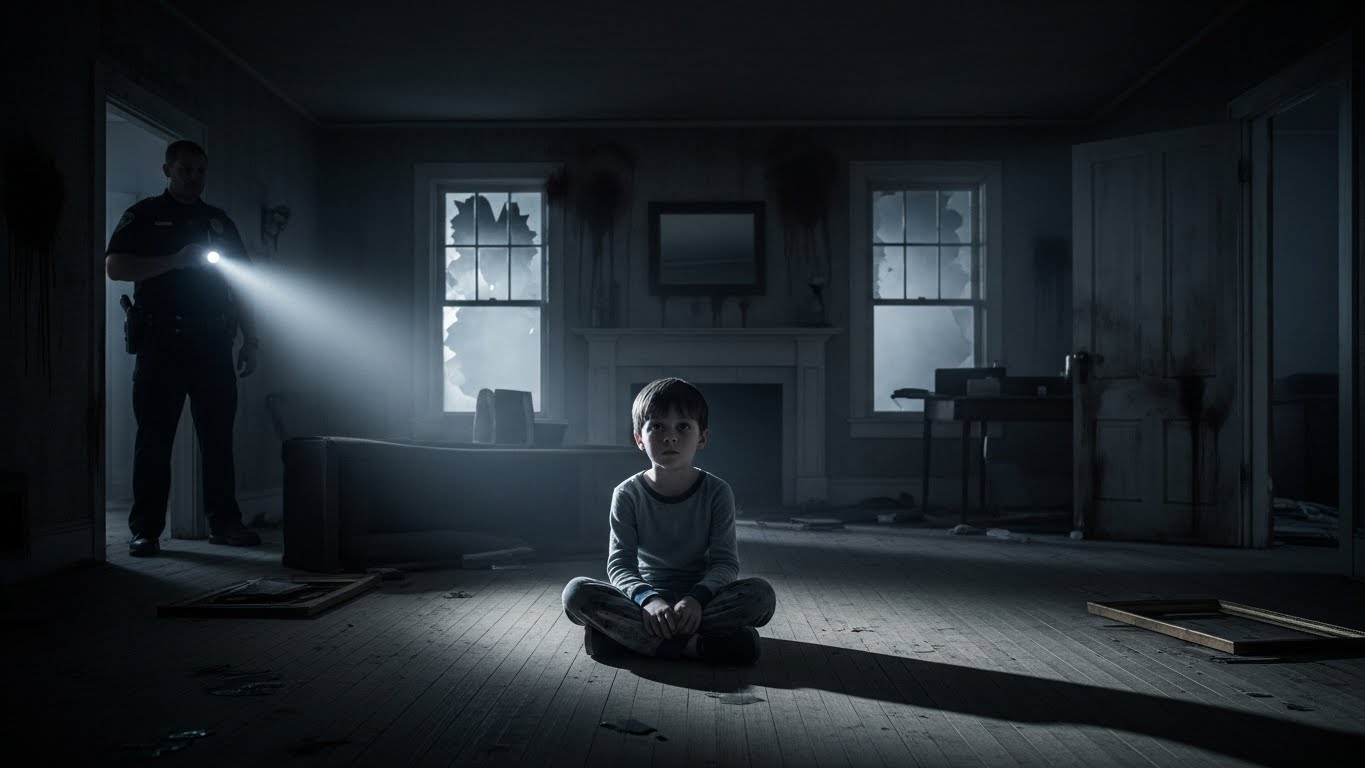
Sitting with his back pressed into the corner, knees pulled up to his chest, was the boy from the photos. He couldn’t have been more than four years old.
He was wearing blue pajamas with little rockets on them. But you could barely tell. He was drenched. Soaked from head to toe in blood that wasn’t his own. His blonde hair was matted with it, sticking to his forehead in dark, crusty spikes.
He didn’t look at me. He was staring at a spot on the floor, his eyes wide, unblinking, pupils blown so wide they swallowed the blue irises.
“Hey, buddy,” I said, my voice cracking. I holstered my weapon and knelt, ignoring the wet soaking into my uniform pants. “It’s okay. I’m a police officer. You’re safe now.”
He didn’t react. He didn’t flinch. He just let out that sound again—a low, rhythmic whimper that sounded more like a wounded animal than a human child.
“Is he hurt?” Miller called from the doorway, gun still raised.
“I don’t know,” I said, reaching out a hand. “Hey, what’s your name? Can you tell me your name?”
I touched his shoulder.
The boy’s head snapped toward me with a speed that made me recoil. He looked directly into my flashlight, blinding himself, but he didn’t blink.
Then, he opened his mouth.
I expected a scream. I expected a cry for his mother.
Instead, a voice that was too flat, too calm for a traumatized toddler, drifted out.
“They are in the walls.”
The temperature in the room seemed to drop ten degrees.
“What?” I whispered.
“The bad men,” the boy said, pointing a small, blood-stained finger at the pristine, white ceiling above us. “They didn’t leave. They are in the walls. And they are watching you.”
At that exact moment, the floorboards directly above my head—in the attic—creaked. A heavy, deliberate footstep.
We weren’t alone.
The boy started to cry then. Not a relief cry. A mournful, high-pitched wail of pure despair. The sound of someone who knows that help has arrived too late.
“Miller!” I screamed, grabbing the boy and pulling him into my chest. “Attic!”
But as I looked up, I saw something that froze the blood in my veins.
On the ceiling, directly above where the boy had been sitting, a fresh stain was spreading. Wet. Red. Expanding rapidly.
Drip.
A single drop of blood fell, landing squarely on the back of my hand.
CHAPTER 3: THE CEILING BLEEDS
I stared at the drop of blood on my hand. It was warm. Warmer than the air in the freezing room. It sat on my skin like a heavy, accusatory ruby, trembling slightly as my hand began to shake.
“Miller,” I rasped, my voice barely working. “Above us.”
Miller looked up. His beam cut through the gloom and hit the ceiling. The stain was no longer just a spot; it was growing, spreading like a dark cancer across the white plaster. It was soaking through from the attic floorboards, pooling, and then dripping again.
Plip.
Another drop hit the carpet inches from the boy’s foot.
“Grab the kid,” Miller hissed. The authority in his voice was brittle, cracking at the edges. “Get him to the cruiser. Lock the doors. Call for backup until someone answers.”
“What about you?” I asked, holstering my weapon to scoop the boy up. He was surprisingly light, his body rigid, his skin fever-hot beneath the layer of cold, drying blood.
“I’m going to check the attic access,” Miller said, backing out of the room, his eyes never leaving the ceiling. “We can’t leave whoever did this behind us. If they have a way down…”
“Miller, don’t,” I said. The boy’s head was resting on my shoulder now. He smelled of iron and old pennies. “Let’s just wait for SWAT.”
“Go!” Miller roared, spinning toward the hallway. “That’s an order, rookie!”
I didn’t argue. Fear is a powerful motivator, and right then, I wanted nothing more than to be out of that house. I turned and ran, clutching the boy to my chest. I took the stairs two at a time, nearly slipping on the wet floorboards. The house seemed to groan around us, the wind outside howling like a chorus of damned souls.
I burst out the front door and into the storm. The rain felt cleansing for a second, washing the metallic stench from my nose, but the cold was biting. I wrenched the back door of the Crown Victoria open and placed the boy inside.
“Stay here,” I told him, breathless. “Keep your head down.”
I slammed the door and ran to the driver’s side to grab the radio mic.
“Dispatch! Officer down! 4402 Blackwood! We need immediate assistance! Suspects potentially on scene!”
Static. Just white noise and the crackle of the lightning storm.
I looked back at the house. The second-story window—the nursery window—was dark. But in the hallway window, I saw the beam of Miller’s flashlight. It was jerking erratically.
Then, I heard it.
Even over the thunder, even through the rain, the sound was unmistakable.
BOOM. BOOM. BOOM.
Three shots from Miller’s .45 service weapon.
Then a scream. It wasn’t a scream of pain. It was a scream of sheer, unadulterated terror. The kind of sound a man makes when his mind snaps before his body does.
Then, silence.
I stood there in the rain, the radio mic slipping from my hand. My training screamed at me to wait for backup. My gut screamed at me to drive away and never look back.
But Miller was my partner.
I looked into the back seat. The boy was sitting up, pressing his face against the glass. He wasn’t looking at me. He was looking past me, up at the attic window of the house. He raised one hand and waved.
A slow, stiff wave.
I turned around.
In the attic window, illuminated by a flash of lightning, a silhouette was standing there. It wasn’t Miller. It was too tall. Too thin. And it seemed to be wearing something on its head.
Something that looked like a pair of antlers, or maybe twisted branches.
I drew my gun. “Miller!” I screamed, sprinting back toward the porch.
I kicked the front door open again, the wood splintering. The house was quieter now. The creaking had stopped. The wind seemed to hold its breath.
“Miller!”
Nothing.
I moved to the stairs. My boots squelched on the wet floor. I kept my gun trained on the landing.
“Miller, sound off!”
I reached the top of the stairs. The nursery door was still open. But the hallway ceiling hatch—the pull-down ladder to the attic—was down. It swung gently, creaking a rhythmic, rusty tune.
Creak… Creak…
Miller’s heavy Maglite was lying on the floor at the base of the ladder. It was still on, the beam pointing directly into the dark, square maw of the attic.
I picked up the light. My hand was trembling so hard the beam shook like a strobe.
I had to go up.
I put my foot on the first rung.
CHAPTER 4: THE NEST
The air grew hotter as I climbed. It shouldn’t have been hot; it was November in Ohio. But the heat radiating from the attic was humid, thick, and smelled of rotting meat and ammonia. It was the smell of a cage that hadn’t been cleaned in years.
I raised my head above the floor level, sweeping the flashlight and my weapon in a wide arc.
“Police! Show me your hands!”
The attic was vast, running the full length of the house. Pink fiberglass insulation was torn up and piled in strange mounds, like nests. Old furniture was draped in white sheets that looked like ghosts in the flashlight beam.
“Miller?”
I saw a boot.
It was sticking out from behind a stack of old trunks in the far corner.
I scrambled up the last few rungs and moved toward the boot, keeping my back to a support beam. “Miller? You okay?”
I rounded the trunks.
Miller was there. He was sitting on the floor, his back against the chimney brick. His gun was in his lap. He was alive, but he wasn’t moving. He was staring straight ahead, his mouth hanging open in a silent rictus of shock.
“Miller,” I whispered, reaching out to check his pulse.
He flinched violently, swatting my hand away. “Don’t,” he croaked. “Don’t touch me.”
“Where is he? Where’s the shooter?”
Miller slowly raised a shaking finger and pointed toward the far end of the attic, where the roof sloped down to meet the floor.
“They aren’t shooters,” Miller whispered. “They’re… livestock.”
I shined my light where he pointed.
At first, I couldn’t understand what I was seeing. It looked like a wall of wet leather hanging from the rafters.
I took a step closer. The beam focused.
It wasn’t leather.
It was the parents.
They had been stripped. Not just of their clothes, but of their skin. They were hung upside down from the heavy oak beams, suspended by bailing wire wrapped around their ankles. Their muscle tissue glistened in the harsh light, dark red and raw.
But they weren’t dead.
The father’s chest was heaving. Shallow, ragged breaths. His eyes—lidless and staring—swiveled toward the light.
I retched, stumbling back, my mind refusing to process the geometry of the violence. The precision. It wasn’t frenzy; it was surgical.
“Oh god,” I choked out. “Oh god.”
“Look at the walls,” Miller said. His voice was devoid of emotion now. He had checked out. He was gone. “Look at the insulation.”
I swung the light to the side, toward the eaves of the house.
The insulation had been tunneled through. There were paths. Burrowed holes that ran deep into the crawlspaces, behind the drywall, down into the spaces between the studs of the rooms below.
The boy was right. They were in the walls.
And then I saw it.
Sitting in the shadows near one of the tunnels, crouched like a gargoyle, was a figure.
It was naked, its skin pale as moonlight, covered in filth and dried blood. It was emaciated, ribs poking through skin so tight it looked ready to tear. But the face…
It was wearing the face of the mother.
The skin had been removed from the woman hanging behind me and draped over this creature’s head like a crude mask. The long blonde hair was matted and tangled with the creature’s own stringy, dark hair.
It didn’t move. It just watched me through the eyeholes of the mother’s face.
“Put your hands up!” I screamed, my voice cracking into a high-pitched squeal. “Do it now!”
The creature tilted its head. It didn’t speak. It made a sound. A clicking sound, like a tongue snapping against the roof of a mouth.
Click. Click. Click.
From the tunnels in the insulation—from the left, from the right, from behind me—echoes answered.
Click. Click.
There wasn’t just one.
“Miller, we have to move,” I said, grabbing his collar. “Miller!”
“They’ve been here a long time,” Miller whispered, staring at the creature wearing the mask. “They’ve been watching them sleep for months.”
The creature in the mask shifted. Its muscles coiled. It held something in its hand. A long, rusted bone saw.
“Run,” Miller said softly.
Then the flashlights went out. Not mine. Not Miller’s. But the ambient light from the streetlamp outside that had been filtering through the attic window.
Something had blocked the window from the outside.
We were in the dark with them.
PART 2 (Continued)
CHAPTER 3 & 4 (Recap): We found the parents skinned alive in the attic. A creature wearing the mother’s face was watching us. The lights went out.
CHAPTER 5: THE FLICKER OF DEATH
darkness is a heavy thing. In that attic, it had weight. It pressed against my eyeballs, stinging them with the sweat and rain that dripped from my forehead. The only light came from the erratic, dancing beam of my flashlight, which was shaking so violently in my hand it looked like a disco strobe in a nightmare.
“Miller?” I whispered. The silence that followed was heavy, wet, and punctuated by that clicking sound. Click. Click. It was coming from everywhere now. From the rafters above, from the insulation piles to my left, from the dark tunnel directly in front of us.
Then, a muzzle flash lit up the room like a bolt of lightning.
BANG.
Miller fired. In that split second of blinding white light, I saw them.
They weren’t just in the corners. The attic was full of them.
There must have been a dozen. Pale, emaciated figures crouched on the beams, clinging to the walls like geckos. Their limbs were too long, their joints swollen and knobby. They were naked, their skin the color of curdled milk, slick with grime and fluids. And all of them were staring at us with wide, black, reflective eyes.
BANG. BANG.
Miller fired again. “Get back!” he screamed, his voice shredding the humid air. “Get down the ladder! Go!”
I scrambled backward, my boots slipping on the fiberglass insulation. I swung my flashlight toward Miller.
The creature wearing the mother’s face had lunged. It moved with unnatural speed, a blur of pale limbs. It collided with Miller, knocking him back against the brick chimney. The bone saw in its hand flashed in my beam.
“No!” I yelled, raising my weapon. But I couldn’t shoot. Miller was grappling with it, struggling to keep the saw from his throat. The mask—the mother’s skin—flapped loosely as the creature snarled, revealing rows of needle-like, filed teeth.
Then, the others descended.
They dropped from the rafters like heavy fruit. Thud. Thud. Thud. They swarmed over Miller, burying him under a pile of writhing, pale limbs.
I heard bones snap. I heard the wet tear of fabric and flesh.
“Run, kid!” Miller choked out from beneath the pile. It was a gurgle, wet with blood. “Seal it!”
I didn’t think. Instinct took the wheel. I threw myself toward the square hole in the floor. I grabbed the sides of the ladder and practically vaulted down, ignoring the rungs.
My feet hit the hallway floor hard, sending a shockwave of pain up my shins. I collapsed, my gun skittering across the wood.
Above me, the attic opening was a square of chaotic noise. Screams. Snarls. The wet tearing sound of a feeding frenzy.
And then, a face appeared in the opening.
It wasn’t Miller.
It was the creature with the mask. It looked down at me, the mother’s dead blue eyes hanging askew over its own black voids. Blood—fresh, bright arterial blood—dripped from its chin.
It reached a long, spindly hand down toward the ladder.
I lunged for the pull cord. I grabbed the bottom of the folding stairs and shoved upward with every ounce of adrenaline-fueled strength I possessed. The springs groaned, protesting.
The creature hissed, slashing at the air inches from my face.
I slammed the hatch shut. The latch clicked.
For a second, there was silence.
Then, a heavy thud from above. Then another. They were jumping on the hatch. The wood bowed. Dust rained down on my face.
Scratch. Scratch. Scratch.
They were clawing at the wood. But then, the sound changed. It wasn’t just on the hatch.
I heard scuttling inside the wall next to my head.
Thump-scurry-thump.
They weren’t trying to break through the hatch. They were going back into the tunnels. They were coming down inside the walls.
I scrambled to my feet, retrieving my gun. My hands were slick with sweat and grime. I looked down the hallway toward the nursery. The darkness seemed to be stretching, reaching for me.
I had to get to the car. I had to get the boy.
I turned and sprinted for the stairs, the sound of movement in the walls racing me down.
CHAPTER 6: THE GLASS CAGE
I hit the bottom of the stairs so hard I nearly went through the dry rot of the entryway floor. The house was alive. The walls were vibrating. It felt like the very structure of the building was digesting me.
I burst out the front door, slipping on the rain-slicked porch and tumbling down the steps into the mud. The cold rain was a shock, but it didn’t wash away the terror. It just made it sharper.
I scrambled up, mud coating my uniform, and ran for the Crown Victoria. The headlights were still on, cutting two yellow cones through the deluge. The engine was idling.
Thank God Miller hadn’t turned it off.
I ripped the back door open.
“We’re leaving!” I shouted, diving into the front seat.
I looked in the rearview mirror. The boy was exactly where I had left him. He was sitting perfectly still, hands folded in his lap, staring out the back window at the house.
He didn’t look scared anymore. He looked… expectant.
“Buckle up,” I stammered, throwing the car into reverse. The tires spun in the gravel, spraying mud, before catching traction. We lurched backward.
I spun the wheel, shifting into drive, desperate to put distance between us and that house of horrors.
But as the headlights swept across the front yard, I slammed on the brakes.
They were there.
Standing in the tall, dead grass at the edge of the driveway. Five of them. They were motionless, standing tall and pale against the dark backdrop of the cornfields. The rain plastered their stringy hair to their skulls. They weren’t attacking. They were blocking the exit.
“Move!” I screamed, hitting the horn. The blare was deafening in the enclosed cabin, but they didn’t flinch.
I revved the engine. I was going to run them over. I didn’t care.
But then, a heavy weight landed on the roof of the car.
CRUNCH.
The metal buckled inward directly above my head. The boy in the back seat let out a small, soft giggle.
I looked back at him, horrified. “What is funny? What is wrong with you?”
“They like the car,” the boy whispered. “It’s warm.”
Another thud on the trunk. Then the hood.
A creature crawled over the windshield. It was on all fours, its face pressed against the glass inches from mine. It didn’t have a mask. Its face was a landscape of scars and pale, translucent skin. It opened its mouth and licked the glass, leaving a trail of thick, yellow saliva.
I fumbled for the radio mic. “Dispatch! 4-Alpha! Surrounded! Requesting immediate backup! Shots fired! Officer down!”
Static. Then, a voice cut through. But it wasn’t dispatch.
It was a garbled, distorted mimicry of Miller’s voice.
“Run… rookie… run…”
I dropped the mic. It wasn’t coming from the radio. It was coming from the creature on the hood. It was mimicking him.
I grabbed my service weapon and aimed it at the windshield. “Get off!”
The glass beside my head shattered.
A hand—long, cold, and strong as steel—punched through the driver’s side window. It grabbed me by the throat, fingers digging into my windpipe, cutting off my air.
The glass shards rained down into my lap. The rain blew in, freezing and wet.
I gagged, clawing at the hand. It smelled of earth and old blood.
Another hand punched through the rear window, right next to the boy.
I tried to turn, to shoot, but my vision was spotting. The pressure on my throat was immense.
“Don’t hurt him!” I tried to wheeze, pointing the gun backward.
But the hand didn’t grab the boy.
It gently stroked his hair.
The boy leaned into the touch, closing his eyes.
“They’re my family now,” the boy said softly.
The creature on the hood raised a fist, ready to smash the windshield in completely. I was pinned. Choking. Watching the monster prepare to drag me out into the dark.
I realized then that this wasn’t a robbery. It wasn’t a murder. It was a recruitment.
And I was the offering.
My finger tightened on the trigger. I didn’t have a shot at the creature choking me. I didn’t have a shot at the ones outside.
I had one bullet left in the chamber.
And as the windshield gave way with a sickening crunch, I had to make a choice.
CHAPTER 7: THE CRASH
My vision was tunneling, fading to black at the edges. The creature’s grip on my throat was like a steel vise. I could feel the cartilage in my windpipe shifting, ready to snap.
On the hood, the other monster raised both fists, a hammer blow preparing to crush my skull.
I looked at the gun in my hand. One bullet.
I looked at the boy in the rearview mirror. He was smiling. A small, serene smile as the creature’s hand stroked his hair through the broken back window.
I couldn’t save him. He didn’t want to be saved.
I made my choice.
I didn’t shoot the monster. I didn’t shoot the boy.
I dropped the gun into my lap and slammed my right foot onto the gas pedal, flooring it until it hit the metal floorboard.
The Crown Victoria’s V8 engine roared—a mechanical scream that drowned out the storm. The rear tires spun, finding purchase in the mud and gravel.
The car launched forward like a missile.
The sudden acceleration threw the creature on the hood off balance. It screeched—a sound like tearing metal—and tumbled backward, its claws raking deep grooves into the roof as it was flung into the dark.
The one choking me held on.
We hit the blockade of creatures standing in the driveway.
THUD. THUD.
It felt like hitting sandbags filled with cement. The car shuddered violently, windshield spider-webbing further, but we punched through.
I couldn’t steer. The creature’s arm was still through the window, crushing my throat. I clawed at its face, my thumb gouging into one of its wet, lidless eyes.
It shrieked, the sound vibrating in my very bones, and finally, the grip loosened.
But I had lost control of the car.
We were doing sixty miles an hour down a gravel driveway in a thunderstorm. The car fishtailed, sliding sideways into the muddy cornfield.
“Hold on!” I rasped, though I knew the boy wouldn’t listen.
The world spun.
The front tires caught a ditch. The nose of the cruiser dipped, dug into the earth, and the back end flipped up.
Gravity reversed. Glass exploded. Metal screamed.
We rolled. Once. Twice.
I felt a sharp snap in my shoulder. My head slammed against the steering wheel.
Then, everything went quiet.
CHAPTER 8: THE BOY IN THE WALLS
I woke up to the taste of copper.
I was upside down. The seatbelt was digging into my chest, holding me suspended in the crushed cabin of the cruiser. The rain was dripping in through the shattered windows, pooling on the ceiling which was now the floor.
My head was pounding with a rhythm that matched the hazard lights blinking on the dashboard. Click-flash. Click-flash.
“Miller?” I groaned, my voice a broken whisper.
Then I remembered. Miller was gone.
I fumbled for the buckle release. It clicked, and I fell hard onto the roof of the car, groaning as pain shot through my dislocated shoulder.
I crawled toward the back window.
“Hey? Kid?”
The back seat was empty.
The boy was gone.
I kicked the crumpled rear door open and pulled myself out into the mud. The storm was breaking. The rain had slowed to a drizzle, and the moon was trying to push through the clouds.
I scanned the cornfield. The stalks were broken and trampled, creating a path leading away from the crash.
Leading back toward the house.
I drew my backup piece—a small .38 from my ankle holster—and limped toward the edge of the corn.
“Police!” I yelled, though it sounded pathetic in the vast, open night.
Then I saw them.
About fifty yards away, moving through the corn like a pack of wolves, were the silhouettes. There were dozens of them now. They moved on all fours, silent and fluid.
In the center of the pack, walking upright, was the boy.
He was holding the hand of the tall creature—the one wearing the mask of his mother.
He didn’t look back. He didn’t stumble. He walked with them as if he belonged to the darkness. As if the house, the walls, and the tunnels were his true inheritance.
I raised my gun. I had a clear shot at the creature.
But I lowered it.
What was the point? There were too many. And the boy… the boy was leading them.
I watched until they disappeared into the tree line behind the farmhouse.
The sirens started then.
Distant at first, then louder. State Troopers. Paramedics. The cavalry arriving an hour too late.
I sat down in the mud, the adrenaline finally draining away, leaving me shaking and cold.
The official report said it was a home invasion robbery gone wrong. They said a gang of meth addicts from across the state line had broken in, killed the parents, and kidnapped the child. They said Miller died a hero in a shootout, taking two of them with him, though they never found the bodies of the suspects.
They said the trauma of the crash made me hallucinate the details. “Stress-induced psychosis,” the department shrink called it.
I didn’t argue. I signed the papers. I took the medical discharge. I handed in my badge and my gun.
I never told them about the skin suits. I never told them about the tunnels in the insulation. And I never told them that the “kidnapped” boy wasn’t a victim.
But I know the truth.
Sometimes, late at night, when the house settles and the floorboards creak, I freeze. I hold my breath and I listen.
I listen for the scratching. I listen for the soft, wet clicking of a tongue against the roof of a mouth.
I live in a city now. A high-rise apartment made of concrete and steel. No attic. No crawlspace.
But I still keep the lights on. Every single one.
Because I know they are out there. And somewhere, in the dark corners of America, that little boy is all grown up now.
And he has a very large, very hungry family to feed.
[END OF STORY]