HE NEVER HIT ME. HE JUST MADE ME HOLD THE BOOKS UNTIL I BROKE.
Chapter 1: The Sound of the Garage Door
The rumble of the automatic garage door was the loudest sound in the world. It was a low-frequency vibration that started in the floorboards and traveled straight up through the soles of my sneakers, lodging itself like a cold stone in the pit of my stomach.
It was 5:45 PM on a Tuesday in manicured suburbia. From the outside, our house on Elm Street was a postcard of the American Dream. It was a two-story Colonial with white shutters, freshly cut fescue grass that smelled of fertilizer and rain, a white weeping willow in the front yard, and a silver Honda Odyssey gleaming in the driveway. We were the family on the Christmas card that you envied. The ones with the matching sweaters.
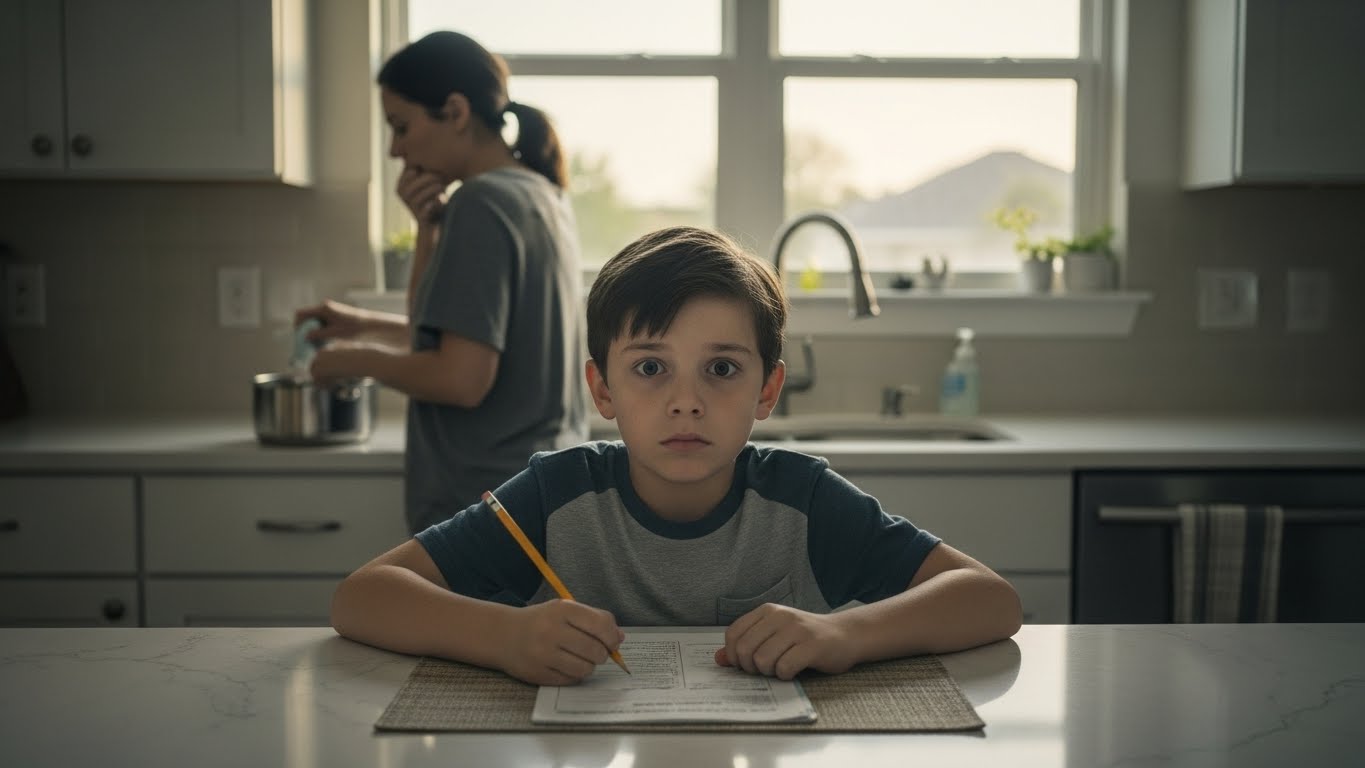
But inside, at the granite kitchen island that cost more than my first car would eventually cost, I was ten years old, and my heart was beating so hard I could see the fabric of my polo shirt vibrating against my chest.
“Leo,” my mom whispered. She was standing by the sink, aggressively scrubbing a pot that was already clean. Her back was to me, but I knew her face. I knew the tightness around her eyes, the way her jaw set when that garage door opened. Her knuckles were white, gripping the sponge like a lifeline. “Is it done?”
I looked down at the worksheet. Advanced Placement Math for Gifted Youth.
I wasn’t gifted. I was just terrified. The numbers swam on the page like drowning ants. Fractions. Decimals. They blurred into a meaningless soup of black ink. My pencil was a slippery twig in my sweating fingers.
“I can’t figure out number seven,” I murmured, my voice cracking. I sounded younger than ten. I sounded like a baby. And babies were weak.
Mom stopped scrubbing. The water ran, drowning out the sound of the garage door finally hitting the concrete with a heavy thud. That thud was the gavel coming down. The trial had begun.
“Put it away,” she hissed, panic flashing in her eyes as she spun around. She wiped her wet hands on her apron, leaving dark streaks. “Just… hide it under your placemat. We’ll do it after he goes to sleep. I’ll wake you up at midnight. We’ll do it then.”
“Sarah!”
The voice boomed from the mudroom. It wasn’t angry. That was the worst part. If he had come in screaming, stumbling drunk, maybe I could have hated him properly. Maybe I could have categorized him as a monster. But his voice was cheerful. It was warm. It was the voice of Mark Distinct, the town’s beloved architect, the man who coached Little League and donated heavily to the local food bank.
“I’m home, honey. Hope the troops are ready for inspection.”
He walked into the kitchen, bringing with him the scent of the crisp autumn air, mixed with expensive cologne—Santal 33 and cedarwood. He looked like a king returning to his castle. He kissed Mom on the cheek. She flinched, just a millimeter, a tiny microscopic contraction of her neck muscles. But I saw it. I always saw it.
Then, he turned to me.
He didn’t look at my face. He didn’t look at my eyes to see if I was happy. He looked at the table. He looked at the eraser shavings scattered like grey snow around my worksheet. He looked at the way my hands were trying to cover the paper.
“Homework time?” he asked, smiling. It was a wide, toothy smile. A shark’s smile. “Let’s see what we conquered today, Leo.”
I tried to keep my arm over the paper, a futile, childish attempt at defense. His hand—large, manicured, heavy as a brick—gently moved my wrist aside. His skin was cold from the outside air.
He looked at Question Seven. The blank space. The eraser burn where the paper had worn thin because I’d tried and failed ten times.
The smile vanished. It didn’t fade; it was deleted. The temperature in the room seemed to drop ten degrees instantly. The air conditioner hummed, but the chill was coming from him.
“I thought we discussed effort, Leo,” he said softly. His voice was a calm, smooth baritone. It was the voice he used to explain structural integrity to clients. “Did we not discuss effort last night?”
“I tried, Dad,” I whispered, staring at his polished loafers. “I just… I forgot the formula.”
“You forgot,” he repeated. He tasted the word like spoiled milk. “Architects don’t forget formulas, Leo. If I forget a formula, a building collapses. People die. Do you want to be the kind of man who lets the building collapse?”
“No, sir.”
“Then we need to reinforce the foundation.”
Chapter 2: The Invisible Lesson
People think abuse is always a closed fist. They think it’s a black eye you have to explain away in gym class, or a split lip that bleeds onto your pillowcase. Movies teach us that bad fathers yell and throw beer bottles.
But my father was an architect. He was a man of precision. He knew that if you want to destroy a structure, you don’t smash the windows where the neighbors can see; you compromise the foundation. You do it from the inside, applying stress to the load-bearing walls until the whole thing implodes on itself.
“Get in the position,” he said.
“Mark, please,” Mom started, her voice trembling. She turned off the faucet. The silence that followed was deafening. “It’s just fractions. He’s ten. He’s tired.”
“It’s not about fractions, Sarah. Don’t coddle him.” Mark didn’t even look at her. He kept his eyes on me, pinning me to the chair. “It’s about discipline. It’s about mental fortitude. It’s about not being a failure in a world that eats failures alive. Do you want him to be soft? Do you want him to work at a gas station?”
He pointed to the spot. “The position. Now.”
I slid off the high stool. My knees were already shaking before my feet hit the floor. I walked to the wall adjacent to the pantry. It was a carefully chosen spot—a blind spot from the living room window. If the neighbors, the Millers or the Robinsons, looked in, they’d just see a family standing in the kitchen. A father mentoring his son.
I put my back against the cream-colored wall and slid down. I bent my knees. I adjusted my feet. I slid down until my thighs were parallel to the floor.
The Wall Sit.
It looks so harmless. It looks like a gym exercise. But try doing it for twenty minutes while your father watches you, sipping wine.
“Hands out,” he commanded. “Palms up. Holding the weight of your incompetence.”
He walked over to the bookshelf in the living room. I heard him slide two heavy books off the shelf. He returned with the Encyclopedia Britannica, Volumes A and B. Thick, hardcover, heavy with knowledge I wasn’t smart enough to learn.
He placed one on my left palm, one on my right.
“Arms straight. Lock the elbows,” he corrected, tapping my elbow with his index finger. “Good.”
He checked his Rolex. It was gold and silver, catching the light from the chandelier. “Ten minutes,” he said. “If you drop them, or if your butt touches the floor, or if your hands dip below your shoulders… we start over at zero. And we add five minutes.”
He went back to the island, loosened his silk tie, and poured a glass of Pinot Noir. The liquid was dark red, swirling in the crystal glass. “So, Sarah, how was your day? Did you pick up the dry cleaning?”
My thighs began to burn within thirty seconds. It started as a dull ache, a tightness in the quadriceps. Then it grew hot. It felt like a hot wire was being tightened around my muscles, twisting, digging into the bone.
“Yes,” Mom whispered. She was chopping vegetables now, frantic, choppy motions. Chop. Chop. Chop. “I got your grey suit. And the shirts.”
“Good. Did they get the stain out of the collar?”
“Yes, Mark.”
“Excellent.” He took a sip of wine. He looked at me over the rim of the glass. Dead in the eyes.
I tried to focus on the pattern of the floor tiles. One, two, three… My arms were trembling now. The encyclopedias felt like lead bricks. My shoulders screamed. The burning in my legs turned into a vibrating agony. My body wanted to collapse. Every instinct screamed at me to stand up, to drop the books, to run.
“He’s shaking, Mark,” Mom said, her voice thick with unshed tears.
“He’s learning,” Dad said calmly. “Pain is just weakness leaving the body, Leo. You didn’t finish the problem because you are mentally weak. Your mind gave up before the math did. Now we are fixing the hardware.”
Two minutes in. The pain was blinding. It wasn’t just physical; it was the humiliation. I was a dog being trained. I was an object being tested for structural flaws. Tears leaked from my eyes, hot and silent, tracking through the sweat on my cheeks. I wasn’t allowed to make a sound. Silence is golden, he always said. Men suffer in silence.
“Don’t you dare drop those books,” he said casually, picking up his mail. “Mrs. Gable told me you were daydreaming in class today, too. Staring out the window. We have a lot of work to do tonight.”
I bit my lip so hard I tasted copper. Blood. The room swam. My legs were bouncing violently now, uncontrollable spasms. I wanted to scream. I wanted to die.
But I held them. I held them because the alternative—starting over—was a hell I couldn’t face.
I was the perfect son. I was the strongest boy on Elm Street. And I was breaking into a million invisible pieces right there in the kitchen, while my father read a bill from the electric company.
Chapter 3: The Crack in the Porcelain
The next morning, the world expected Leo Distinct to be normal.
I woke up when the sun hit my pillow, but my body refused to move. My quads felt like they had been shredded with broken glass. Walking down the stairs to breakfast was a calculated act of deception. I had to grip the banister, lowering myself step by step, hiding the wince that tried to escape with every movement.
“Good morning, champ,” Dad said. He was already at the table, reading the Wall Street Journal, eating a grapefruit. He looked fresh, rested, vibrant. The monster from last night was gone, replaced by the pillar of the community. “Big game today. You ready?”
It was Saturday. Soccer.
“Yes, sir,” I said, sliding into my chair. My arms were so sore I could barely lift the milk carton to pour it over my Cheerios.
“Eat up. We need energy. The Tigers are counting on you.”
We drove to the soccer fields in his pristine SUV. The town of Oak Creek was awake and bustling. Other fathers were driving their sons, talking about strategy, laughing. I sat in the passenger seat, staring at the window, praying that my legs would work.
The soccer field was a sea of green grass and colorful jerseys. Parents lined the sidelines in folding chairs, holding coffees from Starbucks. It was a perfect American Saturday.
“Go get ’em, Leo!” Dad slapped me on the shoulder—right on the sore deltoid where the encyclopedia had rested. I swallowed a gasp.
I jogged onto the field. My run was stiff, robotic.
“You okay, Leo?” asked Toby, my best friend. He was tying his cleats. “You’re walking like a zombie.”
“Just… slept wrong,” I lied. The lie came easy. It was my second language.
The game started. I was a midfielder. Usually, I was fast. I was good. Dad expected me to be the best, so I made sure I was. But today, my legs were empty. The “hardware fix” from last night had depleted the battery.
Ten minutes into the first half, the ball came soaring towards me. It was a perfect pass. All I had to do was trap it, turn, and sprint down the line.
I planted my left foot to pivot.
My leg gave out. It didn’t just slip; the muscle simply refused to hold my weight. It collapsed like a wet cardboard box. I crumbled to the grass, the ball rolling harmlessly past me to the opposing team.
The whistle blew.
“Leo!” Coach Miller yelled. “You alright?”
I scrambled to get up, panic flooding my chest. I looked toward the sideline. I looked for him.
Dad was standing near the center line, arms crossed. He wasn’t yelling. He wasn’t cheering. He was just watching. He wore sunglasses, so I couldn’t see his eyes, but I saw the set of his jaw. The disappointment radiating off him was hotter than the sun.
“I’m fine,” I gasped, forcing myself up. My legs trembled uncontrollably. “I tripped.”
” sub!” Coach Miller called out. “Leo, take a breather. You look pale.”
“No, Coach, I can play!” I pleaded. I couldn’t come off. Coming off meant failure. Failure meant the garage door closing tonight. Failure meant Volume C and D.
“Sit down, son,” Coach Miller said firmly.
I walked to the bench, head down. As I reached for my water bottle, a shadow fell over me. I flinched, expecting Dad.
But it was Mr. Sterling.
Mr. Sterling lived three houses down. He was a retired mechanic, a man with grease permanently etched into his fingerprints and a belly that spoke of too much beer and good living. He didn’t have a perfect lawn. He drove an old beat-up truck. My dad called him “unsightly.”
“Hey, kiddo,” Mr. Sterling said. He was holding a cooler. His voice was rough, like gravel, but his eyes were kind. Too kind. “That was a nasty fall. You hurt?”
“No,” I said quickly, screwing the cap off my water. “Just clumsy.”
Mr. Sterling didn’t walk away. He crouched down next to the bench, invading my personal space. He smelled of tobacco and peppermint. He looked at my legs. I was wearing shin guards and high socks, but my knees were bare.
“You’re shaking, Leo,” he observed quietly. “Like a leaf in a hurricane.”
“It’s cold,” I said. It was seventy degrees.
Mr. Sterling looked toward the sideline, where my father was now charming a group of soccer moms, laughing at something, showing off his perfect teeth. Then Mr. Sterling looked back at me. His gaze felt heavy, like he was reading a book I was trying to keep closed.
“Your dad runs a tight ship, huh?” he asked. It wasn’t really a question.
I froze. “What?”
“I see the lights on in your kitchen late at night,” Mr. Sterling murmured, looking at the grass. “Through the side window. When I’m walking the dog. I see you standing by that wall a lot, kid.”
My heart stopped. The world went silent.
“He’s helping me with my posture,” I said, reciting the script I had never written but always knew. “It’s for… spinal alignment.”
Mr. Sterling looked at me then. Really looked at me. And for the first time in my life, I saw something in an adult’s eyes that terrified me more than anger.
I saw pity. And behind the pity, I saw suspicion.
“Spinal alignment,” he repeated slowly. He reached out and patted my shoulder. His hand was rough, calloused, warm. “You know, Leo… if you ever need a break. Or just… to sit on a porch and not stand against a wall. My garage is always open. I got old comics in there.”
“Leo!” Dad’s voice cut through the air like a whip.
I jumped. Dad was waving me over. The game was halftime.
“Gotta go,” I whispered to Mr. Sterling.
I ran to my father. I ran on legs that were screaming, away from the man who offered me comics, and towards the man who offered me perfection.
“Who was that?” Dad asked as I approached, his hand resting possessively on the back of my neck. He squeezed. Just a little too hard.
“Mr. Sterling,” I said. “He asked about the game.”
“Stay away from him,” Dad said, his voice low, for my ears only. “He’s a loser, Leo. He has no ambition. You don’t associate with people who are content with mediocrity. Do you understand?”
“Yes, Dad.”
“And Leo?” He leaned down, bringing his face close to mine. “Stop limping. It looks pathetic.”
I straightened my spine. I locked my knees. I smiled.
“Yes, Dad.”
But as I walked back to the team, I could feel Mr. Sterling’s eyes on my back. A tiny crack had appeared in the porcelain perfection of my life. Someone had seen. And I didn’t know if that was going to save me, or if it was going to get us both killed.
Here is the response for Part 3.
———–POST TITLE————-
“PAIN IS JUST WEAKNESS LEAVING THE BODY,” HE SAID. BUT I WAS RUNNING OUT OF WEAKNESS.
—————FULL STORY—————-
(Continued from Chapter 3)
Chapter 4: Sanctuary in Grease
The following Tuesday, the inevitable happened. I got a B- on a History quiz.
It wasn’t a failure to anyone else. To Mrs. Gable, it was “a solid effort.” To me, looking at the red ink circling the grade, it was a death sentence. It was a warrant for my arrest.
I couldn’t go home. Not yet. The garage door wouldn’t open until 5:45 PM, but the dread was already closing my throat at 3:30.
I found myself walking slow—dragging my sneakers against the pavement to delay the arrival. Without realizing it, I stopped in front of Mr. Sterling’s house. His garage door was open. The smell of oil, sawdust, and old radio tunes drifted out. It smelled like chaos. It smelled safe.
“You gonna stare at my truck all day, or are you gonna help me hand me that wrench?”
Mr. Sterling was under the hood of a rusted ’69 Ford. I jumped, clutching my backpack straps.
“Sorry, I just…”
“Get in here,” he grunted, sliding out on a mechanic’s creeper. He wiped his hands on a rag that was black with grease. “You look like you saw a ghost. Or failed a math test.”
I flinched. “History,” I whispered.
Mr. Sterling laughed. It was a wheezy, genuine sound. “History. Who cares about dead guys? I failed History three times. Look at me. I’m happy as a clam.”
He walked over to a mini-fridge in the corner and tossed me a glass bottle of Coca-Cola. It was ice cold. “Drink. Sugar helps the brain.”
I sat on a stack of old tires. For twenty minutes, I wasn’t Leo Distinct, the Architect’s son. I was just a kid drinking a Coke in a messy garage. Mr. Sterling didn’t ask about my posture. He didn’t ask about my future. He talked about carburetors.
“You like comics, kid?” He gestured to a dusty box.
I hesitated. Dad didn’t allow comics. Trash literature for trash minds, he called them.
“Go ahead,” Sterling said. “Take one. X-Men. It’s about people who are different. Freaks. But they save the world anyway.”
I pulled out a tattered issue. The cover showed a man with metal claws. He looked angry, but strong. Not the fake, polished strength of my father. Real, messy strength.
“Can I… borrow this?” I asked, my heart pounding. This was rebellion. This was dangerous.
“Keep it,” Sterling said, winking. “Just don’t let the General see it. I know he hates anything that isn’t a blueprint.”
I hid the comic between my history textbook and my binder. I felt a surge of adrenaline. I had a secret. I had a piece of the outside world, right there in my bag.
Chapter 5: The Contraband
The high lasted exactly two hours.
Dinner was silent. The B- was burning a hole in my backpack in the mudroom, but I hadn’t confessed yet. I was delaying the inevitable.
“Leo, go get your bag,” Dad said, cutting his steak with surgical precision. “Let’s review the agenda.”
I froze. “Can I finish eating first?”
“Now, Leo.”
I went to the mudroom. My hands were shaking so bad I could barely unzip the bag. I pulled out the History quiz. I was prepared for the lecture. I was prepared for the Wall Sit.
But as I pulled the quiz out, the comic book—X-Men #143—slid out with it.
It hit the tile floor with a slap that sounded like a gunshot.
Time stopped. The colorful cover, with its bright yellow letters and angry mutants, looked violently out of place in our beige, sterile house.
Dad appeared in the doorway. He didn’t look at the quiz. He looked at the comic.
He walked over and picked it up with two fingers, as if it were a dead rat.
“What,” he said, his voice terrifyingly quiet, “is this?”
“Mr. Sterling gave it to me,” I stammered. “It’s just a story, Dad.”
“Mr. Sterling.” He said the name with pure venom. “The grease monkey. The man who lives in filth.” He looked at me, his eyes narrowing. “You went into his house?”
“Just the garage. For a second.”
Dad sighed. It was a long, disappointed exhale that deflated my entire soul. “I try so hard, Leo. I build the walls to keep you safe. To keep you pure. And you go and roll around in the mud with the pigs.”
He walked into the kitchen. He opened the drawer where we kept the matches for the fireplace.
“Dad, no,” I whispered.
He walked to the large stainless steel sink. He threw the comic in. He lit a match.
“Sarah, open a window,” he said calmly. “It’s going to smell.”
“Mark, please,” Mom begged from the table. She hadn’t moved. She never moved.
“He needs to learn, Sarah. Contamination spreads.”
I watched as the flames caught the cheap paper. Wolverine’s face curled and blackened. The bright colors turned to ash. The smell of burning paper filled the kitchen, choking me.
“You see, Leo?” Dad said, watching the fire die down. “Trash burns fast. Quality endures. You brought trash into my house. Now, we have to scrub the stain off you.”
Chapter 6: The Long Night
“There will be no wall sits tonight,” Dad announced.
For a second, relief flooded me. But it was premature. It was the relief of a prisoner being told the firing squad was cancelled, only to be led to the gallows.
“Wall sits are for building muscle,” Dad said, washing the ashes down the drain. “But this… this was a lapse in judgment. A lapse in vigilance. You let your guard down. You let the enemy in.”
He turned to me. “Soldiers who fall asleep on watch get their platoons killed. You need to learn how to stay awake. How to be alert.”
He pointed to the corner of the dining room. There was nothing there but the hardwood floor and the expensive wallpaper.
“Stand there,” he said. “Face the room. Do not lean against the wall. Do not sit. Do not close your eyes.”
“For how long?” I asked, my voice trembling.
Dad checked his watch. It was 8:00 PM.
“Until I wake up tomorrow morning,” he said. “I usually get up at 6:00. That’s ten hours. If I come down for a glass of water and you are sitting… if I find you sleeping on the floor… we start over the next night. Do you understand?”
“Ten hours?” Mom gasped. “Mark, he’s a child! He needs sleep!”
“He needs character!” Mark slammed his hand on the counter. It was the first time he’d raised his voice in months. We both jumped. “He is associating with losers! He is bringing garbage into this home! He is soft, Sarah! Soft! And I will harden him if it kills me!”
He turned off the kitchen lights.
“Goodnight, Leo. Stand guard. Protect this house from your own stupidity.”
They went upstairs. I heard their bedroom door close.
I stood in the dark.
The first hour was easy. I was fueled by fear and residual adrenaline. I replayed the burning comic in my head. I hated him. I hated him so much it felt like a physical object in my chest.
The second hour, my legs began to ache. Not the sharp burn of the wall sit, but a dull, throbbing heaviness. The silence of the house was oppressive. The refrigerator hummed. The house settled with creaks and groans that sounded like footsteps.
By the fourth hour—midnight—the hallucinations started. The shadows of the dining chairs began to look like crouching animals. The pattern on the rug seemed to move, swirling like snakes. My eyelids felt like they were made of lead. Every time I blinked, I had to fight to open them again.
My knees locked. My lower back screamed. I shifted my weight from foot to foot, a slow, rhythmic swaying just to keep the blood flowing.
Just sit down, a voice in my head whispered. He won’t know. You can hear him coming.
I slid down to a crouch for just a second. The relief was orgasmic.
Creak.
A floorboard upstairs.
I shot back up, heart hammering against my ribs. I stood rigid, terrified. Had he heard? Was he coming?
I waited ten minutes. Nothing.
But the fear had done its job. I couldn’t sit. He was everywhere. He was the ceiling. He was the floor. He was the air I breathed.
At 3:00 AM, I started crying. Silent, steady tears. I wasn’t crying because of the pain anymore. I was crying because I was lonely. I was ten years old, standing in the dark in my pajamas, guarding an empty room against invisible enemies, while the only person who had offered me a kindness—Mr. Sterling—was sleeping three houses away, thinking I was safe.
I realized then that Mr. Sterling was wrong. The X-Men weren’t real. Nobody was coming to save the mutants. The bad guys won because they made the rules.
At 5:58 AM, the sun began to bleed through the curtains. My legs were numb. I couldn’t feel my feet. I felt like I was floating, detached from my body.
At 6:00 AM exactly, I heard the alarm buzz upstairs.
At 6:05 AM, Dad walked down the stairs. He was wearing his silk robe. He looked fresh, rested.
He walked into the dining room. He turned on the light. I flinched, blinded.
He looked at me. I was swaying, pale as a ghost, eyes red-rimmed and hollow.
“Good morning, Leo,” he said cheerfully.
He didn’t say “good job.” He didn’t hug me.
He walked past me to the coffee maker.
“Since you’re up,” he said, “why don’t you get started on the dishes from last night? Mom forgot to load the dishwasher.”
I took a step and fell. My legs just didn’t work. I hit the floor hard.
“Careful,” Dad said, not turning around. “We don’t want to scratch the hardwood.”
Here is the final response for Part 4.
———–POST TITLE————-
THE DOCTOR SAID IT LOOKED LIKE I RAN A MARATHON. I HADN’T MOVED FROM THE DINING ROOM RUG.
—————FULL STORY—————-
(Continued from Chapter 6)
Chapter 7: The Structural Failure
The human body is an amazing machine, but even machines have a breaking point. Architects call it “catastrophic failure”—when the load exceeds the capacity of the material, and the collapse is sudden, violent, and total.
I went to school that Wednesday. I had to. A distinct never misses a day unless he is on a stretcher.
I walked through the hallways of Oak Creek Elementary like a ghost haunting his own life. My legs weren’t just tired; they felt liquefied. Every step sent a jolt of nausea rolling through my stomach. The voices of other kids were muffled, like I was hearing them from underwater.
Fourth period. Math.
Mrs. Gable was writing equations on the whiteboard. Solve for X.
I stared at the board. The white background became the white wall of my kitchen. The black numbers began to twist. The X turned into my father, standing with his arms crossed.
Stand up straight, Leo.
I blinked, trying to clear the hallucination. My heart was fluttering in my chest like a trapped bird—fast, erratic, terrifying. I tried to grip my pencil, but my fingers were numb.
“Leo?” Mrs. Gable’s voice. “Leo, are you with us? Question four.”
I tried to stand up to answer. That was the rule. You stand when spoken to.
I pushed my chair back. I put weight on my legs.
And then, the lights went out.
I didn’t just faint. My body seized. I hit the linoleum floor with a sound that stopped the entire class. I remember hearing a scream—maybe mine, maybe a girl in the front row. Then, the convulsions started. My muscles, pushed beyond endurance for months, were misfiring in a chaotic electric storm.
When I woke up, the world was white and smelled of rubbing alcohol.
Beep. Beep. Beep.
I was in a hospital bed. There were tubes in my arm.
“He’s awake,” a voice said.
I turned my head. It felt heavy as a bowling ball.
Standing at the foot of the bed was a doctor I didn’t know. He looked tired. Next to him was my mother, her face buried in her hands. And next to her… was Dad.
Dad looked annoyed. Not worried. Annoyed. He was checking his phone.
“Leo,” the doctor said gently. He stepped closer. “I’m Dr. Aris. Do you know where you are?”
“Hospital,” I croaked. My throat was sandpaper.
“Do you know why?”
I looked at Dad. His eyes flashed a warning. Silence is golden.
“I… I tripped?” I whispered.
“No, son,” Dr. Aris said. His voice was hard, tight. He picked up a clipboard. “You didn’t trip. You went into renal failure.”
He turned to my father. The polite veneer was gone.
“Mr. Distinct, you told the intake nurse your son is ‘active in sports.'”
“He plays soccer,” Dad said smoothly, pocketing his phone. “He pushes himself. He’s competitive. Like me.”
“Soccer doesn’t do this,” Dr. Aris said, slamming the clipboard down on the rolling table. “Leo has severe Rhabdomyolysis. His muscle tissue is breaking down and releasing toxins into his bloodstream. His CPK levels are through the roof. We usually only see this in marathon runners who collapse, or car crash victims.”
The doctor leaned in, getting right in my father’s face.
“Or torture victims.”
The word hung in the air. Torture.
“Watch your tone,” Dad said, his voice dropping to that dangerous, quiet register. “I am a respected member of this community. I am raising a strong son.”
“You are killing him,” Dr. Aris said. “His legs are destroying themselves from the inside out. There are no bruises, Mr. Distinct. But his body is screaming.”
The door opened.
Two police officers walked in. And behind them, looking small and terrified but determined, was Mr. Sterling.
“That’s him,” Mr. Sterling said, pointing a grease-stained finger at my father. “That’s the son of a b*tch who keeps that boy standing against the wall all night.”
Chapter 8: The Ruins
The collapse of the House of Distinct didn’t happen with a bang. It happened with a whimper.
Dad didn’t fight the police. He didn’t scream. He simply adjusted his cufflinks, looked at the officers with a sneer of superior disgust, and said, “This is a misunderstanding. I will be calling my lawyer. You people have no concept of discipline.”
He looked at me one last time as they led him out. He didn’t look sad. He looked disappointed. Like I was a building that had failed inspection.
“Weak,” he mouthed.
Then he was gone.
The silence in the hospital room was different than the silence in our kitchen. It wasn’t heavy. It was empty. It was the silence of a storm that had finally blown over.
Mom sat on the edge of the bed. She touched my hand. Her fingers were shaking, but for the first time, she didn’t pull away.
“I’m sorry, Leo,” she whispered. “I’m so sorry. I was so afraid of the noise. I was so afraid if I spoke up, he’d… he’d break us.”
“He did break us, Mom,” I said. My voice was small, but it was mine.
We didn’t go back to the house on Elm Street. Not really.
The investigation was swift. Mr. Sterling’s testimony, combined with the medical evidence of my shredded muscles, was enough. “Child Endangerment causing severe bodily harm.” It turns out, you don’t need a belt to go to prison. You just need to be a monster who knows how to hide the scars.
Dad lost his firm. He lost his reputation. The town of Oak Creek, which had worshipped his perfect smile, turned on him the moment the truth came out. The “Architect of the Year” was just a man who tortured his kid in a designer kitchen.
Six months later.
I was sitting on a porch. Not our porch. Mr. Sterling’s porch.
My legs were still weak. Physical therapy was hell. I had to learn how to walk without wincing, how to run without expecting pain. But I was getting there.
The sun was setting, casting long, orange shadows across the lawn. The grass here was overgrown. There were dandelions. It was imperfect. It was beautiful.
“Here,” Mr. Sterling said, walking out the screen door. He handed me a bottle of Coke and a comic book. X-Men #144.
“Thanks,” I said.
“Your mom’s inside,” he said, sitting in the rocking chair next to me. “She’s laughing at something on the TV. Haven’t heard that sound in a while.”
“Yeah.”
I opened the comic. The pages were crisp, colorful. A world where people were hurt, but they fought back.
“You know,” Sterling said, looking at the street where the flashing lights had taken my father away. “You’re gonna be alright, kid. You got a strong foundation.”
I looked down at my legs. They were scarred on the inside. I would always carry the memory of the burning, the shaking, the wall.
But I wasn’t standing against it anymore.
I leaned back in the chair. I let my spine curve. I slouched. I put my feet up on the railing, a posture that would have gotten me screamed at six months ago.
I took a sip of the cold soda.
“Yeah,” I said, watching the first star appear in the darkening sky. “I think I’m finally done with the inspection.”
I closed my eyes. And for the first time in ten years, the garage door opened in my mind, and I didn’t feel a thing.
(End of Story)