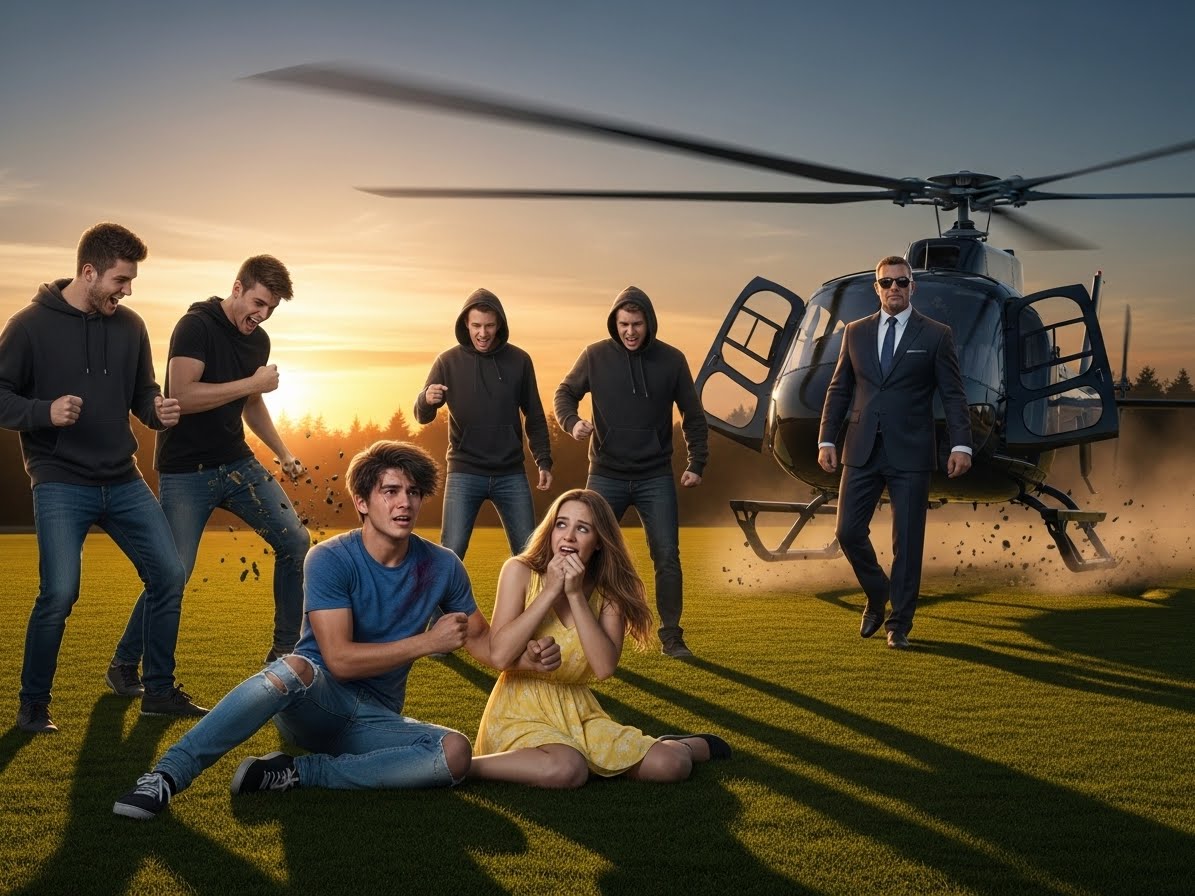
The Bully Broke My Spine to Get to Her. He Didn’t Know Her Billionaire Father Was Watching From a Black Hawk Helicopter.
Chapter 1: The Ghost in the Cafeteria
The cafeteria at Oak Creek High School didn’t smell like food. It smelled of anxiety, cheap body spray, and the distinct, metallic scent of social warfare. It was a kingdom divided not by stone walls, but by invisible, electrified lines of wealth and status.
I sat at the extreme edge of this jungle, my back pressed against the cold cinder block wall. I preferred the periphery. It was safer here. I took a bite of my homemade sandwich—peanut butter, no jelly, because jelly was a luxury we skipped this week—and scanned the room with the practiced caution of a soldier in enemy territory.
“Keep your head down, Mia,” my father had told me just that morning, wiping motor oil from his calloused hands onto a rag. “The nail that sticks out gets hammered down. We are there to learn, not to fight. The world doesn’t look kindly on folks like us making noise.”
I respected my father’s wisdom more than anything. He was a man of dignity who believed in the quiet power of endurance. He fixed the Mercedes and BMWs of the parents who sent their kids here, but he never looked them in the eye. He knew his place. And by extension, I knew mine.
So, I remained a ghost in the hallways. I maintained perfect grades and absolute silence. I was the girl you borrowed a pencil from and immediately forgot.
Until the double doors swung open.
A mechanical whir cut through the chatter, a sound distinct from the usual gossip. A new student entered. She was navigating a heavy, outdated electric wheelchair through the maze of crowded tables.
This was Sophie.
She looked small, swallowed whole by a faded gray, oversized hoodie that seemed two sizes too big. Her hair hung in a thick curtain around her face, shielding her from the prying eyes of the student body. The wheelchair squeaked rhythmically—squeak, whir, squeak—a rusted sound that betrayed its age and lack of maintenance.
Sophie clutched her lunch tray with white-knuckled intensity, her eyes fixed on a singular empty table in the far corner. To get there, she had to pass the “Golden Table.”
That was Brad Miller’s territory.
Brad sat there occupying the center of the room like a feudal lord. He wore his varsity jacket like a royal cape, the leather sleeves gleaming under the fluorescent lights. His father’s name was plastered on the scoreboard outside; therefore, Brad believed he owned the ground beneath the school.
He sat with his legs sprawled wide, blocking the aisle, laughing loudly at a joke one of his sycophants had just made. He took up space because he had never been told to make room for anyone else.
Sophie approached the blockage. She stopped the chair, the motor whining down to silence. She waited, head bowed, hoping Brad would notice her presence and retract his legs.
Brad saw her. He stopped laughing.
The air in the cafeteria seemed to drop ten degrees. He looked at the girl, then at her battered machine. A cruel, bored smirk twisted his lips. Instead of moving his legs, he extended his right foot further, positioning his heavy designer sneaker directly in the path of her wheel.
Sophie tried to maneuver around him. It was a tight squeeze.
Brad kicked.
It wasn’t an accident. It was a calculated, vicious strike against the wheel’s locking mechanism. The machine lurched violently to the left.
Gravity took over instantly. Sophie tumbled sideways, hitting the hard linoleum floor with a sickening thud that vibrated through the soles of my shoes across the room. Her lunch tray flew into the air. Spaghetti and red sauce rained down, splattering across her face, her gray hoodie, and the pristine white floor.
Silence slammed into the room.
For a heartbeat, the only sound was the hum of the overturned wheelchair’s motor, spinning its wheel uselessly in the air like a dying beetle.
Then, the laughter started.
It wasn’t a nervous chuckle. It was the barking, predatory laughter of a pack.
“Watch where you’re driving, cripple!” Brad sneered, wiping a speck of sauce from his jeans with exaggerated disgust. “You almost got my shoes dirty. Do you know how much these cost?”
Sophie lay amidst the wreckage of her lunch. She didn’t move to get up. She curled into a ball, trying to disappear into the floor, her shoulders shaking with silent, racking sobs. The students around her took out their phones, cameras flashing, capturing her humiliation for Snapchat and TikTok.
My grip tightened on my sandwich until the bread compressed into dough.
Don’t make waves, Mia. Don’t stick out.
My father’s voice echoed in my head. If I got involved, I became a target. If I became a target, I could lose my scholarship. If I lost my scholarship, my dad’s sacrifice meant nothing.
But then I saw Sophie try to wipe the sauce from her eyes with a trembling hand, and another voice screamed louder in my chest. It was the voice of my ancestors, a deep, resonant demand for dignity.
I stood up.
The scrape of my chair against the floor sounded like a gunshot in the sudden quiet. I walked through the sea of mocking faces. I didn’t run. I marched with a steady, terrifying calm.
I reached the center of the room. I ignored the phones pointed at my face. I ignored the whispers of “What is she doing?”
I knelt beside Sophie in the mess of pasta and milk.
“Hey,” I said. My voice was low, devoid of fear. “Take my hand.”
Sophie looked up, her eyes wide with shock and humiliation. She saw a hand extended towards her—steady, strong, grease-stained under the fingernails, and unhesitating.
Sophie reached out.
I grasped her hand and pulled. With strength built from years of helping my dad lift engine blocks, I hoisted the girl up and stabilized her. I didn’t stop there. I grabbed a stack of napkins from the nearest table and began to wipe the red sauce from Sophie’s shoulder. It was an intimate, motherly act of care in the middle of a public execution.
I righted the heavy wheelchair, checking the mechanism, and helped Sophie sit back down.
Only then did I turn to look at Brad.
The laughter in the room died down, replaced by a tense, suffocating awkwardness. Brad stood up, his height imposing, his chest puffed out. He wasn’t used to being ignored. He wasn’t used to defiance from the scholarship kids.
“You cleaning up the trash, Mia?” Brad asked, his voice dripping with venom. “That fits you. Once a janitor’s kid, always a janitor’s kid.”
I looked him dead in the eye. My expression remained stone cold. I didn’t scream. I didn’t curse. I simply stared at him with eyes that held a depth of maturity he could never comprehend. I looked at him not with fear, but with pity.
I turned my back on him—the ultimate insult to a narcissist. I placed my hand on the back of Sophie’s chair.
“Let’s go,” I said to Sophie.
Brad’s face flushed with rage. I heard him step forward, heard the intake of breath as he prepared to escalate. He hissed through his teeth, just loud enough for me to hear.
“You just made a big mistake, little mouse.”
I kept pushing her cart forward, unaware that my small act of kindness had just painted a deadly target on my back.
Chapter 2: The Urinal and the Mechanic
The gymnasium smelled of rubber soles and stale ambition. For Sophie, forty-five minutes of Physical Education was not a class; it was a sentence of solitary confinement.
While the other students ran laps and played volleyball, their sneakers screeching against the polished wood, Sophie was relegated to the bottom row of the bleachers. She sat there, a statue of exclusion, watching a world she was physically barred from entering.
I was on the volleyball court, spiking the ball with more aggression than necessary, pretending the ball was Brad’s face. When the whistle blew, signaling the end of the period, the students flooded toward the locker rooms like a tidal wave.
I hung back, collecting the stray balls, trying to stay useful to Coach Henderson so he wouldn’t mark me down for “attitude.”
When I finally headed toward the locker rooms, the gymnasium had emptied. The heavy double doors swung shut, leaving behind a hollow silence.
That’s when I saw her.
Sophie was on the floor.
She wasn’t in her chair. She was dragging her body across the court, inch by agonizing inch. Her useless legs trailed behind her like dead weight. The friction burned her elbows. The floor, which looked clean from a distance, was covered in dust and grit that stuck to her sweating palms.
It was a dehumanizing procession of one. She wasn’t a student anymore; she was an animal forcing itself forward. Tears blurred her vision, hot and stinging, but she refused to stop. To stop was to die of shame.
I dropped my gym bag. I didn’t run; I strode with a terrifying purpose.
I reached Sophie just as she collapsed, exhausted near the three-point line.
“Where is it?” I asked. My voice was not soft. It was the low rumble of a gathering storm.
Sophie didn’t look up. She couldn’t bear to be seen like this. She simply pointed toward the boys’ locker room door, which was propped open with a trash can.
“They took it,” she whispered, her voice cracking. “Brad… he said I was a fire hazard.”
I walked into the forbidden territory of the boys’ locker room. The smell of Axe body spray and sweat was overpowering. There, shoved into a urinal stall, was the wheelchair.
It was a deliberate, sanitary violation. They had jammed it in so hard the metal frame was bent against the porcelain.
I grabbed the handles and pulled it out. I noticed immediately that the brake lever was dangling loose. They hadn’t just moved it; they had sabotaged it. If she had tried to sit in it, it would have rolled away and dumped her again.
I wheeled the chair back to Sophie. I didn’t offer empty platitudes. I didn’t say, “It’s going to be okay.” Instead, I effortlessly lifted Sophie from the floor—my arms burning from the effort—and placed her back into the seat.
“Stay here,” I ordered.
I marched straight to the coach’s office. Coach Henderson sat behind his desk, feet up, eating a sandwich while reading a sports magazine. He looked up, annoyed at the interruption.
“Coach,” I said, my voice steady. “Brad’s girlfriend and her friends hid Sophie’s wheelchair in the boys’ urinal and broke the brakes. She had to crawl across the gym floor.”
Henderson chewed slowly. He swallowed, then wiped his mouth with the back of his hand. He didn’t look angry. He looked bored.
“Look, Mia,” he sighed, leaning back. “Kids play pranks. It’s high school. Don’t be so dramatic. I’m sure it was just a misunderstanding. The brakes on that thing are old anyway.”
“It wasn’t a prank. It was assault,” I stated, my fists clenching at my sides. “You have a duty of care—”
Henderson’s eyes narrowed. He dropped the magazine.
“You’re a scholarship kid, right, Mia? You got a good thing going here. Good grades. Don’t ruin it by being a troublemaker. Brad’s father just donated the new scoreboard. We don’t need assault accusations flying around over a broken toy.”
The threat was clear. Shut up, or lose your future.
I stood there, the bile rising in my throat. Every instinct in my body screamed to flip the desk, to scream about justice, to burn the whole corrupt system down. But then I thought of my father. I saw his grease-stained overalls. I saw the stack of unpaid bills on the kitchen counter. I saw the pride in his eyes when I got into this school.
Survival meant invisibility.
I swallowed the rage. It tasted like ash.
“Understood, Coach,” I said, my voice dead.
I turned and left the office. I found Sophie waiting in the hallway, looking at me with hopeful eyes, expecting justice. I didn’t have the heart to tell her that justice didn’t exist in this zip code.
I knelt beside the wheelchair. From my backpack, I pulled out a small multi-tool—a gift from my dad for my sixteenth birthday.
“The brake cable is snapped,” I said quietly, focusing on the metal. “But I can rig it.”
My hands moved with the dexterity of a surgeon. I stripped the wire, twisted the metal, and tightened the tension screw. It was the language I knew best: fixing broken things.
Sophie watched me, mesmerized. For the first time since arriving at Oak Creek, Sophie didn’t feel like a burden. She felt seen.
“You’re amazing,” she whispered. “Where did you learn that?”
“My dad,” I muttered, tightening the final screw. “He says if you can fix it, you own it. Nobody can take it away from you.”
I tested the brake. It clicked firmly into place. I stood up and looked at Sophie. There was no pity in my eyes, only a fierce, shared understanding of the battlefield we were on.
“It holds,” I said.
We walked to the next class together, a silent convoy. But neither of us knew that today’s silence was only the calm before a much bigger storm—one that would break loose tomorrow in History class.
Chapter 3: The Thief and the Tower
Mr. Sterling’s History classroom was a shrine to American ideals. Above the blackboard hung the Declaration of Independence, and the flag stood proudly in the corner. But on this Tuesday morning, the air in the room didn’t smell like freedom. It smelled of betrayal.
I sat with my hands clasped tightly on my desk. I was exhausted. For the past three nights, I hadn’t slept. I had poured my soul into the term paper on the 14th Amendment and the concept of equal protection. It wasn’t just homework to me; it was a personal manifesto. I had cross-referenced court cases, analyzed legal precedents, and polished every sentence until it shone. I needed this ‘A’ to maintain my scholarship.
Mr. Sterling, a man who wore bow ties to hide his lack of a spine, stood at the front of the room with a stack of graded papers.
“I must say,” Sterling began, his eyes scanning the room, “I was disappointed with the general effort of this class. However…” He paused for dramatic effect. “One student showed a remarkable grasp of constitutional law. Truly Ivy League material.”
My heart fluttered. I knew I had nailed it.
“Brad Miller,” Sterling announced, beaming. “Come get your paper. A perfect score.”
I froze. My blood turned to ice in my veins.
The room erupted in polite applause. Brad swaggered to the front, a smirk plastered on his face. He snatched the paper, holding it up like a trophy. As he walked past my desk, he winked. It was a slow, deliberate wink that sent a chill down my spine.
“And now,” Sterling’s voice dropped an octave, losing all warmth. “Mia Davis. Please step forward.”
I stood up, my legs feeling like lead. I approached the desk. Sterling didn’t hand me the paper. He threw it onto the desk surface. It slid toward me, stopping at the edge.
A giant red F was slashed across the front page, along with the word PLAGIARISM.
“I don’t tolerate cheaters in my classroom, Miss Davis,” Sterling said loud enough for the back row to hear.
“Excuse me?” I whispered, my voice trembling, not with fear, but with shock.
“Don’t play innocent,” Sterling sneered. “Your paper is word-for-word identical to Mr. Miller’s. Since he submitted his file to the server yesterday afternoon, and yours appeared two hours later, the conclusion is obvious. You copied him.”
“That’s impossible!” My voice rose. “I wrote every word of that! Check the metadata! Check my drafts! Brad must have accessed my account!”
It was the truth. Brad hadn’t written a word. He had simply paid a student aide in the admin office fifty bucks to pull my file from the shared drive and rename it. It was a crude, lazy theft characteristic of someone who had never worked for anything in his life.
“Mr. Miller is an honor student,” Sterling cut me off, his face hardening. “Why would he need to copy you?”
The question hung in the air, heavy with unspoken prejudice. Why would the rich golden boy steal from the poor mechanic’s daughter? The implication was clear: Brad was above suspicion. I was the desperate one.
“I can prove it,” I insisted, reaching for my bag. “I have my handwritten notes—”
“Enough!” Sterling slammed his hand on the desk. “I am not interested in your excuses. People like you…” He paused, letting the insult sink in. “People like you often look for shortcuts. You think the world owes you something. It doesn’t.”
People like you.
The phrase hit me like a physical slap. It wasn’t just about the paper anymore. It was about my station in life. It was a reminder that in this school, the truth was a commodity that could be bought and sold.
“You are receiving a zero for this assignment,” Sterling declared, finalizing the execution. “And you will report to detention this afternoon for academic dishonesty. If you argue, I will escalate this to the Expulsion Committee. Sit down.”
I stood there for a second, vibrating with the urge to scream. I looked at Brad. He was leaning back in his chair, checking his phone, bored with the destruction he had caused. He didn’t even care enough to watch. To him, destroying my grade was as casual as crushing a bug.
I turned and walked back to my seat. I didn’t cry. I wouldn’t give them the satisfaction. But inside, something fractured. The belief that hard work pays off died in that classroom.
That afternoon, the detention room was a gray, windowless box in the basement. It was the holding pen for the school’s “undesirables.” I walked in, tossing my bag onto a desk. I was seething, my mind plotting a dozen ways to prove my innocence, knowing none of them would work against Brad’s father’s money.
Then I saw I wasn’t alone.
In the corner, sitting quietly in her wheelchair, was Sophie.
I blinked. “Sophie? What are you doing here?”
Sophie looked up, her eyes red and puffy. She held a pink detention slip in her lap.
“I was in the hallway,” Sophie whispered, her voice trembling. “Brad was walking with his friends. He said I was blocking the traffic. He told the Vice Principal I was a fire hazard and that I refused to move.”
I stared at the girl. “And they gave you detention? For existing?”
Sophie nodded, tears spilling over again. “My dad… if he finds out I got detention, he’ll think I’m a failure. He hates failures.”
I pulled up a chair and sat next to her. The anger in my chest didn’t vanish, but it changed shape. It transformed from a hot, chaotic rage into a cold, steel resolve. They were both here: the mechanic’s daughter and the billionaire’s cast-off, punished for the crime of getting in Brad’s way.
“He won’t find out,” I said firmly. “And you’re not a failure, Sophie. The system is the failure.”
The detention ended as the sun began to dip below the horizon, painting the sky in bruises of purple and gray. I pushed Sophie’s wheelchair toward the bus stop. The school bus for the wealthy districts had long departed. We were left with the city bus, a rattling metal box that smelled of diesel and damp wool.
“Why do you stay here?” I asked gently as the bus lurched forward. “Your last name is Ashcroft. I saw it on the detention slip. As in Ashcroft Industries? Your father could buy this entire town. Why take the bus? Why live in the dorms?”
Sophie didn’t answer immediately. She traced a raindrop sliding down the glass with her finger.
“He can’t look at me,” Sophie whispered, her voice fragile as glass. “Five years ago, we were driving to the Hamptons. It was raining just like this. A truck skidded. My mom died instantly. I survived, but my legs didn’t.”
She turned to look at me, her eyes swimming in a pool of ancient grief.
“I look exactly like her. Every time my dad looks at me, he doesn’t see his daughter. He sees the accident. He sees the ghost of the woman he loved. So he sent me away. Out of sight, out of mind.”
I felt a lump in my throat. I had thought Sophie’s life was easy—a life of silk sheets and silver spoons. But I realized now that Sophie was poorer than I was. I had a father who hugged me every night despite the grease on his clothes. Sophie had a billionaire father who treated her like a broken antique locked away in an attic.
The bus dropped us off at the Oak Creek Dormitory. It was a bleak brick building on the edge of campus. Mrs. Gable, the dorm matron, sat behind the front desk. She was a sour-faced woman who wore oversized cardigans and looked at the students as if they were livestock she had to feed.
“You’re late,” Mrs. Gable snapped, not looking up from her magazine. “Dining hall is closed. No dinner for you, Sophie.”
“We had detention,” I said, stepping forward.
“I don’t care if you had a tea party with the Queen,” Gable sneered. She adjusted the heavy gold bracelet on her wrist. It glinted under the harsh lobby lights.
My eyes narrowed. I recognized that bracelet. It was a custom design—a delicate lattice of gold vines. I had seen a picture of it in a magazine on Sophie’s desk weeks ago, a catalog of things she wished she had.
We went up to Sophie’s room. If I expected luxury, I was wrong. The room was a cell—a single bed, a bare desk, and peeling wallpaper. It was devoid of personal touches. No photos, no trinkets, no warmth.
“It’s sparse,” I noted, trying to be polite.
“He never writes,” Sophie said, wheeling herself to the center of the room. She looked around helplessly. “Birthdays, Christmas, nothing. He pays the tuition, but that’s it. I guess he really does hate me.”
I walked over to the small trash bin in the hallway cleaning cart parked just outside the open door to throw away a tissue. Something caught my eye.
Resting on top of the trash pile was a torn cardboard box. The return label was unmistakable: Ashcroft Private Estate.
I picked up the box. It was empty. I looked back at Mrs. Gable’s office down the hall. I remembered the gold bracelet. I remembered the brand new designer handbag I had seen under Gable’s desk last week.
The realization hit me like a physical blow.
The father hadn’t forgotten. The letters, the gifts, the tokens of love—they had been arriving. And Mrs. Gable, seeing a vulnerable, disabled girl who thought she was unloved, had been intercepting them. She was stealing the gifts to sell or wear and trashing the letters to keep Sophie isolated and pliable.
“Sophie,” I said, my voice trembling with suppressed rage. “He didn’t forget you.”
Before I could explain, a thunderous CRASH shattered the moment.
A jagged rock sailed through the glass window, spraying shards across the room. The cold wind howled in immediately. Sophie screamed, covering her head.
I rushed to the window, crushing the glass under my boots. Outside, standing on the dark lawn under the street lamp, was Brad. He was flanked by his goons, laughing.
“Hey, orphan!” Brad yelled, his voice carrying over the wind. “Daddy didn’t want you, so why do you think we do? Do us a favor and roll yourself into traffic!”
Sophie began to sob, a deep, guttural sound of pure despair. “He’s right,” she choked out. “I’m garbage. Everyone knows it.”
I looked from the broken window to the sobbing girl. I looked at the stolen box in my hand. I thought of the corrupt teacher, the thief in the matron’s office, and the monster on the lawn.
The world was trying to crush this girl. The system was designed to break her.
I turned away from the window. I walked over to Sophie and knelt down, ignoring the glass shards digging into my knees. I took Sophie’s face in my hands, forcing the girl to look at me.
“Listen to me,” I commanded, my voice fierce and low. “Brad is a liar. And tomorrow, I swear to you, every one of them will pay for every tear you’ve shed.”
But I didn’t know that this promise would drag me into a bloody showdown on the field the next day—where courage would be measured in blood.
Chapter 4: The Shield and the Black Hawk
The sky over Oak Creek High turned the color of a fresh bruise. Heavy, swollen clouds hung low over the football field, threatening a storm that mirrored the tension on the ground below.
I pushed Sophie’s wheelchair along the dirt path behind the bleachers. It was a shortcut to the bus stop, a way to avoid the main exit where Brad usually held court. But today, the shortcut was a trap.
As we rounded the corner of the equipment shed, four figures stepped out from the shadows. They formed a wall of varsity jackets and arrogance. It was Brad, flanked by Kyle, Trent, and Jason—the defensive line of the football team.
They didn’t look like students anymore. In the dim light, they looked like predators who had finally cornered their prey.
“Going somewhere?” Brad asked. His voice was deceptively calm, but his eyes were manic. He slapped a baseball bat rhythmically against his palm. Thwack. Thwack.
I stopped the wheelchair. I felt Sophie tremble violently beneath my hands.
“Move, Brad,” I said, my voice steady despite the racing of my heart. “We don’t want trouble.”
“Trouble?” Brad laughed. A sharp bark that had no humor in it. “You are the trouble, Mia. You think because you fixed a brake line, you’re a hero? You think you can embarrass me in the cafeteria and walk away?”
He took a step forward. “And you?” He pointed the bat at Sophie. “You’re an eyesore. My dad pays for this field. He pays for the grass you’re rolling on. And I’m sick of looking at you.”
“Leave her alone!” I stepped in front of the wheelchair, shielding Sophie. “She did nothing to you!”
“She exists,” Brad spat. He nodded to his friends. “Tip it.”
Kyle and Trent lunged forward. They were fast and heavy. Before I could react, they grabbed the handles of the wheelchair.
“No!” I screamed, grabbing Kyle’s arm.
Jason, the linebacker, shoved me hard. I flew backward, landing in the dirt.
With a cruel heave, Kyle and Trent flipped the heavy electric wheelchair sideways.
Sophie screamed—a high, piercing sound of pure terror—as gravity took hold. She crashed into the muddy ground. The heavy metal frame of the chair scraped against her leg, pinning her down. Her face was pressed into the wet earth. She tried to crawl, to push herself up, but her paralyzed legs were dead weight in the mud. She looked like a broken doll discarded by a petulant child.
“Look at that!” Brad sneered, towering over her. “Crawling in the dirt right where you belong.”
Sophie sobbed, covering her head with her mud-caked hands. “Please… please stop…”
“I’m not done,” Brad growled.
He stepped back and adjusted his footing. He wore heavy Timberland boots. He looked at Sophie’s exposed face, defenseless and terrified. He pulled his leg back, preparing for a soccer-style kick directly to her head.
It wasn’t a bullying tactic anymore. It was an execution. It was a blow meant to shatter bone.
I saw the leg draw back. I saw the trajectory. I knew that kick could kill Sophie.
Time seemed to warp. I knew if I fought back, if I threw a punch, if I used the multi-tool in my pocket, I would be the “violent scholarship kid” who got expelled. I would lose my future.
So be it.
I didn’t attack. I didn’t block. I dove.
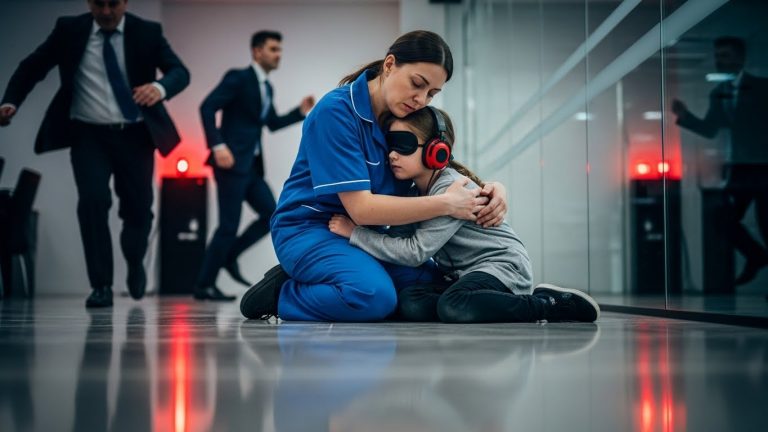
With the desperation of a mother saving a child, I launched myself through the air. I landed on top of Sophie, curling my body around the smaller girl, tucking Sophie’s head into my chest. I transformed myself into a human shield.
CRACK.
Brad’s boot didn’t hit Sophie’s face. It slammed into my ribs.
The air left my lungs in an agonizing whoosh. The pain was blinding, white-hot and instant. But I didn’t let go. I locked my fingers together, creating a cage of bone and flesh around Sophie.
“Get off her!” Brad screamed, enraged that his target was covered. “Kick her! Kick her until she moves!”
The boys descended. It became a frenzy of violence. Boots rained down on my back, my shoulders, my thighs. Each impact was a dull, sickening thud.
I squeezed my eyes shut. I gritted my teeth so hard I tasted copper.
One kick—my shoulder. Two kicks—my lower back. Three kicks—the back of my head.
“Don’t look, Sophie,” I whispered into Sophie’s ear, my voice strained with agony. “Just close your eyes. I’ve got you. I’ve got you.”
Blood began to flow from a cut on my forehead. It dripped down, mingling with the mud, staining Sophie’s white collar crimson. To Sophie, looking up from the mud, I wasn’t a high school student anymore. I was an angel of steel, absorbing the hate of the world so she wouldn’t have to.
The beating seemed to last for hours. My vision began to blur. The pain dulled into a distant, throbbing hum. I felt my consciousness slipping, sliding away into the dark.
But even as my mind faded, my muscles locked. My grip on Sophie didn’t loosen by a single millimeter.
Brad raised his foot for one final, crushing stomp on my spine.
“Stay down, trash,” he roared.
And then, the ground shook.
It started as a vibration in the mud, then a rhythmic thumping that drowned out Brad’s screaming. The wind picked up instantly, violently. It wasn’t a breeze; it was a gale force. Dust and debris swirled into a blinding vortex.
Brad froze, his foot hovering in the air. He looked up.
The clouds above the field had been torn apart. Descending from the gray sky was a shadow darker than night. A sleek, black helicopter—devoid of markings except for a gold insignia on the tail—plummeted toward the football field with terrifying speed.
It didn’t circle. It didn’t wait. It dropped like a stone, leveling out just twenty feet above the grass. The downdraft was immense. It flattened the grass. It slammed the bullies against the chain-link fence. Brad’s expensive baseball cap was ripped from his head and sucked into the chaos.
I lay still in the mud, barely conscious, my blood pooling around us. But my hand was still locked in Sophie’s.
The helicopter sat on the 50-yard line like a dark, prehistoric beast, its rotors slowly winding down but still slicing the air with a menacing whoosh-whoosh-whoosh.
The side door slid open.
Two men stepped out first. They were not police officers. They were not school security. They were giants in tactical suits, moving with the fluid, lethal grace of apex predators. They scanned the perimeter in a single second, their eyes locking onto the four boys by the fence.
Then, a third figure emerged.
He was a man of average height, but he commanded the space as if he were ten feet tall. He wore a charcoal gray bespoke suit that likely cost more than the teachers’ annual salaries combined. His hair was silver, swept back, and his face was a mask of granite.
This was Alexander Ashcroft.
Brad, trying to salvage a shred of his bravado, stepped forward, shielding his face from the wind. “Hey! You can’t land here! My dad—”
Ashcroft didn’t even blink. He didn’t look at Brad. To him, Brad was less than an insect. He was an obstacle to be stepped over.
Ashcroft walked straight through the group, his Italian leather shoes sinking into the bloody mud without hesitation. His focus was entirely on the mound of misery in the center of the field.
“Sophie!” Ashcroft’s voice cracked, losing its corporate polish.
Sophie looked up from the mud. Her face was streaked with dirt and tears. She was shaking uncontrollably, still pinned beneath the overturned wheelchair and my unconscious body.
“Daddy…” she choked out, her voice barely a whisper. “Daddy… she won’t wake up. Mia won’t wake up.”
Ashcroft dropped to his knees. The mud soaked instantly into his trousers, but he didn’t care. He reached out, his hands hovering over us. What he saw broke the heart of the man who was known on Wall Street as the “Iron Wolf.”
He saw his daughter, terrified but physically untouched. And covering her, like a shield of flesh and bone, was a girl he had never met.
I lay face down. My back was a tapestry of muddy footprints and bruising skin. Blood from the gash on my head matted my hair and dripped onto Sophie’s shoulder. Even in unconsciousness, my arm was locked tight around Sophie—a permanent embrace of protection.
Ashcroft realized with a sickening jolt that every kick, every stomp, every blow intended for his disabled daughter had been absorbed by this stranger.
Tears, hot and unbidden, spilled from Ashcroft’s eyes. He had spent his life accumulating power to protect his family. Yet, when the moment came, it was a mechanic’s daughter, with nothing to her name but courage, who had done the job.
“Get the medic!” Ashcroft roared over his shoulder, his voice raw.
He hastily stripped off his suit jacket, a garment of hand-stitched silk, and gently, reverently, draped it over my broken body. It was a gesture of supreme respect. He was covering a queen.
“I’ve got you,” Ashcroft whispered to Sophie, stroking her hair with trembling hands. “I’m here. I’m so sorry, baby. I’m so sorry.”
Behind him, the sound of violence erupted. Brad and his friends had tried to edge away, looking for an exit. They didn’t get far.
“Secure the hostiles,” the lead bodyguard said into his comms.
The security team moved. It wasn’t a fight. It was a cleanup operation. One guard grabbed Kyle by the back of his varsity jacket and slammed him face-first into the goalpost. Another swept Trent’s legs, sending him crashing into the mud.
Brad tried to run. “Do you know who my father is?!” he shrieked.
The lead bodyguard caught him. He didn’t punch Brad. He simply grabbed the boy’s throat and forced him down. Down into the mud. Down into the filth.
“Kneel,” the guard commanded. It wasn’t a suggestion.
He applied pressure until Brad’s knees hit the dirt with a bone-jarring thud. The guard held him there, face pressed into the earth, just inches from where Sophie had been lying.
“Don’t you dare look up.”
The scene was a tableau of reversed fortunes: the bullies on their knees, choking on mud, while the billionaire cradled the victims.
But Ashcroft wasn’t done. He looked at Brad, his eyes burning with a cold, terrifying fire. The hunt had just begun.
Chapter 5: The Pen and the Predator
Suddenly, the double doors of the school gymnasium burst open. Principal Skinner came sprinting out, his tie flapping over his shoulder, his face red with exertion and indignation. He had seen the helicopter land from his office window and had nearly had a stroke.
“What is the meaning of this?!” Skinner screamed as he ran onto the field. “This is private property! You are destroying the turf! I will have you arrested! I will sue you for every penny you have!”
Skinner skidded to a halt ten yards away, panting heavily. He pointed a shaking finger at the silver-haired man kneeling in the mud.
“You!” Skinner yelled. “Get that chopper off my field immediately! Do you have any idea who runs this town?”
“Mr. Smith will—”
Ashcroft stood up. He turned slowly to face the principal. He didn’t shout. He didn’t rage. He simply stared with eyes that looked like freezing water. The wind from the idling rotors whipped Skinner’s comb-over into a frenzy.
The principal’s eyes drifted past Ashcroft, landing on the side of the sleek black helicopter. There, emblazoned in gold leaf against the black metal, was a logo: a stylized ‘A’ intertwined with a globe.
Skinner’s breath hitched. His blood ran cold. He knew that logo.
It was on the bank statements the school received every month. It was on the header of the terrifying letters regarding the school district’s massive overdue loans. It was the logo of Ashcroft Capital, the holding company that owned the debt of the entire Oak Creek school district.
The principal’s face drained of all color. His legs nearly gave out. He wasn’t screaming at some trespassing parent. He was screaming at his own creditor—a man who could turn this entire school into a parking lot with a single phone call.
And worse, far worse, he had just realized that this man’s daughter was the one lying in the mud in the middle of his campus.
Principal Skinner’s office was designed to intimidate students. But right now, it felt like a bomb shelter waiting for impact. The air conditioning was humming loudly, yet sweat beaded visibly on Skinner’s forehead.
He sat behind his desk, wringing his hands, glancing nervously between the two powerful men occupying his visitor chairs.
On the left sat Alexander Ashcroft. He was still wearing his mud-stained dress shirt, having given his jacket to me. He sat with absolute stillness, his legs crossed, his face a mask of impenetrable granite. He hadn’t said a word since entering the room.
On the right was Gerald Smith, Brad’s father. He was a large man who wore his wealth like a blunt weapon. He was red-faced, pacing the small room, his voice booming off the walls. Standing by the door, arms crossed over his chest, was Sheriff Brody, a man whose badge served Mr. Smith more than the law.
“This is outrageous!” Smith bellowed, slamming his fist onto Skinner’s desk, making the nameplate jump. “You let a maniac loose in this school, Skinner! A violent, unstable, ghetto thug!” He pointed a thick finger at Ashcroft, though he didn’t dare look him in the eye. “And this man? He assaults my son’s friends with a private paramilitary force on school grounds! I want him in handcuffs, Brody!”
“Mr. Smith, please…” Skinner stammered. “The situation is—”
“The situation is clear!” Smith cut him off. “My son Brad called me. He was terrified. He said that girl, Mia, has been stalking him. She’s been threatening him for weeks because he’s successful. Today, she finally snapped. She ambushed him and his friends behind the bleachers. She had a weapon! My boy was just trying to defend himself!”
It was a lie so audacious, so completely detached from reality, that the room seemed to bend around it. Smith was constructing a narrative where the predator was the prey. He was banking on the oldest prejudice in the book: the scary, violent outsider attacking the innocent, golden-haired elite.
Sheriff Brody stepped forward, his boots heavy on the carpet. He nodded in agreement.
“We’ve had reports about that Davis girl’s family,” Brody lied smoothly. “Troublemakers. We found a multi-tool in her backpack. That’s a weapon in the eyes of the law. Assault with a deadly weapon on a minor. That’s five to ten years.”
Ashcroft remained silent. He watched them with the detached curiosity of a scientist observing rats in a maze.
Smith, emboldened by Ashcroft’s silence, leaned over the desk. “I want that girl expelled, Skinner. Immediately. And I want charges pressed. If her parents try to sue, we countersue. We bury them. They’re nobodies. Mechanics. They can’t afford a parking ticket, let alone a legal battle.”
“Actually,” Sheriff Brody interjected, a cruel smirk playing on his lips, “I’ve got a patrol car heading to the hospital right now. The parents are accomplices. If they don’t sign a waiver admitting their daughter’s guilt and agreeing to non-disclosure, I’ll have them arrested for child negligence and disorderly conduct. I’ll drag them out of that ICU in cuffs.”
Skinner gasped. “Sheriff, surely that’s excessive…”
“It’s justice!” Smith roared. He turned to Ashcroft, finally acknowledging him. “And you… I don’t know who you think you are, landing in a chopper on my field. But in this town, the name Smith means something. You’re lucky I don’t have you thrown in a cell for trespassing. Now take your crippled daughter and get out of my sight before I ruin you too.”
The silence that followed was heavy.
Slowly, methodically, Alexander Ashcroft uncrossed his legs. He leaned forward. The movement was slight, but it shifted the gravity of the room. He reached into the pocket of his mud-stained shirt. Smith flinched, perhaps expecting a weapon.
Ashcroft pulled out a sleek, silver fountain pen. He placed it gently on the center of Skinner’s desk. It made a soft clack against the wood.
“Are you done?” Ashcroft asked. His voice was soft, baritone, and terrifyingly calm.
Smith blinked. “Excuse me?”
“I asked if you were finished digging your grave,” Ashcroft said. He looked at the Sheriff, then at Smith.
“You see, five years ago, after my wife died, I became paranoid. I was terrified something would happen to Sophie that she couldn’t tell me about. So, I had her wheelchair custom-built by my defense contractors.”
Ashcroft tapped the silver pen.
“It has a GPS tracker,” Ashcroft continued. “And it has a high-fidelity omnidirectional microphone that activates whenever the chair is tipped more than 30 degrees. It records everything to a cloud server instantly.”
The color drained from Smith’s face. Sheriff Brody uncrossed his arms, his hand dropping nervously to his belt.
“That’s illegal wiretapping,” Smith stammered, but his voice lacked its previous fire.
“It’s a security feature on a medical device for a minor,” Ashcroft corrected him coldly. “Admissible in court. And I listened to the upload on my flight over here.”
Ashcroft pressed a button on the side of the pen. The room was suddenly filled with the high-quality audio of the event.
Brad’s voice, clear as a bell: “Tip it.” The sound of Sophie screaming. Brad’s voice again: “Kick her! Kick her until she moves!” The sickening thud of boots hitting flesh. My strained whisper: “Don’t look, Sophie. I’ve got you.”
Ashcroft let the recording play until the sound of the helicopter drowned out the screams. Then he clicked it off.
He stood up. He towered over the sitting principal and the shrinking billionaire.
“I am holding two recordings,” Ashcroft looked Smith dead in the eyes. “One is the one you just heard. The other is the sound of your son’s bones breaking if I don’t call off my security detail. Which one do you want the court to hear? Or would you prefer the sound of the truth?”
He picked up his pen, turned his back, and walked toward the door.
“You have one hour to call your lawyers. After that, the hunt begins.”
Chapter 6: The Check and the Spine
The Intensive Care Unit was a purgatory of white noise. The rhythmic beep… beep… of the cardiac monitor was the only thing confirming that I was still alive.
I lay in the center of the room, small and fragile amidst a forest of tubes and wires. My face, usually so stoic, was swollen and bruised—a map of the violence I had endured.
Mr. Ashcroft stood by the door. He felt like an intruder. For the first time in decades, he didn’t know what to do with his hands. He was a man who moved armies of lawyers and shifted global markets. Yet here, in front of a working-class family, he felt incredibly small.
Sitting by the bedside were my parents, Mr. and Mrs. Davis. They hadn’t changed clothes. My dad was still wearing his mechanic’s jumpsuit, the name “JOE” stitched in red over the pocket. His hands were stained with motor oil and grease—permanent tattoos of a life of hard labor. He held my limp hand with a tenderness that made Ashcroft’s chest ache. My mom sat with her head bowed, praying silently, her worn rosary clicking softly.
Ashcroft took a deep breath and stepped forward. He reached into his suit pocket and pulled out his checkbook. It was his reflex. When things broke, he bought new ones. When people were hurt, he paid them off. It was the only language he knew.
“Mr. Davis,” Ashcroft said softly.
The mechanic looked up. His eyes were red-rimmed but dry. They were eyes that had seen too much hardship to be easily intimidated.
“I cannot express…” Ashcroft started, his voice faltering. He cleared his throat and regained his composure. “I want to handle this. All of it. The medical bills, your lost wages, pain and suffering. I will set up a trust fund for Mia. She will never have to work a day in her life.”
Ashcroft uncapped his pen, ready to write a figure with six, maybe seven zeros. “Name your price, sir. Whatever you need.”
Mr. Davis stood up. He wasn’t a tall man, but in that moment, he seemed to fill the room. He looked at the checkbook in Ashcroft’s hand, then at Ashcroft’s face. There was no greed in his eyes. There was only a profound, weary sadness.
“Put that away,” Mr. Davis said. His voice was rough, like gravel.
“Please, I insist,” Ashcroft pressed, feeling desperate. “It’s the least I can do. She saved my daughter.”
“My daughter didn’t jump in front of those boots for a check,” Mr. Davis said firmly. He took a step closer to the billionaire. “She didn’t do it because she wanted your money. She didn’t do it because she wanted fame.”
Mr. Davis held up his grease-stained hands. “I teach my girl that you work for what you get. But I also teach her that when you see evil, you don’t look away. You stand in front of it, even if it hurts. Especially if it hurts.”
He looked back at me. “She did it because it was the right thing to do. That is who she is. And you cannot buy that, Mr. Ashcroft. You cannot write a check for integrity.”
Ashcroft stood frozen. The checkbook felt heavy and useless in his hand. He looked at this mechanic—a man who probably struggled to pay rent, who fixed other people’s cars to survive—and saw a dignity that no amount of wealth could purchase.
Ashcroft realized with a crushing clarity: I am a failure.
He had provided Sophie with the best doctors, the best schools, the best clothes. But he had left her alone. He had thrown money at her problems from a distance. Mr. Davis had given Mia nothing material, but he had given her a soul of steel and a heart of gold. He had given her presence.
“I…” Ashcroft stammered, capping the pen. He lowered his head. “I am ashamed. You are a better father than I could ever hope to be.”
It was a confession that stripped him bare.
Before Mr. Davis could respond, the sliding glass door opened. Dr. Aris, a grim-faced man with gray hair, entered the room holding a clipboard. He didn’t look at the men; he looked straight at the monitors.
“The CT scans are back,” Dr. Aris announced. The room temperature seemed to drop ten degrees.
“How is she?” my mom asked, clutching her rosary.
“She has severe swelling around the L4 and L5 vertebrae,” the doctor explained, pointing to the illuminated screen on the wall. “The trauma from the repeated impacts caused a compression fracture. We are doing everything we can to reduce the inflammation, but…” He paused, removing his glasses.
“But what?” Ashcroft demanded, his voice sharpening.
“There is a significant chance of permanent nerve damage,” Dr. Aris said quietly. “If the swelling doesn’t go down in the next twelve hours, or if the surgery is anything less than perfect… Mia may never walk again.”
My mom let out a choked sob and buried her face in my dad’s shoulder. My dad paled, his strong hands trembling as he gripped the bed rail. The girl who had saved the girl in the wheelchair was now facing the same fate. The cruelty of the irony was suffocating.
Ashcroft looked at my motionless legs. He thought of Sophie’s wheelchair. He thought of the debt he owed.
The sorrow in Ashcroft’s eyes hardened into a diamond-sharp resolve. He was done being the absent father. He was done being the man who just wrote checks. He was now the man who solved problems.
He pulled out his phone, not his checkbook.
“Doctor,” Ashcroft said, his voice commanding the room like a general. “Stabilize her. Do not touch her spine yet.”
“Excuse me?” Dr. Aris frowned. “I am the Head of Neurology here, and—”
“And you are excellent,” Ashcroft cut him off. “But I don’t want excellent. I want a miracle.”
Ashcroft dialed a number. He didn’t look at the contacts; he knew it by heart.
“Connect me to Zurich,” Ashcroft spoke into the phone. “Dr. Hans Weber. I don’t care if he’s sleeping. I don’t care if he’s in surgery. Wake him up. Tell him Alexander Ashcroft is calling in his marker. Tell him to fuel his jet. I need the best neurosurgeon in the world in this room in six hours.”
Ashcroft hung up the phone and turned to my parents, his eyes unwavering.
“I can’t buy your daughter a conscience,” he said. “But I can buy her back her legs. This fight isn’t over.”
But while I was fighting for my life, Mr. Ashcroft knew he had another battle—one that couldn’t wait. A purge was coming for the people who did this.
Chapter 7: The Ledger and the Betrayal
The emergency board meeting was convened at 8:00 PM. The air in the room was so thick with tension it felt solid.
Principal Skinner sat at the head of the long mahogany table, but he looked less like a leader and more like a man waiting for a guillotine blade to drop. Flanking him were Coach Henderson and Mr. Sterling, the history teacher. They wore cheap suits that fit poorly, fidgeting with their ties.
Opposite them sat Alexander Ashcroft. He had showered and changed into a fresh, crisp black suit. He looked immaculate, sterile, and utterly terrifying. Beside him sat Mr. Thorne, his lead counsel—a man with eyes like predatory flint and a briefcase that contained the ruin of everyone across the table.
Skinner cleared his throat, the sound weak and rattling. “Mr. Ashcroft, we appreciate you meeting with us. I’m sure we can come to a quiet…”
“Quiet?” Ashcroft said. He didn’t raise his voice. He simply dropped the word like a stone into a pond.
Ashcroft nodded to Thorne. The lawyer opened his briefcase and slid three thick folders across the polished wood. They spun perfectly, stopping directly in front of Skinner, Henderson, and Sterling.
“Gentlemen,” Thorne began, his voice smooth and dangerous. “You are laboring under the misconception that this is a negotiation. It is not. It is a notification of termination.”
“You can’t fire us!” Henderson blustered, his face turning blotchy red. “We have tenure! We have a union! Just because some rich guy is upset about a prank—”
“A prank?” Ashcroft interrupted. His eyes bored into the coach. “You allowed a disabled student to crawl fifty yards across a dirty floor while you ate a sandwich. You ignored a report of vandalism to a medical device.”
Ashcroft tapped the folder in front of Henderson. “Inside, you will find statements from three other students who witnessed you laughing when you heard about the wheelchair in the urinal. You will also find a copy of the school’s safety protocols, which you violated eighteen times in one hour.”
“That’s hearsay!” Henderson yelled.
“It’s on video,” Thorne corrected him, tapping a tablet screen. “The gym has security cameras. You thought they were off. They weren’t.”
Henderson slumped back in his chair, defeated.
Ashcroft turned his gaze to Mr. Sterling. The history teacher was trembling, his hands clasped tightly on the table to stop the shaking.
“And you,” Ashcroft said, his voice dripping with disdain. “The guardian of American values. The man who teaches the Constitution.”
“I grade fairly,” Sterling stammered. “Mia Davis plagiarized—”
“Stop lying,” Ashcroft cut him off. “My IT team performed a forensic analysis of the school’s server logs an hour ago. We traced the file access. At 4:15 PM on Monday, a user logged in from the admin terminal using a generic password. They accessed Mia’s folder, copied the file, and renamed it for Brad Miller.”
Sterling swallowed hard. “That doesn’t prove I knew.”
“No,” Ashcroft agreed. “But this does.”
Thorne slid a single sheet of paper forward. It was a bank statement.
“A deposit of $2,000 was made to your personal checking account on Tuesday morning,” Thorne read aloud. “From a shell company registered to Gerald Smith.”
Thorne leaned forward. “That’s the price of a young girl’s future, isn’t it, Mr. Sterling? Two thousand dollars.”
Sterling went pale. He looked like he was going to vomit. Bribing a teacher was a crime. He wasn’t just losing his job; he was facing jail time.
“This is a witch hunt!” Skinner squeaked, trying to regain control. “Mr. Ashcroft, you cannot simply come in here and dictate personnel changes! The school board—”
“The school board works for me now,” Ashcroft said coldly. He stood up and walked to the window, looking out at the dark campus. “As of 7:00 PM tonight, Ashcroft Capital has recalled the loans underwriting this district’s bond measures. We are foreclosing on the debt. Effectively, I own the lights, the desks, and the very chairs you are sitting in.”
Skinner gasped. The financial implications were catastrophic. The school would be bankrupt by morning.
“Furthermore,” Ashcroft continued, turning back to face them. “I have ordered a complete forensic audit of the school’s finances for the last ten years. Every penny. Every donation from Mr. Smith. Every disappearing grant.”
Skinner’s face turned the color of old milk. It was an open secret that the administration skimmed funds. An audit would send them all to federal prison.
“What do you want?” Skinner whispered.
“I want the cancer cut out,” Ashcroft said.
Thorne placed three pens on the table next to the folders. “These are letters of resignation,” Thorne explained. “Effective immediately. For Mr. Henderson and Mr. Sterling, it involves surrendering your teaching licenses permanently. For you, Principal Skinner, it is an early retirement due to health reasons.”
“And if we refuse?” Henderson asked weakly.
“Then I release the audit to the FBI and the videos to the press,” Ashcroft said. “You will not just be unemployed. You will be unemployable. You will be pariahs.”
The room was silent. The only sound was the hum of the air conditioner.
Sterling was the first to break. He grabbed the pen with a shaking hand and signed. He knew he had no choice. Henderson followed, cursing under his breath. Skinner looked at the papers. He looked at Ashcroft. He saw no mercy in the billionaire’s eyes. With a trembling hand, he signed away his career.
“Get out,” Ashcroft ordered. “You have ten minutes to clear your desks. Security will escort you off the premises.”
The three men stood up. They were ghosts of their former selves. They shuffled out of the room, stripped of their power, their arrogance crushed under the weight of their own corruption.
Ashcroft watched the door close. He didn’t smile. This was just hygiene. He had cleaned the wound, but the infection was still in the system.
Thorne put the signed papers into his briefcase. “That’s the small fry, Alexander. What about the big fish?”
Ashcroft walked back to the table. He picked up the file labeled GERALD SMITH / SMITH ENTERPRISES.
“Smith thinks he’s untouchable because he owns the local police and half the town council,” Ashcroft said, his voice dropping to a dangerous whisper. “He thinks money is a shield.”
Ashcroft opened the file. It was thick with financial reports, tax filings, and business contracts.
“He’s about to find out that there is always a bigger shark.”
Ashcroft snapped the file shut, the conference room lights catching a cold, lethal glint in his eyes. The pawns were gone. Now, it was time to bring down the King.
But Ashcroft had no idea that the enemy’s son, Brad, was already preparing to ignite the very bomb that would destroy his own family from the inside out.
The Smith mansion, usually a sanctuary of silence and expensive scotch, was in chaos. It was 10:00 PM, but the lights blazed in every room.
In the grand living room, Gerald Smith paced back and forth like a caged tiger. His tie was loosened, his face a map of purple rage. He held a phone to his ear, screaming at a business partner.
“You can’t pull the construction contract, Mike! We have a deal!” Smith roared. He listened for a moment, his eyes widening in disbelief. “What do you mean ‘toxic asset’? Ashcroft? Alexander Ashcroft called you personally?”
“Listen to me, Mike—Mike!”
He slammed the phone down onto the antique coffee table, cracking the screen. “Damn it!” Smith kicked the sofa.
Mrs. Smith sat in the corner, clutching a glass of wine. Her mascara was running. “Gerald, the neighbors are talking. The police cars at the school… it’s all over Facebook. They’re saying we’re bankrupt. Are we bankrupt?”
“Shut up, Linda!” Smith snapped. “I’m trying to think.”
Upstairs, Brad sat at the top of the marble staircase, hidden in the shadows of the landing. He was trembling. For the first time in his life, his father’s money couldn’t fix the mess he had made. He hugged his knees, waiting for his dad to come up and tell him it would be okay—that they would crush Ashcroft together.
But then, the phone rang again. Smith snatched it up.
“Yes?” Smith answered, his voice changing instantly to a smooth, desperate charm. “Ah, Mr. Henderson from the PR firm. Yes, I saw the news.”
Brad leaned forward, listening.
“Look, we need to spin this,” Smith said, lowering his voice. But in the echoing hall, Brad heard every word. “We need to distance the company from the incident. The stock dropped 15% in two hours.”
Smith paused, listening to the advice on the other end. Then he nodded.
“I agree,” Smith said coldly. “We paint Brad as the problem. He’s troubled. We’ll say he has a history of mental instability that we tried to treat privately. I’ll issue a statement apologizing for my son’s ‘uncontrollable outbursts.’ We’ll say I was unaware of his bullying because I was too busy serving the community.”
Brad’s breath hitched in his throat. His heart stopped.
“Yes,” Smith continued, unaware his son was listening. “I’ll commit him to a facility upstate tomorrow morning. Get him out of the public eye. We cut the limb to save the body. Right. I can’t let a stupid kid’s mistake destroy a thirty-year empire. He’s a liability.”
A liability.
The word echoed in Brad’s mind, louder than any scream. He wasn’t a son. He was an asset that had depreciated. His father didn’t love him. He only loved the reflection of himself he saw in Brad. And now that the reflection was cracked, he was throwing Brad into the trash.
Brad stood up. The fear that had paralyzed him all evening evaporated. In its place, a cold, dark hatred bloomed. It was the same hatred he used to inflict on Sophie. But now, it had a new target.
If I’m going down, Brad thought, I’m taking the Captain with the ship.
He turned and walked silently down the hallway to his father’s home office. The door was unlocked. Brad knew where the secrets were kept. He had seen his dad hide cash there a hundred times.
He walked to the heavy bookshelf and pulled the fake leather-bound copy of Moby Dick. The panel slid open, revealing a wall safe.
Brad knew the combination. His father was too arrogant to believe anyone would dare rob him. The heavy steel door swung open. Inside were stacks of cash, passports, and a thick black ledger.
Brad ignored the cash. He reached for the ledger. He knew what was in it. He had heard his dad bragging to his drunk friends about “cooking the books” and paying off the zoning commissioner. This book contained the details of every bribe, every tax evasion scheme, every illegal corner cut in the construction of the town’s public buildings.
Brad pulled out his smartphone. His hands were steady now.
He opened the ledger. He snapped a photo of the bribery log for the school stadium. Snap. He turned the page. Tax fraud for the last five years. Snap. He turned the page. Money laundering through shell companies. Snap.
He took twenty photos. The flash of the camera was the only light in the dark room.
Then he opened his email. He typed in the address he had seen on the business card Mr. Ashcroft’s lawyer had left on the news earlier.
Subject: The Smith Ledger Attachment: 20 Images Message: Here is the smoking gun. Bury him.
Brad’s thumb hovered over the SEND button. He could hear his father downstairs, still lying to the PR firm, planning Brad’s exile to a mental hospital.
“Goodbye, Dad,” Brad whispered.
He pressed SEND.
Brad shut the safe, placing the ledger back exactly where it belonged, as if nothing had ever happened. He returned to his room, lay on his bed, and waited. He knew that by tomorrow, the sirens would scream again. But this time, the handcuffs wouldn’t be for him alone.
The snake had bitten off its own tail just to drive its venom straight into the head.
Chapter 8: The Sky Above the Mud
The morning sun rose over Oak Creek, but for the Smith family, it was the beginning of a long, dark winter.
At 6:00 AM sharp, the heavy oak doors of the Smith mansion were not opened by a butler, but smashed open by a battering ram.
“FBI! SEARCH WARRANT!”
The shout echoed through the marble foyer, shattering the morning silence. Agents in windbreakers swarmed the house like ants. They didn’t care about the expensive rugs or the antique vases. They moved with the precision of a machine fueled by undeniable evidence.
Gerald Smith was dragged out of his master bedroom in silk pajamas, screaming about his rights. He looked pathetic. His hair was messy, his face pale and puffy without the armor of his expensive suits.
“You can’t do this!” Smith yelled as an agent pushed his head down to enter the squad car. “I built this town! I own this town!”
“Not anymore, Mr. Smith,” the agent replied, slamming the door. “We received the ledger. We have the bribery logs. We have the offshore accounts. It’s over.”
Inside the house, Mrs. Smith stood in the foyer, weeping hysterically as agents tagged her paintings and jewelry for seizure. The assets were frozen. The accounts were locked. The empire had evaporated overnight.
Brad stood at the top of the stairs, fully dressed. He watched his father being hauled away like common trash. He felt a strange, cold emptiness. He had pulled the trigger, and the bullet had hit its mark perfectly.
With the house being sealed as a crime scene, Brad grabbed his backpack and walked out the back door. He had nowhere else to go. So, out of sheer muscle memory, he walked to school.
By the time Brad arrived at Oak Creek High at 8:00 AM, the news had spread like wildfire. Every phone in the hallway was playing the footage of his father’s arrest. The headline “SMITH EMPIRE BUILT ON FRAUD” was burned into every screen.
Brad walked through the main doors. Usually, the hallway parted for him like the Red Sea. Usually, people lowered their eyes or shouted greetings, desperate for his acknowledgement.
Today, the hallway stopped.
Silence rippled outward from the entrance. Hundreds of eyes fixed on him. But there was no fear in them anymore. There was curiosity. There was judgment. And worst of all, there was amusement.
Brad kept his head high, trying to summon the ghost of his old arrogance. He looked for his crew. He saw Kyle and Trent by the lockers.
“Hey,” Brad said, walking toward them.
Kyle didn’t high-five him. He took a step back, looking at Brad as if he were contagious.
“Don’t come over here, man,” Kyle said loud enough for others to hear. “We don’t want to be involved with whatever your family is into.”
“Yeah,” Trent added, sneering. “My dad says your dad is a crook. You guys are finished.”
The betrayal was instant. The loyalty Brad thought he commanded was never loyalty. It was just rented fear. Now that the check had bounced, the rental was over.
“You cowards,” Brad hissed.
Before he could do anything, the main doors opened again. Two uniformed police officers entered, followed by the new Acting Principal. They walked straight toward Brad.
The hallway held its breath.
“Brad Miller?” one officer asked.
“Yeah?” Brad challenged, though his voice wavered.
“You are under arrest for aggravated assault and battery of a minor,” the officer stated, pulling out a pair of steel handcuffs. “Turn around and place your hands behind your back.”
Brad froze. He looked around. He expected someone to step in. He expected the system to protect him. But the system had changed owners.
The officer grabbed Brad’s wrist and twisted it behind his back. Click. Click. The sound was crisp and final.
As Brad was marched down the center of the hallway, a sound began. It started low, a single laugh. Then another. Then, a chant began to rise from the back of the crowd.
“Na na na na. Na na na na. Hey, hey, hey. Goodbye.”
It was the student body—the scholarship kids, the nerds, the band geeks, and even his former cheerleaders. They were taking out their phones, filming him just as he had filmed Sophie the day before.
“Smile for the camera, Brad!” someone shouted.
“Where’s your daddy now?” another voice jeered.
Brad hung his head. His face burned with a shame hotter than any fire. He wasn’t being led away like a King. He was being discarded like waste. He saw the spot on the floor where he had tripped Sophie. It was clean now.
The police car waited outside. As they shoved him into the backseat, Brad looked through the wire mesh. He saw the school fading into the distance. He realized with a terrifying certainty that he was completely and utterly alone.
The police car door slammed shut, locking Brad into a world of steel bars and cold law.
But while his empire of cruelty collapsed, a quiet miracle was unfolding ten miles away, in an operating room where a faint light of hope had begun to rise again.
The storm had passed. Outside the hospital window, the sky was a piercing, brilliant blue. The morning sun streamed through the blinds, painting stripes of gold across the sterile white sheets of my bed.
I floated in the space between dreams and reality. The rhythmic beeping of the monitor was slower now, steady and reassuring. The crushing weight on my back was gone, replaced by a dull, managed ache and the stiffness of a heavy brace.
I blinked. My eyelids felt like sandpaper. The light was bright, stinging my eyes.
“She’s waking up,” a soft voice whispered.
I forced my eyes open again. The room came into focus. It wasn’t the cramped, noisy ward I expected. It was a private suite filled with flowers—lilies, roses, orchids—enough to fill a garden.
But I didn’t look at the flowers. I looked at the girl sitting by my bedside.
It took me a moment to recognize her.
Sophie sat in a new, state-of-the-art titanium wheelchair that looked sleek and agile. Gone was the oversized gray hoodie that she used to hide inside. Sophie was wearing a bright yellow sundress that caught the morning light. Her hair, once a curtain to shield her from the world, was cut into a stylish shoulder-length bob that framed her face.
But the biggest change was in her eyes. The fear was gone. In its place was a quiet, glowing strength.
My throat was dry, tasting of cotton. I tried to speak, but it came out as a rasp.
“Sophie?”
Sophie leaned forward instantly, taking my hand. Her grip was firm. “I’m here, Mia. I’m right here.”
“Are you…” I swallowed, wincing at the dryness. “Did they hurt you?”
It was the first question. Not “Will I walk?”, not “Where am I?”, but “Are you safe?”
Sophie’s eyes filled with tears, but she didn’t let them fall. She smiled—a genuine, radiant smile that transformed her face.
“I’m fine, Mia. Not a scratch. Because of you. You saved me.”
From the shadows near the window, a figure stepped forward. Alexander Ashcroft looked different too. The granite mask was gone. He looked tired, older, but infinitely more human.
He walked to the foot of the bed, his hands clasped in front of him in a posture of humility.
“Mia,” Ashcroft said, his voice thick with emotion. “Dr. Weber flew in from Zurich. He performed a 12-hour surgery on your spine. He says the compression was severe, but the prognosis is good. With therapy, you will walk again. I will make sure you have the best therapists in the country.”
I nodded slowly, processing the news. I was alive. I wasn’t paralyzed.
“Mr. Davis and your mother are in the cafeteria getting coffee,” Ashcroft continued. “They haven’t left your side for three days. I sent them to get some rest.”
Ashcroft took a breath, composing himself. “Mia, I owe you a debt I can never repay. But I am going to try. I have set up a trust in your name. It covers your college tuition—any university you choose, anywhere in the world. It covers a new house for your parents. It ensures your father never has to work another day under a car hood unless he wants to.”
He paused, waiting for a reaction. To Ashcroft, this was the ultimate gesture. He was solving her life’s problems with the stroke of a pen.
I looked at the ceiling, then back at Ashcroft. I saw a man who was used to transacting in currency, who thought every problem had a price tag.
“I don’t want your money, Mr. Ashcroft,” I whispered.
Ashcroft blinked, confused. “Mia, please. It’s not charity. It’s a reward. It’s justice.”
“My dad pays the bills,” I said, my voice gaining a little strength. “We do fine. We don’t need a mansion.”
I turned my head to look at Sophie. I saw the hope in her friend’s eyes, but also the lingering shadow of loneliness that a new haircut couldn’t entirely hide.
“But I do want one thing,” I said.
Ashcroft stepped closer, eager. “Name it. Anything.”
I looked Ashcroft dead in the eye.
“Don’t send her back,” I said.
The room went silent.
“Excuse me?” Ashcroft asked.
“The dorm,” I clarified. “The letters you wrote that she never got. The birthdays she spent alone. The money you sent that couldn’t hug her when she cried.”
I took a breath, fighting the pain in my ribs.
“You think you’re protecting her by hiding her away? You’re not. You’re just hiding yourself. She doesn’t need a trust fund, Mr. Ashcroft. She needs her dad.”
I squeezed Sophie’s hand. “Take her home,” I commanded softly. “Let her live with you. Eat dinner with her. Ask her about her day. Be her father, not her banker. That is my price.”
Ashcroft stared at the girl in the bed. He felt stripped bare. This teenager, broken and bandaged, had just diagnosed the sickness in his soul with surgical precision. She was rejecting millions of dollars to ask for something that cost him nothing but his time and his heart.
He looked at Sophie. He really looked at her. He saw his wife’s eyes. He saw the years he had wasted mourning the dead while neglecting the living.
Ashcroft’s composure cracked. A single tear traced a path down his cheek. He walked around the bed and knelt beside Sophie’s wheelchair. He took his daughter’s hand, pressing it to his forehead.
“I won’t send her back,” Ashcroft whispered, his voice trembling. “I promise. We are going home, Sophie. To the big house. We’ll open the curtains. We’ll fill it with life again.”
Sophie threw her arms around her father’s neck, sobbing into his shoulder. It was the embrace she had waited five years for.
I watched them, a small, tired smile playing on my lips. The pain in my back was still there, but in my heart, I felt a profound, settling peace. This was the victory. Not the surgery, not the expulsion of the bullies, but this. The family was whole again.
But social justice was far from delivered. When Mr. Ashcroft rose to his feet, wiping away his tears and turning toward me, something shifted in his eyes. The softness of a father vanished, replaced by the cold focus of a shark about to hunt.
“You healed our family, Mia. Now, let me clean up the rest of this world for you. Brad’s hearing is next week. And I want you there to witness his end.”
One year later, the sun over the Oak Creek High football field was blindingly bright, a stark contrast to the gray concrete of Brad’s cell, where he was currently serving his sentence.
The stands were packed with families, balloons, and banners. But today, the field wasn’t a place of violence. It was a stage for triumph.
“And now,” the principal announced into the microphone, “our Valedictorian. A student who has taught us that true strength is not in the muscles, but in the spirit… Mia Davis.”
A hush fell over the crowd. Then, a thunderous applause began, starting from the front row and rolling back like a wave.
I rose from my seat. I held a cane—a sleek, black walking stick. My steps were slow and measured. The doctors had said I might never walk, but I had spent twelve months in grueling physical therapy proving them wrong. Every step was a battle won. Every step was a defiance of the odds.
I walked to the podium. I didn’t look like a victim. I stood tall in my graduation gown, my back fused with titanium, but my head held high with dignity.
“They told us high school is about survival,” I spoke, my voice clear and strong. “But I learned it’s about who you are standing next to when the storm hits.”
I looked down at the front row. Sophie was there, sitting in her wheelchair, holding a plaque that read The Sophie Ashcroft Resilience Award. Sophie beamed, her face glowing with health and happiness, waving furiously at her best friend.
But my eyes drifted past Sophie, past the teachers, to two people sitting in the folding chairs.
Mr. Joe Davis sat upright in his best Sunday suit—a suit that was ten years old and slightly tight at the shoulders. His hands, still rough and scarred from years of fixing engines, were clasped tightly together. Beside him, Mrs. Davis wiped her eyes with a tissue, trembling with emotion.
They didn’t have a building named after them. They didn’t have millions in the bank. But as Mr. Davis looked at his daughter—the girl who had saved a life, broken her back, and risen again to lead her class—he wept openly. It was the tears of a man who knew he had succeeded in the only job that truly mattered: raising a good human being.
I smiled at my father.
The applause washed over us, cleansing the past, sealing a future where justice had been served, and kindness had finally, unequivocally, won.
The engines of the private jet hummed with a quiet, powerful promise. On the tarmac, the heat shimmered, but the air felt crisp and clean. It was a perfect day for flying.
I stood at the foot of the airstairs, leaning lightly on my black cane. I wore a simple university sweatshirt: HARVARD CRIMSON.
Beside me, Sophie was already halfway up the stairs, laughing as she waved to the pilots. The heavy electric wheelchair of the past was gone, replaced by a lightweight, travel-friendly model stored in the cargo hold.
Alexander Ashcroft stood in front of me. The wind tugged at his coat, but he stood rooted like an old oak tree. He wasn’t looking at his phone or checking the time. He was looking at the young woman who had rewritten his family’s history.
“Your tuition is paid in full,” Ashcroft said, his voice thick with emotion. “The apartment in Cambridge is ready. Mrs. Gable… well, let’s just say she won’t be managing any dormitories ever again.”
I smiled. “Thank you, Mr. Ashcroft. For everything.”
Ashcroft shook his head slowly. He reached out and took my hand—the hand that had once held Sophie’s in the mud.
“No, Mia. Don’t thank me,” he said, his eyes glistening. “You saved my daughter’s life on that football field. But you did something else, something harder.”
He squeezed my hand. “You saved me from being a terrible father. You taught me that my job wasn’t to build a fortune for Sophie, but to build a home for her. You saved my soul, kid.”
I squeezed back. “Take care of the Center, Mr. Ashcroft.”
“I will,” he promised. “It will stand forever.”
I turned and climbed the stairs. I stepped into the cabin. The door sealed shut behind me with a solid thud. I buckled into the leather seat next to Sophie.
“Ready?” Sophie asked, her eyes shining.
“Ready,” I replied.
The jet taxied to the runway. The engines roared to life, pressing us back into our seats. As the plane lifted off, I looked out the window.
Below us, Oak Creek High School shrank. The football field where I had bled looked like a tiny green postage stamp. The courthouse where Brad was sentenced was just a gray speck. The town that had once seemed like a prison of prejudice and hierarchy was now small, insignificant, and far behind us.
We climbed higher, breaking through the clouds into the endless, blinding blue of the stratosphere.
Justice may sometimes be delayed, arriving on slow wheels or hidden wings. But as I looked at the horizon, I knew the truth. Money can build empires, but only kindness and courage can build a future. They were the shield that protected the weak and the sword that cut through the darkness.
And now, finally, we were free.