They Thought They Could Break Her Just Because She Was Poor—But They Didn’t Know Who I Was Before I Became A Teacher. When I Kicked That Door Open, The Game Changed Forever.
PART 1
Chapter 1: The Sound of Breaking
The hallway of Oak Creek High smells like floor wax and teenage desperation. It’s a smell I’ve grown used to over the last three years, layering over the memories of cordite and burning diesel that used to fill my lungs.
I’m Mr. Cross. History. 11th Grade. Most of the kids think I’m just the quiet guy who assigns too much reading on the Civil War and stares out the window a little too long when a car backfires in the parking lot. They don’t know about the unit I served with. They don’t know why my personnel file in the principal’s office has so many redacted lines. And honestly, I wanted to keep it that way.
I wanted a normal life. I wanted to worry about standardized tests, not IEDs.
But then came Sarah.
Sarah Miller is the kind of kid who slips through the cracks of the American education system. She’s on a scholarship, her clothes are second-hand, and her father works two jobs just to keep the lights on in their trailer on the south side. She’s brilliant—like, scare-you-half-to-death brilliant—but she hides it. She hides everything.
Because of them.
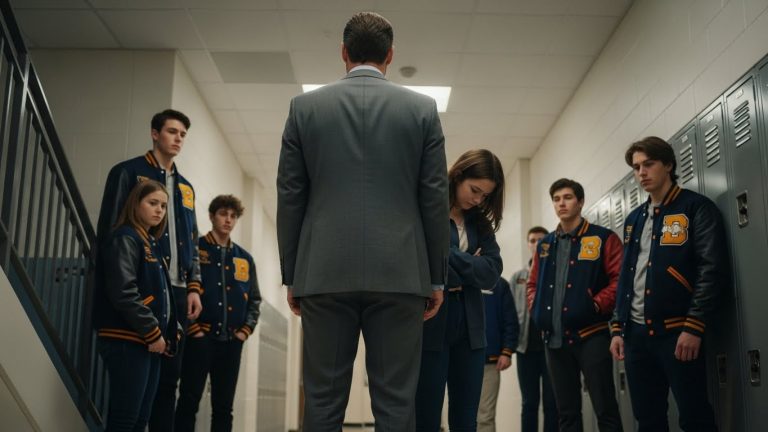
The “Golden Circle.” That’s what they call themselves. Brad, the quarterback. Jessica, the head cheerleader. And their court of sycophants. They rule this school with a toxicity that would make a dictator blush.
It was Tuesday, third period. My planning period. I was walking past the Art room, Room 304. The art teacher, Mrs. Gable, was out sick. A sub was supposed to be there, but you know how it is. Subs are late. Subs get lost.
The classroom should have been empty or quiet.
It wasn’t.
I heard the sound first. It wasn’t a scream. A scream I could handle. A scream is a reaction. This was worse. It was the sound of a heavy, wet thud against the floor. Followed by the squeak of high-top sneakers pivoting on tile.
“Oops. My bad, trash.”
That was Brad’s voice. I recognized the arrogance. It’s a tone that says, I can do this, and no one will stop me.
Then, the laughter. It started low, a rumble of shared cruelty, and then pitched up into that high, mocking cackle that makes your skin crawl.
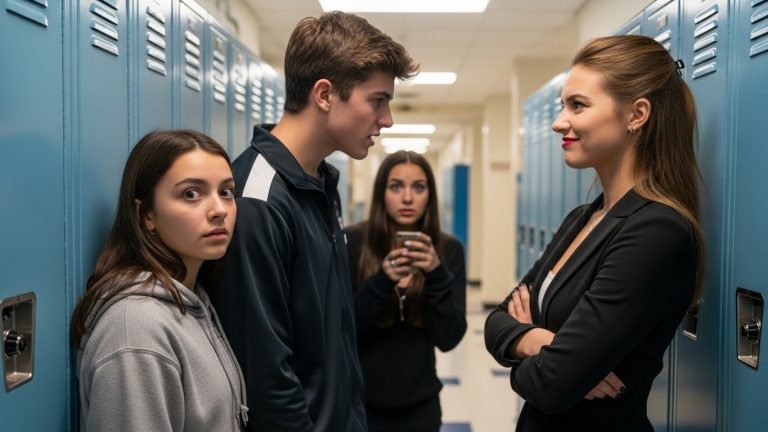
“Get a close up on her shoes,” a girl’s voice said. Jessica. “Are those from Goodwill? Or did you dig them out of a dumpster?”
I stopped. My hand hovered over the door handle.
Through the narrow vertical window, I saw the scene. It was like a tableau of modern warfare, high school style.
Sarah was on the ground. She had been carrying her portfolio—weeks of work. It was scattered everywhere. Charcoal sketches trampled by hundred-dollar Nikes. But that wasn’t the worst part.
Brad was standing over her, an empty carton of chocolate milk crushed in his hand. The brown liquid was dripping down Sarah’s face, matting her hair, ruining the one clean white shirt I knew she owned.
She wasn’t fighting back. She wasn’t even shielding herself. She was just… taking it. She was curled inward, trying to make herself smaller, trying to disappear into the floor tiles.
Around them, ten or twelve other students had their phones out. The flashlights were on. They were recording.
Live streaming.
I saw the red “LIVE” icon on a phone screen closest to the window. They were broadcasting her lowest moment to the entire school, maybe the entire town.
My heart didn’t race. That’s a misconception about anger. Real anger, the dangerous kind, is cold. It’s ice water in your veins. It’s absolute clarity.
I checked my watch. 10:14 AM.
I took a breath. I remembered the breathing exercises. In for four. Hold for four. Out for four.
It didn’t work.
Chapter 2: The Teacher Who Wasn’t
I didn’t turn the handle. Turning the handle gives them a second to compose themselves. It gives them a second to hide the phones. It gives them a second to put on the mask of innocence.
I didn’t want the mask. I wanted the truth.
I stepped back, pivoted on my right heel, and drove the sole of my boot just to the right of the latch mechanism.
CRACK.
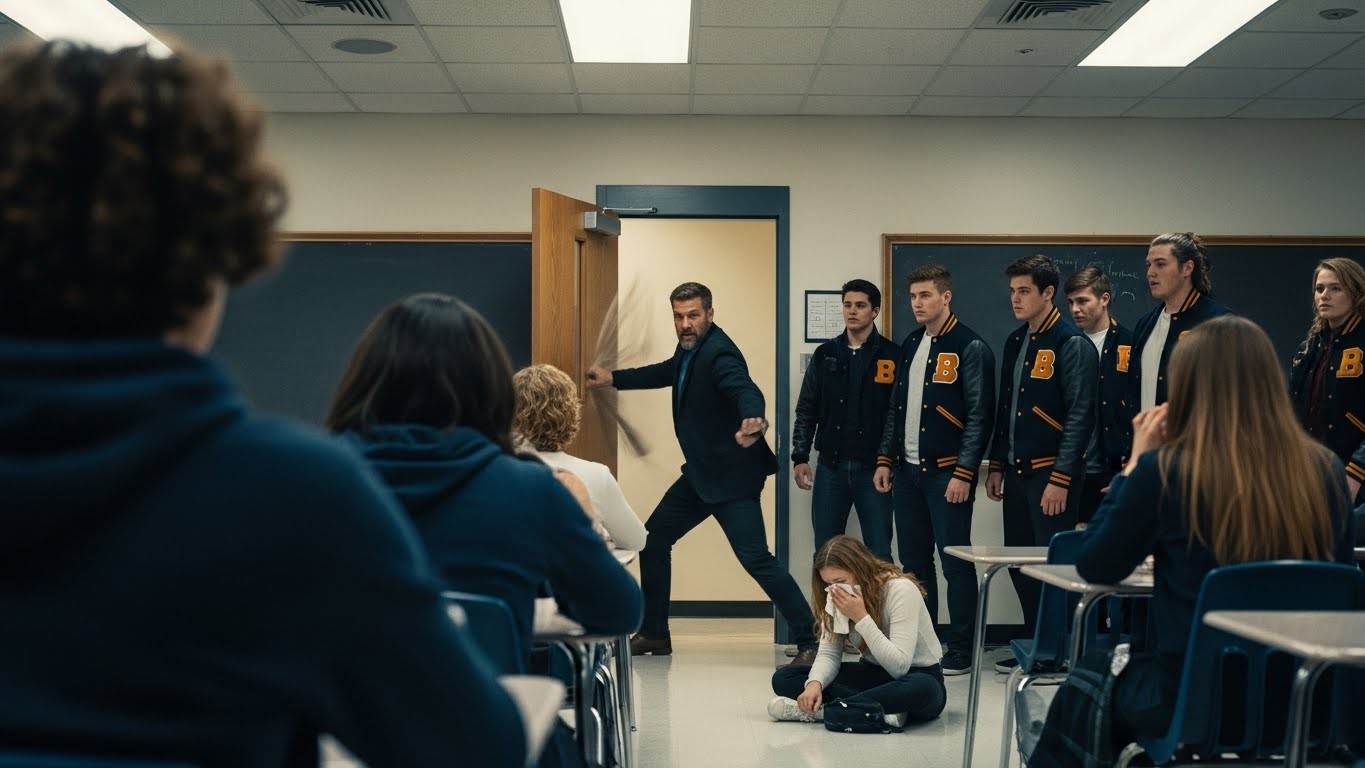
The door flew open with violence that shook the doorframe. The stopper on the wall shattered. The noise was like a cannon shot in the enclosed space.
The room froze. It was instantaneous. The laughter didn’t trail off; it was amputated.
Every head snapped toward the door.
I stood there. I didn’t have a weapon. I didn’t have a uniform. I was wearing a button-down shirt from Target and wrinkled khakis. But in that moment, I wasn’t Mr. Cross the history teacher. I was the man who had cleared rooms in Fallujah.
I stepped inside. The glass on the door rattled in its pane.
“Don’t move,” I said.
My voice wasn’t loud. It was a whisper. But in the dead silence of that room, it sounded like a command from God.
Brad was the first to react. His brain was trying to catch up. He was the king of the school; teachers were just staff to him. He lowered the milk carton, a nervous, confused smile flickering on his face.
“Mr. Cross?” he chuckled, but the sound was thin. “Jesus, you almost gave us a heart attack. You can’t just—”
“I said, don’t move.”
I walked toward him. I didn’t rush. I walked with a rhythm, my boots heavy on the floor. I walked past the other students holding phones. They lowered them instinctively, hiding them behind their backs like guilty children.
I stopped right in front of Brad. He’s a big kid. Six-two, 200 pounds of muscle and ego. But when I stepped into his personal space, he shrank. He smelled like expensive cologne and fear.
I looked at the milk dripping from his hand. Then I looked down at Sarah.
She was still on the floor. She hadn’t looked up. The milk was pooling around her knees.
“Help her up,” I said to Brad.
He blinked. “What?”
“You heard me. Put the phone down. Put the trash in the bin. And help her up.”
Brad’s face flushed red. He looked around at his friends. He was losing status. He had to posture.
“Look, Mr. Cross, you’re misinterpreting this. She fell. I was trying to—”
“Stop,” I cut him off. “I’ve heard lies from men who were much better at it than you. Men who were pleading for their lives. Don’t insult my intelligence, and don’t test my patience. Not today.”
The room went deadly silent again. The reference was vague, but the weight behind it wasn’t. The students exchanged glances. Who is this guy?
Brad swallowed hard. He looked at me, really looked at me, and saw something in my eyes that told him this wasn’t a detention conversation. This was a primal confrontation.
Slowly, resentfully, he dropped the carton. He reached a hand down toward Sarah.
“Get up,” he muttered.
“Don’t touch me.”
The voice was soft, scratching, but it cut through the tension like a razor.
It wasn’t me. It was Sarah.
She pushed herself up. She ignored Brad’s hand. She ignored me. She stood up, milk dripping from her chin, her clothes ruined. She looked small, frail, and utterly destroyed.
But then she lifted her head.
She looked at Brad. Then she looked at the circle of students holding phones. Finally, she looked at me.
Her eyes were dry. There were no tears. There was no panic.
There was just a cold, calculating void.
She reached into her soaked pocket and pulled out her own phone. It was an old model, screen cracked. She tapped the screen once.
“You guys thought you were livestreaming me,” she whispered, her voice trembling not with fear, but with adrenaline. “But you forgot one thing. The school WiFi logs everything.”
She turned the phone around.
“And I’ve been recording the audio in this room since the moment I walked in. Every threat. Every slur. Every laugh.”
She looked at Brad, and a small, terrifying smile touched her lips.
“I didn’t fall, Brad. I waited.”
The blood drained from Brad’s face so fast he looked like a ghost.
I looked at Sarah, and a chill went down my spine that had nothing to do with the air conditioning. I had stepped in to save a victim.
But looking at her face, I realized I might have just walked into the middle of a war I didn’t understand. And Sarah? She wasn’t the victim.
She was the bait.
PART 2
Chapter 3: The Coldest Burn
The silence in Room 304 wasn’t just quiet; it was heavy. It felt like the air pressure had dropped before a tornado touches down.
Brad was still staring at Sarah’s cracked phone screen. The arrogance that usually fit him like a tailored suit was gone, replaced by a raw, naked panic. He looked at his friends—the “Golden Circle”—but they were already backing away. That’s the thing about hyenas; they only pack up when they’re winning. When the lion turns around, everyone scatters.
“You… you can’t record us,” Jessica squeaked from the back, clutching her own iPhone like a lifeline. “That’s illegal. That’s, like, wiretapping or something!”
I turned my gaze to her. “Actually,” I said, my voice flat, “in this state, as long as one party consents to the recording, it’s legal. Sarah consented. You’re on public school property. And you were live-streaming. You waived your expectation of privacy the second you hit ‘Broadcast’.”
I looked back at Sarah. She hadn’t moved. The chocolate milk was beginning to dry on her skin, sticky and smelling sickly sweet, but she stood with the posture of a queen. She held that phone like a detonator.
“I didn’t just record the audio,” Sarah said, her voice gaining strength. She tapped the screen again. “I have the upload logs. It’s already in the cloud. You can smash this phone, Brad. You can throw it out the window. It won’t matter.”
Brad’s hands balled into fists. For a second, I saw the violence flare behind his eyes. He was cornered. A cornered animal is dangerous.
I stepped in. Smoothly. Deliberately. I placed my body between him and Sarah, blocking his line of sight.
“Don’t,” I warned him. “Don’t even think about it.”
Brad looked up at me, breathing hard. “You’re a teacher. You’re supposed to be on our side. You’re supposed to de-escalate.”
“I am de-escalating,” I said. “I’m preventing you from catching an assault charge on top of the harassment suit that’s coming your way.”
I held out my hand. “Phones. All of them. Now.”
“You can’t take my phone!” Jessica shrieked.
“This is a crime scene now,” I lied. Well, partially lied. “And those phones contain evidence of cyberbullying, harassment, and assault. Hand them over, or I call the police right now and we let the officers collect them.”
I waited.
Brad was the first. He slammed his sleek, case-less iPhone into my palm. Then the others followed. One by one, the tools of their torment became a pile of plastic and glass in my hands.
“Go to the Principal’s office,” I ordered Brad. “All of you. Now.”
“My dad is going to—”
“Your dad isn’t here,” I cut him off, leaning in close enough that he could see the gray specks in my irises. “I am. Start walking.”
They shuffled out, a defeated parade of varsity jackets and designer jeans. The hallway was empty, but the energy of their exit was frantic. They were already texting on their backup devices—Apple Watches, hidden burners—calling in the cavalry.
When the room was empty, save for the silent watchers in the back who had done nothing, I turned to Sarah.
She was trembling now. The adrenaline dump was hitting her.
“You okay?” I asked, keeping my distance so I wouldn’t spook her.
She looked at her ruined sketchbook. Then she looked at me. The scary determination faded just a fraction, revealing the terrified kid underneath.
“Did I do it right?” she whispered.
I frowned. “Did you do what right?”
“The trap,” she said. “I knew they were coming for me today. I knew it. So I waited. I let them do it so I could catch them.”
My chest tightened. This wasn’t just a prank gone wrong. This was a tactical maneuver. This girl, with her second-hand clothes and quiet demeanor, had analyzed her enemy, predicted their movements, and sacrificed her own dignity to secure a victory.
It was brilliant. And it was heartbreaking. No sixteen-year-old should have to think like a soldier.
“You did good, Sarah,” I said softly. I took off my jacket—a cheap blazer, but clean—and draped it over her shoulders to cover the mess. “But now comes the hard part.”
“What’s that?” she asked.
“Now the system tries to protect itself.”
As if on cue, the PA system crackled to life.
“Mr. Cross. Sarah Miller. Please report to Principal Vance’s office immediately.”
I looked at her. “Ready?”
She pulled my jacket tighter around herself. “I have the files.”
“Then let’s go,” I said. “And Sarah? Don’t say a word unless I tell you to. Let me do the talking.”
Chapter 4: The War Room
Principal Vance’s office was designed to intimidate. It was cooler than the rest of the school, smelling of mahogany polish and expensive coffee. The walls were lined with trophies from the football team—Brad’s team.
Vance sat behind his massive desk. He was a small man who wore suits that were too large, trying to occupy more space than he deserved.
But he wasn’t the problem.
The problem was the man sitting in the leather guest chair. Mr. Harrington. Brad’s father.
He was wearing a golf shirt and slacks, looking like he’d just come from the country club. He owned half the car dealerships in the county and sat on the School Board. He was the kind of man who thought rules were suggestions for poor people.
Sarah and I walked in. I pulled out a hard plastic chair for Sarah. I remained standing.
“Mr. Cross,” Vance began, his voice tight. “And… Miss Miller.” He wrinkled his nose slightly at the smell of the souring chocolate milk. “We’ve had some… disturbing reports.”
“I’m sure you have,” I said calmly. “I assume Brad told you his version?”
“Brad is a good kid,” Mr. Harrington interrupted. He didn’t look at Sarah. He looked at me. “He said this girl provoked them. That she was recording them without permission. That you, Mr. Cross, physically threatened a minor and damaged school property by kicking a door in.”
I almost laughed. It was so predictable. The aggressor plays the victim. DARVO: Deny, Attack, and Reverse Victim and Offender.
“Is that right?” I asked.
“We take student safety very seriously,” Vance said, sweating slightly. “Mr. Cross, kicking a door… that’s excessive force. And Miss Miller, recording students in a private moment…”
“It wasn’t a private moment,” Sarah said. Her voice shook, but she didn’t look down. “It was an assault. In a classroom.”
“Alleged assault,” Harrington snapped. “Look, let’s cut to the chase. Kids goof around. Milk gets spilled. It’s a prank. But illegal wiretapping? That’s a felony. And a teacher acting like a vigilante? That’s grounds for termination.”
He leaned back, a smug smile playing on his lips. “Here is the offer. Sarah deletes the video and the audio. She apologizes to Brad for the invasion of privacy. We forget the door damage, Mr. Cross, and you go back to teaching history. We sweep this whole mess up.”
Vance nodded eagerly. “I think that sounds very reasonable. Very generous, considering.”
I looked at Vance. Then I looked at Harrington.
I felt that click in my head again. The calm.
“No,” I said.
The room went silent. Harrington’s smile faltered. “Excuse me?”
“I said no. She won’t delete anything. In fact, I’m advising her to forward a copy to the local police department and the state superintendent.”
Harrington stood up. He was red in the face. “Listen to me, you glorified babysitter. I pay your salary. I can have your license pulled before the end of the day. Do you know who I am?”
I took a step forward. I didn’t shout. I lowered my voice to that register I used in the desert, the one that meant danger.
“I know exactly who you are, Mr. Harrington. You’re a man who buys his son’s way out of consequences. But you don’t know who I am.”
I reached into my pocket and pulled out a flash drive—the backup Sarah had transferred to me in the hallway.
“I wasn’t always a teacher,” I said. “Before I came here, I worked in Intelligence. I specialized in digital forensics and asset protection.”
I tossed the flash drive onto Vance’s desk. It made a loud clatter.
“That drive contains the audio. But it also contains the metadata from the live stream. It shows the IP addresses of every student who watched and commented. It shows Brad’s location. It shows the timestamp.”
I turned to Harrington.
“And, since I knew you’d try this, I took the liberty of looking up the ‘Zero Tolerance’ bullying policy that you signed into effect on the school board last year. The one that mandates immediate expulsion for physical assault caught on camera.”
Harrington’s mouth opened, but no sound came out.
“So here is the counter-offer,” I said, my voice hard as steel. “Brad is suspended pending an expulsion hearing. Sarah gets a formal apology. And you walk out of this office and thank God that I’m letting you off that easy.”
“You… you can’t…” Harrington sputtered. “I’ll bury you.”
“Try it,” I said. “I have nothing to lose. I live in a one-bedroom apartment and I drive a ten-year-old truck. But you? You have a reputation. You have a business. Imagine what the local news would do with the audio of your son laughing while he assaults a scholarship student.”
I leaned over the desk, invading his space.
“Do you really want to go to war with a man who has nothing to lose, Mr. Harrington?”
Harrington looked at Vance. Vance looked at his shoes.
The silence stretched for ten seconds. Then, Harrington grabbed his car keys off the desk.
“This isn’t over,” he snarled. He stormed out of the office, slamming the door harder than I had.
I turned to Vance. He looked like he was about to be sick.
“Process the suspension, Principal Vance,” I said. “I’ll be in my classroom.”
I motioned for Sarah to follow me. We walked out into the main office. The secretaries were staring.
Once we were in the hallway, Sarah stopped. She looked up at me, her eyes wide.
“Were you really in Intelligence?” she asked.
I smiled, a genuine, tired smile. “I was a logistics officer, Sarah. I counted trucks. But they don’t know that.”
She stared at me, and then, for the first time, a real smile broke through the chocolate milk and the grime.
“You bluffed him.”
“We bluffed him,” I corrected. “But he’s right about one thing. It’s not over. Harrington won’t stop. He’s going to come back harder.”
“I know,” Sarah said. She gripped her phone tight. “But I’m not invisible anymore.”
“No,” I said. “You’re not.”
But I knew something she didn’t. Men like Harrington don’t just get mad; they get even. And they don’t fight fair. The next attack wouldn’t be at school. It would be at home.
And I had to be ready.
Chapter 5: Unintended Consequences
The drive to Sarah’s home was quiet. I drove an old Ford F-150 that had more rust than paint, a relic from a time when things were built to last—much like myself, I suppose. Sarah sat in the passenger seat, staring out the window as the manicured lawns of the school district gave way to the cracked pavement and overgrown lots of the South Side.
She had tried to clean herself up in the faculty restroom, but the smell of sour milk still clung to her hair. It was a smell I knew well—the scent of humiliation.
“My dad is going to kill me,” she whispered, breaking the silence.
I glanced at her. “He shouldn’t. You didn’t do anything wrong.”
“You don’t understand,” she said, pulling at a loose thread on her sleeve. “He works for a subsidiary of Harrington Motors. He details cars at the lot on Route 9. If Mr. Harrington is as mad as you say…”
She didn’t finish the sentence. She didn’t have to.
My grip on the steering wheel tightened. I hadn’t considered that. Harrington wasn’t just a wealthy parent; he was an economic ecosystem in this small town. He didn’t just have money; he had leverage over livelihoods.
“We’ll handle it,” I said, though I wasn’t sure how yet. “One step at a time.”
We pulled into the trailer park. It was a place called ‘Pineview Estates,’ though there were no pines and certainly no estates. It was rows of single-wide trailers, some well-kept with flower boxes, others sagging under the weight of neglect.
Sarah’s place was one of the neat ones. The gravel driveway was raked. There was a small vegetable garden out front. It spoke of pride despite poverty.
But as we pulled up, I saw it.
A dark sedan was parked across the street. Tinted windows. Engine idling. It wasn’t a police car. It was a Lincoln Town Car, sleek and black—the kind used by corporate executives or funeral homes.
“Stay in the truck,” I said, unbuckling my seatbelt.
“That’s not my dad’s car,” Sarah said, panic rising in her voice.
“I know.”
I stepped out of the truck. The air was humid, heavy with the threat of rain. I walked around the front of my truck, keeping my eyes on the Lincoln.
The driver’s door opened. A man in a cheap suit stepped out. He wasn’t big, but he had the weaselly look of a lawyer who chases ambulances. He was holding a manila envelope.
At the same time, the front door of the trailer opened. A man stepped out—Sarah’s father. He looked exhausted, wearing a grease-stained mechanic’s jumpsuit. He looked confused.
“Can I help you?” Sarah’s dad asked the man in the suit.
“Mr. Miller?” the suit asked. “I have a cease and desist order here, along with a notice of termination regarding your employment, effective immediately.”
My stomach dropped. Harrington moved fast.
I walked faster, my boots crunching on the gravel. “Hey!” I shouted.
The suit turned to look at me. “Sir, this is a private matter.”
“It stopped being private when you stalked a minor to her home,” I said, stepping between the suit and Sarah’s father.
Sarah’s dad looked at me, then at Sarah, who was now climbing out of the truck. “Sarah? What’s going on? Who is this?”
“I’m her teacher, Mr. Miller. My name is Cross. And this,” I gestured to the man in the suit, “is a bully with a law degree.”
The lawyer sneered. “I’m representing Mr. Harrington. Your daughter illegally recorded a private conversation and distributed it. We are filing a civil suit for defamation and emotional distress against your family. And as for your job… well, Mr. Harrington doesn’t employ people who attack his family.”
Mr. Miller looked like he had been punched in the gut. He slumped against the doorframe. “Fired? But… I have rent. I have bills.”
“That’s not my problem,” the lawyer said, extending the envelope. “You’ve been served.”
I saw Mr. Miller’s hand tremble as he reached for the envelope. He was a man being crushed by a giant he couldn’t even see.
Something inside me snapped. Not the hot anger of the classroom. This was the cold, tactical rage of the field.
I reached out and snatched the envelope before Mr. Miller could touch it.
“Hey!” the lawyer shouted. “That is legal property!”
“You’re trespassing,” I said calmly. “This is private property. You have five seconds to get off this land before I remove you.”
“You can’t threaten me. I know who you are, Cross. Harrington told me. You’re just a washed-up vet teaching history.”
I took a step closer. I invaded his personal space until I could smell his stale coffee breath.
“You have three seconds,” I whispered.
He looked into my eyes. I don’t know what he saw there. Maybe he saw the miles of desert. Maybe he saw the things I’ve done in the dark so that people like him can sleep in the light. Whatever he saw, it terrified him.
He stepped back. “This isn’t over. You’re making it worse for them.”
“Go,” I barked.
He scrambled back to his car, threw the Lincoln into gear, and peeled away, gravel spraying behind him.
I turned to Mr. Miller. He was shaking. Sarah ran to him, hugging him tight, sobbing into his greasy jumpsuit.
“I’m so sorry, Dad. I’m so sorry.”
“It’s okay, baby,” he soothed her, though his eyes were wide with fear. He looked at me over her shoulder. “Mr. Cross… is it true? Did I lose my job?”
“Yes,” I said honestly. “But we’re going to get it back. And then some.”
“How?” he asked, despair in his voice. “Harrington owns this town. We’re nobody.”
I looked at the retreating dust cloud of the Lincoln.
“You’re not nobody,” I said. “You’re the people he underestimated.”
I pulled my phone out. I had one number saved that I hadn’t called in six years. A number I swore I’d never use again. It was a number that didn’t go to a person, but to a server farm in Virginia.
“Go inside,” I told them. “Lock the door. Don’t open it for anyone but me.”
“Where are you going?” Sarah asked.
“I have to make a call,” I said. “And I need to go get something from my storage unit.”
“What kind of teacher are you?” Mr. Miller asked, bewildered.
I paused, hand on the door of my truck.
“The kind who hates bullies,” I said.
Chapter 6: The Ghost in the Machine
I drove three miles to a self-storage facility on the edge of town. It was a miserable place, surrounded by chain-link fences topped with razor wire. I punched in my code—my old service ID number—and the gate rattled open.
Unit 42.
I rolled up the metal door. inside, it smelled of dust and old memories. There wasn’t much. A few boxes of books. A collection of vinyl records. And in the back, under a heavy canvas tarp, a black pelican case.
I hadn’t opened this case since I was discharged. I had told myself that part of my life was over. I was Mr. Cross now. I graded essays. I chaperoned prom.
But Harrington had broken the rules. He had attacked a civilian family in their home. He had used his power to starve a working man because his son was a sociopath.
I clicked the latches open.
Inside, resting in custom-cut foam, wasn’t a gun. I don’t use guns anymore. Not if I can help it.
It was a laptop. A ruggedized, military-grade terminal with an encrypted satellite uplink. Next to it were several hard drives and a signal interceptor that looked like a black brick.
I wasn’t just a logistics officer. That was the cover. My MOS (Military Occupational Specialty) was 35Q. Cryptologic Cyberspace Intelligence Collector.
I hunted people. Not with bullets, but with data. I found the money trails that funded insurgents. I found the blackmail material warlords used to control politicians. I destroyed lives from a keyboard to save lives on the ground.
I closed the case and carried it to my truck.
The sun was setting now, casting long, bruised purple shadows across the highway. I needed a place to work. I couldn’t go to my apartment; if Harrington knew my name, he knew my address. He’d have eyes on it.
I drove to the one place nobody would look for a teacher at night. The school.
I still had my key fob. The parking lot was empty. The building loomed dark and silent. I let myself in through the side gym entrance.
I made my way to the server room in the basement. It was cool and hummed with the sound of fans. I didn’t need to hack the school—I had the admin passwords. But I needed their fiber optic connection. It was the fastest in town.
I set up my terminal on a folding table. I plugged the interceptor into the main switch.
Boot sequence. Green text scrolled rapidly down the black screen.
Target: Harrington, Charles. Assets: Harrington Motors, Oak Creek Real Estate Holdings, First National Board.
I cracked my knuckles. “Okay, Chuck. Let’s see what you’re hiding.”
People like Harrington always make the same mistake. They think they’re untouchable, so they get sloppy. They think digital security is something you buy at Best Buy. They don’t understand that to someone like me, their firewalls are made of tissue paper.
I started digging.
First, I went for the easy stuff. Emails. I ran a script to brute-force his personal email server. It took four minutes.
I started reading. Most of it was boring. Golf schedules. Complaints to the country club about the towel service.
But then I found a folder labeled “Re-Zoning.”
I opened it.
It was a correspondence between Harrington and the Mayor. They were discussing the Pineview Estates trailer park—where Sarah lived.
Harrington: “We need that land condemned by August. The mall development deal depends on it.” Mayor: “It’s tricky, Charles. There are forty families there. We need a reason to evict.” Harrington: “Make a reason. Find code violations. Cut the water. I don’t care. Get them out.”
I felt a cold fury settle in my chest. He wasn’t just firing Sarah’s dad because of the fight. He was using the fight as a smokescreen to accelerate a plan he’d had for months. He was going to bulldoze Sarah’s home to build a strip mall.
But that wasn’t enough. Corruption is common. I needed something criminal. Something that would put him away, not just embarrass him.
I went deeper. I followed the money.
Harrington Motors. A chain of five dealerships.
I accessed their inventory logs and cross-referenced them with the DMV database. I noticed a discrepancy. Every month, about ten high-end SUVs were marked as “Sold – Export” to a shell company in Miami.
I traced the shell company. It led to a bank account in the Caymans.
And from there, I traced the shipping manifests.
The cars weren’t going to Miami. They were going to a port in Eastern Europe known for being a hub of black-market arms dealing.
Harrington wasn’t just a crooked car salesman. He was laundering money for organized crime. He was cleaning dirty cash by “selling” cars that didn’t exist or were stolen, shipping them out, and bringing the “profits” back as clean American dollars.
I sat back in the chair, the blue light of the screen illuminating my face.
“Gotcha,” I whispered.
I had enough to bury him. I had enough to send the FBI to his front door.
But then I hesitated.
If I released this now, the Feds would swoop in. It would take months. Harrington has lawyers. He’d make bail. He’d spin it. And in the meantime, he’d destroy Sarah and her father just out of spite.
I needed to stop him tonight. I needed to make him stand down immediately.
I didn’t need a judge. I needed leverage.
I pulled out my phone. I found the number for Harrington’s personal cell—the one he thought was secure.
I sent a single text message.
It wasn’t a threat. It was a file attachment.
A PDF of his Cayman Island bank statement from yesterday.
And a simple caption: Class is in session, Mr. Harrington. Meet me at the school. Alone. Or I send this to the FBI.
I hit send.
Then I waited.
I checked the security cameras on my screen. The school was empty, a labyrinth of dark hallways.
Ten minutes later, I saw headlights sweep across the front lot.
A single car. The Lincoln.
He was here.
I closed the laptop. I didn’t need it anymore. I walked out of the server room and headed for the main lobby.
It was time for a parent-teacher conference.
Chapter 7: The Final Lesson
I waited in the center of the gymnasium. It was the perfect stage. High ceilings, echoing acoustics, and the smell of old sweat and floor varnish. I sat on the bleachers, the bottom row, perfectly relaxed.
The double doors at the far end creaked open.
Harrington walked in. He looked smaller without his entourage, without the bright lights of his office. But he was dangerous. His right hand was tucked deep into the pocket of his trench coat.
He spotted me and stopped.
“You have a lot of nerve,” he called out. His voice echoed, bouncing off the championship banners hanging from the rafters.
“I have a lot of things,” I replied, standing up slowly. “I have the logs. I have the bank routing numbers. I have the names of the Russian shell companies.”
Harrington walked closer, his steps clicking on the hardwood court. He stopped at the free-throw line. I stood under the basket.
“How much?” he asked. “Everyone has a price. You want a million? Two? I can have it wired to an offshore account in ten minutes. You walk away. You forget the girl. You forget the dad.”
I laughed. It was a dry, humorless sound.
“You really don’t get it, do you? You think money solves everything because you’ve never had to pay with anything else. You’ve never paid with blood. You’ve never paid with your soul.”
I took a step toward him.
“This isn’t about money, Chuck. It’s about consequences.”
Harrington’s face twisted into a snarl. “You think you can judge me? You’re a high school teacher driving a rust bucket. I built this town!”
“You poisoned this town,” I corrected. “And now, you’re going to cure it.”
I pulled a folded piece of paper from my pocket.
“This is a confession,” I said. “It states that you falsified the reasons for firing Mr. Miller. It states that you withdraw all legal threats against the Miller family. And it includes your immediate resignation from the School Board.”
I tossed the paper onto the floor between us. It slid across the polished wood.
“Sign it. And I don’t send the FBI the file on your friends in Eastern Europe.”
Harrington looked at the paper, then back at me. His eyes went cold.
“You think I’m scared of the FBI?” he whispered. “The people I work with… they make the Feds look like Boy Scouts. If that file leaks, I’m a dead man.”
“Then you better sign fast,” I said.
Harrington shook his head. “No. There’s a third option.”
He pulled his hand from his pocket. He was holding a snub-nose revolver.
“I kill you,” he said, his voice trembling slightly. “I take your laptop. And I burn this place down.”
I didn’t flinch. I didn’t raise my hands. I looked at the gun, then I looked at his eyes. He wasn’t a killer. He was a desperate man playing a role he’d seen in movies. His finger was shaking on the trigger.
“Put it down, Chuck,” I said softly.
“Shut up!” he screamed. “Get on your knees!”
“I don’t kneel,” I said. “And you’re not going to shoot me.”
“Try me!”
“You’ve never fired a gun without ear protection, have you?” I asked, taking a slow step forward. “In here? With these acoustics? You’ll burst your eardrums. You’ll be disoriented. And before you can blink, I’ll be on you.”
“Stay back!”
I took another step. “You’re shaking. Your grip is loose. You’re going to miss.”
I was ten feet away.
“I said stay back!”
I took another step.
Harrington squeezed his eyes shut and pulled the trigger.
CLICK.
The sound was loud in the empty gym. But there was no bang. No flash.
Harrington’s eyes snapped open in horror. He pulled the trigger again. CLICK.
“I told you I specialize in asset protection,” I said, closing the distance. “I stopped by your house while you were driving here. Your wife let me in. Lovely woman. She thinks I’m your new security consultant. While she was making tea, I found your safe. The combination was your birthday. Predictable.”
I stood right in front of him now. I reached out and gently took the gun from his limp hand.
“I emptied the cylinder, Chuck. I’m a teacher. I don’t allow firearms on school property.”
Harrington fell to his knees. He began to sob. It was a pathetic, broken sound.
“Please,” he wept. “They’ll kill me.”
“Then you better hope the police get to you first,” I said.
I pulled out my phone. I had been on a call the entire time.
“Did you get that, Detective?”
“Loud and clear, Mr. Cross,” the voice on the speakerphone said. “Units are pulling into the lot now.”
Sirens began to wail in the distance, growing louder by the second. Blue and red lights flashed against the high windows of the gym, painting us in chaotic colors.
I looked down at Harrington.
“Class dismissed.”
Chapter 8: The Sunrise
The next morning, the sun rose over Oak Creek like it always did, but the air felt different. Lighter.
The arrest was all over the news. ‘Local Business Tycoon Arrested for Money Laundering and Attempted Murder.’ The video of Sarah—the one from the classroom—had gone viral, but not in the way Brad had intended. It was being hailed as an act of bravery. #StandWithSarah was trending.
I pulled my truck into the school parking lot. I was tired. I hadn’t slept.
I walked into the building. The hallways were buzzing. Students were whispering, pointing at me as I passed. But the mockery was gone. It was replaced by a strange kind of awe.
I walked into Room 304.
The door was fixed. The janitor had worked overtime.
The class was full. Everyone was in their seats. Even the members of the “Golden Circle.” Brad wasn’t there. His locker had been cleared out that morning. His mother had pulled him out of school, presumably to move to a town where nobody knew their name.
I walked to the front of the room. I put my briefcase on the desk.
“Open your books to page 194,” I said, my voice raspy. “The Reconstruction Era.”
Nobody moved.
I looked up.
Sarah was sitting in the front row. She was wearing a new shirt—clean, bright yellow. She wasn’t hiding in a hoodie. She had her sketchbook on her desk.
She stood up.
“Thank you,” she said.
It was two words. But it was enough.
Then, the kid next to her stood up. Then the next. Within seconds, the entire class was standing. Even Jessica, the cheerleader, stood up, looking at her shoes, ashamed but standing.
It wasn’t applause. It was just respect. A silent acknowledgment that the rules had changed.
I felt a lump in my throat. I swallowed it down. I’m not the emotional type.
“Sit down,” I grunted, turning to the chalkboard to hide my face. “We have a lot of material to cover. History doesn’t wait for anyone.”
I picked up the chalk.
I am Mr. Cross. I teach history. I drive a beat-up truck and I live alone.
But if you come for my students? If you try to crush the weak to make yourself feel strong?
You’ll find out that the history teacher has a very dark past. And he’s not afraid to repeat it.
THE END.