Everyone in the Store Ignored the Girl in the Pink Sweater. But My K-9 Rex Saw Her Hand Signal and Froze. What Happened Next Changed Everything.
Part 1 of 4
Chapter 1: The Invisible Scent of Fear
The air in a grocery store always smells the same. It’s a mix of floor wax, overly ripe bananas, and the freezing cold draft coming off the dairy coolers. For most people, it’s the smell of chores. It’s the smell of a boring Tuesday.
But for me, Officer Daniels, and my partner Rex, smells are information.
I’ve been K-9 certified for six years. Rex is a four-year-old German Shepherd, eighty-five pounds of muscle, fur, and teeth. But his most dangerous weapon isn’t his jaw. It’s his nose.
We were doing a standard community patrol at the Super-Mart on Riverside. The manager liked having us walk through. It made the customers feel safe, and it gave Rex a chance to work on his socialization. Usually, these walks are the highlight of my day. People stop to ask if they can pet him (I always say yes, as long as he’s in “ease” mode), and kids stare at him like he’s a superhero.
That Tuesday started exactly like that. Routine. Easy.
“Cleanup on aisle four,” the PA system crackled overhead, followed by some generic pop music.
I was relaxed. My hand was resting lightly on the leash. I was actually debating whether to buy a frozen pizza for dinner or try to be healthy and get a salad. That’s how checked out I was.
But Rex? Rex never checks out.
We turned the corner into the cereal aisle—Aisle 9. It’s usually the loudest aisle in the store, filled with kids begging for the sugary stuff. Today, though, it was relatively quiet. Just a few shoppers meandering through.
That’s when the leash snapped tight.
It wasn’t a playful tug. Rex didn’t see a ball or a treat. He stopped dead in his tracks, his paws sliding slightly on the polished white tile.
“Rex?” I murmured, stopping with him. “What’s up, buddy?”
The change in him was instant. One second, he was my goofy, tail-wagging partner. The next, he was a statue.
His ears, usually swiveling to catch every sound, locked forward. His tail stopped wagging and went stiff, hovering just below his hocks. His mouth closed. He stopped panting.
He was scenting something.
I watched his nose work. Twitch. Flare. Twitch.
I looked down the aisle. Nothing looked dangerous.
There was an elderly woman comparing prices on oatmeal.
There was a teenager stocking shelves, looking bored out of his mind.
And about thirty feet away, walking away from us, was a man and a little girl.
“Leave it,” I said softly, giving the leash a tiny correction. Usually, that’s all it takes to snap Rex out of a distraction.
He ignored me.
He didn’t growl. He didn’t bark. He let out a sound that I can only describe as a vibration deep in his chest. A low, shuddering huff.
I felt a prickle of heat run up the back of my neck. I’ve learned to trust that feeling. That’s the feeling that says the dog knows something the human brain hasn’t processed yet.
Rex took a step forward, dragging me with him. He wasn’t aggressive, but he was determined. He was pulling me toward the man and the girl.
“Okay,” I whispered, loosening my grip on the leash just a fraction. “Show me.”
Chapter 2: The Silent Scream
We moved down the aisle. I tried to keep my body language casual. I didn’t want to spook anyone if Rex was just smelling a cat on someone’s clothes. But my eyes were scanning, dissecting everything.
I focused on the pair.
The man was big. Heavy-set, maybe six-foot-two. He wore a grey t-shirt that was straining against his back and cargo shorts. His arms were covered in ink—faded tattoos that looked homemade.
He was walking fast. Too fast for a leisurely shop.
And the girl.
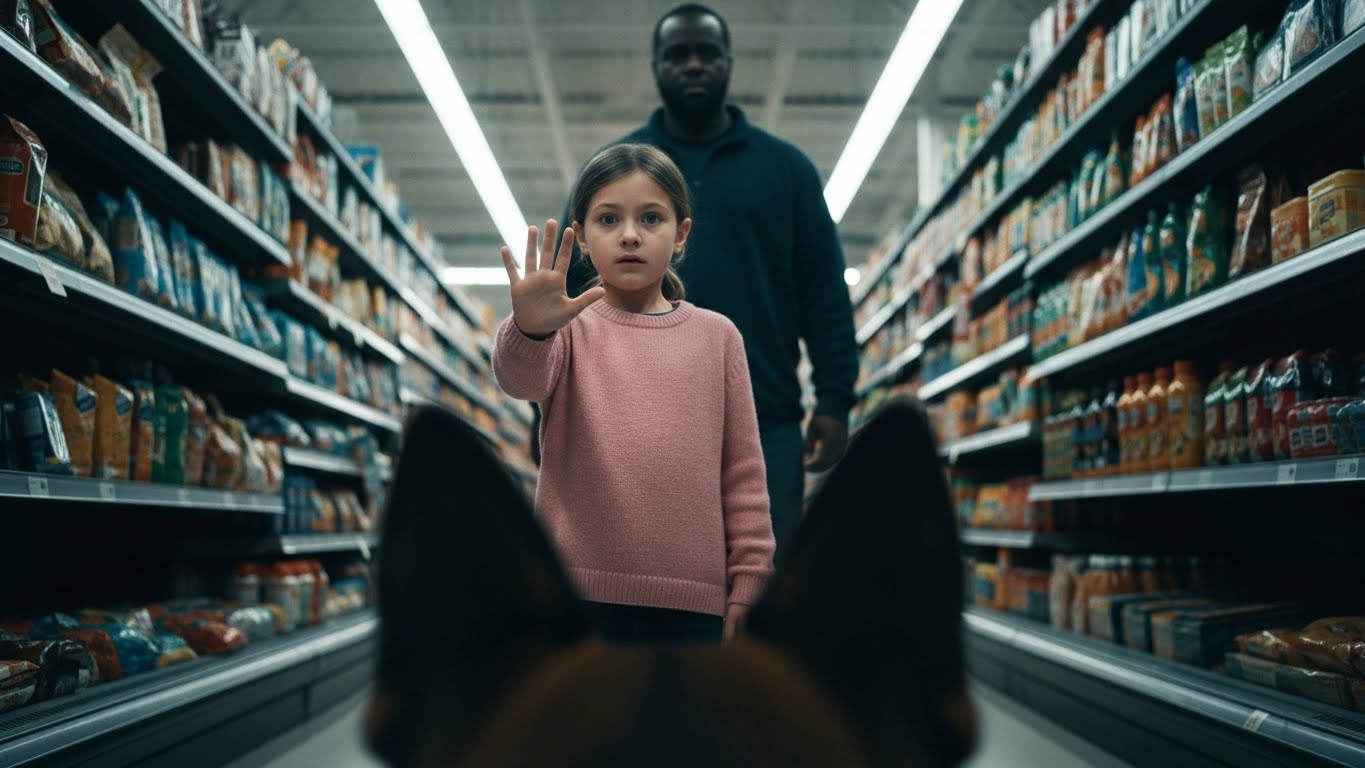
She was tiny. Maybe seven years old. She was wearing a bright pink knit sweater that looked expensive, paired with jeans and sparkle sneakers. Her hair was neatly brushed.
But it was the way they were connected that made my stomach turn.
He wasn’t holding her hand. He was gripping her wrist.
His fingers were wrapped completely around her small forearm, and his knuckles were white. He was towing her along like a piece of luggage.
As we got closer, about fifteen feet away, the man stopped. He grabbed a box of cereal off the shelf, but he didn’t look at it. He looked over the top of the box, scanning the aisle behind him.
His eyes met mine.
For a split second, I saw it. Pure, unfiltered adrenaline. His eyes darted to my badge, then to the gun on my hip, and finally, they landed on Rex.
He flinched. It was subtle, just a twitch of his shoulder, but I saw it.
“Hey there,” I said, putting on my friendly ‘Officer Friendly’ voice. “Cute kid.”
The man forced a smile. It didn’t reach his eyes. It was a mask. “Thanks,” he grunted. His voice was gravelly and tight. “We’re in a hurry.”
He pulled the girl’s arm. “Come on, sweetie. Mom’s waiting.”
Mom’s waiting.
It sounded normal. It should have been normal.
But the girl looked up.
She didn’t look at him. She looked at me.
Her face was pale, almost translucent under the harsh store lights. Her eyes were wide, rimmed with red, like she had been crying for hours and had run dry. She was clutching a dirty, grey stuffed rabbit to her chest with her free hand.
She didn’t speak. She didn’t cry out. She didn’t try to pull away.
She just stared at me with an intensity that hit me like a physical blow.
Rex let out a whine. He shifted his weight, putting himself slightly in front of me, angling his body toward the girl. He sensed the distress. He smelled the chemical spikes of cortisol—the stress hormone—rolling off her in waves.
The man turned his back to me, trying to block my view of her. “Let’s go,” he hissed at her.
And in that sliver of a second, before he dragged her around the corner, she did it.
She let her free hand—the one holding the rabbit—drop slightly. Then she raised it, palm facing me.
She tucked her thumb into her palm.
She trapped her thumb with her fingers.
Open. Tuck. Trap.
The “Signal for Help.”
It’s a silent distress signal popularized on social media during the lockdowns. It’s for victims of domestic abuse or trafficking to signal they need help without alerting their abuser.
I had seen the training videos. I had shared the posts. But I had never, in fifteen years, seen a child use it in real life.
Time seemed to stop.
The girl dropped her hand instantly, clutching the rabbit again. She looked down at the floor, making herself small.
My heart hammered against my ribs. This wasn’t a suspicion anymore. This wasn’t just Rex acting weird.
This was a kidnapping in progress.
If I drew my weapon now, he might hurt her. He was too close to her. He had a grip on her. If I yelled, he might panic and snap her neck or pull a weapon I couldn’t see.
I had to be smart. I had to be fast. And I had to use the only advantage I had.
I looked down at Rex.
“Watch him,” I whispered.
Rex didn’t need the command. He was already coiled like a spring, his amber eyes fixed on the man’s throat.
“Sir!” I called out, my voice dropping the friendly act. “Hold up a second. You dropped something.”
It was a lie. But it was enough to make him stop.
The man froze. He didn’t turn around immediately. I saw his free hand drift toward his waistband.
“I said stop,” I commanded, my hand hovering over my holster.
The man slowly turned around. The smile was gone. The mask had slipped. beneath it was the face of a cornered animal.
“I didn’t drop anything,” he spat.
“I think you did,” I said, stepping closer, closing the distance to ten feet. “I think you dropped your story.”
The man’s eyes went wide. He realized I knew.
And then, he did the worst possible thing.
He yanked the girl off her feet, pulling her in front of him like a human shield, and reached into his waistband.
“Back off!” he screamed. “Or I’ll hurt her!”
Shoppers down the aisle screamed. The jar of tranquility in the store shattered instantly.
But he forgot one thing.
He wasn’t just facing me. He was facing Rex.
And Rex was done waiting.

Part 2 of 4
Chapter 3: The Standoff in Aisle Nine
The silence that followed the man’s scream was heavy, suffocating. It felt like the air had been sucked out of the entire grocery store.
“Back off! Or I’ll hurt her!”
The words hung there, vibrating in the space between the Corn Pops and the Raisin Bran.
The man had the little girl pulled tight against his chest. His left arm was wrapped around her neck in a chokehold that made my stomach turn. His right hand was buried in his waistband, gripping something I couldn’t see.
Gun? Knife? It didn’t matter. In close quarters like this, anything was deadly.
I didn’t draw my gun. Not yet.
If I pulled my service weapon, the escalation would be instant. He might panic. He might twitch. And if he twitched, that little girl in the pink sweater would pay the price.
Instead, I held my hands up, palms open, keeping them level with my chest.
“Okay,” I said, my voice steady, low, and terrifyingly calm. “Nobody needs to get hurt today. Let’s just take a breath.”
But my eyes weren’t on him. They were on Rex.
My partner was vibrating with potential energy. He had lowered his body into a crouch, his belly fur brushing the linoleum floor. His lips were peeled back, revealing teeth that were designed to crush bone. But he wasn’t barking.
Barking is for warnings. Rex was past warnings. He was calculating the trajectory of an attack.
He was waiting for the ‘gap’.
In K-9 training, we teach the dogs to find the opening—the split second where the target is vulnerable. But right now, there was no gap. The man was using the girl as a human shield. If Rex launched, he risked hitting the child.
Rex knew it. I could see the frustration in the way his claws dug into the tile, scratching white lines into the wax. He let out a sound that was half-growl, half-whine—a sound of pure, restrained fury.
The girl, Emily (I didn’t know her name yet, but I would soon), was making small, choking noises. Her feet were dangling inches off the ground. She looked at me, her eyes wide pools of terror.
“Let her go,” I said, taking a microscopic step forward.
“Stay back!” the man shrieked. Sweat was pouring down his face now, stinging his eyes. “I’m walking out of here! I’m walking out, and she’s coming with me!”
“You can’t walk out,” I told him, keeping my tone conversational. “Look around you.”
I gestured slightly with my head.
At the end of the aisle, a group of shoppers had gathered. They weren’t running away anymore. They were watching. And more importantly, they were recording.
A dozen smartphones were held up, creating a wall of digital witnesses.
“You’re on camera,” I said. “Everyone sees you. There’s no ‘walking away’ from this. The only way this ends well is if you let the girl go.”
The man’s eyes darted to the crowd. For a second, the reality of his situation crashed down on him. He wasn’t anonymous anymore. He was a spectacle.
“Get them back!” he yelled at me, spit flying from his lips. “Tell them to stop filming!”
“I can’t do that,” I lied. “But I can keep them away from you. Just let the girl go.”
He tightened his grip. The girl gasped, her face turning a shade of red that terrified me.
“She’s my daughter!” he shouted, trying to spin the narrative one last desperate time. “She’s sick! We’re just going to the car!”
“She’s not your daughter,” I said. My voice dropped an octave. It was the voice I used when the negotiating was over. “Because your daughter wouldn’t use the emergency hand signal on you.”
The color drained from his face. He looked down at the girl, stunned.
He hadn’t seen it. He hadn’t realized that in her silence, she had screamed louder than anyone in the store.
That moment of distraction—that split second where he looked down—was what I was waiting for.
“Rex,” I whispered. “Watch.”
The man began to back up. He was moving toward the rear of the store, toward the employee-only swinging doors that led to the loading dock. If he got in there, I’d lose my line of sight. He could barricade himself. He could hurt her in private.
I couldn’t let him leave the aisle.
“Don’t do it,” I warned him.
He took another step back, dragging the girl. Her sneakers squeaked against the floor.
Then, he made a mistake.
He shifted his weight to kick a shopping cart out of his way. As he kicked out, his balance faltered for a fraction of a second. His grip on the girl’s neck loosened just enough for her to tuck her chin.
Rex saw it.
The dog lunged.
He didn’t go for the bite. He went for the distraction. Rex slammed his front paws onto the shelving unit next to the man, knocking a cascade of cereal boxes down onto them.
It was chaos. brightly colored boxes rained down—Fruit Loops, Cheerios, Lucky Charms.
The sudden noise and the avalanche of cardboard startled the man. He flinched, throwing his hands up instinctively to block the falling boxes.
In that second, he let go of the girl.
“Run!” I roared.
Chapter 4: The Sound of Rescue
The little girl didn’t need to be told twice.
She dropped to the floor, scrambling on her hands and knees, crawling under the bottom shelf of the display. She moved with the desperate, frantic energy of a trapped animal finding a hole in the fence.
The man realized his mistake instantly. He roared in frustration, ignoring the cereal boxes bouncing off his shoulders. He reached down, his hand grasping for her ankle.
“No, you don’t!”
I didn’t have to shoot. I had a missile on a leash, and I had just let go of the handle.
“Rex! Fas!” (That’s the command for ‘Strike’).
Rex hit the man in the chest like a freight train.
Eighty-five pounds of German Shepherd moving at thirty miles per hour generates an incredible amount of force. The man was lifted off his feet. He flew backward, crashing into the shelf of oatmeal canisters behind him.
CRASH.
The shelf buckled. Cylinder containers exploded open, sending oats flying like snow.
The man hit the ground hard, but he was tough. He scrambled to get up, his hand fumbling at his waistband again.
But Rex was already on top of him.
This wasn’t the movies. Rex didn’t maul him indiscriminately. He targeted the weapon arm. Rex’s jaws clamped onto the man’s right forearm—the one reaching for the waistband.
The pressure of a police dog’s bite is immense. It can crush bone.
The man screamed. It was a high-pitched, primal sound that echoed off the high ceilings.
“Drop it!” I yelled, rushing forward, my gun drawn now. “Show me your hands!”
The man was thrashing, trying to punch Rex with his free hand. But Rex didn’t budge. He shook his head violently, tugging the man’s arm, keeping him off balance, keeping him pinned. Rex was a machine of controlled violence. He wasn’t angry; he was working.
“Get him off! Get him off me!” the man shrieked.
“Stop fighting!” I commanded. “Stop moving and I’ll call him off!”
The man went limp, sobbing in pain. “Okay! Okay! I’m done!”
“Rex, uit!” (Out).
Rex released the arm instantly. But he didn’t back away. He stood over the man, straddling his chest, his muzzle inches from the guy’s face. He let out a low, rumbling growl that vibrated right through the man’s ribcage. Don’t. Move.
I moved in, holstering my gun and pulling my cuffs. I flipped the man onto his stomach. He didn’t resist. The fight had been completely drained out of him.
“You have the right to remain silent,” I recited, the adrenaline making my own hands shake slightly as I ratcheted the cuffs tight.
As I secured him, a strange sound began to fill the store.
It started as a few chirps. Then a buzz. Then a screech.
Within seconds, the air was filled with a cacophony of electronic alarms.
BREE-BREE-BREE.
It was the sound of fifty cell phones going off at the exact same time.
I looked up. The shoppers standing at the end of the aisle were all looking at their phones.
The Amber Alert.
It had just pushed through to everyone’s device.
A woman in the front of the crowd gasped, her hand flying to her mouth. She looked from her phone screen to the little girl who was now shivering under the cereal shelf.
“That’s her,” the woman whispered. Then she yelled it. “That’s the girl! That’s Emily! The alert just came through!”
The timing was almost supernatural. If we had been two minutes slower… if Rex hadn’t stopped him… the alert would have gone off while he was driving her away.
I hauled the man to his feet. He wouldn’t look at anyone. He stared at the floor, defeated.
“Rex, heel,” I said.
Rex trotted back to my side, his tail giving a single, tentative wag. He looked up at me with those amber eyes. Did I do good, Dad?
“You did good, buddy,” I whispered. “You did real good.”
But we weren’t done.
I handed the suspect over to the two backup officers who had just sprinted through the front doors.
“Get him out of here,” I said, my voice hard. “And check his waistband.”
One of the officers reached in and pulled out a six-inch hunting knife. The blade was serrated.
I felt a cold chill wash over me. If I had rushed him… if Rex hadn’t knocked him down… that knife would have been in one of us. Or worse, in her.
I turned my attention to the real victim.
She was still curled up under the shelf, surrounded by spilled Fruit Loops and crushed oatmeal. She was shaking so hard her teeth were chattering.
I holstered my weapon and got down on my knees. I wanted to be smaller. I wanted to be less scary.
“Hey,” I said softly. “Emily, right?”
She didn’t answer. She was staring at Rex.
Most kids are scared of police dogs. They’re big, they’re loud, and they just saw this one take down a grown man.
But Emily wasn’t looking at Rex with fear. She was looking at him with awe.
Rex, sensing the shift in the room, broke his command. He didn’t ask for permission. He slowly, gently, army-crawled forward on his belly.
He moved through the spilled cereal, making himself look as unthreatening as an eighty-five-pound wolf could look. He let out a soft whine.
He stopped two feet away from her and laid his head on his paws. He blinked slowly.
Emily slowly uncurled herself. She wiped her nose on her sleeve.
She reached out a trembling hand.
“Is he… is he nice?” she whispered.
I smiled, and I felt the tears pricking the corners of my eyes. “He’s the nicest boy in the world. And he knew you were in trouble before I did.”
She inched forward. Her small fingers brushed the fur on Rex’s head.
Rex closed his eyes and leaned into her touch.
And right there, in the middle of Aisle 9, surrounded by the wreckage of a violent struggle and the blaring sound of Amber Alerts on every phone, the little girl buried her face in the neck of the dog who saved her and finally, finally started to cry.
But these weren’t the silent tears of the terrified. These were the loud, sobbing tears of someone who knows they are safe.
I stood up and keyed my radio.
“Dispatch, this is K-9 One. Suspect in custody. Child secured. We need EMS for a check-up, but… I think she’s going to be okay.”
I looked down at the pair of them. Rex hadn’t moved. He was letting her cry into his fur, absorbing her pain like a sponge.
I thought the hard part was over. I thought the story ended there.
But I was wrong. Because when they searched the suspect’s car in the parking lot, they found something that turned this from a kidnapping case into something much, much bigger.
And Emily? She had one more secret to tell us.
Part 3 of 4
Chapter 5: The Horror in the Silver Sedan
The adrenaline that fuels a crisis eventually burns off, leaving behind a cold, shaky exhaustion. But I didn’t have time to be tired yet.
The store was now a crime scene. Yellow tape was being strung up across Aisle 9, crisscrossing over the spilled cereal and the crushed oatmeal canisters. Uniformed officers were taking statements from the witnesses, who were still clustered together, speaking in hushed, excited tones.
Rex was still sitting with Emily. He hadn’t moved an inch. He was in “guard mode”—posture upright but relaxed, eyes scanning the perimeter, creating a visible bubble of safety around the little girl.
Paramedics were checking Emily’s vitals. She was dehydrated and in shock, but physically, she was unharmed. No broken bones. No bruises, other than the red marks on her wrist where the man had gripped her.
“Officer Daniels?”
I turned. It was Detective Miller. He had arrived on the scene five minutes ago, looking like he hadn’t slept in a week. Miller was good police, the kind who took cases personally.
“We found his car,” Miller said. His voice was grim. ” parked in the fire lane, engine running. You need to see this.”
I looked back at Rex. “Stay,” I commanded softly. Rex flicked an ear at me but didn’t lift his head from Emily’s knee. He knew his job wasn’t done yet.
I followed Miller out the automatic sliding doors into the bright afternoon sun. It was jarring. Inside, the world had been small and terrifying. Outside, people were pumping gas and walking their dogs like nothing had happened.
The suspect’s car was a silver sedan, roughly ten years old. Unremarkable. It was the kind of car you pass on the highway a thousand times and never remember. The ultimate camouflage.
The trunk was popped open. A crime scene tech was already photographing the contents.
“Prepare yourself,” Miller muttered as we approached.
I stepped up to the bumper and looked inside.
My stomach dropped.
It wasn’t just messy. It was prepared.
The trunk had been lined with thick, black plastic sheeting, taped down at the edges with meticulous care. It was designed for easy cleaning.
In the corner, organized in a plastic tote, was a “kit.” Duct tape. Heavy-duty zip ties. A bottle of chloroform. A box of surgical masks. And a pile of children’s clothes—different sizes, different genders.
“He wasn’t shopping for cereal,” Miller said, his voice tight with suppressed rage. “He was shopping for a victim.”
But that wasn’t the worst part.
Tucked into the side pocket of the trunk was a stack of photos. They looked like they had been taken from a distance—telephoto lens shots.
I leaned in, careful not to touch anything.
The photos were of playgrounds. Schools. Parks. And right on top, a photo of the grocery store entrance we had just walked out of.
There were circles drawn in red marker on the photos. Times were scribbled in the margins. 3:00 PM. Bus Stop. 4:15 PM. Soccer practice.
“He’s been scouting,” I said, a chill running down my spine despite the heat. “He’s been planning this.”
“Look at the passenger seat,” Miller said.
I walked around to the passenger side window. The glass was tinted dark, illegal tint. I cupped my hands against the glass to see inside.
The front seat had been modified. The door handle on the inside had been removed. The window lock switch was glued down. Once you were in that seat, you weren’t getting out unless the driver let you out.
And on the floorboard, half-hidden under the seat, was a child’s backpack. It was bright blue with cartoon sharks on it.
“That’s not Emily’s,” I said. “She had a pink sweater. No bag.”
Miller nodded slowly. “We ran the plates. The car is registered to a shell company. This guy is a ghost. But that backpack? That matches the description of a missing person report filed three counties over. A little boy. Took two weeks ago.”
I felt the blood drain from my face.
We hadn’t just stopped a kidnapping. We had stumbled onto a predator who had been operating in the shadows for who knows how long.
Rex hadn’t just sensed fear. He had sensed evil.
“If Rex hadn’t stopped him…” I started, but I couldn’t finish the sentence.
If Rex hadn’t stopped him, Emily would have been in this car. She would have been in that modified seat, behind that tinted glass, being driven away to a fate I didn’t even want to imagine.
And the man would have just driven away, blended into traffic, and disappeared.
“We need to talk to the girl,” Miller said, turning back toward the store. “We need to know everything he said to her. If this guy has taken others… she might be the key to finding them.”
I nodded, swallowing the lump in my throat. “Let’s go. Her mom should be here any minute.”
As we walked back toward the store, the weight of the badge felt heavier than usual. We had won the battle in Aisle 9, but looking at that car, I realized we were in the middle of a much larger war.
And Emily held the only map we had.
Chapter 6: The Girl in the Blue Coat
When we got back inside, the atmosphere had shifted again.
The initial shock of the violence had faded, replaced by the raw, piercing sound of a mother’s grief.
Emily’s mom had arrived.
She was on her knees on the cold tile floor, clutching Emily so tightly I thought she might accidentally hurt her. She was rocking back and forth, sobbing—a guttural, broken sound that echoed off the metal shelves.
“I’m sorry, I’m so sorry, I was just late, I was just five minutes late,” the mother choked out, burying her face in Emily’s hair.
Emily wasn’t crying anymore. She looked exhausted, her eyes heavy, but she was patting her mother’s back. “It’s okay, Mommy. Rex saved me. It’s okay.”
Rex was sitting right there, his head resting on the mother’s shoulder now. He seemed to understand that she needed comfort just as much as the daughter did. The mother had one hand tangled in Rex’s fur, holding onto him like a lifeline.
I gave them a moment. You don’t interrupt that kind of reunion.
Miller stood back, respectful, but I could see him checking his watch. We were losing time. If the man had accomplices, if he had other victims stashed somewhere, every second counted.
After a few minutes, the mother pulled back, wiping her face with shaking hands. She looked up at me. Her eyes were red and swollen.
“Thank you,” she whispered. “My God, thank you.”
“Don’t thank me,” I said, nodding toward the dog. “Thank him.”
“We need to ask Emily a few questions,” Detective Miller said gently, stepping forward. “I know it’s hard, Mrs. Lewis, but it’s very important.”
The mother stiffened. She pulled Emily closer. “Can’t we do this later? She’s traumatized.”
“It’s about the man,” I said softly. “We think… we think he might have done this before. Anything Emily knows could help us.”
The mother looked at me, then at Emily. She nodded slowly.
I crouched down next to Emily. “Hey, kiddo. How are you doing?”
“I’m okay,” she said, her voice small. She reached out and touched Rex’s wet nose.
“You were incredibly brave,” I told her. “Using that hand signal? That was genius. You saved yourself.”
She shook her head. “No. The dog saved me. He saw it when the people didn’t.”
“He sure did,” I agreed. “Emily, I need to ask you something. When that man took you… did he say anything to you? Did he tell you where you were going?”
Emily froze. Her hand stopped petting Rex. Her eyes darted to her mother, then back to the floor.
She was hiding something.
“It’s okay,” I said, keeping my voice low. “You can tell us. You’re not in trouble. He can’t hurt you anymore. He’s in handcuffs, in a police car, going to jail forever.”
Emily bit her lip. She leaned in closer to Rex, whispering into his ear first, as if testing the words.
Then she looked at me.
“He told me not to scream,” she whispered.
“Okay,” I encouraged. “Why did he say that?”
“He said…” She took a shaky breath. “He said if I screamed, he would put me in the hole with the other one.”
The air in the circle went dead silent. Detective Miller stopped taking notes. My heart slammed against my ribs.
“The other one?” Miller asked, his voice very gentle. “Did he say a name?”
Emily shook her head. “No. But… I saw her.”
Miller and I exchanged a look of pure shock.
“You saw her?” I asked. “Where, honey?”
“Before we went into the store,” Emily said, her voice trembling. “We were in the parking lot. He grabbed me by the cart return. He opened his trunk to get the tape…”
She paused, tears welling up in her eyes again. Rex nudged her hand with his nose, grounding her.
“What did you see in the trunk, Emily?”
“A girl,” she whispered. “She was sleeping. But her eyes were open.”
I felt sick. “Was she moving?”
“No,” Emily said. “She was really still. She was wearing a blue coat. And… and she had a red ribbon in her hair.”
“A blue coat,” Miller repeated, his face pale. He pulled out his phone and started scrolling frantically.
“He told me…” Emily continued, the tears spilling over now. “He told me she was the ‘bad girl’ who didn’t listen. And that if I didn’t listen, I would sleep next to her.”
I stood up, my legs feeling numb.
The backpack in the car. The blue one with the sharks.
And now a girl in a blue coat.
“Miller,” I said, my voice urgent. “The trunk was empty when we searched it. Just the kit.”
Miller looked up from his phone, his eyes wide with realization. “He must have moved her. Or… he dropped her off somewhere before he came to the store to get a ‘replacement’.”
“He was hunting,” I realized. “He dropped one victim off and came immediately to get the next one.”
“Dispatch!” Miller yelled into his radio, abandoning all protocol. “I need an immediate grid search of the suspect’s route. We have a confirmed second victim. Female, juvenile, wearing a blue coat. Possible dump site within a five-mile radius of the Super-Mart.”
I looked down at Emily. She was burying her face in Rex’s fur again, sobbing. She had carried that secret through the entire ordeal. She had walked through the grocery store, terrified not just for herself, but because she knew exactly what waited for her if she failed.
“You did good, Emily,” I whispered. “You just saved someone else.”
I looked at Rex. His ears were up. He was looking at the door.
He knew.
The suspect was in custody, but the clock hadn’t stopped. Somewhere out there, alone in the dark, was a girl in a blue coat. And we had to find her before it was too late.
“Daniels,” Miller said, grabbing my shoulder. “Get the dog in the car. We need his nose. If she’s out there, he’s the only one who can find her.”
I didn’t hesitate. “Let’s go, Rex. Time to work.”
Part 4 of 4
Chapter 7: The Ghost in the Woods
The sun was beginning to dip low, casting long, bruised purple shadows across the parking lot. The flashing lights of the police cruisers strobed against the fading daylight—red, blue, red, blue.
Inside the store, we had won. But out here, the real nightmare was just beginning.
“Daniels!” Detective Miller shouted, sprinting toward his unmarked car. “We pulled the GPS data from the suspect’s phone. He made a stop twenty minutes before he got to the Super-Mart. A dead-end service road just two miles from here. Near the old textile factory.”
Two miles.
He had dumped her. He had hidden the first child to free up space in the car so he could come hunting for Emily.
“I’m right behind you,” I yelled.
I ran to the suspect’s silver sedan. I needed a scent article. I grabbed the shark backpack from the floorboard—the one we knew didn’t belong to the suspect. It smelled like stale car air and faint bubblegum.
“Rex, smell,” I commanded, shoving the bag near his nose.
Rex took a deep breath, his nostrils flaring wide, cataloging the molecular signature. He looked up at me, his eyes sharp and serious. He knew the game had changed. We weren’t looking for a bad guy anymore. We were looking for a lost lamb.
I threw Rex into the back of my K-9 unit and peeled out, following Miller’s taillights.
The drive took three minutes, but it felt like three hours. My hands were gripping the steering wheel so hard my knuckles turned white. All I could hear was Emily’s small, trembling voice in my head: She was sleeping. But her eyes were open.
We turned off the main highway onto a gravel service road that hadn’t been used in years. Weeds grew chest-high through cracks in the asphalt. The old factory loomed in the distance, a skeleton of rusted steel and broken glass.
Miller skidded to a stop near a patch of dense woods bordering a creek.
“GPS puts him right here for six minutes,” Miller said, slamming his door. “He stopped, got out, and then left. This is the drop site.”
I popped the door for Rex. He bounded out, but he didn’t run wild. He stayed close, his nose instantly hitting the ground.
“Find her, Rex. Find her.”
The woods were thick with underbrush—brambles, poison ivy, and rotting logs. It was getting dark fast. If the girl was in a blue coat, she would blend right into the shadows.
Rex moved with a frantic intensity I rarely saw. Usually, he works methodically. Left to right, sweeping the wind. Today, he was pulling straight ahead, straining against the long lead.
He had the scent.
“He’s got something!” I yelled to Miller, who was flanking me with a flashlight.
We crashed through the brush, ignoring the thorns tearing at our uniforms. The air smelled of damp earth and decay. It was the kind of place people went to hide things they never wanted found.
Rex scrambled up a muddy embankment, his claws digging into the soft soil. He stopped at the top, his head snapping to the left.
He let out a single, sharp bark.
Not an aggressive bark. An alert bark.
We crested the hill. Below us was a concrete drainage culvert, half-blocked by a rusted metal grate and a pile of old construction debris—discarded tarps, plywood, and trash.
Rex ran down the slope, sliding on the mud. He didn’t go to the pipe. He went to the pile of debris.
He started digging.
My heart stopped. Dogs dig when they find… things buried.
“No, no, no,” I whispered.
Rex grabbed the corner of a heavy, mildew-covered canvas tarp with his teeth and pulled backward with all his might. He was whining now, a high-pitched sound of distress.
I holstered my weapon and slid down the hill, Miller right behind me.
“Help him!” I yelled.
I grabbed the other end of the tarp. It was heavy, waterlogged. We heaved it aside, revealing a hollow space beneath the plywood.
And there she was.
A flash of blue.
A small body, curled into the fetal position, lying in the mud. She was wearing a puffy blue winter coat, way too warm for the season. A red ribbon was tied loosely in her messy blonde hair.
She wasn’t moving.
“Oh God,” Miller choked out.
Rex dropped to his belly instantly, inching forward until his nose touched her cheek. He let out a soft, mournful howl.
I fell to my knees beside her. She looked like a discarded doll. Her skin was pale, almost grey in the twilight. Her eyes were half-open, staring at nothing, pupils blown wide.
I reached out with trembling fingers to check for a carotid pulse.
The seconds stretched out. One. Two. Three.
Nothing.
I pressed harder, panic rising in my throat like bile. “Come on, sweetie. Come on.”
And then, I felt it.
A flutter. Weak. Thread, really. But it was there.
Thump… thump…
“She’s alive!” I screamed. “She’s alive! Get the medics! Now!”
Chapter 8: The Goodest Boy
The next hour was a blur of flashing lights and chaotic noise.
Paramedics swarmed the drainage ditch. They had to stabilize her before they could move her. They said her breathing was shallow, likely suppressed by a heavy dose of sedatives or chloroform.
“She’s hypothermic and overdosed,” the lead medic shouted over the radio. “But we got her. We got her in time.”
I stood back, watching them work. My uniform was covered in mud. My hands were shaking.
Rex was sitting beside me, leaning his heavy weight against my leg. I reached down and buried my hand in his fur. He was trembling too. He knew how close it had been.
When they loaded the little girl—her name was Sarah, we found out later—into the ambulance, the doors slammed shut, and the siren wailed into the night. It was the most beautiful sound I had ever heard.
Miller walked over, wiping sweat and dirt from his forehead. He looked ten years older than he had this morning.
“You realize what happened today?” he said, lighting a cigarette with shaking hands. “That monster had a rotation. He was swapping them out. If Rex hadn’t stopped him in the store… if Emily hadn’t told us…”
“We would have found Sarah a week from now,” I finished for him. “And it wouldn’t have been a rescue mission.”
We drove back to the station in silence. Rex slept in the back, snoring softly. He had earned it.
The aftermath was exactly what you’d expect. The story blew up. The media called it “The Miracle in Aisle 9.” The photo of the suspect being led away in handcuffs was on every front page.
But the real photo—the one that went viral—was taken by a bystander in the grocery store.
It was the picture of Emily, on her knees, wrapping her arms around Rex’s neck, burying her face in his fur while chaos erupted around them. The caption simply read: Safety.
Two weeks later, I was sitting at my desk filling out the mountain of paperwork that comes with a double kidnapping case.
“Officer Daniels?”
I looked up. Standing in the doorway of the precinct was Emily’s mom. And holding her hand was Emily.
She looked different. The terror was gone from her eyes, replaced by a shy curiosity. She was wearing a new dress—yellow this time, bright like sunshine.
“We wanted to come say hi,” her mom said, smiling through teary eyes. “And… we brought something.”
Emily stepped forward. She was holding a giant, butcher-paper-wrapped package.
“Is Rex here?” she asked.
“He sure is.”
I whistled. Rex trotted out from the break room, his toenails clicking on the floor. When he saw Emily, his tail started thumping against the desks like a drum.
He didn’t jump. He walked right up to her and sat, nudging her hand with his wet nose.
“Hi, Rex,” she giggled. She unwrapped the package.
It was a T-bone steak the size of a dinner plate.
“Mom said he likes steak,” Emily said seriously.
“He loves it,” I laughed. “But he loves you more.”
We sat there for a while, just watching the girl and the dog. It was a moment of pure, unadulterated good in a world that can be so dark.
Later that afternoon, Detective Miller came by my desk.
“Update on Sarah,” he said. “The girl in the blue coat. She woke up today. She’s talking. She’s going to make a full recovery.”
I let out a breath I felt like I’d been holding for two weeks.
“And the suspect?”
“He’s not talking,” Miller said with a grim smile. “But with the DNA from the trunk, the items in his car, and two surviving witnesses? He’s never seeing the sun again.”
I looked down at Rex, who was currently destroying the T-bone bone under my desk.
People always ask me why I do this job. Why I put up with the long hours, the danger, the things you can’t unsee.
I do it for days like that Tuesday.
I do it because monsters are real. They walk among us in grocery stores, looking like normal people, hiding their evil behind smiles and routine.
But as long as they are real, we have to be real too.
Most people saw a man and a daughter shopping for cereal.
Rex saw a heartbeat that was too fast. He smelled a fear that was too sharp. And he saw a hand signal that was a silent scream for help.
If there’s one thing I want you to take away from this story, it’s this: Pay attention.
Look up from your phone. Look at the people around you. Trust your gut. If something feels wrong, it probably is.
And if you ever see a child in a pink sweater—or a blue coat—looking at you with eyes that are screaming while their mouth is shut… don’t look away.
Because sometimes, all it takes to save a life is noticing the hand that’s asking for help.
Just ask Rex.
(End of Story)