I sat barefoot in the freezing snow on Christmas Eve, watching hundreds of wealthy families step over me like I was trash. I was ready to give up until a 3-year-old girl in a red coat broke away from her father, wrapped her tiny arms around my dirty neck, and whispered six words that saved my life: “I think you need a hug.”
Chapter 1: The Invisible Girl
The cold wasn’t just a temperature anymore. It was a predator.
It had teeth. I could feel them sinking into the marrow of my bones, gnawing at my ankles where the skin was exposed. I sat on the side steps of St. Catherine’s Church, pressing my back against the rough, freezing stone, trying to steal a fraction of the warmth bleeding out from the building.
It was Christmas Eve. Inside, they were singing “Silent Night.” Outside, in the real world, the snow was falling in thick, wet clumps that didn’t drift—they splattered.
I looked down at my feet. That was a mistake.
They were a swollen, violent shade of purple-red. My shoes had finally given up the ghost two weeks ago. They didn’t just break; they disintegrated, the cheap soles peeling away in the slush like wet cardboard, leaving me barefoot on the concrete. I tried to tuck them under the hem of my thin beige dress, but the fabric was threadbare. It offered about as much protection as a paper napkin.
I was twenty-three years old.
Eight months ago, I was “Anna the graphic designer.” I was “Anna who loves oat milk lattes.” I was “Anna who pays her rent on time.”
Then Mom got sick. The cancer moved faster than the paperwork. The medical bills ate the savings, then the checking account, then the rent money. When she died, the grief didn’t just break my heart; it broke my mind. I couldn’t get out of bed. I couldn’t answer the phone. I lost the job. Then the eviction notice came.
And now, I was just “The homeless girl on the corner.”
The heavy oak doors of the church swung open. A blast of golden light and the smell of incense and beeswax candles rolled out into the night, hitting me like a physical blow. It smelled like safety.
Then came the people.
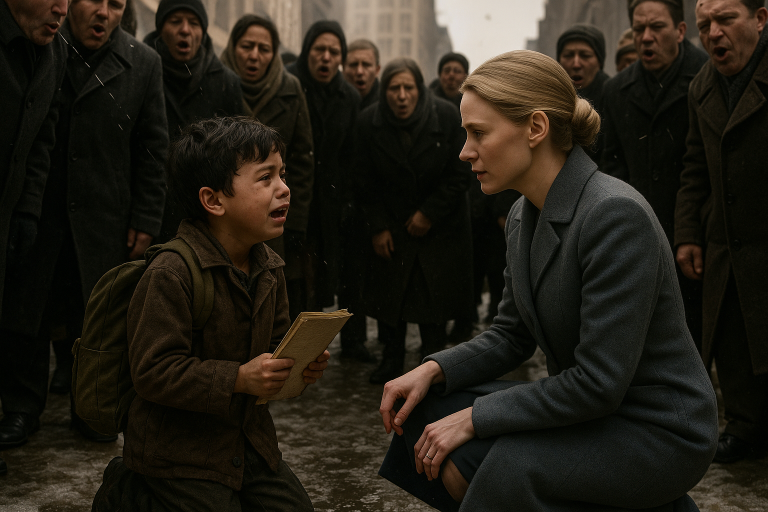
It was an evening mass for the wealthy families of the district. I watched them pour out, a parade of cashmere, wool, and leather. Men in dark overcoats holding the hands of women in furs. Children bundled up so tight they looked like little marshmallows, their eyes bright with the anticipation of Santa Claus.
I shrank back against the stone railing. This was the hardest part. The Invisibility.
I learned quickly that when you’re homeless, you become a ghost. People look right through you. Or worse, they look at you, but their eyes slide away instantly, terrified that if they make eye contact, your bad luck might be contagious.
A group of teenagers walked past, laughing, their breath clouding in the air. One of them, a boy in a varsity jacket, glanced at me. He didn’t look sad. He looked annoyed. Like I was a piece of trash someone had forgotten to sweep up before the holiday.
“Gross,” I heard him mutter to his girlfriend. “Why doesn’t the church move them along?”
I didn’t say anything. I didn’t have the energy to be angry. The cold does that to you—it steals your fight. I just pulled my knees tighter to my chest, shivering so hard my teeth clacked together.
I was debating whether to try and find a cardboard box behind the appliance store or just stay here and risk freezing to death. Honestly, freezing felt like the easier option. It would be like going to sleep. Just drifting away.
Then I heard it. A sound that cut through the wind.
“Daddy, look!”
It was a small, bright voice. A voice that hadn’t learned to whisper yet.
I lifted my head. My neck cracked, stiff from the chill.
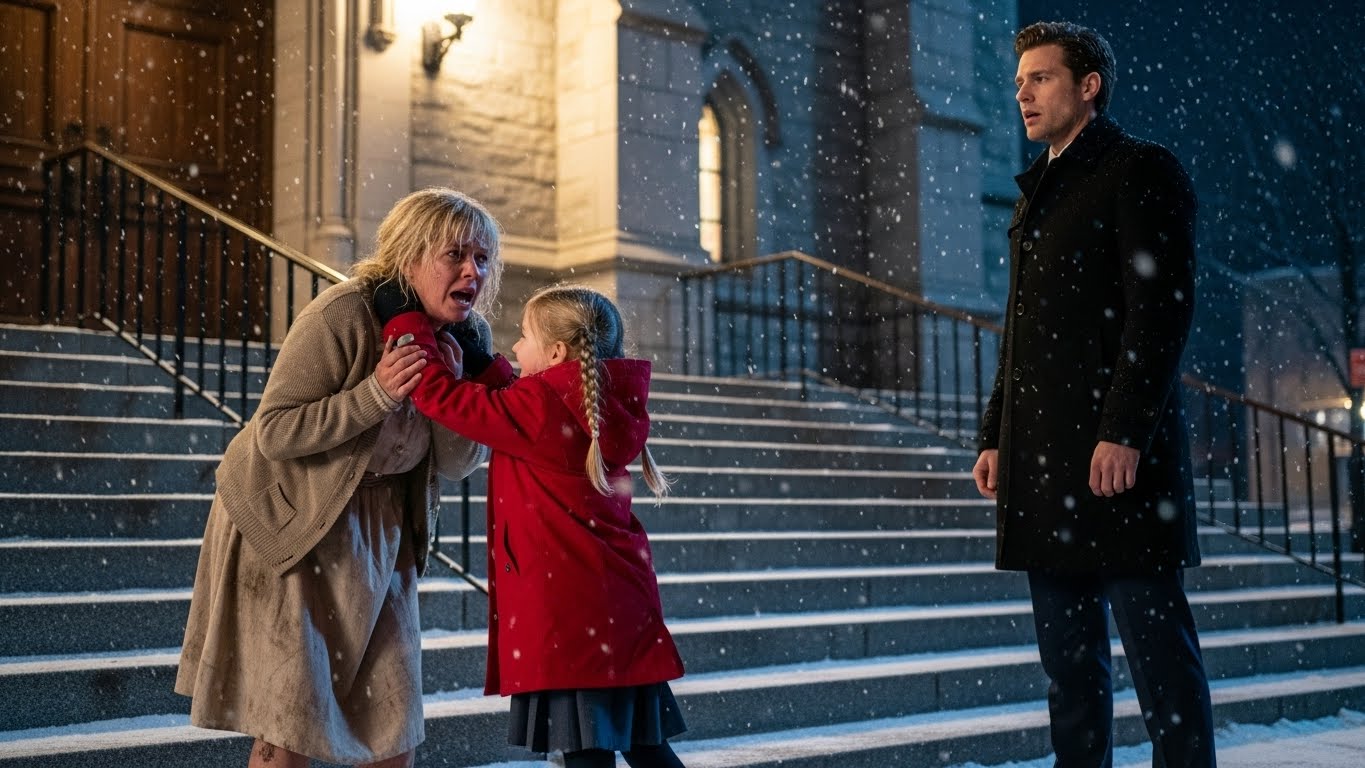
Standing about ten feet away, near the bottom of the main stairs, was a little girl. She couldn’t have been more than three. She was a vision of Christmas—blonde pigtails bouncing, a pristine red wool coat with shiny gold buttons, and tiny black patent leather boots.
She wasn’t looking through me. She was pointing directly at me.
Her finger was gloved in red knit, a stark accusation in the white snow.
“Emma, don’t point,” a man’s voice clipped.
I shifted my gaze to the father. He was tall, broad-shouldered, wearing a black trench coat that fit him perfectly. He had the kind of face you see in business magazines—handsome, sharp, and currently etched with impatience. He was checking his watch with one hand and gripping the little girl’s hand with the other.
“Come on, sweetie. Grammy is waiting. We have to get to the car.”
“But Daddy,” the girl—Emma—dug her heels into the slush. She refused to move. “Why is that lady sitting in the snow?”
The question hung in the air, louder than the car horns in the distance.
The man, Michael, sighed. He glanced at me.
Our eyes met.
For a second, I saw the calculation in his gaze. He saw the dirt on my face. The matted hair. The bare feet. He was assessing the threat level. Was I on drugs? Was I crazy? Was I going to ask for money?
“She’s just… resting, Emma. Come on.” He pulled her hand harder this time.
He was lying to her. He was teaching her the lesson everyone else had learned: Ignore the broken things. Keep walking.
But Emma wasn’t ready to learn that lesson.
“She doesn’t have shoes!” Emma shouted, her voice rising in distress. “Daddy, look! Her feet are purple! She’s hurting!”
The man froze. He looked down at his daughter, then back at me. I saw his gaze drop to my feet buried in the snow. I instinctively tried to hide them, tucking them under my dress, shame burning my cheeks hotter than the frostbite.
“I know, honey,” he said, his voice softer now, but still firm. “But we can’t do anything about it right now. We need to go.”
“No!”
The scream startled me. It startled him, too.
Emma yanked her hand. It was a violent, desperate motion. The man’s grip, loosened by surprise and wet leather gloves, slipped.
She was free.
And she ran. Not away from me—but toward me.
Chapter 2: The Hug That Broke Me
Panic spiked in my chest. Not for me, but for her.
I was filthy. I hadn’t showered in weeks. I carried the smell of the city’s underbelly—stale alleyways, damp clothes, and fear. She was perfect and clean. I didn’t want to contaminate her.
“No, sweetie, don’t,” I rasped out. My voice was a broken croak, unused for days.
She didn’t listen. She scrambled up the slick steps, her little boots crunching in the snow, until she was standing right in front of me.
Up close, her eyes were an impossible shade of blue. They were wide, searching, and completely devoid of judgment. She didn’t see a homeless woman. She just saw a person who was cold.
“Hi,” she said, panting slightly, her breath puffing in my face. “I’m Emma.”
I pressed my back harder against the stone railing, trying to put distance between us. “I’m… Anna.”
“Where are your shoes, Anna?” she asked, her brow furrowing. “Did you lose them?”
“They broke,” I whispered. “I don’t have any others.”
“Is your mommy coming to bring you new ones?”
The question hit me like a physical punch to the gut. Mommy. The image of my mother in the hospice bed, holding my hand, telling me to be brave, flashed before my eyes.
“No,” I choked out, tears instantly welling up, hot and stinging against my frozen skin. “I… I don’t have a mommy anymore. I don’t have anyone.”
Emma stared at me. She processed this information with the serious gravity only a toddler can muster. Her face crumpled. It wasn’t pity—it was pure, unadulterated heartbreak.
“No mommy?” she whispered. “And no shoes?”
I shook my head, unable to speak. I looked past her, waiting for the father to storm up the stairs and snatch her away. Waiting for him to yell at me for upsetting his child.
But he was standing at the bottom of the steps, frozen. He was watching us.
Emma took a step closer. She looked me right in the eye.
“I think you need a hug,” she declared.
It wasn’t an offer. It was a diagnosis.
Before I could protest, before I could say I’m dirty or please don’t, she stepped into my personal space. She opened her arms and wrapped them around my neck.
She buried her face in the crook of my shoulder, right against my dirty, matted hair.
The contact was electric. I hadn’t been touched—truly touched with kindness—in eight months. I had been shoved, pushed, and grabbed by security guards. But I hadn’t been held.
The warmth of her small body seeped through my thin dress. She smelled like sugar cookies and expensive laundry detergent. She smelled like home.
I tried to stay rigid. I tried to be strong. But the dam broke.
A sob ripped out of my throat, a guttural, ugly sound. I crumbled forward, wrapping my arms carefully around her small back, terrified I might crush her, and just wept. I cried for the apartment I lost. I cried for my mom. I cried for the shame of sitting in the snow while the world walked by.
“It’s okay,” Emma patted my back with a clumsy, gloved hand. “It’s okay to be sad.”
I don’t know how long we stayed like that. Maybe ten seconds. Maybe an hour.
Then I heard the boots. Heavy. Crunching snow. Fast.
Here it comes, I thought. The anger.
I pulled away from Emma, wiping my face frantically with my dirty hands. I looked up, terrified.
“I’m sorry,” I blurted out to the man towering over us. “I didn’t mean to touch her. I’m sorry, I’m leaving. I’ll go.”
I started to scramble to my feet, but my frozen legs wouldn’t cooperate. I stumbled.
“Stop,” the man said.
His voice was rough. Tight.
I flinched, expecting him to yell.
Instead, he dropped to his knees. right there in the slush. His expensive suit pants soaked up the freezing water instantly, but he didn’t seem to notice.
He wasn’t looking at me with anger. He was looking at me with wet eyes.
“Don’t apologize,” he said, his voice shaking. “My God… do not apologize to me.”
He reached out a hand, hovering near my shoulder, as if asking permission. “My daughter… she saw what I refused to see. She saw a human being.”
He looked at Emma, who was beaming at him, then back at me. He took a deep breath, like he was making a decision that scared him.
“My name is Michael,” he said. “And we are not leaving you here.”
“I… I’m fine,” I lied, my teeth chattering so hard I bit my tongue. “I’ll go to the shelter.”
“The shelters are full. It’s Christmas Eve,” Michael said sharply. Then his voice softened. “You’re freezing, Anna. You are literally turning blue. We’re going to my mother’s house for dinner.”
“I can’t,” I whispered, the shame burning me again. “Look at me. I’m a mess. I can’t go to a fancy dinner.”
Michael stood up. He unbuttoned his heavy black trench coat and shrugged it off. The blast of cold air must have hit him through his suit, but he didn’t flinch. He draped the heavy wool over my shoulders.
It was heavy, warm, and smelled of cedar and cologne.
“You can,” Michael said firmly. “And you will. My mother always sets an extra place at the table. She says, ‘You never know who might need a seat.’ Tonight, that seat is for you.”
“Please come?” Emma asked, taking my hand again. Her little fingers squeezed mine through her mittens. “Santa comes to Grammy’s house. He can bring you shoes.”
I looked at the two of them. A businessman who looked like he had the weight of the world on his shoulders, and a little girl who looked like an angel.
I looked at the snow piling up on my dead mother’s favorite dress—the only thing I had left of her.
“Okay,” I whispered. “Okay.”
Chapter 3: The Longest Mile
Michael didn’t let me walk.
When I tried to stand, my legs buckled. The blood rushing back into my frozen feet felt like needles of fire. Before I could hit the ground, Michael scooped me up.
He lifted me effortlessly, one arm under my knees, the other supporting my back. I stiffened, acutely aware of how light I was. I hadn’t eaten a real meal in three days. I felt like a bag of bird bones in his arms.
“I’m getting your coat dirty,” I mumbled into his chest.
“I can buy a new coat,” he said, his jaw set tight. “I can’t buy a clear conscience if I leave you here.”
He carried me to the curb where a sleek, black luxury sedan was idling. It looked like a spaceship compared to the rusted-out hatchback I used to own. He opened the back door and gently set me down on the leather seats.
Emma scrambled in beside me, buckling herself into her booster seat with practiced efficiency.
“It’s warm in here!” she chirped.
It was. It was overwhelmingly warm. The heat blasted from the vents, wrapping around me like a blanket. But instead of feeling good, it made my skin prickle and burn. My body was confused, vibrating between the memory of the cold and the shock of the heat.
Michael got into the driver’s seat. He didn’t look back, but I saw his eyes in the rearview mirror. He looked haunted.
As he pulled away from the curb, leaving the church and the other homeless people behind, a wave of guilt crashed over me. Why me? Why did I get the warm car? Just because a little girl liked my hair? Just because I happened to be sitting on those steps?
“Are you hungry?” Emma asked, breaking the silence. She was swinging her legs, kicking the back of the passenger seat.
“A little,” I lied. I was starving. My stomach felt like a hollowed-out cave.
“Grammy makes the best mashed potatoes,” Emma confided. “But don’t eat the green bean casserole. It has crunchy onions, but the green stuff is yucky.”
I managed a weak smile. “Thanks for the tip.”
The car glided through the city. We left the downtown area, with its grimy snow and neon signs, and moved into the suburbs. The houses got bigger. The Christmas lights got more elaborate.
I watched the world pass by through the tinted window. I saw families in living rooms, silhouettes against warm yellow light. I saw trees piled high with gifts.
For the last eight months, that world had been behind glass. I was on the outside, looking in. Now, suddenly, I was in the bubble. And it terrified me.
What if this is a trick? The thought whispered in the back of my mind. What if he’s crazy? What if he takes me somewhere and hurts me?
But then I looked at Emma. She was humming “Jingle Bells” off-key, trying to unzip her boots. And I looked at Michael’s hands on the steering wheel—white-knuckled, gripping tight. He wasn’t angry. He was terrified, too. He had just picked up a stray human being and was bringing her to his mother’s house. He was breaking every social rule in the book.
“We’re almost there,” Michael said. His voice startled me.
“Does… does your mother know I’m coming?” I asked, my voice trembling.
“No,” Michael admitted.
My heart hammered against my ribs. “She’s going to be angry. She’s going to throw me out.”
“My mother?” Michael let out a short, dry laugh. “You don’t know Patricia Crawford. If I didn’t bring you, she’s the one who would throw me out.”
He turned the car into a driveway that seemed to go on for miles.
The house was massive. A Colonial-style mansion with white pillars and a wreath on the door the size of a tractor tire. Every window was glowing. There were reindeer made of white lights on the lawn.
Panic seized my throat. This wasn’t just a house. This was wealth. Old wealth. The kind of place where the napkins are linen and the people judge you by your shoes.
And I didn’t have any shoes.
“I can’t go in there,” I whispered, clutching Michael’s coat tighter around me. “Please, just drop me at a bus station. I’ll ruin the floor.”
Michael put the car in park. He turned around in his seat to face me. The engine hummed beneath us.
“Anna,” he said. He used my name. “Look at me.”
I met his gaze.
“You are not dirt,” he said, enunciating every word. “You are a guest. And in this family, we take care of our guests.”
He opened his door. “Now, let’s go get you some dinner.”
Chapter 4: The Sanctuary
The front door opened before we even reached the top step.
I was huddled under Michael’s coat, Emma holding my hand like a lifeline, while Michael shielded me from the wind.
A woman stood in the doorway. She was older, maybe in her sixties, with silver hair styled in an elegant bob. She wore a deep green velvet dress and pearls. She looked like the queen of a small country.
This was Patricia.
I braced myself for the look. The sneer. The “What is that thing doing on my porch?” face.
Patricia looked at Michael. Then she looked at Emma. Then she looked at me—shivering, dirty, barefoot, wrapped in a man’s trench coat.
She didn’t blink. She didn’t gasp.
“Well,” she said, her voice crisp and authoritative. “Don’t just stand there letting the heat out. Get her inside.”
She stepped back, ushering us into a foyer that was bigger than my entire old apartment. It smelled of pine needles, roasting turkey, and expensive perfume. The floor was polished marble. I curled my toes, terrified of leaving a smudge.
“Michael, close the door,” Patricia commanded. She walked straight up to me.
I flinched, expecting a lecture.
Instead, she reached out and placed a hand on my cheek. Her palm was warm and soft.
“You’re freezing, child,” she murmured. Her eyes scanned me, taking in the damage—the thin dress, the purple feet, the exhaustion. “Michael, why is she still wearing wet clothes?”
“We just got here, Mom,” Michael said, sounding like a scolded teenager.
“Well, fix it,” she snapped, but there was no malice in it, only efficiency. “Emma, go tell your aunts to set another place at the table. Michael, get the first aid kit. I’m taking her upstairs.”
“I… I can’t,” I stammered. “I’m dirty. I’ll get everything dirty.”
Patricia laughed. It was a warm, throaty sound. “Honey, I raised three boys in this house. This floor has seen mud, blood, and worse. dirt washes off. Now come with me.”
She didn’t give me a choice. She took my arm—gently, but firmly—and led me toward a grand staircase.
Ten minutes later, I was sitting on the edge of a clawfoot bathtub in a bathroom that looked like a spa. Steam filled the air. Patricia was bustling around, pulling fluffy white towels from a cabinet.
“Here,” she said, setting a stack of clothes on the vanity. “These belonged to my daughter, Sarah. She’s about your size. They’re clean.”
She turned the taps off. The bath was full of bubbles.
“Take your time,” she said softly. “Lock the door if you want. Nobody will disturb you. There’s a razor, shampoo, soap… use whatever you need.”
She started to leave, then stopped at the door.
“What’s your name, honey?”
“Anna,” I whispered.
“Well, Anna,” Patricia said, her expression softening into something incredibly tender. “I’m glad you’re here. Christmas wouldn’t be right without you.”
She closed the door.
I was alone.
I stood in front of the mirror. For the first time in months, I really looked at myself.
The woman staring back was a stranger. Her face was gaunt, cheekbones protruding sharply. There were dark circles under her eyes that looked like bruises. Her hair was a tangled bird’s nest of grease and dirt.
I looked like a ghost.
I stripped off the filthy beige dress. I peeled off Michael’s coat.
I stepped into the water.
It burned at first, then it soothed. I sank down until the water covered my shoulders. I scrubbed my skin until it was raw. I washed my hair three times, watching the grey water swirl down the drain.
I wasn’t just washing off dirt. I was washing off the invisibility. I was washing off the shame.
When I finally stepped out, wrapped in a towel that felt like a cloud, and put on the clothes Patricia had left—soft grey leggings and an oversized cashmere sweater—I looked in the mirror again.
The ghost was gone. The woman looking back was still thin, still tired, still scared.
But she was clean. She was warm.
And for the first time in a long time, she was visible.
I took a deep breath, opened the bathroom door, and walked toward the smell of dinner.Chapter 5: A Seat at the Table
Walking down the stairs felt harder than surviving the winter.
I clutched the banister, my knuckles white. I was clean. I was wearing soft clothes that smelled like lavender. But inside, I was still the shivering girl from the steps. I was terrified that the moment I walked into the dining room, the illusion would shatter. They would see me for what I was: a charity case, an intruder, a mess.
I heard laughter drifting from the dining room. The clinking of silverware. The low hum of comfortable conversation. It was the soundtrack of a life I used to have, a life that felt like a dream now.
“Anna!”
Emma’s voice pierced the anxiety.
She came running into the hallway, abandoning her dinner. She looked at me and gasped.
“You look like a princess!” she shouted, throwing her arms up.
I managed a weak, watery smile. “I think you’re the princess, Emma.”
“Come on! Daddy saved you a seat next to me.”
She grabbed my hand—my clean, warm hand—and pulled me into the lion’s den.
The dining room was magnificent. A long mahogany table was laden with food: a golden turkey, bowls of mashed potatoes, roasted vegetables, cranberry sauce. But it was the people who terrified me.
There were about ten of them. Michael, Patricia, a younger couple who must have been siblings, and a few teenagers glued to their phones.
When I walked in, the room went quiet. Not a hostile silence. A curious one.
Michael stood up immediately. He had changed out of his suit into a sweater and jeans, looking less like a titan of industry and more like a dad.
“Anna,” he said, smiling. It was a genuine smile, reaching his eyes. “You look… much warmer.”
“Thank you,” I whispered, gripping the back of the chair he pulled out for me. “Thank you for the clothes. And… everything.”
“Sit, sit!” Patricia commanded from the head of the table. “The gravy is getting cold, and that is a sin in this house.”
I sat.
I stared at the empty plate in front of me. fine china with a gold rim. Beside it, three different forks. I panicked. Which fork? I used to know this. My mom taught me this. But the street erases your manners; it replaces them with survival instincts. On the street, you don’t use a salad fork; you eat with your hands before someone steals your food.
“Start from the outside and work your way in,” a soft voice whispered.
I looked up. It was the woman sitting across from me—Michael’s sister, probably. She gave me a conspiratorial wink.
“I always forget, too,” she lied kindly. “I’m Sarah. It’s nice to meet you.”
“I’m wearing your clothes,” I blurted out. Then I blushed, horrified. “I mean… Patricia said…”
“They look better on you,” Sarah said firmly. “Seriously. Keep them.”
As the food was passed around, something miraculous happened. They didn’t grill me. They didn’t ask, “Why are you homeless?” or “Are you an addict?” or “Where do you sleep?”
They talked about the football game. They argued about whether Die Hard is a Christmas movie (Michael said yes, Patricia said absolutely not). They complained about the traffic.
They let me just be.
For the first twenty minutes, I couldn’t eat. My throat was too tight. I just drank the water, feeling it cool my parched throat.
But then Emma, who was sitting beside me, nudge a roll onto my plate.
“You have to eat,” she whispered loudly. “Or Grammy gets mad.”
I took a bite. The taste of butter and warm bread hit my tongue, and my stomach roared to life. I ate. I ate roast turkey and stuffing and beans (avoiding the green ones, per Emma’s advice).
With every bite, the cold receded a little further. With every laugh shared around the table, the invisibility cloak I’d worn for eight months began to dissolve.
I wasn’t a ghost anymore. I was Anna. I was sitting at a table. I was alive.
Chapter 6: The Empty Chair
After dinner, the family moved into the living room for coffee and pie. The teenagers disappeared into the basement to play video games. Emma fell asleep on the rug in front of the fireplace, clutching a new teddy bear.
I stood by the window, watching the snow fall. It looked beautiful from this side of the glass. Safe.
“It’s coming down hard,” a voice said beside me.
It was Michael. He held out a mug of coffee. “Decaf. My mom says you need to sleep tonight, not jitter.”
“Thank you,” I took the mug. The ceramic warmed my palms. “Michael… I don’t know how to thank you. You didn’t have to do any of this.”
He looked out at the snow, his expression darkening.
“I almost didn’t,” he confessed quietly. “When I saw you on the steps… my first instinct was to walk away. To protect Emma. To pretend you weren’t there.”
“That’s normal,” I said. “Everyone does that.”
“It shouldn’t be normal,” he said sharply. He took a sip of his coffee. “Do you know why Emma is the way she is? Why she ran to you?”
I shook my head.
“Her mother,” Michael said. The pain in his voice was raw, like an open wound. “Rachel. She died two years ago. Car accident.”
My breath hitched. “I’m so sorry, Michael.”
“Rachel was… she was light,” he continued, staring at his reflection in the dark glass. “She volunteered at the shelter downtown every Tuesday. She kept protein bars in her purse for people on the street. She taught Emma that everyone has a story, and everyone deserves to be seen.”
He turned to look at me.
“When Rachel died, I shut down. I got angry. I focused on making money, on controlling everything, on keeping Emma safe in a bubble. I forgot everything Rachel tried to teach us.”
He nodded toward the sleeping little girl on the rug.
“Tonight, when Emma ran to you… it was like seeing Rachel again. She defied me. She defied the logic of the ‘safe’ world to help someone. And when I looked at you, really looked at you… I saw that you were just a person. A person having the worst time of her life.”
He paused, swallowing hard.
“I realized that if Rachel were here, she would have been holding your hand long before Emma did. And I felt ashamed. I’m trying to be the man she wanted me to be. I’m failing mostly. But tonight… tonight felt like a start.”
I looked at him—this powerful, wealthy man who was just as broken on the inside as I was on the outside. Grief is the great equalizer. It doesn’t care about your bank account.
“You’re not failing,” I whispered. “You saved me. You literally saved my life tonight, Michael. Rachel would be proud.”
Michael’s eyes shimmered. He reached out and squeezed my shoulder.
“You’re not going back to the street, Anna,” he said. It wasn’t a suggestion. “We have a guest cottage in the back. It’s heated. It has a kitchen. You’re staying there until you’re back on your feet.”
“Michael, I can’t—”
“You can,” he interrupted. “Consider it a Christmas present. For me. I need to know you’re safe so I can sleep at night.”
I looked at Emma sleeping peacefully. I looked at the snow swirling violently outside.
“Okay,” I said, tears spilling over again. “Thank you.”
Chapter 7: The Climb
The next morning, I woke up in a bed that felt like a cloud. For a solid five seconds, I panicked, thinking I had broken into someone’s house. Then the memories of the night before rushed back. The dinner. The bath. The cottage.
I wasn’t homeless. Not today.
I walked to the window of the guest cottage. The world was buried in white, but the sun was shining.
There was a knock on the door. It was Patricia. She was holding a garment bag and a laptop.
“Good morning, sunshine,” she breezed in, setting the items on the small table. “Coffee is brewing in the main house, but we have work to do.”
“Work?” I rubbed the sleep from my eyes.
“Michael tells me you were a graphic designer,” she said, pulling a chair out. “Is that true?”
“Yes,” I said, surprised. “Before… everything.”
“Good. My charity foundation needs a new logo and a brochure redesign. Our current one looks like it was made in Paint by a blindfolded toddler. I’m hiring you.”
I stared at her. “Patricia, you don’t have to create a fake job for me.”
She stopped unpacking the laptop and looked at me sternly. “Anna, look at this face. Do I look like the kind of woman who pays for work she doesn’t need? I need a designer. You need a portfolio. And money. It’s a transaction. Now, get dressed. We have a deadline.”
That was the beginning.
The next three weeks were a blur of activity. The Crawfords didn’t just give me money; they gave me something far more valuable. They gave me purpose.
Patricia kept me busy with design work, paying me a fair market rate (actually, probably double, though she denied it). Michael used his network. He made calls. He didn’t ask for favors; he simply told his business contacts, “I know a talented designer who is available immediately. You should interview her.”
But the hardest part wasn’t the work. It was the mental battle.
Every time I walked into a store to buy groceries with the money I’d earned, I flinched, expecting the security guard to kick me out. Every time I signed a document, my hand shook. The trauma of the street doesn’t vanish overnight. It lingers in the way you hoard food, the way you sleep with one eye open.
One afternoon, Michael found me sitting in the cottage, staring at a rental application for a small studio apartment. I was crying.
“What’s wrong?” he asked, alarmed. “Is it the application fee? I can cover it.”
“No,” I wiped my eyes. “It’s just… they want rental history. They want references. I have an eight-month gap where I didn’t exist, Michael. Who’s going to rent to me?”
Michael sat down opposite me. He took the pen from my hand.
In the section for “Current Landlord,” he wrote: Michael Crawford. In the section for “Phone Number,” he wrote his personal cell.
“You have a rental history,” he said calmly. “You’ve been renting my guest cottage. You’re an excellent tenant. Quiet. Clean. Pays on time.”
He looked at me. “And for the character reference? put Patricia. God help the landlord who calls her and tries to deny you.”
I laughed. A real, genuine laugh that bubbled up from my chest.
“You guys are crazy,” I said.
“We’re family,” Michael corrected.
The word hung in the air. Heavy. warm.
“Family,” I repeated, testing the weight of it.
Two weeks later, I moved into my own apartment. It was small. The view was of a brick wall. But it had a lock on the door. It had a shower. And the lease had my name on it.
Chapter 8: The Ripple Effect
Six Months Later
The sun was setting, casting long golden shadows across the Crawford’s lawn. It was summer now. The snow was a distant memory, replaced by blooming hydrangeas and the sound of cicadas.
I parked my car—a used Honda Civic I’d bought last month—in the driveway.
I checked my reflection in the rearview mirror. The woman staring back was healthy. Her hair was cut in a stylish bob. Her cheeks had color. Her eyes were bright, focused, and alive.
I grabbed the box of pastries from the passenger seat and walked up the path. I didn’t need to knock anymore, but I rang the bell anyway out of habit.
The door flew open.
“ANNA!”
Emma, now almost four, launched herself at my legs. She was wearing a sundress and covered in chalk dust.
“I drew a picture of you on the driveway!” she squealed. “Come see!”
I picked her up—she felt heavier than she had in the winter—and hugged her tight. “I want to see it. But first, I brought bribery.” I held up the pastries.
Michael appeared in the doorway behind her. He looked relaxed, happy. The haunted look was gone from his eyes, too. We had saved each other, in a way.
“You’re late,” he teased. “Mom is threatening to start the grill without you.”
“I had a client meeting that ran over,” I said, walking inside. “People talk too much.”
“Look at you,” Michael grinned, taking the box from me. “Complaining about clients. You’re a full-blown professional.”
We walked out to the back patio where Patricia was presiding over the barbecue with a glass of Chardonnay in hand. When she saw me, her face lit up.
“There she is! The prodigal daughter.”
We sat down to dinner as the fireflies started to come out. We ate burgers and corn on the cob. We laughed about Emma’s chalk art. It was perfectly, wonderfully mundane.
As the evening wound down, I found myself sitting on the patio steps with Emma, watching the stars appear.
“Anna?” Emma asked, leaning her head on my shoulder.
“Yeah, sweetie?”
“Do you remember when I gave you a hug in the snow?”
I smiled, stroking her hair. “I remember every second of it.”
“Why were you sad that day?” she asked innocently.
I thought about how to answer. I could tell her about the economy, about grief, about the cruelty of the system. But she was four.
“I was sad because I forgot that I mattered,” I said softly. “I thought nobody could see me. And then you saw me.”
Emma nodded, as if this made perfect sense. “You’re hard to miss, Anna. You’re my best friend.”
I looked back at the house. Through the sliding glass door, I could see Michael and Patricia cleaning up the kitchen. They were laughing.
Six months ago, I was ready to close my eyes and never wake up. I was a statistic. A nuisance. A ghost.
But it didn’t take a government program to save me. It didn’t take a million dollars.
It took one little girl who hadn’t learned to be indifferent yet. It took a father who was willing to be uncomfortable. It took a mother who opened her door instead of locking it.
It took a hug.
I squeezed Emma back.
“You’re my best friend too, Em.”
I looked up at the moon, full and bright above the trees. I wasn’t just surviving anymore. I was home.
And I promised myself, right then and there, that I would never walk past someone in the cold. I would never look away. Because I knew the secret now. I knew the truth that most of the world forgets.
We are all just one bad break away from the steps. And we are all just one hug away from being saved.
THE END.