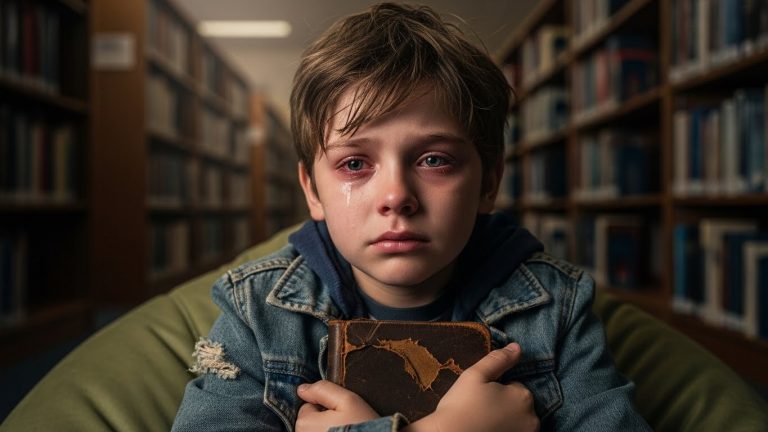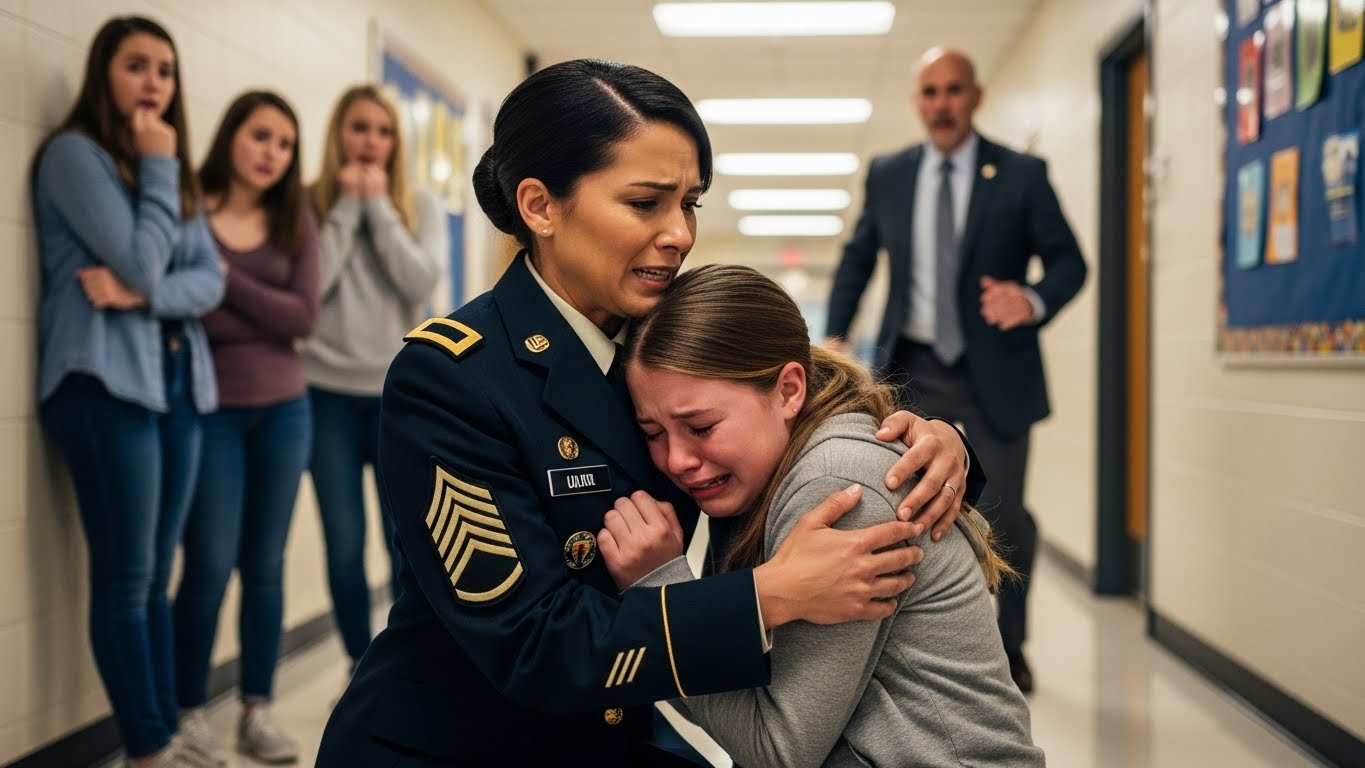
They thought locking my daughter in a filth-ridden stall was a game. They didn’t know her Sergeant mother just walked through the front door.
PART 1
Chapter 1: The Long Way Home
Eighteen months.
That’s five hundred and forty-seven days.
Five hundred and forty-seven days of staring at the ceiling of a barracks, listening to the hum of a generator, wondering if my little girl, Lily, remembered the sound of my voice.
I was deployed to a base where the sand gets into your teeth and never leaves. But the hardest part wasn’t the heat, or the drills, or the constant state of hyper-vigilance. It was the silence on the other end of the phone.
Lily used to bubble over with stories. About her drawings, her weird science teacher, the stray cat she named “Tank.”
But three months ago, the calls changed. She got quiet. She’d say, “School’s fine, Mom,” in a voice so small it cracked my heart right down the middle.
My mother’s intuition—that primal alarm system that screams louder than any siren—told me something was wrong. But I was 6,000 miles away. Helpless.
When my commanding officer told me my leave was approved early, I didn’t tell a soul. I wanted to surprise her. I wanted to walk through the front doors of Oak Creek Middle School, pick her up in my arms, and take her for the biggest ice cream sundae in the state.
I didn’t change out of my fatigues. I literally hopped a transport, then a commercial flight, then a cab straight to the school. I smelled like jet fuel and stale coffee, but I didn’t care.
I checked in at the front office. The secretary, Mrs. Higgins, almost dropped her coffee mug.
“Sergeant Miller! Oh my god, Lily doesn’t know?”
“No,” I smiled, though my hands were shaking. “Where is she?”
“It’s fourth period. Lunch break. She should be in the cafeteria.”
I thanked her and headed down the main corridor. The school smelled the same as it did twenty years ago—floor wax and old textbooks.
But as I turned the corner toward the cafeteria, my training kicked in.
Soldiers know the sound of distress. We are tuned to a specific frequency of fear.
I didn’t hear the roar of the cafeteria. I heard laughter. Cruel, sharp, hyena-like laughter coming from the hallway to my left. The hallway where the old bathrooms were.
The hair on the back of my neck stood up.
I moved. I didn’t walk; I stalked. My boots were heavy on the linoleum, but I knew how to move quietly.
Chapter 2: The Ambush
There were three of them.
Three girls, maybe thirteen years old, standing outside the girls’ bathroom. They were leaning against the door. Actually, no—they weren’t just leaning.
They had wedged a janitor’s mop handle through the exterior handle of the bathroom door and were using their body weight to hold it shut.
“Let me out! Please!”
The voice was muffled, thick with tears, hyperventilating.
It was Lily.
One of the girls, a blonde with a high ponytail, laughed and banged her fist on the wood. “Say it louder, Lily! Tell us you’re a loser! Maybe then the door will magically open!”
“I can’t breathe in here! Please, it smells!” Lily screamed, her voice cracking into a sob that sounded like she was drowning.
“Aww, the little artist can’t breathe?” another girl sneered, filming the door with her phone. “Maybe your mom will come save you? Oh wait, she’s gone because she probably hates you!”
Red.
I saw absolute red.
The combat stress, the discipline, the rules of engagement—they all vanished. In that moment, I wasn’t Sergeant Miller. I was a mother wolf coming home to find jackals circling her cub.
I dropped my duffel bag. It hit the floor with a heavy, dull thud.
The sound echoed like a gunshot in the empty hallway.
The girls jumped. The one filming spun around.
Her phone clattered to the floor.
They saw me.
They saw the boots. The camouflage. The rank insignia on my chest.
And they saw my eyes.
I didn’t say a word. I didn’t have to. I just took one step forward.
The blonde girl, the ringleader, went pale. Her hand slipped off the door handle.
“M-ma’am?” she squeaked.
I ignored her. I walked right through the space they were occupying. They scattered like roaches when the lights turn on.
I grabbed the mop handle that was jamming the door and ripped it out with a force that splintered the wood. I threw it down the hall.
“Lily?” I said, my voice changing from steel to velvet in a split second. “Baby, it’s Mom.”
The sobbing inside stopped instantly.
Silence.
Then, a tiny, disbelief-filled whisper. “…Mom?”
I pushed the door open.
PART 2
Chapter 3: The Assessment
The smell hit me first. It was that acrid mix of industrial cleaner and stale sewage.
But what I saw broke me.
Lily was curled up in the corner of the furthest stall. The door to the stall had been kicked in—likely by the girls before they trapped her in the main room.
She was hugging her knees. Her sketchbook, her prized possession, was floating in the toilet bowl, ruining months of her drawings. Her hair was matted with something sticky—soda, maybe? Or juice.
She looked up, her eyes red and swollen, blinking against the harsh fluorescent light. She looked terrified, as if she was hallucinating.
“Mom?” she choked out again.
I didn’t care about the grime. I dropped to my knees on that filthy tile floor and pulled her into me.
She collapsed against my chest, wailing. It wasn’t a cry of sadness; it was a cry of pure release. The kind of cry you let out when you realize you don’t have to be strong anymore.
I held her so tight I was afraid I’d bruise her. I rocked her, whispering into her messy hair. “I’ve got you. I’m here. I’m home. Nobody touches you again. I promise.”
Over her shoulder, I saw the girls trying to sneak away.
Oh, no.
“FREEZE!”
My voice was the one I used on the drill field. It wasn’t a shout; it was a command that vibrated in your bones.
The three girls stopped dead in their tracks, about ten feet down the hallway.
I stood up, helping Lily to her feet. I wiped a tear from her cheek with my thumb, smearing a bit of the dirt on her face.
“Stay here, baby,” I whispered. “Just for a second.”
I stepped out of the bathroom.
The girls were huddled together now. The arrogance was gone. The ‘Queen Bee’ attitude had evaporated the second an adult with actual authority showed up.
“We… we were just playing,” the blonde one stammered, her eyes darting around for an exit.
“Playing?” I repeated, walking toward them. My boots crunched on the plastic of the phone the other girl had dropped.
I stopped two feet in front of them. I towered over them.
“You trapped a human being in a confined space. You destroyed her property. You psychologically tortured her. In my world, that’s not playing. That’s a war crime.”
The girl who had been filming started to cry. “We didn’t mean it…”
“You meant every second of it,” I said, my voice low and dangerous. “You filmed it. You wanted a trophy.”
I pointed a finger at the blonde one. “What is your name?”
“M-Mackenzie,” she whispered.
“Well, Mackenzie. You have made a severe tactical error.”
Just then, the double doors at the end of the hall burst open. A man in a suit came running, followed by Mrs. Higgins from the front office.
It was Principal Skinner.
“What is going on here?” he demanded, breathless. “I heard shouting.”
He looked at me, then at the terrified girls, then at Lily, who was standing in the bathroom doorway, trembling.
“Sergeant Miller,” he said, adjusting his tie, trying to regain control. “Welcome back. I… I see there’s been a situation.”
“A situation?” I laughed, but there was no humor in it. “Principal, I just walked in to find these three holding my daughter hostage in a bathroom while she had a panic attack. I want the police called. Now.”
Chapter 4: The Bureaucracy of Cruelty
Principal Skinner’s face went from flushed to pale. He held up his hands in a placating gesture.
“Now, now, Sergeant. Let’s not overreact. ‘Hostage’ is a strong word. Kids will be kids. I’m sure it was just a misunderstanding.”
I stared at him. I had seen officers make bad calls in the field, but this kind of willful blindness made my blood boil.
“A misunderstanding?” I pointed to the bathroom. “Her sketchbook is in the toilet. The door was jammed with a mop handle. That is premeditated.”
“We have a zero-tolerance policy for bullying, of course,” Skinner said, sweating. “But calling the police? These are good students. Mackenzie’s father is on the school board.”
Ah. There it was.
The politics.
I stepped closer to Skinner. “I don’t care if her father is the President of the United States. They assaulted my daughter.”
Mackenzie, sensing an ally, piped up. “She started it! She threw water on us!”
I looked at Lily. She shook her head violently, fresh tears spilling over. “I didn’t! I was just washing my hands and they came in and…”
“Silence!” I barked, cutting off the lie.
I turned back to Skinner. “Here is what is going to happen. You are going to call the police to file a report for unlawful imprisonment and destruction of property. Or, I will call the Military Police and the local news station. I’m sure the headline ‘War Hero Returns to Find Daughter Tortured at Local School’ will do wonders for your next board meeting.”
Skinner froze. He knew I wasn’t bluffing.
“Mrs. Higgins,” I said, not looking away from the Principal. “Call the police.”
Mrs. Higgins, who looked like she wanted to applaud, nodded vigorously and pulled out her cell phone.
“Fine,” Skinner hissed. “But let’s move this to my office. We are causing a scene.”
“No,” I said firmly. “We aren’t going anywhere until the officers arrive. I want them to see the crime scene exactly as I found it. Nobody touches that bathroom.”
I walked back to Lily. I took off my uniform jacket—the one with my name tape and the flag—and wrapped it around her shoulders. It swallowed her small frame.
“Put this on,” I said.
She pulled it tight, burying her nose in the fabric. It smelled like me. It smelled like safety.
” Mom,” she whispered. “I missed you.”
“I missed you too, bug. I missed you every single second.”
I stood guard in front of that bathroom door, arms crossed, watching the three bullies and the spineless principal. I wasn’t moving. I was holding the perimeter.
And for the first time in months, Lily stopped shaking.Chapter 5: The Digital Fingerprint
The wait for the police felt longer than any recon mission I’d ever sat through. The hallway was suffocatingly silent, save for the occasional sniffle from one of the girls or the nervous tapping of Principal Skinner’s dress shoe against the tile.
Ten minutes later, two officers walked in. One was older, tired-looking. The other was younger, sharp-eyed, with a name tag that read “Officer Rodriguez.”
Rodriguez saw me first. He took in the uniform, the stance, the protective hand on my daughter’s shoulder. He nodded—a subtle, respectful acknowledgment between people who wear a badge or a flag for a living.
“Who called it in?” Rodriguez asked, his voice echoing slightly.
“I did,” Mrs. Higgins piped up from behind Skinner, looking surprisingly defiant.
Skinner stepped forward, his smile tight and oily. “Officers, really, this is just a schoolyard dispute. Sergeant Miller here is… understandably emotional. She just returned from active duty. We can handle this internally.”
I didn’t flinch. “Officer, I’d like to report an assault, unlawful imprisonment, and destruction of personal property.”
Rodriguez looked at Skinner, then at me. He walked over to the bathroom door. He saw the splintered wood where the mop handle had been jammed. He looked at the handle lying on the floor. He stepped inside and saw the kicked-in stall door and the sketchbook floating in the toilet.
He came back out, his face hard.
“This doesn’t look like a schoolyard dispute, Principal. This looks like a crime scene.”
He turned to the girls. “Which one of you filmed it?”
Mackenzie’s eyes went wide. “I… I didn’t…”
“Don’t lie to me,” Rodriguez said calmly. “I see the phone in your hand. Hand it over. Now.”
“You can’t do that!” the third girl, the quiet follower, shrieked. “That’s private property!”
“It’s evidence,” Rodriguez corrected. “If you recorded a crime, it’s evidence. Hand it over, or I’ll arrest you for obstruction right now.”
Mackenzie’s hand trembled as she unlocked the phone and handed it to him.
Rodriguez tapped the screen. He pressed play.
We all stood there. The volume was up.
The sound of Lily’s screams filled the hallway again. But this time, we heard the commentary.
“Look at the little rat,” Mackenzie’s voice on the recording sneered. “She’s actually crying. Hey Lily, does your mom kill people for a living? Maybe you should do the world a favor and join her.”
My stomach dropped. It wasn’t just bullying. It was hateful. It was targeted. They used my service—my sacrifice—as a weapon to hurt my child.
I felt Lily flinch under my jacket. I squeezed her shoulder. “I’m here,” I whispered. “I hear it. It’s over now.”
Rodriguez stopped the video. He looked at Mackenzie with pure disgust.
“You think that’s funny?” he asked quietly.
Mackenzie stared at her shoes.
“That video,” I said, my voice steady, “is going to the District Attorney. And I want a copy.”
“You’ll get it, Sergeant,” Rodriguez promised. “We’re taking statements now. We need to call parents.”
“My dad is going to sue you,” Mackenzie muttered, her defiance flickering back like a dying flame. “He’s on the board. He’ll have your badge.”
Rodriguez chuckled, a dry, humorless sound. “He can try, kid. But right now, you’re coming with us.”
Chapter 6: The Teflon Don
It took twenty minutes for the parents to arrive.
Mackenzie’s father, Mr. Vance, didn’t walk in; he stormed in. He was wearing a suit that cost more than my annual salary, and he carried an air of entitlement so thick you could choke on it.
“What is the meaning of this?” he bellowed, ignoring the police and zeroing in on Skinner. “Why is my daughter in handcuffs?”
She wasn’t in handcuffs—yet—but she was sitting on a bench, separated from her friends, looking small.
“Mr. Vance,” Skinner stammered. “There was an… incident.”
“Incident?” Vance turned his glare on me. He looked me up and down, sneering at my dusty combat boots and the fatigues. “And who is this? Security?”
“That is Sergeant Miller,” Officer Rodriguez interjected, stepping between them. “The mother of the victim.”
“Victim?” Vance laughed. “Please. My daughter is a straight-A student. She doesn’t create ‘victims.’ If there was a fight, I’m sure the other girl started it. Probably lack of discipline at home. You know how these military families are.”
The air left the room.
I gently moved Lily behind me. I handed my jacket to Mrs. Higgins to hold for a second.
I walked up to Mr. Vance. I stood toe-to-toe with him. I am not a tall woman, but in that moment, I felt ten feet tall.
“Mr. Vance,” I said. My voice was quiet. Dangerous. “You want to talk about discipline?”
“Excuse me?” he sputtered.
“I have spent the last eighteen months sleeping in the dirt, eating MREs, and getting shot at so that men like you can walk around in expensive suits and pretend you own the world. My discipline is what keeps you safe at night.”
He blinked, taken aback by the intensity.
“Your daughter,” I continued, pointing a finger at Mackenzie, “locked my child in a bathroom stall filled with filth. She destroyed her property. She told my daughter she should die. And she filmed it for fun.”
“Lies,” Vance spat. “Mackenzie is a good girl.”
“Officer Rodriguez,” I said, not breaking eye contact with Vance. “Play the video.”
Rodriguez held up the phone. He pressed play.
Vance watched. He listened to his daughter’s cruel laughter. He heard the vile things she said about me, about Lily, about life and death.
For a moment, his face wavered. But then, the ego took over. He couldn’t be wrong. He couldn’t lose face.
“So?” Vance scoffed. “Kids talk trash. It’s roughhousing. It’s not criminal. I’ll pay for the damn sketchbook. How much was it? Ten dollars? Here.”
He reached into his pocket and pulled out a money clip. He peeled off a hundred-dollar bill and threw it at my feet.
“Buy her ten sketchbooks. And teach her to toughen up.”
The bill fluttered to the floor, landing on the dirty linoleum.
Silence. Absolute, heavy silence.
I looked at the money. Then I looked at him.
“You think this is about money?” I asked.
“Everything is about money,” Vance smirked. “Now, Principal Skinner, I expect Mackenzie to be back in class in five minutes, or I’m calling the Superintendent regarding your tenure.”
Skinner looked like he was about to faint.
I picked up the hundred-dollar bill. I folded it neatly.
“Officer Rodriguez,” I said. “Is attempted bribery of a witness on the list of charges today?”
Rodriguez smiled. “It can be arranged.”
Vance’s face turned purple. “This is ridiculous! Do you know who I am?”
“I know exactly who you are,” I said. “You’re a bully who raised a bully. But here’s the thing about bullies, Mr. Vance. They only win when people are afraid. And I ran out of fear a long time ago.”
I turned to Skinner. “If that girl walks back into class today, or any day while my daughter is in this school, I will go to the press. I will go to social media. And I will post that video everywhere. I wonder how your investors will feel about their ‘family man’ raising a sociopath?”
Vance froze. The threat of public humiliation—that was the only language he understood.
“Fine,” Vance hissed. “We’re leaving. Mackenzie, get your things. We’re transferring.”
“No,” Rodriguez said, stepping forward with actual handcuffs this time. “You can transfer later. Right now, she’s coming to the station for processing. Juvenile assault is a serious charge.”
As they led a weeping Mackenzie away, she looked back at her father. He didn’t look at her. He was too busy furiously typing on his phone, already trying to spin the story.
He had failed her just as much as she had failed Lily.
Chapter 7: The Decompression
The ride home was quiet.
I didn’t have a car—I’d taken a cab to the school—so Mrs. Higgins, the saint that she was, drove us.
Lily sat in the backseat, wearing my jacket, staring out the window. She hadn’t said much since the police station.
We pulled up to our small house. The grass was a little long. The paint was peeling a bit on the porch. But it was still standing.
I thanked Mrs. Higgins and promised to call her.
Inside, the house smelled like dust and enclosed air. It felt empty. My sister had been checking in on Lily and staying with her, but she was at work.
I dropped my duffel bag in the hallway.
“Lily?” I asked softly.
She was standing in the middle of the living room, hugging herself.
“Why didn’t you tell me?” I asked, my heart aching. “On the phone… why did you say everything was fine?”
She turned to me, her face crumpling. “Because you were at war, Mom. You were fighting bad guys. I didn’t want you to worry about… about stupid school stuff. I wanted to be strong. Like you.”
That broke me.
I crossed the room in two strides and pulled her onto the couch with me.
“Oh, baby. No.” I stroked her hair. “You don’t have to be strong for me. I’m the mom. I’m the soldier. You’re the kid. Your only job is to be happy and safe.”
“They said… they said you left because you didn’t want me,” she sobbed into my shirt.
“Look at me.” I pulled back so she had to look into my eyes. “I left because I love you. I do what I do to make the world safer for you. There is nowhere on this earth I would rather be than right here with you.”
She nodded, sniffing. “I was so scared, Mom. I thought they weren’t going to let me out.”
“I know. But you’re out now. And they can’t hurt you anymore.”
We sat there for an hour, just holding each other. I let her cry until she ran dry. I let myself cry a little, too.
Then, I stood up.
“Go wash your face,” I said, putting on my ‘Mom’ voice. “Pack a bag.”
“Where are we going?” she asked, wiping her eyes.
“Well,” I said, smiling for the first time that day. “I promised myself that the second I saw you, we were getting the biggest ice cream sundae in the state. And after that… maybe we go look for a new sketchbook. A better one.”
A small, genuine smile tugged at the corner of her mouth. “Can I get extra sprinkles?”
“You can get the whole jar of sprinkles.”
Chapter 8: Mission Accomplished
Two weeks later.
The fallout was swift and severe.
The video, despite my initial hesitation, had leaked. Not by me, but by another student who had been sent it before Mackenzie was arrested. It went viral locally.
The school board, faced with a PR nightmare, couldn’t save Vance. He resigned within 48 hours.
Mackenzie and her two friends were expelled. The “zero tolerance” policy finally meant something when the evidence was undeniable and the public was watching. There were legal charges pending—probation, community service, mandatory counseling.
It wasn’t prison, but it was accountability. For girls like that, losing their social standing was a fate worse than jail.
I was sitting on the porch, drinking coffee that didn’t taste like jet fuel. The morning sun was hitting the trees.
Lily walked out, her backpack slung over one shoulder. She was wearing a new outfit we’d bought—something bright, colorful. Not the grey hoodies she used to wear to hide in.
She looked… lighter.
“Ready for school?” I asked.
She took a deep breath. “Yeah. I think so.”
“You know I can drive you,” I offered. “I have another week of leave before I have to report to base for reassignment.”
I had requested a transfer. No more deployments for a while. I was taking a training instructor role at a base two hours away. I’d be home every weekend. I’d be there for dinner.
“No,” Lily said. “I can walk. tank is walking with me.”
She pointed to the sidewalk where her friend Sarah—and the stray cat Tank, who apparently followed them everywhere now—were waiting.
“Okay,” I said. “But keep your phone on.”
“I will.”
She started to walk down the steps, then stopped. She ran back up and threw her arms around my neck.
“Thank you, Mom,” she whispered.
“For what?”
“For coming back.”
I kissed the top of her head. “Always. That’s the mission.”
I watched her walk down the street, her head held high, chatting with Sarah. She didn’t look back. She didn’t need to. She knew I was watching.
The war overseas was complicated. It was messy and unending.
But this war? The war for my daughter’s safety and happiness?
That was a victory.
I took a sip of my coffee, listened to the birds, and for the first time in five hundred and forty-seven days, I finally relaxed.
The perimeter was secure.
Would you like me to help you create a social media posting schedule for this story?