The Chocolate Bar Trap: Why a K-9 Cop Broke Down the Door of a Millionaire’s Mansion
Part 1
Chapter 1: The Gilded Cage
The town of Oak Haven woke under a blanket of deceptive perfection. It was one of those rare, flawless days where the sky was a piercing, unblemished blue and the temperature hovered comfortably around 68 degrees. A gentle breeze, carrying the sweet scent of blooming magnolia and freshly cut grass, whispered through the manicured hedges of the affluent southern suburbs. Sunlight bathed the streets in liquid gold, making the white picket fences gleam and the leaves of the ancient oak trees dance in a rhythmic shimmer. It was the kind of weather that promised happiness—a day designed to hide secrets beneath a veneer of warmth and light.
In the driveway of the grandest estate on Elm Street, a black luxury sedan purred, its engine idling softly. Arthur, a man of imposing height with graying temples and a perpetually distracted expression, checked his watch for the third time. He wore an Italian suit that cost more than most people’s cars, tailored to fit a frame that carried the weight of a multinational corporation. He was a man who solved problems with signatures and bank transfers, yet remained blind to the equations of his own home.
“I really must go, Iris,” Arthur said, his voice deep but hurried. “The Tokyo partners are expecting me to land by Tuesday morning.”
Iris stood on the porch steps, a vision of domestic elegance. At thirty-two, she possessed a beauty that was sharp and polished, like a diamond that could cut glass. Her blonde hair was swept up in a flawless chignon, and her floral silk dress fluttered delicately in the breeze. She had the poise of the runway model she once was and the calculating eyes of a woman who had fought hard to secure her place in this golden world.
“Of course, darling,” Iris cooed, stepping forward to brush a non-existent speck of dust from his lapel. “Don’t worry about a thing here. I’ll take care of the house… and Benny.”
At the mention of his son’s name, Arthur paused, a flicker of guilt crossing his face. “Is he… Is he still sleeping?”
“He had a rough night, Arthur,” Iris lied smoothly, her smile not wavering for a second. “You know how he gets. The tantrums leave him exhausted. It’s best we let him rest.”
Arthur sighed, relieving himself of the burden of checking. “You’re a saint, Iris. I don’t know how you handle him.” He kissed her cheek, climbed into the car, and without looking up at the second-floor windows, drove away.
He did not see the small, pale hand pressed against the glass of the attic dormer, nor the pair of large, terrified eyes watching him disappear. Benny was five years old, but he looked smaller, his growth stunted by the lack of nourishment and the abundance of fear. He had dark, messy curls that hadn’t been washed in days, and he was wearing a tattered, oversized t-shirt that hung off his protruding ribs. Since the day his voice had left him—stolen by the grief of losing his mother and the terror of his new reality—he had become a ghost in his own home.
As soon as Arthur’s car vanished around the bend, the warmth drained from Iris’s face. The transformation was instant and terrifying. She turned to the hired caterers bustling in the kitchen through the side door.
“Set the garden tables,” she commanded, her voice turning brittle. “The ladies will be here in an hour. And make sure those cucumber sandwiches are cut precisely. I won’t have sloppy crusts.”
Up in the attic, the air was stifling. While the rest of the house was climate-controlled, the ventilation to this room had been conveniently blocked months ago. The sun beat down on the roof, turning the small space into an oven. Benny sat on the dusty floorboards, his stomach twisting into painful knots. He hadn’t eaten since yesterday morning—a piece of dry toast Iris had thrown at him before locking the door.
He crawled over to the small bathroom attached to the attic. It was unfinished, with exposed pipes and a dripping faucet. He cupped his hands under the tap, drinking the lukewarm, metallic-tasting water. It did little to quell the gnawing emptiness in his belly, but it was all he had.
Down below, the garden party began. Laughter floated up like helium balloons. Benny pressed his ear to the floor, listening to the clink of fine china and the murmur of polite conversation. Iris was holding court.
“Oh, you know how devoted I am,” Iris was saying to Mrs. Gable, the town gossip. “Benny is such a challenge, poor dear. Violent tendencies, the doctors say. I have to keep him isolated for his own safety when he has these episodes.”
“You are so brave, Iris,” Mrs. Gable replied, sipping her tea. “Most women would have sent him away.”
“I could never,” Iris sighed dramatically. “He is my husband’s flesh and blood.”
Outside the wrought-iron gates of the estate, a black and white police cruiser rolled slowly down the street. Officer Silas sat behind the wheel, his arm resting on the open window frame. He was a man of thirty-five with the rugged, weather-beaten face of someone who had seen too much of the world’s ugliness during his time in the Marines. His eyes were sharp, scanning the neighborhood with a habitual vigilance that never truly slept.
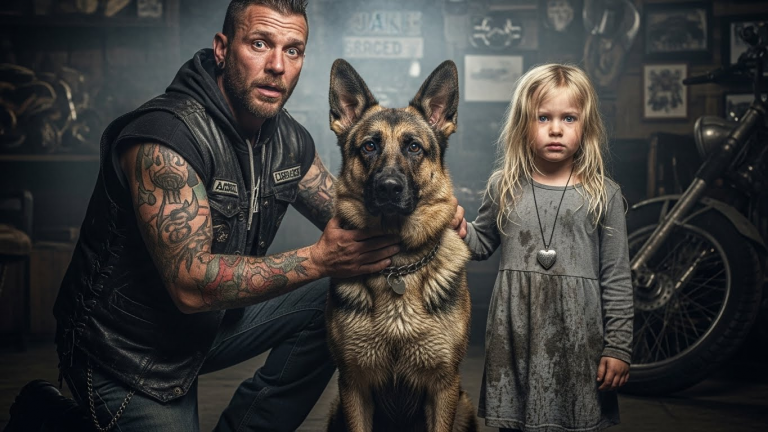
In the back seat sat Ranger, a magnificent German Shepherd with a coat of black and rich tan. Ranger was not just a dog; he was a precision instrument wrapped in fur and muscle. His amber eyes were intelligent and deep, capable of reading human emotion better than most humans.
As the cruiser approached Arthur’s residence, Ranger’s ears swiveled forward. He stood up on the back seat, his nose twitching as he inhaled the air rushing in through the window. It smelled of jasmine and expensive perfume. But beneath that, Ranger caught something else. It was the scent of distress. A sharp, acrid pheromone of fear that pricked his instincts.
A low, guttural whine escaped Ranger’s throat. The hair along his spine stood up in a rigid ridge. Silas glanced in the rearview mirror, his brow furrowing. “What is it, boy?”
Ranger didn’t settle. He pressed his wet nose against the wire mesh separating them. Staring intently at the second-floor of the mansion, he let out a sharp, demanding bark.
Silas slowed the car to a crawl. He looked at the house. It was the picture of tranquility. Ladies in pastel hats, a manicured lawn, a woman laughing.
“It’s just a tea party, Ranger,” Silas muttered, though a cold prickle of unease danced down his own neck. He trusted Ranger more than he trusted his own eyesight. If Ranger said something was wrong, something was wrong. But looking at the scene, Silas had no probable cause. He couldn’t storm a wealthy man’s house because his dog didn’t like the vibe.
“I know,” Silas whispered, noting the address in his mind. “We’ll keep an eye out.” He eased his foot on the gas, and the cruiser rolled on, though Ranger remained standing, watching the house until it disappeared from view.
Chapter 2: The Sound of Shattering Glass
Hours passed. The sun began its slow descent, casting long orange shadows across the lawn. The guests finally departed, their cars leaving one by one. Iris stood at the door, waving until her cheeks hurt from the fake smile.
As soon as the last car was gone, she slumped against the doorframe, her posture collapsing. She kicked off her heels. “God, what a bore,” she muttered to the empty hall.
Upstairs, Benny heard the silence return. The hunger had become a physical pain, a sharp cramping that made him dizzy. He tried the door handle of the attic, as he had done a hundred times that day. Usually, it was locked tight, but today—perhaps distracted by the preparations for the party, or perhaps simply careless in her arrogance—Iris had not turned the deadbolt all the way.
The latch clicked. Benny’s heart hammered against his ribs like a trapped bird. He pushed the door open, the hinges groaning softly. He froze, waiting for the shriek of his stepmother. Silence.
He crept out onto the landing. The house was cool, the air conditioning a blessed relief against his sweaty skin. He moved on bare feet, silent as a shadow, drawn by the smell of the leftover catering.
He reached the top of the grand staircase. Below, the foyer was bathed in the golden light of the late afternoon. On a side table near the bottom of the stairs, a tray of abandoned pastries sat, forgotten by the cleaning staff. Benny’s mouth watered. He took a step down, then another.
He was halfway down the stairs when the front door opened. Iris walked in from the garden carrying a large vase filled with lilies she had saved from the centerpieces. She looked up, and her eyes met Benny’s.
For a second, there was no sound. Benny froze, his eyes widening in terror. Iris’s face contorted, the mask of the elegant hostess vanishing to reveal the monster beneath.
“You,” she hissed, her voice low and dangerous. “Who let you out?”
Benny scrambled back, his foot slipping on the polished wood. In his panic to retreat, his elbow knocked against the pedestal on the landing. Perched there was a crystal vase—an antique Arthur prized above all else.
It teetered. Benny reached for it, his small fingers grazing the cold glass, but he was too slow.
The vase fell. It seemed to fall in slow motion, catching the sunlight one last time before it smashed against the marble floor of the foyer below. The sound was explosive, a shattering crash that echoed through the cavernous house like a gunshot.
Benny squeezed his eyes shut and curled into a ball, trembling violently. He knew, with the instinct of a hunted animal, that the silence that followed was not peace. It was the calm before a terrible, violent storm.
The echoes of shattering crystal died away, leaving a silence that felt heavier than the noise itself. Iris did not scream. She did not raise her hand to strike. Instead, she stared down at the glittering shards of the antique vase, her face void of all color, her expression terrifyingly still. To a stranger, she might have looked like a statue of grief, but Benny knew better. He saw the cold, reptilian flicker in her blue eyes—a look not of sorrow, but of calculation.
Benny shrank back against the banister, his small chest heaving with silent sobs. He waited for the blow, flinching as she took a step toward him. But Iris was too smart for physical violence. Bruises were evidence. Bruises were messy. Bruises invited questions from nosy doctors and teachers should the boy ever be allowed to return to school.
“You clumsy, ungrateful little wretch,” she whispered, her voice a hiss of venom. “That vase was worth more than your entire existence.”
She reached out, not to slap, but to grip. Her fingers, manicured to sharp points, dug into the soft flesh of his upper arm like talons. She hauled him to his feet with surprising strength. Benny’s feet scrambled for purchase on the polished wood, but he was no match for her fury.
She didn’t drag him back up the stairs to the sweltering attic. That was too far, and she was too angry to make the climb. Instead, she marched him down to the main hallway, past the sun-drenched living room where the dust motes danced in the afternoon light, towards the heavy oak door beneath the grand staircase.
It was a storage closet, a narrow, windowless space usually reserved for winter coats and cleaning supplies. Iris threw the door open and shoved Benny inside. He stumbled over a vacuum cleaner, his knees hitting the hard floor. The smell of cedar, old wool, and harsh chemical cleaners assaulted his nose.
“You like to sneak around? You like to break things?” Iris loomed in the doorway, blocking out the light. “Then you can stay in here until you learn how to exist without destroying my life.”
“No,” Benny mouthed, his throat constricting. He reached a hand out, pleading, but the door slammed shut. The darkness was instantaneous and absolute. The click of the lock turning was the loudest sound in the world.
Benny scrambled to the door, pressing his palms against the rough wood. He didn’t bang on it. He knew better. Noise only brought Iris back, and her return would mean something worse than darkness. He slid down to the floor, pulling his knees to his chest, trying to make himself as small as possible.
The closet was a suffocating void. The air was stale and thick. To a five-year-old boy whose world had already shrunk to the size of a grief he couldn’t articulate, this darkness was alive. It pressed against his eyes, filled with shapeless monsters that whispered of abandonment. He squeezed his eyes shut, trying to summon the image of his mother, her soft laugh, the smell of her lavender shampoo. But the memories were fading, eaten away by the fear that now defined his life.
He wanted to cry out for his father, but Arthur was miles away, chasing deals in another time zone, willfully blind to the nightmare he had left behind. Benny bit his lower lip, clamping down hard. He bit until he tasted the copper tang of blood, using the sharp, stinging pain to ground himself, to keep the scream trapped in his throat.
If he cried, Iris would win. If he stayed silent, he was still—in some small way—safe. But as the minutes stretched into hours, a darker realization began to form in the mind of the woman pacing just outside the door. Iris wasn’t thinking about punishment anymore. She was thinking about a permanent solution.
Part 2
Chapter 3: The Silent Alarm
A few streets away, the black and white police cruiser idled at a stop sign. Officer Silas drummed his fingers on the steering wheel, his gaze drifting to the rearview mirror. Ranger was pacing the width of the back seat, a low, restless whine vibrating in his throat. The dog’s agitation was palpable, filling the small cabin of the vehicle with a nervous energy that made Silas’s skin crawl.
“Settle down, Ranger,” Silas murmured, though his own brow was furrowed deep with concern. “We did a pass. Nothing there. It’s just a quiet Saturday.”
Ranger ignored him. The dog spun in a tight circle and dropped his chin onto the barrier, his amber eyes fixed in the direction of Elm Street. He let out a sharp, frustrated bark. It wasn’t an aggression bark. It was an alert. It was the specific sound Ranger made when he found a missing hiker’s scent on the wind or when he sensed a suspect hiding in the brush. It was the sound of a discovery.
Silas sighed, shifting the car into gear. He had worked with Ranger for four years. The dog had saved his life twice in the sandbox overseas and countless times on the streets of Oak Haven. He didn’t question the dog’s nose. He questioned the law that bound his own hands.
“All right, all right,” Silas said, turning the wheel with a heavy sigh. “One more loop. But if the sergeant asks why we’re burning gas circling the rich neighborhoods, I’m blaming you.”
He drove slowly back toward the estate. The afternoon sun was beginning to dip, casting long, stretching shadows across the pristine lawns. The neighborhood was quiet. Sprinklers hissed rhythmically on adjacent properties. A cat sat on a brick wall, licking its paw. It was a scene of perfect Americana, utterly devoid of danger.
Silas pulled the cruiser to the curb across the street from Arthur’s mansion. He cut the engine and rolled the window down further. “Show me what you got, buddy,” Silas whispered.
Ranger stood rigid, his nose testing the air. He didn’t bark this time. He just stared at the house, a low growl rumbling in his chest like distant thunder. Silas watched the house. The windows were dark, reflecting the orange hues of the setting sun. The front door was closed. There were no shouts, no breaking glass, no signs of disturbance. It was the picture of suburban tranquility.
“It’s quiet, Ranger,” Silas said softly, a knot of frustration tightening in his gut. “Too quiet?”
He grabbed his radio, contemplating calling it in. But call in what? “Dispatch, my dog has a bad feeling about the rich lady’s house?” He’d be laughed off the force. Without probable cause—a scream, a witness, a visible crime—he couldn’t breach the property. The Fourth Amendment didn’t have an exception for canine intuition.
Silas sat there for twenty minutes, watching the shadows lengthen, waiting for a sign that never came. Finally, reluctantly, he started the engine. “We’ll come back tonight,” he promised the dog, who let out a huff of disappointment and lay down, though his eyes never left the house. “I promise.”
Inside the closet, time had lost its meaning. Benny didn’t know if he had been in there for minutes or days. His legs had gone numb, and the terror had dulled into a heavy, exhausting fog. He drifted in and out of a light doze, jerking awake every time the floorboards creaked overhead.
Outside the closet, Iris paced the hallway, a glass of Chardonnay in her hand. The broken vase had been swept away, the evidence of Benny’s “clumsiness” erased, but her anger had not abated. It had curdled into something colder, something more dangerous.
She stopped in front of a hallway mirror, adjusting a stray lock of hair. She looked at her reflection—the perfect skin, the designer clothes, the heavy diamond ring on her finger. She deserved this life. She had earned it. She had endured Arthur’s boring business dinners, his tedious stories, his absentee affection.
But the boy, Benny, was the variable she couldn’t control. He was a constant drain on her energy, a stain on her perfect household. And worse, he was the heir.
Arthur’s will was ironclad. Everything went to the son. If Arthur were to have a heart attack tomorrow—and with his stress levels, it wasn’t unlikely—Iris would be left with a stipend, an allowance controlled by trustees for the benefit of the child. She would be a glorified nursemaid to a mute brat for the rest of her life.
Iris took a long sip of wine, her eyes narrowing. She looked at the closet door. Four hours had passed since she locked him in. The house was beginning to dim as evening approached.
She walked to the door and turned the key. The door creaked open. Benny blinked, shielding his eyes from the sudden influx of dim hallway light. He looked pathetic, curled into a ball, his face streaked with dust and dried tears, trembling like a leaf in a storm. Most people would see a vulnerable child in need of comfort. Iris saw a problem in need of a solution.
“Get up,” she commanded, her voice devoid of emotion.
Benny scrambled to his feet, his legs wobbly. He hugged himself, looking at the floor, waiting for the next order.
Iris stared at him, and for the first time, a dark clarity settled over her. Sending him to boarding school was risky; he might talk, or teachers might see the scars of her neglect. Keeping him here was exhausting. But accidents… accidents happened all the time. Especially to clumsy children who broke vases. Especially in big houses with polished floors and steep, dangerous staircases.
She looked toward the grand staircase that spiraled up to the second floor. It was beautiful, architectural, and lethal. A plan, fully formed and chilling in its simplicity, bloomed in her mind.
If Benny were to have a tragic fall—a terrible, fatal tumble while playing where he shouldn’t be—Arthur would be devastated, yes. But he would eventually recover. He would lean on his loving wife for support. And the inheritance… the inheritance would have nowhere else to go.
Iris smiled. It was a small, tight smile that didn’t reach her eyes.
“You look filthy,” she said, her voice dropping to a terrifyingly gentle register. “Go upstairs, Benny. Go to the top of the stairs and wait for me. I think it’s time we cleaned you up.”
Benny looked up, confused by the sudden change in her tone. He didn’t understand the malice hiding behind the softness. He only knew that the closet door was open, and he was being told to leave the dark. He nodded slowly and began to walk toward the stairs, unaware that he was walking toward his own execution.
Chapter 4: The Push
The staircase of the Arthur Estate was a masterpiece of architectural cruelty. It spiraled upward in a sweeping curve of polished mahogany, the banisters carved with intricate vines that seemed to twist and choke the wood beneath them. To a five-year-old, it was a mountain. To Iris, standing at the bottom and looking up, it was a weapon.
“Go upstairs to your room, Benny,” she commanded, her voice eerily calm, devoid of the venom that usually coated her words. “Change out of those filthy clothes. Put on the blue shirt, the one your father likes.”
Benny hesitated at the first step. His legs were still trembling from the hours spent curled in the dark closet, his muscles cramping with every movement. He looked at Iris, searching for the trick, the sudden blow, but her face was a smooth, unreadable mask. Hunger gnawed at his belly, a dull, persistent ache that made the edges of his vision blur.
He nodded once, a jerky motion, and began the slow climb, gripping the railing with both hands. Iris watched him go, her eyes tracking his small, frail body until he disappeared onto the second-floor landing.
The moment he was out of sight, she moved with the efficiency of a predator. She walked briskly to the downstairs powder room and opened the cabinet beneath the sink. There, amidst the high-end cleaning products and guest towels, sat a bottle of baby oil—a remnant from a gift basket a friend had sent years ago, mocking her childless state before she married Arthur. She had never thrown it away.
She uncapped the bottle, the smell of artificial lavender and mineral oil drifting into the air. It was a scent of innocence, of nurseries and baths, now repurposed for something vile.
Iris moved to the top of the stairs. She didn’t pour the whole bottle. That would be amateurish. A puddle would be obvious to the paramedics. Instead, she tilted the bottle carefully, letting a thin, viscous stream coat the center of the very top step—the nosing of the wood where a foot would naturally pivot to descend.
The oil pooled, glistening like liquid glass. Iris pulled a microfiber cloth from her pocket. With precise circular motions, she wiped the excess away. She didn’t clean it up; she spread it. She worked the oil into the grain until the puddle was gone, leaving behind only a sheen that looked to the untrained eye like a spot that had been recently polished. But to the touch, it was deadly. A frictionless sheet of ice waiting for a victim.
She stood up, pocketing the cloth and the bottle. She examined her handiwork. Perfect. It caught the light from the chandelier, shining with a deceptive luster.
“Benny,” she called out, her voice pitching up into a sweet, coaxing melody that made the hair on the back of Benny’s neck stand up. “Benny, come here, sweetie. I have a surprise for you.”
Three blocks away, the atmosphere inside Officer Silas’s cruiser had shifted from tense to explosive. The sun had dipped lower, painting the sky in bruises of purple and red, but the heat of the day lingered on the asphalt. Silas had driven a mile down the road, intending to circle back to the station, but Ranger would not let him.
The German Shepherd was no longer whining. He was screaming.
It was a sound Silas had never heard from the dog before. A high-pitched, frantic yelp mixed with a guttural roar. Ranger threw himself against the metal grate separating the front and back seats, his claws scrabbling against the mesh. Froth gathered at the corners of his mouth, his eyes were wide, dilated, fixed on the rear window—back toward the estate they had just left.
“Ranger, heel down!” Silas barked, looking in the rearview mirror.
Ranger ignored the command. He slammed his body against the door, biting at the handle, trying to break out. The dog was possessed by a panic so raw, so absolute, that it sent a jolt of adrenaline straight into Silas’s heart. In the Marines, they taught you to trust your equipment. On the force, they taught you to trust your partner.
Ranger wasn’t just a dog. He was a biological sensor tuned to frequencies Silas couldn’t perceive. If Ranger was reacting like this, something wasn’t just wrong. Something was dying.
“Damn it,” Silas cursed.
He slammed on the brakes, the cruiser skidding to a halt in the middle of the empty suburban street. He didn’t call dispatch. He didn’t ask for permission. He flipped the switch on the console. The red and blue lights exploded into life, reflecting off the manicured lawns. The siren chirped once, a warning growl, before Silas stomped on the accelerator. The cruiser whipped around in a tight U-turn, tires screeching, leaving black rubber on the pavement.
“Hold on, buddy!” Silas gritted out, his knuckles white on the wheel. “We’re coming.”
Benny stood in the doorway of his room. He had changed into the blue shirt, though it hung loosely on his emaciated frame. He heard Iris calling him.
Surprise. The word was alien in this house. Surprises here were usually painful. A pinch, a locked door, a missing meal. But the hunger… the hunger was a monster that roared louder than his fear.
“Benny, look what I found.”
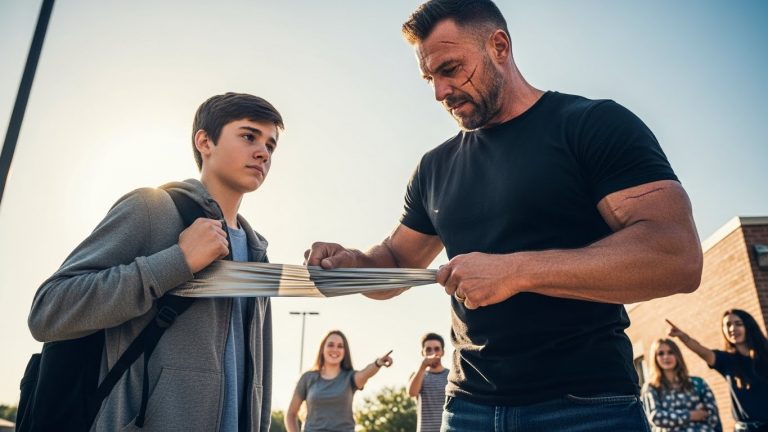
He crept into the hallway. Iris was standing at the very top of the stairs, slightly to the side, leaving the path open. In her hand, held out over the void of the staircase, was a king-sized chocolate bar. The wrapper was peeled back, revealing the dark, rich confection inside. Benny’s mouth flooded with saliva, his stomach cramped violently. It was a cruel, primal lure.
“You’re hungry, aren’t you?” Iris cooed, her smile stretching tight across her face. “You didn’t get any cake at the party. I saved this just for you. Come and get it.”
Benny took a step forward. The floorboards creaked. He looked at the chocolate, then at Iris’s face. He took another step. He was five feet away. Then four. He reached the edge of the landing.
The top step, the one Iris was standing next to, gleamed strangely in the artificial light of the hallway sconces. It looked wet. Benny stopped. Animals sense earthquakes before the ground shakes. Children of abuse sense violence before the hand is raised. A cold prickle of warning shot down Benny’s spine.
The smell of the chocolate was overpowering. But beneath it, there was something else. A faint chemical scent of lavender that reminded him of the times Iris would scrub her hands after hurting him. He looked at the step. Then he looked up at Iris.
For a fleeting second, the mask slipped. Iris’s eyes weren’t warm. They were impatient. They were dead.
Benny lowered his hand. He took a tiny step back.
Iris saw the hesitation. She saw the survival instinct override the hunger. And in that moment, her patience snapped. The carefully constructed plan of a clumsy child tripping on his own feet evaporated, replaced by a surge of murderous rage.
“Take it!” she shrieked, her voice cracking.
She didn’t wait for him to step onto the oil. She lunged.
It happened in a blur of motion. Iris closed the distance between them, her hands shooting out like a viper strike, her fingers hooked into the collar of Benny’s blue shirt. Benny’s eyes went wide. He tried to scramble backward, his bare heels digging into the carpet of the hallway, but he was weightless against her strength.
“No!” he tried to scream, but the sound died in his throat, emerging only as a strangled gasp.
Iris yanked him forward with a violent jerk. The force was so sudden that the fabric of the cheap shirt couldn’t hold. The top plastic button popped off with a sharp snap.
Time seemed to suspend. The small white button spun through the air, catching the light—an insignificant piece of plastic that would become the most important object in the world. It flew past Iris’s shoulder, bounced off the baseboard, and skittered under the heavy mahogany console table that stood against the hallway wall, coming to rest in the deep shadows beneath.
Iris didn’t notice the button. She only felt the boy in her grasp. She pulled him onto the oiled step. Benny’s feet hit the slick wood and went out from under him instantly. He was falling before she even touched him again, but she wasn’t taking any chances. With both hands, she shoved him hard in the chest.
“Goodbye, Benny,” she whispered.
There was no friction, no traction. Benny tilted backward into the empty air above the stairs. His arms flailed, grasping at nothing but the heavy scent of lilies and betrayal. He saw the ceiling rotate, saw Iris’s face contorted in a triumphant sneer, and then the world dissolved into a terrifying rush of gravity.
He didn’t scream as he fell. He was silent, just as he had been taught to be.
The first impact was a sickening thud as his small shoulder struck the edge of the fourth step. Then the tumbling began. A chaotic, bone-breaking descent down the hard, unforgiving wood. A rag doll tossed by a storm, falling toward the marble floor far, far below.
The sound of a body hitting marble is distinct. It is not a dull thud like wood, nor a hollow echo like metal. It is a wet, cracking slap—a sound of finality that seems to vibrate through the very foundation of a house.
Benny lay crumpled at the foot of the grand staircase. His small body was twisted in an unnatural angle, one leg bent beneath him like a broken twig, his arm thrown out as if reaching for a savior who wasn’t there. The blue shirt, the one with the missing button, was bunched up around his thin chest.
For a long, terrible moment, there was silence. The dust motes in the afternoon sun continued to dance, indifferent to the tragedy. The house held its breath.
High above, standing on the edge of the oiled step, Iris looked down. Her chest was heaving, not from exertion, but from the adrenaline of the commitment. She gripped the banister, her knuckles white, and waited. She needed to be sure. If he moved, if he cried out, the narrative would be harder to sell.
She watched his chest. It was still. Then, a small hitching spasm followed by a shallow, ragged intake of breath. He was alive. Broken, shattered, but alive.
Iris let out a breath that was half relief, half frustration. It would have to do. She counted to three in her head. One. Two. Three.
Then she flipped the switch.
“No! Oh, God! No!”
The scream she tore from her throat was a masterpiece of fabrication. It was shrill, piercing, and loud enough to penetrate the thick walls of the estate. She scrambled down the stairs, carefully avoiding the top step she had rigged, her heels clicking frantically against the wood.
She reached the bottom and fell to her knees beside the boy, careful not to touch him, careful not to get blood on her silk blouse. She pulled her phone from her pocket, her hands shaking with a practiced tremor, and dialed 911.
“Emergency. Which service?”
“My son!” Iris shrieked into the receiver, running a hand through her perfect hair to dishevel it. “He fell! He slipped on the stairs! There’s so much blood. Please, he’s not moving. Send someone, please!”
She hung up and looked at Benny. His eyes were closed, his face the color of old parchment.
“Don’t you dare wake up,” she whispered, her voice dropping to a cold, flat tone the operator hadn’t heard. “Just go to sleep, Benny. Go to sleep.”
Outside, the world exploded into noise. Officer Silas had just screeched around the corner when the call came over the dispatch radio.
“Code three, pediatric trauma. Fall at 42 Elm Street.”
“That’s it!” Silas growled. “That’s the house.”
He didn’t wait to park properly. He slammed the cruiser into the curb, the tires chewing up the pristine grass of the verge. Before the car had even rocked to a standstill, he was out the door.
Ranger was a black and tan blur of motion. The dog hit the pavement running, his earlier panic replaced by a lethal, focused drive. He didn’t need a command. He knew the mission.
Silas sprinted up the driveway, his boots pounding the pavement. He reached the massive oak front door. It was locked. Through the wood, he could hear a woman wailing. A sound that made his stomach turn. Not out of sympathy, but out of a deep, inexplicable suspicion honed by years on the force.
“Police! Open up!” Silas roared, banging his fist against the wood.
No answer, just more wailing.
Silas didn’t hesitate. He stepped back, raised his right leg, and drove the heel of his tactical boot into the door just below the lock mechanism. Wood splintered with a sharp crack. He kicked again, harder. The frame gave way and the door swung inward, crashing against the interior wall.
Silas burst into the foyer, his hand instinctively resting near his holster, though he didn’t draw. Ranger flowed in beside him like smoke low to the ground. The scene froze Silas in his tracks. The opulence of the foyer—the crystal chandelier, the marble floors, the vases of fresh lilies—was marred by the small, broken figure lying in the center of the light.
“Officer!” Iris looked up, tears streaming down her face, her mascara smudged artfully. “Help him! Oh god, my baby!”
Silas dropped to his knees beside Benny. But his partner, the dog whose instincts had brought them here, did not look at the boy. Ranger was looking at the woman. And he was growling.

Part 2 (Continued)
Chapter 5: The Judge on Four Legs
The combat medic training from his days in the Marines took over, pushing aside the horror. Silas dropped to his knees, his large hands hovering over the small, broken form of the boy.
“Ma’am, step back,” Silas ordered, his voice steady and authoritative. He didn’t look at her. He couldn’t. If he looked at the fake tears streaming down her face while a child lay shattered at her feet, he might lose the professional detachment keeping him grounded.
He gently placed two fingers against Benny’s neck. The pulse was there—thready, rapid, and weak. He leaned down, listening to the chest. The breathing was wet, a bubbling sound that signaled trouble. A punctured lung, maybe, or broken ribs pressing inward.
“Benny, can you hear me, son?” Silas whispered, his hand gently stabilizing the boy’s neck.
Benny’s eyelids fluttered. A sliver of white showed, then rolled back. He was deep in shock. Silas scanned the body. The leg was definitely broken; the femur angled wrong beneath the skin. But as Silas carefully moved the tattered blue shirt to check for chest injuries, he saw something that made the blood freeze in his veins.
There were bruises.
Not just the fresh, angry purple swelling from the fall. Beneath those, mapping the geography of the boy’s ribs and upper arms, were older marks. Yellow and green shadows of violence that were weeks old. Faint, crescent-shaped scars that looked suspiciously like fingernails.
Silas’s jaw tightened until his teeth ached. Old bruises. A fall down the stairs didn’t cause bruises that were three days old.
“Where is the ambulance?” Iris sobbed, hovering too close, her perfume cloying and suffocating in the tense air. “Why aren’t you doing anything?”
“They’re two minutes out,” Silas said, his voice clipped. “I need you to give him space. You’re crowding his air.”
While Silas worked to keep the boy tethered to the world of the living, he assumed his partner was doing what canines usually did: guarding the perimeter or checking the victim. But Ranger was doing neither.
The dog had entered the house and ignored the boy completely. Ranger knew Silas had the pup covered. Ranger’s job was the threat.
The German Shepherd moved with a terrifying, silent grace. He bypassed the tragic scene on the floor and trotted to the base of the stairs. He stopped, lifting his head. His nose worked furiously, drawing in the air currents of the house.
He smelled the metallic tang of blood from the boy. He smelled the fresh lilies. He smelled the sweat and fear coming from Silas.
But coming from the woman—coming from Iris—he smelled something else.
It wasn’t the clean, sharp scent of grieving shock. It was sour. It was the smell of deception. It was a chemical cocktail of adrenaline and triumph, barely masked by fake distress.
And there was something else. A scent trail leading up the stairs. The smell of oil. The smell of the trap.
Ranger let out a sound that was not a bark. It was a low, vibrating rumble that started in his chest and seemed to shake the floorboards.
Iris, who was busy wiping her eyes with a handkerchief, froze. She looked up. The huge dog was staring directly at her. His ears were pinned back against his skull. His lips were curled up, revealing white, gleaming fangs.
“Get that dog away from me,” Iris shrieked, her voice losing its mournful tremor and sharpening into genuine fear. “Why is it looking at me like that?”
Ranger didn’t blink. He took a step forward, then another. He began to ascend the stairs, but he kept his eyes locked on Iris, effectively cutting off her escape route, pinning her against the wall with his gaze.
“Ranger, hold!” Silas called out without looking up, his hand still on Benny’s chest.
Ranger stopped, but he didn’t relax. He stood rigid on the third step, a sentinel of judgment. He let out a sharp, aggressive bark directed squarely at the woman. A bark that said, I know what you did.
Iris scrambled backward, her heels slipping on the marble. She pressed her back against the wall, her eyes wide. For the first time, she wasn’t acting.
“He… He’s crazy!” Iris stammered, pointing a trembling finger at the dog. “Shoot it! It’s going to attack me!”
Silas finally looked up. He saw the scene: his usually disciplined, calm partner acting with extreme aggression toward a “grieving mother.” But Silas knew Ranger. Ranger didn’t hate mothers. Ranger hated bad guys.
A cold realization settled in Silas’s gut, heavier than the stone floor beneath his knees. He looked at the old bruises on Benny’s arm. He looked at the terrified, guilty sweat beading on Iris’s forehead. He looked at his dog, who was telling him the truth in the only language he could speak.
“My dog isn’t crazy, ma’am,” Silas said, his voice dropping to a dangerous whisper. “He’s just very observant.”
In the distance, the wail of the ambulance sirens grew louder, cutting through the tension. Help was arriving for Benny. But for Iris, the nightmare was just beginning. The judge had arrived on four legs, and the trial had already started.
Chapter 6: The Slippery Truth
The arrival of the paramedics was a chaotic ballet of noise and light. Red and white strobes bounced off the crystal chandelier, turning the foyer into a disorienting, strobe-lit nightmare. Two EMTs burst through the open door, pushing a gurney with frantic urgency.
Leading them was Miller, a veteran paramedic with salt-and-pepper hair and a face etched with the deep lines of a man who had spent twenty years seeing people on the worst days of their lives. He didn’t ask questions. He took one look at the crumpled form of Benny and the unnatural angle of the boy’s leg, and his professional mask descended.
“Spine precautions. Let’s move. Let’s move,” Miller barked to his partner, a younger woman named Sarah, who looked pale but moved with swift precision.
Silas stepped back, giving them room to work, but his eyes never left the boy. He watched as they cut away the blue shirt to attach the defibrillator pads. The fabric fell away, revealing the map of pain etched onto Benny’s skin.
Miller paused for a microsecond, his eyes locking with Silas’s. It was a silent conversation between two men who knew exactly what accidental falls looked like and exactly what this was. This wasn’t play. This was abuse.
“We’re losing pressure,” Sarah announced, her voice tight. “Pulse is thready. We need to load and go. Now.”
They lifted Benny onto the backboard. He was so small, so devastatingly light, that it looked as if they were carrying a broken doll rather than a human child.
Iris, who had been hovering near the wall, seemingly terrified of Ranger, suddenly pushed herself forward. The arrival of the audience had seemingly rebooted her performance. She let out a fresh sob, lunging toward the gurney.
“My baby! Don’t take him!” she cried, reaching out a manicured hand to touch the rail of the stretcher. “I’m coming with you! I have to be with him!”
She made to follow the gurney out of the door, her heels clicking rapidly on the marble. It was the perfect exit strategy. Leave the scene, play the grieving mother at the hospital, and control the narrative before anyone asked too many questions.
But a heavy hand clamped down on her shoulder. It wasn’t a comforting touch. It was an anchor.
“Ma’am,” Silas said. His voice was low, devoid of warmth, cutting through her hysteria like a blade. “You’re not going anywhere.”
Iris spun around, her eyes wide with shock and indignation. The tears on her cheeks glistened in the flashing lights. “Excuse me? That is my son. He is dying. I have a right—”
“You are the only witness to a near-fatal incident involving a minor with suspicious injuries,” Silas interrupted, his tone brooking no argument. He didn’t shout, but the authority in his voice was absolute. “The paramedics need space to work, and I need a statement. Right now. Here.”
“You can’t keep me here!” Iris shrieked, looking toward the open door where the ambulance doors were already slamming shut. The siren wailed to life, a mournful sound that began to fade into the distance, taking Benny away. “I’ll sue you! I’ll have your badge! Do you know who my husband is?”
“I know who he is,” Silas said, releasing her shoulder but stepping between her and the door, effectively blocking her path. “And I know he would want us to find out exactly what happened here. So unless you want me to arrest you for obstruction of justice and interfering with a crime scene investigation, you will step back into the living room and sit down.”
Iris faltered. The threat of arrest was a bucket of ice water. She looked at Silas, then at the hulking form of Ranger, who was still watching her with unblinking, predatory intensity. The fight drained out of her, replaced by a jittery, cornered fear.
“Fine,” she spat, smoothing her silk blouse with trembling hands. “Fine. Ask your questions. It was an accident. He tripped. He’s clumsy. That’s all there is to it.”
Silas didn’t answer immediately. He turned his head slightly.
“Ranger, search.”
It was a soft command, barely a whisper. But the German Shepherd moved instantly.
Ranger didn’t go to Iris. He didn’t go to the spot on the floor where Benny had landed. Instead, he moved with a singular, driving purpose toward the stairs.
The dog ascended slowly, his nose skimming the wood. He wasn’t tracking a person anymore. He was tracking an anomaly. He bypassed the lower steps, ignoring the blood splatter on the marble, and climbed higher.
Iris watched the dog, her breath catching in her throat. “What is he doing? Why is he going up there?”
Silas ignored her. He watched his partner. Ranger reached the middle of the staircase and slowed down. He climbed past the spot where Benny’s body would have first impacted the wood, moving higher toward the summit.
When Ranger reached the very top step—the landing where the mahogany floor met the staircase—he stopped. He didn’t bark. He didn’t growl. He lowered his head, his black nose hovering millimeters above the wood. He took a deep, loud sniff, the sound echoing in the quiet house.
Then, he lifted his right paw and scratched at the wood. Scritch. Scratch.
It was a precise, deliberate gesture. Here, the dog was saying. The story starts here.
Iris went pale. In the dim light of the hallway, her face looked like a porcelain mask beginning to crack. “Get him down from there! He’s scratching the finish! That wood is imported!”
Silas turned his flashlight on. The beam cut through the gloom of the upper hallway.
“Stay here,” he ordered Iris.
He walked up the stairs. The wood creaked under his heavy boots. He moved slowly, his eyes scanning every inch of the steps. He reached the top, standing next to his dog. Ranger looked up at him, then back down at the step, nudging it with his nose.
Silas knelt. From a standing position, the step looked perfectly normal. It was shiny, polished, immaculate. But Silas knew that crime scenes were landscapes of secrets, and perspective was everything.
He lowered his head, placing his cheek almost parallel to the floorboards. He shined his flashlight horizontally across the surface of the top step.
The beam caught it.
It wasn’t a puddle. It wasn’t a spill. It was a texture.
The rest of the floor had the uniform, waxy luster of aged wood polish. But here, right at the edge of the nosing, the light refracted differently. There was a greasy, iridescent smear. It was uneven, swirling in circular patterns where someone had hastily tried to wipe something up but hadn’t used a solvent to cut the grease. They had just spread it out.
Silas reached out with his gloved hand. He peeled the glove back, needing the sensitivity of his own skin. He touched the wood.
It was slick. Incredibly, dangerously slick. His finger slid across it with zero resistance, coming away coated in a thin, transparent film. He rubbed his thumb and forefinger together. It was viscous, oily.
He brought his fingers to his nose and inhaled.
The smell hit him instantly. It was a soft, powdery scent. Sweet, floral, innocuous. It was the smell of a nursery. It was the smell of a baby after a bath. It was the smell of artificial lavender and mineral oil.
Baby oil.
Silas felt a cold rage settle in his stomach, heavier and darker than anything he had felt in the desert. This wasn’t negligence. This wasn’t a clumsy child slipping on socks. This was a trap. A deliberate, engineered mechanism of death placed at the top of a lethal drop.
He stood up slowly. The air in the house seemed to drop ten degrees. He looked down the staircase, past the twisted banisters, down to the foyer where the woman stood.
Iris was watching him. She wasn’t crying anymore. She was gripping the back of a chair, her knuckles white, her posture rigid. She looked like a deer that had heard the snap of a twig and knew the hunter was already drawing the bow.
Silas descended the stairs. He didn’t rush. Each step was a hammer blow of judgment. He held his hand out slightly, the finger still glistening with the oil, the evidence caught in the beam of his flashlight. He stopped three steps from the bottom, towering over her. Ranger sat at the top of the stairs, a silent gargoyle watching the exit.
Silas looked directly into Iris’s eyes. He didn’t yell. He didn’t need to. His voice was a quiet rumble of thunder.
“The paramedics took Benny,” Silas said. “They’re fighting to save his life.”
“I… I hope he makes it,” Iris stammered, her voice thin and reedy. “I pray he makes it.”
“I’m sure you do,” Silas said. He took one more step down. “Because if he doesn’t, this becomes a murder investigation.”
He raised his hand, showing her the glistening residue on his fingertip.
“Ms. Iris,” Silas said, the title dripping with cold irony. “You have a beautiful home. Very clean. Very polished.”
He brought his finger closer to her face. She flinched, leaning back, the smell of the lavender oil drifting toward her—the scent of her own guilt.
“So tell me,” Silas whispered, his eyes boring into hers, stripping away the lies, the wealth, and the pretense. “Why is the top step—and only the top step—covered in baby oil?”
Part 2 (Continued)
Chapter 7: The Missing Piece
The silence that followed was deafening. It was the silence of a trap snapping shut. Iris opened her mouth to speak, to lie, to spin another web, but the words died in her throat. She stared at the oil on his finger. And for the first time that day, the monster in the silk dress looked truly, mortally afraid.
The air in the foyer was thick enough to choke on. The silence that followed Silas’s question wasn’t empty. It was heavy, pressurized, like the air in a room just before a backdraft.
Iris stared at the glistening smear of oil on Silas’s fingertip. Her chest rose and fell in shallow, rapid hitches. The color that had returned to her cheeks during her earlier outburst drained away again, leaving her as pale as the marble beneath her heels.
“I…” she started, her voice cracking. She cleared her throat, a desperate, rasping sound. “I told you I was cleaning. I must have… I must have knocked the bottle over this morning. I thought I got it all up.”
She forced a laugh, a brittle, jagged sound that bounced eerily off the high ceilings. “You know how it is. Servants these days, they miss spots. I had to do it myself. It’s just… It’s just a household accident, officer. You’re making it sound like something sinister.”
Silas didn’t blink. He didn’t lower his hand. He kept the evidence right there in her line of sight. A tiny, undeniable moon of guilt.
“A spill,” Silas repeated flatly.
“Yes,” Iris insisted, gaining a sliver of confidence from her own lie. “A spill. It happens.”
“Physics disagrees with you, Miss Iris,” Silas said, his voice dropping an octave, rumbling with the quiet intensity of a gathering storm. “When liquids spill, they pool. They seek the lowest point. They drip down the riser to the next step. They soak into the cracks.”
He took a step closer, invading her personal space, forcing her to look up at him.
“But this oil…” He rubbed his thumb against his finger again. “It wasn’t pooled. It was spread. It was buffed. And it was located specifically on the nosing of the top step. The exact pivot point where a foot needs traction to descend. Nowhere else. Not on the riser, not on the step below.”
Iris took a step back, her back hitting the heavy oak console table near the door. “You’re twisting things. You’re trying to blame a grieving mother for her son’s clumsiness because you… you have a vendetta against wealthy people. That’s it, isn’t it?”
“And then there’s my dog,” Silas continued, ignoring her accusation completely. “Ranger doesn’t alert to floor cleaner. He doesn’t alert to accidents. He alerts to distress. He alerts to the chemical signature of adrenaline and fear.”
He gestured up the stairs where the large German Shepherd was still pacing the landing. “Why is he still up there, Iris? If the scene is down here, why is my partner convinced the crime happened up there?”
Iris’s eyes darted up the stairs. “I told you to get that beast out of my house.”
Up on the landing, Ranger ignored the shrill voice of the woman. His world was not made of words and lies. It was made of scent and truth. He had marked the oil. That part of the hunt was done, but the scent of the struggle was still hanging in the air—faint, ghostly, but undeniable to a nose that could detect a single drop of blood in a gallon of water.
He smelled the boy’s fear, sharp and metallic. He smelled the woman’s perfume, cloying and heavy. And he smelled the sudden, explosive burst of sweat that comes with a violent exertion.
Ranger lowered his head, his black nose hovering just above the carpet runner in the hallway. He tracked the invisible footsteps. Here the boy hesitated. Here the woman lunged.
He moved toward the wall where a heavy mahogany side table stood on carved clawed legs. The air current under the table was stagnant, trapping the particles of dust and debris.
Ranger dropped to his belly. He crawled forward, his front paws working to pull his large frame low enough to investigate the shadows beneath the furniture. He huffed, blowing dust bunnies aside.
There, wedged against the baseboard, hidden in the deepest corner of the shadow, was a small, round object. It smelled of the boy. It smelled of laundry detergent. And it smelled of torn fibers.
Ranger stretched his neck, his jaws opening delicately. With the precision of a surgeon, he clamped his front teeth around the object. He didn’t bite down. He cradled it.
He backed out from under the table, shook the dust from his ears, and stood up. He looked down the stairs at Silas. He let out a short, sharp bark.
I have it.
Silas heard the bark. He knew that tone. It was the “find” tone.
“Stay,” Silas ordered Iris, his voice leaving no room for negotiation.
He didn’t wait for her response. He turned and jogged up the stairs, taking them two at a time. Iris watched him go, her eyes widening in terror. She knew what was up there. She knew what hadn’t been accounted for.
Silas reached the landing. Ranger was waiting, his tail wagging slowly—a rare sign of satisfaction in the midst of a job. The dog stepped forward and nudged Silas’s hand with his wet nose.
“What do you have, boy?” Silas whispered. He held out his palm.
Ranger opened his mouth and dropped a small, white plastic object into Silas’s hand.
Silas lifted it to the light. It was a button. A standard white plastic button from a child’s dress shirt. But it wasn’t whole. The plastic was intact, but the threads that should have held it to the fabric were not cut clean.
Silas squinted. Wrapped around the threads in the center of the button was a tiny, ragged scrap of blue cotton. The fabric hadn’t unraveled. It had been ripped.
The image of Benny lying on the marble floor flashed in Silas’s mind. The paramedics cutting the shirt. The blue shirt. The collar that was bunched up and twisted.
Buttons pop off when a shirt is too tight, or when a thread wears out. But when a button takes a piece of the shirt with it… that happens when someone grabs the fabric and yanks with violent force.
The puzzle pieces slammed together with a deafening clarity. The oil wasn’t just a trap. It was the second phase. The first phase was the grab. She had pulled him onto the trap.
Silas closed his fist around the button. The heat of anger that flared in his chest was white-hot, but his exterior turned to ice. He walked back to the top of the stairs.
Iris was standing exactly where he left her, but she looked ready to bolt. Her eyes locked onto his clenched fist.
“Benny was wearing a blue shirt,” Silas said, his voice echoing from the high vantage point. He held the button up between his thumb and forefinger.
“So?” Iris said, her voice trembling. “He… he pops buttons all the time. He’s destructive.”
“This button has a piece of the collar still attached to it,” Silas said, descending the stairs slowly, step by judgment-laden step. “It was ripped off violently.”
He reached the bottom. He was a wall of muscle and moral certainty.
“You didn’t just watch him fall, Iris. You grabbed him. You pulled him.” He held the button inches from her face. “There was a struggle at the top of the stairs. This proves it. The oil proves premeditation. This button proves assault.”
Iris stared at the small piece of plastic. It was such a tiny thing, insignificant, and yet it was the nail in her coffin. The weight of her own actions came crashing down on her. The money, the estate, the freedom—all of it was dissolving because of a button and a dog.
Panic, raw and animalistic, hijacked her brain.
“No!” she shrieked. “You planted that! You’re lying!”
She didn’t think. She reacted. With a feral cry, Iris shoved Silas. She threw her entire body weight against his chest, trying to knock him off balance.
Silas, trained for combat, barely rocked back. But the move gave Iris a split second of clearance. She bolted. She didn’t run for the front door. She ran for the kitchen, toward the back exit, toward the garage keys hanging on the hook.
“Ranger!” Silas shouted. “Take her down!”
Ranger didn’t need the verbal command. He had been waiting for this moment since he first smelled the oil. The German Shepherd launched himself from the stairs. He was a black missile, a blur of kinetic energy. He cleared the banister and landed on the marble floor with a heavy thud, his claws scrabbling for traction for a millisecond before he found his grip.
Iris was fast, fueled by terror, but Ranger was faster. He closed the distance in three powerful strides. Just as Iris reached the doorway to the kitchen, Ranger leaped.
He didn’t bite her arm. He didn’t tackle her to the ground. He executed a perfect block. He slammed his body into the space between her and the doorframe, snapping his jaws inches from her face with a thunderous, cavernous roar.
Iris skidded to a halt, screaming. Ranger stood his ground, his hackles raised, his teeth bared in a snarl that promised absolute violence if she moved one more inch. He herded her back against the wall, his deep growl vibrating through her very bones.
“Don’t move,” Silas commanded, drawing his handcuffs from his belt as he strode across the room. “Iris, you are under arrest for the attempted murder of Benjamin Arthur.”
Iris slumped against the wall, sliding down until she hit the floor. She looked at the dog, then at the handcuffs, and finally, she began to weep. Not the fake tears of a grieving mother, but the ugly, terrified sobs of a criminal who had finally been caught.
Chapter 8: The Voice of the Innocent
The ride to the precinct was short, silent, and suffocating for the woman in the back seat. Iris, stripped of her silk and her pretenses, sat with her hands cuffed behind her back, staring blankly at the wire mesh divider. Ranger sat in the passenger seat, his ears swiveled backward—a constant, silent guardian ensuring the threat remained neutralized.
Silas parked the cruiser and handed Iris over to the booking sergeant. He didn’t stay for the fingerprinting or the mug shot. He had a more difficult task ahead.
He walked into his office, sat at his cluttered desk, and pulled up the contact information for Arthur’s company. It was late in Oak Haven, but for a man like Arthur, time was a fluid concept defined by deal closings and stock markets.
Silas dialed the emergency number listed in the file.
“This is Arthur,” the voice on the other end answered on the second ring, brisk and impatient. “I am in the middle of a dinner with the board. This better be catastrophic.”
“Mr. Arthur,” Silas said, his voice heavy with the gravity of the news he carried. “This is Officer Silas from the Oak Haven Police Department. You need to clear the room.”
There was a pause. The clinking of silverware in the background ceased abruptly. “Excuse me?”
“It’s about your son, Benjamin,” Silas said. “And your wife. You need to come home. Now.”
The flight back was a blur of black coffee and white-knuckled terror. Arthur had chartered a private jet, screaming at pilots and burning favors to cut flight paths, turning a ten-hour ordeal into a race against death.
He sat alone in the leather cabin, the hum of the engines mocking him. He looked at the photo of Benny on his phone—a picture from two years ago, the last time he remembered seeing the boy truly smile. How had he missed it? The “clumsiness,” the tantrums, the isolation. He had bought Iris’s stories because they were convenient. They allowed him to stay away, to focus on his empire while his kingdom at home crumbled into a dungeon.
When the plane touched down on the private tarmac outside Oak Haven, the sun was just beginning to bleach the horizon, turning the sky a bruised purple. A car was waiting. Arthur didn’t wait for the driver to open the door. He threw his bag in and barked the address of the hospital.
Oak Haven General Hospital was quiet in the pre-dawn hours. The antiseptic smell of bleach and floor wax hit Arthur like a physical blow as he ran down the corridor of the pediatric ICU.
He found Room 304. He stopped at the door, his hand hovering over the handle, trembling. He was a man who commanded boardrooms, who moved millions with a signature, but he was terrified to open this door.
He pushed it open. The room was dim, lit only by the rhythmic flashing of the heart monitor. In the center of the bed, swallowed by white sheets and tubes, lay Benny.
He looked so small. His left leg was encased in a heavy cast and elevated. His chest was wrapped in bandages. His face—his beautiful, innocent face—was a map of trauma. One eye was swollen shut, purple and angry. His lip was split.
Arthur approached the bed as if walking on holy ground. He sank into the plastic chair beside the bed, his knees giving way. He reached out to touch Benny’s hand—the only part of him that wasn’t bandaged or bruised—but pulled back, afraid he might shatter him further.
“I’m so sorry,” Arthur whispered, his voice breaking into a sob that wrecked his throat. “I’m so, so sorry, Benny.”
He sat there for hours, watching the rise and fall of his son’s chest, each breath a ragged victory. He replayed every excuse Iris had ever given him. Every time he had chosen a business trip over a weekend at home, he realized with a sickening clarity that he hadn’t just been absent. He had been an accomplice.
At 8:00 AM, the door opened softly. Officer Silas stepped in. He looked exhausted, his uniform rumpled, dark circles under his eyes, but his gaze was sharp. He held a clear plastic evidence bag in his hand.
Arthur stood up, wiping his face with the back of his hand, trying to regain some semblance of composure. “Officer?” Arthur croaked. “How is she? Where is she?”
“She’s in a holding cell, Mr. Arthur,” Silas said quietly, closing the door behind him. “Denied bail. The DA is looking at attempted murder charges.”
Arthur’s jaw tightened. “Attempted murder? I… I still can’t believe she would…”
Silas walked over to the small table by the window and set the evidence bag down. Inside, the small white button with a scrap of blue fabric looked innocuous, like a piece of trash someone might sweep up. Next to it was a sealed vial containing a swab of wood stained with oil.
“I know it’s hard to reconcile the woman you married with the evidence,” Silas said. “But the evidence doesn’t lie. Humans do.”
He pointed to the vial. “We found baby oil on the top step of your staircase. Just the top step. It was wiped down to be invisible, but slick enough to be lethal.”
Arthur stared at the vial, nausea rolling in his gut.
“And this,” Silas pointed to the button. “Ranger, my K-9, found this under the console table in the hallway. It’s from Benny’s shirt. The shirt the paramedics had to cut off him.”
Silas looked Arthur in the eye. “Buttons pop off when kids play. But look closely at the fabric, Arthur. It’s torn. That happens when someone grabs a collar and yanks it back with violent force. She didn’t just watch him fall. She threw him.”
Arthur looked at the tiny piece of blue cloth. It was the shirt he had bought Benny for his birthday. He imagined Iris’s manicured hands twisting into the fabric, the terror in Benny’s eyes. The last wall of denial crumbled. The beautiful, charming woman he had welcomed into his home was a monster.
“I want her to rot,” Arthur whispered, his voice trembling with a dark, primal rage. “I want her to lose everything.”
“We’re building the case,” Silas said. “But Benny… Benny is the key. If he wakes up. If he can communicate.”
A soft moan from the bed cut him off. Both men turned.
Benny’s head moved slightly on the pillow. His good eye fluttered open, unfocused and glassy. The drugs were still heavy in his system, pulling him down, but the pain was pulling him up.
“Benny,” Arthur rushed to the bedside, leaning over the rail. “Benny, it’s Daddy. Can you hear me?”
Benny blinked. His vision cleared slowly. He saw a figure looming over him. A man. Large. Dark suit.
In the haze of morphine and trauma, Benny didn’t see his father. He saw him. The enforcer. Or maybe he saw her shadow.
Panic, sharp and electric, spiked through his small body. He gasped, a dry, rattling sound. He tried to scramble backward, pushing his heels into the mattress, forgetting his broken leg. A silent scream of terror contorted his face. He threw his hands up to shield his head, cowering into the pillows, his entire body shaking.
“No, no, Benny! It’s me!” Arthur cried, terrified by his son’s reaction. “It’s Dad! I’m not going to hurt you!” He grabbed Benny’s hand, trying to comfort him, but Benny yanked it away as if burned.
“He thinks you’re her,” Silas said softly from the corner. “Step back, Arthur. Give him a second. Let him see you.”
Arthur stepped back, raising his hands in surrender, tears streaming down his face. “Benny, look. Look at me. It’s just Dad. Iris isn’t here. She’s gone. She can’t hurt you anymore.”
Benny stopped thrashing. His breath hitched. He lowered his arms slowly, peering over the blankets with his one good eye. He looked at the man. He saw the gray hair. He saw the tears. He saw the messy tie.
It wasn’t the monster. It was the man who used to read him stories before the monster came.
Benny’s trembling slowed. He stared at Arthur, his chest heaving. The realization dawned in his gaze. He was safe. Or at least, he wasn’t with her.
“Benny,” Arthur whispered, his voice cracking. “Did she do this? Did Iris hurt you?”
Benny couldn’t speak. The words were locked behind a wall of trauma so thick he didn’t know how to breach it. He opened his mouth, but only a dry rasp came out.
Frustrated, tears welling in his eyes, Benny looked at Silas, then back at his father. He needed them to know. He needed to be sure she wouldn’t come back.
Slowly, painfully, Benny lifted his left hand. He brought it to his own throat. He bunched his small fingers into a fist, mimicking grabbing a collar. He squeezed tight, his knuckles white.
Arthur watched, mesmerized and horrified.
Then, Benny made a violent jerking motion with his fist, pulling it forward. And then, with his palm open flat, he shoved hard against the air, pushing an invisible enemy away.
Grab. Push.
He repeated it. Grab. Push.
Then he pointed to his leg and made a motion of tumbling over and over with his hands.
The room fell silent, save for the beep of the monitor. It was a testimony louder than any scream, clearer than any sworn affidavit. It was a reenactment of his own murder attempt.
Arthur let out a sound that was half-sob, half-growl. He fell forward, wrapping his arms gently around his son’s shoulders, burying his face in the mattress so Benny wouldn’t see the murderous rage in his eyes.
“I saw it, Benny,” Arthur choked out. “I saw it. She will never, ever come near you again. I promise you. I swear on my life.”
Benny didn’t hug back—he was too weak—but he rested his cheek against his father’s head. He closed his eye. A single tear leaked out, sliding down his bruised cheek. It was the first time in months he had cried not from pain, but from relief.
Silas watched from the shadows, a lump in his throat. He reached into his pocket and touched the plastic evidence bag. He didn’t need the button anymore to know the truth. He had just seen it in the hands of a five-year-old boy. He turned and quietly slipped out of the room, pulling his phone out to call the district attorney. It was time to upgrade the charges.
Time is often described as a river, but for the residents of Oak Haven, the last six months had been more like a slow, steady exhale after holding their breath for too long. The seasons had turned, trading the sweltering heat of that terrible summer for the crisp, golden embrace of a perfect autumn.
The thermometer read a pleasant 68 degrees. It was the kind of weather that demanded open windows and long walks. The kind of sunlight that felt like a blessing rather than a spotlight.
In the center of town, Oak Haven Park was alive with the sounds of Saturday morning. Children chased each other around the fountain, dogs caught frisbees in midair, and the smell of roasting chestnuts from a vendor’s cart drifted on the breeze.
Sitting on a wooden bench near the duck pond, Arthur watched the water ripple. He looked different. The stiff, armor-like Italian suits were gone, replaced by a comfortable cable-knit sweater and jeans. The gray at his temples had spread, and lines of worry were etched permanently around his eyes, but his shoulders were lower, relaxed. The phone that used to be surgically attached to his hand was nowhere in sight.
He had sold the estate on Elm Street three weeks after the trial. He couldn’t walk past that staircase without seeing the ghost of his son falling. He couldn’t sit in a dining room that echoed with the lies of a woman he had slept beside. The mansion, with its cold marble and dark secrets, was someone else’s property now. They lived in a condo downtown. It was smaller, warmer, filled with soft rugs and bright colors. It was a home, not a museum.
“Dad! Watch this!”
Arthur’s head snapped up instantly, his eyes locking onto the small figure moving across the grass.
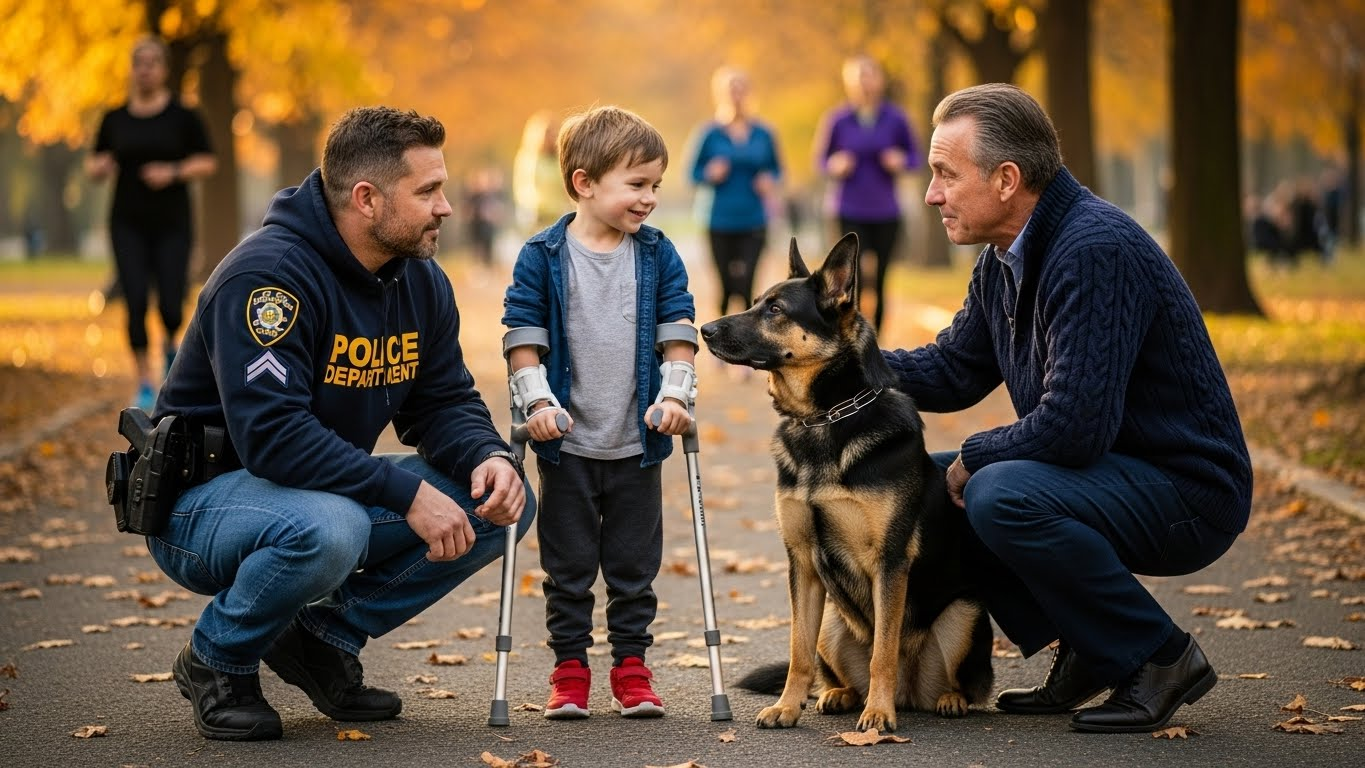
Benny was navigating the uneven terrain of the park. He wore a pair of bright red sneakers and gripped sleek forearm crutches. His left leg, no longer in a cast but still weak from the atrophy of recovery and the metal pins holding his femur together, dragged slightly. But he was moving. He was moving under his own power.
“I’m watching, pal!” Arthur called out, a genuine smile breaking through his weary face. “You’re doing great! Heel, toe! Remember, heel, toe!”
Benny gritted his teeth in concentration. He swung his legs forward, planting the crutches with determination. He was still thin, his cheekbones sharp against his pale skin, but the hollow, haunted look was gone from his eyes. In its place was a spark—fragile, flickering, but undeniably alive.
Six months. It had taken six months to rebuild a life that had been systematically dismantled. The trial had been swift but brutal. The evidence Silas and Ranger had uncovered was irrefutable: the oiled wood, the torn button, the testimony of the paramedics. Iris had tried to play the victim until the very end, weeping about “postpartum depression” and “stress.” But the jury had seen the photos of the dark closet. They had heard the testimony about the starvation.
The sentence was life without parole. Iris would grow old in a concrete box, far smaller and darker than the one she had forced Benny into.
Justice had been served, but Arthur knew that a prison sentence couldn’t undo the nightmares. It couldn’t untwist a broken leg or erase the memory of being pushed by a mother figure. Only love could do that. And Arthur was spending every waking second trying to provide enough of it to fill the void.
“Can we get ice cream after?” Benny asked, pausing to catch his breath, leaning heavily on his crutches.
“We can get ice cream, pizza, and a pony if you want,” Arthur joked, standing up to walk over to him. “But let’s stick to ice cream for now.”
A low, familiar rumble cut through the park noise. Benny froze. For a second, Arthur tensed, ready to shield his son, but then he saw Benny’s face. It wasn’t fear. It was recognition.
A black and white police cruiser pulled into the lot adjacent to the park. The engine cut, and the driver’s door opened. Officer Silas stepped out. He was in uniform, his badge gleaming in the sun, but he wasn’t on a call. He held a coffee cup in one hand and a leash in the other.
“Okay, partner,” Silas said, opening the back door. “Go say hi.”
Ranger hopped out. The German Shepherd looked magnificent, his coat brushed to a high shine, his ears perked up. He stood on the pavement, sniffing the air, filtering out the hot dogs and the ducks until he found the specific scent profile he had locked into his memory six months ago.
Lavender oil and fear were gone. Now, the scent was just boy, soap, sweat, and hope.
Ranger let out a soft woof and trotted onto the grass.
“It’s Ranger!” Benny gasped.
The boy forgot his therapy. He forgot the heel-toe rhythm. He tried to run, his crutches clacking awkwardly against the ground.
“Slow down, Benny!” Arthur warned, hurrying to catch him, but he didn’t stop him.
Ranger saw the boy struggling. The dog stopped his trot. He lowered his body posture, tucking his tail slightly, making himself look smaller, less imposing. He didn’t bound over like an excited puppy. He approached with the reverence of a guardian entering a temple.
Benny stopped. He let the crutches fall to the grass. He wobbled for a second on his weak legs, but he didn’t fall. He sank to his knees, not in defeat, but in invitation.
“Hi, boy,” Benny whispered.
Ranger closed the gap. He stepped forward and gently, so incredibly gently, pressed his massive head against Benny’s chest. He didn’t lick; he just leaned. He offered his warmth and his strength as a physical anchor for the fragile boy.
Benny wrapped his arms around the dog’s thick neck. He buried his face in the coarse, clean fur. He smelled the earth and the pine shampoo Silas used. It was the smell of safety. It was the smell of the hero who had refused to leave the stairs.
Silas walked over, standing next to Arthur. The two men watched in silence.
“He looks good, Arthur,” Silas said quietly.
“He is good,” Arthur replied, his voice thick with emotion. “He still has nightmares. He still checks the locks twice. But he’s laughing again.”
Arthur turned to the officer. “We owe you everything, Silas. You know that. I tried to send a check, a donation, but you sent it back.”
“I didn’t do it for the money,” Silas shrugged, watching his dog. “And neither did Ranger. We just did the job.”
“You did more than the job,” Arthur said. “You gave me a second chance to be a father.”
On the grass, the interaction shifted. Benny pulled back from the hug. He looked into Ranger’s deep amber eyes. The dog looked back, panting softly, his tongue lolling out in a doggy grin.
Benny reached out and traced the line of Ranger’s ear. He took a deep breath. His voice box, unused and tight for so long, felt rusty. The doctors had said his mutism was selective—a trauma response. He spoke to Arthur now in whispers, but he hadn’t spoken to a stranger yet.
But Ranger wasn’t a stranger. Ranger was family.
Benny cleared his throat.
“Ranger,” Benny said.
The word was raspy, cracked, and quiet, but in the morning air, it carried like a bell.
Silas and Arthur stiffened. Arthur’s hand flew to his mouth.
Benny leaned his forehead against the dog’s wet nose.
“Thank you,” Benny whispered, the syllables forming slowly, deliberately. “Thank you for finding me.”
Ranger let out a soft whine and licked the tear that had escaped Benny’s eye.
Arthur let out a breath he didn’t know he was holding, tears streaming freely down his face now. He looked at Silas. The tough ex-Marine was blinking rapidly, looking up at the sky as if inspecting the clouds.
“He spoke,” Arthur choked out. “He thanked him.”
“Yeah,” Silas said, his voice rough. “He did.”
The sun climbed higher, bathing the park in a brilliant, cleansing light. The shadows of the old mansion, of the dark closet, of the slippery stairs—they were all gone, banished by the simple, enduring power of a boy and his dog.
Arthur walked over and knelt beside his son, placing a hand on Benny’s back and another on Ranger’s head. Silas joined them, completing the circle.
“Come on, Benny,” Silas said, smiling down at the brave little survivor. “Ranger has a tennis ball in the car. I think he wants to show you how fast he can run.”
Benny looked up, his face radiant, a smile breaking through the scars of the past like the dawn breaking over the horizon.
“Okay,” Benny said, his voice stronger this time. “Let’s play.”
And as the ball flew through the air, arching against the blue sky, the darkness at the foot of the stairs was finally, truly, left behind.
This story reminds us that the darkest secrets often hide behind the most beautiful doors, and that true evil can wear a polished smile. Arthur thought he was providing for his son by working hard to build a fortune, but he learned the painful lesson that the greatest gift a parent can give is their presence and protection.
It teaches us to trust our instincts—and the instincts of the animals we love—because sometimes, they see the truth that human eyes miss. Like Ranger, we must be vigilant for the vulnerable. And like Arthur, we must be brave enough to admit our mistakes and fight for those we love. No matter how deep the darkness falls, justice and love will always find a way to bring the light back in.
May God bless your home with peace and your family with safety. May He give you the discernment to see the truth in others and the courage to protect the innocent. May He send guardian angels to watch over your children and grandchildren, keeping them safe from harm and surrounding them with love.
If this story of rescue and redemption touched your heart, please press the like button and share it with a friend who needs to believe in justice today. Don’t forget to subscribe to our channel for more powerful stories about the miracles that happen when humans and animals work together. And if you believe that God uses our four-legged friends to protect us and perform His miracles, please write “Amen” in the comments below.