I Found A Little Girl Trembling Under The Kitchen Table, Clutching A Headless Doll And Begging Me Not To Hurt Her. She Thought I Was The Monster Returning For Round Two, But I Was The Soldier Who Was Finally Home To End It.
Chapter 1: The Ghost in the Kitchen
The house on Elm Street didn’t look like a home anymore. It looked like a carcass. The siding, once a cheerful yellow that my mother had picked out twenty years ago, was now peeling like dead skin, revealing the gray, rotting wood beneath. The lawn was knee-high, choked with crabgrass and dandelions that had gone to seed. A rusted tricycle lay on its side near the porch, one wheel spinning lazily in the cold October wind.
I stood on the sidewalk, my duffel bag heavy on my shoulder, feeling that familiar tightening in my chest. It wasn’t the anxiety of patrol in Kandahar—that was a sharp, electric buzz. This was different. This was a dull, heavy ache. It was the weight of five years of silence. Five years since I’d walked out on my sister, Sarah, after a fight so stupid I couldn’t even remember how it started, only how it ended.
“If you leave, Caleb, don’t bother coming back.”
Well, I was back. Discharge papers in my back pocket, a bum leg that throbbed when it rained, and a silence from Sarah that had stretched too long. Her phone had been disconnected for six months. Her letters had stopped a year before that.
I walked up the driveway. My combat boots felt too loud on the cracked concrete. I knocked. The sound echoed hollowly inside, like the house was empty.
“Sarah?” I called out.
Nothing.
I tried the knob. It turned. Of course it did. In this neighborhood, people either had nothing to steal or nothing left to lose.
The smell hit me first. It was a thick, sour cocktail of stale beer, damp drywall, and something rotting—maybe trash, maybe hope. I stepped inside, my eyes adjusting to the gloom. The curtains were drawn, letting in only thin slivers of gray afternoon light.
The living room was a war zone. Not the kind I was used to, with craters and shrapnel, but a domestic kind of violence. A lamp lay shattered on the floor. The drywall had holes punched in it, perfectly fist-sized, creating a constellation of rage across the hallway. Pizza boxes and empty bottles of cheap whiskey created an obstacle course on the carpet.
“Sarah?” I said again, louder this time. The silence that answered me was heavy. It was the kind of silence that screams.
I moved through the house, the soldier in me taking over. Clear the room. Check corners. Watch your six. It was ridiculous, treating my childhood home like a hostile compound, but my gut was screaming that something was wrong.
I reached the kitchen. It was worse here. Dishes were piled in the sink, molding. Flies buzzed in lazy circles. But I didn’t look at the mess. I looked at the table.
It was a cheap, plastic dining table, the kind you buy at Walmart for thirty bucks. And underneath it, in the deep shadow against the wall, something moved.
I froze. My hand twitched toward my hip, phantom muscle memory reaching for a sidearm that was sitting in an armory halfway around the world.
I took a slow step forward. The floorboards creaked.
A sharp, terrified intake of breath hissed from under the table.
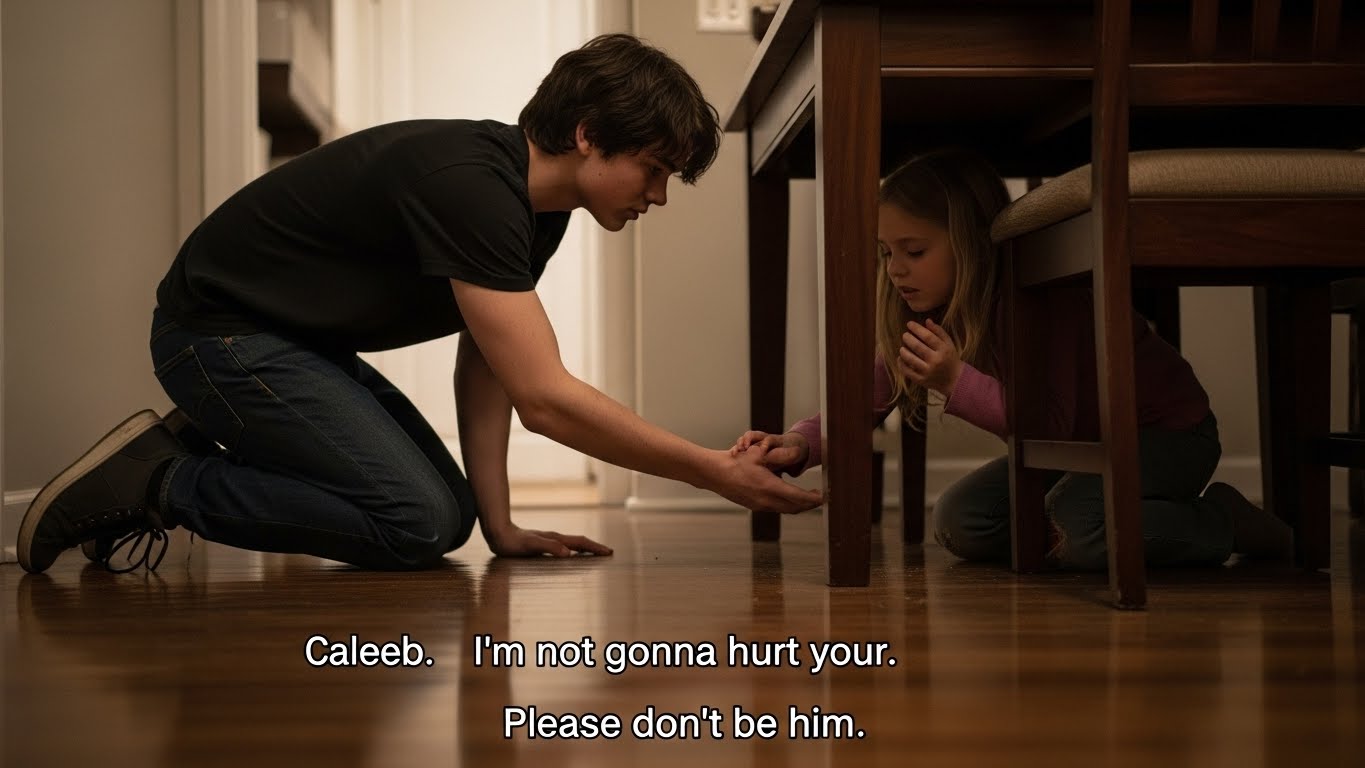
I dropped to one knee, wincing as my bad knee hit the linoleum. I lowered my head to peer into the darkness.
Two wide, terrified blue eyes stared back at me.
It was a little girl. She couldn’t have been more than six years old. She was pressed so hard against the wall she looked like she was trying to melt into the drywall. Her hair was a matted mess of blonde tangles, and her face was smudged with dirt and dried tears. She was clutching a headless Barbie doll to her chest with white-knuckled desperation.
“Hey,” I whispered, holding my hands up, palms open. The universal sign of surrender. “I’m not gonna hurt you.”
She flinched. The sound of my voice hit her like a physical blow. She squeezed her eyes shut, burying her face in the doll’s neck.
“Please don’t be Daddy,” she whispered. Her voice was thin, brittle as glass. “Please don’t be Daddy. I didn’t eat the bread. I promise.”
My heart stopped. It felt like someone had reached into my chest and squeezed it into a pulp. The rage that flooded my veins was instant, hot, and blinding.
“I’m not Daddy,” I said, my voice trembling, struggling to keep the fury out of it. “I’m Caleb. I’m… I think I’m your uncle.”
She opened one eye. It was Sarah’s eye. The same shape, the same electric blue.
“Did he send you?” she asked.
“No,” I said softly. “Nobody sent me. I just came home.”
I looked at this child—my blood, my family—cowering under a table in a house that smelled like a brewery. I realized then that the war hadn’t ended when I got on the plane. It had just changed locations.
Chapter 2: The Sound of Heavy Boots
She didn’t move for a long time. She just watched me, tracking my every micro-movement like a bomb disposal tech watching a timer. I stayed on my knee, ignoring the pain radiating up my thigh.
“What’s your name?” I asked gently.
“Lily,” she whispered.
“Nice to meet you, Lily. I’m Caleb.” I slowly reached into my jacket pocket. Her eyes widened, panic flaring again. I moved slower than I ever had in my life, pulling out a foil-wrapped protein bar. “I’m not reaching for anything bad. Just food. You hungry?”
Her eyes locked onto the wrapper. The hunger was primal. I could see it warring with the fear.
I slid the bar across the sticky linoleum. It stopped inches from her hand. She hesitated for a second, then snatched it like a striking cobra. She tore the wrapper open with her teeth, not bothering with her hands, and shoved half the bar into her mouth.
As she ate, her oversized t-shirt shifted.
I saw the bruises.
They were purple and yellow, shaped like fingerprints, wrapping around her thin upper arm. There was another one, darker, on her collarbone.
I looked away, staring at the refrigerator magnets, trying to keep my breathing steady. Inhale for four. Hold for four. Exhale for four. If I didn’t control it, I was going to punch a hole in the wall, and that would only scare her more.
“Where is your mom, Lily?” I asked, keeping my voice level.
She stopped chewing. She swallowed hard, the dry bar looking painful going down.
“She went away,” Lily said. Her voice was flat, devoid of emotion. “Daddy said she was broken, so she had to go to the hospital.”
“Which hospital?”
“I don’t know. The one for tired people.”
My stomach turned. Tired people. That could mean rehab. It could mean the psych ward. Or it could mean something much worse.
“And Daddy?” I asked. “Is he… is he coming back?”
Lily’s eyes darted to the window, then to the back door. She started trembling again. “He went to get more medicine. The liquid kind. He gets mad when he drinks the medicine.”
“Okay,” I said. I shifted my weight, preparing to stand up. “Lily, you can’t stay under there. We need to get you cleaned up. We need to—”
Crunch.
The sound came from the driveway. Tires crushing gravel. Then, the heavy slam of a car door.
Lily dropped the rest of the protein bar. The color drained from her face so fast she looked like a ghost. She scrambled backward, kicking the wall, trying to make herself invisible.
“Hide me,” she mouthed. No sound came out. Just the shape of the words. “He’s back.”
Heavy boots thudded on the front porch stairs. One. Two. Three.
I stood up. The pain in my leg was gone, replaced by a surge of adrenaline that sharpened every sense. The world slowed down. I heard the keys jingle. I heard the heavy, wet breathing of a man on the other side of the oak door.
I looked down at Lily. I put a finger to my lips.
“Stay there,” I whispered. “Don’t make a sound.”
I walked out of the kitchen and stood in the center of the living room, facing the front door. My hands hung loose at my sides, but my fingers were curled, ready. I wasn’t a brother anymore. I wasn’t a weary traveler.
I was the barrier.
The lock tumbled. The door swung open with a groan.
A man filled the frame. He was huge—at least six-four, with a belly that strained against a grease-stained tank top. He had a thick, patchy beard and eyes that were red-rimmed and glassy. He smelled like cheap bourbon and unwashed sweat.
He stepped inside, kicking the door shut behind him with his heel. He didn’t see me at first. He was looking down at a plastic bag in his hand, muttering something about “damn change.”
Then he looked up.
He stopped. His eyes narrowed, trying to focus in the dim light.
“Who the hell are you?” he grunted. His voice sounded like gravel in a blender.
I didn’t blink. I didn’t move.
“I’m the guy who lives here,” I said calmly.
Chapter 3: Rules of Engagement
The man blinked, his brain processing the information slowly through a haze of alcohol. He laughed, a wet, hacking sound.
“You live here?” He took a step forward, swaying slightly. “Buddy, I think you got the wrong house. Unless you’re the pizza guy, get the hell out before I throw you out.”
He dropped the plastic bag. A bottle clinked against the floor. He cracked his knuckles, rolling his neck. He was big, sure. He had the kind of bar-fight bulk that intimidated most people. But he was sloppy. He was heavy on his feet. His center of gravity was off.
“I’m Caleb,” I said, watching his hands. “Sarah’s brother.”
Recognition flickered in his eyes, followed immediately by a sneer. “Oh. The war hero.” He spat on the carpet. “Sarah talked about you. Said you ran off to play soldier because you couldn’t handle real life.”
“Where is she, Ray?” I assumed his name was Ray. Sarah had dated a Ray back in high school. This guy looked like a Ray who had given up on life twenty years ago.
“Who gives a damn?” Ray waved a hand dismissively. “She’s gone. Split. Couldn’t handle the kid. Left me with the burden.”
“The burden,” I repeated. My voice dropped an octave. “You mean her daughter?”
“Her daughter,” Ray corrected, pointing a thick finger at me. “Not mine. Little leech. Eats my food. Takes up my space.” He took another step toward me, encroaching on my personal space. “Now, get out of my house, G.I. Joe. Before I make you.”
“I’m not leaving without the girl,” I said.
Ray’s face darkened. The playfulness vanished, replaced by a dull, brutish anger. “You ain’t taking nothing. That kid is my ticket. The state sends checks for her. You think I’m giving up my paycheck?”
He lunged.
It was a clumsy, telegraphed haymaker. A right hook that started all the way back in the kitchen.
I didn’t block it. I stepped inside it.
My left forearm deflected his bicep, guiding the blow harmlessly over my shoulder. In the same motion, I drove my right fist into his solar plexus.
It wasn’t a movie punch. It was a short, sharp piston strike designed to shock the diaphragm.
Ray made a sound like a deflating tire—OOF. He doubled over, gasping for air.
But he was tough. Or maybe just too drunk to feel the full pain yet. He swung his head up, roaring, and tried to tackle me. His weight slammed into me, driving me back against the wall. A picture frame crashed down, glass shattering on my shoulders.
My bad leg buckled. We went down in a tangle of limbs.
Ray was on top, smelling of rot. His hands found my throat. He squeezed. His thumbs dug into my windpipe, cutting off the air. He was grinning, his teeth yellow and jagged.
“You think you’re tough?” he spat, spittle hitting my face. “I’ll snap your neck like a chicken.”
My vision started to swim. Black spots danced at the edges. I couldn’t breathe.
Panic.
No. Training.
I grabbed his pinky fingers—the weakest link in the grip. I bent them back. Hard. Until I felt the pop.
Ray screamed and let go.
I bucked my hips, throwing his weight off me. I rolled, scrambling to my feet before he could recover.
He was on his knees, clutching his hand, cursing. He looked up at me, eyes filled with murderous hate. He reached into his back pocket.
I saw the glint of metal. A knife. A cheap switchblade, but sharp enough to kill.
“I’m gonna gut you,” he wheezed.
He stood up, swaying, the knife held low.
I didn’t have a weapon. I had a protein bar wrapper and a pocket full of lint. I looked around. The living room was empty of anything useful.
“Ray,” I said, my voice steady despite the adrenaline hammering in my ears. “Put the knife down. You don’t want to do this.”
“Watch me,” he snarled.
He slashed at the air, closing the distance.
From the hallway behind me, a tiny voice squeaked.
“Stop!”
Ray’s eyes flicked over my shoulder. “Get back in the kitchen, you little rat!” he roared.
The distraction was all I needed.
As he looked at Lily, I kicked. A front snap kick, driving the heel of my boot directly into his kneecap—the one he was putting all his weight on.
There was a sickening crack.
Ray howled. His leg bent the wrong way. He collapsed, the knife skittering across the floor. He writhed on the carpet, clutching his leg, screaming in a high-pitched agony that didn’t match his size.
I kicked the knife away. I stood over him, breathing hard.
“If you ever come near her again,” I said, leaning down so he could hear me over his own screaming, “I won’t aim for the knee. Do you understand me?”
He just sobbed, cursing me, curling into a ball.
I turned around.
Lily was standing in the doorway of the kitchen. She was trembling so hard she looked like she was vibrating. She was still clutching the headless Barbie.
She looked at Ray, broken on the floor. Then she looked at me.
Her eyes were wide. She was terrified.
“Is he dead?” she whispered.
“No,” I said, walking over to her. I wanted to hug her, but I was covered in sweat and Ray’s stench, and I didn’t want to scare her. “He’s not dead. But he can’t hurt you anymore.”
I looked around the trashed living room. The violence hung in the air, thick and heavy. This wasn’t a home. It was a crime scene waiting to happen.
“Go get your shoes, Lily,” I said.
“Where are we going?” she asked.
“Anywhere but here.”
I grabbed my duffel bag. My leg was throbbing with a vengeance now, a hot poker of pain with every step. But as Lily came running back, wearing mismatched sneakers and holding a small, dirty backpack, the pain didn’t matter.
I took her hand. It was tiny and cold.
We walked out the front door, stepping over the shattered glass, leaving the groaning man and the broken house behind. The sun was setting, painting the suburban street in blood-orange light.
I had no car. No plan. No idea where Sarah was.
But as Lily squeezed my hand, I knew one thing for sure. My war wasn’t over. It had just begun.Chapter 4: Neon Lights and Dead Bolts
We walked for three miles. I kept to the shadows, avoiding the streetlights that buzzed and flickered overhead. My leg was on fire, a grinding ache that shot from my knee to my hip with every step, but I didn’t slow down. I couldn’t. Not with Lily’s small, cold hand gripping mine like a lifeline.
We ended up at the Starlight Motel on Route 9. It was the kind of place that charged by the hour and didn’t ask for ID if you paid in cash. The neon sign out front was missing the “S” and the “T,” so it just read “arlight Motel.” Fitting. There wasn’t much light here.
I left Lily outside the lobby, tucked behind a vending machine.
“Don’t move,” I told her, my voice low. “If anyone talks to you, you scream. Loud as you can. You understand?”
She nodded, hugging the headless Barbie. She looked like a refugee in her own town.
I went inside. The clerk was a kid with acne and a headset around his neck, barely looking up from his phone. I slapped two crumpled fifties on the counter.
“One night. Ground floor. Back of the lot.”
He took the money without blinking. He slid a key across the Formica. Room 108.
The room smelled like bleach and stale cigarettes. The carpet was a sticky, industrial orange that probably hadn’t been cleaned since the nineties. I locked the door, engaged the deadbolt, and then wedged a chair under the handle. Old habits.
Lily stood in the center of the room, looking around as if she’d landed on Mars. She didn’t take off her backpack.
“You can put your bag down, Lily,” I said, sitting on the edge of the sagging mattress. I started unlacing my boots, grimacing as the pressure released.
“Is he coming?” she asked.
“No,” I said firmly. “He’s not finding us here.”
“He always finds Mom,” she whispered. “Even when we hid at Grandma’s. He broke the window.”
I stopped unlacing. I looked at her—really looked at her. Under the fluorescent bathroom light, the bruises on her arms looked darker, like ink stains on parchment.
“He won’t break this window,” I said. “I promise.”
I went to the bathroom and wetted a washcloth with warm water. I came back and knelt in front of her.
“Let’s get that face clean.”
She flinched when I reached out, but she didn’t pull away. I wiped the dirt and dried tears from her cheeks. She closed her eyes, leaning slightly into the warmth of the cloth. It was such a small, trusting gesture that it almost broke me.
“You hungry still?” I asked.
She nodded.
“I saw a vending machine. I’ll be right back. Three minutes. Keep the chain on the door.”
I walked out into the cool night air. I needed air. I needed to scream. I bought two bags of chips, a package of beef jerky, and two sodas.
When I got back, she was sitting on the bed, staring at the TV. It wasn’t on. She was just staring at the black screen.
We ate in silence. The crunch of potato chips was the only sound in the room.
“Caleb?” she said after a while.
“Yeah?”
“Are you a bad guy?”
I paused, a chip halfway to my mouth. “Why do you ask that?”
“Ray said you killed people. He said you were crazy.”
I put the chip down. I looked at my hands. They were scarred, rough, capable of violence. I had hurt Ray. I had hurt men in Kandahar.
“I was a soldier, Lily,” I said softly. “Sometimes soldiers have to do bad things to stop worse things from happening. But I’m not a bad guy to you. I’m your shield.”
“My shield,” she tested the word.
“Yeah. Like Captain America.”
For the first time, a tiny, ghost of a smile touched her lips. “Captain America has a shield.”
“Exactly.”
She finished her soda and curled up on the far side of the bed, still wearing her shoes. She fell asleep almost instantly, the exhaustion finally winning out.
I didn’t sleep. I sat in the chair by the window, watching the parking lot through a crack in the curtains, waiting for a monster that I knew was coming.
Chapter 5: The Nightmare in Room 108
Around 3:00 AM, the screaming started.
It wasn’t a whimper. It was a full-throated, blood-curdling shriek of pure terror.
I was out of the chair and across the room in a heartbeat, leading with my shoulder, thinking we were under attack. But the room was empty.
Lily was thrashing on the bed, fighting off invisible demons. Her eyes were wide open but seeing nothing.
“No! No! Don’t put me in the box! I’ll be good!” she screamed, clawing at the air.
“Lily!” I grabbed her shoulders. She was burning up. “Lily, wake up! It’s Caleb!”
She kicked me, her small heel catching me in the chest. “Let me out! Mommy! Mommy!”
“Lily, you’re safe!” I shouted, shaking her gently.
She gasped, her back arching, and then she collapsed, her eyes focusing on my face. She sucked in a huge, ragged breath. The terror didn’t leave her eyes, but the hallucination faded.
She looked at me, trembling, sweat plastering her blonde hair to her forehead. Then she lunged forward, wrapping her arms around my neck, burying her face in my chest. She sobbed—deep, wrenching sobs that shook her entire small frame.
I held her. I didn’t know what else to do. I awkwardly patted her back, feeling the sharp ridges of her spine. She was too thin.
“It’s okay,” I murmured into her hair. “You’re out of the box. Whatever the box was, you’re out.”
“He puts me in the closet,” she choked out between sobs. “When I make noise. He says it’s the Quiet Box.”
My jaw clenched so hard my teeth ached. The Quiet Box.
“He’s never putting you in there again,” I swore. “I will burn this whole world down before he touches you again.”
She cried until she ran out of tears, eventually settling into hiccups.
“Caleb?”
“Yeah, kid?”
“Where is Mommy?”
It was the question I had been dreading.
“I don’t know, Lily. But tomorrow, we’re going to find out. I have a friend in town. Jenna. She knows everything that happens in this city. We’ll go see her.”
“Is she nice?”
“She used to be. She makes really good pancakes.”
“I like pancakes,” Lily whispered, her eyelids drooping.
She fell asleep against my chest. I didn’t move her. I sat there, leaning against the headboard, listening to the sirens wailing in the distance, wondering if they were coming for me.
I looked at the backpack she had dropped on the floor. It was unzipped slightly.
I reached over, careful not to wake her, and pulled it closer. Inside, buried under a dirty sweater, was a stack of envelopes.
They were letters. Addressed to me.
To: Caleb. From: Sarah.
None of them had stamps. They had never been sent.
I opened the top one. The date was from three months ago.
Caleb, I messed up. I messed up so bad. Ray isn’t who I thought he was. He’s into deep stuff with the wrong people. He makes me hold things for him. Packages. I want to leave, but he says he’ll hurt Lily. I’m scared, Cal. I think he’s going to—
The handwriting trailed off into a scribble.
I folded the letter. My hands were shaking. This wasn’t just domestic abuse. This was something bigger. Ray was using my sister as a mule. And if she was “gone,” it meant she either ran away with the “package,” or Ray had disposed of her because she lost it.
And now he was after Lily. Which meant Lily knew something. Or she was the leverage.
Chapter 6: Coffee and Handcuffs
Morning hit the motel like a hangover. Gray, damp, and too bright.
We checked out at 7:00 AM. I bought Lily a donut from the lobby and we walked to the Bluebird Diner, a greasy spoon on the edge of the industrial district.
The place was half-empty. Truckers nursing black coffee and locals reading the paper. I pulled my baseball cap lower.
Jenna was behind the counter, just like I hoped. She looked older—tired lines around her eyes, her hair dyed a fierce red—but it was her. We’d dated for a summer before I enlisted.
When I walked in, she dropped a coffee pot. It didn’t break, but it clattered loud enough to turn heads.
“Caleb?” she breathed.
I steered Lily to a booth in the back corner. “Hey, Jen. Long time.”
Jenna rushed over, wiping her hands on her apron. She looked at me, then at Lily, then back at me. Her expression wasn’t happy. It was terrified.
“What are you doing here?” she hissed, keeping her voice low. “Are you insane?”
“I just got back. I need to find Sarah.”
Jenna’s eyes darted to the front door. “Caleb, you need to leave. Now.”
“Why? What’s going on?”
“You haven’t seen the news?” She pulled her phone out of her apron pocket and tapped the screen, shoving it across the table.
It was a Facebook post from the local Police Department.
WANTED FOR QUESTIONING: CALEB MILLER. SUSPECT IN AGGRAVATED ASSAULT AND KIDNAPPING.
Below it was my military ID photo. And a picture of Lily.
“Ray called them,” Jenna whispered frantically. “He told them you broke into the house, beat him half to death with a pipe, and snatched the girl at gunpoint. He’s got the whole town looking for you. He’s playing the grieving stepfather.”
“He’s lying,” I said, my voice rising. “He was hurting her. Look at her arms, Jenna!”
I pulled up Lily’s sleeve. Jenna looked at the bruises and gasped. Her hand flew to her mouth.
“Oh my god,” she whispered. “Sarah… Sarah told me he was rough, but I didn’t know…”
“Where is Sarah, Jen?” I pressed. “I found letters. Ray was using her for something.”
Jenna looked around nervously. “Sarah disappeared two weeks ago. Ray told everyone she relapsed and ran off. But…” She leaned in closer. “A few days before she vanished, she gave me something. Said if anything happened to her, I should keep it safe. But I was too scared to go to the cops, Ray knows people on the force.”
“What is it?”
“A key. To a storage locker.”
“Give it to me.”
“It’s at my apartment. I get off in ten minutes. I can—”
She stopped. Her eyes locked on the window behind me. Her face went pale.
“Cops,” she mouthed.
I turned slowly. A cruiser was pulling silently into the diner parking lot. No lights, no sirens. Just a shark patrolling the waters.
Two officers got out. One of them I didn’t know. The other one was Deputy Miller—no relation, just a guy I used to play football with. A guy who owed Ray gambling debts back in the day.
“Back door?” I asked Jenna.
“Kitchen. Through the alley. Go.”
I grabbed Lily’s hand. She had donut sugar on her face. She looked up at me, sensing the shift in energy.
“Time to go, bug,” I said.
We moved fast. Through the swinging doors, past the startled cook, and out into the alleyway that smelled of rotting grease.
“Hey!” A voice shouted from inside the diner. “Stop!”
I didn’t stop. I scooped Lily up into my arms, ignoring the scream of protest from my bad leg, and I ran.
We burst out of the alley onto a side street. The cruiser was parked out front, but they would be coming around the back any second.
I needed a car.
A beat-up Ford F-150 was idling at the red light, the driver distracted, looking at his phone.
I had never carjacked anyone in my life. But looking at Lily’s terrified face, and thinking about Ray’s “Quiet Box,” I knew I’d crossed a line. The rules of the civilian world didn’t apply anymore.
I ran to the truck. I ripped the door open.
“Out!” I roared.
The driver, a teenager, looked at me, saw the look in my eyes, and didn’t argue. He scrambled out, dropping his phone.
I threw Lily across the bench seat and jumped in. I slammed the gearshift into drive just as Deputy Miller burst out of the alley, gun drawn.
“Freeze, Caleb!”
I ducked. A bullet shattered the side mirror.
I stomped on the gas. The truck squealed, tires smoking, and we fish-tailed down the street, leaving the diner, the cops, and my old life in the rearview mirror.
“Where are we going?” Lily screamed over the roar of the engine.
“To get the truth,” I said, gripping the wheel until my knuckles turned white. “And then we’re going to war.”