My Student Was Losing His Mind During A Final Exam, And He Had No Idea I Was Watching The Person Sitting Next To Him Destroy His Life Pixel By Pixel.
PART 1
Chapter 1: The Silence of the Lab
The air in Computer Lab 304 always smelled the same: a distinct, sterile blend of ozone, dry erase markers, and the desperate sweat of teenagers realizing they hadn’t studied. It was a smell I had grown accustomed to over ten years of teaching IT at Oak Creek High.
Today, however, the tension was thick enough to choke on.
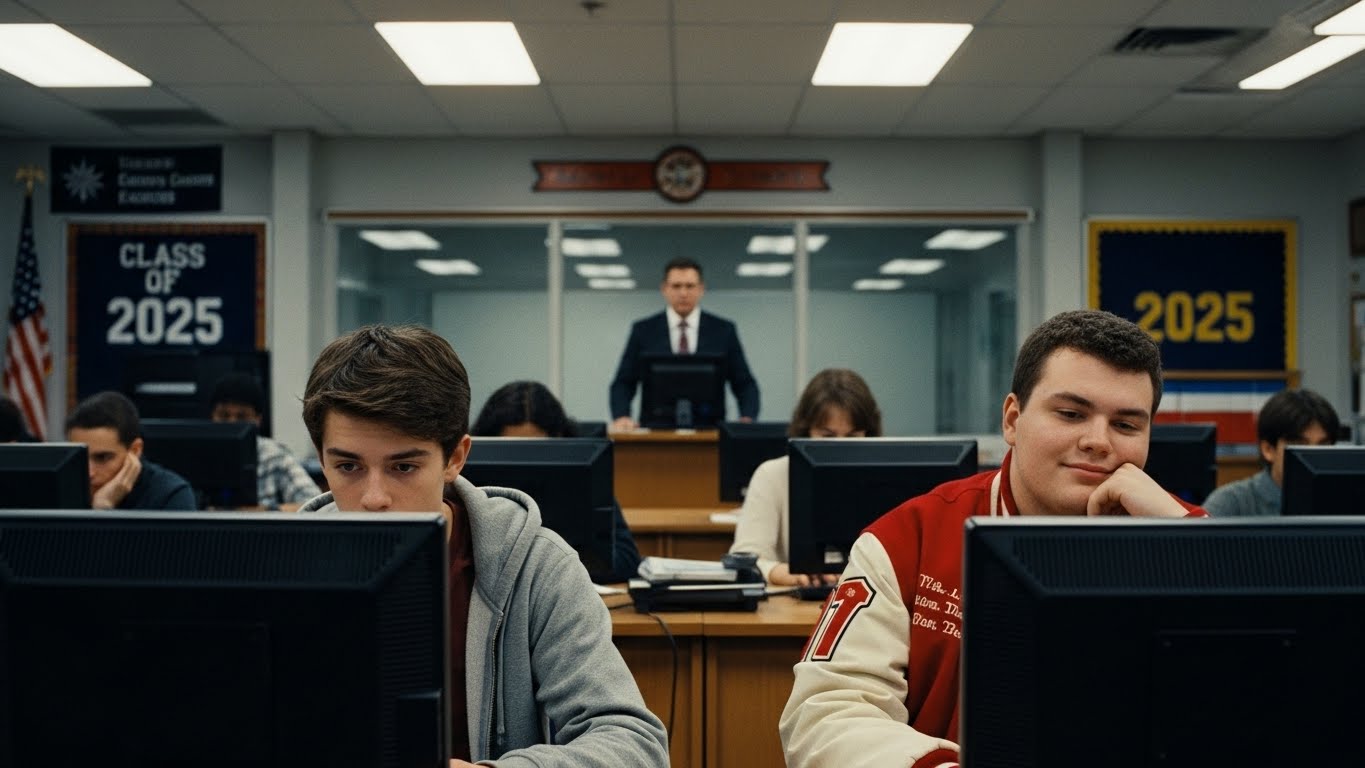
It was 10:05 AM on a Tuesday. Finals week. The room was filled with the rhythmic, plastic clatter of thirty keyboards being hammered simultaneously. It sounded like heavy rain on a tin roof. Every student in my AP Computer Science Principles class was currently locked into a timed essay prompt.
Explain the ethical implications of data privacy in the modern age.
Easy enough if you did the reading. Impossible if you spent the semester playing unblocked browser games.
I sat at my desk, which was elevated on a small riser at the front of the room—my “Command Deck,” the kids called it. To them, I was Mr. Henderson, the guy with the coffee stains on his tie who reset their passwords when they forgot them for the fifth time. I was part of the furniture. A non-player character in the movie of their high school lives.
They often forgot that in this room, I was God.
My dual-monitor setup wasn’t just for checking emails. The left screen displayed the district’s network diagnostics. The right screen ran a remote monitoring software called LanSchool. It gave me a thumbnail view of every single monitor in the room. I could see what they were typing, what windows were open, and exactly how fast they were working.
I wasn’t spying for fun. I was looking out for one student in particular.
Leo.
Leo sat in the third row, station 14. He was a quiet kid, the kind who walked the hallways with his shoulders hunched, trying to take up as little space as possible. He wore the same faded grey zip-up hoodie every day. His family was going through it—everyone in town knew his dad had lost his job at the plant last year.
This class, and specifically this final exam, was Leo’s lifeline. He needed an A to secure his GPA for a specific tech scholarship at the state university. If he got it, he had a ticket out of here. If he didn’t, he was looking at community college or, more likely, a shift at the distribution center down the highway.
I checked his thumbnail on my screen. He was typing furiously. Good. He was in the zone.
Then, my eyes drifted to Station 15.
Brad.
Brad was the opposite of Leo in every measurable way. He was the starting linebacker, loud, abrasive, and currently wearing his red and white varsity jacket despite the room being seventy-two degrees. Brad didn’t care about coding. He had been placed in this class because it was the only elective that fit his practice schedule.
Brad’s screen showed three sentences. He had stopped typing ten minutes ago. He was currently staring at the ceiling, spinning a pen between his fingers.
I took a sip of my lukewarm coffee and watched.
There is a specific energy to a bully who is bored. It’s like watching a cat with a trapped mouse. They don’t just walk away; they need entertainment.
I saw Brad shift in his chair. He stretched his arms out, a massive yawn that was clearly performative. As he brought his arms down, his left hand didn’t go back to his keyboard. It dropped below the desk level.
Most teachers would have missed it. They would have been looking at their phones or grading papers. But I wasn’t grading. I was watching.
Brad’s hand drifted into the narrow, dusty gap between his computer tower and Leo’s.
I frowned. What was he doing? Cheating? Trying to pass a note?
Then I saw Leo’s thumbnail on my master screen freeze.
Chapter 2: The Glitch
At first, Leo didn’t realize what had happened.
I watched him tap the spacebar. He expected the cursor to jump forward. It didn’t. He tapped it again. Then he hit the backspace key.
Nothing.
I could see the confusion register on his face. He lifted his mouse, shaking it slightly, the laser sensor looking for purchase on the mousepad. The cursor on his screen remained dead center, frozen in time.
Leo’s eyes darted to the clock on the wall. 10:14 AM. He had thirty minutes left.
He ducked his head, looking under the desk. He wiggled the mouse wire.
Suddenly, the cursor snapped back to life.
Leo let out a breath I could hear from across the room—a sharp, relieved exhale. He immediately went back to typing. He was rattled, but he was recovering.
I looked at Brad.
Brad was looking straight ahead at his monitor, his face a mask of innocent concentration. But I saw the corner of his mouth twitch. A suppressed smile.
My stomach turned. This wasn’t a technical glitch.
I pulled up the system logs for Station 14 (Leo) and Station 15 (Brad). I filtered the event viewer for hardware changes.
10:14:02 AM – USB INPUT DEVICE REMOVED (Station 14) 10:14:15 AM – USB INPUT DEVICE INSERTED (Station 14)
It wasn’t a ghost. It was the linebacker next door.
The computers in Lab 304 are older models. The USB ports are located on the back of the towers. Because the desks are cramped, the towers sit side-by-side on the floor. If you sit at Station 15, and you have long arms like Brad, you can easily reach behind the tower at Station 14 without even looking.
Brad had reached back, found the cluster of cables, and gently pulled the keyboard or mouse plug just enough to break the connection.
I felt a surge of anger, hot and sharp. This wasn’t just “kids being kids.” This was sabotage.
I kept watching. I needed to be sure. I needed a pattern.
Two minutes passed. The room was quiet again, save for the typing. Leo was making up for lost time, his fingers flying.
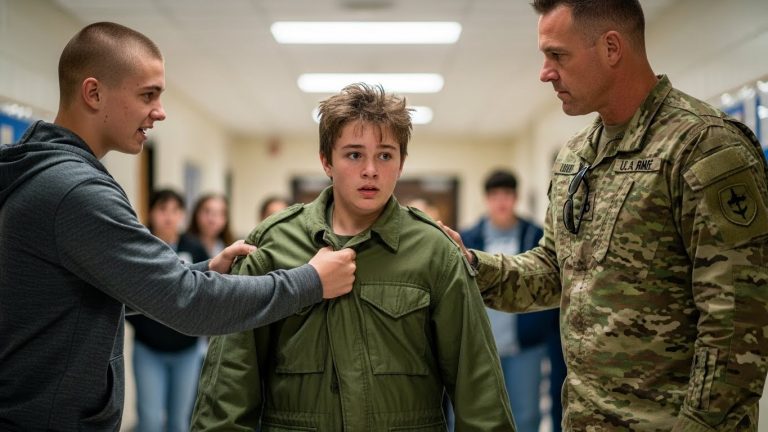
Then, Brad stretched his legs. He shifted his weight, his heavy combat boots squeaking against the linoleum. He leaned back, his chair creaking.
And his hand dropped again.
I zoomed in on my monitor.
10:16:30 AM – USB INPUT DEVICE REMOVED (Station 14)
Leo slammed his hands down on the desk. It wasn’t loud, but in the silence of the exam, it sounded like a gunshot.
“What is going on?” Leo whispered, his voice cracking. He sounded close to tears.
He crawled under the desk this time, fully disappearing from view. He was frantically checking the connections, probably thinking the computer was broken, thinking his luck had finally run out at the worst possible moment.
While Leo was under the desk, Brad looked around. He looked at the other students. He looked at me.
I didn’t move. I kept my head down, staring at my papers, playing the role of the oblivious teacher perfectly.
Brad grinned. He actually chuckled silently to himself. He reached down and seemingly “helped” by nudging the wires back into place just as Leo emerged, red-faced and sweating, from under the desk.
“It’s working now,” Leo muttered, more to himself than anyone else.
“Piece of junk computers, man,” Brad whispered loud enough for the surrounding rows to hear. “You should probably type faster. Time’s ticking.”
The audacity.
I looked at the clock. 10:18 AM.
Leo was shaking now. I could see it. His hands were trembling as they hovered over the keys. The flow was gone. The anxiety had set in. He was waiting for the next crash. He wasn’t thinking about data privacy anymore; he was thinking about the hardware.
Brad had successfully paralyzed him without landing a single physical blow.
I could have stopped it right then. I could have walked over, told Brad to knock it off, and moved Leo to a spare computer.
But if I did that, Brad wins. He gets a slap on the wrist. He gets to tell his friends how he messed with the nerd during finals. And Leo? Leo still loses his focus, and he still feels like a victim.
No.
I looked at the “admin tools” dropdown menu on my screen.
The school policy on bullying was strict, but the process was slow. It involved forms, parent meetings, and “restorative justice” circles that never worked.
However, the school policy on “Tampering with School Technology” was immediate and severe. And more importantly, the authority in this room belonged to me.
I cracked my knuckles.
If Brad wanted to play games with connectivity, he was about to learn that he was playing against the House. And the House always has better tools.
I opened the remote command prompt. It was time to intervene.
PART 2
Chapter 3: The Digital Bear Trap
The clock on the wall ticked past 10:20 AM. The silence in the room had shifted. It was no longer the focused silence of productivity; it was the tense, jagged silence of a room where something was going wrong, even if most people didn’t know what it was yet.
Leo was falling apart. I could see it from twenty feet away.
He was no longer typing. He was staring at his monitor, his hands hovering over the keys, terrified to touch them. He was afraid that if he typed a single character, the machine would freeze again. He was operating under a Pavlovian fear response. Brad had successfully trained him to be afraid of his own tool.
I looked at Brad’s screen. He had opened a Minesweeper clone in a browser window that he thought I couldn’t see because he had minimized it to the taskbar. He was playing casually, waiting for his cooldown timer to reset so he could mess with Leo again.
He was bored. That was his weakness. He needed stimulation.
I turned back to my console.
In the world of IT, we have a term called a “honeypot.” It’s a trap set to detect, deflect, or, in some manner, counteract attempts at unauthorized use of information systems. Usually, it’s used for hackers. Today, it was being used for a high school linebacker with a varsity jacket and a cruelty streak.
I didn’t just want to lock his screen. I wanted to catch him red-handed in a way that he couldn’t deny. I wanted the logs to be the judge, jury, and executioner.
I opened the scripting interface for the lab management software. I had about two minutes before Brad would likely strike again.
My fingers flew across my mechanical keyboard. I wasn’t just an admin; I used to be a sysadmin for a logistics firm before I decided I wanted to “mold young minds.” I missed the command line.
I wrote a simple trigger script.
Target: Station 15 (Brad). Condition: If USB Input Device Status = Disconnected/Reconnected at Station 14 (Leo). Action 1: Lock Workstation (Station 15). Action 2: Display Custom Message. Action 3: Maximize Volume. Action 4: Play System Sound “Critical_Stop.wav”.
I smiled. It was petty? Maybe. Was it professional? Debatable. Was it necessary? Absolutely.
I needed a message. Something that would shake him.
I typed into the text field: SECURITY ALERT: PHYSICAL INTERFERENCE DETECTED. BIOMETRIC LOCK ENGAGED.
It was nonsense, technically speaking. The computers didn’t have biometric scanners. But Brad didn’t know that. Brad barely knew how to turn the computer on. To him, technology was magic—magic he was currently abusing.
I hovered my mouse over the “Execute on Trigger” button.
I looked up.
Leo had started typing again. He was frantic, his posture horrible, his nose almost touching the screen. He was trying to get his thoughts down before the inevitable happened. He was in the “Conclusion” paragraph of his essay. If he could just finish this, he could save his grade.
I saw Brad glance over. He saw Leo typing. He saw the momentum building.
Brad’s eyes narrowed. He didn’t like that. He didn’t like seeing his victim recover. He wanted total submission.
Brad sat up straight. He cracked his neck. He looked left. He looked right. He looked at me.
I was ready. I was staring at a spreadsheet on my left monitor, looking for all the world like I was calculating the budget for printer toner.
Satisfied that the coast was clear, Brad slid his hand down the side of his chair.
I watched the live feed on my right monitor. I saw the shadow of his arm move on the floor cam—a security feature I rarely checked, but one that covered the aisles.
His hand reached into the nest of cables behind Leo’s tower.
I held my breath.
Don’t pull it yet, Brad. Wait for it…
My finger hovered over the Enter key, ready to activate the script the moment the system flagged the disconnect.
Brad’s fingers found the USB plug. He gripped it.
On my screen, the status for Station 14 flickered.
STATUS: DISCONNECTED.
Leo froze. He let out a small, strangled sob.
I hit Enter.
Chapter 4: Access Denied
The reaction was instantaneous.
The second Brad pulled that plug, my script executed with the precision of a guillotine.
BEEP-BEEP-BEEP!
The sound didn’t come from Leo’s computer. It came from Brad’s.
I had set the volume to 100%. The system error sound—that harsh, jarring “Critical Stop” noise—blasted through Brad’s headphones.
He jumped so hard his knees hit the underside of the desk with a loud thud. He ripped the headphones off his head, throwing them onto the desk.
“Whoa!” someone in the back row shouted.
Every head in the class turned toward Station 15.
Brad was staring at his monitor. It wasn’t showing his essay anymore. It wasn’t showing Minesweeper.
The screen had gone completely black, save for a large, blinking red box in the center of the screen with bold white text:
SECURITY ALERT: PHYSICAL INTERFERENCE DETECTED. BIOMETRIC LOCK ENGAGED. ADMINISTRATOR NOTIFIED.
Brad turned pale. He jammed his fingers onto his keyboard, hitting Escape, Enter, Control-Alt-Delete.
Nothing happened. The screen was locked tight. The message just kept blinking. Red. Black. Red. Black.
He looked at the mouse. He wiggled it. Nothing.
“What the…” he whispered. He looked around, panic setting in. He looked at Leo.
Leo was staring at him, confused. Leo’s computer was still disconnected because Brad hadn’t had the chance to push the plug back in before the alarm went off.
Brad quickly reached down to shove the plug back in, trying to hide the evidence.
“I wouldn’t do that if I were you, Brad,” I said.
My voice wasn’t loud, but in the sudden quiet of the room, it carried perfectly.
I stood up slowly from my desk. The floorboards creaked. I walked around the front of the podium, holding a printed sheet of paper—just a random attendance roster, but to them, it looked like a death warrant.
I walked down the center aisle. Step by step. The rhythmic clicking of my dress shoes was the only sound in the room.
The students parted like the Red Sea. They sensed blood in the water.
I stopped at Row 3.
I looked at Leo. “Leo, why aren’t you typing?”
Leo looked terrified. He thought he was in trouble. “Sir, my… my keyboard stopped working again. I don’t know why. I swear I didn’t touch anything.”
“I know you didn’t, Leo,” I said softly.
Then, I turned my body slowly, deliberately, to face Brad.
Brad was sweating. He was trying to look cool, leaning back in his chair, but his eyes were darting between me and the blinking red screen.
“Computer crash?” Brad asked, forcing a laugh. “Piece of junk, right? Just like Leo’s.”
“It didn’t crash, Brad,” I said, keeping my voice level. “It’s a security lockout.”
“Oh,” Brad said. “Weird. Can you unlock it? I need to finish my essay.”
“I can,” I said. “But first, we need to address the error message.”
I pointed to the screen. “Physical Interference Detected. Do you know what that means?”
“No clue,” Brad lied. He crossed his arms over his varsity jacket.
“It means,” I said, raising my voice slightly so the back row could hear, “that the system detected a discrepancy in the hardware configuration. Specifically, it detected that the USB input device at Station 14 was forcibly removed at the exact same timestamp that your workstation registered user activity consistent with… reaching under the desk.”
The room went dead silent.
Brad’s face flushed a deep, angry crimson. “I didn’t touch his computer. That’s crazy.”
“Is it?”
I walked back to the front of the room. “Let’s look at the logs.”
I projected my main screen onto the SmartBoard at the front of the classroom.
“This is the event viewer,” I explained, playing the role of the teacher to the bitter end. “It records everything. Here, at 10:14 AM, Leo’s keyboard is unplugged. Here, at 10:16 AM, it is unplugged again. And here, at 10:25 AM, it is unplugged a third time.”
I highlighted the lines.
“And here,” I pointed to the adjacent column, “we see the activity at Station 15. At those exact moments, your typing stops. Your browser activity ceases. And just moments ago…”
I pointed to the final line.
10:25:03 – SYSTEM LOCKOUT TRIGGERED BY ADJACENT DISCONNECT.
“I wrote a script, Brad,” I said, dropping the act. “I programmed the system to lock your computer the moment you touched Leo’s cables.”
The class gasped. A few students covered their mouths. Someone in the back whispered, “Oh, snap.”
Brad sat there, his mouth slightly open. He had been caught in 4K resolution. There was no lie he could spin. The technology had snitched on him.
“You… you can’t do that,” Brad stammered. “That’s… invasion of privacy or something.”
“It’s network administration,” I corrected. “And it’s my classroom.”
I walked back to his desk. I reached down behind Leo’s computer and plugged the keyboard back in.
Leo’s screen flickered. His cursor blinked. He was back online.
“Leo,” I said. “You have lost approximately twelve minutes of work time due to technical sabotage. I am authorizing a twenty-minute extension for you. You will stay after the bell to finish. Is that acceptable?”
Leo nodded, his eyes wide. “Yes. Yes, sir. Thank you.”
“Good. Get to work.”
I turned back to Brad. The red message was still blinking on his screen.
“Now, for you,” I said.
Brad looked at his screen. “Just unlock it so I can finish. I have like, two paragraphs left.”
“I’m afraid I can’t do that, Brad,” I said. “The system has flagged your workstation as a security risk. I can’t have you on the network until a full diagnostic is run. That could take hours.”
“But it’s a final!” Brad shouted, his cool demeanor shattering. “I’ll fail!”
“You should have thought about that before you decided to sabotage a classmate,” I said coldly.
I reached behind Brad’s computer. I grabbed his keyboard cable. I pulled it out. Then I grabbed his mouse cable. I pulled that out too.
I stood up, holding his peripherals in my hand like trophies.
“Since you seem to be having so much trouble with USB connections today,” I said, “I think it’s best we remove the temptation entirely.”
I pointed to the corner of the room, where a lonely, wobbly wooden desk sat facing the wall. It was the “Offline Desk,” usually reserved for students waiting for a password reset.
“Grab a pen and a stack of lined paper, Brad,” I ordered. “You’re going to write the rest of your essay by hand.”
“By hand?” Brad looked at me like I had asked him to kill a goat. “I can’t write an essay by hand! It’s computer science!”
“The prompt is about ethics,” I said. “I think you have a lot to reflect on regarding that topic. Maybe writing it out longhand will help the lesson stick.”
“I’m not doing that,” Brad said, standing up. He was big. He was trying to use his size to intimidate me.
I didn’t flinch. “Then you can take a zero. And I can send these logs to the Principal, the Athletic Director, and the scholarship committee at State U. I’m sure they’d love to know how their star linebacker handles ‘technical difficulties’.”
Brad froze. The mention of the Athletic Director hit home. If he got suspended for academic dishonesty, he was benched. If he was benched, he lost scouts.
He looked at me with pure hatred. He looked at the silent class watching him. He looked at Leo, who was typing away, ignoring him completely.
Brad slumped. His shoulders dropped.
He grabbed a pen from his backpack. He walked to the corner desk, his boots dragging on the floor.
“Silence,” I announced to the room. “Eyes on your own screens. Ten minutes remaining.”
I walked back to my Command Deck and sat down. My heart was pounding, but my hands were steady.
I unlocked my phone and sent a quick message to the Principal: Incident in Lab 304. Handled. Report to follow.
I watched Leo on my screen. He was flying now. 70 words per minute. He was going to finish.
I looked at the corner. Brad was staring at a blank sheet of paper, gripping the pen so hard his knuckles were white.
It was over. Or so I thought.
But high school politics are never that simple. And Brad wasn’t the kind of kid who took a public humiliation lying down.
The bell rang at 10:50 AM.
“Pencils down. Log off,” I called out.
As the students shuffled out, Leo stopped by my desk. He looked exhausted but relieved.
“Mr. Henderson?” he said quietly.
“Yeah, Leo?”
“Thanks,” he said. “I… I thought I was going crazy.”
“You’re a good coder, Leo,” I said. “Don’t let the hardware glitches get you down.”
He smiled and walked out.
Brad was the last one to leave. He dropped his handwritten essay on my desk. It was barely legible scrawl.
He leaned in close.
“This isn’t over,” he muttered. “You made me look like an idiot.”
“You did that yourself, Brad,” I replied, not looking up from his paper.
He stormed out, kicking the doorframe on his way.
I took a deep breath. I knew he was right. It wasn’t over. In fact, by the time lunch started, the story would be all over the school. And by tomorrow, I’d probably have angry parents in my inbox.
But I didn’t care.
I picked up Brad’s paper. I uncapped my red pen.
Explanation of Ethics: 0/10.
I was ready for the fallout. But I wasn’t ready for how far Brad was willing to go to get his revenge.
PART 3
Chapter 5: The Escalation
I expected a meeting. I expected an angry email. I didn’t expect the ambush.
The next morning, Wednesday, the atmosphere in the faculty lounge was radioactive. The moment I walked in to get my coffee, the conversation died. Three teachers looked at me, then looked away.
Sarah, the English teacher, whispered to me as I poured my dark roast. “Henderson, the Principal wants to see you. Now. And… bring a union rep if you can.”
“That bad?” I asked, stirring in my sugar.
“Brad’s parents are here,” she murmured. “And they brought a lawyer.”
Of course they did.
Brad’s father owned the largest car dealership in the county. His face was on billboards on the interstate. He was a booster for the football team, the kind of guy who thought writing a check meant he owned the curriculum.
I walked down the hallway to the administrative wing. My stomach was doing flips, but my mind was cold, calculating. I was running through my defenses like I was patching a firewall.
When I entered Principal Skinner’s office (yes, really), the room was crowded.
Brad was there, looking smug, slouching in a leather chair. Next to him was his father, a man wearing a suit that cost more than my car, and his mother, who looked like she was ready to speak to the manager of the entire universe.
The Principal looked sweaty. “Ah, Mr. Henderson. Please, sit.”
“I prefer to stand,” I said.
“This is unacceptable!” Brad’s dad boomed. His voice filled the small room. “You publicly humiliated my son! You targeted him! You accused him of sabotage without proof!”
“And you made him write with a pen!” his mother added, as if I had forced him to churn butter by hand. “He has carpal tunnel potential! He’s a quarterback!”
“Linebacker,” I corrected automatically.
“Don’t get smart with me,” the father snapped. “Brad told us everything. He said his computer crashed, and instead of helping him, you accused him of messing with that other kid’s computer just because you like the other kid better. You locked him out of his final exam!”
“He says he was profiling,” the lawyer—a slick guy in a grey suit—interjected smoothly. “Singling out a student athlete based on bias. That’s a Title IX violation, potentially.”
I looked at Brad. He was grinning. A nasty, predatory grin. He thought he had won. He thought that because his dad sold F-150s, reality could be bent to his will.
“Did Brad tell you why I locked his computer?” I asked calmly.
“Because you’re a petty tyrant!” the dad shouted.
“No,” I said. “Because he was physically tampering with another student’s hardware to prevent them from completing their exam. That is a violation of the Student Code of Conduct, Article 4, Section B: Intentional Sabotage of School Property or Peer Work.”
“That’s a lie!” Brad shouted. “I never touched his computer! You can’t prove it! It’s my word against yours!”
The Principal cleared his throat. “Mr. Henderson, without concrete proof… and considering the severity of the accusation… maybe we should just let Brad retake the exam? Online? And perhaps strike the incident from the record?”
He was caving. He was afraid of the booster money drying up.
I looked at the Principal. Then I looked at the lawyer.
“You want proof?” I asked.
I reached into my pocket and pulled out a USB drive.
“I anticipated this might happen,” I said. “So I exported the raw server logs, the local machine event viewer logs, and… the security footage.”
Brad’s grin vanished.
Chapter 6: The Receipts
The silence that followed was heavy.
“Footage?” the dad asked, his voice dropping an octave. “You don’t have cameras in the lab. It’s a privacy violation.”
“We don’t have surveillance cameras in the lab,” I corrected. “But we do have a webcam on the teacher’s podium that is set to motion-activate for security purposes when the room is empty. Or… when I manually activate it.”
I lied slightly. I had turned the webcam on the moment I saw Brad’s hand drop the first time. It was a wide-angle shot. It wasn’t 4K cinema quality, but it was enough.
“May I?” I gestured to the Principal’s computer.
He nodded, looking relieved that the ball was out of his court.
I plugged in the drive. I navigated to the file.
I played the video.
On the screen, grainy but unmistakable, was the layout of Row 3. You could see Leo, hunching over his work. You could see Brad, leaning back.
And then, you saw it.
Brad looking around. The coast is clear. His arm dropping. A yank. Leo’s hands flying up in frustration. Brad laughing.
I fast-forwarded.
Brad doing it again.
I fast-forwarded again.
The moment the alarm went off. Brad jumping. The look of guilt. The attempt to plug it back in.
I paused the video on the frame where Brad was holding the unplugged cable in his hand, looking like a deer in the headlights.
“That,” I said, pointing to the screen, “is your son holding the connection cable to Station 14. At the exact second his computer locked out.”
I turned to the father.
“Your son wasn’t having a technical difficulty. He was gaslighting a scholarship student who was trying to write an essay on ethics.”
The lawyer closed his notebook. He knew when a case was dead.
Brad’s mom looked at the screen, then at her son. “Bradley? You said the teacher was picking on you.”
“He was!” Brad stammered, his face bright red. “He… he set me up!”
“I set you up to unplug a classmate’s computer?” I asked. “Did I use mind control?”
The father stood up. He walked over to the screen, looked closely at the image, and then turned to face his son. The air left the room.
“You lied to me,” the father said. It wasn’t a question.
“Dad, I was just messing around!” Brad pleaded. “It was just a joke! Leo’s a nerd, he doesn’t care!”
“That ‘nerd’,” I interrupted, “is fighting for a scholarship that determines his entire future. Your son wasn’t just ‘messing around’. He was actively trying to destroy another student’s academic career for entertainment.”
I turned to the Principal.
“I am submitting this evidence to the district board formally,” I said. “Unless, of course, we want to handle this ‘in-house’.”
Chapter 7: The Fallout
The meeting didn’t last much longer.
The lawyer excused himself, muttering something about a conflict of interest. The mother looked like she was about to cry. The father looked like he was about to explode, but this time, the target wasn’t me.
“Get in the car,” the father hissed at Brad.
“But Dad—”
“NOW.”
Brad scrambled out of the office.
The Principal looked at me. He wiped his forehead with a handkerchief. “Well. That was… definitive.”
“I’ll need a grade change form for Brad,” I said.
“For the exam?”
“For the semester,” I said. “Academic dishonesty carries an automatic failure of the course, according to the handbook. I assume we are following the handbook?”
The Principal sighed. He knew he couldn’t fight it. The evidence was digital, timestamped, and backed up on a drive I was currently holding.
“Fine,” he said. “Fail him.”
I walked out of that office feeling ten feet tall.
But the real victory came two days later.
It was graduation rehearsal. The gym was packed. I was standing near the tech booth, checking the sound system, when Leo walked up to me.
He looked different. He was standing straighter. He wasn’t wearing the hoodie; he was in a button-down shirt.
“Mr. Henderson?”
“Hey, Leo. Congrats on making it to the finish line.”
“I got it,” he said. A massive smile broke across his face.
“Got what?”
“The scholarship. The State U Tech Initiative. They emailed me this morning. Full ride.”
I felt a lump in my throat. “That’s incredible, Leo. You earned it.”
“I wouldn’t have,” he said seriously. “If I hadn’t finished that essay… if you hadn’t given me that extra time… I would have panicked. I would have failed.”
He paused, looking down at his shoes. “I heard about Brad. I heard he has to go to summer school to graduate.”
“Some people have to learn lessons the hard way,” I said.
“Did you really… you know… hack his computer?” Leo asked, his eyes wide.
I winked. “Let’s just say I utilized the available administrative tools to ensure network integrity.”
Leo laughed. It was a good sound.
Chapter 8: System Restore
The summer break started the next day. The halls of Oak Creek High were empty, the servers humming quietly in the air-conditioned dark of the server room.
I was cleaning up Lab 304, wiping down the monitors, coiling the cables.
I stopped at Station 15.
The “Access Denied” sticker I had mentally placed on Brad’s forehead was permanent. He was back in summer school, sitting in this very room, retaking the course with a different teacher. He had been benched for the first three games of the next football season by the Athletic Director, who, it turned out, hated liars more than he loved winning.
But at Station 14, I saw something else.
Leo had left a sticky note on the monitor before he left for the last time.
It just said: Thanks for watching the screen. – Leo
I peeled it off and stuck it to my own monitor on the Command Deck.
We often talk about technology as this cold, unfeeling thing. We talk about algorithms and data and privacy like they are abstract concepts. But in that lab, on that Tuesday, technology wasn’t just code.
It was a shield.
I sat down at my desk and opened the terminal one last time before shut down.
> SYSTEM STATUS: ALL CLEAR. > NETWORK INTEGRITY: 100%. > USER ‘BRAD’: DISCONNECTED. > USER ‘LEO’: UPLOAD COMPLETE.
I smiled, typed exit, and hit Enter.
The screens went black. The hum faded.
I walked out of the lab, locked the door, and turned off the lights.
Class dismissed.