They weren’t hitting her. They were doing something much worse. They had her trapped in a silent circle of torment, pulling at her life thread by thread. I’m the Student Body President, and I’m supposed to play by the rules, but when I saw the fear in her eyes, I knew the rulebook had to burn. Here is exactly how I shattered their power without raising a fist.
PART 1
Chapter 1: The Velvet Trap
You think you know what violence looks like.
You think it’s a shoved locker, a trip in the cafeteria, or a fist connecting with a jaw behind the bleachers. That’s the kind of violence they teach us to look for in those mandatory assemblies at Oak Creek High. They show us blurry videos of kids getting pushed around, and we all nod, thinking we’d know exactly what to do if we saw it.
But real violence? The kind that breaks you? It’s usually silent.
It’s a Wednesday. The air in the courtyard is heavy, thick with the smell of cut grass and that vague, anxious energy that always hums through an American high school during lunch block. I’m sitting on the concrete retaining wall near the weeping willow, nursing a lukewarm iced coffee.
I’m Maya. Senior. Student Body President. To the administration, I’m the golden girl who organizes the pep rallies and reads the morning announcements with a smile that says, “Everything is fine.” To the student body, I’m… complicated. I have the varsity jacket, I have the grades, and I have the social capital. But I earned it by keeping my eyes open.
And right now, my eyes are locked on the far corner of the quad, near the vending machines.
Most people wouldn’t notice it. To a casual observer, or a teacher scanning the crowd while checking their phone, it looks like a huddle. Just a group of girls, maybe five or six of them, standing in a tight circle. They look like they’re sharing a secret. They’re laughing. Their hair is glossy, their jeans are designer, and they radiate that specific brand of terrifying confidence that peaks at age seventeen.
But I know that formation.
That isn’t a friendship circle. That’s a shark tank.
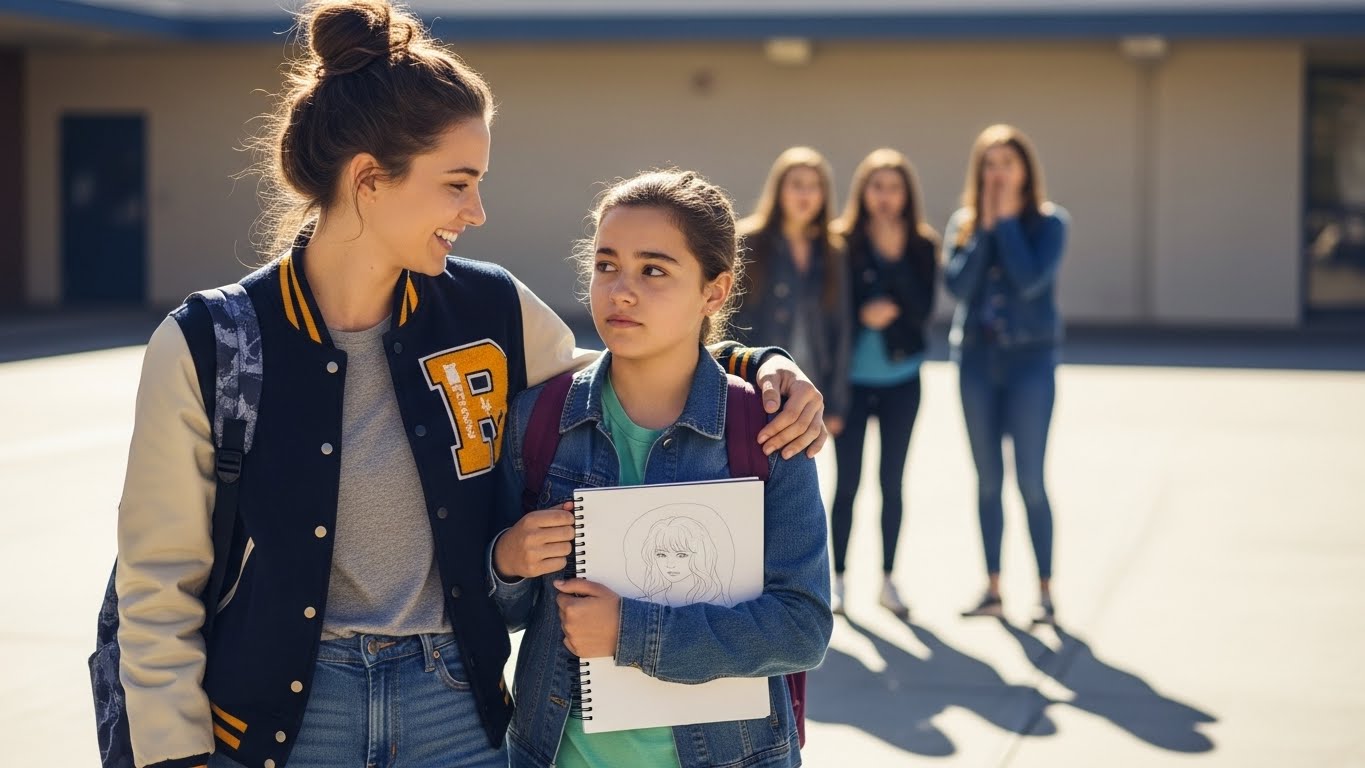
In the center of the knot is a girl I’ve seen maybe twice. A sophomore, I think. Lily. She’s the type who tries to disappear into the lockers when the bell rings. She wears oversized flannels and paints her Converse with sharpies. Today, she’s wearing a vintage denim jacket that probably cost five dollars at the Goodwill downtown.
The girls surrounding her are led by Chloe. Chloe is the kind of girl who knows exactly how to destroy someone’s reputation without ever raising her voice above a whisper.
They aren’t hitting Lily. If they hit her, a teacher would see. If they hit her, there would be evidence. Bruises heal. Suspensions happen.
No, this is the Silent Treatment’s evil twin. The Velvet Trap.
They are standing just a little too close. Invading her personal space by mere inches. I watch as Chloe reaches out. She’s smiling, her teeth bright white in the midday sun. She touches Lily’s collar. She smooths it down. It looks affectionate from fifty feet away.
But I have 20/20 vision, and I can see the tension in Lily’s neck. She’s frozen. She’s clutching her sketchbook against her chest like a shield.
Chloe leans in. She whispers something in Lily’s ear.
Lily flinches.
The other girls giggle. It’s a low, synchronized sound, like dry leaves skittering on pavement.
Another girl, one of Chloe’s lieutenants, reaches out and tugs on the strap of Lily’s backpack. Not a hard yank. Just a pull. Just enough to off-balance her. Just enough to remind her: You can’t leave until we let you.
Lily tries to step back. The circle tightens. They shift their feet, blocking her exit path. They are boxing her in with nothing but their bodies and their whispers.
My stomach drops. I know what’s happening. They are dissecting her. They are picking apart her clothes, her hair, her existence, line by line, whisper by whisper. It’s psychological suffocation.
I look around. The courtyard is packed. Hundreds of kids. And nobody is doing a damn thing. Most are on their phones. Some are looking, seeing the dynamic, and quickly looking away, thankful it isn’t them in the center.
The teachers are by the cafeteria doors, laughing at some joke, totally oblivious.
Lily’s eyes dart around, looking for an escape, looking for a lifeline. For a split second, her gaze meets mine across the crowded quad.
It’s a look of pure, unadulterated desperation. It’s the look of a drowning person watching a boat sail past.
I set my iced coffee down on the wall. The condensation leaves a wet ring on the concrete.
I have a choice. I always have a choice.
I can finish my lunch. I can look down at my phone. I can pretend I didn’t see the terror in that girl’s eyes. I can preserve my own peace, keep my head down, and graduate in three months without incident.
Or, I can walk into the fire.
Chapter 2: The Decision
My heart is hammering against my ribs. It’s a physical thud, thud, thud that echoes in my ears.
People think being popular makes you fearless. That’s a lie. Being popular just means you have more to lose. If I intervene and fail, if I make it awkward, if I look weak, the sharks turn on me. Chloe has been waiting for a crack in my armor since freshman year.
I stand up. My legs feel heavy, but my adrenaline is spiking.
I watch the circle again. The girl on the left has hooked her finger through the loop of Lily’s backpack. She’s pulling Lily backward, gently, casually, while Chloe is whispering in her face.
It’s the backpack strap that does it for me.
That small, controlling gesture. It says, “I own you.” It says, “You are not a person; you are a plaything.”
It triggers a memory I buried a long time ago. Seventh grade. A locker room. A circle of girls just like this one. The heat of shame burning my face while they laughed at my Payless sneakers. The feeling of being small. The feeling of praying for the floor to open up and swallow me whole.
I swore then that if I ever got power, I wouldn’t use it to hurt people. I’d use it to stop the hurting.
Well, Maya. Here’s your test.
I take a breath, inhaling the scent of asphalt and exhaust fumes from the nearby parking lot. I smooth down the front of my shirt.
I don’t look at the teachers. They are useless in this game. If a teacher walks over, they’ll say, “Is there a problem here, ladies?”
Chloe will smile her shark smile and say, “No, Mr. Henderson! We’re just admiring Lily’s jacket. Right, Lily?”
And Lily, terrified of retaliation, will nod. The teacher will walk away, and the circle will tighten, and the punishment for snitching will be ten times worse.
Authority figures cannot break the Velvet Trap. Only social force can break it.
I have to beat them at their own game.
I start walking.
My pace is steady. Not running. Running looks panicked. I walk with the rhythm of someone who owns the concrete beneath her feet. I focus on my breathing. In for four. Out for four.
I need a plan. If I go in there yelling—“Leave her alone!”—I create a scene. I make Lily a “victim” in front of the whole school. I confirm that she is weak and needs saving. That might stop the bullying for five minutes, but it destroys her dignity forever.
No. I need to flip the script.
I need to make the bullying irrelevant. I need to make them invisible.
I’m ten feet away now. I can hear the whispers.
“…did you get that out of a dumpster?”
“…my mom gives clothes like that to the housekeeper…”
“…why don’t you say anything? Are you mute?”
Lily’s head is bowed so low her chin is touching her chest. She’s trembling. The girl holding her backpack strap gives it another tug, jarring Lily backward.
I’m five feet away.
They haven’t seen me yet. They are too focused on their prey. They are drunk on the power of the circle.
I don’t slow down. I don’t hesitate.
I walk straight toward the gap between Chloe and her lieutenant. I don’t say “Excuse me.” I don’t ask for permission to enter.
I simply walk as if they aren’t there.
I shoulder-check the girl holding the backpack strap. Not a violent shove, just a firm, confident collision, as if I didn’t see her standing there because she is so insignificant.
The contact breaks her grip. She stumbles back, gasping, “Hey!”
The circle shatters. The vacuum is broken.
Heads snap toward me. Chloe spins around, her eyes narrowing, her mouth opening to launch a venomous retort. She sees it’s me. The words die in her throat.
“Maya?” she says, her voice pitching up, sickly sweet but confused. “What are you—”
I don’t look at Chloe. I don’t look at the girl I bumped into. I don’t acknowledge their existence. To me, right now, they are ghosts. They are background noise.
I lock eyes with Lily.
She looks up, startled, tears swimming in her lower lash line. She looks like a deer caught in headlights, waiting for the final blow.
I smile. Not a polite smile. A radiant, genuine, best-friend smile.
“Oh my god,” I say, my voice loud, clear, and projecting to the back of the courtyard.
I reach out. But I don’t grab her. I offer my arm.
PART 2
Chapter 3: The Disruption
The silence that follows my entrance is deafening.
For a heartbeat, the entire dynamic of the courtyard hangs in the balance. Chloe is standing there, mouth slightly agape, processed blonde hair glinting in the sun. She’s waiting for me to acknowledge her. She’s waiting for the confrontation. She’s ready to fight, to argue, to play the victim. “We were just talking, Maya! God, why are you so aggressive?”
She has that script memorized. She’s used it a thousand times.
But I denied her the cue.
I am looking exclusively at Lily. My entire body is turned toward her, blocking Chloe out with my shoulder. It’s a deliberate physical snub. In the language of high school social hierarchy, it’s a nuclear strike.
“I have been looking everywhere for you!” I lie effortlessly. My voice is bright, warm, and carries a tone of excitement that implies Lily is the most important person on this campus.
Lily blinks, confused. A tear escapes and tracks through the thin layer of foundation on her cheek. She opens her mouth to speak, but nothing comes out. She’s still vibrating with fear.
I step closer, invading the space the bullies had claimed, reclaiming it for us.
“Is that the jacket?” I ask, pointing to her thrifted denim. I reach out and touch the fabric, exactly where Chloe had touched it, but my touch is different. It’s admiring. It’s respectful. “The one you were telling me about? The vintage Levi’s?”
I’m improvising wildly. I have no idea what brand it is. It doesn’t matter.
Lily stares at me. She’s smart. I see the gears turning behind her panicked eyes. She realizes I’m throwing her a rope.
“I… um…” her voice is a whisper, cracked and dry.
“It is!” I exclaim, turning slightly so the surrounding crowd can hear. “It’s incredible. The wash is perfect. You literally cannot find this in stores anymore.”
I hear Chloe shift behind me. She clears her throat. A loud, demanding Ahem.
“Maya,” Chloe says, her voice sharp, trying to regain control of the scene. “We were having a conversation with her.”
The tension spikes. The circle is trying to reform. They want their power back. They want to remind everyone that they decide who is cool and who is trash.
This is the critical moment. If I turn around and address Chloe, even to tell her to shut up, I validate her. I give her equal standing.
So I do the hardest thing possible.
I continue to ignore her completely. I don’t even flinch. It’s as if she is a ghost shouting from another dimension.
I keep my eyes locked on Lily. “You have to show me where you found it. Seriously. I’ve been looking for something exactly like this for the Student Council retreat.”
I see the confusion ripple through the other girls in the circle. They’re looking at Chloe, then at me, then at Lily. Their leader is being ignored. Their victim is being praised. The script is broken. They don’t know what to do with their hands. They drop the straps of their backpacks. They take half a step back.
The invisible walls of the prison are starting to crack.
Chapter 4: The Link
Now for the physical extraction.
I can’t just walk away and hope Lily follows. She’s still frozen, her feet glued to the pavement by trauma. If I walk away, they might pounce back on her.
I need to physically bind her to my status.
“Come on,” I say. “I’m heading to Mr. Harrison’s room. You have Art next, right?”
I don’t know if she has Art next. I’m guessing based on the sketchbook she’s clutching like a life preserver.
Lily nods, a jerky, mechanical motion. “Y-yes.”
“Perfect. Walk with me.”
I don’t wait. I step in and loop my arm through hers.
It’s a bold move. Linking arms is intimate. It’s a sign of solidarity, of sisterhood. In the high school ecosystem, linking arms creates a closed unit. It says: We are together. If you mess with her, you mess with me.
I feel her muscles tense up under her flannel shirt. She’s stiff as a board. She’s terrified that this is a trick, that I’m going to lead her away and then laugh at her too.
I give her arm a gentle, reassuring squeeze. A signal. I’ve got you.
“Let’s go,” I whisper, low enough that only she can hear. “Just look at me. Don’t look at them.”
She takes a shaky breath. She looks at my face. She sees the determination there. And then, she takes a step.
We turn together.
We are now facing the wall of girls. Chloe is standing directly in our path, hands on her hips, her face twisted in an ugly scowl. She’s furious. She’s used to people cowering. She’s not used to people walking right through her.
She stands her ground, expecting us to go around her.
I don’t deviate. I steer Lily straight toward Chloe.
It’s a game of chicken. And I am driving a tank.
I keep my head high, my expression breezy and unbothered, chatting away to Lily. “And did you finish that sketch? The charcoal one?”
Two feet away. Chloe’s eyes widen. She realizes I am not going to stop. I am not going to step aside.
At the very last second, Chloe breaks.
She shuffles awkwardly to the left, stumbling slightly over her own platform sandals to get out of our way.
We breeze past her. The air rushes between us.
I feel Lily exhale, a long, shuddering release of breath. We have broken the circle. We are out.
Chapter 5: The VIP Treatment
We are walking through the courtyard now, and I can feel the eyes on us.
High school is a fishbowl. Everyone saw what just happened. They saw the Student Body President swoop in, ignore the Queen Bee, and link arms with the quiet art girl.
The whispers are starting, but they’re different now.
“Is Lily friends with Maya?” “Did you see Chloe’s face?” “I didn’t know they knew each other.”
This is the power of narrative. I am rewriting Lily’s social standing in real-time. By treating her like a VIP, I am forcing everyone else to view her that way too.
I keep up the chatter. It’s important that we look natural.
“You’re shaking,” I say quietly, keeping a smile plastered on my face so anyone watching thinks we’re joking around.
“I thought… I thought they were going to…” Lily’s voice trails off. She’s gripping my arm so tight her knuckles are white.
“I know,” I say soothingly. “I know. But they can’t touch you now. You’re with me.”
I steer us toward the main building. We pass a group of freshman boys who usually jeer at everyone. They see me. They see Lily. They nod respectfully and move aside.
“Why are you doing this?” Lily asks. She looks up at me, her eyes wide and searching. “You don’t even know me.”
We reach the double doors of the Science wing. The cool air conditioning hits us, drying the sweat on my forehead.
I stop for a second, but I don’t let go of her arm.
“I know what it feels like,” I tell her honestly, dropping the performance for a split second. “To be in the middle. I know what they were doing. And I wasn’t going to let them win.”
She looks down at her shoes. “They said my clothes were trash.”
“They’re liars,” I say firmly. “And they’re boring. Look at them, Lily. They all dress exactly the same. They’re clones. You have actual style. That scares them. They attack what they can’t understand.”
A small, tentative smile touches the corner of her mouth. “You really like the jacket?”
“I really do,” I say. “And I want you to wear it like armor. Don’t you dare take it off because of them.”
Chapter 6: The Crumble
I glance back through the glass doors of the building.
Out in the courtyard, the scene has dissolved. Without their victim, the circle had no purpose. Chloe is standing there, checking her phone, trying to look busy, but her lieutenants look awkward. They’re drifting away.
The power dynamic has shifted.
Bullying relies on isolation. It relies on the idea that the victim is “less than.” By elevating Lily, I made the bullies look petty and mean. I made them look small.
I didn’t fight them. I didn’t give them a war story to tell. I just made them irrelevant.
We walk down the hallway. The bell is about to ring.
“Where is your class?” I ask.
“Room 304. Art,” she says.
“Okay. I’m walking you all the way to the door.”
“You don’t have to—”
“I want to,” I interrupt. “Plus, I need everyone to see us. We need to cement this. By tomorrow, everyone will know you’re cool with me. Chloe won’t touch you again. If she does, she looks desperate.”
We walk past the trophy case. We walk past the principal’s office. I wave to the secretary. She waves back at both of us.
Lily’s posture is changing. She’s standing a little straighter. She’s not hunching her shoulders anymore. The physical weight of the bullying is lifting, replaced by the buoyancy of acceptance.
It’s amazing what five minutes of basic human decency can do.
Chapter 7: The Aftermath
We reach Room 304. The art room smells like turpentine and clay. It’s a sanctuary.
I unhook my arm from hers.
Lily turns to face me. She looks different than she did ten minutes ago. The color has returned to her cheeks.
“Thank you,” she says. It’s not a casual thank you. It’s heavy. It carries the weight of someone who was pulled back from the edge of a cliff.
“Anytime,” I say. “Hey, are you free lunch tomorrow?”
She blinks. “Me?”
“Yes, you. Come sit with us. We usually sit by the willow tree. It’s quieter there.”
I’m inviting her into the inner circle. It’s the final nail in the coffin for the bullies. If she sits with the Student Council, she is untouchable.
Her face lights up. A real, genuine smile. “I’d like that.”
“Good. See you then.”
I watch her walk into the classroom. She doesn’t slink in. She walks in. She says hi to the teacher. She sits down and opens her sketchbook.
I turn around and lean against the lockers for a second, letting out a long breath. My hands are shaking slightly now that the adrenaline is wearing off.
It was risky. It could have backfired. Chloe could have started screaming. Lily could have run away.
But it worked.
I check my phone. I have three texts from people who saw it. “Did u just shut down Chloe? LMAO.” “That was savage.” “Is that girl your cousin or something?”
I type back one reply: “She’s my friend. Back off.”
Chapter 8: The Lesson
I walk to my next class, AP History. I slide into my seat as the final bell rings.
I look out the window. The courtyard is empty now. Just discarded wrappers and empty tables.
The Silent Treatment is a weapon. It destroys people without leaving a mark. It convinces you that you are worthless, that you are alone, that you deserve the silence.
But kindness? Kindness is a weapon too.
Not the soft, passive kind of kindness. I’m talking about aggressive, strategic kindness. The kind that steps in the way. The kind that disrupts the status quo.
I didn’t need to punch Chloe. I didn’t need to get suspended. I just needed to show Lily that she wasn’t alone.
Power is a funny thing. We spend so much time in high school trying to hoard it, trying to climb the ladder, trying to be on top. But power is useless if you just keep it for yourself.
The only time power actually matters is when you use it to pull someone else up.
I open my notebook. I write down a reminder for tomorrow: Lunch with Lily.
I smile. I have a feeling she’s going to be a really cool friend. And as for the sharks? They can keep swimming in circles. We’re already on dry land.
PART 2: THE SHIFT
Chapter 3: The Disruption
The silence that follows my entrance is not empty; it is heavy, suffocating, and pressurized. It is the kind of silence that usually precedes an explosion.
For a heartbeat—which feels like an eternity stretched thin over the asphalt of the courtyard—the entire dynamic of the social ecosystem hangs in a precarious balance. I can feel the heat radiating off the pavement, or maybe it’s the heat of a hundred eyes suddenly swiveling toward us. The courtyard, usually a cacophony of laughter, gossiping, and the crinkle of lunch wrappers, seems to have held its collective breath.
Chloe is standing there, frozen. Her mouth is slightly agape, a perfectly painted “O” of shock. The sun glints off her processed blonde hair, which she usually flips dismissively, but right now, she’s too stunned to move. She is waiting for the script she knows by heart. She is waiting for me to acknowledge her dominance. She is waiting for the confrontation, the moment where I ask, “What’s going on?” so she can roll her eyes and deliver her rehearsed line: “We were just talking, Maya! God, why are you so aggressive? Can’t we even talk to people anymore?”
She has that script memorized. She has used it a thousand times to gaslight teachers, parents, and other students. It’s her shield. It turns her aggression into victimhood and makes the person interfering look crazy.
But I denied her the cue.
I am not looking at her. I have turned my body completely, angling my shoulder to create a physical wall between Chloe and Lily. It is a deliberate, calculated snub. In the intricate, brutal language of high school hierarchy, refusing to make eye contact is a nuclear strike. It says, You are not a threat. You are not a peer. You are furniture.
I am looking exclusively at Lily.
Up close, the damage is more visible. Lily isn’t just scared; she is trembling with a vibrational intensity that shakes the buttons on her denim jacket. Her knuckles are white where she grips her sketchbook, pressing it against her chest as if it can stop a bullet. Her eyes are wide, darting between me and Chloe, waiting for the trap to spring. She expects me to join in. She expects this to be the part where the “nice” popular girl reveals she’s just as cruel as the rest of them.
“I have been looking everywhere for you!” I lie.
The lie comes out smooth, bright, and warm. My voice is pitched perfectly—loud enough to be heard by the onlookers ten feet away, but intimate enough to feel like a secret between friends. It carries a tone of genuine excitement, the kind you save for your best friend when they return from a long trip.
Lily blinks, confused. A single tear escapes from her left eye, cutting a clean track through the thin layer of foundation she’s wearing. She opens her mouth to speak, to apologize, to beg, but nothing comes out. Her vocal cords are paralyzed by the adrenaline flooding her system.
I step closer, invading the space the bullies had claimed as their torture chamber. I am reclaiming this concrete square for us.
“Is that the jacket?” I ask, pointing to her thrifted denim. I reach out and touch the fabric near the collar.
This is the pivotal moment. Chloe had touched this jacket seconds ago, but her touch was a violation—a pinch, a pull, a sneer made physical. My touch is different. I handle the fabric with reverence. I treat it like it’s spun gold.
“The one you were telling me about? The vintage Levi’s?” I continue the improvisation, my brain firing on all cylinders. I have no idea what brand it is. It doesn’t matter. The truth is irrelevant; the narrative is everything.
Lily stares at me. She is a smart girl—you can see it in the depth of her terrifying gaze. She realizes, slowly, that I am not holding a knife. I am throwing her a rope.
“I… um…” her voice is a whisper, cracked and dry like dead leaves.
“It is!” I exclaim, turning my head slightly so my voice projects toward Chloe without actually looking at her. “It’s incredible. The wash is perfect. You literally cannot find this in stores anymore. I saw one like this in a boutique in LA last summer and it was like, three hundred dollars.”
I hear the shuffle of feet behind me. Chloe is rebooting. She clears her throat. A loud, demanding, aggressive Ahem.
“Maya,” Chloe says. Her voice is sharp, vibrating with suppressed rage. She hates being ignored more than she hates being insulted. “Maya, we were having a conversation with her.”
The tension spikes. The air grows thin. The circle of girls—Chloe’s lieutenants—are trying to reform. They want their power back. They want to remind everyone watching that they decide who is cool and who is trash. They are shifting their weight, crossing their arms, preparing to verbally swarm me.
This is the critical juncture. If I turn around and address Chloe—even to tell her to shut up, even to say “Leave her alone”—I validate her. I give her equal standing. I make this a debate between two powerful girls, with Lily as the helpless object in the middle.
So I do the hardest thing possible. I do the thing that goes against every instinct I have to fight back.
I continue to ignore her completely.
I don’t flinch. I don’t pause. It is as if Chloe is a ghost shouting from another dimension, totally inaudible to the living.
I keep my eyes locked on Lily, beaming a smile that I hope hides the fact that my heart is hammering against my ribs like a trapped bird.
“You have to show me where you found it,” I say, increasing the enthusiasm in my voice to drown out Chloe’s presence. “Seriously. I’ve been looking for something exactly like this for the Student Council retreat. We’re doing a 90s theme and this is authentic.”
I see the confusion ripple through the other girls in the circle. I can see them in my peripheral vision. They are looking at Chloe, then at me, then at Lily. Their leader is being ignored. Their victim is being praised. The script is broken. They don’t know what to do with their hands. One girl drops the strap of her backpack she had been aggressively holding. Another takes a half-step back, sensing the shift in the wind.
The invisible walls of the prison are starting to crack. They rely on fear to keep the walls up, but my refusal to acknowledge the fear is dissolving the mortar.
Chloe tries one more time. “Maya! I’m talking to you!”
I lean in closer to Lily, creating a bubble of privacy in the middle of the chaos. “Ignore them,” I mouth, barely voicing the words. “Just look at me.”
Lily takes a shaky breath. She looks at my face. She sees the determination there. She sees that I am not backing down. And for the first time in ten minutes, the terror in her eyes recedes just a fraction, replaced by a spark of hope.
Chapter 4: The Link
Now comes the extraction.
Disruption is one thing; escape is another. I can’t just walk away and hope Lily follows. She is still frozen, her feet glued to the pavement by the residue of trauma. If I walk away, the moment I’m out of earshot, the sharks could pounce back, sharper and crueler than before, punishing her for my interference.
I need to physically bind her to my status. I need to merge our social signatures until she is under my protection.
“Come on,” I say, straightening up. “I’m heading to Mr. Harrison’s room. You have Art next, right?”
I am guessing based on the sketchbook she is clutching. It’s a calculated risk.
Lily nods, a jerky, mechanical motion. “Y-yes. Studio Art.”
“Perfect. That’s on my way. Walk with me.”
I don’t wait for her to agree. I don’t give her time to doubt. I step in and loop my arm through hers.
It’s a bold, intimate move. Linking arms is a specific language in high school. It’s not just walking together; it is a declaration of solidarity. It signifies a closed unit. It says: We are together. We are a team. If you mess with her, you mess with me.
I feel her muscles tense up under the flannel shirt. She is stiff as a board, her arm rigid against mine. She is terrified that this is a trick, a cruel prank where I lead her away only to shove her into a mud puddle.
I give her arm a gentle, reassuring squeeze. Not hard, just grounding. A tactile signal. I’ve got you. I am not letting go.
“Let’s go,” I whisper, low enough that only she can hear. “Chin up. Don’t look at them. Look at the horizon.”
She takes a shaky breath, inhaling sharply through her nose. She looks at me, then at the gap in the circle I’ve created. And then, she takes a step.
We turn together.
We are now facing the wall of girls. Chloe has moved. She is standing directly in our exit path, hands on her hips, her legs planted wide in a power stance. Her face is twisted in an ugly scowl. She is furious. She is used to people cowering. She is not used to people walking right through her.
She stands her ground, expecting us to go around her. She expects us to yield, to step onto the grass, to acknowledge her dominance by deviating from our path.
I don’t deviate.
I tighten my grip on Lily’s arm, silently communicating: Stay with me. Don’t stop.
I steer us straight toward Chloe.
It’s a game of chicken. And I am driving a tank.
I keep my head high, my expression breezy and unbothered, chatting away to Lily as if the fuming girl in front of us doesn’t exist. “And did you finish that sketch? The charcoal one you were working on?”
Lily is terrified. I can feel her hesitation, her instinct to stop. But I keep moving, my momentum carrying both of us forward.
Three feet away.
Chloe’s eyes widen. She realizes I am not going to stop. I am not going to step aside. I am going to collide with her if she doesn’t move.
Two feet away.
I see the calculation in Chloe’s eyes. If we collide, she looks like the aggressor. If she blocks us physically, she starts a fight she can’t win in front of this many witnesses.
At the very last second, Chloe breaks.
She shuffles awkwardly to the left, stumbling slightly over her own platform sandals to get out of our way. It’s a clumsy, undignified movement. She looks foolish.
We breeze past her. The air rushes between us.
I feel Lily exhale, a long, shuddering release of breath that seems to deflate her entire body. We have broken the circle. We are out.
But we aren’t safe yet. The walk across the courtyard is the gauntlet.
Every head is turned. The whispers are starting, buzzing like cicadas in the heat.
“Is Lily friends with Maya?” “Did you see Chloe’s face? She looked like she was gonna kill someone.” “Since when do they hang out?”
This is the power of narrative control. I am rewriting Lily’s social standing in real-time. By treating her like a VIP, I am forcing everyone else to view her that way too. Humans are herd animals; they look for cues on how to treat people. For years, the cue on Lily was “target.” I just changed the cue to “protected.”
I keep up the chatter, my voice light and airy. It’s important that we look natural, like two friends gossiping on the way to class. If I look intense or worried, people will know it’s a rescue mission. If I look happy, people will think it’s a friendship.
“You’re shaking,” I say quietly, keeping a bright smile plastered on my face so anyone watching thinks we’re joking around.
“I thought… I thought they were going to…” Lily’s voice trails off. She’s gripping my arm so tight her knuckles are white, her fingernails digging into my varsity jacket.
“I know,” I say soothingly, matching my stride to hers. “I know. But they can’t touch you now. You’re with me. We’re just walking. Just one foot in front of the other.”
We pass the weeping willow. We pass the senior benches. A group of freshman boys who usually jeer at everyone see me. They see the Student Body President. They see the determination in my walk. They nod respectfully and move aside, clearing a path.
“Why are you doing this?” Lily asks, her voice barely audible over the noise of the quad. She looks up at me, her eyes wide and searching, scanning my face for a hint of cruelty or pity. “You don’t even know me.”
We reach the double doors of the Science wing. The cool air conditioning hits us, drying the sweat on my forehead. The noise of the outside world is cut off as the heavy doors swing shut behind us.
I stop for a second, but I don’t let go of her arm. I turn to her, dropping the performance for a split second.
“I know what it feels like,” I tell her honestly, looking her dead in the eye. “To be in the middle of that circle. To feel like you’re disappearing. I know exactly what they were doing. And I wasn’t going to let them win.”
She looks down at her shoes, her paint-splattered Converse. “They said my clothes were trash.”
“They’re liars,” I say, my voice firm. “And they’re boring. Look at them, Lily. They all dress exactly the same. They’re clones. You have actual style. That scares them. They attack what they can’t understand because it threatens their little hierarchy.”
A small, tentative smile touches the corner of her mouth. It’s fragile, but it’s real. “You really like the jacket?”
“I really do,” I say, squeezing her arm again. “And I want you to wear it like armor. Don’t you dare take it off because of them. If you take it off, they win.”
She nods, a small, jerky motion. “Okay.”
“Okay,” I echo. “Now, let’s get you to Art before the bell rings. We’ve got an entrance to make.”
We start walking again, down the long, polished hallway. The lockers blur past us. We are not just walking to class anymore. We are walking away from the victim she was, and toward the person she is going to be. And I am walking toward a version of myself that finally feels real.
PART 3: THE NEW ORDER
Chapter 5: The VIP Treatment
The hallway of Oak Creek High is a biological ecosystem, and I know every predator, every scavenger, and every hiding spot. Usually, the transition period between lunch and fourth block is chaos—a riptide of bodies, slamming lockers, and shouting.
But today, walking with Lily, the hallway feels different. It feels like a runway.
We move past the trophy case, the glass reflecting our distorted images. Me, with my varsity jacket and the confident stride I practiced in the mirror for years. Lily, with her oversized flannel and her head slowly, tentatively, beginning to lift.
I am not just walking her to class. I am performing a transfer of social capital.
It’s an invisible currency, but it buys you safety. In this building, if you are “random,” you are prey. If you are “connected,” you are off-limits. By keeping my arm linked with hers, by leaning in and laughing at things she hasn’t even said, I am broadcasting a signal on a frequency everyone receives: She is with me. She is valid. She is VIP.
We pass the varsity football players leaning against the radiators near the gym. Tyler, the quarterback, looks up. He sees me. He sees Lily.
Usually, Tyler might make a joke about someone like Lily. He might bark or make a comment about her thrift-store clothes.
I lock eyes with him. I smile—a sharp, knowing smile. “Hey, Tyler. Good game Friday.”
Tyler blinks. He looks at Lily. He sees my hand on her arm. The social calculus runs through his brain in a nanosecond. Maya is cool. Maya likes this girl. Therefore, this girl is cool.
“Thanks, Maya,” he says, nodding. He even gives a small, half-nod to Lily. “Sup.”
Lily freezes for a microsecond, stunned that the quarterback just acknowledged her existence without malice. I pull her forward gently.
“Sup,” she squeaks out.
I squeeze her arm. “Good,” I whisper. “Keep going. You’re doing great.”
We pass the cheerleaders by the water fountain. We pass the burnout kids by the exit. The reaction is the same everywhere. Heads turn. Whispers start. But the tone has shifted from mockery to curiosity.
“Who is she?” “Is that Maya’s cousin?” “I like her jacket.”
I hear that last comment clearly. It was from a sophomore girl who usually follows Chloe around. The narrative has already flipped. Ten minutes ago, that jacket was “trash.” Now, because it’s in proximity to power, it’s “vintage.” It’s “edgy.”
It makes me sick, honestly. The fickleness of it all. The way people are so desperate to follow the leader that they will abandon their own opinions in a heartbeat. But right now, I am using that sickness. I am weaponizing their shallowness to build a shield around this girl.
“You know everyone,” Lily whispers, looking around as if seeing the school for the first time.
“I make it my business to know everyone,” I say. “It’s the only way to survive. But listen to me, Lily. They’re just people. Tyler? He’s failing Algebra. Those cheerleaders? They’re terrified of breaking a nail. They aren’t gods. They’re just teenagers with acne and anxiety, hiding it better than you are.”
She looks at me, really looks at me. “Even you?”
I laugh, and this time it’s 100% genuine. “Especially me. My hands are still shaking. Can you feel it?”
She looks down at where my arm is looped through hers. She nods. “Yeah. A little.”
“See?” I say. “Bravery isn’t about not being scared. It’s about being terrified and walking the walk anyway.”
Chapter 6: The Crumble
I can’t help it. As we turn the corner toward the Art wing, I glance back toward the courtyard doors.
Through the safety glass, I can see the distant figures of the “Velvet Trap.”
Without their center, the circle has collapsed.
The physics of bullying requires a focal point. It requires a victim to absorb the negative energy. Without Lily there to take the whispers and the tugs, the energy has nowhere to go. It bounces back onto them.
Chloe is standing alone near the vending machine. She’s furiously typing on her phone. I know exactly what she’s doing. She’s trying to spin the story. She’s texting her other friends, trying to frame the interaction as me being “crazy” or “rude.”
But it’s too late.
Her lieutenants—the girls who were pulling Lily’s backpack straps—have drifted away. Two of them are talking to some guys near the benches. Another one is walking toward the cafeteria. They have abandoned Chloe.
Why? Because in the shark tank, weakness is blood. And Chloe just showed weakness. She let someone walk right through her. She lost the standoff.
The hierarchy is brutal, even for the ones at the top. If you lose face, you lose soldiers.
I turn back to Lily. “They’re gone,” I tell her.
“What?”
“The girls. They broke up. They aren’t following us. They aren’t plotting. They’re just… gone.”
Lily lets out a breath she seems to have been holding since freshman year. Her shoulders drop three inches. The tension that was holding her body in a constant state of fight-or-flight begins to drain away, leaving her looking exhausted but lighter.
“I didn’t think it could stop,” she says quietly. “I thought it was just… how it was always going to be.”
“Nothing is permanent,” I say firmly. “Especially not high school. You just needed a wedge. I was the wedge. Now you have to be the hammer.”
“I don’t feel like a hammer,” she admits. “I feel like… I don’t know. Like I’m waking up.”
“Good. Stay awake. Because we have about thirty seconds before we get to Mr. Harrison’s room, and I need to ask you something important.”
Chapter 7: The Aftermath
We reach Room 304. The door is propped open with a rubber wedge. The smell of turpentine, drying clay, and cheap acrylic paint wafts out. To me, it smells like a headache. To Lily, I can see it smells like home.
I unhook my arm from hers. The loss of contact is sudden, and she looks at me with a flash of panic, like a child being dropped off at kindergarten for the first time.
“I have to go to History,” I say gently. “But I meant what I said about the jacket. It’s cool. Wear it tomorrow.”
She nods, clutching her sketchbook. “Okay. I will.”
“And Lily?”
She looks up. “Yeah?”
“What are you doing for lunch tomorrow?”
She hesitates. I know the answer. She probably eats in the library, or in the stairwell of the B-wing, or quickly in the cafeteria before running away.
“I usually just… read,” she says evasively.
“Not tomorrow,” I say. It’s a command, not a question. “Tomorrow, you’re eating with us. Under the big oak tree near the senior lot. You know where I mean?”
Her eyes go wide. The Senior Tree is prime real estate. It’s where the Student Council and the varsity captains sit. It is the Mount Olympus of Oak Creek High.
“With… you?”
“With me. And Sarah, and Jen. Don’t worry, they’ll love you. Just bring your sketchbook. I want you to show Jen that charcoal drawing. She’s trying to get into RISD and she sucks at shading. You could probably teach her a thing or two.”
A slow, incredulous smile spreads across her face. It transforms her. She doesn’t look like a victim anymore. She looks like a girl who just got invited to the party of the year.
“Okay,” she whispers. “I’ll be there.”
“12:15. Don’t be late.”
I wink at her, turn on my heel, and walk away.
I don’t look back this time. I know she made it into the classroom. I know she’s safe.
As I walk down the hall, my phone buzzes in my pocket. Once. Twice. Three times.
I pull it out.
Jen: Did u just shut down Chloe? LMAO. Sarah: Becky said you walked right through her. That was savage. Unknown Number: Is that girl your cousin or something?
I smile. The gossip network is faster than fiber optics.
I type back one reply to the group chat: “She’s my friend. She’s sitting with us tomorrow. Make room.”
I hit send. It’s done. I have just authorized a permanent change in the social registry. Lily is now protected species.
Chapter 8: The Lesson
I slide into my seat in AP History just as the final bell rings. Mr. Henderson starts droning on about the Industrial Revolution, but I’m not listening.
My heart rate is finally coming down. My hands have stopped shaking.
I look out the window. The courtyard is empty now. The wind is blowing a few empty chip bags across the concrete.
The Silent Treatment is a terrifying weapon. I remember it. I remember being twelve years old and feeling it wrap around me like a python. It destroys you without leaving a mark. It convinces you that you are worthless, that you are invisible, that you deserve the silence. It’s a velvet trap—soft to the touch, but inescapable.
But kindness? Real kindness?
That’s a weapon too.
People think kindness is soft. They think it’s baking cookies or smiling at strangers. But that’s passive kindness.
What I did today was aggressive kindness. It was strategic. It was tactical. It was a disruption of the status quo.
I didn’t need to punch Chloe. I didn’t need to get suspended. I didn’t need to lower myself to her level and scream insults.
I just needed to change the lighting. I needed to shine a spotlight on Lily that was so bright, the shadows couldn’t survive.
Power is a funny thing in America. We are obsessed with it. We spend our high school years trying to hoard it, trying to climb the ladder, trying to be the one standing in the center of the circle. We think power is about who you can exclude.
But I realized something today, watching Lily walk into that art room with her head held high.
Power is useless if you just keep it for yourself. It stagnates. It rots.
The only time power actually matters—the only time it’s actually real—is when you use it to pull someone else up.
I open my notebook. I write the date at the top of the page.
And then, underneath it, I write a reminder for tomorrow:
1. Lunch with Lily. 2. Tell Chloe to get a new hobby.
I smile, watching the American flag wave on the pole outside. The sharks can keep swimming in their circles. They can keep hunting for blood in the water.
But me and Lily? We’re already on dry land. And the view from here is pretty damn good.
[END OF STORY]