The Billionaire’s Detour: I Found Two Homeless Boys Shivering Behind a Mall, and When One of Them Opened His Eyes, I Realized My Entire Life Was a Lie.
Chapter 1: The Wrong Turn
The GPS in my Escalade chirped with a robotic indifference that matched my mood perfectly. “Recalculating.”
I sighed, dragging a hand down my face. The leather steering wheel felt cool under my palms, a stark contrast to the heat rising in my chest. “Fantastic,” I muttered. “Just fantastic.”
“What’s wrong, Dad?” Caleb’s voice piped up from the back seat. He was eight years old, sharp as a tack, and unfortunately, he picked up on my stress levels faster than any of my board members.
“Nothing, bud,” I lied, glancing at him in the rearview mirror. He was playing on his tablet, headphones around his neck, looking small in the cavernous back seat of the SUV. “Just a detour. Construction on I-25 again. We have to take the side streets through the industrial district.”
“Okay,” he said, returning his attention to his game.
I was Mark Halston. My name was on buildings. My face was in magazines. I solved problems for a living—usually million-dollar problems. But navigating the labyrinth of one-way streets and broken pavement in this forgotten part of the city was testing my patience. This wasn’t my world. My world was the penthouse office, the country club, the gated community in Cherry Hills where the lawns were manicured with scissors.
This world? This was gray concrete, chain-link fences, and the smell of exhaust and despair.
I took a sharp right, following the blue line on the dashboard screen. It led us behind a sprawling, dilapidated strip mall. The loading docks were empty, save for overflowing dumpsters and wooden pallets rotting in the damp afternoon air. It had been raining all morning, a cold, miserable Colorado drizzle that turned the dust into sludge.
I pressed the gas, eager to get back to the main road, back to comfort.
“DAD! STOP!”
The scream was so sudden, so primal, that I didn’t think. I reacted. I slammed the brake pedal to the floor. The heavy SUV skidded on a patch of wet oil, the ABS pulsing against my foot, before lurching to a halt inches from a pile of debris.
“Caleb!” I whipped around, panic surging through me. “Are you okay? What happened?”
He wasn’t looking at me. He had unbuckled his seatbelt—something he knew was strictly forbidden—and was pressing his face against the tinted glass. His breath fogged up the window.
“You almost hit them,” he whispered.
“Hit who? A dog?” I scanned the area. There was nothing but trash.
“No, Dad. The boys.”
Before I could stop him, Caleb popped the door lock. The sound echoed loud in the quiet car.
“Caleb, do not get out of this car!” I commanded, my “CEO voice” booming.
He ignored me. My son, the boy who usually followed every rule, who was terrified of thunderstorms and loud noises, pushed the heavy door open and jumped down into a muddy puddle.
“Damn it.” I threw the car into park, unbuckled, and scrambled out.
The air hit me first—cold, damp, smelling of wet cardboard and something sour. I rounded the back of the car, ready to grab Caleb and toss him back inside. I was ready to lecture him about safety, about germs, about listening to his father.
“Caleb, we are leaving right n—”
The words died in my throat.
Caleb was kneeling on the ground near a large, rust-eaten dumpster. He wasn’t looking at me. He was staring at a bundle of rags tucked into the corner, sheltered slightly by the overhang of the dumpster lid.
I walked closer, my anger replaced by a confusing knot of dread.
The bundle moved.
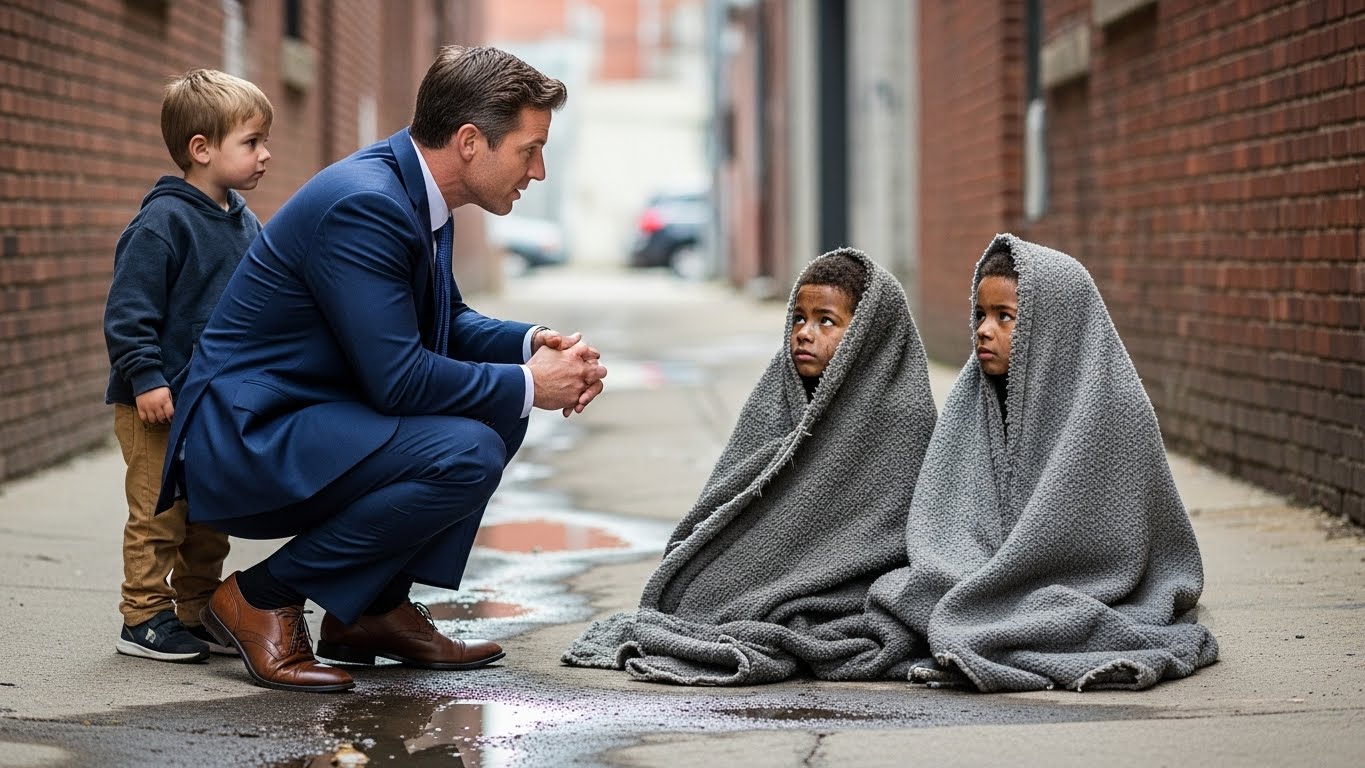
It wasn’t just rags. It was a blanket. A filthy, torn, grey wool blanket. And underneath it, two small heads popped up.
They were children.
My stomach dropped. They were terrified, their eyes wide and darting between me and the massive black car. They were dirty—layers of grime on their cheeks, their hair matted—but underneath the dirt, they were terrifyingly pale.
“I told you,” Caleb said softly, looking up at me. “They were sleeping.”
I stood there, paralyzed. I had donated millions to charity. I had attended galas for homelessness. I had written checks that built wings of hospitals. But I had never, not once, stood three feet away from two children living in a pile of garbage.
“Hey,” I said, my voice sounding foreign to my own ears. I didn’t know how to talk to them. I felt like an alien in a three-thousand-dollar suit. “Where are your parents?”
The boy on the left, the one who seemed slightly more protective, shifted. He put an arm in front of the other boy.
And then he looked me dead in the eye.
Chapter 2: The Reflection
Time is a funny thing. In business, it’s money. In moments of trauma, it stretches like taffy. But in that alleyway, time simply shattered.
The boy looked at me.
He had messy, light brown hair that curled slightly at the ends. His face was smudged with grease. He was shivering so hard his jaw was trembling.
But his eyes.
They were honey-brown. Golden, with flecks of green near the pupil.
I knew those eyes. I saw them every time I brushed my teeth. I saw them every time I looked at Caleb across the dinner table. They were the Halston eyes. My father had them. I had them. Caleb had them.
It was a coincidence, I told myself. A genetic fluke.
“Do you have food?” the boy asked. His voice was raspy, dry. It sounded like an old man’s voice coming out of a five-year-old’s mouth.
I blinked, my brain struggling to process the visual input. “I… yes. Yes, we have food.”
“Caleb,” I snapped, my voice trembling. “Get the protein bars from the glove box. Now.”
Caleb didn’t argue. He scrambled back to the car.
I took a step closer, sinking to one knee. The wet concrete soaked immediately through my trousers, but I didn’t care. I needed to see him closer. I needed to prove to myself that I was hallucinating.
“What is your name?” I asked, trying to keep my voice gentle.
“Milo,” the boy said. He kept his arm in front of the other boy, who was now peeking out.
The second boy had darker hair, almost black. But when he looked up, the resemblance was even more striking. He had the same nose. The same shape of the jaw that I saw in old photos of myself as a child.
“I’m Dylan,” the second boy whispered.
“How old are you guys?” My heart was hammering against my ribs like a trapped bird. Please don’t say five. Please don’t say five.
“We’re five,” Milo said. “We’re twins.”
The world spun. I had to put a hand on the dumpster to steady myself.
Five years old.
Emily, my wife, had died two years ago. Caleb was eight.
But five years ago… five years ago was the “Dark Year.” Emily had been in the hospital for months with complications during her second pregnancy, a pregnancy we eventually lost. I had been grieving, lonely, angry at the world, and drinking too much.
And I had an assistant.
Lena.
Lena Brooks.
She was kind. She listened when no one else did. It was brief—a mistake, a moment of weakness that lasted a few weeks. When I came to my senses, filled with guilt, I ended it. I transferred her to another department with a generous raise, and then, a few months later, she resigned and moved away. She never told me she was pregnant. She never asked for a dime.
“Where is your mom?” I choked out the words. I felt like I was going to throw up.
Milo looked down at his dirty sneakers. Dylan sniffled.
“She went to sleep,” Dylan said softly.
“She died,” Milo corrected him, his voice flat, devoid of emotion. That was the worst part. The acceptance. “Two months ago. She got sick. She coughed a lot.”
“What was her name?” I asked, though I already knew. I felt it in my marrow.
“Lena,” Milo said. “Lena Brooks.”
The name hit me like a physical blow to the chest. I actually stumbled back, gasping for air.
Lena was dead. And these… these were my sons.
My flesh and blood. Sleeping behind a dumpster. Freezing. Starving. While I slept on 800-thread-count sheets and worried about stock prices.
Caleb came running back, clutching three protein bars and a bottle of water. He ripped the wrappers open with frantic hands and handed them to the boys.
Milo didn’t eat immediately. He broke the bar in half and gave the bigger piece to Dylan. Only after Dylan started eating did Milo take a bite, closing his eyes as he chewed.
“Dad?” Caleb touched my shoulder. He was looking at me with confusion. “Dad, why are you crying?”
I reached up and touched my face. My cheeks were wet. I hadn’t even realized I was weeping.
I looked at Caleb—my son, raised in luxury, loved, protected. And then I looked at Milo and Dylan—my sons, raised in shadows, dirty, abandoned.
The guilt wasn’t a wave; it was a tsunami. It threatened to drown me right there in the alley.
“Caleb,” I whispered, my voice breaking. “Open the back door.”
“Are we taking them home?” Caleb asked, hope lighting up his face.
I looked at Milo. He had stopped eating and was watching me with those honey-brown eyes, waiting for me to leave. Waiting for the rich man to get back in his car and drive away, just like everyone else did.
“Yes,” I said, the word coming out as a vow. “We are taking them home.”
I looked at Milo and Dylan.
“Boys,” I said, extending a hand. “You don’t have to sleep here anymore. Not tonight. Not ever.”
Milo hesitated. He looked at the car, then at Caleb, and finally at me.
“Are you the police?” Milo asked suspiciously.
“No,” I said, swallowing the lump in my throat. “I’m… I’m a friend of your mother’s.”
I couldn’t tell them yet. I couldn’t drop that bomb on them in a dirty alleyway. But as I lifted Dylan into my arms—he was so light, terrifyingly light—I made a silent promise to the ghost of Lena Brooks.
I would fix this. Or I would die trying.
Chapter 3: The Glass Castle
The drive back to Cherry Hills was the quietest journey of my life.
Usually, my Escalade was a mobile office. I’d be barking orders at my assistant over Bluetooth, or Caleb would be blasting the soundtrack to his favorite video game. But today, the silence was heavy, suffocating. It was filled with the smell of wet wool, old dirt, and the distinct, sour scent of unwashed bodies.
I looked in the rearview mirror. Milo and Dylan were pressed against the doors, their eyes wide, watching the city blur past. They looked terrified, as if I were taking them to a prison rather than a mansion. Caleb sat in the middle, his small hands resting protectively on their knees. He didn’t say a word, but his jaw was set in a way that reminded me of my father. He was on guard.
When we pulled up to the iron gates of my estate, the boys gasped.
“Is this a hotel?” Dylan whispered, his nose pressed against the glass.
“No,” Caleb said softly. “This is my house. Our house.”
As the gates swung open and we rolled up the long, heated driveway, I felt a wave of nausea. My house was a monument to my success. Ten thousand square feet of glass, steel, and imported stone. I had built it to impress people I didn’t like. Now, looking at it through the eyes of my starving sons, it just looked grotesque. It looked like a waste.
I parked and killed the engine. “Okay, boys. Let’s go inside.”
Getting them out of the car was like coaxing wild animals. They moved slowly, flinching at sudden noises. When I opened the front door, Mrs. Higgins, my housekeeper, was waiting in the foyer.
“Mr. Halston, you’re early, I haven’t started din—”
She stopped. Her eyes went to the two filthy children standing on her pristine marble floor, dripping muddy water onto the Persian rug.
“Oh my god,” she breathed, her hand flying to her mouth. “Mr. Halston?”
“We need food, Mrs. Higgins,” I said, my voice leaving no room for questions. “Soup. Bread. Something warm. And we need baths. Now.”
Mrs. Higgins didn’t ask questions. She was a grandmother of seven; her instincts kicked in before her curiosity did. She rushed to the kitchen.
I led the boys upstairs. I had plenty of guest rooms, but they felt too cold, too impersonal. So I took them to Caleb’s room. It was a wonderland of Lego sets, posters, and soft beanbag chairs.
Milo stood in the doorway, refusing to enter. He stared at the mountain of toys in the corner as if it were an alien artifact.
“It’s okay,” Caleb said, grabbing a stuffed dinosaur. “You can touch it.”
Dylan reached out a trembling hand and touched the soft fabric. A small, confused smile touched his lips.
“We need to get you cleaned up,” I said gently.
The bath was the hardest part.
When I helped them peel off their wet, rotting clothes, my heart shattered into a million irreparable pieces.
Their bodies were maps of suffering.
They were so thin I could count every rib. Their shoulder blades jutted out like wings that had been clipped. Their skin was pale, covered in bruises, scratches, and bug bites. Dylan had a nasty scrape on his knee that looked infected. Milo had a burn mark on his arm—cigarette? Stove? I didn’t want to know. I wanted to kill whoever had let this happen.
And I realized: I was the one who let this happen.
I was the one who hadn’t checked on Lena. I was the one who had been too wrapped up in my own grief to care about the woman who had comforted me.
“Is the water warm?” I asked, testing the temperature with my elbow.
“It’s hot,” Milo said, his teeth still chattering. “We usually use the hose at the gas station.”
I had to look away. I bit the inside of my cheek until I tasted copper.
I washed their hair three times. The water turned grey, then brown, then finally clear. I scrubbed the dirt from under their fingernails. I was gentle, but every time I touched them, they flinched, expecting pain.
When they were finally clean, wrapped in Caleb’s oversized pajamas, they looked different. They looked like children.
We went downstairs to the kitchen. Mrs. Higgins had prepared tomato soup and grilled cheese sandwiches.
I watched them eat.
It wasn’t eating. It was devouring.
They didn’t use spoons. They dipped the bread, shoved it into their mouths, swallowed without chewing. They hunched over their bowls, protecting their food with their arms, looking around as if someone was going to snatch the plates away.
“Slow down,” I whispered, tears pricking my eyes again. “There is more. There is always more. I promise.”
Dylan looked up, milk mustache on his lip. “Promise?”
“I swear on my life,” I said.
That night, I tried to put them in the guest room down the hall. A beautiful room with a queen-sized bed and a view of the mountains.
But they wouldn’t separate. And they wouldn’t stay in the big bed.
When I checked on them an hour later, they were on the floor.
They had pulled the duvet off the bed and curled up on the rug in the corner of the room, huddled together just like they had been behind the dumpster. The bed was too soft, too open. They felt safer on the floor.
I sat in the hallway, my back against the wall, listening to their breathing. I sat there all night. I didn’t sleep. I couldn’t. I was afraid that if I closed my eyes, I would wake up and they would be gone, or worse—I would wake up and realize I was still the selfish man I was yesterday.
Chapter 4: The Cold Truth
The next morning, reality hit me with the force of a freight train.
I woke up stiff, my neck cricked from sleeping sitting up in the hallway. The sun was streaming through the skylights, illuminating the dust motes dancing in the air. For a split second, I forgot. Then I heard a giggle.
I scrambled up and looked into the room.
Caleb was in there. He was on the floor with them, showing them how to operate a Nintendo Switch. Milo and Dylan were clean, their hair fluffy and soft, but they still looked frail.
I needed answers. And I needed to make this official.
I called my personal physician, Dr. Evans, and told him to come to the house immediately. Then I called a private lab for a DNA test. Not because I doubted it—I knew in my soul they were mine—but because the world would doubt it. The lawyers would doubt it. And I needed to armor myself against the inevitable storm.
Dr. Evans arrived at 9:00 AM. He was a stoic man, used to treating the discreet ailments of the wealthy. But when he examined the twins, his professional mask cracked.
He pulled me into the hallway, closing the door softly.
“Mark,” he said, his voice low and dangerous. “Where did you find these boys?”
“It doesn’t matter,” I said. “Just tell me how they are.”
“They are severely malnourished,” he listed, ticking off points on his fingers. “They have Vitamin D deficiency—rickets, essentially. Their bone density is low. Dylan has a respiratory infection that could turn into pneumonia if we aren’t careful. They are in the fifth percentile for height and weight. They look five, but physiologically? They’re closer to three.”
He paused, looking me in the eye. “And the psychological trauma… Mark, the flinching? The hoarding of food? This isn’t just poverty. This is neglect. Who had them?”
“Their mother died,” I said, my voice hollow. “They’ve been on the street for two months.”
Dr. Evans sighed, rubbing his temples. “They need aggressive vitamin therapy, high-calorie diets, and rest. But mostly, they need stability. If they go into the foster system now, in this state… they won’t make it.”
“They aren’t going anywhere,” I snarled. The ferocity in my own voice surprised me. “They stay here.”
By noon, the mobile phlebotomist had come and gone. The boys had cried at the needles, and I had held them, whispering soothing words that felt clumsy on my tongue.
Then came the hardest call.
I called Arthur, my family lawyer and the closest thing I had to a confidant.
“Arthur, I need you to come over. And bring the paperwork for custody filings.”
“Custody?” Arthur asked, his voice tinny over the speakerphone. “For who? Mark, are you dating someone?”
“Just come.”
When Arthur arrived, I sat him down in the library. I poured him a scotch, even though it was barely lunchtime. Then I told him everything. The affair. Lena. The alley. The boys.
Arthur listened, his face paling. He didn’t look at me with sympathy. He looked at me with calculation.
“Mark,” he said slowly, setting the glass down. “Do you have any idea what this will do to the stock price? To your reputation?”
“Excuse me?” I blinked, stunned.
“The headline writes itself,” Arthur continued, pacing the room. ” ‘Billionaire CEO Abandons Secret Love Child to Die on Streets.’ It’s a PR nightmare. The board will have your head. Investors will pull out. We need to handle this… delicately.”
“Delicately?” I stood up, my chair scraping loudly against the floor.
“Yes. We set up a trust. We find a high-end boarding school in Switzerland. Excellent care, best doctors, total anonymity. You visit them, you pay for everything, but you don’t bring them here. You don’t make them Halstons publicly. Not yet.”
I stared at him. This was a man I had known for ten years. A man I trusted. And he was talking about my sons as if they were a liability on a balance sheet.
“Get out,” I said quietly.
“Mark, be reasonable. I’m trying to protect your empire.”
“I said get out!” I roared, throwing my glass into the fireplace. It shattered, the sound echoing like a gunshot. “They are my sons! They are Halstons! And if the stock price drops to zero, if the board fires me, if I lose every damn building with my name on it, I don’t care! They are sleeping upstairs on my floor because they are afraid of beds, Arthur! Do you understand that? They are afraid of beds!”
Arthur stared at me, wide-eyed. He adjusted his tie, nodded stiffly, and walked to the door.
“I’ll draw up the adoption papers,” he said coldly. “But don’t say I didn’t warn you.”
I collapsed onto the leather sofa, burying my face in my hands. My hands were shaking.
I had spent my whole life building an empire of money. But sitting in that library, surrounded by expensive books I never read, I realized I was poor. I was morally bankrupt.
I heard small footsteps.
I looked up. Milo was standing in the doorway of the library. He was holding the stuffed dinosaur Caleb had given him.
“Are you mad?” he whispered. “We heard yelling.”
I wiped my face quickly, forcing a smile. “No, Milo. I’m not mad. I was just… telling a bad man to go away.”
Milo took a hesitant step inside. “Is he coming back?”
“No,” I said. “No bad men are coming back.”
Milo nodded. He walked over to me, climbed onto the sofa, and sat next to me. He didn’t hug me. He didn’t hold my hand. He just sat there, his small shoulder touching my arm.
“Can we have more soup?” he asked.
I laughed. It was a wet, broken sound, but it was a laugh.
“Yes, Milo,” I said, wrapping my arm around him. He stiffened for a second, then relaxed, leaning his head against my expensive shirt. “We can have all the soup you want.”
The DNA results came back forty-eight hours later.
Probability of Paternity: 99.99998%.
I didn’t need the paper. I already knew. But holding it made it real. It was no longer a rescue mission. It was a redemption arc.
But the world wasn’t ready to let me redeem myself easily. As the week went on, the rumors started. Someone had seen me at the alley. Someone had seen the boys. The press was sniffing around.
I had two choices: Hide them, like Arthur suggested. Or own it.
I looked at the boys, playing on the floor with Caleb. Dylan was laughing—a rusty, quiet sound, but a laugh nonetheless.
I picked up my phone and dialed my PR director.
“Set up a press conference,” I said. “Tomorrow morning. I have an announcement.”
Chapter 5: The Confession
The flashbulbs were blinding.
I stood at the podium in the lobby of Halston Tower, a sea of microphones bristling before me. I looked out at the faces of reporters who had spent years praising my business acumen and the last forty-eight hours dissecting my personal life.
“Mr. Halston! Is it true the children were found in a dumpster?” “Are you resigning?” “Is there a paternity suit?”
I raised a hand. The room fell silent.
“I am not resigning,” I began, my voice steady, amplified through the speakers. “But I am confessing.”
I gripped the sides of the podium. “Five years ago, I made a mistake. I had a relationship that I ended poorly. I failed to follow up. I failed to care. Because of my negligence, two innocent children—my sons—spent the last two months surviving in conditions that no human being should ever endure.”
A murmur rippled through the crowd.
“I found them three days ago,” I continued, looking directly into the lens of the nearest camera. “Hungry. Cold. Terrified. I am not standing here as a CEO today. I am standing here as a father who is lucky to have a second chance. From this day forward, my priority is their healing. And if anyone in this room, or on my board, has a problem with that… you know where the door is.”
I walked off the stage.
I expected the stock to tank. I expected to be ousted.
Instead, something strange happened. The story went viral—not as a scandal, but as a wake-up call. Thousands of messages flooded in. People weren’t judging the affair; they were captivated by the rescue.
But back at the mansion, the real battle was just beginning.
The “honeymoon phase” of the first two days evaporated. The trauma set in.
Milo began hoarding food. We found slices of ham tucked under his pillow. We found half-eaten apples in his shoes. He was terrified the food would stop coming.
Dylan stopped speaking entirely. He would sit by the window for hours, rocking back and forth, clutching the hem of his shirt.
And the nights… the nights were a war zone.
At 2:00 AM on the fourth night, a scream tore through the house that made my blood freeze.
I sprinted down the hall, bursting into their room.
Milo was thrashing in his sleep, screaming, “No! Don’t take him! No!”
I rushed to the bed—they were sleeping in the bed now, finally—and tried to wake him. “Milo! It’s me! It’s Dad! You’re safe!”
He woke up swinging. His small fist connected with my jaw, hard.
He scrambled backward, eyes wild, chest heaving. For a second, he didn’t recognize me. He saw an attacker.
“It’s okay,” I whispered, holding my hands up. “Look at the room, Milo. Look at the walls. You’re in the house. You’re safe.”
Dylan woke up and immediately started crying, a high, keening sound of pure distress.
Caleb appeared in the doorway, rubbing his eyes, holding his blanket.
“Dad?” Caleb whispered. “Are they okay?”
“Go back to bed, Caleb,” I said, trying to keep the panic out of my voice.
“No,” Caleb said.
He walked past me. He climbed onto the bed, right between his screaming brothers.
“It’s the Shadow Man, right?” Caleb asked Milo calmly. “I used to see him too.”
Milo stopped panting. He looked at Caleb. “He… he had a knife.”
“Yeah,” Caleb nodded. “But my dad chased him away. He has a security system. Lasers. Like in the movies. Nothing gets in here.”
Caleb wrapped his arms around Milo. Then he pulled Dylan in.
“We can build a fort,” Caleb suggested. “Shadow Men can’t get into forts.”
I watched, stunned, as my eight-year-old son dismantled the pillows and blankets, building a protective cave for his brothers. He did what I couldn’t do. He met them at their level.
I sat on the floor outside the fort until the sun came up, realizing that my money could buy the house, but only love could make it a home.
Chapter 6: The Breaking Point
Two weeks later, the crisis I feared arrived.
Dylan spiked a fever.
It started as a cough, dry and hacking, then escalated rapidly. By midnight, he was burning up, gasping for air. Dr. Evans’ warning about his weak lungs echoed in my head.
I scooped him up, his body limp and radiating heat, and ran to the car. Milo was screaming, clinging to Dylan’s leg.
“You can’t take him! You can’t take him!” Milo shrieked, his eyes filled with the terror of separation.
“Milo, he’s sick! I have to take him to the hospital!” I yelled, struggling to buckle Dylan in.
“No! Mom went to the hospital and she never came back!” Milo sobbed.
The realization hit me like a punch. To him, the hospital wasn’t a place of healing. It was a place where people disappeared.
“Come with us,” I said, grabbing Milo. “Get in. Caleb, you too. Everyone goes.”
I drove like a maniac to Denver General.
The ER was chaos. Doctors swarmed Dylan. They hooked him up to monitors, inserted an IV, put an oxygen mask over his small face.
Milo stood in the corner of the trauma room, holding Caleb’s hand so tight his knuckles were white. He watched every move the doctors made with hawk-like intensity.
“Pneumonia,” the doctor told me an hour later. “Severe. His immune system is compromised from the malnutrition. He’s stable, but he needs to stay for a few days.”
I didn’t leave the room for three days.
I ran my multi-billion dollar corporation from a plastic chair in the pediatric ICU. I took Zoom calls with board members while holding a cool washcloth to Dylan’s forehead.
On the second night, Dylan woke up. The fever had broken.
He looked around the sterile room, the beeping machines. Then he looked at me.
“Dad?” he croaked.
It was the first time he had called me Dad.
Tears sprang to my eyes. “I’m here, buddy. I’m right here.”
“Did you pay them?” he whispered.
“Pay who?”
” The doctors. To fix me. Mom… Mom couldn’t pay.”
My heart shattered. Lena had died because she couldn’t afford care? Because she was too proud to call me? Or because she thought I was a monster who wouldn’t help?
“I paid them, Dylan,” I choked out. “I will always pay them. You will never, ever have to worry about that again.”
Milo, who had been sleeping on a cot in the corner, sat up. He walked over to the bed and climbed in next to his brother.
“We’re rich now,” Milo whispered to Dylan. “Dad said so.”
“It’s not about being rich,” I said, leaning my forehead against the metal rail of the bed. “It’s about being family. Family doesn’t leave anyone behind.”
Chapter 7: The Question
Dylan recovered. We brought him home, and slowly, the color returned to his cheeks.
The boys started school in the fall. I was terrified they would be bullied, or that they would fall behind. But they were resilient. They were survivors.
Life settled into a rhythm. Pancake Sundays. Soccer practice. Homework battles. The nightmares became less frequent. The hoarding of food stopped.
But the emotional scars were deeper.
One evening, about six months after I found them, I was in the kitchen chopping vegetables for dinner. I had given the private chef the night off. I liked cooking now. It felt grounding.
Milo walked in. He was wearing a soccer jersey that was slightly too big for him. He hopped up onto the counter—something I usually forbade, but I let it slide.
“Dad?”
“Yeah, bud?”
“Can I ask you something?”
“Anything.”
He picked at a thread on his shorts. “That day… in the alley. Why did you stop?”
“Because Caleb screamed,” I said, smiling.
“No,” Milo said, his voice serious. “I mean… why did you take us? There were other kids in the alley sometimes. Other people saw us. Why did you help?”
I stopped chopping. I turned to look at him.
He was looking at me with those honey-brown eyes. My eyes.
I could have lied. I could have told him it was out of the goodness of my heart. I could have told him I was a hero.
But I promised I would never lie to them.
“Because you looked like me,” I said softly.
Milo tilted his head.
“If… if we didn’t look like you,” he hesitated. “If we had different eyes… would you have left us there?”
The question hung in the air, heavy and suffocating.
I closed my eyes. I thought about the man I was six months ago. The man who stepped over homeless people to get to his Uber. The man who thought poverty was a lack of ambition, not a lack of luck.
“I don’t know,” I admitted, my voice barely a whisper. “The old me… the man I was before I met you… he might have kept driving.”
Milo looked down.
I walked over and placed my hands on his shoulders.
“But that scares me, Milo,” I said urgently. “It scares me that I was that person. You boys… you didn’t just need saving. You saved me. You taught me that every kid in that alley is someone’s son. Every person on the street has a story.”
Milo looked up, searching my face.
“So,” I continued, “that’s why I started the Foundation last week. Have you seen the new building downtown?”
Milo shook his head.
“It’s a shelter. A real one. With beds like ours. And doctors. And schools. For kids who don’t look like me. For kids who have no one.”
Milo’s eyes widened.
“Really?”
“Really,” I said. “Because I never want to be the man who keeps driving again.”
Milo leaned forward and wrapped his arms around my neck. It was a tight, fierce hug.
“You’re a good dad,” he whispered.
“I’m trying,” I said into his hair. “I’m trying.”
Chapter 8: The Legacy
Two Years Later.
The backyard of the Halston estate was chaos.
A dozen kids were running through the sprinklers. There was a bouncy castle in the shape of a dragon. It was Caleb’s tenth birthday, but it felt like a celebration for all of us.
I stood on the patio with a cold beer, watching them.
Caleb was taller now, the leader of the pack. Dylan was laughing, chasing a golden retriever we had adopted. He was healthy, strong, his lungs completely healed.
And Milo.
Milo was sitting at the picnic table, helping a smaller boy—a kid from the shelter we had invited—open a juice box.
“Here,” Milo said gently. “You have to poke it like this.”
I watched my son, the boy who once hoarded ham under his pillow, sharing his food without a second thought.
My phone buzzed in my pocket. It was a notification from Forbes. “Mark Halston named Philanthropist of the Year.”
I swiped it away without opening it.
It didn’t matter. The stocks, the buildings, the magazine covers—none of it mattered.
I looked at the three boys running across the grass.
They were different. Milo and Dylan were wilder, scrappier. Caleb was softer, more thoughtful. But they moved as a unit. They were brothers in every sense of the word.
I thought about the detour. The construction on I-25. The rain. The wrong turn.
People say you can’t change the past. And they’re right. I can’t undo the years I missed. I can’t bring Lena back. I can’t erase the cold nights my sons spent behind a dumpster.
But you can change the future.
Caleb ran up to me, breathless, with Dylan and Milo right behind him.
“Dad! Dad!” Caleb yelled. “Can we order pizza tonight? For everyone?”
I looked at the crowd of kids—half from the wealthiest private school in Denver, half from the shelter downtown, all of them wet, laughing, and equal in this moment.
“Yeah,” I smiled, my heart so full it felt like it might burst. “Order the pizza. Order everything.”
“Yes!” The boys cheered and ran off.
I watched them go, realizing that the greatest wealth I possessed wasn’t in the bank. It was running across the lawn, loud and messy and alive.
I took a sip of my beer and looked up at the sky. The clouds were clearing.
I had taken a wrong turn that day. But it led me exactly where I was supposed to be.
The End.