I CAUGHT MY DAUGHTER’S TEACHER THROWING TRASH AT HER FACE—SHE DIDN’T KNOW I WAS HOME FROM DEPLOYMENT
PART 1
Chapter 1: The Long Way Home
The smell of jet fuel always sticks to you. It’s a heavy, oily scent that buries itself in the fabric of your uniform and the pores of your skin. For fourteen months, that smell meant I was leaving. It meant another mission, another patrol, another night sleeping with one eye open in a dusty tent halfway across the world. But today, standing on the tarmac at Rickenbacker Air National Guard Base in Ohio, the smell was different. It smelled like freedom. It smelled like home.
My name is Sarah. I’m a Staff Sergeant, a squad leader, and a specialist in logistics. I’m used to organizing chaos. I can move a convoy through a sandstorm without losing a single truck. I can coordinate supply drops in hostile territory. But standing there, waiting for my duffel bag, my hands were shaking. Not from fear—I’d left fear back in the desert—but from anticipation.
Fourteen months. That’s four hundred and twenty-five days. That’s a lifetime in the world of a nine-year-old. When I left, Lily was missing her two front teeth and was obsessed with unicorns. Now? I didn’t even know if she still liked pink. The only connection we had were choppy video calls where the pixelation was so bad her face looked like a watercolor painting left out in the rain.
I grabbed my bag, throwing it over my shoulder. My husband, Mark, had died three years ago in a car accident. It was just me and Lily. My sister, Jenna, had been watching her while I was deployed. Jenna was great—she loved Lily—but she wasn’t Mom. And Jenna had been vague on the phone lately.
“She’s struggling, Sarah,” Jenna had said two weeks ago, her voice tight. “School is… hard right now.”
“Is it the math?” I had asked, feeling helpless from 7,000 miles away. “I can try to help her over Zoom.”
“It’s not just the math. It’s the environment. Her teacher… Mrs. Gable. She’s old school. Strict.”
I had brushed it off. “Strict is good. Lily needs structure.”
God, I was so naive.
I took an Uber straight from the base. I didn’t stop to shower. I didn’t stop to change into civilian clothes. I wanted Lily to see me in the uniform. She used to call it my “superhero suit.” I wanted to be her hero today.
The drive to Lincoln Elementary took forty minutes. The suburbs of Ohio were painfully normal. Green manicured lawns, SUVs in driveways, flags hanging from porches. It was so quiet compared to where I had been. It felt surreal.
I checked in at the front office. The secretary, a kind older woman named Barbara, nearly dropped her coffee mug when she saw me.
“Sergeant Miller?” she gasped. “Oh my goodness! Does Lily know?”
“No,” I smiled, feeling the exhaustion melt away. “It’s a surprise. Is she in class?”
“Room 4B. Down the hall, second door on the left. Mrs. Gable’s class.” Barbara’s smile faltered for a split second when she said the teacher’s name. I caught it—a flicker of hesitation. “Just… go on in. Do you want me to announce you?”
“No,” I said. “I want to just walk in.”
I walked down that hallway, the scent of floor wax and old paper bringing back memories of my own childhood. I passed artwork taped to the walls—hand turkeys, finger paintings. It was innocent. It was safe.
Or so I thought.
As I approached Room 4B, the silence of the hallway was broken. It wasn’t the sound of a teacher lecturing. It was shouting. High-pitched, aggressive shouting.
I slowed down, my combat boots making no sound—a habit from patrol. I stopped just outside the door. The window was a narrow vertical strip of glass with wire mesh inside it. I peered through.
The classroom was tense. You can feel the energy of a room even through a door. The kids were frozen in their seats. And there, at the front of the room, was my daughter.
Lily.
She looked smaller than I remembered. She was wearing a hoodie I didn’t recognize, the hood pulled half-up, trying to hide. She was standing next to her desk.
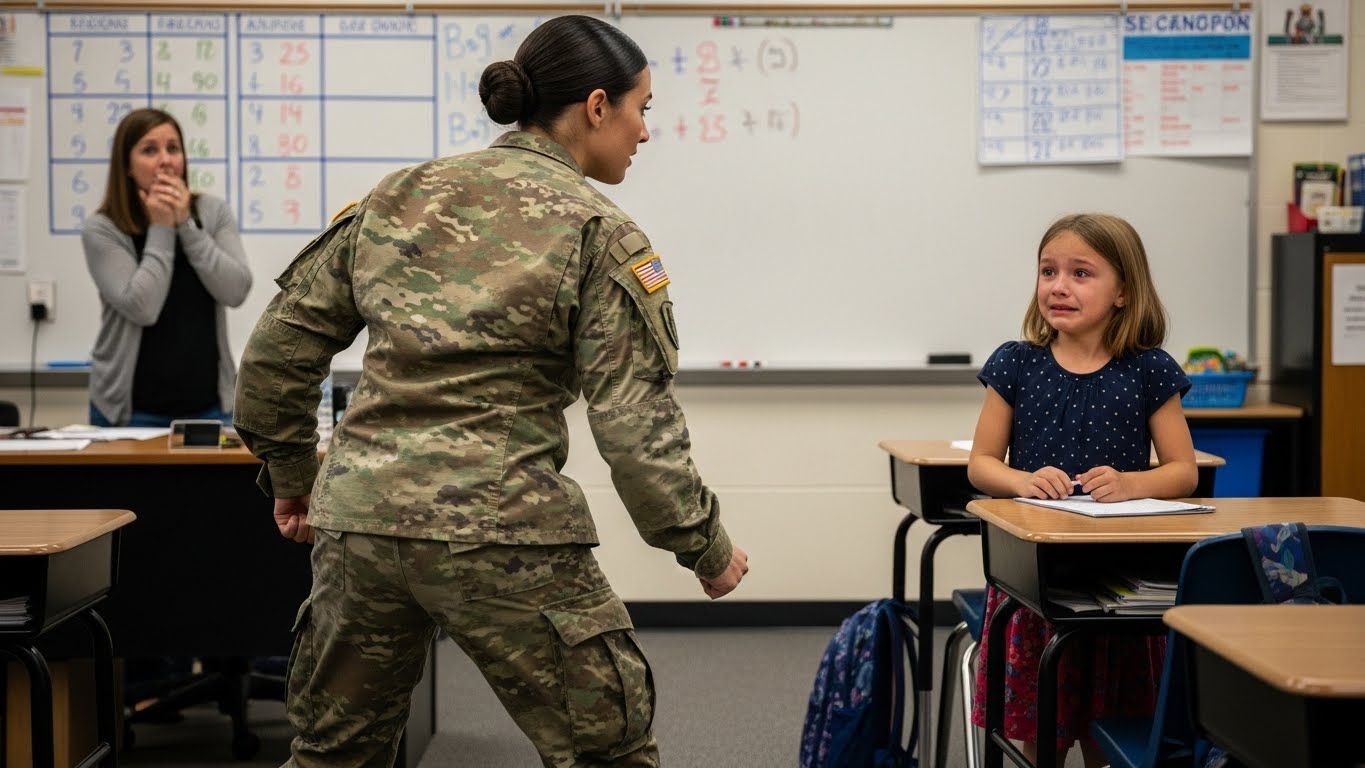
And standing over her, invading her personal space, was a woman in a grey cardigan. Mrs. Gable. She was pointing a finger right in Lily’s face.
“I have explained this to you three times, Lily!” The teacher’s voice was muffled by the door but loud enough to be clear. “Three times! Are you deaf? Or are you just refusing to listen?”
My hand hovered over the door handle. My instinct was to burst in. But training kicked in. Assess the situation. Gather intel. I needed to know what I was dealing with.
“I… I don’t understand the carry-over,” Lily whispered. I could see her shoulders shaking.
“Because you aren’t trying!” Mrs. Gable snatched a piece of paper from Lily’s desk. It was a test. “Look at this mess. Scribbles. Eraser marks everywhere. It looks like a toddler did this.”
The other kids were dead silent. They looked terrified. This wasn’t teaching. This was bullying.
“I’m trying,” Lily sobbed.
“Trying?” Mrs. Gable laughed. It was a cold, cruel sound. “You’re failing, Lily. You are bringing down the class average. I have students here who are going to be doctors. And you? You can’t even do basic subtraction.”
My blood began to boil. A heat started at the base of my neck and spread upwards.
“Maybe,” Mrs. Gable continued, her voice dropping to a hiss that was somehow louder than the shouting, “if your mother cared enough to be here instead of running around playing soldier, you wouldn’t be so… broken.”
I froze.
Did she just say that?
The air in my lungs turned to ice. She brought me into this. She used my service—my sacrifice—as a weapon to hurt my nine-year-old child.
Then, she did it.
She took the test paper. She crumpled it up into a tight, jagged ball. And with a flick of her wrist, she threw it.
It hit Lily right in the forehead.
A few kids in the back snickered—a nervous, conditioned reaction to please the tyrant in charge. Lily didn’t move. She just stood there, the paper ball at her feet, tears streaming down her face, utterly defeated.
I didn’t think. I didn’t plan.
I grabbed the handle. I turned it. And I shoved.
Chapter 2: The Sound of Authority
The door hit the wall with a violence that shook the doorframe. WHAM.
The room gasped. It was a collective intake of breath.
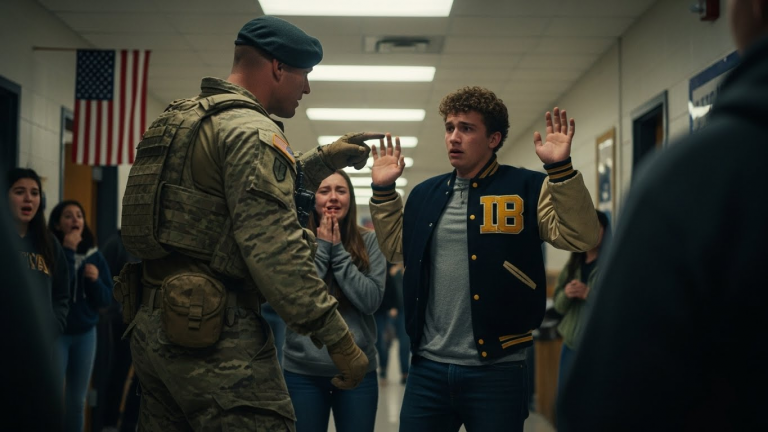
I stepped into the room. I am five-foot-eight, but in my boots and with the adrenaline pumping through me, I felt ten feet tall. I didn’t look at the students. I kept my eyes locked on the target.
Mrs. Gable.
She spun around, her face a mask of shock. Her mouth opened to yell at the intruder, but the words died in her throat when she saw the uniform. She saw the “U.S. ARMY” tape on my chest. She saw the rank insignia. She saw the look in my eyes.
It was the look of a mother wolf who just found a snake in the den.
The silence in that room was absolute. You could hear the hum of the fluorescent lights. You could hear the distant ticking of the clock.
I walked forward. Slow. Deliberate. Every step was a statement. Thud. Thud. Thud.
I stopped three feet from her. Close enough to smell her cheap perfume. Close enough to see the panic flaring in her eyes.
I looked down at Lily. She looked up, her eyes wide, red-rimmed, and swollen. For a second, she looked confused, like I was a hallucination.
“Mom?” she squeaked.
My heart broke, but I couldn’t show softness yet. I had a threat to neutralize.
I turned my gaze back to the teacher.
“Mrs. Gable,” I said. My voice was calm. It was the voice I used when radioing in coordinates. precise, deadly calm. “I believe you dropped something.”
She stammered. Her face flushed a deep, blotchy red. “I… I beg your pardon? Who do you think you are barging in here?”
“I am Staff Sergeant Sarah Miller,” I said, my voice rising just enough to command the room without shouting. “I am Lily’s mother. The one you just said was ‘playing soldier.'”
The color drained from her face. She looked like she might faint.
“I… I didn’t know…” she stuttered, backing up until her hip hit her desk.
“You didn’t know I was listening?” I stepped closer. “Or you didn’t know I was coming back?”
I pointed to the floor. To the crumpled ball of paper lying next to Lily’s dirty sneakers.
“Pick it up.”
Mrs. Gable blinked. “Excuse me?”
“You heard me,” I said. “Pick up the paper you threw at my daughter. Uncrumple it. And apologize to her.”
The class watched, wide-eyed. They had never seen anyone talk to Mrs. Gable like this. She was the dictator of Room 4B. And I was toppling the regime.
“I will do no such thing,” Mrs. Gable tried to regain her composure, straightening her cardigan. “You cannot come in here and give orders. This is my classroom. Lily was being disruptive and—”
“Disruptive?” I cut her off. “She was crying because she didn’t understand math. And you mocked her. You humiliated her. And you threw trash at her.”
I leaned in. “I have seen things in the last year that would make you curl up in a ball and cry for your mother. I have learned that there are two types of leaders. Those who serve their people, and those who abuse their power because they are small, insecure tyrants.”
I looked around the room at the other students. “Is this how she treats all of you?”
A little boy in the front row, wearing a Superman shirt, nodded slowly. Then a girl in the back nodded. Then another.
Mrs. Gable looked around, realizing she was losing control. “Get out,” she hissed. “Get out before I call the principal.”
“Oh, please do,” I smiled, but there was no humor in it. “Call the principal. Call the superintendent. Call the police. Because I’m not going anywhere until you pick up that paper.”
I stood my ground. I crossed my arms. The American flag patch on my shoulder faced the class.
Mrs. Gable looked at me. She looked at the door. She realized she had no exit. She realized that physically, mentally, and morally, she was outmatched.
Slowly, painfully slowly, she bent her knees. She reached down. Her hand trembled as she grasped the crumpled ball of paper.
She stood up. She smoothed it out on the corner of Lily’s desk. Her hands were shaking so bad she could barely flatten it.
“I’m waiting,” I said.
Mrs. Gable didn’t look at me. She looked at Lily. Her jaw was tight.
“I’m sorry, Lily,” she mumbled.
“I didn’t hear you,” I said.
“I’m sorry, Lily!” she snapped, louder. “For throwing the paper.”
I looked at Lily. “Baby, grab your backpack.”
“Mom?” Lily asked, her voice trembling.
“We’re leaving,” I said. “You are done with this class for today. Maybe forever.”
Lily grabbed her bag. She rushed over to me and buried her face in my uniform. I wrapped my arms around her, feeling her small body sob against the rough fabric of my cammies. I kissed the top of her head.
“I’ve got you,” I whispered. “Mommy’s here.”
I looked at Mrs. Gable one last time. “This isn’t over. This is just the briefing.”
I walked Lily out of that classroom, her hand gripping mine like a lifeline. As we walked out, I heard a sound.
One clap. Then another. Then a whole roar of applause from twenty-four fourth graders.
I didn’t look back. We walked down the hall, straight to the principal’s office. But as the adrenaline began to fade, a new feeling washed over me. This wasn’t just about one bad teacher. Mrs. Gable felt too comfortable doing what she did. She acted like she had permission.
And that meant the rot went deeper than Room 4B.PART 2
Chapter 3: The Chain of Command
Principal Henderson’s office smelled like stale coffee and fear. It was a stark contrast to the tactical operations centers I was used to, where the air smelled of ozone and determination. Here, the air felt thick with bureaucracy.
I sat in a low chair that was clearly designed to make parents feel smaller. Lily was sitting on a bench outside with the school secretary, clutching a juice box like it was a grenade she didn’t want to let go of.
Mr. Henderson, a man with a comb-over that was fighting a losing battle, smiled at me nervously. He tapped a pen on his desk.
“Staff Sergeant Miller,” he began, his voice oily. “First, thank you for your service. We had no idea you were returning today. If we had known, we would have organized an assembly.”
“I didn’t come for a parade, Mr. Henderson,” I cut him off. “I came to pick up my daughter. Instead, I walked into a hostile environment.”
He sighed, leaning back and tenting his fingers. This was the part where he was going to minimize everything. I’d seen officers do this when a mission went sideways—spin the narrative until the failure looked like a success.
“Look, I understand emotions are running high,” he said smoothly. “Mrs. Gable is… passionate. She has high standards. Sometimes, her methods can be misinterpreted as harsh.”
“Misinterpreted?” I leaned forward. The leather of the chair creaked. “She threw a projectile at my daughter’s face. She publicly humiliated her. She questioned my parenting and used my deployment as a weapon to insult a nine-year-old.”
Henderson winced. “Mrs. Gable has been with this district for twenty years. She’s tenured. She’s going through a difficult divorce right now. She’s under a lot of stress.”
I stood up. The chair scrapped loudly against the floor.
“Mr. Henderson,” I said, my voice dropping an octave. “I have soldiers under my command who are nineteen years old. They sleep in dirt. They get shot at. They haven’t showered in weeks. And yet, they treat local civilians with more respect than your ‘tenured’ teacher treated my child.”
I placed my hands on his desk. “Stress is not an excuse for abuse. If one of my soldiers threw something at a subordinate, they would be court-martialed. I want her gone.”
Henderson let out a nervous chuckle. “Gone? Sergeant, we can’t just fire a teacher because of one bad day. There’s a process. The union…”
“Process,” I repeated. I knew about processes. I knew how to navigate red tape. “Okay. Let’s talk process. I want to file a formal complaint. I want it on record. And I want Lily transferred out of that class immediately. Today.”
“Transferring is difficult this late in the year…” he started.
“Make it happen,” I said. “Or I will stand in the parking lot at pickup time in this uniform and tell every single parent what I just saw.”
Henderson paled. He knew what that would look like. A crying military mom in fatigues telling the wealthy suburban parents that their school was abusive? It was a PR nightmare he wasn’t equipped to handle.
“I’ll see what I can do about the transfer,” he muttered, reaching for his phone. “But as for Mrs. Gable… my hands are tied until there’s an investigation.”
“Start the investigation,” I said, grabbing my beret from the desk. “Because I’m not the only witness. There were twenty-five other kids in that room. And kids talk.”
I walked out. I had won the skirmish, but the war was just starting. He was hoping I’d deploy again soon or just get tired. He didn’t know that patience is a sniper’s best virtue. And I had plenty of it.
Chapter 4: The Casualties of War
The drive home was quiet. Lily sat in the backseat of the Uber, staring out the window. She hadn’t said a word since we left the school.
When we pulled into the driveway, the house looked the same, but it felt different. My sister, Jenna, was waiting on the porch. When she saw the Uber, she ran down the steps.
She saw me and screamed, throwing her arms around me. For a moment, it was pure joy. But then she saw Lily’s face.
“What happened?” Jenna asked, pulling back. “Did she see you? Was she surprised?”
“She saw me,” I said grimly. “Inside the classroom.”
We went inside. I ordered pizza—Lily’s favorite, pepperoni with extra cheese. But when the box arrived, Lily just picked at the crust.
I sat down next to her on the couch. I had changed out of my uniform into sweatpants and a t-shirt. I wanted to be just ‘Mom’ now.
“Lil,” I said softly. “Talk to me.”
She shrugged, pulling her knees up to her chest. “It’s okay, Mom. I’m used to it.”
That sentence hit me harder than a bullet. I’m used to it.
“You shouldn’t be used to it,” I said firmly. “Mrs. Gable was wrong. You know that, right? You aren’t stupid.”
Lily looked at me, her big brown eyes filling with tears again. “She says I’m slow. She says I day-dream too much. She put my desk in the corner last week. She calls it the ‘Day-Dreamer’s Island.’ Everyone laughs.”
“Jenna,” I looked at my sister. “Did you know?”
Jenna looked guilty. She sat on the coffee table, wringing her hands. “I knew she was strict. I complained, Sarah. I really did. I emailed Henderson twice. He told me that Lily was just ‘adjusting’ to your absence. He made it sound like it was our fault. Like we were coddling her.”
“They gaslighted you,” I realized.
“And…” Lily’s voice trembled. “She said something else.”
“What did she say, baby?”
Lily wiped her nose on her sleeve. “Last week, when I failed the quiz… she told the class that people who are smart go to college, and people who aren’t smart join the Army to get shot at.”
My vision actually blurred. The room went red.
It wasn’t just personal. It was ideological. This woman wasn’t just a bad teacher; she was poisoning these kids with her own bitter worldview. She was telling my daughter that her mother was essentially a failure who couldn’t cut it in the “real world.”
I stood up and walked to the window, staring out at the darkened street.
“She didn’t just insult me,” I whispered to Jenna. “She told my daughter that my service is a punishment for stupidity.”
I turned back to them.
“Does she have a class website?” I asked.
Jenna nodded. “Yeah. Why?”
“Does she post grades? Or comments?”
“She uses an app,” Jenna said. “ClassDojo. But she uses it to shame kids. She posts ‘sad faces’ for public behavior points.”
“Log me in,” I said.
I spent the next three hours going through the history. It wasn’t just Lily. I saw patterns. Comments like “Lack of focus,” “Disruptive,” “Lazy” attached to the same four or five kids. I looked at the class roster.
The kids she targeted? They were the ones with single parents. The ones on free lunch programs. The ones, like Lily, who didn’t fit the perfect mold.
Mrs. Gable was a bully. And like all bullies, she picked targets she thought couldn’t fight back.
She thought Lily was an easy target because her mom was 7,000 miles away.
She was about to find out that distance is relative when you have a mother’s rage.
Chapter 5: The Whisper Network
The next morning, I didn’t go to the school. I went to Starbucks.
I wasn’t there for coffee. I was there for intel. I knew that in every suburban town, the real power isn’t in City Hall; it’s in the mom groups.
I logged onto Facebook. I found the local community page: “Lincoln Elementary Parents Group.” It was a private group, but Jenna was a member. I used her phone.
I wrote a post. I kept it simple. I didn’t rant. I used the cold, hard facts I had learned in report writing.
“My name is Staff Sergeant Sarah Miller. I returned from deployment yesterday to surprise my daughter in Mrs. Gable’s class. Instead of a reunion, I walked in on Mrs. Gable throwing a crumpled test paper at my daughter’s face and telling her that she was ‘useless’ because her mother was ‘playing soldier.’ I am looking to connect with other parents who have had similar experiences in Room 4B. Please DM me.”
I hit post.
Then, I waited.
It took ten minutes.
Ping.
A message from a woman named Karen (ironically). “She told my son he would end up pumping gas if he didn’t learn cursive. He has dyslexia.”
Ping.
“She made my daughter stand in the hallway for sneezing too loudly during silent reading. My daughter was terrified to go to school for months.”
Ping.
“We tried to complain. Henderson buried it. He said she’s a ‘legacy teacher.'”
Within two hours, I had thirty messages. Thirty stories of abuse, humiliation, and systematic bullying. This wasn’t just a bad teacher. This was a reign of terror that had gone unchecked for a decade.
I printed every single screenshot. I organized them into a binder. I labeled them by date and severity.
By noon, I had a dossier.
But then, the counter-attack started.
My phone rang. It was a number I didn’t recognize.
“This is Sarah,” I answered.
“Ms. Miller, this is Robert Thorne. I represent the Lincoln School District.” A lawyer.
“Staff Sergeant Miller,” I corrected him.
“Right. Sergeant. We’ve been made aware of a social media post that is circulating. It contains defamatory statements regarding a district employee. We are advising you to take it down immediately, or we will be forced to pursue legal action for libel and harassment.”
I laughed. A dry, humorless laugh.
“Mr. Thorne,” I said. “Defamation requires the statement to be false. I saw it with my own eyes. And I have thirty other parents willing to testify to what they’ve seen. So, you go ahead and file whatever paperwork you want.”
“You are escalating a situation that could be handled internally,” he warned. His voice was tight.
“Internally? Like you handled the dyslexia complaint in 2019? Or the anxiety attack in 2021?”
Silence on the other end.
“I know you’re recording this,” I said. “So record this: The next School Board meeting is Tuesday night. I’ll be there. And I’m bringing the cavalry.”
I hung up. My hands were shaking again, but this time, it was from adrenaline. I looked at Lily, who was sitting at the kitchen table drawing a unicorn. She looked happier today. Lighter.
She knew I was fighting for her.
“Mom?” she asked. “Are you going to get in trouble?”
“No, baby,” I said, kissing her forehead. “But someone is.”
Chapter 6: The Thin Blue Line of Education
The weekend was a blur of organization. I wasn’t just a mom anymore; I was a Squad Leader.
I met with five of the other parents in my living room on Sunday. We drank coffee and compared notes. The stories were heartbreaking. One boy had wet his pants because Mrs. Gable refused to let him go to the bathroom during a “learning block.” Another girl had developed a facial tic from the stress of that classroom.
These parents were defeated. They had been told over and over that their kids were the problem. That their kids were too sensitive, too slow, too loud.
“We thought it was just us,” said a mom named Brenda, wiping her eyes. “I thought I was failing him.”
“That’s how they win,” I told them. “Divide and conquer. They keep you isolated so you don’t realize the problem is systemic.”
“What do we do?” Brenda asked. “Henderson won’t listen.”
“Henderson answers to the Board,” I said. “And the Board answers to the voters. We don’t go to the Principal. We go to the public.”
Tuesday night arrived.
The School Board meeting was held in the high school auditorium. Usually, these meetings were empty—just a few people complaining about bus routes or budget cuts.
Tonight, the parking lot was full.
My Facebook post had been shared four hundred times. The local news van was parked on the grass.
I wore my Class A uniform. The dress blues. It wasn’t for vanity. It was psychological warfare. I wanted them to see the medals. I wanted them to see the discipline. I wanted them to understand that they were picking a fight with the United States Army.
Lily wanted to come. I debated it, but finally agreed. She needed to see this. She needed to see that the monster could be slain.
We walked into the auditorium. The air was buzzing.
At the front table sat the Board members—five people looking very uncomfortable. To the side sat Mr. Henderson, looking like he wanted to vomit. And next to him, looking defiant and angry, was Mrs. Gable.
She saw me enter. Her eyes flicked to my uniform, then to the parents walking in behind me. A phalanx of angry mothers and fathers.
She whispered something to Henderson. He shook his head, staring at the table.
The Board President, a woman named Mrs. Higgins, banged her gavel.
“Order,” she called out. “We have a full agenda tonight. But… I see we have a large turnout. We will open the floor for public comment first.”
She looked at the sign-up sheet.
“First speaker… Sarah Miller.”
I stood up. The room went silent. I walked to the microphone in the center of the aisle. I adjusted the stand.
“Good evening,” I said. My voice didn’t shake. “My name is Staff Sergeant Sarah Miller. I am a combat veteran. I have served two tours in the Middle East. I know what it looks like when a person in power abuses the people they are supposed to protect.”
I paused. I looked directly at Mrs. Gable. She refused to meet my eyes.
“Three days ago, I returned home to find my daughter being verbally abused and physically assaulted by a teacher in this district.”
Gasps from the Board members. They hadn’t heard the “physically assaulted” part yet.
“Throwing an object at a child is assault,” I continued. “But the physical act was nothing compared to the emotional warfare being waged in Room 4B.”
I held up the binder.
“I have here sworn statements from thirty-two families. Thirty-two children who have been called ‘stupid,’ ‘lazy,’ and ‘worthless’ by this woman.”
I slammed the binder down on the podium. The sound echoed like a gunshot.
“Mr. Henderson told me this was just ‘stress.’ He told me she was ‘tenured.’ I am here to ask the Board a simple question.”
I looked up at Mrs. Higgins.
“Is tenure a shield for abuse? Does a union contract supersede the safety of our children? Because if this Board does not act, if you do not remove this toxicity from our school, I will go to the media. I will go to the State Department of Education. And I will not stop until every single person who enabled this behavior is held accountable.”
I stepped back.
“And one more thing,” I said, looking at Mrs. Gable. “You told my daughter that smart people go to college and stupid people join the Army.”
The crowd murmured angrily.
“I didn’t join the Army because I was stupid. I joined because I believe in fighting for those who can’t fight for themselves. And right now? That’s my daughter. And every other kid you’ve tormented.”
I turned to walk away.
Mrs. Gable stood up. She couldn’t help herself. Her arrogance was her downfall.
“This is a witch hunt!” she shrieked. “I am a good teacher! These children are soft! They need discipline, not coddling by a… a part-time mother!”
The room exploded.
Chapter 7: The Checkmate
The auditorium erupted into chaos. Parents were shouting. Mrs. Higgins was banging the gavel so hard I thought it would break.
But Mrs. Gable had just hammered the final nail into her own coffin. She had shown her true colors in front of the press, the Board, and the entire community. Calling a deployed soldier a “part-time mother” on public record? It was social suicide.
I didn’t yell back. I just stopped, turned around, and looked at her.
“I was gone,” I said, my voice cutting through the noise because the room quieted down to hear my response. “I was gone defending your right to stand there and be hateful. But I’m home now. And I’m a full-time mom.”
Mrs. Higgins leaned into her microphone. “Mrs. Gable, sit down. Now.”
Mrs. Gable looked around. She saw the cameras from the local news pointing right at her. She saw the disgust on the faces of the Board members. Even Henderson was physically distancing himself from her, inching his chair away.
She sat down, her face pale.
The next speaker was Brenda. Then Karen. Then a father named Mike.
For an hour, they rained down truth. They told the stories Henderson had buried. They exposed the bullying, the name-calling, the favoritism.
By the time the public comments were over, the Board members looked shell-shocked.
Mrs. Higgins whispered to the other members. They nodded.
“We are going to move into an immediate executive session,” Mrs. Higgins announced. “We will return with a decision.”
They left the room. We waited. The tension was electric. Lily was holding my hand so tight her knuckles were white.
“Did we win?” she whispered.
“We fought,” I said. “That’s what matters.”
Thirty minutes later, the Board returned. They looked grim.
Mrs. Higgins spoke. “Based on the overwhelming testimony presented tonight, and the incident witnessed by Staff Sergeant Miller, the Board has voted to place Mrs. Gable on immediate unpaid administrative leave pending a formal termination hearing.”
Cheers erupted. People were hugging. Brenda was crying.
“Furthermore,” Mrs. Higgins continued, looking at Henderson. “We will be launching an independent investigation into the administrative handling of previous complaints.”
Henderson put his head in his hands.
It was a clean sweep.
Chapter 8: The New Mission
Two weeks later, I walked Lily to school.
We walked to the same classroom, Room 4B. But the air was different. The heavy, oppressive feeling was gone.
There was a new teacher standing at the door. Mr. Davis. He was young, energetic, and he was high-fiving the kids as they walked in.
“Good morning, Lily!” he said brightly. “I like your unicorn backpack.”
Lily smiled. A real, genuine smile. “Thanks, Mr. Davis.”
She turned to me. She didn’t look scared anymore. She looked like a kid.
“Bye, Mom,” she said.
“Bye, trooper,” I said.
I watched her walk into the classroom. She sat at a desk—not in the corner, but right in the middle of the room. She took out her pencil. She started talking to the girl next to her.
I walked back down the hallway. I passed the office. I saw a new Interim Principal sitting at Henderson’s desk. The system was correcting itself.
I walked out into the sunshine. The smell of jet fuel was gone. The smell of fear was gone.
I had fought in deserts. I had fought in cities. But this? This was the most important victory of my career.
My phone buzzed. It was a text from Jenna.
“She got an A on her math quiz today. Mr. Davis sent a note saying she’s a bright kid.”
I smiled, tears pricking my eyes.
I got into my car. I took off my beret and placed it on the passenger seat.
The war was over. Lily was safe. And Mrs. Gable? Last I heard, she was moving two towns over, but her reputation had arrived there before she did. The internet never forgets.
I started the car. I had missed a lot of things while I was deployed. But I promised myself one thing: I would never miss a sign of trouble again.
I was Sarah Miller. Staff Sergeant. But above all, I was Mom. And that was the highest rank of all.
(End of Story)