I thought I was saving a life in the freezing Montana wilderness, but I unknowingly painted a target on my family’s back. When the sun came up, the silence of the forest was broken by screams, and I realized my act of kindness had summoned a nightmare that would change our small town forever.
Chapter 1: The Silence of the Snow
The winter that descended on Blackwood Creek that year wasn’t just a season; it felt like a judgment. We were a small community tucked high in the Montana Rockies, the kind of place where you knew your neighbor’s truck by the sound of its engine and everyone had a shotgun behind the front door. But this freeze was different. It was the kind of cold that snaps iron and turns your breath into ice crystals before it even leaves your lips.
It had been snowing for three days straight. The drifts were waist-deep, burying the fences and turning the pines into hunched, white ghosts. At night, the silence was absolute, broken only by the groaning of the timber in the walls or the distant, mournful howling from the deep woods. We usually ignored the howls. Wolves were a fact of life out here, like the wind or the power outages. You respected them, you stayed out of their territory, and usually, they stayed out of yours.
But usually doesn’t count for much when survival is on the line.
The trouble started on a Tuesday morning. I woke up to a dry tap. The old subterranean pipeline that fed water from the natural spring down to our cluster of six cabins had seized up. In weather like this, a frozen pipe isn’t just an inconvenience; it’s an emergency. Without water, things go south fast.
“I’ll go,” I told Sarah, my wife, as I pulled on my heavy boots. “It’s probably just the valve at the North Ridge junction. I’ll torch it and be back by noon.”
“Take the rifle, Jack,” she said, not looking up from her coffee. She was staring out the window at the relentless gray sky.
“I’ve got the toolkit, Sarah. It’s heavy enough. I’m not hiking two miles with a Winchester strapped to me.”
I should have listened.
The hike was brutal. The snow was packed hard enough to walk on in some places, but in others, I’d sink up to my thighs, cursing the sky and the cold. The wind was a physical weight, pushing against my chest. I was about a mile out, crossing the edge of the Miller pasture—a vast, open expanse of white—when I saw it.
A black shape disrupted the perfect white blanket.
At first, I thought it was a piece of tarp blown off a truck, or maybe a stray calf that had wandered off and frozen to death. But as I trudged closer, the shape resolved itself. Fur. Massive shoulders.
It was a wolf. A timber wolf, black as coal and bigger than any dog I’d ever seen.
I stopped dead in my tracks, my hand instinctively going to the hunting knife on my belt. The wind shifted, carrying the scent toward me. It was the smell of musk, wet fur, and something metallic. Blood.
The wolf wasn’t moving. My gut screamed at me to turn around. Walk away, Jack. Don’t borrow trouble. In these mountains, nature takes its course. If a predator dies, it feeds the scavengers. That’s the law.
I took a step back, ready to leave, when a sound cut through the wind. A high-pitched, desperate whimper.
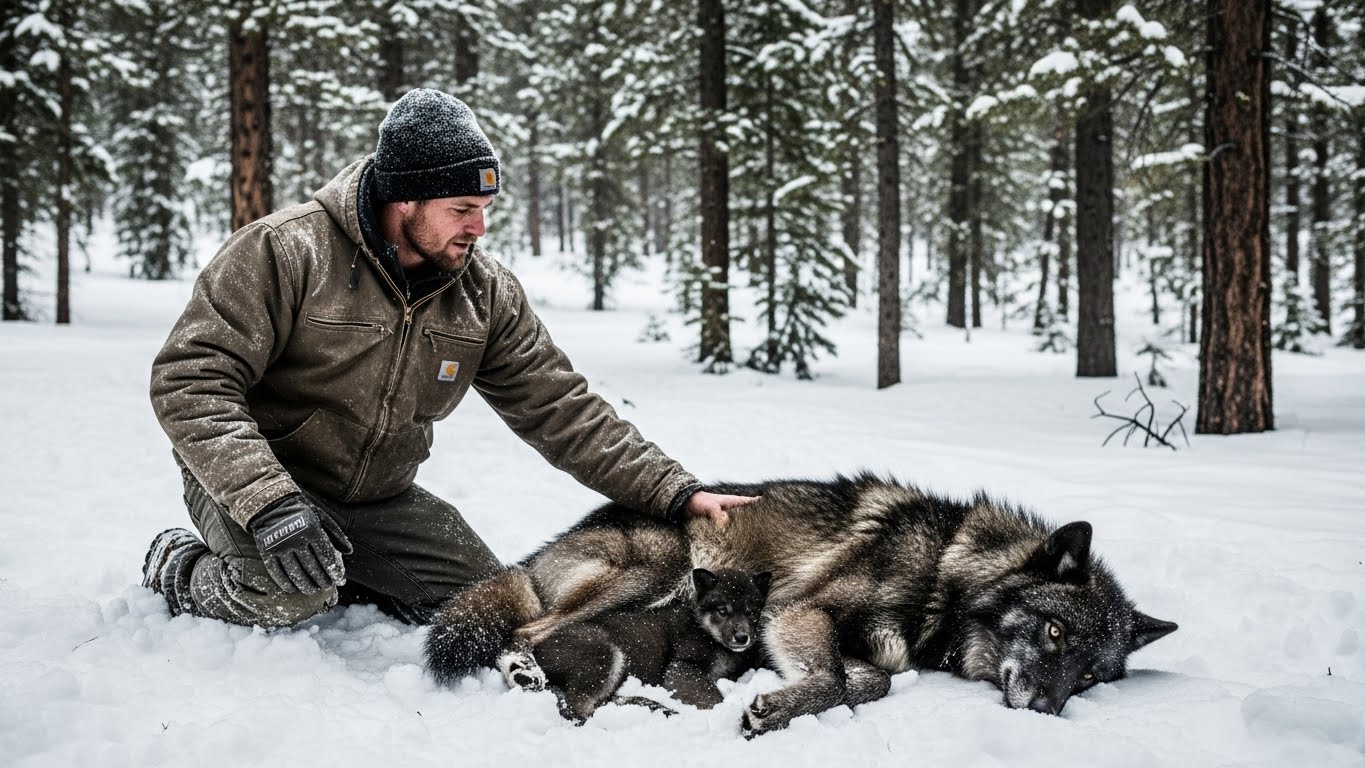
I squinted against the glare. There, circling the massive black body, was a pup. A tiny ball of gray fur, no bigger than a football. It was frantic, nuzzling the mother’s neck, licking her frozen muzzle, jumping on her side trying to wake her up. The mother didn’t stir.
The pup looked up and saw me. It didn’t growl. It didn’t run. It just stood there, shivering violently, and let out a cry that sounded terrifyingly like a human child.
My heart hammered against my ribs. I looked at the mother again. Her flank was rising and falling. Shallow. Ragged. She was alive, but barely. And then I saw the wire. A rusted poacher’s snare had snapped off a fence post and was dug deep into her rear leg, twisting the flesh. She had dragged it until she couldn’t drag it anymore.
I stood there on that ridge, the cold biting my face, wrestling with a choice that seemed simple but felt heavy. If I walked away, they both died. The mother from the wound, the pup from the cold.
“Dammit,” I whispered, the steam of my breath vanishing instantly.
I dropped my heavy tool bag into the snow. I knew the rules of the wild. But I also knew I wouldn’t sleep tonight if I left that pup to freeze next to its dead mother.
Chapter 2: The Scent of Mercy
I approached low and slow, making myself small. “Easy now,” I murmured. “I’m not gonna hurt you.”
The pup scurried behind the mother’s back, peeking out with wide, terrified amber eyes. As I got within five feet, the she-wolf’s eyes cracked open. They were yellow, glassy, and filled with a pain so deep it made me wince. Her lip curled up to reveal white fangs, a low rumble vibrating in her chest, but she didn’t try to rise. She couldn’t. She was completely spent.
“I’m just gonna cut the wire, girl,” I said, keeping my voice flat and calm. “Just the wire.”
I knelt in the snow, my knees instantly soaking through. I pulled out my Leatherman and the small bottle of isopropyl alcohol I used for de-icing the valve threads.
I reached out. The she-wolf flinched, her muscles bunching up under the black fur, but she didn’t snap. It was like she knew. Or maybe she was just too close to death to care.
The snare was tight. It had cut down to the bone. I had to work the wire cutters in deep. My hands were shaking from the adrenaline and the cold. Snap. The wire gave way. The wolf let out a sharp exhale, her head lolling back into the snow.
Now for the wound. It was nasty, jagged and oozing dark blood that was freezing into sludge.
“This is gonna sting,” I warned her.
I poured the alcohol over the gash. The wolf howled—a weak, strangled sound—and her jaws snapped shut inches from my wrist. I jerked back, falling onto my rear in the snow.
She didn’t pursue. She just panted, her eyes fixed on me.
I needed to stop the bleeding and keep the heat in. The temperature was dropping fast. I looked at my own gear. I was wearing a heavy thermal parka over a thick, red flannel shirt. The flannel was old, worn soft, and frankly, it smelled like me. It smelled like woodsmoke, motor oil, and sweat. It smelled like human.
I unzipped my parka, the freezing air hitting my chest like a hammer, and peeled off the flannel shirt. I was down to my thermal undershirt now, risking hypothermia myself, but the adrenaline was keeping me warm.
I moved back in. “One more minute,” I whispered.
I wrapped the flannel tightly around her midsection, covering the wound. I tied the sleeves in a knot over her back to keep it in place. The fabric would act as a bandage and a blanket.
The pup crept forward. It sniffed my hand, its nose wet and cold, then curled up against the flannel, burying its face in the scent of the shirt.
“Alright,” I said, standing up and quickly zipping my parka back up to my chin. “That’s all I can do.”
I grabbed my tool bag and backed away, never taking my eyes off them. The she-wolf watched me go. She didn’t growl. She just watched, that red flannel bright against her black fur.
I fixed the pipeline in record time, my hands numb, my mind racing. I hiked back to the cabin as the sun began to dip behind the peaks, casting long, purple shadows across the valley.
When I walked through the door, Sarah looked up. “You look like you’ve seen a ghost. And where’s your shirt?”
“Long story,” I said, heading straight for the fireplace. “I helped an animal. Lost the shirt.”
“You lost your shirt helping an animal in twenty-below weather?” She shook her head, pouring me a whiskey. “You’ve got a soft heart, Jack. It’s gonna get you killed one day.”
We ate dinner in the warm glow of the cabin, the fire crackling. I felt good. I felt righteous. I imagined the she-wolf regaining her strength, the pup surviving another night. I told myself I had balanced the scales a little bit.
I went to bed early, exhausted from the trek. I slept deeply, the kind of sleep that comes from physical labor and a clear conscience.
I thought the story ended there. I thought nature would take its course, and I would just be a passing shadow in that wolf’s life.
But I had made a mistake. A fatal, amateur mistake.
In wrapping that wolf in my clothes, I hadn’t just bandaged a wound. I had branded her. I had covered a wild alpha predator in the scent of a human male.
And in the wild, scent is a map.
I woke up just as the sun was hitting the ridgeline. But it wasn’t the light that woke me. It was the sound.
Screams.
Not human screams—at least, not at first. It was the shrieking of animals in terror. The chickens.
I shot out of bed, grabbing the shotgun from the corner this time. “Sarah, stay down!” I yelled.
I ran to the front window and tore back the curtain. My breath caught in my throat.
The pristine white snow of our front yard was gone. It was a churned-up battlefield of mud and slush. The heavy timber fence of the coop was smashed inward like matchsticks. Feathers were floating in the air like snow.
But it was what was standing in the middle of the yard that made my knees weak.
Wolves. A pack of them. Gray, brown, and massive. There were at least fifteen, pacing back and forth, their hackles raised, teeth bared. They weren’t eating the chickens. They had killed them, yes, but they weren’t feeding.
They were looking at the house.
And in the center of the pack, limping slightly but standing tall, was the black she-wolf. My red flannel shirt was still tied around her, shredded and stained, waving like a flag of war.
She wasn’t looking at the chickens. She was looking right at my window.
They had tracked the scent. My scent. They had followed the smell of the man who touched their queen right to my front door. And they didn’t come to say thank you.
I racked the slide of the shotgun, my hands sweating against the cold steel.
“Jack,” Sarah whispered behind me, her voice trembling. “What did you do?”
“I don’t know,” I said, watching the pack spread out, encircling the cabin. “But I think I just invited the devil to breakfast.”
Chapter 3: The Siege of the Alpha
The silence of the mountains was gone, replaced by a low, rhythmic growling that seemed to vibrate through the floorboards of the cabin. I stood at the window, the shotgun heavy and slick in my sweating palms, watching a nightmare unfold in the snow.
“They aren’t leaving, Jack,” Sarah’s voice was barely a whisper. She was crouched behind the kitchen island, clutching a steak knife, her knuckles white. “Why aren’t they leaving?”
“Because they found the source,” I muttered, my eyes locked on the she-wolf.
She was still standing in the center of the yard, surrounded by the pack. The other wolves were agitated, snapping at the air, pacing in tight circles around her. It wasn’t a reunion; it looked more like an interrogation. They were sniffing the red flannel shirt tied around her midsection—my shirt. They would take a whiff of the fabric, recoil with a snarl, and then turn their gaze toward the house.
I realized then the magnitude of my mistake. To a wolf pack, scent is identity. Scent is hierarchy. I hadn’t just bandaged her; I had covered their matriarch in the stench of a human male. I had confused the pack order. They weren’t just aggressive; they were deeply unsettled. They smelled a rival on their leader, and they had tracked that rival here to eliminate it.
A massive gray male—likely the Beta, the enforcer of the group—broke from the circle. He didn’t run; he stalked toward the porch. He was huge, his winter coat thick and matted with ice, a scar running down his snout.
He stopped at the bottom of the steps, sniffing the wood where I had walked yesterday. He looked up at the window. Our eyes met. There was an intelligence in that gaze that chilled me to the bone. This wasn’t a dumb animal; this was a general assessing a fortress.
“Get back from the window,” I hissed to Sarah.
The gray wolf lunged.
He hit the heavy oak door with a thud that shook the entire frame. Sarah screamed. I heard the wood splintering as claws raked against the finish. He wasn’t trying to knock it down; he was testing the latch.
Then, the others joined in.
It was a coordinated assault. Two wolves ran to the side of the house, scratching frantically at the foundation, trying to find a gap in the siding. Another leapt onto the woodpile stacked against the wall, trying to reach the bedroom window.
The sound was horrific—the screech of claws on glass, the heavy thumping of bodies against the walls, and the constant, terrifying chorus of snarls. We were in a wooden box, and they were trying to peel it open.
“I have to scare them off,” I said, my voice shaking. “If they break a window, they’re in.”
“Don’t open the door!” Sarah cried out.
“I’m not going to.”
I moved to the fireplace and grabbed the poker. I smashed the upper pane of the small ventilation window near the ceiling. A blast of freezing air rushed in, carrying the overwhelming stench of wet dog and musk.
I shoved the barrel of the shotgun through the broken pane, aiming high into the trees.
BOOM.
The sound of the 12-gauge was deafening in the small space. The recoil slammed into my shoulder. Outside, the pack scattered—but only for a second.
They didn’t run for the treeline. They just retreated ten yards, turning back immediately, hackles raised. They were not afraid of the noise. They were too focused, too driven by the scent.
The she-wolf hadn’t moved. She stood like a statue in the bloodied snow, the red flannel shirt bright against the white. She looked at the house, then at the pack. She let out a sharp bark, but the gray Beta ignored her. He was staring at the hole I’d just made in the window.
“They aren’t scared, Jack,” Sarah said, standing up now, trembling. “They’re angry.”
The phone rang. The sound was so normal, so domestic, that it felt absurd in the middle of a siege.
I grabbed it. “Hello?”
“Jack? It’s Tom from down the road.” Tom lived in the cabin about three hundred yards east. “I heard a shot. Everything okay over there?”
“Tom, stay inside!” I shouted. “Do not come out. We have wolves. A massive pack. They’re attacking the house.”
“Wolves?” Tom sounded confused. “I see ’em. I’m looking out my upstairs window. Jack, there’s… there’s a dozen of them.”
“Don’t come over here, Tom. Call the Sheriff. Tell them we’re trapped.”
“Sheriff is an hour out in this snow, Jack. You can’t wait that long. They’re tearing at your crawlspace vent.”
My blood went cold. The crawlspace. I had forgotten to secure the lattice after checking the pipes. If they got under the house, they could tear through the uninsulated floorboards in the utility room.
“I have to go down there,” I told Sarah.
“No!”
“I have to block the vent from the inside, Sarah! If they get under the floor, we’re dead.”
I ran to the utility room, hearing the terrifying sound of wood snapping beneath my feet. They were already tearing at the lattice. I could hear their breathing, heavy and wet, right under the floor.
Chapter 4: Blood on the Ice
I grabbed a heavy bag of concrete mix I had stored in the corner and slammed it down over the loose floorboard that led to the crawlspace access. I piled toolboxes, old paint cans, anything heavy I could find, creating a barricade. Beneath me, the scratching intensified. They knew. They could smell the draft coming from the floor.
Suddenly, a different sound cut through the chaos. A truck engine.
I ran back to the living room window. “No, no, no…”
Tom.
Tom hadn’t listened. He was a Vietnam vet, stubborn as a mule and fiercely loyal. He had driven his old Ford pickup down the unplowed lane, plowing through the drifts, and was now idling at the edge of my property.
He cracked the driver’s side door open, a scoped deer rifle in his hand.
“Tom, get back in the truck!” I screamed, pounding on the glass, but he couldn’t hear me over the engine and the wind.
The pack turned.
Their attention shifted instantly from my house to the new threat. The intelligence of these animals was terrifying. They didn’t just charge; they flanked.
Three wolves darted to the left, using the snowdrifts as cover. The large gray Beta moved straight down the driveway, growling low, challenging the truck.
Tom stepped out, raising his rifle. He took aim at the Beta.
CRACK.
The rifle shot echoed. The Beta flinched, a stripe of red appearing on his shoulder, but he didn’t drop. He roared—a sound that was more monster than animal—and charged.
“Tom!” I screamed.
I couldn’t stay inside. Not anymore.
“Lock the door behind me,” I told Sarah, my eyes wild. “Do not open it for anyone but me.”
“Jack, you’ll die!” she grabbed my arm, tears streaming down her face.
“He’s helping us. I can’t let them tear him apart.”
I threw the deadbolt and kicked the door open. The cold hit me like a physical blow. I stepped onto the porch, leveled the shotgun, and fired at the wolves flanking Tom’s truck.
Buckshot sprayed the snow. One wolf yelped and spun in circles, biting at its leg. The distraction worked for a split second.
“Get back in the truck, Tom!” I roared.
But the snow was too deep, and Tom was too slow. The Beta wolf, ignoring his wound, leaped. He hit Tom in the chest, knocking the old man backward into a snowbank. The rifle flew out of his hands.
It was pure chaos. I pumped the shotgun, ejecting a shell, and ran down the steps into the yard. The snow was up to my knees, slowing me down, making every movement feel like I was running underwater.
Two other wolves peeled off from the house and came for me.
I swung the barrel, firing from the hip. The closest wolf dropped, sliding in the snow. The second one veered off, circling to my right.
I was twenty yards from Tom. The Beta was on top of him, snapping at his arms which Tom had thrown up to protect his throat. The old man was kicking, screaming, his heavy coat the only thing saving him from being disemboweled.
I raised the gun to shoot the Beta, but I couldn’t. They were thrashing too much. I might hit Tom.
“Hey! Get off him!” I yelled, trying to draw the wolf’s attention.
And then, a blur of black and red slammed into the gray wolf.
It was the she-wolf.
My flannel shirt was tattered, dragging in the snow, but she moved with a ferocity that defied her injuries. She hit the Beta broadside, her jaws clamping onto his neck.
The Beta roared in surprise, releasing Tom and rolling in the snow to engage this new attacker.
It was Alpha against Alpha. The black she-wolf against the gray male.
She was defending… what? Me? Tom? Or was she just asserting dominance over a pack that had turned chaotic?
I didn’t wait to analyze wolf politics. I reached Tom, grabbing him by the collar of his coat.
“Get up!” I yelled, dragging him through the snow. He was bleeding from a gash on his forearm, his face pale with shock.
“My leg… I think it’s broken,” Tom gasped.
The wolves were circling us now. The fight between the she-wolf and the Beta had paused the rest of the pack. They were watching, confused. The she-wolf stood over the Beta, who was now on his back, exposing his throat in submission. She was snarling, blood dripping from her jaws—mixed with the red of my flannel shirt.
She looked at me.
For a second, in that frozen, violent tableau, we connected again. Her eyes weren’t grateful. They were wild, fierce, and demanding. She had bought us a moment.
“Go,” her posture seemed to say.
“Move, Tom!” I hoisted him up, half-carrying him toward the cabin.
The pack began to close in again. The truce was temporary. The scent of fresh blood—Tom’s blood—was overpowering the scent of the flannel now. Their predatory instincts were overriding their confusion.
We scrambled up the porch steps just as a brown wolf snapped at my boot, its teeth catching the rubber sole. I kicked backward, connecting with its snout, and threw Tom through the open doorway.
I dived in after him and slammed the door, throwing the deadbolt just as a heavy body slammed against the wood from the outside.
We were back inside. But now we had a wounded man, zero ammo in my shotgun, and a pack of wolves that had tasted human blood.
And outside, the howling began. It wasn’t the mournful call of the wild anymore. It was a war cry.
Chapter 5: Darkness Descends
The deadbolt slid home with a heavy, metallic click that echoed like a gunshot in the sudden silence of the cabin. For a moment, the only sounds were Tom’s ragged, wet breathing and the frantic pounding of my own heart against my ribs.
“Sarah! Get the first aid kit! The big one from under the sink!” I yelled, dropping to my knees beside Tom.
The old Vietnam vet was pale, his skin turning a waxy shade of gray. His heavy Carhartt coat was shredded at the arm, the canvas soaked dark with blood. But it was his leg that worried me most. It was twisted at an unnatural angle just below the knee, the boot pointing outward in a way that made my stomach churn.
“I’m okay, Jack… I’m okay,” Tom wheezed, his eyes squeezing shut as a tremor of pain rolled through him. “Just… just gave ’em something to chew on.”
“Save your breath, Tom.” I grabbed a throw pillow from the couch and propped up his head.
Sarah skidded into the room, the plastic orange box in her hands. She took one look at Tom’s arm and her face went white, but she didn’t freeze. She knelt down, popping the latches.
“Jack, the bleeding… we need to stop it,” she said, her voice tight but controlled.
“Apply pressure. Use the towels. I need to check the perimeter.”
“You’re leaving him?” she looked up, panic flaring in her eyes.
“I’m not leaving the room, Sarah. But if they find a way in, patching him up won’t matter.”
I stood up, my hands trembling. I felt naked without a loaded weapon. I grabbed the shotgun anyway—it was a heavy steel club if nothing else—and moved to the window.
Outside, the scene had shifted from a riot to a siege. The frantic scrambling had stopped. The howling had ceased. Now, there was only movement.
The wolves were pacing. They had established a perimeter, a perfect circle around the cabin, just beyond the range of where the snow from the roof had fallen. They were waiting. Watching.
The gray Beta, the one the she-wolf had attacked, was back on his feet. He was limping, shaking his head, blood matting the fur around his neck. He wasn’t looking at the she-wolf anymore. He was staring at the front door.
The she-wolf was there, too. She was pacing closer to the house than the others, effectively putting herself between the pack and us. My red flannel shirt was a tattered rag now, dragging in the snow, a bizarre banner of allegiance. She snapped at a younger wolf that got too close to the stairs, driving him back with a guttural snarl.
“She’s holding them back,” I whispered to myself. “But for how long?”
The wind picked up, whistling through the eaves. And then, the lights flickered.
Once. Twice.
“No,” I breathed. “Not now.”
The cabin plunged into darkness. The hum of the refrigerator died. The electric baseboard heaters clicked off.
“Jack?” Sarah’s voice trembled in the dark.
“It’s okay,” I lied. “Power lines probably iced over. Or…” I didn’t finish the sentence. Or the wolves had chewed through the junction box on the side of the house. They were smart. They were destructive.
“Get the flashlights,” I said. “And the candles. We need to conserve the heat. Block the drafts under the doors with blankets.”
The temperature in the cabin began to drop immediately. Montana winters don’t forgive a lack of heating. Within an hour, we would be seeing our breath.
I moved to the fireplace. We had wood, thankfully. I struck a match, the flare illuminating the terrified faces of my wife and my neighbor. As the fire caught, casting long, dancing shadows against the log walls, the atmosphere shifted from desperate to primal.
We were cavemen now. Huddled around a fire, darkness pressing in, with monsters waiting just outside the circle of light.
I sat by the window, peering through the crack in the curtains. The eyes. That’s what I saw. Dozens of yellow, reflective orbs glowing in the darkness, catching the faint light of the moon that was trying to break through the clouds.
“They aren’t leaving, are they?” Tom asked. His voice was weaker. Sarah had bandaged his arm and splinted his leg with a broom handle and duct tape, but he was in shock.
“No, Tom,” I said grimly. “They’re settling in. They know we’re trapped.”
A heavy thud came from the back of the house. Then another. The sound of wood splintering.
I jumped up, grabbing the empty shotgun and a heavy iron poker from the fireplace. “Stay with him!”
I ran to the kitchen. The back door. It was a solid wood door, but it had a small window at the top.
A snout was pressed against the glass. A wolf was standing on its hind legs, scratching at the frame, testing the hinges.
I slammed my hand against the glass. The wolf didn’t flinch. It just stared at me, drool freezing on the pane. It knew I couldn’t hurt it.
I backed away. We were running out of time. The cold was seeping in, and the pack was testing every weak point. But the worst part wasn’t the cold or the fear.
It was the realization of why this was happening.
I looked down at my hands, the hands that had touched the she-wolf, the hands that had tied that flannel shirt.
I had intervened in nature. I had played God. And now, nature had come to collect the debt.
Chapter 6: The Roof
The hours dragged on like a funeral procession. The fire was our only world. Outside, the wind howled, masking the sounds of the pack, which was almost worse. Every creak of the house sounded like a claw prying open a board.
Tom had fallen into a feverish sleep. Sarah sat beside him, clutching a kitchen knife, her eyes wide and unblinking.
“Jack,” she whispered. “Do you hear that?”
I stopped pacing. I strained my ears against the roaring of the wind.
Scritch. Scritch. Thump.
It wasn’t coming from the doors. It wasn’t coming from the windows.
It was coming from above.
My blood ran cold. The roof.
The snow was deep up there, packed hard. But a wolf is light on its feet. They had found the snowdrifts piled high against the north wall—the “ramps” the wind built every winter. They were on the roof.
“The chimney,” I said, realizing the danger instantly.
“They can’t come down the chimney, Jack,” Sarah said, her voice rising in panic. “It’s too narrow. The damper is closed.”
“Not the chimney,” I said, looking up at the vaulted ceiling. “The skylight.”
In the loft upstairs, above our bedroom, there was a skylight. It was old. The seal was cracked. I had meant to fix it last summer.
I grabbed the fireplace poker. “Stay here. Guard the door.”
“Jack, don’t go up there!”
“If they break that glass, they drop right into the bedroom. I have to board it up.”
I sprinted up the wooden stairs, my boots heavy on the treads. The air upstairs was freezing; the heat from the fire didn’t reach this high.
I burst into the bedroom. The moonlight was filtering through the skylight, casting a pale, blue square on the bed.
And there, pressed against the glass, was a face.
A wolf. It was looking down, scratching at the flashing. The glass groaned under its weight.
I didn’t have wood. I didn’t have nails. I looked around wildly. The dresser.
I grabbed the heavy oak dresser and dragged it across the floor. It screeched, a horrible sound. The wolf on the roof paused, tilting its head.
I pushed the dresser under the skylight. It wasn’t tall enough to reach the ceiling. It wouldn’t stop them if the glass broke; it would just give them something to land on.
CRACK.
A spiderweb fracture appeared in the center of the glass. The wolf had bitten the metal frame and was pulling.
“Hey!” I screamed at the ceiling, swinging the iron poker and smashing it against the wall to make noise. “Get back!”
The wolf snarled, its breath fogging the glass from the outside. Then, a second shadow joined it. Two of them. They were going to crash through.
I needed a weapon. A real one.
I remembered the flare gun.
It was in the emergency kit in the closet—the kit we kept for avalanches or getting lost skiing.
I threw the closet door open, tearing through boxes. Blankets, batteries, radio… yes.
The orange plastic case. I ripped it open. One flare gun. Two shells.
I loaded a shell, my fingers numb and clumsy.
I ran back to the center of the room. The glass was bowing inward. The scratching was frantic now. They could smell me. They knew I was right there.
SMASH.
The glass shattered.
Snow and shards of plexiglass rained down onto the bed. A wolf—a sleek, brown female—dropped through the hole.
She hit the mattress with a thud, shook herself, and looked straight at me. She snarled, gathering her legs to spring.
I raised the flare gun. I didn’t aim at her—I didn’t want to burn the house down. I aimed at the open hole in the roof, right where the second wolf was peering in.
POP-WHOOSH.
The flare shot upward, blindingly bright in the dark room. It hissed and sputtered, sticking into the wood framing of the roof just outside the hole.
Red light flooded the roof. The second wolf yelped in terror and scrambled back.
The wolf on the bed panicked. The sudden blinding light and the hissing sound confused her. She snapped at the air, backing away, her hind legs tangling in the duvet.
I screamed, a primal roar of my own, and swung the iron poker. I hit the mattress right next to her head.
She wasn’t the Alpha. She was young, inexperienced. The fire, the noise, and the aggression broke her nerve. She scrambled toward the dresser, trying to leap back up to the skylight, but it was too high.
She turned on me, cornered.
“Get out!” I yelled, brandishing the poker.
She looked at the door to the hallway. The door leading downstairs to Sarah and Tom.
“No!” I lunged, blocking her path.
We circled each other in the red, flickering light of the dying flare. Her teeth were bared, drool dripping onto the floorboards. She lunged, snapping at my leg.
I brought the poker down, hitting her hard across the shoulder. She yelped, a high-pitched cry of pain.
Then, a sound from outside stopped us both.
A howl.
But not just a howl. A command. It was deep, resonant, and authoritative. It cut through the wind and the chaos.
The young wolf in my bedroom froze. Her ears flattened. She looked at me, then at the hole in the roof, then whined.
She scrambled past me—not attacking, but fleeing—and threw herself at the window on the far wall. The glass shattered, and she tumbled out into the snowbank below, disappearing into the night.
I rushed to the broken window, the freezing wind blasting my face. I looked down into the yard.
The she-wolf—the one I had saved—was standing on top of Tom’s truck. She was elevated, visible to the whole pack.
She was howling at the roof. She was howling at the wolves by the door.
She was challenging the pack.
She wasn’t just defending herself anymore. She was drawing a line in the snow.
But as I watched, the massive gray Beta—the one she had fought earlier—stepped out of the shadows. He wasn’t alone. Three other large males flanked him.
They weren’t looking at the house anymore. They were looking at her.
The siege on the house had paused. The civil war had begun. And I realized with a sinking heart that my act of kindness had sentenced her to death. She was outnumbered four to one.
I looked at the flare gun in my hand. One shell left.
“Jack!” Sarah screamed from downstairs. “They’re at the back door again!”
I looked at the she-wolf, alone on the truck, facing down the execution squad.
“Hold on,” I whispered. “I’m not letting you die for this.”
Chapter 7: The Suicide Run
I raced down the stairs, taking them two at a time, the wooden treads groaning under my boots. The flare gun was gripped tight in my sweating hand, a single orange shell loaded in the chamber. It wasn’t much—a firework against a firing squad—but it was the only edge I had left.
In the kitchen, the scene was one of contained panic. Sarah had pushed the heavy oak dining table against the back door, jamming it under the handle. The wood of the door frame was splintering, shards flying inward as heavy paws battered it from the outside.
“Jack!” Sarah cried, her face streaked with soot and tears. “It’s giving way! The hinges are popping!”
I didn’t go to the door. I went to the front window.
I needed to see the war.
Outside, the world had dissolved into a blurred frenzy of violence. The she-wolf was no longer on top of the truck. The Beta and his three enforcers had dragged her down into the snow. It was a brawl of teeth and fur, a swirling mass of gray and black.
She was fighting with a desperation that broke my heart. She snapped, rolled, and tore at them, but she was injured, exhausted, and outnumbered. The Beta had his jaws locked onto her shoulder—the same shoulder I had touched, the one covered by my shredded flannel. He wasn’t just killing her; he was punishing her. He was tearing away the human scent.
Under the truck, I saw movement. Two glowing eyes. The pup. It was watching its mother die.
A cold clarity washed over me.
If she died, the barrier fell. Once the Beta killed the “traitor,” his authority would be absolute. The pack’s bloodlust would be peaked, and they would turn that fury back on the house. They would finish what they started. They would come through the walls, through the roof, through the doors. We wouldn’t survive the night.
“I have to go out there,” I said. My voice sounded distant, like someone else was speaking.
Sarah turned from the barricade, her eyes wide with horror. “What? No! Jack, are you insane? You have one flare!”
“The rifle,” I said, pointing through the glass.
Tom’s hunting rifle. It was lying in the snowbank where he had dropped it, maybe fifteen yards from the porch. It was a black line in the white snow, half-buried but visible.
“It’s fifteen yards, Jack! They’ll tear you apart before you make it down the steps!”
“They’re distracted,” I said, checking the flare gun. “The pack is watching the fight. They’re focused on the execution. If I move now, I have a chance. If I wait five minutes, she’s dead, and we’re next.”
I didn’t wait for her to argue. I couldn’t. If I looked at her, if I thought about Tom bleeding out on the rug, I would freeze. And freezing meant death.
I walked to the front door. “Lock it behind me. Immediately. Do not open it unless you hear my voice.”
“Jack…”
“Lock it, Sarah!”
I threw the deadbolt, took a breath of the stale cabin air, and opened the door.
The noise hit me instantly. The growls were guttural, wet, and terrifyingly loud. The wind was screaming. The cold was a physical slap.
I stepped onto the porch.
The pack was gathered in a semi-circle around Tom’s truck, their backs to me. Their tails were twitching, their heads low. They were spectators at a gladiatorial match.
I moved.
I didn’t run. Running triggers the chase instinct. I crept down the stairs, keeping my body low, moving with the agonizing slowness of a predator.
My boots crunched softly on the fresh snow. Every step felt like a thunderclap to my ears, but the wolves didn’t turn. The sounds of the fight—the yelps, the snapping of bone—masked my approach.
I reached the bottom of the stairs. Ten yards to the rifle.
The cold was seeping through my thermal gear, but my hands were sweating. I gripped the flare gun in my left hand, keeping my right hand free for the rifle.
I was halfway there when the wind shifted.
A wolf on the periphery of the circle—a scrawny, mangy male—lifted his head. He sniffed the air. He turned.
His yellow eyes locked onto me.
Time stopped.
He didn’t bark. He didn’t growl. He just stared, processing the sight of the human creeping through the snow. Then, his lips peeled back to reveal yellowed fangs. He crouched, preparing to spring.
I raised the flare gun.
Don’t shoot, I told myself. If you shoot now, the whole pack turns. You need the rifle.
I held his gaze. I projected every ounce of aggression I had. Come on, I thought. Make a move. Do it.
The wolf hesitated. The hierarchy was confusing. The Alpha fight was happening behind him, but here was a human, bold and out in the open.
I took another step. Then another.
I was five feet from the rifle.
The scrawny wolf made his choice. He let out a sharp bark—an alarm call—and lunged.
I didn’t shoot him. I dove.
I threw myself into the snowbank, my hand scrambling blindly in the powder. My fingers brushed cold steel. The barrel.
I gripped the rifle and rolled onto my back just as the wolf hit me.
His weight drove the air from my lungs. Jaws snapped inches from my face. I jammed the barrel of the flare gun into his ribs and pulled the trigger.
THUMP-HISS.
The flare didn’t shoot into the sky. It discharged directly into the wolf’s fur. The muffled explosion threw us both apart. The wolf shrieked—a sound of pure terror—as his coat caught fire. He scrambled backward, rolling in the snow to douse the flames, yelping in agony.
The silence of the pack shattered.
Every head turned. The fight by the truck paused. Twenty pairs of eyes fixed on me.
I scrambled to my knees, racking the bolt of Tom’s rifle. Please don’t be jammed. Please don’t be frozen.
The bolt slid back smoothly. A brass cartridge ejected, and a fresh one slid home.
I raised the rifle to my shoulder.
The Beta stood over the she-wolf. He looked at me, blood dripping from his muzzle. He looked at the burning wolf rolling in the snow. Then, he roared.
He forgot about the she-wolf. He charged me.
Chapter 8: The Debt Paid
A charging wolf covers ground with terrifying speed. It’s not a run; it’s a blur of motion, a missile of muscle and teeth.
He was twenty feet away. Fifteen.
I didn’t look through the scope. At this range, a scope is useless; all you see is fur. I looked over the barrel, keeping both eyes open. I aimed for the center of the massive gray chest.
My finger tightened on the trigger.
Ten feet.
I saw the madness in his eyes. This wasn’t hunger. This was hate.
Five feet.
I fired.
BOOM.
The .30-06 round hit him mid-stride. The impact was kinetic, brutal. It stopped his forward momentum instantly, lifting him off his paws and slamming him backward into the snow.
He didn’t get up.
The echo of the shot rolled through the valley, bouncing off the canyon walls.
Then, silence. Absolute, ringing silence.
I stood there, breathing hard, the steam rising from the barrel of the rifle. I cycled the bolt, ejecting the spent casing and chambering another round. I kept the rifle raised, panning across the pack.
The other wolves froze. They looked at the dead Beta. They looked at me. Then, slowly, they looked back at the truck.
The she-wolf was rising.
She was in bad shape. Her ear was torn, one eye was swollen shut, and her black fur was matted with blood. But she stood up. She shook herself, sending a spray of red droplets onto the white snow.
She didn’t look at the pack. She looked at me.
We locked eyes across the twenty yards of death and snow.
There was no softness in her gaze. No “thank you.” This wasn’t a Disney movie. This was the wild. Her look was one of recognition. I was the creature with the thunder-stick. I was the one who had tipped the scales. I had paid my debt.
She turned to the pack. She let out a low, vibrating growl that started deep in her chest and rose to a terrifying snarl. She walked over to the body of the Beta and snapped her jaws inches from his dead throat.
It was a statement. He is gone. I remain.
One by one, the other wolves lowered their heads. The tails tucked. They averted their eyes.
Submission.
She was Alpha again. Not because she had won the fight, but because she had survived the war.
She let out a sharp bark.
The pup, shivering and terrified, crawled out from under the truck. It ran to her, nuzzling her leg. She licked its head once, then turned toward the treeline.
She began to walk. She didn’t run. She walked with a limp, but with her head high.
The pack followed. They filed past me, giving me a wide berth, their eyes wary. They dissolved into the tree line, shadows merging with shadows, until they were gone.
The only thing left was the wind, the body of the Beta, and the blood on the snow.
I lowered the rifle. My legs gave out, and I sat down heavily on the porch steps.
The front door creaked open.
“Jack?” Sarah’s voice was barely a whisper.
I looked back at her. “It’s over,” I said. “They’re gone.”
The adrenaline crashed, and the cold finally took hold. I started to shake uncontrollably. Sarah ran out, throwing a blanket over me, hugging me so tight I thought my ribs would crack.
We sat there for a long time as the sun began to crest over the peaks, painting the bloody snow in brilliant, indifferent shades of pink and gold.
The sheriff arrived three hours later. A snowplow had finally cleared the pass. He looked at the dead wolf in the yard, the smashed coop, the bullet holes, and the blood.
“Hell of a night, Jack,” he said, tipping his hat. “You wanna tell me what happened?”
“I helped a stranger,” I said, looking at the treeline where the tracks disappeared into the dark woods. “And they came to say goodbye.”
We never saw the black she-wolf again. The pack moved on, likely crossing the range into the next valley. But sometimes, on the coldest nights of the year, when the wind dies down and the moon is full, I hear them.
I hear the howl.
And every time, I check the locks. I check the rifle.
Because I learned the lesson. You can show mercy to the wild, you can save a life, and you can even bond with a beast. But you can never, ever tame the nature of things.
A good deed in the mountains isn’t a gift. It’s a transaction. And sometimes, the price is higher than you can afford to pay.
I saved a life that day. But I’ll never know if I saved a wolf, or if I just unleashed a queen.