My Father Beat Me Unconscious In A Crowded Parking Lot Over A $4 Mistake, And Every Single Adult Watched It Happen Without Lifting A Finger.
Chapter 1: The Longest Ride Home
The silence in the truck was heavy, like a physical weight pressing against my chest. It was thicker than the humidity outside, hotter than the Ohio summer sun baking the hood of the Ford F-150.
My father’s knuckles were white on the steering wheel. I kept my eyes glued to the mesmerizing blur of the yellow lines on the highway, counting them to keep from throwing up. One, two, three… don’t look at him. Four, five, six… don’t breathe too loud.
We were coming back from the Regional Little League qualifiers. To anyone looking in from the outside, we were the picture-perfect American duo. The dedicated father who coached the team, sacrificing his weekends to mold young men. The dutiful son, sitting in the passenger seat with his cleats still on, dirt on his knees, smelling like grass and sweat.
But the reality was rotting from the inside out.
We had lost. 4-3.
And it was my fault.
It was the bottom of the sixth inning. Two outs. Bases loaded. The batter had popped a high foul ball behind the plate. It was an easy catch. A routine play. I had done it a thousand times in the backyard while he screamed instructions at me.
But the sun had been in my eyes. I lost the white leather sphere in the glare. I stumbled. The ball hit the edge of my mitt and dropped into the dust with a soft, mocking thud.
The groan from the parents in the bleachers still rang in my ears. But that sound was nothing compared to the silence coming from the driver’s seat right now.
“You know what you are?”
His voice was low. Calm. That was always worse. When he yelled, it was just noise. When he whispered, it was a promise of violence.
I didn’t answer. I shrank into the seat, trying to make myself as small as possible. Maybe if I disappeared into the fabric, he wouldn’t be able to reach me.
“I asked you a question, Leo,” he said, his eyes never leaving the road. “You know what you are?”
“No, sir,” I whispered, my voice trembling.
“You’re a waste of my time.”
The words hit me harder than a pitch to the ribs. My dad was a man who measured love in victories. If we won, we got pizza and a pat on the back. If we lost, we got the long, silent drive and the terror of what waited at home.
But today felt different. The air in the cab was electric with a tension that felt dangerous. He wasn’t just disappointed. He was humiliated. He felt my failure as a direct attack on his ego.
“I spend three grand on gear,” he muttered, shaking his head. “Three grand. Private lessons. Travel fees. And you can’t catch a popup? A toddler could catch that ball, Leo.”
I bit my lip so hard I tasted blood. Don’t cry. Whatever you do, don’t cry. Crying was weakness. Weakness was punished.
He abruptly jerked the wheel to the right, swerving the massive truck onto the exit ramp. My seatbelt locked against my chest.
“Where are we going?” I asked, panic flaring in my gut. This wasn’t the way home.
“I need a drink,” he snapped. “And gas. Since I wasted my entire Saturday watching you embarrass the family name, the least I can do is get a soda.”
He pulled into a sprawling gas station complex. It was busy. Saturday afternoon traffic. Families on road trips. Teenagers hanging out. Normal people living normal lives where fathers didn’t look at their sons like they wanted to crush them.
“Get out,” he commanded as he parked at Pump 4. “Go inside. Get me a Diet Coke. And get yourself something. Maybe the sugar will help your brain work next time.”
He threw a crumpled five-dollar bill at my chest.
I scrambled out of the truck, grateful for the escape, however brief. The heat hit me instantly, but it felt safer than the air-conditioned prison of the cab.
I walked into the store, the chime of the door announcing my arrival. I grabbed his soda. Then, hesitating, I walked over to the Slurpee machine. I needed something cold. Something to soothe the dry lump in my throat.
I filled a cup with blue raspberry. The bright, artificial color looked cheerful. For a second, just a second, I felt like a normal kid getting a treat after a game.
I paid the cashier, a bored teenager with headphones around his neck. He didn’t look at me. He didn’t see the terror in my eyes. He just took the money and pointed to the door.
I took a deep breath, clutching the icy cup. I had to go back out there.
If I had known what was about to happen, I would have stayed in that store forever. I would have hidden in the bathroom. I would have run out the back door and kept running until my legs gave out.
But I didn’t know. So, I pushed the door open and walked back toward the truck.
Chapter 2: The Spill
The walk back to Pump 4 felt like walking the green mile.
My dad was leaning against the bed of the truck, the gas nozzle in his hand. He was wearing his mirrored sunglasses, so I couldn’t see his eyes, but I could feel them. He was watching my every step, analyzing my gait, probably criticizing the way I walked.
I approached the passenger side. I needed to get in, sit down, and be invisible. That was the strategy.
“Did you get it?” he barked.
“Yes, sir,” I said, holding up the Diet Coke.
“Get in.”
I opened the heavy door of the F-150. It was lifted—my dad loved that truck more than he loved most people. It was his pride and joy. The interior was custom leather, pristine beige, spotless. He cleaned it every Sunday.
I put one foot on the running board. My cleats were metal. The running board was metal.
Maybe there was oil on it. Maybe I was just clumsy, shaking from the adrenaline and fear.
My foot slipped.
My shin slammed against the metal step. A sharp bolt of pain shot up my leg. My hands threw forward instinctively to catch my balance.
The blue Slurpee cup launched out of my grip.
It happened in slow motion. I watched the cup rotate in the air, the lid popping off like a cork. The bright blue slush, thick and syrupy, arced through the open door.
It landed directly on the passenger seat.
Splat.
The sound was sickeningly wet.
The blue dye instantly soaked into the beige leather. It splattered across the center console. It dripped down onto the pristine carpet. It looked like a Smurf had been murdered in the front seat.
I froze. My heart didn’t just stop; it turned to ice.
I looked up.
My dad was standing there, the gas nozzle still in his hand. He had frozen too. He was staring at the seat. Then, slowly, terrifyingly, he turned his head to look at me.
He took off his sunglasses.
There was no yelling at first. Just a low, guttural noise, like a growl from a predatory animal.
“What,” he whispered, “did you just do?”
“I… I tripped,” I stammered, backing away. “Dad, I tripped. I’m sorry. I’ll clean it. I’ll clean it right now!”
He dropped the gas nozzle. It clattered against the side of the truck, scratching the paint. He didn’t care.
“You stupid…”
The rage exploded out of him. It wasn’t human. It was a dam breaking.
He lunged at me.
I tried to run, but he was too fast. He grabbed the front of my jersey—the uniform that bore his name on the back—and yanked me toward him. My feet left the ground.
“You useless, clumsy little piece of trash!” he roared.
He threw me.
He actually threw me.
I flew backward and hit the concrete pavement hard. My elbow cracked against the ground, sending a shockwave of pain up my arm. I rolled, trying to protect my head, curling into the fetal position.
“Get up!” he screamed, looming over me.
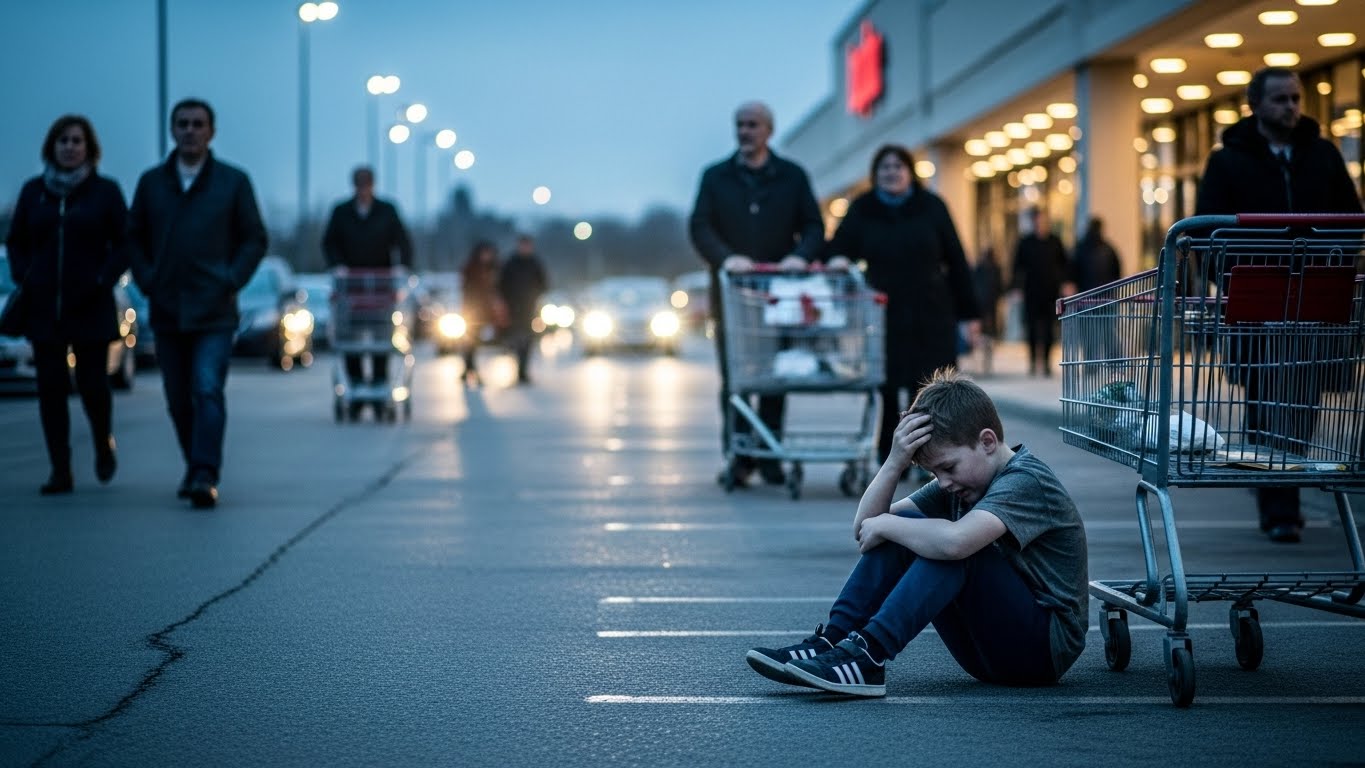
I looked around frantically. We were in public. This was a gas station. There were people everywhere.
At the pump next to us, a woman in a floral dress was putting gas in her SUV. She was staring right at us. Her mouth was slightly open.
“Help me!” I screamed at her. “Please!”
She blinked. Her eyes darted from me to my father—a hulking, furious man with veins bulging in his neck.
And then, she looked down. She turned her back to us and focused intently on the numbers ticking up on the gas pump.
My dad kicked me in the ribs.
The air left my lungs in a whoosh. I gasped, flopping like a fish on the dry concrete. The pain was blinding.
“You ruined my truck!” Kick. “You ruined the game!” Kick. “You ruin everything you touch!”
I saw a man walking out of the convenience store. He was big, wearing a construction vest. Surely, he would help. He was a tough guy. He wouldn’t be scared.
He stopped, holding a bag of chips. He watched my dad grab me by the hair and drag me a few feet across the asphalt.
“Hey!” the man said.
Hope surged in my chest. Yes. Here it is. The hero.
My dad whipped his head around, snarling like a rabid dog. “What are you looking at? Mind your own damn business! This is my son! I’m disciplining my son!”
The man in the construction vest hesitated. He looked at my dad’s size. He looked at the rage. He looked at me, crying, bleeding from a scrape on my cheek.
“Just… keep it down, alright?” the man mumbled.
And he walked to his truck.
He walked away.
My dad laughed. A cold, cruel sound. “See that, Leo? Nobody cares. Nobody gives a damn about a loser.”
He hauled me up by my arm, his fingers digging into my bicep so hard I thought the bone would snap. He shoved me against the side of the truck, pinning me there.
“You’re going to lick it up,” he hissed, his face inches from mine. Spittle flew onto my cheek.
“What?” I sobbed.
“The seat. You’re going to lick it clean. Right now.”
“Dad, please…”
He raised his hand.
I flinched, shutting my eyes tight, waiting for the blow that would turn the lights out.
I was twelve years old, surrounded by Americans, surrounded by families, surrounded by “good people.” And I realized, in that parking lot, that safety is a lie.
Nobody was coming.
Chapter 3: The Blackout and the Silent Highway
The hand came down.
It wasn’t a slap. It wasn’t a spanking. It was a closed fist, heavy with a gold wedding band that acted like brass knuckles.
It connected with the side of my head, just above the ear.
The world didn’t go black immediately. First, it went white. A blinding, searing white light that exploded behind my eyes. The sound of the gas station—the hum of the refrigerator units, the distant highway traffic, the murmur of the bystanders—snapped off like someone had cut a wire.
There was a high-pitched ringing, like a siren screaming inside my skull.
Then, my legs turned to water. I didn’t decide to fall; gravity just reclaimed me. I felt the rough concrete scrape against my cheek again, but it felt distant, like it was happening to someone else.
Then came the darkness.
I don’t know how long I was out. It might have been ten seconds. It might have been ten minutes.
When consciousness clawed its way back, the first thing I registered was the vibration. A low, steady rumble.
I opened my eyes. Everything was blurry, swimming in a haze of nausea.
I wasn’t on the pavement anymore.
I was in the passenger seat of the Ford F-150. We were moving.
I blinked, trying to clear the fog. My head throbbed with a rhythmic, pounding agony that synced with my heartbeat. Every bump in the road sent a fresh spike of pain drilling into my skull.
I looked down at my lap. My baseball pants were stained with dirt and… something else. Blood. A small, dark spot on the knee.
I slowly turned my head to the left.
My father was driving.
He looked completely calm. He had his sunglasses back on. His left arm was resting casually on the door frame, the wind from the open window ruffling the hair on his arm. He was chewing gum.
The radio was on. A country song about dirt roads and cold beer was playing softly.
It was psychotic.
Minutes ago, he had beaten his twelve-year-old son into unconsciousness in a public parking lot. Now, he was driving down Interstate 75 like we were heading to a Sunday picnic.
“You awake?” he asked. He didn’t look at me. His voice was flat, devoid of any emotion.
I tried to speak, but my jaw clicked painfully. “Yeah,” I croaked.
“Good,” he said. “You got blood on the seatbelt. Wipe it off.”
I looked down. Sure enough, a smear of red on the gray fabric strap.
I didn’t argue. I didn’t ask what happened. I didn’t ask who had put me in the truck—did he drag me? Did he carry me? Did those people watch him load my limp body into the cab like a sack of mulch?
I just licked my thumb and started scrubbing at the blood stain.
The smell in the truck was nauseating. It was a mix of the cloying, sweet scent of blue raspberry syrup and the metallic tang of my own fear.
I looked at the center console. He had wiped it down. It was mostly clean, though the stitching was stained a faint blue.
“I hope you learned something today, Leo,” he said, signaling to change lanes.
I froze.
“I hope you learned that actions have consequences,” he continued, sounding like a professor giving a lecture. “You were careless. You were disrespectful. And you paid the price.”
He wasn’t sorry. He felt justified. In his mind, he hadn’t committed a crime; he had delivered a lesson.
“My head hurts,” I whispered.
“You’ll be fine,” he scoffed. “Don’t be a drama queen. It’s just a headache. Maybe next time you’ll keep your feet on the ground and your hands on the cup.”
I turned my head toward the window, watching the suburban landscape roll by. Strip malls. Applebee’s. Carefully manicured lawns.
It all looked so normal.
That was the terrifying part. The world outside was functioning perfectly. People were buying groceries. Kids were riding bikes.
And inside this truck, I was trapped with a monster who had convinced himself he was a good father.
I touched the side of my head gingerly. There was a lump the size of a golf ball. It was hot to the touch.
“Don’t touch it,” he snapped. “You’ll make it worse.”
We turned into our subdivision. The “fancy” neighborhood. The place where doctors and lawyers lived. The place where abuse didn’t happen—or so the neighbors liked to pretend.
As we pulled into the driveway, my stomach twisted into knots.
Mom.
Would she save me? Would she see the bruise, the blood, the terror, and finally pack a bag? Would she call the police?
Or would this be just another Saturday?
The garage door opened with a mechanical groan. My dad pulled the truck in and killed the engine. The silence returned, heavy and suffocating.
“Go inside,” he said. “Wash your face. Put some ice on it. And Leo?”
I paused with my hand on the door handle.
“Don’t tell your mother I hit you. Tell her you fell at the gas station. You tripped over a hose. Understand?”
I looked at him. He took off his sunglasses. His eyes were hard, daring me to defy him.
“Yes, sir,” I said.
“Good boy.”
I opened the door and stepped out, my legs shaking so hard I almost collapsed again. I walked to the door that led into the kitchen, praying for a miracle I knew wouldn’t come.
Chapter 4: The Conspiracy of Silence
The kitchen smelled like pot roast.
It was the smell of comfort, of safety, of a happy American home. It made me want to vomit.
My mother was standing at the island, chopping carrots. She was wearing an apron. She had music playing—something soft, classical maybe.
She looked up as I walked in. She smiled, that practiced, tight smile she always wore when Dad was around.
“Hey, slugger!” she chirped. “How was the—”
Her voice died in her throat.
She saw me.
She saw the dirt caked on one side of my uniform. She saw the tear in the fabric of my pants. She saw the blood dried on my chin.
And she saw the massive, purple-black swelling on the side of my head.
The knife clattered onto the cutting board.
“Leo?” she whispered. She rushed over to me, her hands hovering around my face but not daring to touch. “Oh my god. What happened?”
I opened my mouth. The truth was right there, sitting on my tongue. Dad hit me. He knocked me out. He kicked me in front of strangers.
But then the door from the garage opened behind me.
My father walked in. He carried himself with the confidence of a king entering his castle. He tossed his keys on the counter.
“Boy had a little accident,” my father said, his voice booming and cheerful. He walked over to the fridge and grabbed a beer.
My mother’s eyes darted from me to him. I saw the calculation in her gaze. I saw the fear flicker behind her eyes, followed immediately by the resignation.
“An accident?” she asked, her voice trembling slightly.
“Yeah,” Dad said, cracking the tab on the beer. Psst. “Clumsy kid. Tripped over a gas hose at the Shell station. Went down like a sack of potatoes. Hit his head on the pump.”
He took a long swig of beer, then looked at me. “Right, Leo?”
The room felt airtight. The pressure was immense.
My mother looked at me. She was begging me with her eyes. Please don’t make a scene. Please don’t make him angry. Please just go along with it.
She knew.
Deep down, she knew exactly what had happened. She knew her husband. She knew he didn’t have “accidents.” She knew I was coordinated enough to be a starting catcher but apparently too clumsy to walk at a gas station?
She knew. And she was waiting for me to lie so she didn’t have to deal with the truth.
A part of me died in that kitchen. The part of me that believed parents were protectors.
“Yeah,” I whispered, looking at the floor tiles. “I tripped. I’m sorry, Mom.”
My mother let out a breath she had been holding. It sounded like a balloon deflating.
“Oh, Leo,” she said, her voice switching back to ‘concerned mother’ mode, pushing the dark reality away. “You have to be more careful, honey. Come here, let me look at it.”
She led me to the sink. She wet a paper towel and started wiping the blood off my face. Her hands were shaking.
My dad leaned against the counter, watching us. “He’s fine, Sharon. Don’t baby him. He needs to toughen up. That’s why we lost the game today. Soft.”
“He’s hurt, Frank,” my mother said softly, not looking at him.
“He’s embarrassed,” Dad corrected. “Go upstairs, Leo. take a shower. You smell like a locker room.”
I pulled away from my mother’s touch. I felt dirty, but not because of the baseball game. I felt dirty because I was part of their lie.
I walked out of the kitchen. As I climbed the stairs, I heard the normal sounds of their evening resuming.
“Did you pick up the dry cleaning?” Mom asked.
“Yeah, it’s in the truck,” Dad replied. “Dinner smells good.”
“It’ll be ready in twenty minutes.”
Normal. Everything was normal.
I went into the bathroom and locked the door. It was the only lock in the house that worked, the only barrier between me and them.
I stripped off my uniform. My ribs were already turning a mottled shade of yellow and green where his boot had connected. My elbow was scraped raw.
I looked in the mirror.
The side of my face was distorted. The bruise was spreading down to my cheekbone. My eye was starting to swell shut.
I touched the glass, staring at my own reflection.
Who are you? I thought. You’re a ghost.
I wasn’t a son. I was a punching bag. I was a prop in their play of a happy family.
I turned on the shower, making the water as hot as I could stand. I sat on the floor of the tub, letting the scalding water beat down on me, hoping it would wash away the feeling of his hands, the sound of his voice, the look of the woman in the minivan who turned away.
But the water just ran clear. It couldn’t wash away the memory.
Later that night, I lay in bed, staring at the ceiling. My head throbbed so hard I couldn’t sleep.
I heard them downstairs. The TV was on. They were watching a movie. I heard my mom laugh.
She laughed.
How could she laugh? How could she sit next to him on the sofa, sharing popcorn, knowing that her son was upstairs battered and broken by the man sitting next to her?
That was the night the silence broke me.
It wasn’t just the silence of the strangers at the gas station. It was the silence of my home. The silence of the suburbs.
We lived in a world where appearances mattered more than people. Where a bruise was just a “fall” and a scream was just “disciplining the kids.”
I realized then that I was completely alone.
If I was going to survive this house, if I was going to survive him, I couldn’t rely on anyone. Not the neighbors. Not the police. Not even my mother.
I curled into a ball, pulling the duvet over my head.
The next day was Sunday. Church day.
We would wake up. We would get dressed. Dad would wear his suit. Mom would wear a dress. I would wear a long-sleeved shirt to hide the bruises on my arms, and Mom would put a little makeup on my eye to “hide the swelling from the accident.”
We would walk into church, shake hands, smile at the neighbors.
And everyone would say, “What a lovely family.”
And I would smile back, and I would hate them all.
Chapter 5: The Masquerade of the All-American Son
Five years later.
I was seventeen. I was six feet tall. I was the captain of the varsity baseball team. I had a 3.8 GPA and a letterman jacket that weighed ten pounds with all the patches on it.
To the outside world, I was the golden boy of our Ohio suburb. I was the product of “tough love” and good parenting.
But inside the house, I was still twelve years old, shaking in a parking lot.
The abuse had changed as I got older. The physical beatings became less frequent—mostly because bruises on a high school athlete raise too many questions.
Instead, the violence became psychological. It was a cold war. It was calculated dismantling of my self-worth.
It was the way he’d stare at me across the dinner table, cleaning his teeth with a toothpick, waiting for me to chew too loudly or hold my fork wrong.
It was the way he’d show up to my games, stand behind the backstop, and not cheer. He would just take notes. Afterwards, in the car, he wouldn’t say “Good game.” He would say, “Your stance is opening up too early. You look like a girl out there.”
I learned to be perfect. Perfection was my armor. If I got an A, he couldn’t yell. If I hit a home run, he couldn’t hit me.
Or so I thought.
The crack in my armor came in the form of a girl named Sarah.
Sarah was everything I wasn’t. She was loud, messy, artistic, and free. She didn’t check the temperature of a room before she walked into it. She just lived.
I made the mistake of bringing her home for dinner.
I prepped her for two days. “My dad is strict,” I told her. “Just… agree with him. Don’t bring up politics. Don’t talk about art school. Just talk about how good the food is.”
Sarah laughed. She thought I was exaggerating. She thought all dads were like hers—goofy guys who fell asleep in recliners.
She didn’t know about the monsters that wear polo shirts.
Dinner started well. My dad was in “Mayor Mode.” He was charming, pouring iced tea, asking Sarah about her classes. My mom was smiling, looking relieved that things were going smoothly.
Then, Sarah made a mistake.
“This pot roast is amazing, Mrs. Miller,” she said. “My dad tries to cook, but he usually just orders pizza.”
It was a harmless comment. A joke.
My dad stopped chewing. He put his fork down.
“So your father doesn’t provide for his family?” he asked. His voice was silky smooth, but I heard the click of the safety coming off.
Sarah blinked, confused. “What? No, I just meant he’s not a great cook.”
“A man who can’t cook a meal is lazy,” my dad said, staring right at her. “Laziness is a disease. Is your father lazy, Sarah?”
“Dad,” I cut in, my voice tight. “Don’t.”
He snapped his head toward me. “Don’t what? Don’t ask a question? Is that how you talk to me in my own house?”
“She’s a guest,” I said. My hands were gripping the table so hard the wood was digging into my palms.
He smiled. It was a terrifying, shark-like smile.
“She’s a guest because I pay the mortgage,” he said. “And you? You’re a guest too. Don’t forget that.”
He turned back to Sarah. “Leo tells me you want to go to art school. You know what they call art majors in the real world?”
“No,” Sarah whispered. She looked scared now. She finally saw it.
“Unemployed,” he laughed. A harsh, barking sound. “Just like Leo would be if I didn’t ride him so hard. You know he cried until he was fourteen? Cried over spilled milk. Literally.”
He started telling the story of the gas station. He twisted it. He made me sound pathetic, weak, a hysterical child who dropped a slushie and threw a tantrum. He left out the beating. He left out the blood.
I sat there, burning with shame, watching the only good thing in my life get tainted by his poison.
Sarah left early. I walked her to her car.
“Is he always like that?” she asked, her voice shaking.
“He’s just stressed,” I lied. The lie tasted like ash. “He had a bad week at work.”
She looked at me, really looked at me, and I saw pity in her eyes. I hated it.
“You don’t have to live like this, Leo,” she said.
I watched her drive away. I wanted to go with her. I wanted to run.
But I turned around and walked back into the house. Because the monster was waiting, and if I didn’t go back, he would take it out on my mother.
Chapter 6: The Wall
Two weeks later, the cold war went hot.
It was a Tuesday. A nothing day.
I was in my room doing calculus homework. I heard the front door slam.
Slam.
The house shook.
I froze. I knew that slam. That wasn’t a “wind caught the door” slam. That was a “bad day, looking for a fight” slam.
I heard his heavy footsteps in the hallway. I heard him go into the kitchen. I heard the distinctive clink of a bottle against a glass. Whiskey.
Then, I heard my mother’s voice. Low, pleading.
“Frank, please. Not tonight. You promised.”
“I didn’t promise a damn thing!” he roared.
My stomach dropped. I put my pencil down.
“I work like a dog!” he shouted. “I break my back for this family! And I come home to this? The sink is full of dishes! Why is the sink full of dishes, Sharon?”
“I was working late,” Mom said. Her voice was trembling. “I just got home ten minutes ago.”
“Excuses!”
Then came the sound that haunts my nightmares.
Smack.
Flesh on flesh.
I didn’t think. I didn’t plan. The boy who cowered at the gas station was gone. In his place was a seventeen-year-old linebacker who had spent five years hating himself for doing nothing.
I kicked my bedroom door open and sprinted down the stairs.
I burst into the kitchen.
My mother was backed against the refrigerator, holding her cheek. She was crying silently.
My father was standing over her, his hand raised for a second strike. He looked huge, his face purple with rage, the smell of bourbon radiating off him in waves.
“Don’t touch her,” I said.
My voice was deep. It was steady. It surprised even me.
My dad froze. He turned slowly, lowering his hand. He looked at me like he was seeing a stranger.
“Excuse me?” he whispered.
I stepped between them. I put my body—my varsity athlete body, built by his obsession with winning—between him and his victim.
“I said, don’t touch her.”
He laughed. It was a incredulous, manic sound. “Oh, look at this. The hero. You think you’re a man now, Leo? You think because you can throw a ball you can tell me what to do in my house?”
He stepped into my space. He got right in my face, nose to nose. I could smell the alcohol and the onions from his lunch.
“Get out of my way,” he hissed.
“No,” I said.
He swung.
It was the same right hook that had knocked me out when I was twelve. But I wasn’t twelve anymore.
I saw it coming.
I caught his wrist.
The sound of his arm hitting my hand was loud—a sharp thwack.
He gasped. His eyes went wide. He tried to pull his arm back, but I held on. I squeezed. I wanted to crush the bones in his wrist. I wanted to make him feel a fraction of the pain he had caused us.
“You’re never going to hit us again,” I said through gritted teeth.
For a second, I saw fear in his eyes. Genuine fear. He realized that the dynamic had shifted. The prey had become the predator.
But my father was a street fighter. He didn’t play fair.
He didn’t try to pull away. Instead, he drove his knee into my groin.
Pain exploded in my stomach. I doubled over, my grip loosening.
He shoved me hard. I stumbled back, tripping over a kitchen chair. I crashed to the floor, taking the chair with me.
Before I could recover, he was on me.
He wasn’t hitting me like a father disciplining a son. He was hitting me like a man fighting for his life. He punched me in the jaw. He kicked me in the side.
“You ungrateful little bastard!” he screamed with every blow.
“Frank, stop! You’ll kill him!” Mom was screaming, pulling at his shirt. He backhanded her without looking, sending her sliding across the linoleum.
I managed to scramble up. My lip was split. My eye was swelling.
I looked at him. He was panting, his shirt untucked, his hair wild.
There was a knife block on the counter behind him.
I saw his eyes flick toward it.
And in that moment, I knew.
This wasn’t just abuse anymore. If I stayed, one of us was going to die. Either he would kill me in a rage, or I would have to kill him to stop him.
I looked at my mom. She was on the floor, weeping, defeated.
“Get out,” my dad wheezed, pointing a shaking finger at the door. “Get out of my house. If I see you here again tonight, I will finish this.”
I wiped the blood from my mouth.
“Come on, Mom,” I said, reaching a hand out to her. “We’re leaving.”
She looked at me. Then she looked at him.
She looked at the house she had spent twenty years decorating. She looked at the life she had built.
“I… I can’t, Leo,” she sobbed. “He’s drunk. He doesn’t mean it. Just go. Just go for a while.”
My heart broke. Not into two pieces, but into dust.
She chose him. Even now. Even with blood on the floor. She chose the devil she knew.
“Fine,” I said.
I turned my back on them. I walked out the back door into the cool night air.
I didn’t take my car. I didn’t take a coat. I just walked.
I walked past the neighbors’ houses with their flickering blue TV screens. I walked past the manicured lawns.
I walked to the only place I could think of. The 24-hour gas station on the edge of town.
Not the one where he beat me. A different one.
I sat on the curb, shivering, bleeding, watching cars come and go.
I was seventeen. I was homeless. And I finally understood why nobody helped me when I was twelve.
Fear is the strongest gravity in the universe. It holds everyone down.
But that night, sitting on that cold curb, I made a promise to myself. I would never go back. Not really. I would finish school, I would get out, and I would never, ever be like him.
But escaping a man like my father isn’t that simple. He doesn’t just let you walk away.
Chapter 7: The Ghost in the Hallway
I didn’t go back that night.
I slept in a dugout at the local park. It was freezing, the wooden bench hard against my bruised ribs, but it was the most peaceful sleep I’d had in years. I woke up with the sunrise, shivering, stiff, but strangely free.
I went to school in yesterday’s clothes. I didn’t care.
For the next three months, I became a ghost in my own town. I stayed on friends’ couches. I showered at the gym. I ate cheap cafeteria food.
My mother would call me, crying, begging me to come home. “He’s sorry,” she’d say. “He didn’t mean it.”
But I knew he wasn’t sorry. And I knew he meant every bit of it.
I only went back to the house one last time. It was August. The humidity was breaking, giving way to the crisp promise of autumn.
I had been accepted to a state university three hours away. I had a partial scholarship for baseball—ironic, considering the sport was the root of so much of my pain—and a night shift job lined up to pay for the rest.
I needed my clothes. I needed my birth certificate.
I pulled into the driveway. His truck was there. My stomach tightened, that old familiar knot of dread forming instantly. Fight or flight.
I walked in.
The house was silent. It was clean, perfect, like a museum exhibit of a happy family.
My father was in the living room, watching a preseason football game. He looked smaller than I remembered. Maybe because I had stopped shrinking myself to fit his world.
He heard me walk in. He didn’t turn his head. He just took a sip of his beer.
I went upstairs, grabbed a duffel bag, and started shoving my life into it. T-shirts, jeans, a few books. I found my old catcher’s mitt in the back of the closet. I held it for a moment, remembering the sting of the ball, the smell of the leather, the sound of his disappointment.
I threw it in the trash can.
When I came back downstairs, my mother was in the hallway. She looked tired. Her eyes were dull, the spark gone. She handed me an envelope.
“It’s not much,” she whispered. “Just some gas money.”
I looked at the envelope. Then I looked at the back of my father’s head.
“I don’t want it,” I said.
“Leo, please,” she begged. “Take it.”
“I don’t want anything from him,” I said, loud enough for him to hear.
My father slowly stood up. He turned off the TV. The silence stretched, thin and brittle.
He walked over to the hallway. He leaned against the doorframe, blocking my exit. He looked me up and down, a smirk playing on his lips.
“Let him go, Sharon,” he said. “He’ll be back.”
He looked me right in the eye. “You think you’re a big man now? You think you can make it out there? You’re soft, Leo. The world eats soft people alive.”
He pointed a finger at my chest. “You’ll fail. You’ll drop out. And when you come crawling back here asking for a roof over your head, I’m going to charge you rent.”
I looked at this man. This man who had terrorized me over spilled slushies and missed catches. This man who ruled his kingdom with fear because he had no love to give.
And for the first time, I didn’t feel fear. I felt pity.
“I’m never coming back,” I said. My voice didn’t shake.
“We’ll see,” he sneered.
I pushed past him. He didn’t stop me. He didn’t hit me. He just laughed, a dry, hacking sound that followed me out the door.
I got into my rusted sedan—a car I had bought with my own money—and backed out of the driveway.
I watched the house disappear in the rearview mirror. The manicured lawn. The perfect siding. The prison.
I drove toward the highway. Toward the future. And I swore to myself, on everything that mattered, that the cycle ended with me.
But trauma is a patient ghost. It waits. It hides in your DNA. It sleeps in your blood, waiting for the right moment to wake up.
Chapter 8: The Spill
Twelve years later.
I was thirty years old. I was a structural engineer living in Chicago. I had a wife, Julie, who was the kindest person I had ever met. And I had a son.
Toby. He was four years old.
He had my eyes, but he had Julie’s spirit. He was wild, clumsy, and full of joy.
My father was dead. A massive heart attack at sixty-two. The rage had finally burst his heart.
I didn’t cry at the funeral. I stood there in my black suit, listening to the town eulogize “Coach Frank.” They talked about his passion. They talked about his dedication. They didn’t talk about the bruises.
My mother was a widow now. She seemed lighter, like a weight had been lifted, but she was also lost. She had spent forty years managing a monster; she didn’t know what to do with peace.
After the funeral, we were driving back to Chicago. It was a long drive.
We stopped at a gas station in Indiana.
It was a hot day. July. The asphalt was shimmering in the heat.
“Can I get a slushie?” Toby asked from his booster seat.
My heart skipped a beat. A physical reaction. A trigger.
“Sure, buddy,” I said, forcing a smile.
We went inside. The smell of the convenience store—hot dogs, coffee, floor cleaner—hit me like a time machine.
Toby ran to the machine. “Blue!” he shouted. “I want the blue one!”
I filled the cup. The bright, neon blue syrup swirled around. It looked radioactive.
We walked back to the car. My new SUV. Leather seats. Beige interior.
I opened the back door to buckle Toby in.
“Here you go,” I said, handing him the cup.
“Thanks, Daddy!”
He reached for it with his small, chubby hands.
But he was four. His coordination wasn’t perfect. And he was excited.
His fingers fumbled. The cup tipped.
The lid popped off.
I watched it happen. It was déjà vu. It was a nightmare manifesting in real time.
The blue slushie exploded all over the backseat. It soaked into the beige leather. It splashed onto the carpet. It splattered onto Toby’s favorite t-shirt.
Toby gasped. He froze.
He looked up at me.
And I saw it.
I saw the terror in his eyes.
He wasn’t just surprised. He was scared. He hunched his shoulders up to his ears. He flinched. He was waiting for the yelling. He was waiting for the grab. He was waiting for the pain.
He didn’t know why he was scared—I had never hit him. I had never screamed at him. But he sensed the shift in the air. He sensed the sudden, jagged spike in my adrenaline.
For a split second, I felt it. The rage.
It surged up from my stomach, hot and acidic. It was my father’s voice screaming in my head: Look at what he did! He ruined it! He’s clumsy! Teach him a lesson!
My hands clenched into fists. My jaw locked.
The beast was there. It was right under the surface, demanding blood for the crime of a spilled drink.
I looked around.
There were people at the pumps. A man in a truck. A woman in a sedan. They were looking. They saw the spill. They were waiting to see what the father would do.
I looked back at Toby. He was starting to cry. “I’m sorry, Daddy! I’m sorry!”
The sound of his voice shattered the spell.
I am not him.
I took a deep breath. I exhaled the rage. I pushed the beast back into the darkness and locked the door.
I dropped to my knees on the hot concrete.
“Hey,” I said softly.
Toby squeezed his eyes shut.
I reached out. I didn’t grab his shirt. I didn’t grab his hair.
I put my hand gently on his knee.
“It’s okay,” I said.
Toby opened one eye. “It’s not?”
“No,” I said, smiling. “It’s just a drink, buddy. It’s just sugar and ice. Cars can be cleaned. You can’t be replaced.”
I saw the tension drain out of his little body. He exhaled a shaky breath.
“I made a mess,” he whispered.
“Yeah, you did,” I laughed. “A big blue one. Looks like a Smurf exploded. Come here.”
I unbuckled him and pulled him into a hug. He buried his sticky, blue-stained face in my neck. I held him tight, right there in the gas station parking lot.
I looked up.
The man in the truck at the next pump was watching us. He was an older guy, rough-looking, wearing a baseball cap.
He caught my eye.
He didn’t look away. He didn’t look at his watch.
He nodded. Just a single, slow nod of respect.
I nodded back.
I grabbed a roll of paper towels from the trunk. We cleaned it up together. It took ten minutes. The stain didn’t come out completely. There was a faint blue shadow on the leather.
I left it there.
I never tried to remove it again.
Every time I looked in the rearview mirror and saw that stain, I didn’t see a mistake. I didn’t see a failure.
I saw a victory.
I saw the exact moment where the timeline split, where the curse was broken, and where a father chose to be a hero instead of a villain.
My father taught me that mistakes are fatal.
My son taught me that mistakes are just opportunities to say, “I love you anyway.”
And that is a lesson worth a four-dollar slushie.
[END OF STORY]