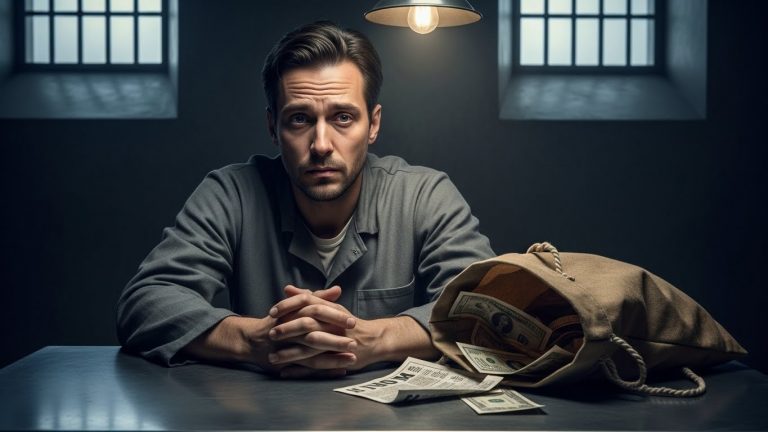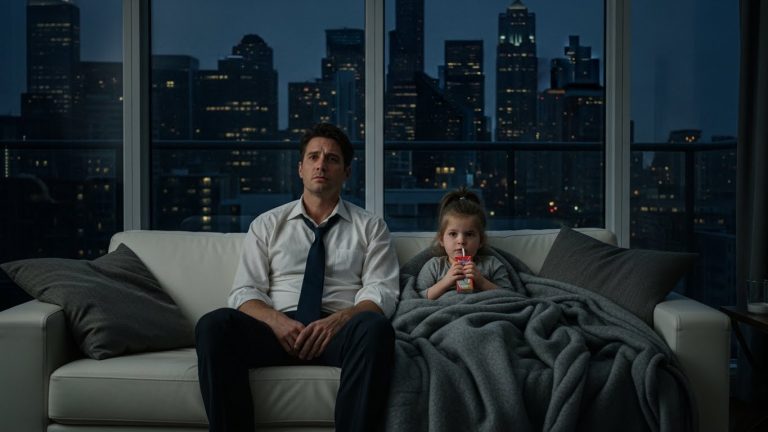
I Gave $300 to a Beggar. The Next Day, She Was at My Wife’s Grave, and She Told Me I Married the Wrong Woman.
PART 1
Chapter 1: The Price of a Conscience
The rain in Seattle doesn’t wash things clean; it just makes the grime slicker.
I stood under the awning of the Sterling Tower, checking my watch. It was a Patek Philippe, worth more than the average American makes in a year. It felt heavy on my wrist. Everything felt heavy lately. My suit, my grief, the very air in my lungs.
It had been ninety days since Alyssa died. Ninety days since the black ice on the interstate turned my Porsche—and my entire life—into twisted metal. I survived without a scratch. She didn’t survive at all.
“Spare a dollar? For a hot meal?”
The voice was like grinding gravel. I looked down.
She was sitting on a flattened cardboard box, huddled against the cold brick of my building. I’d seen her before. She was a fixture of the city’s underbelly—a ghost in layers of dirty wool and plastic ponchos. But today, for the first time, I actually looked at her.
Her hands were wrapped in fingerless gloves, stained with soot. Her face was hidden beneath a hood, but I saw strands of hair—matted, grey, wild.
I felt a surge of something nauseating. Guilt. It was the survivor’s guilt that my therapist, Dr. Aris, kept telling me to “acknowledge.”
I reached into my pocket. I pulled out my money clip. I didn’t have any ones or fives. I had three crisp hundred-dollar bills. Fresh from the bank.
I didn’t hesitate. I pulled them all out.
“Here,” I said, my voice sounding hollow over the drumming rain.
I dropped the bills into her paper cup. They didn’t flutter; they landed with a soft thud. Three hundred dollars. A fortune for her. A rounding error for me.
The woman didn’t grab the money. She froze. Slowly, she tilted her head up. The hood fell back slightly.
Her eyes.
They were a piercing, electric blue. Alyssa had blue eyes. But Alyssa’s eyes were like a summer sky—warm, inviting. This woman’s eyes were like ice on a frozen lake. Jagged. Dangerous.
“That’s a lot of blood money,” she whispered.
I recoiled. “Excuse me?”
“You think this pays for it?” She reached into the cup, her fingers trembling, and clutched the bills. “You think paper covers the cracks?”
“Take it or leave it,” I snapped, the sudden anger masking my unease. “Buy food. Or don’t. I don’t care.”
I turned on my heel, signaling for my driver. As the black sedan pulled up, I heard her voice one last time, cutting through the traffic noise.
“She’s cold, Arthur. Even in the velvet, she’s cold.”
I froze. My name is Arthur. I had never spoken to this woman in my life.
I dove into the car and slammed the door.
“Go,” I told the driver. “Just drive.”
My heart was hammering against my ribs. Coincidence, I told myself. She probably heard someone say my name. I’m a public figure. It means nothing.
But as we sped away, I looked back. She was still sitting there, staring at the departing car, clutching the three hundred dollars to her chest like it was a holy relic.
Chapter 2: The Intruder in the Garden of Stone
I couldn’t sleep that night. The woman’s voice rattled around in my empty house. She’s cold, Arthur.
Alyssa had hated the cold. She used to sleep with three blankets, even in July.
By morning, the rain had stopped, replaced by a thick, suffocating fog. I needed to see her. I needed to ground myself.
I drove to Oak Hill Cemetery alone. It was an exclusive plot, gated and manicured. The grass was impossibly green.
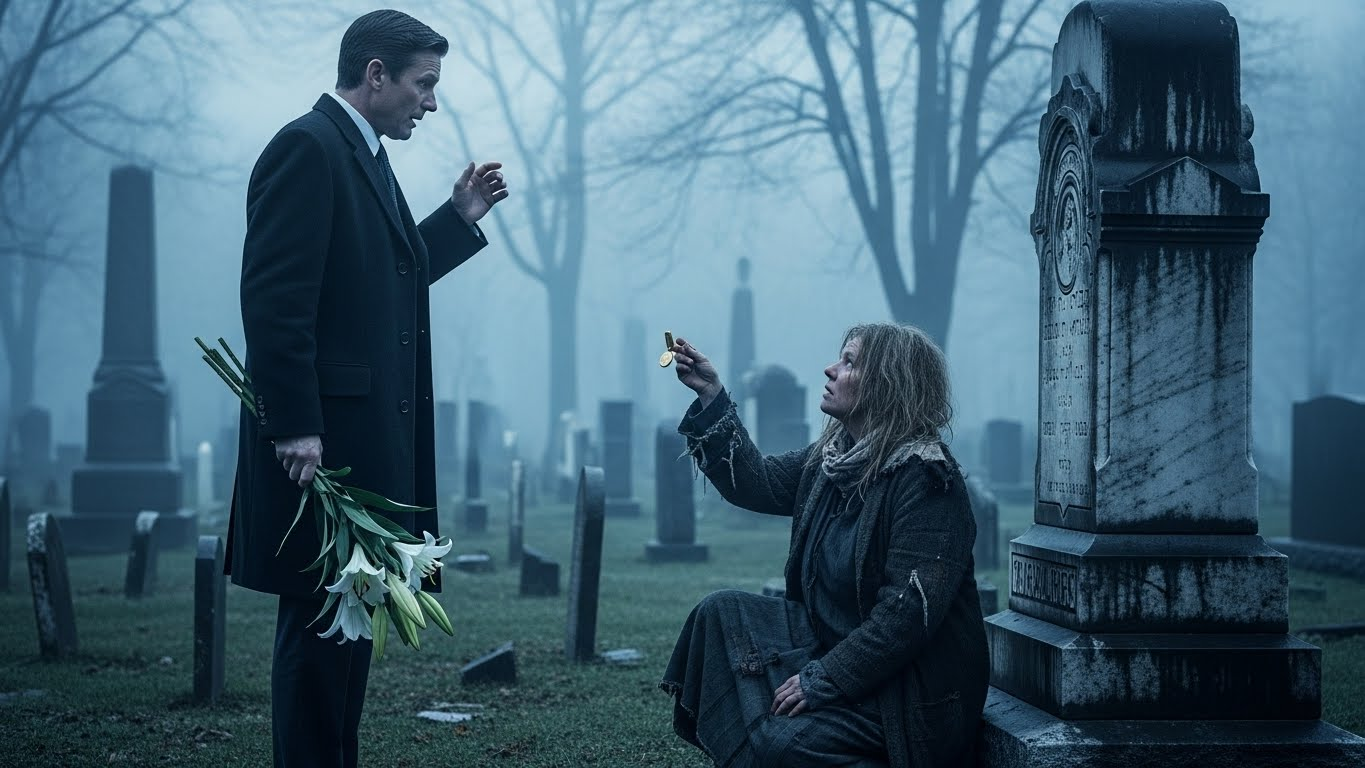
I parked the car and walked up the hill toward the Sterling family plot. I was carrying a bouquet of white lilies—Alyssa’s favorite.
As I crested the hill, I stopped dead.
Someone was there.
A figure was crouching over Alyssa’s grave. It wasn’t the groundskeeper. The groundskeepers wore crisp green uniforms. This person looked like a pile of discarded rags.
Rage, hot and blinding, flooded my veins.
“Hey!” I shouted, dropping the flowers. “Get away from there!”
The figure didn’t run. They didn’t even flinch.
I ran toward them, slipping on the wet grass. As I got closer, I saw the motion of their arm. Back and forth. Scrubbing.
“I said get back!” I reached the grave and grabbed the person by the shoulder, spinning them around.
It was her. The beggar from the office.
Up close, the smell hit me—stale rain, old sweat, and something metallic. But what stopped me wasn’t the smell. It was what was in her hand.
A toothbrush. And a bottle of store-bought cleaner.
She had been scrubbing the mud off the base of the headstone. She had used the three hundred dollars I gave her to buy cleaning supplies.
“You…” I stammered, my hand still gripping her dirty coat. “What are you doing?”
She looked at me, her blue eyes red-rimmed and raw. She wasn’t aggressive. she looked shattered.
“The moss,” she said, her voice cracking. “She hated dirty things. You know she hated dirty things, Arthur. Why did you let the moss grow?”
I let go of her, stumbling back. “How do you know my wife? How do you know my name?”
“Your wife?” The woman let out a laugh that sounded like dry leaves breaking. She stood up. She was taller than she looked hunched over. “Is that who she was to you? A wife? A doll?”
“I’m calling the police,” I said, fumbling for my phone. “You’re trespassing.”
“Call them,” she challenged. “But ask yourself one thing before they come.”
She reached into the layers of her coat. I flinched, thinking she had a weapon.
Instead, she pulled out a gold locket. It was battered, scratched, and old. But I recognized the design. It was a vintage piece, something from the 1920s.
“Open it,” she said, tossing it to me.
I caught it. My hands were shaking. I pried the latch open with my thumbnail.
Inside was a tiny, sepia-toned photograph. Two little girls. Identical twins. They were holding hands, standing in front of a trailer park. They looked poor, dirty, and happy.
I looked closer at the faces. The eyes. The smiles.
One of them was undeniably Alyssa.
I flipped the locket over. Engraved on the back were two names.
Mara & Maya.
“Who is Maya?” I whispered.
The homeless woman took a step closer, the smell of the street overpowering the scent of the lilies I had dropped.
“Alyssa wasn’t her name, Arthur,” she said softly. “Her name was Maya. And I’m Mara. I’m the sister she left behind in the gutter so she could play princess in your castle.”
(End of Part 1. Part 2 continues below.)
PART 2
Chapter 3: The Ghost in the Rags
The world tilted on its axis. The fog seemed to thicken, wrapping around the gravestones like a shroud.
“Sisters?” I managed to choke out. “Alyssa was an only child. She was an orphan from Chicago. I saw the adoption papers. I saw her birth certificate.”
“Paper,” Mara spat, looking at the grave. “Paper is easy to forge when you’re desperate enough. When you’re running from a debt you can’t pay.”
She snatched the cleaning bottle off the ground. “She told you she was an orphan because it was cleaner. It was a better story for a Sterling. ‘The poor tragic girl who pulled herself up by her bootstraps.’ Not ‘the trailer trash twin who stole her sister’s savings and ran away in the middle of the night.'”
“You’re lying,” I said, but my voice lacked conviction. The resemblance was there. Under the grime, under the years of hardship etched into her skin, the bone structure was identical. The nose. The line of the jaw.
“Am I?” Mara stepped closer. She reached out a dirty finger and tapped my chest. “Ask yourself, Arthur. Did she ever talk about her childhood? Did she ever show you a picture of herself before the age of eighteen? Did she ever let you meet a single person from her past?”
I stood frozen. She hadn’t. Alyssa had always been vague. Too painful, she would say. I want to focus on our future, Artie. The past is a dead place.
“She ran,” Mara said, her voice dropping to a whisper. “We made a pact. We saved every dime. We were going to go to California together. Get out of the park. Start a catering business. She took the jar, Arthur. The jar under the floorboards. Five thousand dollars. And she left a note saying ‘I’m sorry.'”
Mara looked down at the grave, tears cutting clean tracks through the dirt on her cheeks. “I spent ten years looking for her. And when I finally found her, walking into that tower of yours… I couldn’t approach her.”
“Why not?” I asked.
“Because she looked happy,” Mara said simply. “And I loved her.”
Chapter 4: The Diary of Lies
“Why are you here now?” I asked. “If you stayed away when she was alive, why scrub her grave now?”
“Because she didn’t die in an accident,” Mara said.
The silence in the cemetery was deafening. A crow cawed in the distance.
“What did you say?”
“I was there,” Mara said. “I was watching her. I watched her every Tuesday. She went to that coffee shop on 4th and Main. I sat on the grate outside. She never saw me. Or maybe she did, and she just looked through me.”
She took a deep breath. “That night… the night she died. She wasn’t driving home to you. She was driving to meet him.”
“Him?”
“The man from the past. The one we ran from. The reason we needed that money.” Mara’s eyes darted around the empty cemetery, paranoid. “He found her, Arthur. He found Maya. He was blackmailing her. He told her if she didn’t pay up, he’d tell the Prince of Seattle that his wife was a fraud.”
My stomach churned. “Alyssa withdrew fifty thousand dollars in cash the day she died. She told me it was for a charity auction.”
Mara shook her head sadly. “It was hush money. But he didn’t want money. He wanted to hurt her. He ran her off the road, Arthur. I saw his truck. A red Ford. Rusted bumper.”
I grabbed her arm again. “You saw this? Why didn’t you go to the police?”
“Look at me!” she screamed, gesturing to her rags. “Who listens to the trash? Who believes the crazy bag lady over the forensic report? They said it was ice. It wasn’t ice. It was murder.”
Chapter 5: The Red Truck
I drove Mara back to my estate. My housekeeper, Mrs. Higgins, nearly fainted when I walked in with a woman who smelled like a dumpster, but one look at my face told her not to ask questions.
We sat in the library. I gave Mara a robe—one of Alyssa’s old ones. She stroked the silk like it was made of diamonds.
“The man,” I said, pouring a glass of whiskey. My hands were finally steady. “What is his name?”
“Frankie Russo,” she said. “He was our step-father. A monster. He treated us like property.”
I went to my desk and opened my laptop. I have resources. I have private investigators on retainer. I typed in the name.
Frank Russo. Released from Walla Walla Penitentiary four months ago.
The timeline fit.
“He’s here,” Mara whispered, looking out the window at the manicured lawn. “I’ve seen him watching your building. He thinks you know. He thinks Maya told you before she died.”
“She didn’t tell me anything,” I said bitterly. “She died protecting a lie.”
“She died protecting you,” Mara corrected. “She knew if you found out, you’d leave her. And she loved you, Arthur. That’s the irony. She really did love you.”
I closed my eyes. I thought of Alyssa—Maya. The way she laughed. The way she looked at me. Was it all an act? Or was the love real, rooted in the desperate soil of her deception?
“Where is he now?” I asked.
“He sleeps in his truck,” Mara said. “Down by the docks. He’s waiting. He thinks there’s more money.”
I stood up. “Stay here.”
“Where are you going?” Panic flared in her eyes.
“To finish what my wife started.”
Chapter 6: The Docks
I took the Bentley, but I parked it three blocks away. I took a tire iron from the trunk. It felt primitive. Heavy.
The docks were dark, smelling of salt and diesel. Mara’s description was perfect. The red Ford was parked under a flickering streetlight, looking like a wound in the night.
I approached slowly. The windows were fogged up.
I tapped on the glass with the iron.
Tap. Tap. Tap.
The window rolled down. A face appeared. Pockmarked skin, greasy hair, eyes that looked like shark eyes. Frankie Russo.
“Yeah?” he grunted. Then he saw my suit. He squinted. “I know you. You’re the husband.”
“Get out of the truck,” I said calmly.
He laughed. He opened the door and stepped out. He was big. Bigger than me. He had a knife on his belt.
“You come to pay the rest of Maya’s tab?” he sneered. “She was a bad investment, that one. Slippery.”
“You killed her,” I said.
“Accident,” he shrugged. “She got scared. Driving too fast. Roads were slick.”
“You chased her.”
“I was just trying to have a conversation. Family reunion.” He took a step toward me. “You got cash on you, fancy boy?”
I didn’t back down. “I have something better.”
I pulled out my phone. It was recording.
“You just admitted to chasing her,” I said. “And I have a witness who saw your truck hit her bumper.”
Russo’s face darkened. “The crazy sister? Nobody listens to her.”
“I listen to her,” I said. “And my lawyers listen to her. And the District Attorney, who happens to be my golf partner, will listen to her.”
Russo lunged.
He was fast, but he was drunk. I sidestepped. He crashed into the side of the truck. I swung the tire iron. I didn’t aim for his head. I aimed for his knee.
CRACK.
He went down screaming.
I stood over him, breathing hard. The rain started again.
“That’s for Maya,” I said. “And for Mara.”
I dialed 911. “This is Arthur Sterling. I’ve located the man who killed my wife.”
Chapter 7: The Cleansing
The trial was quick. With my money, the best investigators, and Mara’s testimony (cleaned up, sober, and dressed in a suit I bought her), Russo didn’t stand a chance. They found paint transfer on his bumper that matched my wife’s Porsche.
He got life.
But the real trial was at home.
Mara didn’t want to stay.
“I don’t belong here, Arthur,” she said one evening, standing in the grand foyer. “This is a museum. I’m just… dust.”
“You’re her sister,” I said. “You’re family.”
“I’m a reminder,” she said. “Every time you look at me, you see the lie.”
“No,” I said, walking over to her. “I see the truth.”
I took her hands. They were still rough, still scarred, but they were warm.
“I loved a version of her,” I admitted. “A version she created because she was terrified. But you… you knew the real her. You carried her memory when I was just mourning a reflection.”
I reached into my pocket.
“The three hundred dollars,” I said. “You never spent it.”
I pulled out the three crumpled bills she had left on the table the first night.
“I don’t want your money,” she said.
“It’s not charity,” I said. “It’s a paycheck.”
She frowned. “For what?”
“I’m starting a foundation,” I said. ” The Maya Initiative. For women running from domestic abuse. Women who need a new name. A new start. I need someone to run the outreach. Someone who knows the streets. Someone who can tell the difference between a con and a cry for help.”
Mara stared at me. Her blue eyes filled with tears.
“You’d trust me?” she whispered. “The beggar?”
“I’d trust the woman who cleaned a grave with a toothbrush because she couldn’t bear to see her sister dirty,” I said. “I’d trust the woman who survived.”
Chapter 8: The Proper Burial
Six months later.
The grass at Oak Hill is green, but the air is warm now. Summer.
We stand by the grave. It looks different.
I had the headstone changed.
It no longer just says Alyssa Sterling.
It says:
Maya ‘Alyssa’ Sterling. Beloved Wife. Beloved Sister. Finally Free.
Mara is standing next to me. She looks healthy. Her hair is cut short, styled. She’s wearing a blazer. She looks like herself, not a copy of Alyssa.
“She would have hated that font,” Mara laughs softly.
“She would have complained about the kerning,” I agree.
We place the lilies down together.
I look at Mara. In her face, I see the woman I married, but I also see the strength that my wife hid. I see the resilience that comes from having nothing and surviving anyway.
I didn’t lose everything in that accident. I lost a dream, but I found a reality that was harder, sharper, and infinitely more important.
“Ready to go?” I ask. “We have that meeting with the City Council at two.”
Mara touches the cold stone one last time. “Yeah. I’m ready.”
She turns to walk down the hill, her head held high. I follow her.
I gave a beggar three hundred dollars, and in return, she gave me back my sanity. She gave me the truth.
And most importantly, she taught me that you can’t buy redemption. You have to build it, scrub it clean, and face it, one dirty truth at a time.