I Found A 4-Year-Old Frozen To The Porch In -20° Weather, But What My K9 Partner Did To Keep Her Alive Broke Me — The Parents Were Warm Asleep Inside.
CHAPTER 1
The cold in northern Minnesota doesn’t just make you shiver; it hunts you. It finds the gaps in your zippers, the seams in your boots, and it presses against your skin like a dead weight. We call it the “Silent Killer” up here. When the wind drops and the temperature plummets past twenty below, the world goes quiet. Birds don’t fly. Cars don’t start. Sound travels differently, sharp and brittle.

It was 2:15 AM on a Tuesday in February. My shift was technically over at midnight, but we were short-staffed due to the flu sweeping through the precinct, so I was pulling overtime. I’m Officer Jack Miller, K9 Unit for the County Sheriff’s Department. I’ve been on the job for six years, and for the last three, I’ve had Gunner by my side.
Gunner is a Belgian Malinois. Ninety pounds of muscle, teeth, and drive. He’s not a pet. He’s a weapon system that breathes. We’ve tracked fugitives through swamps and sniffed out meth in gas tanks. He’s fearless. But that night, Gunner was acting strange.
I was cruising down County Road 9, trying to keep the heater blowing on my face to stay awake. Gunner usually sleeps in his crate in the back during the long, boring stretches of night patrol. But tonight, he was pacing. I could hear his nails clicking against the metal floor of the crate. Click-click-click. Then a pause. Then a whine.
It wasn’t his “I need to pee” whine. It was higher, more urgent.
“Settle down, G,” I said, glancing in the rearview mirror. All I could see were his eyes reflecting the dashboard lights. He was staring out the back window into the pitch black.
The radio crackled, startling me. The reception is spotty out in the boonies.
“Unit 7-Alpha. Copy?”
I grabbed the mic. “7-Alpha, go ahead.”
“We have a call from a resident on Cedar Ridge. Anonymous. Says they heard… distress. Possible crying. It stopped about twenty minutes ago.”
“Distress?” I asked. “Like a domestic?”
“Caller wasn’t sure. Said it sounded like a kid. But they aren’t sure which house. They think it came from the property at the end of the cul-de-sac. The old Henderson place.”
I knew the house. It was a rental now. We’d had a few noise complaints there in the summer—parties, loud music—but nothing violent.
“Copy that, Dispatch. I’m ten minutes out. Weather is extreme. advise EMS to be on standby just in case.”
“10-4, 7-Alpha.”
I flipped on the overhead lights, skipping the siren. On these icy roads, speed wasn’t an option anyway, and I didn’t want to announce my arrival if there was a domestic situation escalating inside. I needed the element of surprise.
As I drove, the feeling in my gut got worse. Call it a cop’s intuition, or maybe I was just feeding off Gunner’s anxiety. He had started barking now. sharp, rhythmic barks. Woof. Woof. Woof.
“Quiet!” I commanded.
He ignored me. That was the first red flag. Gunner never ignored a command. He was trained to override his instincts and listen to me, but right now, his instincts were screaming louder than my voice.
I turned onto Cedar Ridge. It was a wealthy area, but the houses were set far back from the road, separated by dense pine forests. It was darker here. No streetlights. Just the sweeping beams of my headlights cutting through the falling snow.
The thermometer on the dash blinked: -22°F.
At that temperature, exposed skin freezes in under ten minutes. If someone was out there, they didn’t have long.
I pulled up to the end of the cul-de-sac. The house was a sprawling ranch style, dark and imposing against the snow-covered trees. There were no lights on inside. No motion sensor lights outside. It looked abandoned.
I killed the engine and the lights. Silence rushed back in, heavy and oppressive.
I stepped out of the cruiser. The air hit me like a physical blow, instantly freezing the moisture in my nose. The snow crunched loudly under my tactical boots.
I went to the back and opened the crate. “Gunner, heel.”
He leaped out, landing in the snow with a thud. But he didn’t heel. He didn’t check in with me. He put his nose to the ground, took one deep sniff, and then his head snapped up. He looked toward the side of the house, toward the backyard.
His hackles—the hair along his spine—stood straight up.
“Gunner, wait,” I whispered, reaching for his collar.
He slipped past my hand. He didn’t run, but he moved with a terrifying purpose. A fast, stalking trot. He disappeared around the corner of the garage.
“Damn it,” I muttered, drawing my service weapon and unclicking the safety on my flashlight.
I followed him, trudging through knee-deep drifts. The wind was howling around the eaves of the house, creating a mournful whistling sound. It masked the crunch of my footsteps, which was good tactically, but it also meant I couldn’t hear if anyone was creeping up on me.
I rounded the corner. The backyard was a vast expanse of white, leading into the woods.
And there was Gunner. He wasn’t chasing a suspect. He wasn’t searching the perimeter.
He was on the back patio.
CHAPTER 2
The patio was a simple concrete slab, partially covered by an overhang, but exposed to the wind on three sides. Drifts of snow had swirled onto the concrete, piling up against the sliding glass door that led into the house.
Gunner was standing there, rigid. He was staring at a pile of what looked like garbage bags or old laundry pushed up against the glass door.
I approached slowly, my gun trained on the shadows. “Police! Anybody out here?”
My voice was swallowed by the wind. No answer.
Gunner looked back at me. In the beam of my flashlight, I saw something in his eyes I’d never seen before. Panic. Pure, unadulterated panic.
He let out a sharp whimper, then dropped to his belly. He crawled forward, shimmying toward that pile of laundry.
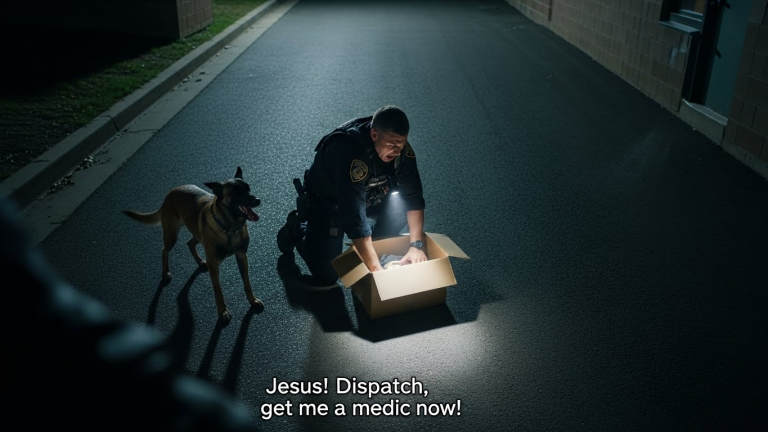
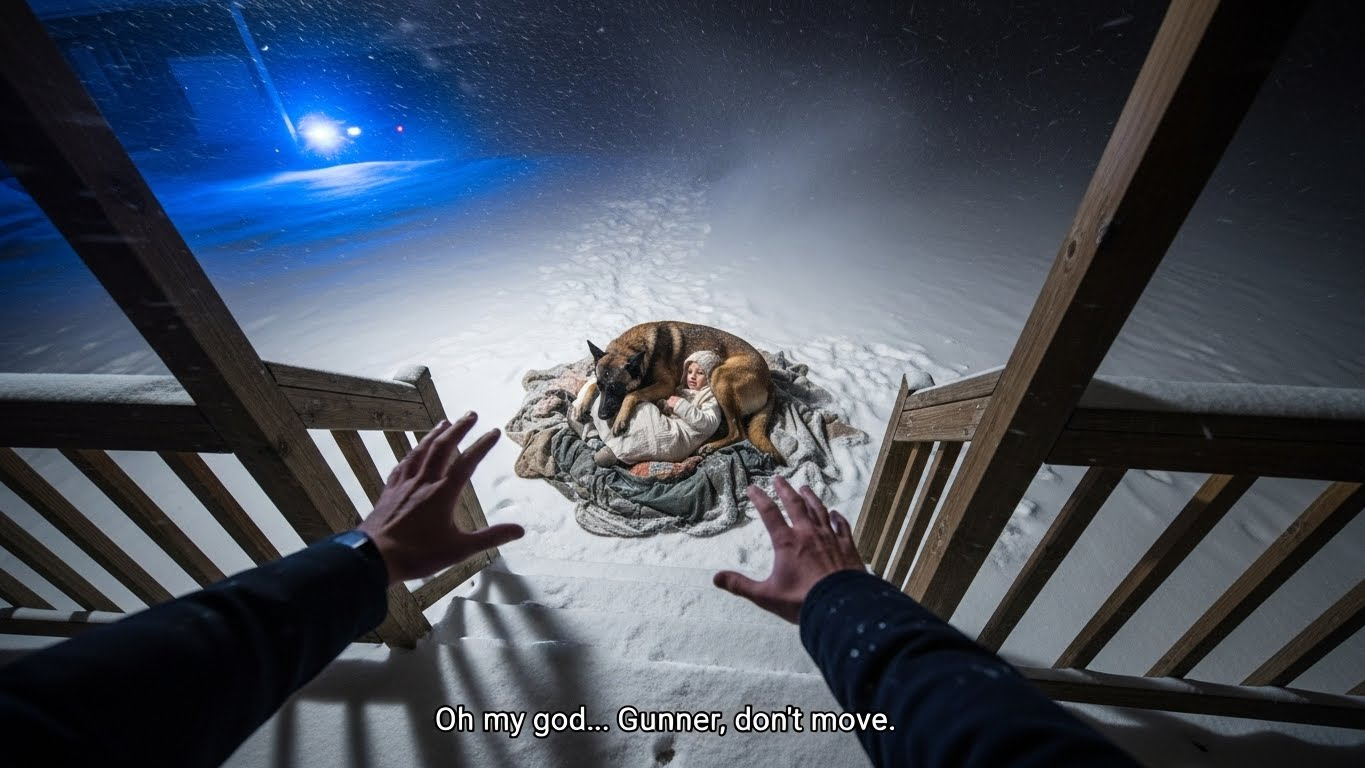
And then he did the unthinkable. He laid down on top of it. He curled his massive body around the pile, tucking his nose into the center of it.
“Gunner, get off that,” I hissed, stepping onto the patio. The concrete was slick with ice. “What do you have?”
I thought maybe it was a dead animal. A deer that had died of the cold.
I reached down and grabbed Gunner’s harness to pull him away. “Up. Now.”
He growled. A deep, vibrating rumble that traveled up my arm. He turned his head and snapped his jaws at the air near my hand.
I recoiled. My own dog—my partner who would take a bullet for me—just threatened me.
“Gunner,” I said, my voice shaking now. Not from the cold, but from the sudden realization that something was horribly wrong.
I shined my light directly onto the pile beneath him. Gunner shifted slightly, trying to shield it from the light, but I saw it.
A foot.
A tiny, bare, purple foot.
My stomach dropped so hard I nearly vomited. I holstered my gun instantly and fell to my knees, ignoring the ice biting into my legs. I shoved Gunner aside with all my strength.
“Move! Move!” I screamed.
He resisted for a second, then backed off, whining pitifully, pacing in a tight circle around me.
I pulled away a dirty, frozen towel.
Underneath was a little girl.
She was tiny. Maybe four years old. She had blonde hair that was matted with ice. She was wearing a pink t-shirt with a cartoon unicorn on it. That was it. No pants. Just underwear.
She was curled into a ball so tight she looked like a stone. Her knees were pressed against her chest, her arms locked around her legs.
She wasn’t shivering.
I ripped my gloves off. I needed to feel heat. I pressed my hand against her neck.
Her skin felt like the concrete beneath us. Cold. Hard. Waxy.
“No, no, no, no,” I chanted. I couldn’t find a pulse. My hands were shaking too badly, and my own fingers were numb.
I put my ear to her mouth.
Nothing. No breath.
“Dispatch! Officer down! I mean—child down! I found a child!” I screamed into my shoulder mic. “Code 3! Send everything! Massive hypothermia! Possible cardiac arrest!”
“Copy 7-Alpha. ETA for EMS is twelve minutes.”
“I don’t have twelve minutes! She’s dead! She’s freezing to death right now!”
I grabbed her shoulders. I had to get her off the concrete. I had to get her warm.
As I lifted her, her body didn’t unfold. She was stiff. Rigor? No, it couldn’t be rigor yet. It was the cold locking her muscles.
Gunner was back instantly. He forced his way between me and the girl. He started licking her face frantically. His rough tongue scraped against her blue cheek.
And then I saw it. A tiny twitch in her eyelid.
“She’s alive,” I whispered. “Gunner, she’s alive.”
I unzipped my heavy tactical parka. It was rated for sub-zero survival. I pulled the girl against my chest, inside my coat, trying to share my body heat.
That’s when I looked up.
I was kneeling right in front of the sliding glass door. The drapes were open a few inches.
Inside, the house was warm. I could tell by the condensation on the corners of the glass. The orange glow of a fire danced on the walls.
On a large leather sectional, facing a sixty-inch TV, were two people. A man and a woman. They were under a thick, faux-fur blanket. The woman had a glass of wine on the table next to her.
They were asleep.
The girl in my arms let out a sound. It wasn’t a cry. It was a rattle. A death rattle.
I looked at the lock on the door. The latch was down.
They hadn’t just forgotten her. They had locked her out.
The rage that filled me in that moment was hotter than any fire. I stood up, the girl clamped to my chest with one arm. I drew my baton with the other.
I didn’t knock.
I swung the baton with everything I had. The safety glass shattered into a million diamonds, raining down onto the carpet inside.
The cold air rushed into the warm living room like a demon.
The man on the couch bolted upright, blinking in confusion. The woman screamed.
“Police Department!” I roared, stepping through the broken door, glass crunching under my boots. Gunner leaped through beside me, barking a sound that promised violence.
The man scrambled back, falling off the couch. “What the hell? Who are you?”
“I’m the guy who just found your daughter dying on your porch,” I snarled, walking toward them.
Gunner lunged, snapping at the man, driving him back into the corner. I didn’t call him off.
The woman looked at the bundle in my jacket. She didn’t look horrified. She looked… annoyed.
“Is she dead?” the woman asked. Her voice was flat. Slurred.
I stared at her. “You better pray she isn’t. Because if she is, I’m going to make sure you never see daylight again.”
I looked down at the girl. Her eyes were open now. Staring at nothing.
“Stay with me, honey,” I whispered. “Stay with me.”
CHAPTER 3
The living room smelled of expensive vanilla candles and stale wine. It was a sickening contrast to the crisp, deadly air pouring in through the shattered sliding door.
I stood there, the freezing child clutched to my chest, my heart hammering against my ribs like a trapped bird. The heat from the fireplace washed over me, but I couldn’t feel it. I was cold. Cold with a kind of rage that makes your vision tunnel.
“You broke my door,” the man said. He was scrambling to his feet, pulling the fur blanket up around his waist. He looked like a soft man. manicured hands, expensive pajamas. “Do you have a warrant? You can’t just burst in here!”
“Gunner, watch!” I barked.
Gunner didn’t need the command. He had positioned himself between the couple and me. His ears were pinned back, his lips curled to reveal gum and white teeth. He let out a low, continuous growl that vibrated through the room. It was the sound of a predator restraining itself by a thread.
“Sit down!” I yelled at the man. “Sit down or I will let him loose!”
The man collapsed back onto the couch, terrified. The woman, however, just stared at me. Her eyes were glazed. Drunk. Or pills. Maybe both.
“She was in a time-out,” the woman slurred, gesturing vaguely toward the broken door. “She wouldn’t stop crying. We put her out for five minutes. Just five minutes.”
I looked down at the girl in my arms. Her skin was the color of old porcelain. Her lips were blue. Five minutes? Ice had formed in her eyelashes. She had been out there for an hour, minimum. Maybe two.
“Dispatch, step it up!” I screamed into my radio. “I have a critical pediatric patient. I’m doing a warm-up now. Get those medics in here!”
I needed to get her flat and start CPR if her heart stopped, but the floor was covered in glass. I kicked the coffee table over, sending magazines and wine glasses flying, clearing a space on the thick rug.
I laid her down gently. She was so light. It felt like holding a hollow bird.
I ripped the rest of my tac-vest off and piled it on top of her. I started rubbing her arms, her legs, trying to generate friction heat without damaging the frozen tissue.
“Come on, sweetheart. Come on,” I whispered.
“You’re making a mess,” the woman muttered. She reached for her wine glass, realized it was on the floor, and sighed. “She’s fine. She’s just being dramatic. She always plays dead when she wants attention.”
I stopped rubbing. I looked up at her.
In my six years on the force, I’ve been punched, spit on, and shot at. I’ve never wanted to hurt a suspect. Until now.
“She is dying,” I said, my voice dangerously quiet. “Your daughter is dying.”
“Stepdaughter,” the woman corrected. As if that made a difference. As if that explained why she was trash.
Sirens wailed in the distance, getting louder. Thank God.
The man, realizing the gravity of the situation, started to panic. “Look, Officer… we fell asleep. Okay? It was an accident. We put her out, we sat down to watch a movie, and we just… drifted off. You know how it is.”
“Accident?” I stood up, looming over him. Gunner took a step forward, snapping his jaws inches from the man’s face. The man shrieked and scrambled back into the cushions.
“You locked the door,” I said. “I saw the latch. That’s not an accident. That’s homicide.”
The front door burst open. “Sheriff’s Department!”
Two deputies rushed in, followed immediately by the paramedics. The room suddenly filled with noise, static, and heavy boots.
“Over here!” I shouted, waving the medics over. “Hypothermia. profound. Unresponsive.”
Sarah, the lead paramedic, dropped her bag and knelt beside the girl. She took one look at the child’s color and her face went pale. “Tube,” she ordered her partner. “We need to intubate. I can’t feel a radial pulse. Carotid is… barely there. She’s bradycardic. Heart rate is maybe 30.”
They worked with a frantic efficiency. Cutting off the wet t-shirt. Wrapping her in thermal blankets. Sticking needles into veins that had collapsed from the cold.
I stepped back, feeling helpless. My hands were shaking.
“Get them out of here,” I pointed to the parents.
Deputy Higgins looked at the couple on the couch. He looked at the broken window. He looked at the freezing child. “With pleasure.”
He grabbed the man by the arm and yanked him up. “Get up.”
“Hey! Watch the silk!” the man protested.
Higgins spun him around and slammed him against the wall, cuffing him hard. “You have the right to remain silent. And I highly suggest you use it, because if you say one more word, I’m gonna lose my badge tonight.”
The woman didn’t resist. She stood up wobbly, looking around the room as if she’d lost her purse. As Deputy Miller cuffed her, she looked at me.
“Can someone feed the cat?” she asked.
I stared at her. The medics were literally pumping air into her stepdaughter’s lungs three feet away, fighting to keep her heart beating, and she was worried about the cat.
“Get them out,” I choked out. “Now.”
As they were dragged out the front door, the man yelling about lawsuits and the woman asking for her shoes, I turned back to the girl.
Sarah looked up at me. “Jack, we’re moving. She’s crashing.”
They lifted the stretcher. I grabbed my jacket, shivering in just my uniform shirt.
“I’m coming with you,” I said.
“Jack, you can’t,” Sarah said, rushing toward the door. “Protocol. You have to secure the scene.”
I looked at Gunner. He was sitting by the spot where the girl had been lying. He was whining, looking at the door where they had taken her.
“Protocol can go to hell,” I said. “Higgins has the scene. I found her. I’m going.”
I whistled for Gunner. He bolted to my side.
We ran out into the snow, following the stretcher to the ambulance. The lights were blinding in the dark night. They loaded her in.
I jumped into my cruiser, Gunner leaping into the passenger seat beside me—another broken protocol. He usually rode in the back. But tonight, I needed him close. And I think he needed to see where we were going.
I slammed the car into gear and peeled out behind the ambulance, the red lights painting the snowy trees in the color of blood.
CHAPTER 4
The drive to St. Mary’s Hospital was a blur of black ice and red lights. I stayed close to the ambulance’s bumper, my knuckles white on the steering wheel.
Gunner sat perfectly still in the passenger seat. He didn’t look out the window. He stared straight ahead at the ambulance doors, his ears swiveling with every siren wail. He was still in work mode. He knew the mission wasn’t over.
When we pulled into the emergency bay, the doors were already open. A trauma team was waiting in the cold, their breath pluming in the air.
They unloaded the stretcher. I saw a nurse performing chest compressions on the tiny form.
My heart stopped. Don’t you die, I thought. Don’t you dare die.
I parked the cruiser haphazardly in the ambulance lane and jumped out. Gunner followed, sticking to my leg like glue.
“Sir, you can’t bring the dog in here!” a security guard shouted as I burst through the automatic doors.
I flashed my badge without breaking stride. “K9 Unit. Official police business. Back off.”
The guard took one look at my face—and one look at Gunner, who looked ready to eat anyone who stopped us—and stepped aside.
We followed the trail of doctors into Trauma Room 1. The doors swung shut, the blinds snapped closed.
I stood in the hallway, the fluorescent lights humming loudly. The hospital smell—bleach and sickness—hit me.
I sank onto a plastic chair outside the room. Gunner sat between my legs, resting his heavy head on my knee. I ran my hand over his fur, feeling the coarse texture. It grounded me.
“Is she gonna make it?”
I looked up. It was Sarah, the paramedic. She had blood on her gloves.
“I don’t know, Jack,” she said softly, pulling her mask down. “Her core temp was 82 degrees when we got her in. That’s… that’s incompatible with life, usually. But kids are resilient. We call it the ‘metabolic icebox.’ Sometimes the cold preserves the brain function before the heart stops.”
“Did her heart stop?” I asked, dreading the answer.
“Twice in the ambulance,” Sarah said. “We got it back both times. But she’s fragile. The frostbite on her hands and feet… it’s bad, Jack. She might lose fingers. Maybe toes.”
I put my head in my hands. “God.”
“There’s something else,” Sarah said, her voice dropping to a whisper.
I looked up. “What?”
“When we cut her clothes off… it wasn’t just the cold.” She hesitated, looking around to make sure no one was listening. “She has scars, Jack. Old ones. Cigarette burns on her back. Healed fractures in her ribs that were never set right. She’s malnourished. You can count every rib.”
The rage I felt at the house was a spark. This was an explosion.
I stood up, pacing the small hallway. Gunner watched me, his eyes tracking my movement.
“So this wasn’t a one-time thing,” I said. “This was torture. Prolonged torture.”
“Looks like it,” Sarah said. “She’s four years old, Jack. And she weighs twenty-five pounds. She should be double that.”
I pulled out my phone. I dialed Detective Miller (no relation), the head of the Child Abuse Unit.
“Miller,” he answered, his voice groggy.
“It’s Jack. You need to get down to St. Mary’s. Now.”
“Jack? It’s 3 AM. What do you have?”
“Attempted murder,” I said. “Maybe worse. I have two suspects in custody, but I need you to nail them to the wall. I want everything. Search warrants for the house. Subpoenas for medical records. Talk to the neighbors.”
I quickly briefed him on the details. The frozen porch. The “time out.” The scars.
When I finished, there was silence on the other end. Then, the rustle of sheets and the sound of feet hitting the floor.
“I’m on my way,” the Detective said. “Don’t let those parents out of your sight. If they make bail before I get there, I will personally burn the courthouse down.”
I hung up.
The doors to the trauma room opened. A doctor stepped out, looking exhausted. He stripped off his gown.
I rushed over. “Doc?”
He looked at me, then at Gunner. He gave a tired half-smile. “She’s stable. For now.”
I let out a breath I felt like I’d been holding for an hour. “Stable?”
“We warmed her up using bypass,” he explained. “Filtered her blood, warmed it, put it back in. Her heart is beating on its own. It’s a strong rhythm.”
“Thank God,” I whispered.
“But,” the doctor raised a hand. “She’s in a coma. We’ve induced it to let her brain heal. We don’t know how much oxygen she lost. We won’t know if there’s permanent brain damage for a few days.”
He paused, his expression hardening. “I also cataloged her other injuries. Officer, whoever did this to her…”
“I know,” I said. “We have them.”
“Good,” the doctor said. “Because she has a fractured collarbone. It’s about two weeks old. If she had shivered violently out there in the cold, the pain would have been excruciating. That’s probably why she curled up so tight. She was trying to hold herself together.”
I felt sick.
“Can I see her?” I asked.
“Briefly,” he said. “She’s in the ICU now.”
I walked into the room. It was dim, lit only by the monitors.
She looked so small in the hospital bed. Wires and tubes were everywhere. A ventilator was breathing for her. Hiss. Click. Hiss. Click.
Her hands were wrapped in thick white bandages. Her feet were elevated.
I walked up to the side of the bed. Gunner padded softly beside me. He stood on his hind legs, placing his front paws gently on the metal railing of the bed. He sniffed the air near her hand.
He let out a soft whine and licked the plastic railing.
“I promise you,” I whispered to the sleeping girl. “I promise you, they will never touch you again.”
My phone buzzed. It was a text from Higgins at the scene.
Jack. You need to see this. We found a camera in the living room. It’s one of those ‘nanny cams’ for watching pets. It recorded everything.
My grip on the phone tightened.
Send it, I typed back.
A minute later, a video file arrived.
I hesitated. Did I want to see it?
I pressed play.
The video was grainy, black and white night vision. It showed the living room. The time stamp was 1:00 AM.
The man, Greg, was dragging the little girl by the arm. She was crying, fighting.
“Please, Daddy, no! It’s cold! It’s scary!”
“Shut up!” he yelled. “You want to act like an animal? You sleep outside like one!”
He threw her out the sliding door and slammed it shut. He locked it.
The girl banged on the glass with her tiny fists. “Mommy! Mommy please!”
The camera panned. The woman, Sheila, was on the couch. She didn’t even look up from her phone. She just took a sip of wine and turned the volume up on the TV to drown out the screaming.
I stopped the video. I felt a darkness rise in me that terrified me.
I looked at Gunner. He was still watching the girl.
“Come on, buddy,” I said, my voice cold as ice. “We have work to do.”
I wasn’t just a witness anymore. I was the guy who was going to destroy them.
CHAPTER 5
The interrogation room mirrors at the County Sheriff’s Department are one-way, but you always feel like the person on the other side can see right into your soul.
It was 5:00 AM. The adrenaline was wearing off, replaced by a heavy, grinding exhaustion. I sat in the observation room with Detective Miller, holding a cup of coffee that tasted like burnt mud.
On the other side of the glass sat Greg, the father. He wasn’t wearing his silk pajamas anymore. He was in an orange jumpsuit, looking small and pathetic under the harsh fluorescent lights.
“He’s been crying for an hour,” Detective Miller said, leaning back in his chair. “Says he loves his daughter. Says it was a ‘lapse in judgment.'”
“A lapse in judgment is running a red light,” I muttered, staring at the man who had thrown his own flesh and blood into a freezer. “Locking a four-year-old out in minus twenty is premeditated torture.”
“Agreed,” Miller said. “But we need him to flip on the wife. She’s the hard target. She hasn’t said a word. Asked for a lawyer immediately. She’s cold as ice, Jack.”
I looked at the monitor showing Room 2. Sheila was sitting there, perfectly upright. She looked bored. She was checking her fingernails.
“Let me go in,” I said.
Miller shook his head. “You’re the arresting officer. You’re too close to it. Plus, you broke their window. Defense attorney will have a field day if you get aggressive.”
“I won’t get aggressive,” I lied.
Miller sighed. He knew I needed this closure. “Fine. But you go in with Higgins. And you stay calm. You let the evidence do the work.”
I walked into the interrogation room. Greg looked up, his eyes red-rimmed. When he recognized me, he flinched.
“Officer,” he stammered. “Look, I… I’m sorry about the door. I’ll pay for it.”
I sat down opposite him. I didn’t say anything. I just placed my phone on the table, screen down.
“Greg,” I said, my voice dangerously level. “We found the camera.”
The color drained from his face so fast he looked like a ghost. “Camera?”
” The puppy cam,” I said. “In the living room. It records to the cloud. We have the footage from last night. And the night before. And the week before that.”
He started to shake.
“We saw you drag her,” I continued. “We heard her begging you. We saw you lock the latch. And then we saw you sit down, drink a glass of Cabernet, and fall asleep while your daughter froze.”
“It was Sheila!” he blurted out. The words exploded out of him. “It was her idea! She hates Lily! She says Lily is… is ‘damaged goods.’ She said we needed to toughen her up!”
“So you listened to her?” I asked. “You’re the father. You’re supposed to be the protector.”
“I… I was afraid of her,” he whispered. “Sheila… she’s intense. She manipulates everything. I just wanted peace. I just wanted her to stop yelling.”
I leaned forward. “So to get some peace and quiet, you decided to kill your daughter?”
“No! Not kill! Just… teach a lesson!”
“The doctor says she has fractures,” I said. “Old ones. Collarbone. Ribs. Did Sheila do that too?”
Greg looked down at his hands. He was sobbing now. “I didn’t stop it. I should have stopped it.”
“Yes, you should have,” I stood up. “You’re going away for a long time, Greg. But if you want any hope of seeing daylight before you’re eighty, you’re going to tell Detective Miller every single thing that woman has done to that little girl. Every slap. Every burn. Every meal she missed.”
I walked out. I couldn’t breathe in there with him. The smell of his cowardice was choking me.
I went to the next room. Sheila.
She didn’t look up when I entered.
“My lawyer will be here in twenty minutes,” she said. Her voice was calm. Arrogant.
“I don’t need to ask you questions,” I said. “I just wanted to tell you something.”
She finally looked at me. Her eyes were empty. Like a shark’s eyes.
“That little girl you tried to throw away?” I said. “She’s alive. She’s fighting. And she’s going to live a long, happy life.”
Sheila smirked. “She’s a brat. Ungrateful. We took her in when her junkie mom died, and she’s been a burden ever since.”
I smiled. It wasn’t a nice smile.
“Enjoy prison, Sheila. I hear the other inmates really love child abusers. You’ll be very popular.”
I turned and left the room.
As I walked back to my desk, my phone buzzed. It was the hospital.
She’s awake.
CHAPTER 6
Gunner hadn’t eaten in two days.
He was staying in the kennel at the precinct while I dealt with the paperwork and the investigation. Every time I went to check on him, he was just lying there, chin on his paws, staring at the door.
He was grieving. He thought we had lost her.
On the third day, I signed him out.
“Where you going?” Miller asked.
“We have a hospital visit to make,” I said.
“Jack, you know the rules. No animals in the ICU.”
“I spoke to the Chief of Medicine,” I said, clipping the leash onto Gunner’s harness. “He’s making an exception. Compassionate care protocol. Or maybe he just doesn’t want to argue with a man who hasn’t slept in seventy-two hours.”
When we got to St. Mary’s, the nurses didn’t stop us. They smiled. Everyone knew the story by now. The “Miracle on Cedar Ridge.”
I walked Gunner down the hallway. His nails clicked on the linoleum. He seemed to know where we were going. His ears were up. His tail gave a tentative wag.
We reached Room 402.
I opened the door slowly.
The room was filled with balloons and teddy bears sent by strangers who had seen the news. But in the middle of all that color, the little girl looked tiny and gray.
She was propped up on pillows. Her hands were heavily bandaged, looking like white boxing gloves. Her face was still swollen, but her eyes were open. Blue eyes. Terrified eyes.
When she saw me, she shrank back into the pillows. She didn’t know me. I was just another big man in a uniform.
“Hi, Lily,” I said softly, staying by the door. “I’m Jack. I’m the one who found you.”
She didn’t speak. She just stared, her breathing picking up on the monitor. Beep… beep… beep.
“I brought a friend,” I said. “He’s been very worried about you.”
I tapped my thigh. “Gunner, here.”
Gunner stepped into the room.
The transformation was instant.
Lily’s eyes went wide. She sat up, ignoring the tubes.
Gunner didn’t rush. He didn’t bark. He walked slowly to the side of the bed. He was tall enough that his head was level with the mattress.
He rested his chin gently on the edge of the bed, his amber eyes locking onto hers. He let out that same soft whine I had heard on the porch.
Lily looked at me, then at the dog.
“Doggy,” she whispered. Her voice was raspy, damaged from the intubation.
“His name is Gunner,” I said, moving a chair closer but keeping my distance. “He’s my partner. He’s the one who heard you. He’s the one who kept you warm.”
Lily moved her bandaged hand. She tried to reach out, but the bandages made it clumsy.
Gunner stretched his neck forward. He nudged her hand with his wet nose. Then, very gently, he licked the tip of her exposed thumb.
A small, cracked smile broke across Lily’s face. It was the most beautiful thing I had ever seen.
“Warm,” she whispered.
“Yeah,” I choked out, tears stinging my eyes. “He’s warm.”
The doctor walked in then. He paused, seeing the ninety-pound police dog in his sterile ICU, but he didn’t say a word about it.
“Officer Miller,” the doctor said. “I have good news.”
I looked up, wiping my eyes.
“We were worried about the fingers on her right hand. The frostbite was deep. But the circulation has returned. She’s going to keep all her fingers and toes. She’ll have some nerve sensitivity, maybe some scarring, but she’s whole.”
I looked at Gunner. He was standing guard, his body blocking the door from the bed, his eyes watching the doctor with suspicion. He had adopted her. It was done.
“Did you hear that, Lily?” I said. “You’re going to be okay.”
She wasn’t looking at me. She was burying her face in Gunner’s neck fur. Gunner had closed his eyes, leaning into her, absorbing her pain.
“I don’t want to go back,” she said suddenly. Her voice was small, trembling. “Please don’t make me go back to the cold room.”
My heart shattered into a thousand pieces.
I walked over to the bed and knelt down, so I was eye-level with her. Gunner licked my ear, including me in the circle.
“Lily, look at me,” I said firmly.
She looked at me.
“You are never going back there. Ever. Those people are in a cage now. A cage with very strong bars. They can’t hurt you. No one is ever going to hurt you again.”
She studied my face, looking for the lie. She didn’t find one.
“Can he stay?” she asked, pointing at Gunner.
“I have to go to work,” I said. “But…”
I looked at the doctor. The doctor looked at the chart, pretending to write something. “I believe this patient requires advanced therapy. Canine therapy. I’d prescribe at least… four hours a day.”
I smiled. “You heard the doc. He can stay for a bit.”
For the next week, that was our routine. Shift. Hospital. Shift. Hospital.
I sat in the chair and slept. Gunner lay on the bed (another broken rule) with his head on her feet. Lily got stronger. She started eating. She started laughing.
But there was a looming problem. A problem called Foster Care.
Social Services was involved. They were looking for placement. And in a broken system, a traumatized four-year-old with medical needs is hard to place.
I sat in the hallway with the caseworker, a tired woman named Brenda.
“We have a temporary home in the city,” Brenda said. “It’s… okay. Overcrowded. But it’s a bed.”
“She needs stability,” I argued. “She’s terrified of strangers. You put her in a group home, she’ll regress.”
“I know, Jack,” Brenda sighed. “But unless you have a magical relative hiding in the woodwork, I don’t have a choice.”
I looked through the glass. Gunner was watching cartoons with Lily. She was feeding him pieces of her hospital toast.
I felt a weight settle in my chest. A terrified, heavy, wonderful weight.
I was a bachelor. I worked sixty hours a week. I lived on coffee and takeout. I was a cop.
But I looked at that little girl. And I looked at my dog.
“Brenda,” I said.
“Yeah?”
“What are the requirements for emergency kinship certification?”
Brenda looked at me. Her eyebrows shot up. “Jack… are you serious? You’re a single guy. You’re K9.”
“I have a big house,” I said. “I have a fenced yard. And apparently,” I pointed to the room, “I already have the nanny.”
Brenda smiled. “Get the paperwork. I’ll fast-track it.”
I walked back into the room.
“Hey, Lily,” I said.
She looked up, toast in hand. “Hi, Jack.”
“How would you like to come meet Gunner’s other friends? And maybe see where he lives?”
Her eyes lit up. “Does he have a warm house?”
” The warmest,” I promised. “It’s really warm.”
CHAPTER 7
You never realize how empty your life is until you try to fill it with a four-year-old.
My house was a “bachelor pad” in the strictest sense. I had a leather couch, a massive TV, an empty fridge, and dog toys scattered everywhere. I had weapons in safes and tactical gear drying in the laundry room. It wasn’t a home; it was a base of operations.
In the forty-eight hours before Lily was discharged, I slept maybe four hours. I was on a mission.
I went to Target. I stood in the aisle staring at bedsheets. Frozen or Paw Patrol? Pink or purple? I was completely out of my depth. I ended up buying both. And a nightlight. And about six different types of cereal because I didn’t know what she ate.
“You look lost, honey,” an older woman said to me, watching me stare at a wall of shampoos.
“I’m… expecting a girl,” I said, realizing how weird that sounded. “I mean, I’m fostering. A four-year-old.”
The woman smiled, patted my arm, and put a bottle of “No Tears” detangler in my cart. “You’ll need this. And patience. Buy lots of patience.”
But the domestic panic was nothing compared to the courtroom.
The arraignment for Greg and Sheila was held on Friday morning. I was there, in my dress uniform, sitting in the front row. I wanted them to see me.
When they walked in, Greg looked broken. He was hunched over, weeping silently. But Sheila? Sheila walked in like she was attending a tedious board meeting. She scanned the room, saw me, and her lip curled in a sneer.
The District Attorney didn’t hold back. He played the video from the nanny cam.
The courtroom went dead silent. You could hear the hum of the HVAC system. On the screen, the grainy footage showed the brutality of that night. The dragging. The locking of the door. The drinking wine while a child froze.
When the video ended, the Judge, a stern woman named Judge Reynolds, took off her glasses. She looked at the defense table.
“In twenty years on the bench,” she said, her voice trembling with suppressed rage, “I have seen cruelty. But this? This is depravity.”
Sheila’s lawyer tried to argue for bail. “My client is a member of the community, she has no prior record—”
“Save your breath, Counselor,” Judge Reynolds snapped. “Bail is denied. Both defendants are remanded to custody pending trial. And I am issuing an immediate protective order for the victim.”
As the bailiffs handcuffed them, Sheila looked back at me one last time. The arrogance was gone, replaced by a flicker of fear. She realized, finally, that her money and her zip code weren’t going to save her.
I walked out of that courthouse feeling ten pounds lighter. But the real test was just beginning.
That afternoon, I picked Lily up.
She was dressed in clothes donated by the nurses—a purple puffer coat and matching boots. She held a small bag with her few belongings.
When we pulled into my driveway, she froze. My house was big, surrounded by trees. It looked a little like the house on Cedar Ridge.
“It’s okay,” I said, unbuckling her. “It’s just a house. It’s safe.”
She wouldn’t move. Her breathing started to hitch.
Then, from the front door, came a bark.
I had left Gunner inside so he wouldn’t overwhelm her in the car. I unlocked the front door and Gunner trotted out.
He didn’t run to me. He went straight to the car door. He put his front paws on the running board and stuck his head inside, licking Lily’s face.
“Hi, Gunner,” she whispered.
She grabbed his collar. Holding onto him like a lifeline, she stepped out of the car.
We walked in together—the cop, the dog, and the girl.
That first night was brutal. Lily was terrified of the dark. She wouldn’t sleep in the new bed I bought. She sat in the corner of the room, clutching a blanket, eyes wide.
“Lily, you have to sleep,” I pleaded gently. “I’m right across the hall.”
“The monsters come when you sleep,” she said simply.
I didn’t know how to answer that. Because for her, the monsters were real. They were her parents.
Gunner solved it.
He walked into the room, carrying his favorite chew toy. He dropped it at her feet. Then, he climbed onto the bed—my brand new, expensive mattress—and circled three times before flopping down with a heavy sigh.
He looked at Lily, then patted the empty space beside him with his paw.
Lily hesitated. Then, she climbed up. She curled into the curve of his stomach, burying her face in his fur.
Within five minutes, she was asleep.
I stood in the doorway, watching them. A tear rolled down my cheek. I realized then that I wasn’t just fostering a child. I was building a family.
CHAPTER 8
Summer in Minnesota is the apology for the winter. The world turns impossibly green. The lakes sparkle. The air smells like pine and hot asphalt.
It had been six months.
Six months of therapy. Six months of nightmares that slowly turned into regular dreams. Six months of learning that food would always be there, that doors were never locked to keep her out, only to keep her safe.
I was in the backyard, grilling burgers. The smell of charcoal filled the air.
“Daddy! Watch this!”
I turned. Lily was on the swing set I had spent three weekends assembling (and cursing at). She was pumping her legs, flying high.
“I see you, Lil! To the moon!” I yelled.
She laughed. A real, deep belly laugh. It was a sound I would never get tired of.
She wasn’t the fragile, broken bird I found on the porch anymore. She had filled out. Her cheeks were rosy. Her hair was long and braided. She had scars—faint white lines on her arms and neck—but they were just history now, not her future.
Gunner was lying in the shade of the oak tree, one eye open, watching her. He was officially retired now. At eight years old, with a touch of arthritis, he had earned his rest. But he was still on duty. He was always on duty where she was concerned.
We had just come from the courthouse that morning.
It was a different courtroom this time. No handcuffs. No anger. Just balloons and a judge who smiled.
The adoption was final. Lily Miller. My daughter.
The trial for Greg and Sheila was scheduled for the fall, but the District Attorney told me they were both taking plea deals. They were looking at twenty years each. They would be old and gray before they ever breathed free air again. And they would never, ever come near us.
I flipped the burgers and looked at the sliding glass door of my house.
For months, Lily was afraid of glass doors. She wouldn’t go near them. She would only use the solid front door.
But today, she jumped off the swing and ran toward the house.
“I’m gonna get ketchup!” she shouted.
She ran right up to the sliding glass door, grabbed the handle, and slid it open. She didn’t hesitate. She didn’t flinch. She just walked inside.
It was a small victory, but it felt like winning the Super Bowl.
I sat down on the patio steps, wiping sweat from my forehead. Gunner got up, stretched, and walked over to me. He sat down and leaned his heavy weight against my shoulder.
I wrapped my arm around his neck.
“You did good, buddy,” I whispered. “You did really good.”
If Gunner hadn’t whined that night… if he hadn’t broken protocol… if he hadn’t used his own body to keep her heart beating…
I shuddered. I didn’t want to think about the “what ifs.”
Lily came running back out, holding the ketchup bottle like a trophy. She tripped over her own feet, stumbling.
Before she could hit the deck, Gunner was there. He moved with a speed that belied his age, nudging her side to steady her.
She giggled and wrapped her arms around his neck, burying her face in his fur.
“I love you, Gunner,” she said.
He licked her nose.
I looked at them—my partner and my daughter. The two best things that ever happened to me.
They say the cold in Minnesota can kill you. And it almost did. But it also stripped away everything that didn’t matter, leaving only the truth.
And the truth was simple.
Family isn’t about blood. It isn’t about whose DNA you share.
Family is about who shows up when it’s twenty below zero. Family is about who keeps you warm when the world tries to freeze you out.
“Alright, crew!” I called out. “Burgers are up!”
Lily ran to the table. Gunner trotted after her.
And I followed them home.