My K9 Partner Growled at My New Wife. I Almost Scolded Him… Until I Saw What She Was Hiding Behind the Door.
Chapter 1: The Warning Beneath the Snow
The Minneapolis winter doesn’t just make you cold; it changes the way you see the world. It turns the sky into a sheet of gray steel and muffles the streets under a heavy, breathless silence. I’ve lived here my whole life, and I’ve been a cop for fifteen years, but that specific Tuesday in January felt heavier than the rest.
I’m Daniel Miller. Most people know me as Officer Miller, the guy with the German Shepherd in the back of the squad SUV. That dog is Max. He’s a five-year-old Black and Tan K9 with a chest like a barrel and eyes that don’t miss a damn thing. We’ve tracked felons through swamps and found missing hikers in blizzards. I trust his instincts more than I trust most people.
But the one time his instincts mattered the most, I almost ignored them.
It was twilight when I pulled into my driveway. The tires crunched over the frozen slush, a sound like breaking bones. My shoulders were tight, locked up near my ears. It wasn’t just the shift. It was the house.
Two years ago, this house was full of music. My first wife, Sarah, played the piano. My daughter, Lily, laughed—a real, belly-shaking laugh that echoed off the walls. Then cancer took Sarah, and silence took the house.
I thought I was fixing it when I married Amanda.
Amanda was everything I thought we needed. She was organized. She was calm. She talked about “structure” and “discipline” like they were the cures for grief. She was beautiful, too, in a polished, untouchable way. Chestnut hair always pinned back, clothes never wrinkled. To the outside world, she was the saint who took on a widower and a grieving six-year-old.
I wanted to believe it. God, I needed to believe it.
I killed the engine. In the back seat, Max didn’t do his usual “shift’s over” shake. He was sitting rigid, staring at the front door. A low whine vibrated in his throat.
“Easy, buddy,” I muttered, grabbing my gear bag. “We’re home.”
Home. The word tasted like ash.
We walked up the path. The wind was biting, stinging my cheeks. I unlocked the door, and the warmth of the house hit me—not welcoming, just stifling.
“Daniel? Is that you?” Amanda’s voice floated from the kitchen. It was smooth, practiced.
“Yeah,” I called out.
I stepped into the entryway, stomping the snow off my boots. Amanda appeared, wiping her hands on a dish towel. She smiled, but it didn’t reach her hazel eyes. It never really did anymore.
“You’re early,” she said. It sounded like an observation, but felt like an accusation.
“Quiet shift,” I lied. I just wanted to see my kid. “Where’s Lily?”
“She’s resting. She had a… difficult afternoon.”
My stomach tightened. “Difficult how?”
Before she could answer, Lily appeared in the hallway.
My heart broke a little every time I looked at her lately. She was eight now, but she looked smaller than she had at six. She was drowning in an oversized pink sweater, the sleeves pulled down over her hands. Her long brown hair—Sarah’s hair—hung in her face like a curtain.
“Hey, Bug,” I said softly, crouching down.
Lily didn’t run to me. She didn’t smile. She took one small, calculated step forward, her eyes darting to Amanda before settling on my boots.
“Hi, Daddy,” she whispered.
And then, Max moved.
Usually, Max waits for the command. But he brushed past my leg, his nails clicking sharply on the hardwood. He walked straight to Lily. He didn’t wag his tail. He didn’t nuzzle her for a treat.
He sniffed her arm—specifically her left wrist, hidden under that thick wool sleeve.
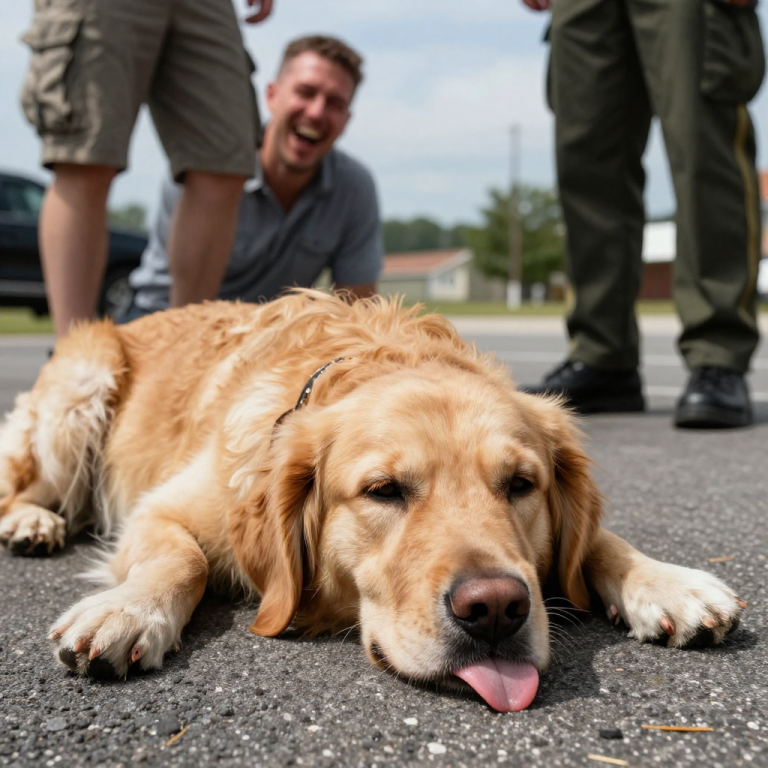
Then, he turned his body. He placed himself directly between Lily and Amanda. He planted his feet, lowered his head, and let out a sound I had never heard him make inside our home.
It wasn’t a bark. It was a growl. A deep, subterranean rumble that you feel in your chest before you hear it.
“Daniel!” Amanda snapped, taking a sharp step back. “Control your animal. He’s dangerous.”
“Max!” I commanded, reaching for his collar. “Heel!”
Max ignored me.
My K9 partner, the most disciplined dog on the force, ignored a direct order. He kept his amber eyes locked on my wife’s face. His hackles were raised, a ridge of dark fur standing up along his spine.
“I told you,” Amanda said, her voice rising, losing that smooth polish. “He’s unstable. You bring that beast into a house with a child? He’s going to hurt someone.”
I looked at Max. Then I looked at Lily.
Lily wasn’t looking at the dog with fear. She was looking at him with… relief. She had one hand buried in his fur, gripping him like he was the only solid thing in the world.
“He’s not unstable, Amanda,” I said, my voice quiet but hard. I stood up, feeling the adrenaline of the street start to pump through my veins. “He detects threats. That’s what he does.”
“Are you calling me a threat?” Amanda crossed her arms. Her face was flushed, her jaw tight. “I am trying to raise your daughter to be a functional human being, Daniel. I am the one here all day while you play hero. And I will not be threatened by a dog.”
She pointed a manicured finger at the living room. “Lily, go to your room. Now.”
Lily flinched. It was a tiny movement, a spasm of the shoulders, but I saw it. She released Max’s fur and scurried backward, disappearing down the hall without a sound.
Max watched her go, then turned back to Amanda. He didn’t growl again, but he didn’t move either. He just watched her.
“Get him out of here,” Amanda hissed.
I grabbed Max’s collar. “Come on, boy.”
I dragged him to the back door, but my heart was hammering against my ribs. I knew this dog. I knew he didn’t growl at ghosts.
As I stood on the back porch, watching Max pace in the snow, a cold feeling settled in my gut that had nothing to do with the winter. I was missing something. Something terrible. And I was terrified that if I pulled the thread, my whole life would unravel again.
But I’m a cop. Pulling threads is what I do.
Chapter 2: The Architecture of Silence
To understand what happened next, you have to understand the silence.
Silence isn’t empty. Silence is heavy. It has texture. There’s the peaceful silence of a sleeping house, and then there’s the silence of a held breath—the kind that comes before a scream.
Our house was drowning in the second kind.
I worked nights mostly. That was part of the problem. I told myself I was doing it for the overtime, to save up for Lily’s college, to pay for the remodel Amanda wanted. But deep down? Maybe I was avoiding the ghost of my first wife in the hallways. Maybe I was avoiding the way Amanda’s eyes seemed to catalog my failures every time I sat down on the couch.
When I left for my shift that evening, the facade went back up. Amanda kissed my cheek. “Be safe,” she said.
“Yeah. You too.”
I looked for Lily, but her door was closed. Max didn’t want to get in the car. I had to physically guide him into his kennel in the back of the SUV. He whined as we backed out of the driveway, his nose pressed against the wire mesh, watching the house disappear.
If I had known what happened the moment my taillights vanished, I would have turned that car around and kicked the front door off its hinges.
Inside the house, the atmosphere shifted instantly. It was like the air pressure dropped.
Amanda locked the deadbolt. The click echoed.
She didn’t scream. She didn’t yell. That was the thing about Amanda—she was quiet. Her cruelty was precise, like surgery.
She walked down the hallway to Lily’s room. She didn’t knock. She just pushed the door open.
Lily was sitting on her bed, reading a book. She froze when the door opened.
“Did you finish your math sheets?” Amanda asked. Her voice was conversational, almost pleasant.
“Yes, ma’am,” Lily whispered.
“Bring them here.”
Lily slid off the bed. She walked to her desk, picked up the paper, and brought it to Amanda. She moved with a heartbreaking caution, keeping her elbows tucked in, making herself small.
Amanda took the paper. She scanned it, her eyes narrowing.
“This is messy, Lily,” she said.
“I… I erased a mistake,” Lily stammered.
“Excuses,” Amanda sighed. She crumpled the paper. One swift motion. She crushed hours of work into a ball and dropped it on the floor. “We don’t do messy in this house. Chaos leads to failure. Your father accepts mediocrity. I do not.”
“I’m sorry,” Lily’s voice trembled.
“Sorry doesn’t fix it. Actions fix it.” Amanda pointed to the hallway. “The corner. Knees.”
I learned all of this later. I learned that “The Corner” wasn’t just a timeout. It was the hardwood floor. No rug.
Lily walked to the corner of the dining room. She knelt on the bare wood.
“Hands behind your head,” Amanda instructed, leaning against the doorframe, watching. “Straight back. If you slouch, we add ten minutes.”
Lily knelt. The cold varnish pressed into her bony knees. A minute is a long time for a child. Ten minutes is an eternity. Thirty minutes is torture.
Amanda went to the kitchen and poured herself a glass of wine. She sat in the living room, scrolling through her phone, liking photos of other people’s happy families, while my daughter knelt in silence ten feet away.
At one point, Lily’s leg cramped. She shifted, just a fraction, trying to relieve the pressure.
“I saw that,” Amanda didn’t even look up from her phone. “Restart the clock.”
This was the structure I had signed up for. This was the “discipline” I thought a grieving child needed. I was out there patrolling the streets, looking for bad guys, while the villain was drinking Merlot in my favorite armchair.
But the cracks were starting to show. You can only compress a victim so much before they break—or before someone notices.
The next morning, the exhaustion on Lily’s face was etched deep. I was home for a brief window between shifts. I was making coffee, bleary-eyed.
“Daddy?”
I turned. Lily was standing by the fridge. She was trying to reach the milk, but her grip was weak. The heavy gallon jug slipped from her fingers.
CRASH.
Milk exploded across the tile floor. White splatter covered the cabinets, the floor, Lily’s socks.
She didn’t gasp. She didn’t cry out.
She dropped to the floor instantly, curling into a ball, covering her head with her hands.
“I’m sorry! I’m sorry! Don’t look! I’ll clean it!” she shrieked.
It wasn’t a normal reaction to spilled milk. It was the reaction of a soldier under fire.
I froze, the coffee mug halfway to my mouth. “Lily? Honey, it’s just milk.”
I stepped toward her, but she flinched away, scooting backward into the puddle of milk, soaking her pajamas.
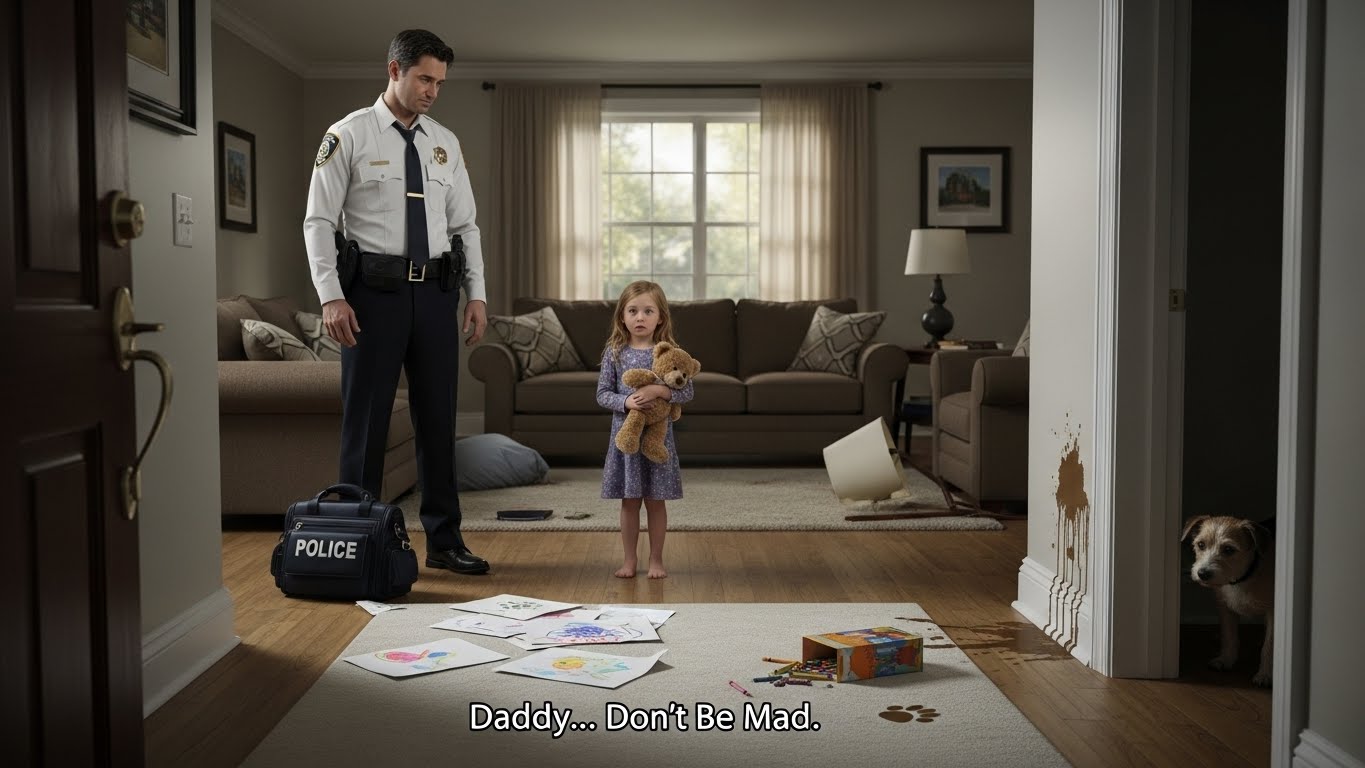
“Don’t be mad, don’t be mad,” she was chanting it.
Max trotted into the kitchen. He ignored the milk. He went straight to her, licking the tears off her face, standing over her.
Amanda walked in a second later. She saw the mess. Her jaw tightened, but when she saw me watching, she forced her face to relax.
“Oh dear,” she said, her voice strained. “Clumsy girl. Daniel, why don’t you go get ready? I’ll handle this.”
“I can help,” I said, putting my mug down.
“No,” Amanda said. She stepped between me and Lily. “You have to go to work. You’re tired. Lily and I have a system for cleaning up. Right, Lily?”
Lily nodded frantically, still on the floor. “Yes. Yes, we have a system.”
I looked at them. The woman standing tall and rigid. The child cowering in spilled milk. The dog watching with eyes that burned.
I walked out of the room. I told myself I was late. I told myself Amanda had it under control.
I am going to regret walking out of that kitchen for the rest of my life.
Chapter 3: The Witness
Schools are strange places in the winter. They smell like wet wool, floor wax, and cafeteria soup. For most kids, it’s a place to learn. For Lily, it had become a sanctuary—but even sanctuaries have windows, and people can see through them.
Miss Greta Pearson was forty-five, wore cardigans that looked hand-knitted, and had the kind of intuition that should be classified as a superpower. She’d been teaching third grade for twenty years. She knew the difference between a kid who was tired and a kid who was exhausted. She knew the difference between a scraped knee and a bruise that shouldn’t be there.
She had been watching Lily Miller for weeks.
Lily used to be the first one to raise her hand. She used to draw pictures of horses and rainbows. Lately, she only drew landscapes. Empty fields. Gray skies. Things with no people in them.
That Wednesday, recess was indoors because of the wind chill. But by Thursday, the sun had come out, deceptive and bright, and the kids were bundled up and sent outside to burn off energy.
Miss Pearson stood by the brick wall, sipping tea from a travel mug, scanning the playground. She saw the boys playing tag near the slide. She saw the girls trading stickers by the fence.
And she saw Lily.
Lily was walking alone near the edge of the blacktop, where the snow plows had pushed up mountains of dirty ice. She was hugging herself, her arms wrapped tight around her torso.
She wasn’t playing. She was pacing.
Suddenly, a boy running for a football slipped on a patch of ice. He flailed and crashed into Lily. It wasn’t malicious, just an accident.
Lily went down hard. She landed on her left side, skidding across the rough ice.
Most kids would cry. They’d look for a teacher. They’d yell at the kid who hit them.
Lily didn’t make a sound. She scrambled up so fast it looked unnatural. She immediately grabbed her left forearm, clutching it to her chest. Her face went pale, draining of all color.
Miss Pearson was moving before she even realized it. She crunched across the snow, her boots sinking deep.
“Lily?” she called out.
Lily spun around, eyes wide with terror. “I’m okay! I’m fine! I didn’t rip my coat!”
That was her first concern. The coat. Not her arm. The coat.
“I don’t care about the coat, honey,” Miss Pearson said, reaching her. She knelt down in the snow, ignoring the dampness seeping into her pants. “Did you hit your arm?”
“No,” Lily lied. She was shaking.
“Lily,” Miss Pearson said gently. “Let me see.”
“No, please. Daddy bought me this sweater. I can’t take it off.”
“We don’t have to take it off. Just push up the sleeve.”
Lily backed away. “I can’t. She said I can’t.”
Miss Pearson froze. “She said?”
“Please, Miss Pearson. I have to go inside. I have to study.”
But Miss Pearson saw it. The sweater sleeve had ridden up just an inch when Lily scrambled away.
Just above the wrist, on the delicate skin of the forearm, there were marks. Not the blue-green of a playground bump. These were yellow and purple. Fingerprints. Three distinct ovals on one side, a thumb mark on the other.
Someone had grabbed her. Hard. And not today.
Miss Pearson stood up slowly. She didn’t force Lily to show her. She didn’t make a scene. She knew the protocol. She knew that if she pushed too hard right now, the child would shut down completely.
“Okay, Lily,” she said softy. “You can go inside. Get warmed up.”
Lily ran toward the building like a prisoner escaping a guard tower.
Miss Pearson watched her go. Then she took out her phone. She didn’t call the principal. She didn’t call the nurse.
She walked straight to her classroom, locked the door during her prep period, and sat at her desk. Her hands were shaking, but her resolve wasn’t. She opened the state’s Mandated Reporter portal on her computer.
She typed in Lily Miller.
She typed in Physical abuse suspected.
She typed in Bruising consistent with grabbing/shaking. Child exhibits extreme fear response.
She hit submit.
She didn’t know that by hitting that button, she was lighting a fuse that would blow my entire world apart. She just knew she had to save the girl with the sad eyes.
Chapter 4: The Shattering
Being a cop means you get used to bad news. You deliver it. You hear it. You swim in it. You develop a callus over your heart so you can function.
But nothing prepares you for when the call is coming from inside the house.
I was at the precinct, sitting at my desk, drowning in paperwork. Max was in the kennel at the station, resting. The fluorescent lights were humming, giving me a headache. I was thinking about dinner. I was thinking about maybe picking up a pizza, hoping Amanda wouldn’t complain about the grease.
My phone buzzed.
I glanced at it. An email notification.
Subject: CPS Inquiry – URGENT – Reference #44902
I frowned. I get work emails about CPS cases all the time. Usually, it’s for a suspect I brought in.
I opened it.
The first line hit me like a physical blow to the chest.
Child: Lily Marie Miller. Guardian: Daniel Miller / Amanda Miller.
The room stopped spinning. The noise of the precinct—phones ringing, cops laughing, radios crackling—all of it turned into white noise.
I read the report.
Reporter noted severe bruising on left forearm. Child expressed fear of consequences regarding clothing damage. Child exhibited flinching behavior. Incident occurred on school grounds.
My hands started to shake. I dropped the phone on the desk.
Bruises?
I thought of the long sweaters. I thought of the way Lily walked. I thought of the spilled milk.
And then, I thought of Max.
I thought of the growl. The way he stood between them. The way he stared at Amanda.
The callus over my heart didn’t just crack; it shattered.
I stood up so fast my chair tipped over.
“Miller? You good?” Sergeant Kowalski called out from across the room.
I didn’t answer. I grabbed my keys. I grabbed my jacket.
I ran to the kennel. Max was lying down, head on his paws. When he saw me, he stood up instantly. He knew. Dogs always know when the energy shifts. He let out a sharp bark, his tail wagging hard, but his eyes were serious.
“Let’s go,” I choked out.
We ran to the SUV. I didn’t bother with the seatbelt. I threw the lights on—not the siren, just the lights—to cut through the traffic.
It was snowing again. Big, fat flakes that swirled in the red and blue strobe of the light bar.
The drive home usually took twenty minutes. I made it in ten.
My mind was replaying every moment of the last six months. Every excuse Amanda made. “She fell.” “She’s clumsy.” “She’s just sensitive.”
I had been sleeping next to a monster.
I had let a monster raise my daughter.
The guilt was acid in my throat. I gripped the steering wheel so hard the leather creaked. I wanted to vomit. I wanted to scream. But mostly, I wanted to get to my little girl.
I pulled into the street. My house was dark, except for the porch light. It looked peaceful. It looked normal.
That was the lie.
I put the SUV in park, but I didn’t turn off the engine. I looked at Max in the rearview mirror.
“You tried to tell me,” I whispered to him. “I’m sorry, buddy. I’m listening now.”
Max pressed his nose against the grate. He was ready.
I stepped out into the snow. The wind howled, whipping my uniform jacket around me. I walked up the driveway, my hand resting on my duty belt—not on my gun, but near it. A habit. Or maybe a warning.
I wasn’t Officer Miller anymore. I wasn’t the grieving widower.
I was a father who had just realized his house was burning down, and I was the only one who could pull his daughter out of the fire.
I reached for the doorknob. It was locked.
I fumbled for my keys, my fingers numb with cold and rage.
I opened the door.
“Honey?” Amanda’s voice called out from the living room. “You’re early again.”
The sound of her voice, that calm, fake sweetness, made my vision blur red.
I stepped inside. Max followed, his nails digging into the floor mat.
“Where is she?” I asked. My voice sounded like gravel.
Amanda walked into the hallway. She was holding a glass of wine. She looked at me, then at the snow on my boots, then at Max.
“Where is who?” she asked innocently.
“Don’t,” I warned. “Don’t play with me, Amanda. Where is Lily?”
She sighed, rolling her eyes. “She’s in the closet. She was acting out. She needed a timeout space to calm down.”
The closet.
“Get out of my way,” I said.
I pushed past her. Max didn’t wait. He bolted down the hallway, slipping on the wood, scrambling for traction. He knew exactly where to go.
He stopped at the door under the stairs. The storage closet.
He scratched at the wood, whining high and desperate.
I fell to my knees in front of the small door. It was locked from the outside with a slide bolt. A slide bolt I hadn’t installed.
“Amanda!” I roared.
“Daniel, you are overreacting!” She was behind me now, her voice shrill. “She needs structure!”
I threw the bolt back. I yanked the door open.
It was dark inside. The smell of bleach and old shoes hit me.
And there, curled up on a pile of laundry, clutching a flashlight that was turned off, was Lily.
She looked up at me, blindingly terrified.
“Daddy?” she whispered, her voice barely a breath. “I didn’t make a noise. I promise.”
That was the moment the old Daniel died. And the man who would tear the world apart for his daughter was born.
Chapter 5: The Hidden Kit
I pulled Lily out of that closet. She was light, too light, like a bird made of hollow bones. I wrapped my arms around her, burying her face in my uniform so she wouldn’t see the rage on mine.
“Get away from her!” I spat at Amanda as she tried to step closer.
“Daniel, please. You’re scaring her,” Amanda said, her voice trembling with fake concern. “She just needed a timeout. She was being difficult.”
“A timeout?” I yelled, my voice echoing off the walls. “In a locked closet? With a slide bolt?”
Max was standing over us, his back to me and Lily, facing Amanda. He was a wall of muscle and teeth. If she moved, he moved.
Suddenly, blue and red lights flashed against the living room window, joining the ones from my SUV. Another car had arrived.
The doorbell didn’t ring. A fist pounded on the door.
I opened it, still holding Lily.
Standing there was Detective Rowan Hail from the Special Victims Unit and a woman I recognized—Karen Douglas from CPS.
“Officer Miller,” Hail said. His voice was calm, deep, and sounded like judgment day. “We received a report. We need to come in.”
“Take her,” I said, my voice cracking. “Please. Just… help her.”
Amanda rushed to the door. “Officers! Thank God. My husband is having some sort of breakdown. He’s upset about work and—”
“Ma’am, step back,” Hail said. He didn’t even look at her. He looked at Lily. “Hi there. I’m Rowan. I’m safe.”
Karen stepped in. She had warm eyes. She gently guided Lily to the couch. “It’s okay, sweetie. Max can come too.”
Max went with Lily instantly. He laid his heavy head on her lap, anchoring her to the earth.
Hail walked through the house. He was looking for something. He looked at the closet. He looked at the lock.
Then, Max did something extraordinary.
He left Lily’s side for just a moment. He trotted over to the staircase, to a small panel near the floorboards—a maintenance access panel I hadn’t opened in years.
Max scratched at it. Once. Twice. Then he looked at Hail and barked. A sharp, demand bark.
“What is it, boy?” Hail murmured.
He knelt down. He pried the panel loose.
Amanda gasped. “You can’t do that! That’s private property! You need a warrant!”
“I can get a telephonic warrant in three minutes, Mrs. Miller,” Hail said, not looking up. “But right now, I have probable cause because a police K9 just alerted to evidence.”
He shined his flashlight into the hole.
He reached in and pulled out a plastic bin.
Inside wasn’t drugs. It was worse.
There was a coil of rough rope. A wooden spoon with a splintered edge. A bottle of industrial cleaner—the kind that burns if it touches your skin. And a towel stained with old, dried blood.
The room went dead silent.
“That’s… that’s just cleaning supplies,” Amanda stammered. Her face was gray. “The rope is for… for gardening.”
Hail held up the spoon. “And this? Is this for gardening too?”
He turned to Lily. “Honey? Did she use this on you?”
Lily was crying silently, tears soaking into Max’s fur. She didn’t speak. She just nodded.
That nod was the loudest thing I have ever heard.
Chapter 6: The Mask Falls
The transformation was instant.
The moment Lily nodded, Amanda’s face changed. The sweet, concerned stepmother vanished. The mask fell off, and beneath it was something ugly and jagged.
“She’s a liar!” Amanda screamed. “She’s a manipulative little brat! She hurts herself to make me look bad! I’ve been trying to help her!”
“You’re under arrest,” Hail said, his voice cutting through her screaming.
He stepped forward, unhooking the handcuffs from his belt. The metallic click-click as he checked them was the only sound in the room besides Amanda’s heavy breathing.
“Daniel!” she pleaded, turning to me. “Daniel, tell them! Tell them how hard she is! Tell them I’m a good mother!”
I looked at her. I looked at the woman I had married, the woman I had let into my home, the woman I had trusted with the most precious thing in my life.
I felt cold. Ice cold.
“You’re not a mother,” I said. My voice was steady. “And if you ever say her name again, God help me.”
Hail spun her around. “Amanda Miller, you have the right to remain silent…”
“No! No! You can’t do this! I have a reputation!”
She fought him. She kicked. She screamed.
Max stood up. He didn’t attack. He just watched her, his ears forward, his body calm. It was as if he knew the threat was neutralized. The predator had been caught.
They dragged her out into the snow. The neighbors were watching from their windows. I didn’t care. Let them see.
Karen, the CPS worker, was sitting next to Lily. She was taking photos of the bruises on Lily’s arm. Every flash of the camera was a testament to my failure.
“Dad?” Lily’s voice was tiny.
I knelt in front of her. “I’m here, Bug. I’m right here.”
“Is she coming back?”
“No,” I choked out, tears finally spilling over. “No. Never. I promise you, Lily. Never again.”
“Max knew,” she whispered. “Max knew the whole time.”
I looked at my dog. He was sitting by her feet, licking the back of her hand.
“Yeah,” I said, stroking his ears. “He did. And I’m going to spend the rest of my life making it up to both of you.”
Chapter 7: The River
We moved three weeks later.
I couldn’t stay in that house. The walls remembered too much. The closet under the stairs felt like a wound that wouldn’t heal.
We found a place near the Mississippi River. It was smaller—a two-bedroom apartment in an old brick building. It had big windows that looked out over the water and the snow-covered banks.
It was a fresh start.
The first night there, I was terrified. I was afraid Lily wouldn’t sleep. I was afraid she’d have nightmares.
I set up her room first. No pink sweaters. We bought new clothes. Jeans. T-shirts. Things she chose.
“Can Max sleep in here?” she asked, standing in the doorway of her new room.
“Max can sleep wherever he wants,” I said.
That night, I woke up at 3:00 AM. Old habits. I got up to check the doors.
I walked past Lily’s room. The door was open.
Lily was asleep, sprawled out on the bed, not curled in a ball. She looked peaceful.
And there was Max.
He wasn’t in his dog bed. He was on the rug right next to her mattress. His head was resting on the edge of her bed, right near her hand. He was fast asleep, snoring softly.
He was off duty. Finally.
Recovery wasn’t a straight line. There were days Lily didn’t want to talk. There were days she flinched if I dropped a fork. We went to therapy—Dr. Keane, a good man who spoke softly and let Lily draw pictures instead of forcing her to talk.
One afternoon, about two months later, I was cooking dinner. Pancakes. We had pancakes for dinner a lot because it made Lily smile.
I heard something from the living room.
It was a sound I hadn’t heard in two years.
A giggle.
Then, a laugh. A real, loud, belly-shaking laugh.
I peeked around the corner.
Lily was on the floor. Max was rolling on his back, legs in the air, making goofy snorting noises while Lily rubbed his belly. She was laughing so hard she was gasping for air.
“Who’s a good boy?” she cooed. “You’re the best boy, Max.”
I leaned against the doorframe, watching them. The knot in my chest, the one that had been there since the funeral of my first wife, finally began to loosen.
She was going to be okay. We were going to be okay.
Chapter 8: The Miracle
Looking back, I realize that miracles don’t always look like burning bushes or parted seas. Sometimes, a miracle looks like a German Shepherd with a bad attitude.
It’s been a year since that night. Amanda took a plea deal. She’s in prison. We don’t say her name. She’s a ghost, fading a little more every day.
Lily is nine now. She’s taller. She plays soccer. She has a scar on her wrist, faint but there. She doesn’t hide it anymore. She calls it her “battle mark.”
I’m still a cop, but I’m different now. I listen more. When a mother tells me something feels off, I listen. When a kid looks scared, I don’t just walk away.
And Max?
Max is retired from the force. He’s ten years old now. His muzzle is gray, and he’s a little slower getting up in the mornings. He spends his days napping in the sunbeams on the apartment floor or walking with us by the river.
But every now and then, he still checks the door. He still puts himself between Lily and strangers. He still remembers.
Last night, I was tucking Lily in. The winter wind was howling outside again, but inside, it was warm.
“Dad?” she asked.
“Yeah, Bug?”
“Do you think Mom sent Max?”
She meant Sarah. Her real mom.
I looked at the dog sleeping at the foot of her bed. I thought about the timing. I thought about how he refused to listen to me that day. I thought about the closet.
“Yeah,” I said, my throat tight. “I think she did.”
Lily smiled and closed her eyes. “Me too.”
I turned off the light and walked to the living room. I sat down and looked out at the frozen river.
We live in a loud world. We’re busy. We’re tired. We miss things. We miss the pain in the people we love because we’re too afraid to look at it.
But if you’re lucky—if you’re truly blessed—you have someone in your life who refuses to let you look away. Someone who will growl at the darkness until you turn on the light.
For me, that was Max.
He didn’t just save my daughter. He saved me.
So, tonight, hug your kids. Trust your gut. And if your dog tells you something is wrong… listen.
They see the things we’re too blind to see. And sometimes, they’re the only ones brave enough to do something about it.
[End of Story]