I Survived 546 Days in a Combat Zone Only to Find the Real Enemy Was a Teacher Scrolling Facebook While a Bully Dragged My Daughter by Her Hair.
CHAPTER 1: THE HOMECOMING
The smell of America is different. You don’t realize it until you’ve been breathing burning trash, diesel fumes, and ancient dust for eighteen months. America smells like asphalt, cut grass, and fast food grease. It smells like safety.
Or at least, it’s supposed to.

I gripped the steering wheel of my Ford F-150, my knuckles white. The truck had been sitting in my brother’s garage for the entire deployment. It smelled a little musty, a mix of stale air and the vanilla air freshener that had long since lost its potency. But the engine purred. That American V8 rumble was the first familiar thing I’d felt in a long time.
My flight had landed at 11:00 AM. I’d bypassed the fanfare. No banners, no news crews. I just wanted to get home. I wanted to take a shower that lasted longer than three minutes. I wanted a steak.
But mostly, I wanted Lily.
My daughter was twelve. She was at that age where everything is a crisis, where the world is ending because of a pimple or a failed math test. I had missed so much. I missed her eleventh and twelfth birthdays. I missed the day she got her braces on. I missed the day she supposedly got her first “boyfriend,” though my wife, Sarah, assured me it lasted three days and involved nothing more than sharing a bag of Hot Cheetos.
Sarah was at work. She didn’t know I was back yet. I wanted to surprise Lily at school first.
I checked the clock on the dashboard. 2:55 PM. The bell at Oak Creek Middle School rang at 3:00 PM. Perfect timing.
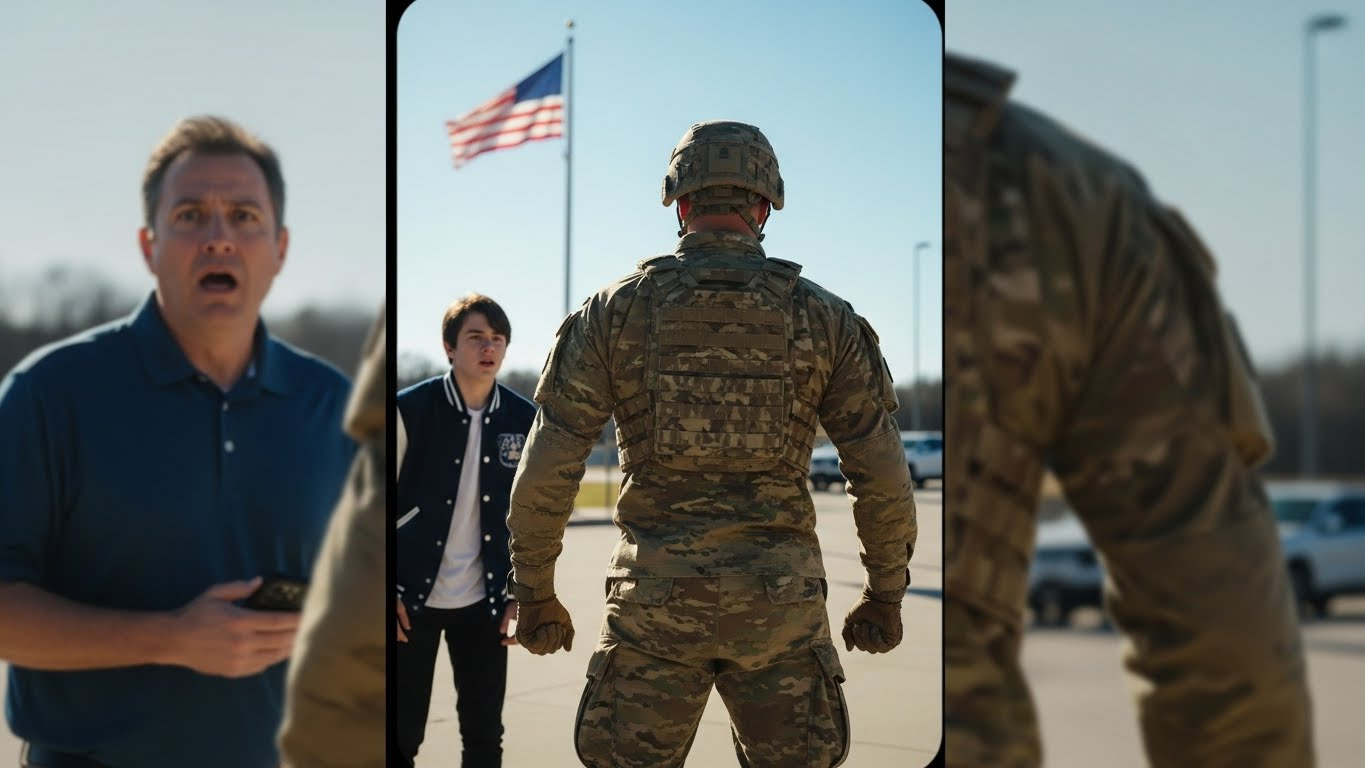
I was still in my OCPs—my Operational Camouflage Pattern uniform. I hadn’t changed. I looked like hell. There was sand in the seams of my boots that had traveled seven thousand miles to be here. My eyes were red-rimmed from the twenty-hour travel day. But the adrenaline was keeping me awake.
I turned onto Sycamore Drive, the tree-lined street that led to the school. The houses here were perfect. Manicured lawns. American flags hanging from front porches. It was the kind of neighborhood I fought to protect. A place where bad things weren’t supposed to happen.
I pulled into the pickup line. It was a chaotic snake of SUVs and minivans. Mothers in yoga pants were sipping iced coffees. Dads were checking emails on their phones.
I parked the truck slightly illegally, half on the curb near the gym, because the line was moving too slow and I just wanted to see her face. I cut the engine.
The bell rang.
A flood of kids poured out of the double doors. It was a sea of backpacks, hoodies, and noise. I scanned the crowd, my eyes working the way they did on patrol—left to right, searching for a specific target.
Where are you, Lil?
I saw her friends first. I recognized Sophie and Emma. They were walking fast, heads down. That was weird. usually, they were glued to Lily’s hip.
Then I saw why.
The crowd near the bike rack wasn’t moving. It was swirling, forming a tight circle. Like water circling a drain.
I knew that formation. I’d seen it in villages overseas when a fight broke out. I’d seen it in barracks. It was the circle of spectators. The circle of complicity.
I squinted through the windshield. The sun was glaring off the hood, making it hard to see.
Then the circle shifted, and I saw her.
Lily.
She wasn’t standing. She was on her knees.
My heart hammered against my ribs, a sudden, violent thud.
A boy was standing over her. He was big. Not just tall, but heavy. Thick neck, broad shoulders. He looked like he’d been held back a couple of years. He was wearing a red and white varsity jacket.
He had his hand wrapped around the back of Lily’s head. He was holding her hair—her beautiful, long dark hair that she spent hours brushing—like it was a handle.
He yanked.
I saw Lily’s head snap back. I couldn’t hear her through the glass of the truck, but I saw her mouth open. I saw the grimace of pure pain.
The kids around them weren’t stopping him. They were holding up phones.
And then I saw the adult.
Mr. Henderson. The gym teacher. I recognized him immediately. He was leaning against the brick wall, maybe twenty feet from where my daughter was being assaulted. He was wearing sunglasses and a whistle around his neck.
He looked up. I saw his head turn toward the circle. He saw the boy. He saw my daughter on the ground.
And then, he looked back down at his phone.
He tapped the screen. He shifted his weight to his other leg. He ignored it.
The world went silent. The hum of the suburb, the birds, the other cars—it all vanished.
All I could hear was the blood rushing in my ears.
I didn’t think. I didn’t plan. I opened the door.
CHAPTER 2: THE CONFRONTATION
My boots hit the pavement. Thud.
I slammed the door of the F-150. Bang.
The sound was loud enough that a few parents in the cars nearest to me looked up. They saw a man in full combat gear, eyes hidden behind ballistic sunglasses, storming toward the school entrance.
I didn’t run. Running implies panic. Running implies you are reacting.
I walked. I marched. I moved with the purpose of a guided missile.
Every step was heavy. I could feel the heat radiating off the asphalt. It reminded me of the desert, but the threat here was different. This wasn’t an insurgent with an AK-47. This was something more insidious. This was cruelty allowed to flourish because of apathy.
As I got closer, the sound returned.
“Say it!” the boy shouted. His voice was cracking, mid-puberty, but deep. “Say you’re a loser!”
“Please, stop!” Lily shrieked. Her voice was raw. She was sobbing, clutching at his wrist, trying to alleviate the tension on her scalp.
“I can’t hear you!” the boy laughed. He jerked her head again. Lily fell forward onto her hands, scraping her palms on the concrete.
The circle of kids laughed. A girl with bright pink phone case was filming, giggling, “Oh my god, Brock is killing her.”
I was ten feet away.
Mr. Henderson was still scrolling. He chuckled at something on his screen.
I breached the circle.
I didn’t push the kids aside. I simply walked through the gap. My shadow fell over Lily and the boy, Brock.
The kids closest to me stopped laughing instantly. They saw the boots first. Then the camo pants. Then the tactical belt. Then the chest laden with ribbons and patches.
Silence rippled through the group like a shockwave. It moved from the back of the circle to the front, until the only sound left was Lily’s ragged breathing.
Brock didn’t notice the silence immediately. He was too high on the power trip.
“I said, tell everyone you’re a—”
He stopped. He sensed the change in atmosphere. He saw the kids around him lowering their phones, their eyes wide.
Brock looked up.
He had to crane his neck. I’m six-foot-two. In my boots, I’m six-four. Brock was a big kid, maybe five-ten, but he was still a child.
He looked at my face. He saw the scar that runs through my left eyebrow. He saw the way my jaw was set, tight enough to snap steel.
He still had his hand in Lily’s hair.
“Let. Go.”
My voice was low. It wasn’t a shout. It was a command. It was the voice I used when I needed a squad to move under fire. It brooked no argument. It promised consequences.
Brock’s eyes darted left and right. He was looking for an audience, looking for validation. But his audience was terrified.
“Who are you?” Brock sneered, though his voice wavered. “Her dad?”
“I’m the guy who’s going to break your wrist if you don’t remove your hand from my daughter’s head in the next one second,” I said.
I took one step closer. I invaded his personal space. I let him smell the dust and the old sweat of the uniform. I let him feel the radiating heat of a man who has seen things Brock couldn’t even imagine in his nightmares.
Brock flinched. His hand opened.
Lily scrambled backward, scuttling like a crab until she was free. She looked up, wiping tears and dirt from her face. Her eyes focused on me.
“Daddy?” she whispered.
She didn’t believe it. She thought she was hallucinating.
I didn’t look at her yet. I couldn’t. If I looked at her, I would cry, or I would lose the necessary edge to handle the threat. I kept my eyes locked on Brock.
“Back up,” I ordered.
Brock took a step back, tripping over his own expensive sneakers. “Whatever, man. We were just playing.”
“Playing,” I repeated.
“Hey! Hey, what’s going on here?”
The voice came from my right. It was Mr. Henderson.
He had finally looked up. He was jogging over, his phone now shoved hastily into his pocket, his keys jingling. He looked annoyed that his relaxation time had been interrupted.
He stopped when he saw me. He looked at the uniform. He looked at Brock, who was now playing the victim, holding his hands up.
“Mr. Reynolds?” Henderson asked, squinting behind his sunglasses. “Jack? I thought you were… away.”
“I was,” I said, turning my body to face him. “I’m back. And I’ve been standing here for two minutes watching this boy assault my daughter while you checked your Facebook likes.”
Henderson’s face turned a mottled red. “Now, hold on. That’s a strong accusation. I was monitoring the situation. It’s just kids being kids, Jack. Brock is a spirited boy. They were just… horseplay.”
I pointed a gloved finger at Lily. She was sitting on the asphalt, her knees bleeding, a patch of her hair frizzed and knotted where it had been pulled.
“Look at her,” I said. The rage was rising, boiling up my throat. “Does that look like horseplay to you?”
“She’s fine,” Henderson said dismissively, waving a hand. “Lily is just a bit sensitive. Drama queen, you know how girls are at this age. Brock, did you hurt her?”
Brock smirked. The teacher had given him an out. “No, sir. She tripped. I was trying to help her up.”
The lie was so bold, so obvious, it felt like a physical slap.
The other kids stayed silent. No one spoke up. No one defended her.
Henderson nodded. “See? Just a misunderstanding. Let’s not make a federal case out of it, Jack. You’ve been gone a long time. You’re probably just… high strung. PTSD and all that, right?”
He smiled. A condescending, pitying smile.
Something inside me clicked. A safety latch disengaging.
I walked up to Henderson. I got so close I could see the reflection of my own angry face in his sunglasses.
“You’re right,” I whispered. “I have been gone a long time. Which means I have a lot of pent-up energy to dedicate to destroying the career of a man who lets children get assaulted on his watch.”
I turned to the crowd of kids. I scanned them.
“I saw the phones,” I barked. “I know you filmed it. Don’t delete it. Because if that video disappears, I’ll know who did it. And I’ll be talking to your parents.”
I turned back to Lily. I knelt down. The anger evaporated from my face, replaced by a desperate, aching love.
“Lil,” I said softly.
She threw herself into my arms. She buried her face in my dusty chest, sobbing into the flag patch on my shoulder. I wrapped my arms around her, shielding her from the world, shielding her from Brock, shielding her from the useless teacher.
“I’ve got you,” I whispered into her hair. “I’m here. I’m not leaving again.”
But as I held her, looking over her shoulder at the smirking bully and the negligent teacher, I knew the war wasn’t over.
I had just exchanged one battlefield for another. And on this one, I wasn’t bound by the Geneva Convention.
CHAPTER 3: ZERO TOLERANCE
I didn’t go home. I didn’t take Lily to get ice cream to make it better. That’s what a civilian would do. That’s what a dad who believes the system works would do.
I walked Lily straight into the administration building.
Every head turned as we walked down the hallway. I was a walking dust storm in a sterile, linoleum-floored environment. My boots squeaked on the wax. I held Lily’s hand so tight I had to remind myself to loosen my grip. She was still sniffing, wiping her nose on her sleeve.
Mr. Henderson was trailing behind us, frantically typing on his phone. I knew exactly what he was doing. He was controlling the narrative. He was warning the higher-ups.
We burst into the main office. The secretary, a woman with glasses on a chain, looked up and gasped.
“I need to see Principal Gable,” I said. “Now.”
“She’s in a meeting,” the secretary stammered, eyeing my uniform.
“I don’t care if she’s meeting with the President of the United States. Get her out here.”
Before the secretary could object, the door to the inner office opened. Principal Gable stepped out. She was a small woman with a tight bun and a blazer that looked like armor. She didn’t look surprised. Henderson’s text had arrived.
“Mr. Reynolds,” she said, her voice practiced and calm. “Mr. Henderson just messaged me. Please, come in. Let’s lower the temperature.”
I guided Lily into the office. I sat her down in one of the plush chairs. I remained standing.
Henderson slid into the room behind us and closed the door. He stood near the corner, crossing his arms, looking at the floor.
“So,” Principal Gable said, clasping her hands on her desk. “I understand there was an incident in the pickup line.”
“An incident?” I repeated. “My daughter was assaulted. Physically assaulted. While your employee watched and played Candy Crush.”
“I was checking a work email,” Henderson interjected quickly. “And it wasn’t assault. It was… verbal. Things got heated. Lily fell.”
I turned on him so fast he flinched. “She fell? She has a clump of hair missing, Henderson. Her knees are bleeding.”
I looked back at Gable. “I want the police called. I want a report filed. And I want that boy, Brock, expelled.”
Principal Gable sighed. It was a long, tired sigh that told me everything I needed to know about how this was going to go.
“Mr. Reynolds, first off, thank you for your service. We are all so glad you’re home safe.”
The “but” was hanging in the air like a guillotine blade.
“But,” she continued, “we have to be careful with our terminology. Brock Miller is a student here. He has a clean record. He’s the captain of the junior varsity football team. We have a Zero Tolerance policy for fighting, yes, but that applies to both parties.”
I blinked. “Both parties?”
“Witnesses say Lily was screaming at him,” Gable said, glancing at a notepad. “That she was escalating the situation.”
“She was screaming because he was hurting her!” I roared. The walls of the small office seemed to vibrate.
“Lower your voice, or I will have to ask you to leave,” Gable said, her eyes hardening. “Look, Jack. Can I call you Jack? You’ve been in a high-stress environment. You see threats everywhere. We understand that. But here at Oak Creek, we handle things internally. Calling the police for a schoolyard spat? It would ruin a young man’s future over a mistake. Brock is a good kid from a good family. His father is on the school board.”
There it was.
The truth.
It wasn’t about safety. It wasn’t about education. It was about politics. Brock’s dad was important. Therefore, Brock could do whatever he wanted.
And Lily? Lily was just collateral damage.
“So,” I said, my voice dropping to a dangerous whisper. “You’re telling me that because his daddy donates money or sits on a board, he gets to drag my daughter across the asphalt?”
“We will have a mediation,” Gable offered. “We’ll have Brock apologize. Lily can apologize for her part in the provocation. And we’ll move on.”
I looked at Lily. She was shrinking into the chair, looking at her shoes. She looked defeated. She looked like she had accepted that this was just how the world worked.
That broke me more than the violence. They had stolen her spirit.
I leaned over the desk. I placed my knuckles on the polished wood.
“There will be no mediation,” I said. “There will be no apology from my daughter. You have twenty-four hours to expel him and fire this negligent excuse for a teacher.”
“Or what?” Henderson challenged from the corner. “You gonna shoot us?”
I stood up straight. I adjusted my tunic.
“No,” I said coldly. “I fought for freedom, Mr. Henderson. That includes the freedom of the press. If you don’t do your job, I’m going to make sure every parent in this district knows exactly what happened today. And I won’t need a gun to destroy this administration. I just need the truth.”
I took Lily’s hand. “Come on, baby. We’re leaving.”
“If you take her out now, it’ll be marked as an unexcused absence!” Gable called out as I opened the door.
I didn’t even look back. I just walked out, leaving the door wide open.
CHAPTER 4: THE EVIDENCE
The drive home was quiet. Lily stared out the window, watching the familiar suburban landscape roll by.
“I’m sorry, Daddy,” she whispered after a few miles.
My heart shattered. “Why are you sorry, Lil?”
“Because you just got home. You shouldn’t have to deal with this. Mom told me not to tell you.”
I pulled the truck over. We were just a block from our house, but I couldn’t drive another foot. I put the truck in park and turned to face her.
“Mom knew?”
Lily nodded, tears spilling over again. “It’s been happening for months. Since you left for the second tour. Brock calls me… names. He trips me in the hall. He knocks my tray over at lunch. Mom called the school five times. They always say they’ll ‘look into it.’ But they never do. Mom didn’t want to tell you because she was scared you’d worry while you were in the war.”
I gripped the steering wheel. Sarah had been fighting this war alone. She had been protecting me from the stress, carrying the burden of our daughter’s pain while working a full-time job and running the house.
I felt a surge of guilt so powerful it nearly choked me. I was over there protecting the country, but I had failed to protect my own house.
“It’s not your fault,” I told Lily, wiping a tear from her cheek with my rough thumb. “And it’s not Mom’s fault. But the rules have changed now. I’m home.”
We pulled into the driveway. The garage door opened, and I saw Sarah’s car. She must have left work early when the school called her.
She came running out the front door before the engine stopped. She looked exhausted, beautiful, and terrified.
We met in the driveway. I hugged her, lifting her off her feet. For a second, just a second, I let myself feel the warmth of my wife. But we couldn’t celebrate. Not yet.
“I heard,” she said into my shoulder. “The school called. They said you were ‘aggressive’ and ‘threatening.'”
“They lied,” I said. “I was controlled.”
We went inside. The house was clean. It smelled like lemons. It was a stark contrast to the dirt and blood of the afternoon.
We sat at the kitchen table. Lily went to her room to wash her face.
“Jack, you can’t go to war with the school board,” Sarah said, pouring me a glass of water. Her hands were shaking. “Brock’s dad is Jim Miller. He owns the biggest dealership in the county. He’s practically the mayor. They’ll bury us.”
“They can try,” I said. “But Sarah, I saw it. I saw Henderson watching it happen. He didn’t care. If I hadn’t shown up…”
I trailed off. We both knew what could have happened.
“We need proof,” I said. “Gable said it was ‘mutual.’ She said witnesses claimed Lily started it. It’s their word against ours, and they have the power.”
“There’s no cameras in the pick-up lane,” Sarah said. “We checked last time.”
“No security cameras,” I corrected. “But there were cameras.”
I closed my eyes, replaying the scene in the parking lot. The circle of kids. The red flashing lights. The girl with the pink phone case.
“Lily!” I called out.
Lily appeared at the top of the stairs, changed into a hoodie and sweatpants.
“Yeah?”
“In the parking lot,” I said, walking to the bottom of the stairs. “Who was standing right next to Brock? A girl. Blonde hair. Pink phone case. Varsity jacket, maybe?”
Lily thought for a moment. “That’s Chloe. She dates one of Brock’s friends.”
“She was filming,” I said. “I saw the recording light.”
“Chloe hates me,” Lily said quietly. “She’s part of their group. She’ll never give us the video. She probably posted it on her private story to make fun of me.”
“She posted it?” I asked.
“Probably. They always do.”
I looked at Sarah. “If it’s on social media, it’s digital. If it’s digital, it exists.”
“Jack, you don’t have social media,” Sarah reminded me. “And even if you did, you can’t see a private story.”
“No,” I said, a dark plan forming in my mind. “I can’t. But I know people who can find anything.”
I wasn’t just a grunt. I was a Master Sergeant in an intelligence-support unit. I had friends who worked in signals. I had friends who spent their days tracking terrorists through encrypted networks. Finding a video on a teenager’s Instagram in suburban Ohio wasn’t exactly tracking Bin Laden, but the skillset applied.
I pulled my phone from my pocket. It was an old model, screen cracked.
I dialed a number I hadn’t called in six months.
“Rizzo,” a voice answered on the second ring. “I thought you were dead or airborne.”
“I’m home,” I said. “I need a favor. A digital extraction.”
“You want me to hack the Pentagon?” Rizzo joked.
“Harder,” I said. “I need you to scrape a private Instagram story from a middle schooler in Ohio. I need a video of an assault. And I need it before they delete it.”
There was a pause on the line. Then the playful tone vanished.
“Send me the handle,” Rizzo said. “Give me ten minutes.”
I hung up. I looked at Sarah.
“We’re not going to sue them,” I said. “Not yet. We’re going to expose them. They want to protect their reputation? Let’s see how their reputation holds up when the whole world sees what they let happen to our daughter.”
Ten minutes later, my phone pinged.
A video file.
I clicked play.
The angle was shaky. It was vertical. But the image was 4K clear.
There was Lily, crying. There was Brock, laughing, saying vile things. And there, in the background, clear as day, was Mr. Henderson.
He wasn’t just looking at his phone.
In the high-resolution video, you could see exactly what was on his screen. He was watching a sports highlight reel. He looked up, saw Brock punch Lily in the shoulder, laughed, and looked back down.
He had laughed.
The video didn’t just prove negligence. It proved cruelty.
I stood up. The chair scraped loudly against the floor.
“Sarah,” I said. “Do you still have the login for the community Facebook page? The one with ten thousand members?”
Sarah nodded slowly, realizing what I was about to do.
“Post it,” I said. “Post it all.”

CHAPTER 5: THE VIRAL STORM
The enter key on a laptop shouldn’t feel heavy. It’s a piece of plastic the size of a fingernail. But as Sarah hovered her finger over it, the room felt pressurized, like the cabin of a plane in a nosedive.
“Are you sure, Jack?” she asked, her voice trembling. “Once this is out there, we can’t take it back. We live here. Lily has to go to school here.”
I stood behind her, my hand resting on her shoulder. I looked at the screen.
The video file was loaded. The caption was written. We didn’t use hyperbole. We didn’t use insults. We just wrote the facts:
“This is what happened at Oak Creek Middle School today at 3:00 PM. While my daughter was dragged by her hair and beaten, the teacher on duty, Mr. Henderson, watched sports highlights on his phone. The administration called this ‘horseplay’ and refused to take action. We are sharing this because our children deserve to be safe.”
“I’m sure,” I said. “They rely on our silence, Sarah. They rely on us being too polite to make a scene. That ends tonight.”
Sarah closed her eyes and pressed the key.
Posting…
Posted just now.
The screen refreshed. The post was live on the “Oak Creek Community Voice” page, a group with twelve thousand members—basically everyone in our town.
For the first minute, nothing happened. The silence in the kitchen was deafening. The refrigerator hummed. The clock ticked. I wondered if the algorithm would bury it. I wondered if people would scroll past, too busy with their own lives to care.
Then, a ping.
One like.
Then another.
One comment.
“Oh my god,” the first comment read. “Is that Lily Reynolds?”
Then the floodgates broke.
My phone, which was synced to Sarah’s account, started vibrating on the table. It buzzed once, then again, and then it turned into a constant, angry hum.
Bzzzz. Bzzzz. Bzzzz.
We watched the numbers climb in real-time. Ten shares. Fifty shares. Two hundred shares.
The comments weren’t just supportive; they were volcanic.
“I know that kid! That’s Brock Miller. He bullies my son too!”
“Look at Henderson! He’s literally laughing! Fire him immediately!”
“This makes me sick to my stomach. I’m calling the superintendent.”
Within an hour, the post had two thousand shares. It had jumped the containment of the local group and was being shared by parents in neighboring towns.
My phone rang. It was a local number.
“Principal Gable,” I said, looking at the caller ID.
“Don’t answer it,” Sarah said, panic flaring in her eyes.
“I’m not going to,” I said. I silenced the call.
It rang again instantly. Then a text message popped up.
Mr. Reynolds, please take the video down immediately. This is a violation of student privacy laws. We need to talk.
I didn’t reply. In the military, we call this “maintaining radio silence.” It confuses the enemy. It makes them sweat. They don’t know what you’re planning, or how much ammo you have left.
By 9:00 PM, the local news station had tagged us in the comments asking for permission to run the story.
By 10:00 PM, the post had ten thousand shares.
Lily came downstairs. She was holding her iPad. Her eyes were wide.
“Dad,” she said. “Everyone is texting me. Even the popular kids. They’re… they’re on my side.”
She showed me a message from a girl who had never spoken to her before. ‘I saw the video. Brock is a psychopath. I’m so sorry, Lily. You’re so brave.’
For the first time in months, I saw a genuine smile touch my daughter’s lips. It wasn’t a smile of joy, exactly—it was the smile of relief. The smile of a prisoner who realizes the cell door is unlocked.
She wasn’t the “weird girl” who got bullied anymore. She was the survivor. And the truth was out.
But I knew the enemy wasn’t sleeping.
Around midnight, I sat on the front porch, watching the quiet street. My combat instincts were screaming. The air felt thick.
A black sedan rolled slowly past our house. It slowed down, the brake lights flaring red in the darkness, then sped up and drove away.
Reconnaissance.
They were checking to see if we were awake. They were checking to see if we were scared.
I took a sip of my coffee. It was lukewarm.
“Go ahead and look,” I whispered to the taillights. “I’m not going anywhere.”
CHAPTER 6: THE COUNTERATTACK
The knock on the door came at 7:00 AM.
It wasn’t a polite knock. It was three hard raps. The kind of knock that demands, doesn’t ask.
Sarah was making pancakes, trying to keep things normal for Lily. She froze, the spatula hovering over the skillet.
“I got it,” I said.
I walked to the door. I was wearing jeans and a tight grey t-shirt. I hadn’t shaved. I looked like a man who was ready for a fight.
I opened the door.
Standing on my porch was a man in a navy blue suit that probably cost more than my truck. He was about fifty, with silver hair and a tan that came from a tanning bed, not the sun.
Jim Miller. Brock’s dad. The owner of Miller Auto Group. The President of the School Board.
Behind him stood a younger man carrying a briefcase. A lawyer.
“Jack Reynolds,” Miller said. He didn’t offer his hand. He smiled, but it didn’t reach his eyes. His eyes were cold, flat shark eyes. “We need to have a chat.”
“I don’t think we do,” I said, blocking the doorway. “Unless you’re here to apologize on behalf of your son.”
Miller laughed. It was a dry, barking sound. “Apologize? Jack, you’ve got a lot to learn about how this town works. You’ve been away playing soldier, and you forgot the hierarchy.”
“Is that right?” I crossed my arms. My biceps flexed against the cotton of my shirt.
“You posted a video of a minor without parental consent,” the lawyer piped up. He sounded nasally. “That is a violation of privacy statutes. We are prepared to file a defamation lawsuit against you and your wife for damages to the Miller family reputation. We’re talking six figures, Mr. Reynolds. You’ll lose the house.”
Miller stepped closer. He tried to loom over me, but he was three inches shorter.
“Take the post down,” Miller hissed. “Post a retraction. Say you misunderstood the situation. Say your daughter was hysterical. Do that, and I won’t bury you in legal fees for the next ten years.”
I looked at Miller. I looked at the lawyer.
I had been interrogated by men who wanted to cut my head off on a livestream. I had negotiated with warlords who had armed guards standing behind them.
These two were nothing. They were soft men in hard suits.
“Are you finished?” I asked calmly.
Miller blinked. He expected me to be scared. He expected the threat of losing the house to break me.
“I suggest you take the deal,” Miller said, his voice hardening. “You don’t want to make an enemy of me, Jack. I golf with the police chief. I own the bank that holds your mortgage.”
I stepped out onto the porch. I closed the front door behind me so Lily wouldn’t hear.
“Let me tell you something, Jim,” I said. My voice was very quiet. “You think money is power. You think influence is power.”
I took a step toward him. Miller held his ground, but the lawyer took a nervous step back.
“Power is watching a man threaten your child and deciding not to break his jaw because you have a better plan,” I said. “You want to sue me? Go ahead. That implies a court case. And a court case means discovery.”
I smiled. It was a wolf’s smile.
“It means I get to subpoena Mr. Henderson’s phone records,” I continued. “It means I get to subpoena the school’s internal emails where they discuss covering up your son’s bullying for the last two years. It means every dirty secret this school board has hidden comes out into the light.”
Miller’s face twitched.
“And regarding the video,” I added. “It was filmed in a public space. There is no expectation of privacy in a school pickup line. My lawyer friend—JAG corps, very aggressive—assured me of that before I hit post.”
I leaned down so I was eye-level with Miller.
“So, you go ahead and sue me. But know this: I am not trapped in here with you, Jim. You are trapped in here with me.”
Miller’s tan seemed to fade. He looked at his lawyer, who was suddenly very interested in his shoes.
“You’re making a mistake,” Miller muttered, but the venom was gone. He sounded unsure.
“The only mistake,” I said, “was your son putting his hands on my daughter. Now get off my property.”
Miller glared at me for one more second, trying to find some weakness, some crack in the armor. He found none.
He turned on his heel and marched back to his Mercedes. The lawyer scrambled after him.
I watched them drive away.
When I went back inside, Sarah was waiting in the hallway. She looked pale.
“What did they say?” she asked.
“They said they’re scared,” I replied. “They tried to bully us, Sarah. Just like his son bullied Lily. It’s the only trick they know.”
“What do we do now?”
“Now?” I checked my watch. “Now we go to the school board meeting tonight. The video has fifty thousand views. The news crews are going to be there.”
I went to the closet and pulled out my Dress Blues. The formal uniform. The one with the medals. The stripes. The credibility.
“I’m not going as an angry dad,” I said, running my hand over the fabric. “I’m going as a witness.”
But I didn’t know that the school had one more card to play. A dirty trick that I didn’t see coming.
My phone buzzed. It was a text from an unknown number.
Check your email, Mr. Reynolds. Lily has been suspended.
I froze.
I opened my email. There it was. An official notice from the Superintendent.
Notice of Suspension: Lily Reynolds. Reason: Instigating a physical altercation, Cyberbullying (posting unauthorized video targeting a student), and Conduct Detrimental to the School Environment.
They had suspended the victim.
They were trying to silence us by punishing her.
The rage that flared in my chest was white-hot. But this time, it didn’t feel like ice. It felt like fire.
“Get dressed,” I told Sarah. “We’re going to war.”
CHAPTER 7: THE TRIBUNAL
The gymnasium of Oak Creek Middle School smelled like floor wax and nervous sweat. Usually, this room was used for pep rallies and basketball games. Tonight, it was a courtroom.
We arrived at 6:55 PM. The meeting started at 7:00 PM.
The parking lot was full. Not just with minivans, but with news vans. Satellite dishes pointed at the sky like mortars. The story had gone national in the last four hours. The headline “Hero Soldier’s Daughter Suspended After Bullying Video Goes Viral” was trending on Twitter.
I stepped out of the truck.
I wasn’t wearing my dusty fatigues this time. I was wearing my Army Service Uniform. The dark blue coat. The light blue trousers with the gold stripe. The white shirt. The black bow tie. And the medals.
Rows of ribbons on my chest told the story of where I’d been. The Purple Heart. The Bronze Star. The Campaign medals. They chimed softly against each other as I moved.
Sarah held my arm. She looked elegant and fierce in a black dress. Lily walked between us, her head held high for the first time in years.
We walked toward the double doors. The crowd of parents waiting outside parted like the Red Sea.
“Give ’em hell, Jack,” a dad in a baseball cap whispered as I passed.
“We’re with you,” a mother said, touching Sarah’s arm.
We entered the gym. There were five hundred chairs set up. Every single one was taken. People were standing along the walls.
At the front of the room, on a raised stage, sat the School Board. Five people behind a long table covered in a black cloth.
In the center sat Jim Miller.
He looked smaller up there than he did on my porch. He was sweating. I could see the sheen on his forehead even from the back of the room. To his right sat the Superintendent, Dr. Aris, a woman who looked like she wanted to be anywhere else on earth.
We walked down the center aisle. The cameras turned. The flashes went off like strobes. Click-click-click-click.
I didn’t stop until we reached the front row. I sat Sarah and Lily down.
I remained standing.
Miller tapped his microphone. It squealed with feedback.
“Order,” he said. His voice was shaky. “Order in the meeting.”
The murmuring crowd quieted down, but the tension was thick enough to choke on.
“Due to the… unique circumstances of tonight’s attendance,” Miller began, reading from a prepared statement, “we will be skipping the public comment section to address the budget issues first.”
A roar of disapproval went up from the crowd.
“Boo!”
“Cowards!”
“Let him speak!”
Miller banged his gavel. “Order! Or I will have this room cleared!”
I didn’t wait for permission. I walked to the microphone stand set up in the center of the aisle. I adjusted it to my height.
“Mr. Chairman,” I said. My voice was amplified, deep and resonant. It cut through the noise instantly.
“Mr. Reynolds,” Miller said, glaring. “You are out of order. Sit down.”
“I have a Point of Order,” I said calmly. “Regarding the safety of the students. Specifically, the Zero Tolerance policy.”
“This is not on the agenda,” Miller snapped. “Security, please escort Mr. Reynolds to his seat.”
Two security guards—off-duty cops who I recognized from high school—stepped forward. They looked at me. They looked at the medals on my chest. They looked at Miller.
They didn’t move.
“They aren’t going to move, Jim,” I said. “Because they swore an oath to protect the people. Not your reputation.”
The crowd erupted in applause. Miller looked like he was going to vomit.
I pulled a piece of paper from my pocket.
“Today at 4:00 PM,” I said, holding the paper up for the cameras, “my daughter, Lily Reynolds, received this email. She was suspended for three days. Her crime? Being the victim of an assault recorded on video.”
A gasp went through the room. Most people hadn’t heard about the suspension yet.
“You suspended the victim,” I continued, my voice rising. “You tried to intimidate a twelve-year-old girl because you were afraid of the truth. You thought if you punished her, we would go away. You thought if you threatened me with a lawsuit, I would retreat.”
I looked directly at Mr. Henderson, who was sitting in the front row of the staff section, shrinking into his seat.
“Mr. Henderson,” I said. “Stand up.”
He froze.
“I said, stand up!” I barked. The command tone. The one that makes muscles react before the brain can process.
Henderson shot up out of his chair, looking terrified.
“I have a question for the board,” I said to the room. “We trust our children to these people for seven hours a day. We trust them to teach. To guide. To protect. Mr. Henderson stood ten feet away while a boy twice my daughter’s size used her head as a ragdoll. And he laughed.”
I pointed at the projector screen behind the board.
“Play it,” I said to the A/V kid sitting at the laptop nearby. I had slipped him a USB drive five minutes before the meeting started.
The kid looked at Miller. Miller shouted, “Don’t you dare!”
The kid hit enter.
The video played on the massive screen. 4K resolution. Amplified sound.
Lily’s scream echoed through the gymnasium. It was horrifyingly loud.
SCREAM.
Then Brock’s voice: “Say you’re a loser!”
Then the camera panned. There was Henderson. The giggle was clear over the speakers.
The silence in the gym after the clip ended was absolute. It was the silence of shame.
I turned back to Miller.
“That,” I said, pointing at the frozen image of the laughing teacher, “is your legacy, Jim. That is the culture you built. A culture where money buys immunity. Where the weak are prey. And where the adults look at their phones while children bleed.”
I took a deep breath.
“I spent 546 days in a desert fighting for a country where everyone is supposed to be equal. Where justice matters. I didn’t come home to watch a petty tyrant in a cheap suit destroy my daughter’s spirit.”
I looked at the other board members.
“You have a choice tonight,” I said. “You can stand with him,” I pointed at Miller. “And you can resign with him tomorrow when the national news trucks park on your front lawns. Or, you can do your job.”
I stepped back from the mic.
“Reignstate my daughter. Fire the teacher. Expel the bully. Or I promise you, this is just the opening skirmish.”
CHAPTER 8: JUSTICE
For ten seconds, nobody moved.
Then, Dr. Aris, the Superintendent, stood up. She walked over to the microphone at the main table. She didn’t look at Miller.
“I move,” she said, her voice shaking slightly, “to immediately revoke the suspension of Lily Reynolds, expunging it from her record.”
“Seconded,” said a board member on the far left.
“All in favor?” Aris asked.
Four hands went up. Miller sat there, his hands gripping the table, his face pale.
“Motion carries,” Aris said.
She took a breath. “I further move to terminate the employment of Mr. Henderson, effective immediately, for gross negligence and failure to protect a student.”
“Seconded.”
“All in favor?”
Four hands.
Henderson let out a sob in the front row. He put his head in his hands. He knew his career was over. He would never teach again. The video would follow him forever.
“Finally,” Aris said, turning to look at the audience. “I move to begin expulsion hearings for Brock Miller, citing the Zero Tolerance policy regarding physical assault.”
Jim Miller slammed his hand on the table. “You can’t do that! That is my son!”
“He is a student, Mr. Chairman,” Aris said coldly. “And he is subject to the same rules as everyone else.”
“Seconded,” said the board member.
“All in favor?”
Four hands went up.
Miller looked at the hands. He looked at the crowd. He looked at the cameras. He realized, finally, that his money couldn’t fix this. The court of public opinion had already reached a verdict.
He stood up. He didn’t say a word. He grabbed his briefcase and walked off the stage, disappearing through the back curtain.
The gym erupted.
It wasn’t polite applause. It was a roar. People were standing, cheering, whistling.
I didn’t cheer. I felt a heavy weight lift off my chest, a weight I hadn’t realized I was carrying since I stepped off the plane.
I turned to Sarah. She was crying, but she was smiling.
I turned to Lily.
She wasn’t looking at the board. She was looking at me. Her eyes were shining with tears, but also with something else. Pride.
“You did it,” she mouthed.
I knelt down in front of her, ignoring the crease in my dress trousers.
“We did it,” I said. “You were brave, Lil. You told the truth.”
We walked out of the gym together. The reporters shouted questions. “Mr. Reynolds! How do you feel?” “What’s next?”
I ignored them. I didn’t want the fame. I didn’t want the interviews.
We got into the truck. The silence inside the cab was peaceful.
“I’m hungry,” Lily said from the back seat, her voice small but steady.
I looked at Sarah. She laughed, wiping her eyes.
“What do you want?” I asked, starting the engine.
“Can we get… ice cream?” Lily asked. “And maybe fries?”
“We can get anything you want,” I said.
We drove to a 24-hour diner on the edge of town. We sat in a booth. I took off my jacket and loosened my tie.
Lily ate her fries. She was laughing at something Sarah said. She looked like a kid again. The shadow that had been hanging over her was gone.
I watched them. My two girls. My squad.
I had survived mortars. I had survived snipers. I had survived the heat and the dust.
But as I sat there, dipping a fry into a milkshake, watching my daughter smile without fear for the first time in years, I realized something.
The war overseas was just a job.
This? Being a father? Being the shield that stands between the innocent and the cruel?
This was the mission.
And for the first time in 546 days, I was truly home.
THE END.